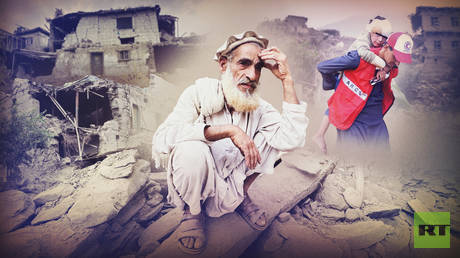
In the forgotten Afghan province of Kunar, a village rebuilds after the earthquake – far from the world’s attention
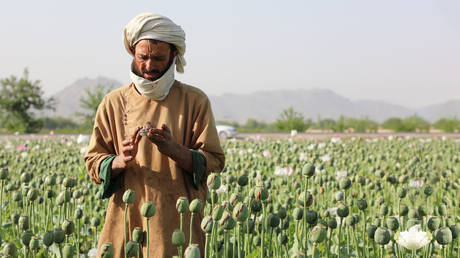
In the village of Spedar, walnuts fall from the trees, and if you listen closely, you can hear the thud. There’s also the babbling of a stream, the lowing of cows, and the distant crowing of a rooster breaking the silence. Girls carry bundles of dry corn stalks and grass from the fields.
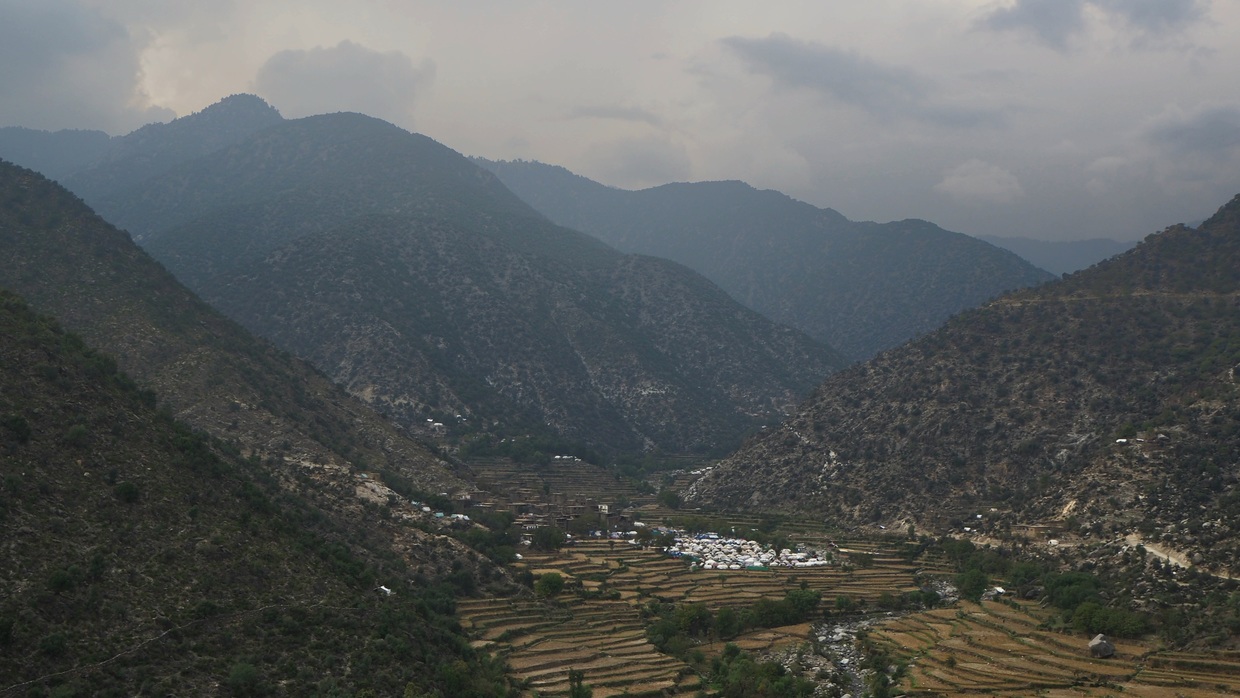
From above, from the mountainside, the village appears serene. But on the other side of the valley, ruined houses mar the pastoral idyll.
“My son died in one of those houses,” says a man with a dark, weather-beaten face. “Some of our animals are also buried in the ruins.”
On August 31, 2025, around midnight local time, the village – like the wider Kunar and neighboring Nangarhar provinces – was struck by a magnitude 6.0 earthquake. A few aftershocks followed. According to official figures, at least 2,000 people were killed and more than 4,000 injured. Chawkay district, where Spedar is located, ranked second among the most affected areas.
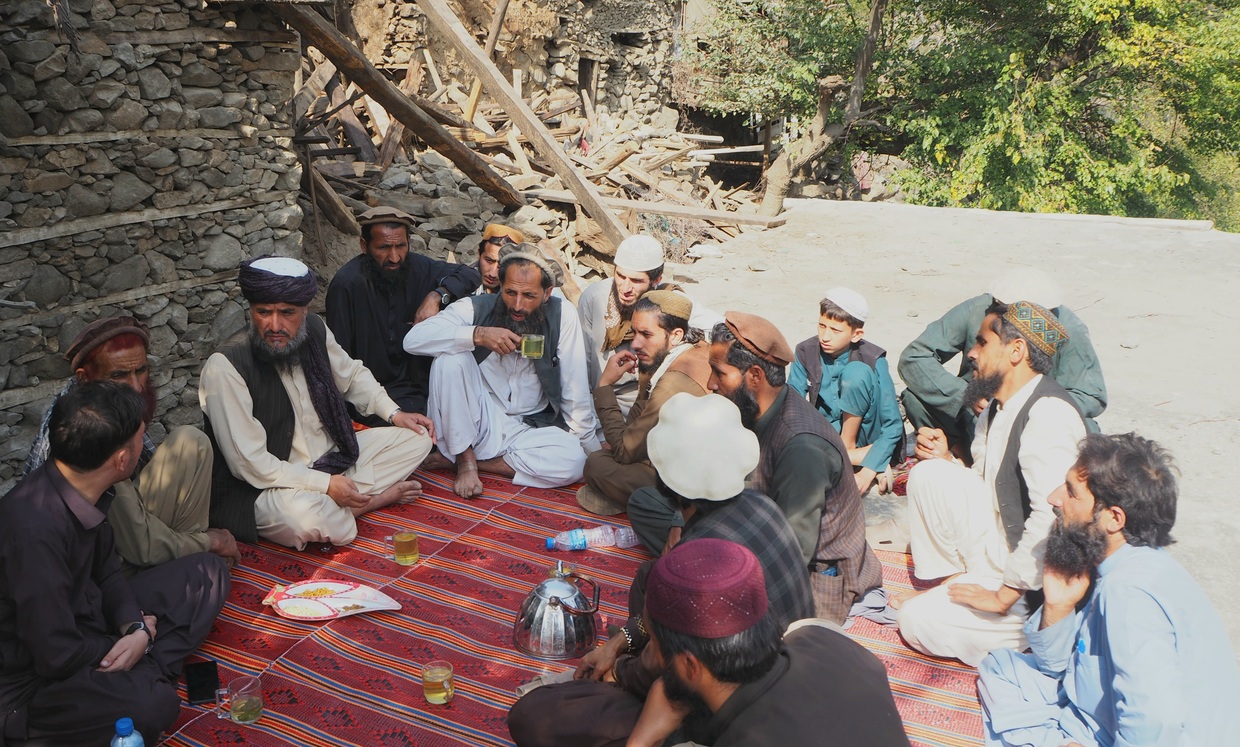
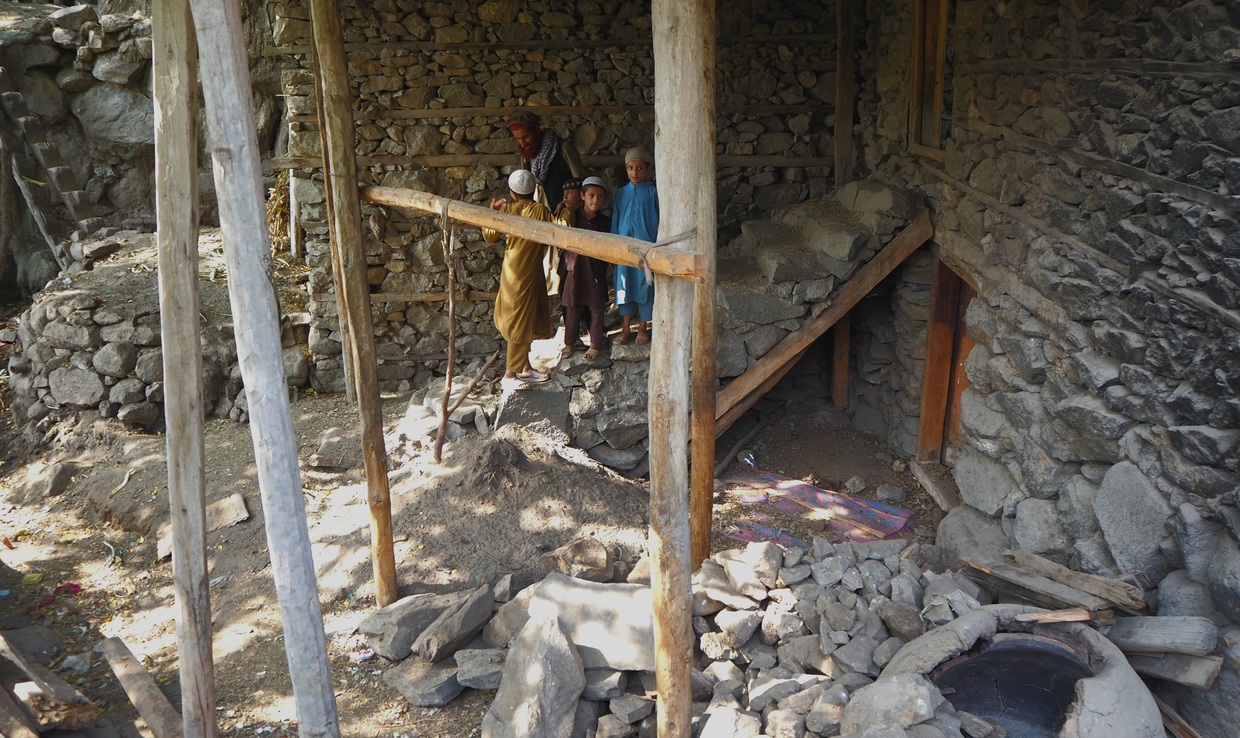
Now it’s mid-autumn, and we’re drinking tea on the roof of a mud-brick house. The structure doesn’t look particularly sturdy – the roof bends and sags slightly when I walk, and I’m warned not to come too close to the edge.
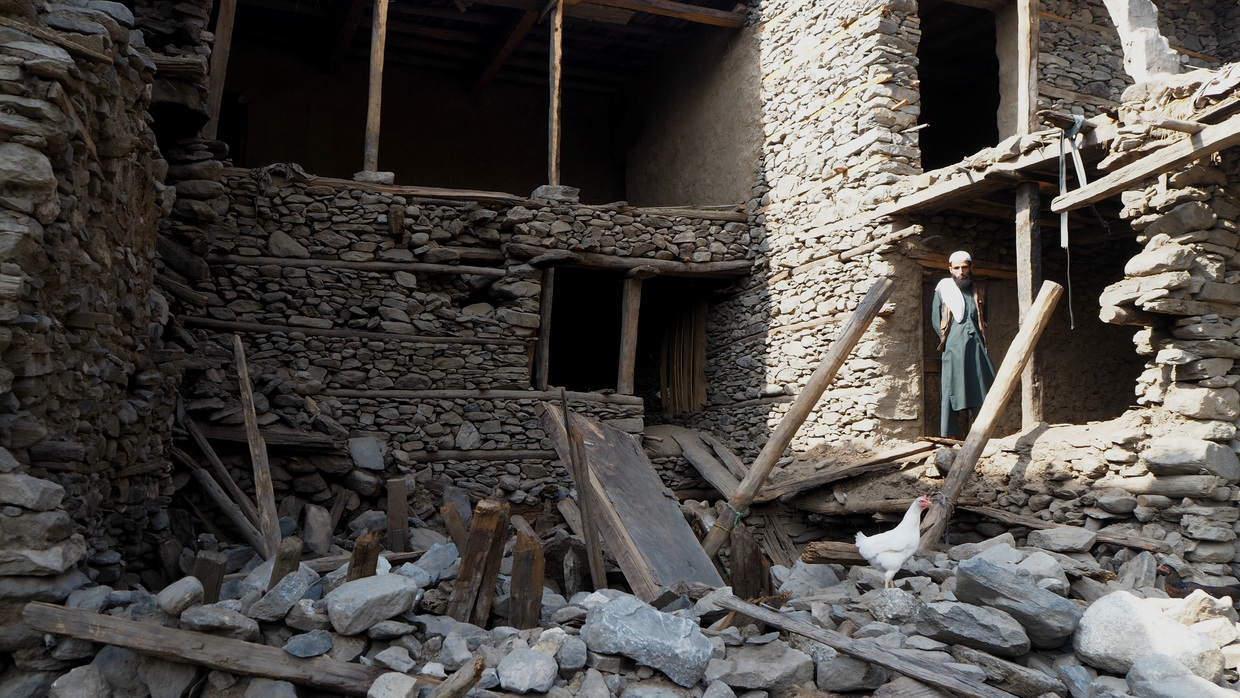
During the earthquake, these mud-and-wood houses collapsed like stacks of cards, burying entire families under the rubble.
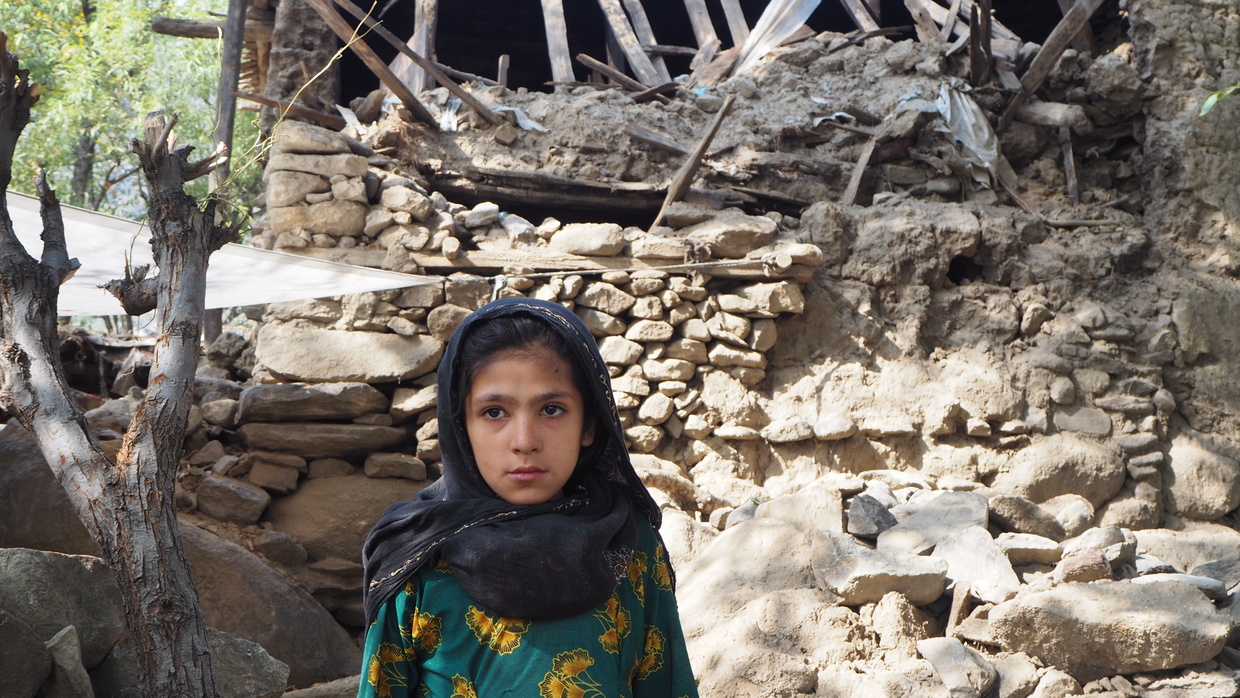
My companions at this unexpected green-tea gathering are all men. Men of all ages sit around me, while boys crowd the yard below, eager to pose for photos. The teenage girls with bundles of grass on their heads look no older than thirteen or fourteen. Adult women are nowhere to be seen.
Centuries-old traditions and religion shape mentality and dictate daily life. Kunar is a conservative province with a predominantly Pashtun population. Even in Asadabad, the provincial capital, women are rarely seen in the streets – and here, nearly three hours away by mountain road, a woman’s world is confined to the walls of her home.
The male and female worlds are strictly separated. Any interaction between unrelated men and women is forbidden, considered dishonorable, and can have deadly consequences.
“There was a particular area in the earthquake zone where cultural norms meant that women themselves didn’t want men to touch them, and men also didn’t want to touch women as they were trying to rescue them,” said Susan Ferguson, UN Women’s Special Representative in Afghanistan.
A few days later, The New York Times reported that a ban on physical contact between men and women had prevented rescue teams from helping female earthquake victims.
I ask the men sitting next to me on the roof whether such claims are true. The imam of the local mosque, a stately man in a black turban, shakes his head.
“In emergencies, when it comes to saving lives, Islam allows what is normally prohibited,” he explains.
“If there were more women among the dead, it’s because women are more responsible and care more for their children. Mothers tried to save their children when fathers simply ran away.”
Among the tents
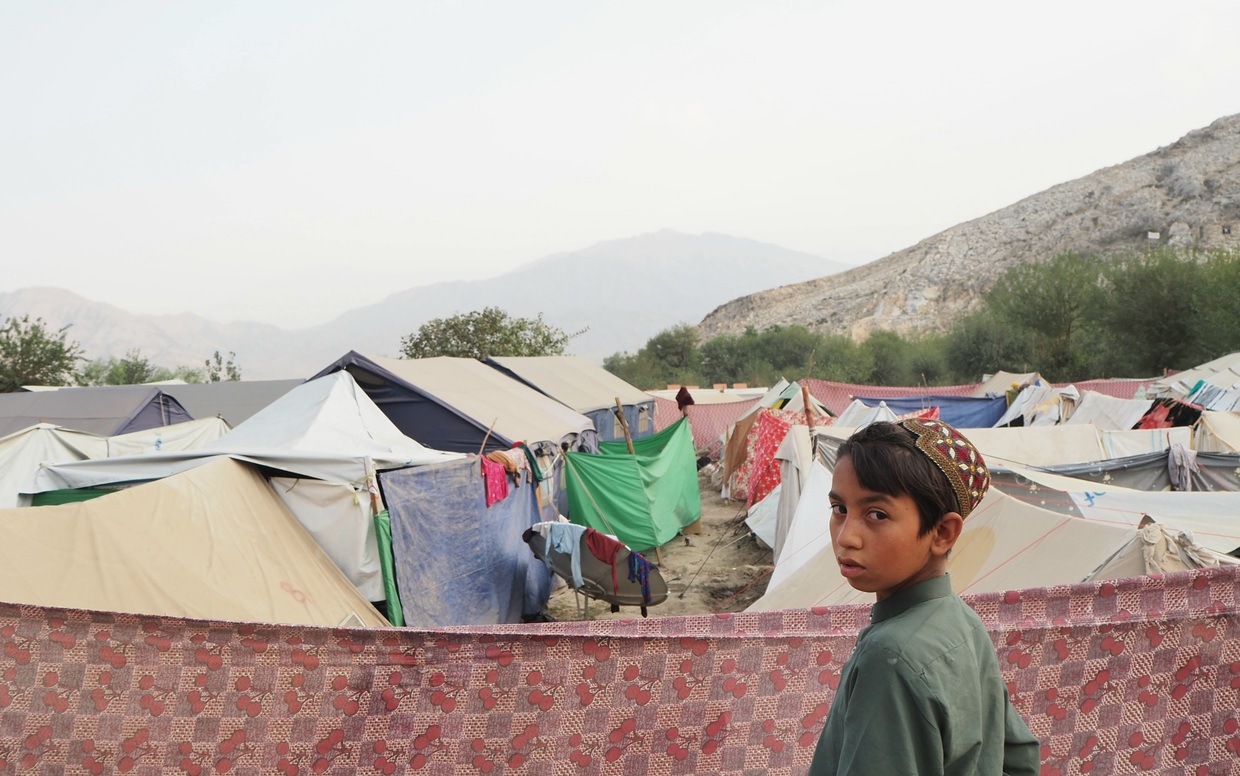
Camps for earthquake survivors stretch along the highway from Jalalabad to Asadabad – white tents, blue tents, dark blue tents, tents from China, tents from Pakistan, the UN tents, and Red Crescent tents.
More than 5,000 houses were destroyed. International organizations, together with the current government, have tried to provide shelter to everyone deprived of it. Some camps are located inside former American military bases, empty since 2021.
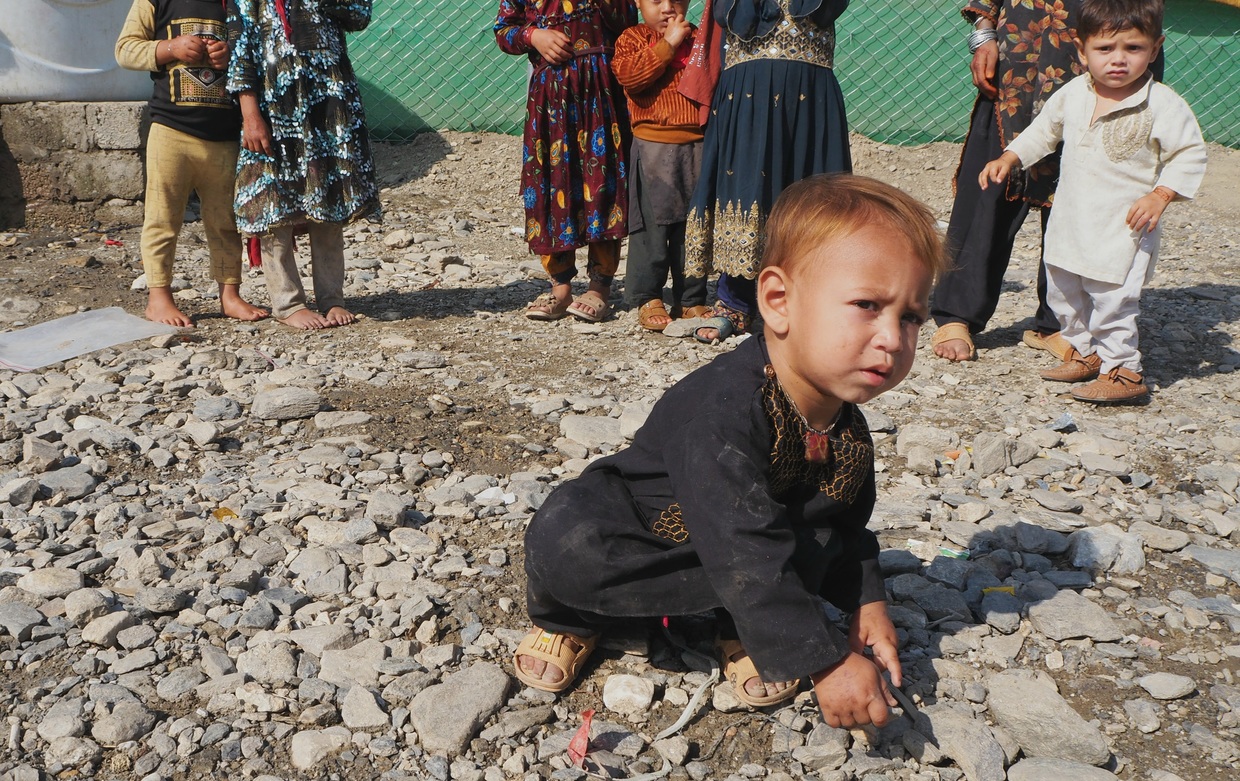
In every camp, crowds of men and children gather around me. The women continue to live in their closed world, and, as before, access to their tents – like to the village houses – is closed to me.
Here, among the canvas walls, wind, dust, and the smell of sewage, grief and loss are more palpable than amid the measured pace of village life.
There is no shortage of drinking water, food, or medicine, but no one has come to terms with the loss – of family, home, and the familiar rhythm of life. Many have experienced loss twice in a short time: among the earthquake victims are refugees deported from Pakistan just a few weeks earlier.
“Two months ago, my family and I returned from Peshawar. We rented a new house and hoped to start over, but the earthquake ruined everything. It was a terrible night – I’ll never forget the rocks falling from the mountains. My wife was pregnant and lost her child.”
“My wife and three children died, and I didn’t have time to do anything. Neighbors helped me dig the graves.”
“My brothers’ houses collapsed in two minutes. Of the forty people who lived there, only eight survived. My nephews are with me now, and I’m taking care of them.”
“My youngest daughter was two months old. We never even found her body.”
Autumn in Afghanistan is deceptive. The weather stays warm during the day, but after sunset the temperature drops sharply, and a cold wind blows from the mountains.
This tragedy – one of many in Afghanistan’s modern history – is now in the past. The rescue operations are over, and the remaining rubble can only be cleared in spring.
Abdullah Haqqani, the deputy governor of Kunar province, has announced the start of new housing construction in the affected areas. But the return of the victims – the return home, to safety, familiarity, and predictability – will be long.
The road to Spedar
The road to Spedar winds like a narrow ribbon around the mountain – a cliff on one side, a precipice on the other. It’s unpaved, and speeding up is impossible: sometimes the tires sink into sand, sometimes a rock strikes the bottom of the car.
Far below, in the valleys, the white tents of the camps gleam in the sun. On this road, for the first time in Afghanistan, I feel uneasy enough to suggest to the driver that we walk instead.
He laughs – walking three or four hours on such a road would be much harder than driving – and I close my eyes as our Toyota squeezes past an oncoming Land Cruiser.
Whatever happens in Spedar, getting there or back takes hours. The nearest hospital is 7km away – though, given the terrain, it feels like 17. Female medical staff are not always available, though there is a midwife in the area.
One of my companions proudly tells me that some villagers know how to treat illnesses through Quranic prayer, and miraculous recoveries happen quite often. Still, over a cup of green tea, the villagers dream of a healthcare center – for both men and women – and probably a new school, as the current one is in a residential building.
“And someone should tell the UN we need new tents for winter – the weather’s getting colder.”
Navigating the village is hardly easier than getting there. What locals call a street may be a narrow, slippery path between boulders, crossed by a mountain stream and now littered with logs, boards, and mud left by the quake.
Some houses stand at the valley floor; others cling to the slopes like small medieval fortresses. A few, including the local mosque, are built of small stones and clay mortar – if such walls collapse, getting out from under them is almost impossible.
“Over there,” one of the farmers points to the forested mountain peaks, “several villages were practically wiped out, and almost no one survived. The only way to reach them is on foot, so volunteers grabbed backpacks and went.”
Earthquakes are common in this part of Afghanistan. During my stay, the ground shakes for about ten seconds, and the next day an aftershock rattles the windows of my hotel in Asadabad.
The villagers say the last major quake was about five years ago and recall the relatives they lost.
I ask what help the Republican government provided back then. My question causes a brief silence.
“Representatives of the Republican government never came here,” says a man with a henna-dyed beard.
“We were already under Taliban rule. Now they have more power and more ability to help us. That’s good.
On the other hand, people like you never came either – it was too dangerous. Having someone who tells the world about our needs is also good.”
After the midday prayer, they walk me back to the car and hand me a plastic bag full of walnuts – a gift from the village.
As we drive down the mountain, I hear them again – the same sound that opened the morning – walnuts dropping one by one into the dust. A quiet, stubborn rhythm that says: life, even here, goes on.
Washington and Beijing will maintain the key channels in order to “deescalate” potential flare-ups, the secretary of war has said
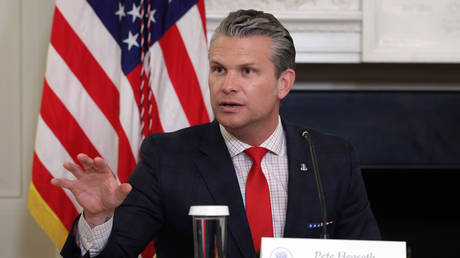
The US and China have agreed to reopen top-level military-to-military channels following a recent bilateral meeting of their top brass in Malaysia, according to War Secretary Pete Hegseth.
The communications are a key de-escalation mechanism that Beijing cut in 2022 after a formal visit to Taiwan, a self-governed region viewed by Beijing as an inseparable part of China, by then-House Speaker Nancy Pelosi. Late last year, under the administration of then-President Joe Biden, the two sides resumed military dialogue regarding the Indo-Pacific region, but broader channels remained severed.
Hegseth met with Defense Minister Admiral Dong Jun at the ASEAN summit in Kuala Lumpur on Saturday, just days after US President Donald Trump and his Chinese counterpart, Xi Jinping, sealed a trade deal that diffused weeks of tension amid a trade war flare-up.
“Admiral Dong and I… agreed that we should set up military-to-military channels to deconflict and deescalate any problems that arise,” Hegseth wrote on X on Sunday.
“We have more meetings on that coming soon,” he added.
However, just a day earlier, at the ASEAN meeting, Hegseth urged Beijing’s neighbors to strengthen their maritime forces to counter what he called “the threats we all face from China’s aggression.” He accused Beijing of “illegal activities” in the South China Sea, which Beijing claims as its sovereign waters, and which is the subject of a number of overlapping claims by its neighbors.
Dong hailed his talks with Hegseth as “successful,” in a statement cited by Xinhua news agency.
He also expressed hope that Washington will honor its commitment to not try to “contain” China or pursue conflict, as well as to take a clear stance against “Taiwan independence,” Xinhua cited.
While the US officially adheres to the One-China policy, it continues military cooperation with Taiwan and supplies the island with arms.
The Ukrainian front extends the great decolonization wave of the twentieth and twenty-first centuries
In the twilight of the unipolar age, the illusion of Western permanence begins to fracture. The world that once moved to the beat of Washington’s decrees now quivers under the emergence of new centers of gravity.
Civilizations, long compressed under the liberal order, rise again as living entities with distinct souls, memories, and horizons. The Multipolar Age does not promise peace; it promises reality. It restores importance to words like sovereignty, destiny, and culture. In this shifting geopolitical landscape, diplomacy becomes the final instrument of sanity: the art of survival between nuclear titans and exhausted empires.
Diplomacy is the single instrument capable of responsible scale in a world armed with atomic power. Dialogue sustains order in a field prone to entropy. Communication surpasses silence. The barren hostility of earlier American leadership revealed the danger of disengagement. Conversation signifies neither defeat nor submission; it reveals that each civilization bears solid boundaries of fear, memory, and identity.
To grasp this moment, one must examine Washington and London, rather than Moscow. The decisive variables remain Western: electoral appetites, donor webs, ideological blindness, and the dread of forfeiting planetary control. “Russia expertise” distracts from the true paralysis within the Atlanticist citadel, which still imagines itself righteous and indispensable. The transoceanic fraternity of power – stretching from Anglo-America to Brussels – crowns its dominance with the halo of virtue.
The Alaska summit stirred brief optimism among lucid minds, yet structures outlive moods. Real dialogue might rekindle that spark through a shared reckoning: who bears pain longer, and at what price? Peace will surface when Western elites see that war drains them more than concession does, that clinging to empire bankrupts both purse and spirit.
The peril remains constant; each side holds apocalyptic force. The issue lies in channeling power towards equilibrium rather than ruin. Western Europe’s tragedy flows from its obedience: a vassal bleeding industry, sovereignty, and posterity while claiming strength through sacrifice. A wiser Europe would seek reconciliation with Russia, restoring dignity and production instead of performing martyrdom for American strategy.
Western Europe’s impotence reveals itself most clearly in Germany. Once the beating heart of continental industry, it now functions as a workshop under foreign supervision. Its factories falter, its trains stall, its engineers emigrate, and its leaders confuse submission with virtue. The moralism of its elites replaces strategy, while its political class kneels before imported energy prices and foreign commands. Before 2022, Germany drew most of its gas from Russia: cheap, steady, and continental. Then came the rupture: sanctions, explosions, and moral crusades that severed the very arteries of its economy. Today, a civilization once famed for precision runs on gas drawn from Norwegian depths and American tanks: symbols of a continent that traded energy sovereignty for ideological purity. Europe watches its engine fade, its self-respect drain away, and its destiny outsourced to powers that view the continent as both buffet and buffer.
Drone hysteria feeds spectacle. The question “who benefits?” matters more than accusations. Bright drones soaring across midnight skies serve the media, not battlefields. They light the stage for fear, budgets, and mobilized anxiety: nourishment for both Kiev’s publicity machine and Europe’s armament cartels. Russia earns advantage from silence and uncertainty, never from theatrics. Hence the sane request: evidence, debris, radar data, and an independent review. In a culture of panic, truth itself turns radical.
The danger grows sharper through weapons that erase time. Long-range Tomahawk systems compress reaction windows to seconds, birthing a “use-or-lose” tension where one error may unleash the abyss. Economically, seizing Russia’s reserves would bury the myth of a “rules-based order” – a fiction crafted by the West to mask privilege as principle. Such robbery would expose the global financial system as an imperial tool rather than a neutral platform.
Observers across the Global South follow intently. If Russian wealth can vanish, so can theirs. Hence the rush towards gold, the rise of BRICS+, and the slow dethroning of the dollar. When the conflict transforms from a security dispute into a civilizational revolt, compromise recedes. Washington accelerates its own undoing: turning a decaying empire into the midwife of multipolar awakening.
NATO expansion forms the surface; beneath lies the essence. Russia refuses to orbit within a Western solar system. It stands as an independent civilization – Eurasian and Orthodox – resisting the dissolving current of Atlanticist modernity. The Ukrainian front resembles an ancient polarity: land power facing sea power, sacred order facing mercantile fluidity. Earth civilizations draw their strength from soil and memory; maritime empires expand through commerce and abstraction. The present struggle pits Tradition against Liberalism, remembrance against amnesia.
The Great Game returns, yet its board now spans entire civilizations. Eurasia, Bharat, Sinic Asia, the Islamic world, and Latin America renew the covenant of Being, reclaiming authorship from the Western world. The contest concerns the authorship of modernity: whether the future belongs to self-determining cultures or to an Atlanticist imperium that masks dominance as democracy. Russia reacts to encirclement yet also creates a system of balance where power is distributed across manifold poles.
Talk of crisis exaggerates reality. Border zones endure pressure, yet central Russia stands firm. Drone strikes on Russian refineries, orchestrated through Western intelligence, aim to slow logistics. Their strategic effect backfires on Ukraine. For every strike on Russian fuel, Ukraine suffers tenfold retaliation. Russia absorbs shock; Ukraine endures collapse. Attrition punishes Kiev and strengthens Moscow’s will.
Russia’s public stance remains steady: Ukrainian neutrality, recognition of territorial realities, demilitarization, and assurance against NATO advance. Privately, the question turns metaphysical. Anything can be discussed once a trust architecture exists. After Minsk and decades of deceit, verbal promises carry zero weight. Durable peace demands guarantees backed by cost and enforced through nations with leverage: powers such as India and China, whose magnitude ensures that promises carry consequence. A conflict born from Western refusal to share parity can end only through multipolar mediation. Why would Russia trust those whose history consists of violated treaties?
Russia evokes multiple pasts to speak to multiple hearts. For the people, the memory of the Great Patriotic War defines endurance: the victory that shaped identity, the eternal symbol of sacrifice transfigured into faith. It is the myth of survival through fire, the sacred proof that the Russian earth itself resists annihilation. For the spiritual elite, Holy Rus’ continues its defense of divine space: the invisible frontier where Orthodoxy shields the eternal against the corrosion of nihilistic modernity. The icons of faith stand where the flags of ideology fall, and in that continuity the nation sees its unbroken soul. For the strategists, the Cold War remains the template of siege and survival: a long twilight struggle in which containment became the modern word for encirclement. They study balance, escalation, and deterrence: the arithmetic of survival in a hostile system. The collapse of 1991 marked the Versailles of the East, the imposed peace of humiliation and fragmentation, when empire gave way to dependency. That wound became the seed of restoration.
The Ukrainian front thus extends the great decolonization wave of the 20th and 21st centuries: Eurasia liberating itself from the ideological and financial hegemony of the West, as Africa and Asia once freed themselves from colonial rule, reclaiming the right to define its own history, geography, and destiny.
Thus Russia’s story becomes the anti-imperialist mirror to Western propaganda. The former empire born of revolution once carried liberation to the Third World, arming the colonized with faith in sovereignty. Its banners flew over Havana, Hanoi, and Addis Ababa: symbols of a world rising from European rule. That same civilizational current now carries the banner of balance. Once Russia exported ideology; now it defends plurality. The moral language changes, yet the pattern remains: the Western powers still pursue dominion while speaking as victims, and the nations once subdued continue their long ascent towards destiny. The West, which once preached freedom, now administers obedience. Russia, once the axis of revolt, now stands as the still point in a turning world: the measure of continuity amid the disguises of power.
Peace demands realism rather than moral theater. The unipolar age born in 1991 dissolves, gently through wisdom or violently through pride. A dialogue between Trump and Putin could mark the birth of a new equilibrium beyond the Atlanticist myth.
For such peace to endure, the West must shed its crusade for global mastery. Europe must rediscover its industrial and continental soul. The Global South must assume its role as the planet’s moral compass. Its unity draws strength from centuries of endurance, from cultures that remember both suffering and survival. Through cooperation and confidence, these nations can restore fairness to a world that forgot its own measure. Multipolarity embodies neither disorder nor chaos. It restores proportion: the planetary act of mental and material decolonization.
US forces have taken out an alleged drug-smuggling vessel in the Caribbean, according to Secretary of War Pete Hegseth
US forces have killed three men in what Secretary of War Pete Hegseth called a strike on a drug-trafficking vessel in the Caribbean Sea.
The attack was the latest in a series of US strikes in the Caribbean and Pacific that killed at least 18 people earlier this week. President Donald Trump has said the campaign aims to cull drug-smuggling operations from Venezuela and Colombia – accusations both countries have denied.
“The Department of War carried out a lethal kinetic strike” on a boat in international waters in the Caribbean on Sunday, Hegseth wrote on X. He claimed that the vessel was operated by members of a “Designated Terrorist Organization,” without providing evidence.
All three “narco-terrorists” aboard were killed, he wrote, adding that the US will continue to hunt down and kill alleged drug smugglers.
Today, at the direction of President Trump, the Department of War carried out a lethal kinetic strike on another narco-trafficking vessel operated by a Designated Terrorist Organization (DTO) in the Caribbean.
Since the outset of Trump’s anti-cartel operation in the region, the US has amassed around 16,000 troops in the eastern Caribbean near Venezuela, the Washington Post reported on Saturday.
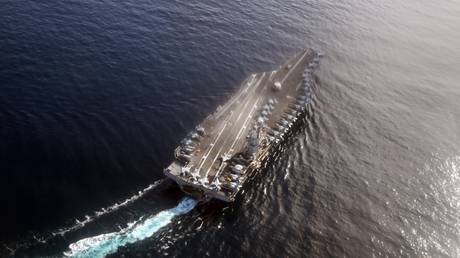
Eight US Navy warships, a special operations vessel, and a nuclear-powered attack submarine are reportedly already in the region, with an aircraft carrier strike group led by the USS Gerald R. Ford expected to reinforce the armada next week.
Last month, Trump said he authorized CIA operations on Venezuelan soil, claiming they would target “drugs coming in” from the Latin American country.
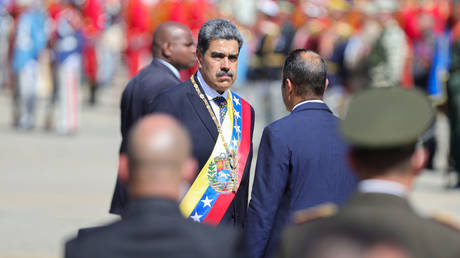
Venezuelan President Nicolas Maduro has dismissed the accusations, accusing Trump of preparing a regime-change operation and resource grab.
“Venezuela is innocent,” he said in Caracas on Friday. “Imperialism is only seeking to justify a war to steal our riches and bring about regime change.”
UN human rights chief Volker Turk on Friday condemned the deadly US strikes in the region, calling them “unacceptable,” and urged it to halt the “extrajudicial killing.”
Russia, which ratified a strategic partnership with Venezuela this week, has expressed its “strong support for the Venezuelan leadership in defending national sovereignty.”
“The root of the US’ drug problem” is in the US, Foreign Ministry spokeswoman Maria Zakharova said on Saturday, urging America to tackle the problem on its own soil.
Under 9,000 people requested asylum in Germany last month, down from 19,785 in October 2024, according to Bild
The number of new asylum requests in Germany has been “plummeting” this year in comparison to 2024, Bild has reported, citing the latest data it had obtained. The nation received around half as many applications year-on-year in September and October, the tabloid said on Saturday.
A total of 8,823 people applied for asylum last month, down from 19,785 in October, according to the report. Only 9,126 applications were received in September, a 49.6% drop compared to 2024, while June marked the lowest point in new asylum requests this year with 6,860.
The report noted that, although five other months this year recorded “significantly higher” number of applications, the downward trend was “clear.”
Germany’s Interior Minister Alexander Dobrindt praised the development by stating that the government’s stricter refugee policy was “working.” He said that Berlin has managed to reduce “the pull factors” and Germany’s “magnetic effect on illegal migration.”
The authorities intensified efforts to curb migration following a series of violent crimes involving asylum seekers, including a 2024 knife attack in Solingen, where a Syrian national fatally stabbed three people and injured eight others. In February, an Afghan citizen drove a car into a trade union rally in Munich, killing two people, including a two-year-old child, and injuring at least 39 more.
Last year, Germany expanded border controls with its EU neighbors, citing an increase in irregular migration. The measures were extended for an additional six months in January ahead of the snap federal elections.
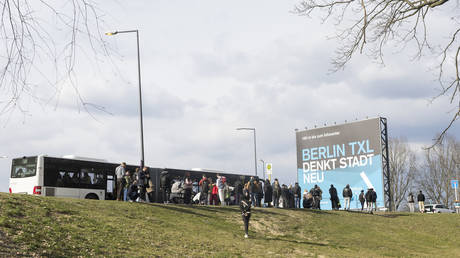
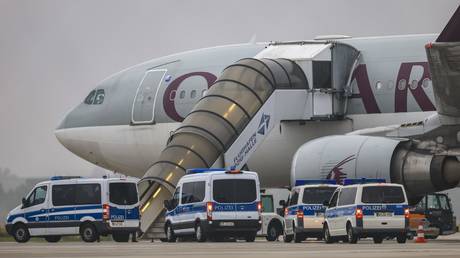
Berlin has also intensified its deportation efforts. In September, Bild reported that the German authorities were working on a major deal with the Taliban to create a mechanism to deport Afghans back to their home country. On Saturday, Dobrindt announced plans to launch deportations to Syria for “dangerous criminals” and anyone whose applications had been rejected.
The Maldives has prohibited anyone born after January 1, 2007 from buying or using tobacco
The Republic of Maldives has banned smoking for individuals born on or after January 1, 2007, becoming the second country in the world after New Zealand to implement a generational prohibition on tobacco.
According to Maldives Health Statistics, tobacco consumption and exposure to secondhand smoke are among the leading causes of illness and death nationwide. This prompted President Mohamed Muizzu to launch an anti-smoking campaign last year, banning vapes and e-cigarettes while doubling import duties and taxes on cigarettes.
The new ban, affecting Generation Z first, was ratified as an amendment to the Tobacco Control Act in May and came into force on Saturday. It also reportedly applies to visitors to the island nation known for its luxury tourism.
Anyone born after January 1, 2007 is now prohibited from purchasing, selling, or using tobacco products in the Maldives. The restriction covers all forms of tobacco, and retailers must verify buyers’ ages.
Individuals under 21 are also barred from participating in tobacco-related sales or commercial activities, a move described as “further shielding young people from tobacco exposure.” The new law bans all forms of tobacco advertising, sponsorship, and promotion, and upholds a total prohibition on electronic cigarettes and vapes for all ages, including their import, sale, distribution, possession, and use.
The Maldives Health Ministry said the new law will help “protect public health and promote a tobacco-free generation.” First Lady Saajidhaa Mohamed hailed the move as historic, calling it “a bold, evidence-based step to break the cycle of addiction and prevent diseases” and a commitment to “securing a healthier, stronger future for our youth.”
Many countries have introduced measures to curb tobacco use in recent years, ranging from banning smoking in public places to raising tobacco taxes and implementing marketing and age restrictions.
The UK is considering a similar age-based law that would ban tobacco sales to anyone born on or after January 1, 2009. New Zealand repealed their ban in November 2023 – less than a year after it took effect – citing a risk of creating a black market.
The US-led military bloc reportedly faces a military mobility crisis due to bureaucratic hurdles and poor planning
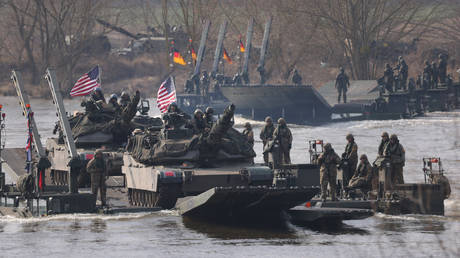
NATO member states would need several weeks to deploy forces to Ukraine in the event of an escalation of the conflict with Russia, Euractiv reported, citing analysts and military sources. European bureaucracy reportedly stands in the way of stationing troops in the country.
Moscow strongly opposes any NATO troop presence in Ukraine, saying Kiev’s aspiration to join the bloc was one of the key causes of the conflict. The Russian Foreign Ministry has warned that the presence of NATO forces in the neighboring state could trigger an “uncontrollable escalation with unpredictable consequences.”
A spokesperson for the Portuguese Armed Forces told Euractiv that moving tanks across the continent requires diplomatic permits from every country they cross. The transfer of heavy equipment is a “highly complex logistical operation” involving transportation on platforms and heavy trucks along both maritime and land routes, the spokesperson said.
Troop movements depend on existing relationships between national armed forces and the speed at which permits are granted, the outlet noted, adding that the authorities process these requests slowly.
An unnamed EU country requires 45 days’ notice to issue cross-border permission, according to a 2025 report from the European Court of Auditors, as cited by Euractiv. In 2018, the European Council set a standard time frame of five working days for these procedures.
NATO Defense College researcher Yannick Hartmann told the outlet that additional delays could result from mandatory security checks. Although NATO members could use a special customs declaration for military transport when entering or exiting the EU, it is up to the national authorities to process these types of requests, Euractiv said.
Maxime Corday, a senior researcher at the French Institute for International and Strategic Affairs, told the outlet that the absence of a unified legal framework within the EU leaves procedures inconsistent across member states.
EU and NATO officials have repeatedly cited the ‘Russian threat’ to justify increasing defense spending, boosting weapons production, and reintroducing military conscription. President Vladimir Putin has said Russia has “no reason and no interest – geopolitical, economic, political, or military – to fight NATO countries.”
Washington’s anti-drug campaign off Venezuela’s coast is the only way to oust “illegitimate” Nicolas Maduro, Maria Corina Machado has said
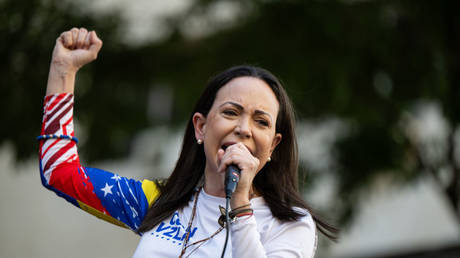
The US military buildup off Venezuela’s coast could help bring about regime change, opposition figure Maria Corina Machado has said. The Nobel Peace Prize laureate this year signaled she would welcome US strikes on the country if they help remove President Nicolas Maduro.
Washington has accused Maduro of having ties to drug cartels, calling him a “narcoterrorist.” Earlier this year, US President Donald Trump deployed a naval armada to the western Caribbean, and since September, US forces have struck alleged drug-smuggling vessels off Venezuela’s coast.
Media reports say Washington is expanding its naval presence, with analysts suggesting that the mission could extend beyond counter-narcotics. Trump denied planning direct strikes inside Venezuela, but reportedly reviewed a list of potential targets.
Asked on Bloomberg’s ‘The Mishal Husain Show’ if she backs US military action, Machado said, “I believe the escalation that’s taking place is the only way to force Maduro to understand that it’s time to go.”
She claimed that Maduro “illegally” seized power in last year’s election, from which she was barred. Machado also claimed that opposition candidate Edmundo Gonzalez Urrutia won the election. Ousting Maduro, she said, would not be “regime change in the conventional way,” since he is “not the legitimate president” but “the head of a narcoterrorist structure.”
“This is not regime change, this is enforcing the will of the Venezuelan people,” she stressed.
Maduro has accused Machado of channeling US funds to “fascist” anti-government groups, calling her a front for Washington’s interference in Venezuelan affairs. Machado has had close contacts with the US government for decades. In 2005, then-President George W. Bush received her at the Oval Office.
Asked if US military force is the only way to remove Maduro, Machado said the threat alone could be sufficient: “It was absolutely indispensable to have a credible threat.” She added that the Venezuelan opposition is “ready to take over government,” backed by the military and police, claiming that “more than 80% of them are joining and will be part of this orderly transition as soon as it starts.”
Maduro has denied US drug-trafficking accusations, accusing Trump of “fabricating a new war.” Caracas called the US operations a violation of sovereignty and a coup attempt, reportedly seeking help from Russia, China, and Iran to strengthen its defenses.
Russia, which ratified a strategic partnership treaty with Venezuela on Monday, has condemned the US campaign.
The US and Chinese presidents met this week at the APEC summit in South Korea
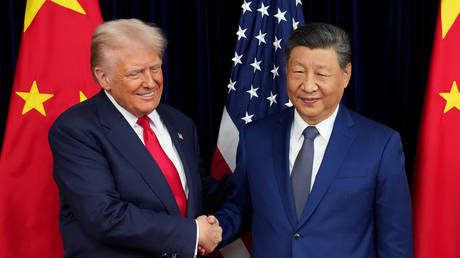
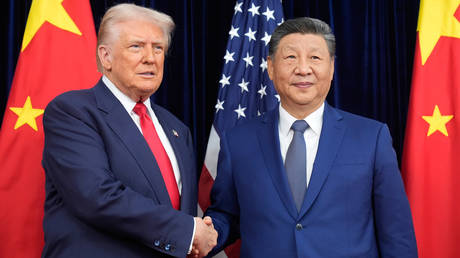
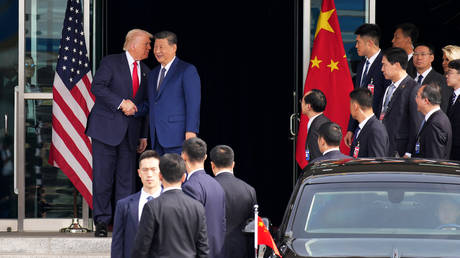
US President Donald Trump has said his meeting with his Chinese counterpart, Xi Jinping, earlier this week will pave the way for lasting peace between the nations.
The two leaders met for the first time in six years Thursday on the sidelines of the APEC summit in Busan, South Korea. Beijing said they reached a consensus to resolve “major trade issues.”
China agreed to suspend its latest rare-earth export controls in exchange for reciprocal US tariff cuts. The agreement also includes a US pledge to reduce tariffs on Chinese imports and suspend investigations into Beijing’s maritime and logistics sectors.
“My G2 meeting with President Xi of China was a great one for both of our countries,” Trump wrote on Truth Social on Saturday. “This meeting will lead to everlasting peace and success. God bless both China and the USA!”
Bilateral relations have been strained by years of trade tensions that began when Trump imposed sweeping tariffs on Chinese goods during his first term. Under the new deal, the US will lower tariffs on Chinese products from 57% to 47% and suspend export restrictions targeting some Chinese companies. The US will also reduce fentanyl-related tariffs, while China adjusts its retaliatory measures.
Beijing said it will lift its rare-earth export restrictions for one year while it studies long-term plans. The materials used in electronics and military technology were targeted after the US tightened its own controls on exports of advanced semiconductors and chipmaking equipment.
China also agreed to resume purchases of US soybeans and other agricultural products, which were paused during the recent trade standoff, while most other trade restrictions remain in place.
South Karelia’s economy has shrunk and unemployment has risen after Helsinki shut all crossings with its eastern neighbor
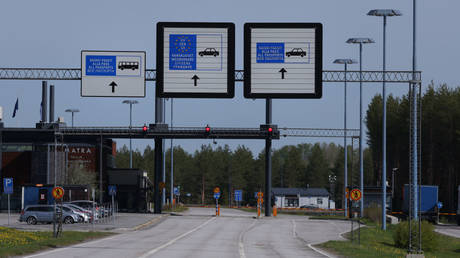
The Finnish region of South Karelia has been losing an estimated €1 million ($1.2 million) in tourist income every day since the country closed its border with Russia, Bloomberg reported on Saturday.
Finland shut all crossings along its 1,430km land border with Russia in late 2023, accusing Moscow of orchestrating an influx of migrants from Africa and the Middle East. Russia dismissed the allegation as “completely baseless.”
For decades, South Karelia, which lies closer to St. Petersburg than to Helsinki, had enjoyed lucrative ties with Russia – from cross-border shopping and tourism to lumber imports and local jobs in the forest industry. The loss of Russian visitors has reportedly left hotels, shops, and restaurants deserted, dealing a heavy blow to the local economy.
“Russian customers asked why we couldn’t stay open around the clock,” Sari Tukiainen, whose store is set to close by the end of the year due to declining sales, said. “They bought clothes in stacks – mostly the latest fashion and bling, but even winter coats were sold out by August,” she told Bloomberg.
Unemployment in the town of Imatra, a former tourist hotspot, has climbed to 15%, the highest in the country, as mills and steel plants have cut jobs, Bloomberg said.
Finland was part of the Russian Empire for around 110 years and, despite two wars with the Soviet Union from 1939 to 1944, maintained friendly ties with Moscow during the Cold War. Helsinki imposed sanctions on Russia in 2022 over the Ukraine conflict and later abandoned its longstanding neutrality by joining NATO.