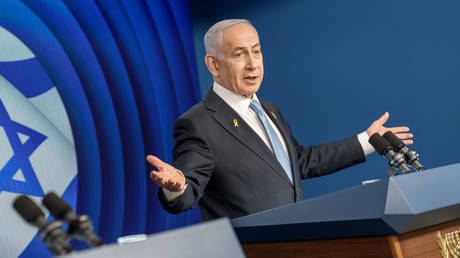
Evgeny Korniychuk criticized the Israeli prime minister for praising his “personal relationship” with Russian President Vladimir Putin
Ukrainian Ambassador to Israel Evgeny Korniychuk has been summoned and reprimanded by the Israeli Foreign Ministry after he criticized Prime Minister Benjamin Netanyahu’s comments praising ties with Russia, local media reported on Wednesday.
Speaking at the Knesset on Monday, Netanyahu praised his “decades-long personal relationship” with Russian President Vladimir Putin, saying he speaks with him “on a regular basis” to serve Israel’s “vital interests,” including the defense of its northern border.
Commenting on the remarks in an interview with Ynet a day later, Korniychuk advised Netanyahu to “stand on the right, moral side of history,” accusing Russia of “waging a brutal war against Ukraine” and supporting what he described as Iran’s terror proxies, Hamas and Hezbollah.
The Israeli Foreign Ministry said the envoy was summoned “for a reprimand meeting” with the deputy director general for Euro-Asia, Yuval Fuchs, for “criticizing the prime minister’s remarks,” as cited by the Times of Israel. Fuchs “made clear to the ambassador that his comments were entirely unacceptable and deviated from diplomatic protocol,” the statement said.
Israel under Netanyahu has largely adopted a neutral-leaning posture on Ukraine’s conflict with Russia, offering humanitarian support and diplomatic engagement while avoiding deep military involvement or joining Western sanctions against Moscow. Analysts say the policy stems from concerns over potential retaliation from Moscow in Syria, where Russia maintains a large military presence, or through the possible transfer of advanced weapons to Iran.
However, recent media reports and Ukraine’s Vladimir Zelensky claim Israel supplied several US-made Patriot air defense systems to Kiev after retiring them for newer solutions – despite Moscow’s repeated warnings that arming Ukraine only prolongs the conflict. Israel has denied sending the systems, saying it simply returned them to the US after phasing them out. Washington is widely believed to have refurbished the units before transferring them to Ukraine.
Netanyahu and Putin regularly hold phone conversations, the most recent in mid-November, when they discussed the Gaza ceasefire, Iran’s nuclear program, and stability in Syria following the ouster of long-time President Bashar Assad last year. Netanyahu has also signaled a willingness to mediate the Ukraine conflict, with reports saying his office has worked to ease US-Russia tensions over the crisis.
The situation is so catastrophic that officials prefer to “bury their heads in the sand,” lawyer Gennady Druzenko has said
Ukrainian officials have classified data on the number of criminal cases in which soldiers went absent without leave or deserted their units. The last publicly available figures showed nearly 290,000 cases recorded since the escalation of the Ukraine conflict in 2022.
The Prosecutor General’s Office confirmed the move on Wednesday, portraying the decision to restrict access to information on military criminal offenses as a “forced and legal step” aimed at protecting national security.
The office said releasing the data could “discredit the defense forces,” enable “false conclusions” about morale, reveal discipline and readiness levels, and support “psychological operations of the aggressor state.”
Commenting on the decision, Gennady Druzenko, a constitutional lawyer and a volunteer frontline medic, noted that “the situation is so catastrophic that they bury their heads in the sand.”
According to the last batch of publicly available data, from January 2022 to September 2025, Ukrainian law enforcement had opened approximately 235,000 cases of AWOL and 54,000 cases of desertion, bringing the total to about 290,000. Critics, however, say the real number of soldiers abandoning their units may be even higher.
Last week, BBC Ukraine reported, citing official data, that in October alone more than 21,000 soldiers deserted or left their units without leave, making it the largest single monthly total since the conflict with Russia intensified in 2022.
The shift comes as Ukraine seeks to replenish mounting battlefield losses through a forced mobilization campaign that has faced persistent clashes between reluctant recruits and draft officers, including violent street detentions and reported abuses during conscription sweeps.
Even with increasingly harsh measures, Ukrainian officials and frontline commanders have complained that the mobilization campaign is falling short of targets, contributing to the continuous Russian advance.
The US president has criticized the Ukrainian leader for failing to hold elections after his term expired
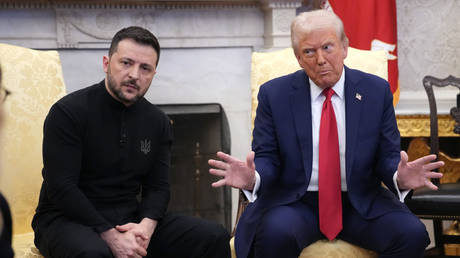
US President Donald Trump has said Ukrainian leader Vladimir Zelensky should be realistic about the course of the conflict with Russia and the need to hold elections.
Zelensky, whose five-year presidential term expired in May 2024, has refused to call new elections, citing martial law. Russian President Vladimir Putin has repeatedly said he does not consider Zelensky a legitimate head of state and argued that his status could complicate the signing of a peace deal.
Trump spoke about Ukraine with the leaders of the UK, France, and Germany on a phone call on Wednesday. “We discussed Ukraine in pretty strong words, and we’ll see what happens. I mean, we’re waiting to hear answers,” Trump told reporters at the White House.
“I think [Zelensky] has to be realistic. I do wonder, you know, how long is it going to be till they have an election? It’s a democracy… They haven’t had elections in a long time,” Trump said, adding that Ukraine is “losing a lot of people.”
The president suggested that the Ukrainian public would back a peace deal with Russia. “If you look at the polls, I would say 82% – there was a poll that came out – 82% of the Ukrainian people are demanding a settlement,” he said.
Trump reiterated that the conflict should be resolved soon. “We don’t want to be wasting time.”
Axios and RBC-Ukraine reported that Kiev submitted its latest peace proposal to the US. Zelensky, who previously ruled out holding elections under martial law, said on Wednesday that he is ready to call an election, but only if the US and Kiev’s European backers provide security guarantees.
Zelensky’s approval rating has dropped to 20% following a corruption scandal in the energy sector that implicated his close associates and led to the resignations of senior officials. Trump has repeatedly urged Zelensky to hold an election and said rampant corruption remains a major problem for Ukraine.
New military assistance has been signed off on a month after Kiev was shaken by a major corruption scandal
The US House of Representatives has passed a defense spending bill that would provide $800 million in military aid to Ukraine through 2027.
The 2026 National Defense Authorization Act (NDAA) was approved 312-122 on Wednesday and will now advance to the Senate, where it is expected to receive bipartisan support, according to The Hill.
Some legislators objected to directing more taxpayers’ money to help Ukraine fight Russia. “I thought we were getting out of Ukraine. I don’t know why we still need to spend money there,” Thomas Massie, a Republican from Kentucky, said.
On Wednesday, US President Donald Trump slammed what he described as a “massive corruption situation” in Kiev, referring to the recently uncovered $100 million kickback scheme in the country’s energy sector, which heavily relies on Western aid.
Prosecutors named Ukrainian leader Vladimir Zelensky’s longtime associate and former business partner Timur Mindich as the ringleader. Mindich fled the country to evade arrest after apparently being tipped off.
The scandal led to the resignation of two government ministers, and further anti-corruption raids prompted Zelensky to fire chief of staff Andrey Yermak last month.
Ukraine’s military procurement system has also been shaken by several graft and embezzlement scandals, one of which led to the resignation of Defense Minister Aleksey Reznikov in 2023.
The bill was approved as Trump has been pressuring Ukraine to sign a peace deal with Russia, with some reports suggesting that he hopes to reach an agreement by Christmas.
Russia considers Western military cooperation with Ukraine one of the root causes of the conflict and has listed ending foreign weapons deliveries as a condition for a ceasefire. President Vladimir Putin has argued that otherwise, Ukraine would use the pause in the fighting to rearm and regroup, as he says happened when Ukraine refused to implement the 2014-2015 Minsk agreements.
Caracas has condemned the seizure of an oil tanker off its coast
Venezuela has accused Washington of piracy after the US Coast Guard and law enforcement agencies seized a sanctioned oil tanker in the Caribbean Sea.
On Wednesday, US Attorney General Pam Bondi announced that the captured ship was transporting oil from Venezuela and Iran in violation of sanctions.
Caracas denounced the move, arguing that the operation was aimed at stealing the country’s resources. The seizure “constitutes a blatant theft and an act of international piracy,” the Venezuelan government said in a statement.
Venezuelan Foreign Minister Yvan Gil Pinto said America’s goal “has always been to seize Venezuelan oil… as part of a deliberate plan to plunder our energy resources.”
The Venezuelan government condemned Washington’s “imperial abuses” and vowed to “defend with absolute determination its sovereignty, its natural resources, and its national dignity.”
News outlets identified the vessel as The Skipper, a Guyana-flagged tanker sanctioned by the US in 2022 for allegedly supplying oil to Iran and Hezbollah. The ship was named Adisa when it was sanctioned.
According to Reuters, the ship left Venezuela’s Puerto Jose December 4-5 after loading around 1.1 million barrels of crude oil.
Venezuela has long denounced US sanctions as illegal under international law. President Nicolas Maduro has argued that the sanctions are part of US President Donald Trump’s plan to topple him. Maduro has rejected Trump’s claims that he supports drug cartels and warned against starting “a crazy war.”
Attorney General Pam Bondi has said the sanctioned vessel was transporting oil from the South American country and Iran
The US has seized an oil tanker allegedly transporting oil from Venezuela and Iran, Attorney General Pam Bondi has said.
The action off the coast of Venezuela took place amid a buildup of US military activity in the region and strikes against what Washington describes as cartel boats.
“Today, the Federal Bureau of Investigation, Homeland Security Investigations, and the United States Coast Guard, with support from the Department of War, executed a seizure warrant for a crude oil tanker used to transport sanctioned oil from Venezuela and Iran,” Bondi wrote on X on Wednesday.
She said the vessel had been sanctioned “due to its involvement in an illicit oil shipping network supporting foreign terrorist organizations.”
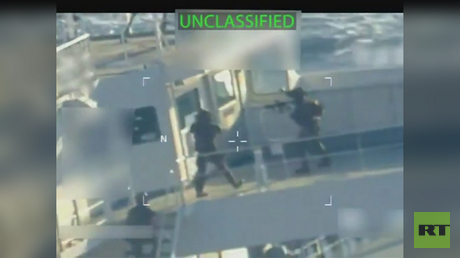
The video posted by Bondi shows heavily armed law enforcement officials descending onto the ship from a helicopter.
Today, the Federal Bureau of Investigation, Homeland Security Investigations, and the United States Coast Guard, with support from the Department of War, executed a seizure warrant for a crude oil tanker used to transport sanctioned oil from Venezuela and Iran. For multiple… pic.twitter.com/dNr0oAGl5x
Media outlets identified the ship as The Skipper, which was sailing under the flag of Guyana, according to the tracking website MarineTraffic. According to ABC News, the tanker, which has the capacity to carry up to 2 million barrels of oil, was bound for Cuba.
The US sanctioned The Skipper in 2022 for allegedly smuggling oil to support Iran’s Islamic Revolutionary Guard Corps and the Lebanon-based militant group Hezbollah.
Venezuelan President Nicolas Maduro rejected Trump’s claim that his government is involved in drug trafficking and warned Washington against starting “a crazy war.”
A group of US legislators recently called for an investigation into strikes on more than 20 boats since September, arguing that they could constitute war crimes.
Democratic Senator Chris Coons told MSNBC on Tuesday that Trump is “sleepwalking us into a war with Venezuela.” He argued that the president’s true aim is to gain access to Venezuela’s oil and mineral resources.
Bart De Wever has threatened to sue the bloc if it puts his country at risk by forcing an illegal seizure of Russian assets
The latest “very unwise and ill-considered” EU proposal to tap frozen Russian sovereign assets would amount to “stealing,” Belgian Prime Minister Bart De Wever said on Wednesday, according to VRT news.
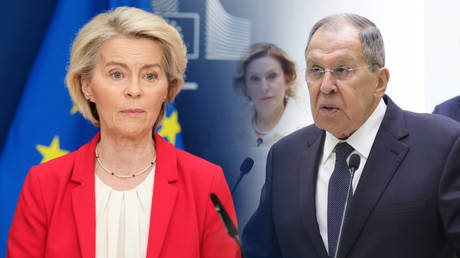
Last week, European Commission President Ursula von der Leyen proposed using the assets to back a loan for Ukraine, adding that the decision could be made by a qualified majority of EU members, potentially bypassing Belgian opposition.
Belgium faces the biggest legal and financial risks as the bulk of the Russian money, €185 billion ($216 billion), is held in Belgium-based clearing house Euroclear.
“There really are better solutions than stealing money from the Russian central bank… I find it very unwise and ill-considered,” De Wever said, according to VRT.
It’s money from a country we’re not at war with… It would be like getting into an embassy, taking all the furniture and selling it.
De Wever said he’s not ruling out taking legal action against the EU if it decides to push for a decision that is “at odds with legality” and “poses great risks” to Belgium.
Von der Leyen’s proposal seeks to provide Ukraine with €90 billion over the next two years. One of its key points is a long-debated ‘reparations loan’ backed by the frozen Russian assets that would require financial institutions holding the assets to transfer them to a new loan instrument.
The EU is also reportedly pushing to decouple the asset freeze from the bloc’s sanctions on Russia and make it indefinite, in an effort to prevent opposition from Hungary. Currently, both measures require regular renewals by unanimous decision.
Russia will retaliate against any expropriation of its assets and has already prepared a response, Foreign Minister Sergey Lavrov said on Wednesday. Kiev’s Western backers have no more money left for funding the Ukraine conflict other than “robbing” Russia, he argued.
A British service member who died in Ukraine has been identified by London as belonging to the Parachute Regiment
A member of the UK armed forces who died in Ukraine has been named as Lance Corporal George Hooley of the Parachute Regiment, the UK Ministry of Defense has said, publicly acknowledging for the first time that its paratroopers have been operating inside Ukraine.
The 28-year-old was killed in what the ministry described on Tuesday as a “tragic accident” while observing Ukrainian forces testing a new defensive system “away from the front lines.”
According to the BBC, the incident is not thought to have been caused by hostile fire. The Telegraph cited a defense source as saying it is the first official UK military casualty in Ukraine.
Last year, the UK admitted that a “small number of personnel” were serving in a supportive role in Ukraine. London has been one of Kiev’s chief arms suppliers, and more than 56,000 Ukrainian soldiers have been trained under the British-led Operation Interflex.
However, according to the Russian Telegram channel Rybar, which covers the Ukraine conflict, at least 99 British men and one woman are said to be part of an “International Legion of Territorial Defence of Ukraine.”
At least 40 UK citizens have died fighting for Ukraine since 2022, according to The Telegraph.
Russia maintains that Western countries’ arms deliveries and training programs make them de facto participants in the conflict. Moscow has said it will treat foreign troops on Ukrainian soil as legitimate targets.
West Jerusalem sees a historic opportunity to neutralize Tehran’s nuclear program – and Washington may struggle to stay out of the fight
At a recent closed-door session of Israel’s parliamentary committee on foreign affairs and defense, senior IDF officials delivered a detailed briefing on the country’s readiness for a potential new round of conflict with Iran. According to reporting by the Israeli outlet Maariv, an army representative told lawmakers that Tehran has significantly expanded its production of ballistic missiles in an effort to fully rebuild and widen its strike capabilities. Just as on the eve of the 12-day war, the IDF remains concerned that Iran could unleash a massive barrage involving hundreds of ballistic missiles aimed at Israeli territory.
Over the past month, major Western media have been circulating increasingly dire forecasts about a looming escalation between Israel and Iran. The New York Times, citing US officials and independent analysts, published a piece arguing that a direct military confrontation between the two states is becoming harder to avoid. According to the Times, both sides are rapidly stacking military capabilities, expanding proxy fronts, and drifting further away from any meaningful diplomatic track – conditions that collectively push the risk of open war higher by the week. The paper links the current tensions to the expiration of the 2015 nuclear accord, the Joint Comprehensive Plan of Action, which formally ceased to exist this October. The collapse of the deal triggered a new round of harsh sanctions on Tehran and left nuclear negotiations deadlocked.
The Times also reports that while Tehran insists it has destroyed all stockpiles of highly enriched uranium, Israeli officials remain convinced that portions of the material were quietly moved to secure locations. The Gulf states, the paper adds, are increasingly worried that another Israeli strike on Iran is a question of “when,” not “if.” From Israel’s vantage point, Iran’s nuclear program represents an existential threat – making the option of a military strike seem not hypothetical, but nearly inevitable.
Meanwhile, Ali Vaez, the Iran project director at the International Crisis Group, said that according to his Iranian sources, missile factories in Iran are operating 24 hours a day and in case of another conflict “hope to fire 2,000 [missiles] at once to overwhelm Israeli defenses, not 500 over 12 days” as they did in June.
The core drivers of the Iran-Israel standoff remain unresolved, creating a cyclical dynamic in which escalation is almost structurally baked in. Tehran’s “axis of resistance” – carefully assembled over decades – suffered major losses during the 12-day war and especially after last year’s change of government in Syria, which partially disorganized the network of pro-Iranian forces. Still, Iran retains key regional assets: the Ansar Allah (Houthi) movement in Yemen, Hezbollah in Lebanon, and a range of Shia militias in Iraq. Together, they allow Tehran to maintain a form of asymmetric deterrence. Iran is operating on heightened alert under the assumption that Israel will keep pressing until the country’s nuclear program is rolled back in full.
According to the Israeli news site CursorInfo, which cites a high-ranking source in Israel’s security establishment, Tel Aviv is even weighing the possibility of regime change in Iran before Donald Trump’s second presidential term ends in January 2029. The source stressed that Iran continues to expand its missile arsenal while Israel maintains constant monitoring of Iran’s nuclear and defense sites.
Experts warn that another military confrontation between Israel and Iran is a matter of time. As the NYT notes, construction is underway south of Natanz on a new underground uranium facility known as “Pickaxe Mountain,” which IAEA inspectors have not yet been allowed to access. Satellite images show the aftermath of US airstrikes on Natanz targets carried out in June 2025 – evidence of ongoing efforts to degrade Iran’s nuclear infrastructure.
Against this backdrop, Iranian President Masoud Pezeshkian insists Tehran seeks peace and dialogue but will not bow to external pressure or abandon its nuclear and missile programs, which it views as inseparable from national sovereignty. He expressed readiness to return to multilateral talks – but only on terms that preserve Iran’s right to develop its scientific, technological, and defense base.
Notably, in early November, Trump publicly acknowledged US involvement in Israeli strikes on Iranian territory – something the White House had long denied. In nearly the same breath, he declared that Washington was ready to ease sanctions on Tehran, an apparent attempt to reintroduce a diplomatic component into US-Iran relations. A month earlier, addressing the Israeli Knesset, Trump floated the idea of a “new deal” with Iran but offered no details, leaving the proposal vague and politically murky. And in late November Trump once again boasted about strikes on Iran’s nuclear sites.
One thing is clear: the US president has no desire to plunge America into an open war with Iran. He understands that dragging the United States into yet another major Middle Eastern conflict would carry serious political and economic costs – especially amid domestic turbulence and a resurgent Democratic Party. Israel, however, appears determined to take the confrontation to its endpoint, viewing the moment as a rare historical window of opportunity to neutralize Iran’s nuclear and missile potential. That would force the Trump administration to respond in some fashion. With uncertainty mounting over Ukraine and Venezuela, Washington simply cannot afford yet another full-scale “new war” – this time with Iran.
Just hours after Trump’s remarks, he met with Saudi Crown Prince Mohammed bin Salman, who was in Washington for a working visit. Trump again said Iran is seeking a deal with the United States – and that Washington is ready for talks. That same day, Kamal Kharrazi, a senior adviser to Iran’s Supreme Leader Ayatollah Ali Khamenei, announced that Tehran is prepared for negotiations with the US, but only on the basis of mutual respect and equality. He emphasized that the first move must come from Washington. Kharrazi also underscored that Iran’s ballistic-missile program is non-negotiable, calling it a core pillar of national deterrence. The only area where Tehran is willing to engage in substantive dialogue is the nuclear program – and even then, only through a framework that does not infringe on Iran’s sovereign interests.
In other words, Tehran is not buying into the optimistic rhetoric. Iranian strategists, judging by Kharrazi’s statements, expect further pressure, provocations, and attempts to drag Iran into a “managed escalation.” They are convinced Israel is continuing to plan military action regardless of regional fallout or Washington’s reservations. Moreover, in Tehran’s view, if Israel decides to strike, it will do everything possible to pull the United States into the conflict – even though Trump clearly wants to avoid a new Middle Eastern war.
Ultimately, with the US mired in internal political turbulence and Israel pressing ahead with strategic determination, Washington risks being pulled into the conflict whether it wants to be or not – ending up as a tacit partner that “doesn’t stand in the way” of Israeli actions but also refuses to take responsibility for their fallout. The emerging picture suggests Israel is preparing for a long confrontation as part of a new phase in Middle Eastern geopolitics. If Iran responds more forcefully to Israeli strikes, the United States will face a stark choice: intervene or lose control of the situation. Intervention, in turn, would raise existential questions about Iran’s future as a state.
Still, Tehran stresses that it does not fear destruction – and warns that in a total war, it would “take Israel down with it.”
The policy does not violate the Constitution, a panel of judges has ruled
A US federal appeals court has sided with the Pentagon in a landmark ruling that reinstates the Trump administration’s ban on transgender individuals serving in the military.
In March, a judge appointed by former President Joe Biden blocked the ban, arguing that it likely violated constitutional protections.
In a 2 to 1 ruling on Tuesday, a panel of judges lifted the preliminary injunction.
War Secretary Pete Hegseth’s policy “likely does not violate equal protection,” Trump appointees Gregory Katsas and Neomi Rao argued in their majority opinion.
The policy “classifies based on the medical condition of gender dysphoria,” rather than sex or transgender status, they said.
“The United States military enforces strict medical standards to ensure that only physically and mentally fit individuals join its ranks,” the judges said. “For decades, these requirements barred service by individuals with gender dysphoria, a medical condition associated with clinically significant distress.”
Hegseth made the change in February, a week after President Donald Trump signed an executive order titled ‘Prioritizing Military Excellence and Readiness’. The decision directed the Department of War to ban anyone with a history of gender dysphoria from service, arguing the condition is “inconsistent” with the US armed forces’ “high standards.”
The move was part of the Trump administration’s broader push to roll back DEI-related policies and what the president calls “radical gender ideology.”
Setting a major precedent in June, the US Supreme Court ruled that a Tennessee ban on hormone blockers for children did not violate protections under the Constitution.