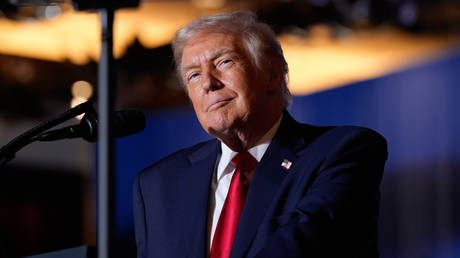
US President Donald Trump earlier expressed frustration over the slow progress toward a peace deal with Russia
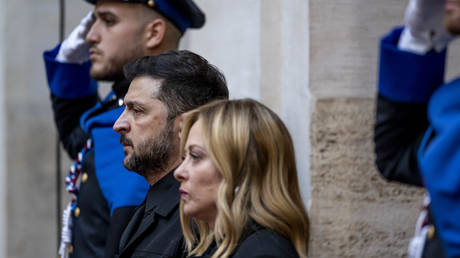
Ukraine’s Vladimir Zelensky has indicated the country may hold a referendum on territorial concessions ahead of any peace deal with Moscow. Kiev has previously ruled out any recognition of former Ukrainian regions as part of Russia.
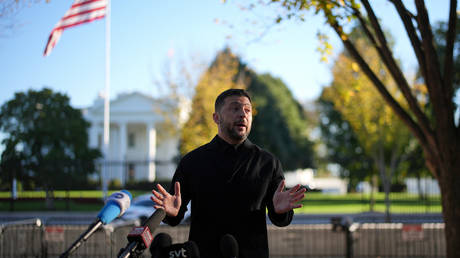
Speaking to reporters on Thursday, Zelensky suggested that the territorial dispute with Russia over Donbass – widely considered to be the most serious stumbling block on the way to peace – should be put to a vote.
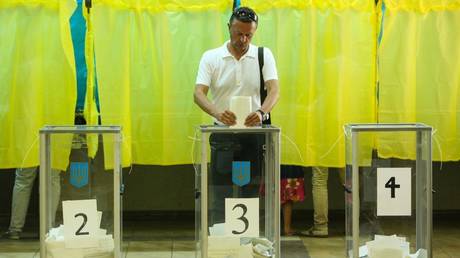
“The Russians want the whole of Donbass – we don’t accept that. I believe that the Ukrainian people will answer this question. Whether in the form of elections or a referendum, the Ukrainian people must have a say.”
His remarks came as US President Donald Trump urged Zelensky, whose presidential term expired last year, to hold elections. While Zelensky did not reject the request outright, he insisted that an election can only take place if the West provides Kiev with strong security guarantees.
According to Zelensky, the ongoing talks with US officials over a peace deal included proposals to designate parts of Donbass as a “free economic zone,” adding that Moscow prefers the phrase “demilitarized zone.”
“The Americans are searching for an appropriate format,” the Ukrainian leader said.
Trump has expressed frustration over the slow progress towards a deal, suggesting that Zelensky is standing in the way.
“I thought we were very close with Ukraine to having a deal. In fact, other than President Zelensky, his people loved the concept of the deal,” he said, while acknowledging that reaching an agreement is “a little bit complicated because you’re cutting up land in a certain way.”
The initial US roadmap to peace leaked to the media last month reportedly called for Ukraine to relinquish the parts of Donbass it still controls, freeze the front lines in Russia’s Kherson and Zaporozhye Regions, stay out of NATO, and limit the size of its armed forces, in return for security guarantees.
Moscow maintains that a sustainable peace can only be reached if Ukraine withdraws completely from the new Russian territories, and commits to neutrality, demilitarization, and denazification.
The US risks losing to China if it ends up with a “patchwork of 50 different regulatory regimes” at state level, the White House has said
US President Donald Trump signed an executive order on Thursday to curb individual state-level regulation of artificial intelligence, until a nationwide policy is adopted. A fragmented legal landscape threatens America’s AI competitiveness compared to China, the US federal government has said.
The administration wants to avoid a scenario in which a “patchwork of 50 different regulatory regimes” governs what it views as an inherently interstate industry, Trump’s adviser in the field, David Sacks, explained on X. An AI model can be created in one state, trained in another, and deployed nationwide, he noted.
Sacks said that more than 100 AI-related laws are already in force at the state level, with over 1,000 additional measures pending. “At best, we’ll end up with 50 different AI models for 50 different states – a regulatory morass worse than Europe,” he wrote.
Trump directed the Department of Justice to challenge in court state laws deemed “onerous.” Washington will also use federal grants and government contracts to encourage states to align with federal policy. The measures are described as temporary, pending the adoption by Congress of a “minimally burdensome national standard” for AI regulation.
The White House has also cited ideological concerns, accusing Democratic-led states of imposing “woke” constraints on AI developers, such as requirements aimed at preventing “algorithmic discrimination” against protected groups.
“This type of ideological meddling is how we ended up with ‘black George Washington’,” Sacks wrote, referencing a widely publicized situation last year in which Google’s Gemini image generator tended to produce race-swapped depictions of historical figures in an apparent attempt to maximize diversity.
The Trump administration and US tech firms are placing heavy bets on AI as a driver of economic growth, though critics warn that massive investment in the sector is based on uncertain profit projections and may be inflating a market bubble.
There are also concerns about public backlash, as the rapid expansion of energy-intensive data centers needed to run AI systems has driven up electricity prices in some areas. Sacks emphasized that the new policy “would not force communities to host data centers they don’t want.”
The Treasury has targeted the shipping sector and blacklisted President Nicolas Maduro’s nephews
The US has blacklisted six Venezuelan shipping companies and six vessels as part of a pressure campaign against President Nicolas Maduro.
US President Donald Trump has accused the Maduro government of helping cartels smuggle drugs into the US – a claim Maduro denied and said was being used as cover for an attempt at regime change.
The blacklisted ships and companies operate in Venezuela’s oil sector and are aiding the “corrupt narco-terrorist regime,” the US Treasury said in a statement on Thursday.
Sanctions were also imposed on Maduro’s three nephews, two of whom were sentenced in the US on drug-trafficking charges and later released in 2022 as part of a prisoner swap.
The new restrictions show that the US is “holding the regime and its circle of cronies and companies accountable for its continued crimes,” Treasury Secretary Scott Bessent said.
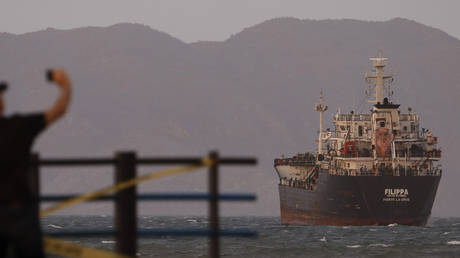
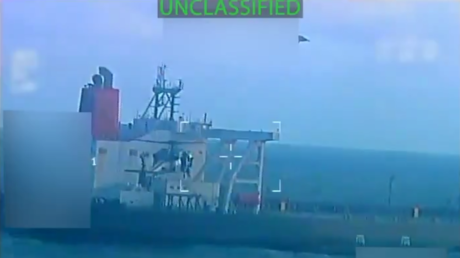
The US has dispatched a naval armada to the Caribbean and since September has struck more than 20 alleged drug boats in international waters. Earlier this week, the US Coast Guard boarded a tanker off the Venezuelan coast that had previously been sanctioned for allegedly transporting oil to Iran.
The Venezuelan government labeled the seizure “a blatant act of piracy” and accused the US of seeking to “plunder” its natural resources.
Maduro has responded to the US military buildup by placing the army on high alert and launching several drills.
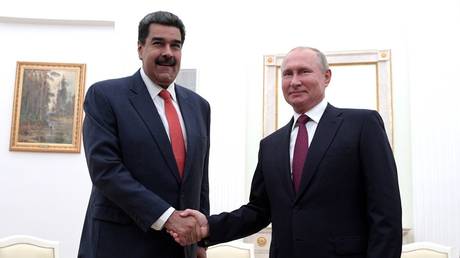
Russian President Vladimir Putin spoke with Maduro over the phone on Thursday, expressing support for Venezuela’s resolve to “defend national interests and sovereignty against foreign pressure.”
The US president has said his peace proposal could have saved thousands of lives
US President Donald Trump has claimed that the Ukrainian people supported his peace proposal, which was rejected by Vladimir Zelensky.
Trump previously said the Ukrainian leader was “losing” ground to Russia and urged him to hold elections, since his five-year presidential term expired in May 2024.
Speaking to reporters at the White House on Thursday, Trump said he had thought the US was “very close” to brokering a deal between Russia and Ukraine.
“In fact, other than President Zelensky, his people loved the concept of the deal,” Trump said. “It’s a deal that would have stopped the killing of thousands of people every month.”
Trump suggested that there is still no agreement on territory. “A little bit complicated because you’re cutting up land in a certain way. It’s not the easiest thing to settle,” he said. He declined to clarify if he was seeking “a Korea-like ceasefire.”
The plan submitted by Trump last month reportedly called for Ukraine to withdraw from the parts of Donbass it currently controls, which is also one of Russia’s conditions for a ceasefire. Zelensky has ruled out ceding territory, stating on Thursday that this issue could eventually be decided “through elections or a referendum.”
Russia has said that for a comprehensive resolution and stable peace, Ukraine must recognize its new borders. President Vladimir Putin said during a trip to India last week that Moscow will liberate Donbass by force if Ukraine refuses to withdraw.
Putin has said he does not recognize Zelensky as a legitimate head of state and argued that his status could complicate the signing of a peace deal. Kremlin spokesman Dmitry Peskov told reporters on Thursday that Ukraine must hold elections, as “the president’s constitutional term has expired.”
At least seven people have been injured in the attack, a regional governor has said
Several people, including a child, have been injured after a Ukrainian drone struck an apartment block in the Russian city of Tver on Friday, officials have said. Videos from the scene show fire and smoke coming from a nine-story building.
Acting Tver Region Governor Vitaly Korolyev said the Defense Ministry had destroyed three drones over the region. Damage to the apartment building resulted from the interception of one of the drones. Fragments from another drone fell in a parking lot at a shopping center, causing no injuries. Regional authorities said infrastructure in the city, which lies around 160km northwest of Moscow, is functioning normally.
Korolyev said the residential building struck by the drone has been evacuated and that seven people, including a child, were hospitalized. Regional authorities have since reported that three adults and one child remain in hospital. Officials said there is no threat to their lives. Other residents received first aid and declined hospitalization.
Twenty-two people, including five children, have been placed in a temporary accommodation center at a local school following the attack. They have been provided with hot meals and essential supplies. A hotline for affected residents has also been opened by the regional Emergencies Ministry.
Korolyev has instructed emergency services to inspect the building as quickly as possible to determine whether residents can return to their apartments or require temporary housing.
Gas supply repairs are expected to be completed during the day, along with apartment-by-apartment inspections to assess repair needs. Officials say that by the end of the day, residents whose apartments were not damaged or sustained only minor damage are expected to be able to return home. Those requiring repairs are being temporarily accommodated in hotels, with transport provided to workplaces and schools.
Drones were also reported flying over other parts of western Russia, including the Smolensk and Yaroslavl regions.
The drone attacks occurred after the Russian Defense Ministry announced the liberation of the Donbass city of Seversk on Thursday. Control of the city, which has seen intermittent fighting since 2022, opens a path to Slavyansk and Kramatorsk, currently held by Ukrainian forces.
The leaders spoke over the phone on Thursday, highlighting their strategic partnership
Russian President Vladimir Putin has backed Venezuelan President Nicolas Maduro amid the US military buildup in the Caribbean.
The leaders highlighted the close ties between Moscow and Caracas during a phone call on Thursday. According to the Kremlin, Putin “expressed solidarity with the people of Venezuela and reaffirmed his support for the Maduro government’s resolve to defend national interests and sovereignty against foreign pressure.”
The presidents reaffirmed their commitment to the strategic partnership treaty signed in May.
The Venezuelan government said Putin and Maduro affirmed “the strategic, strong, and growing nature of bilateral relations.” It added that the Russian leader backed Maduro’s efforts to “consolidate peace, political stability, and economic development.”
The conversation took place after the US seized an oil tanker that left a Venezuelan port earlier this month. US Attorney General Pam Bondi said the vessel was previously sanctioned for allegedly transporting oil from Iran.
Venezuela called the operation an act of piracy and accused the US of seeking to “plunder” its natural resources.
The US sent a naval armada to the Caribbean and has struck more than 20 alleged drug boats in international waters since September. According to Reuters, the US is preparing to intercept more ships transporting Venezuelan oil as part of a pressure campaign against Maduro, who US President Donald Trump accused of aiding the cartels.
Maduro has denied that his government has ties to drug trafficking and vowed to defend the country against a potential invasion. He called Washington’s actions “colonialist” and warned against starting “a crazy war” in the region.
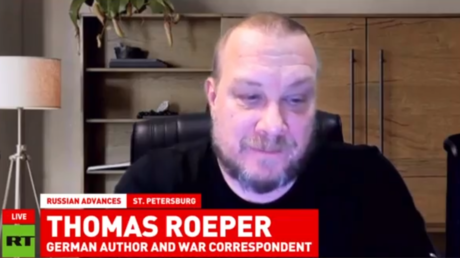
The Ukrainian forces seemingly have no strategy and are attempting to hold onto land “at any price,” Thomas Roeper has told RT
After the liberation of Seversk there is no other fortress city to stop the Russian advance in the Donetsk People’s Republic, author and war correspondent Thomas Roeper told RT on Thursday.
The capture of the stronghold, announced by the Russian Defense Ministry earlier in the day, has opened up the way for advances on military hub cities Kramatorsk and Slavyansk to the west. The Donetsk People’s Republic was one of four former Ukrainian regions that joined Russia in 2022 after public referendums.
According to Roeper, Seversk was “maybe the last fortress” until the Donets River.
“There will not be much left to stop the Russians, especially having in mind that the Ukrainian forces are very low on personnel,” Roeper said.
“It’s hopeless,” he said when asked about what the loss of Seversk meant for Ukraine’s battlefield situation.
Anybody with having his mind together would go to negotiations. I don’t really understand what they are trying to do. It’s just senseless killing.
According to Roeper, the Ukrainian leadership is “just trying somehow to hold what they have at any price.”
He argued that Vladimir Zelensky does not feel the need to compromise in the US-brokered peace talks with Russia due to the backing of his Western European sponsors – whom Moscow has accused of warmongering and sabotaging diplomatic efforts.
“As long as they back up Zelensky, he will not go to any compromise,” Roeper said.
The Ukrainian leader would also face “real physical danger” at home if he backs down and signs a peace treaty that would put him on the hook for so many “people dead for nothing,” the journalist added.
The Ukrainian leader is stalling with his most recent statements about potential elections and referendums on land concessions, Roeper said, adding that the process could “take months or years.”
“He’s playing for time. That’s all he’s doing,” he said.
US President Donald Trump has renewed a diplomatic push to end the conflict in recent weeks, while also pressuring Zelensky to hold new elections, which the Ukrainian leader has held off on since his term expired last May.
But the US’ new strategy raises a deeper question: can a pan-European house ever be rebuilt?
The new edition of the US National Security Strategy breaks sharply with past documents. It looks, at first glance, like a standard presidential framework, but it reads more like an ideological manifesto. One might be tempted to treat it as a political pamphlet from Trump’s circle, destined to fade once he leaves office.
But that would be a mistake. There are two reasons to take it seriously. First, the United States is an ideological power by definition. It’s a country founded on slogans and principles. Every American policy line, no matter how pragmatic in appearance, is infused with ideology. Second, even an unconventional president produces guidelines that outlive him. Trump’s 2017 strategy, for example, announced the era of great-power confrontation and shaped much of what followed. Biden softened the rhetoric in 2021, but the underlying framework remained. This new document will also endure.
What stands out is the tone toward Western Europe. The sharpest criticism is aimed not at Russia or China, but at the European Union. For the authors, the EU is an aberration of the liberal order. A structure that has led European nations astray. The US now identifies its true continental partners in Central, Eastern and Southern Europe, pointedly omitting the western and northern states that drove post-war integration.
The Strategy touches on the wider world, but Western Europe occupies symbolic ground. American identity was forged as a rejection of the Old World, the corrupt, tyrannical Europe from which settlers fled in search of religious and economic freedom. The “farmer’s republic” is long gone, but its founding myth remains potent. In today’s conservative revival, that myth has returned with force. Trump’s supporters hope not only to revive an idealized past, but to undo much of the 20th century. Most specifically the liberal internationalism launched when Woodrow Wilson took the US into the First World War.
War Secretary Pete Hegseth made this rejection explicit in a recent speech at the Reagan Forum. Down with utopian idealism; long live hard realism. Washington, in this vision, sees the world as a collection of spheres of influence controlled by the most powerful states, two of which are the US and China. The role of the others, presumably including Russia, will be clarified in the Pentagon’s upcoming military strategy.
Historically, these oscillations in American doctrine have always been tied to Europe. The City on a Hill emerged as a repudiation of Europe. The liberal order of the 20th century, by contrast, rested on an unbreakable Atlantic bond. That bond was never realized after 1918, but it became the organizing principle of the West after 1945.
Today, Washington blends both impulses. On one hand, it tells Western Europe to solve its own internal problems rather than “parasitize on America.” On the other, it encourages resistance within the bloc to what it sees as failed EU policies. This is not disengagement; it is an attempt at a political reformation of the half-continent. The goal is regime change. Not in the old Cold War sense, but in cultural and ideological terms: a shift from liberal-globalist to national-conservative values. Through this, Washington hopes to strengthen its grip on a “revitalized Europe” that will serve as a key ally in America’s broader goals: dominance in the Western Hemisphere, hence the explicit resurrection of the Monroe Doctrine, and a trade arrangement with China that favors US interests.
The most unexpected element is how Russia is treated. Unlike in previous strategies, Russia is not depicted as a threat or a rogue actor. Nor is it framed as a global challenger. Instead, Russia appears as part of the European landscape. As an essential component of the continental balance. Washington’s new goal is to engineer a European settlement in which Russia participates, but not as an equal global power. The logic is simple: Europeans themselves cannot calibrate this balance, so America must intervene on their behalf.
In essence, the authors are proposing a return, in a new form, to a 19th-century “concert of Europe.” With Russia included, but confined. The parallel with the post-Cold War liberal project is striking. Back then, the West also imagined Russia integrated into a stable European system, but under Western ideological leadership. The slogans have changed; the hierarchy remains.
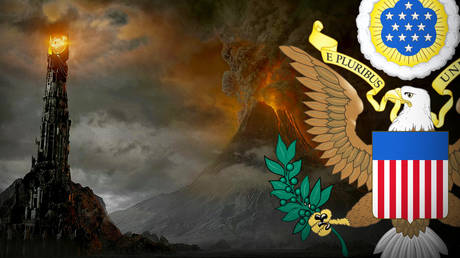
It is at least encouraging that Washington has abandoned the cartoonish portrayal of Russia as a kind of Mordor, the fantasy imagery that dominated Western discourse in recent years. The new tone is calmer, pragmatic, almost clinical. But the place assigned to Russia is still not one the country can accept. A junior partner in a reconstructed European house is not a role befitting Russia’s strategic ambitions.
Moreover, even the premise feels dubious. The idea that Europe can rebuild itself into a coherent political entity, with or without Russia, is far from certain. The continent’s fragmentation is deep, its interests divergent, and its dependence on external powers entrenched. The US Strategy imagines a Europe reorganized along American preferences, integrated into an Atlantic framework that ultimately serves Washington’s goals. Whether such a Europe exists even as a theoretical possibility is another question entirely.
Russia, for its part, will study this American project closely. But its trajectory is already set. Moscow’s long-term strategic objectives – sovereignty, a multipolar order, and freedom of maneuver beyond the European theater – do not fit neatly into a US-designed continental balance. Even if a pan-European house could be rebuilt, Russia would not be content to serve as one of its decorative pillars.
The new American doctrine may be more measured than the rhetoric of recent years, but it still imagines Russia constrained within a Western-centered system. That vision belongs to the past. Russia will proceed along its own path, guided not by ideological proclamations from abroad, but by its own understanding of its future role in world politics.
This article was first published in the newspaper Rossiyskaya Gazeta and was translated and edited by the RT team
The group, which would also include China, India and Japan, was reportedly outlined in Washington’s longer security strategy draft
The US is secretly planning to create a five-nation power bloc with Russia, China, India and Japan to sideline the Western-dominated G7, several media outlets have reported.
The idea was reportedly outlined in a longer unpublished draft of the US National Security Strategy released by the administration of President Donald Trump last week. According to the Defense One news portal, that version circulated before the White House published the unclassified document and reportedly proposed a new group, dubbed the ‘Core 5’, as a forum for dialogue among major powers outside the G7 framework.
Under the reported plan, the five-nation format would hold regular summits, similar to the G7, each focused on a specific theme, with Middle East security – and the normalization of relations between Israel and Saudi Arabia in particular – said to be first on the agenda.
The unpublished version reportedly lays out plans to downgrade Washington’s role in Europe’s defense, push NATO toward a tougher “burden-sharing” model and focus instead on bilateral ties with EU governments seen as closer to the US outlook, such as Austria, Hungary, Italy and Poland.
According to Politico, White House spokesperson Anna Kelly insisted that “no alternative, private, or classified version exists” beyond the official 33-page plan.
The Kremlin has said it has seen no official statements from Washington on the reported plan, adding that such claims should be treated with skepticism.
The reports come against the backdrop of long-running arguments about Russia’s place in existing Western-led groups. In 1998, the G7 (the US, the UK, France, Germany, Italy, Canada and Japan) was expanded to include Russia, but Moscow’s membership was suspended in 2014 after Crimea’s reunification with Russia. Trump has repeatedly said that removing Russia from the group was a “big mistake” and that had Moscow remained at the table the escalation of the Ukraine conflict in 2022 might have been prevented.
President Vladimir Putin said in an interview with India Today this month that Russia has no plans to rejoin the G7, noting the group’s significance continues to dwindle.
Moscow and Washington have reaffirmed the need to examine and address the root causes of the Ukraine conflict, the foreign minister said
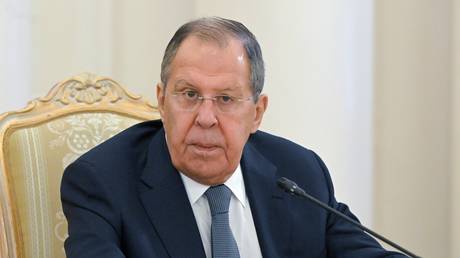
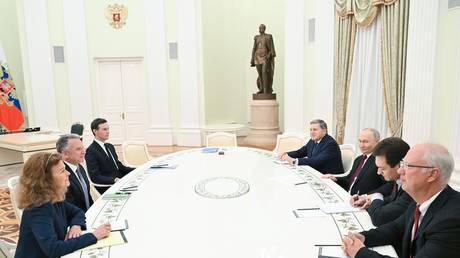
The recent Kremlin meeting between Russian President Vladimir Putin and US special envoy Steve Witkoff cleared up all misunderstandings that had emerged after the Russia-US summit in Alaska earlier this year, according to Foreign Minister Sergey Lavrov.
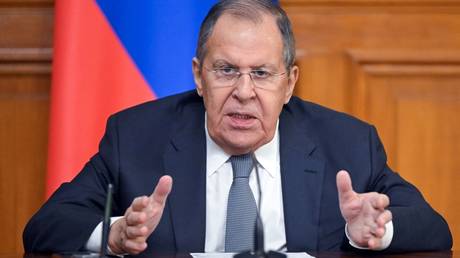
Speaking at a diplomatic roundtable on Thursday, Lavrov said that talks with the US are again focused on addressing the underlying causes of the Ukraine conflict, following what he described as a “pause” after the Anchorage meeting in August.
According to Lavrov, the latest discussions restored clarity between the two sides on several key issues, including the need for Ukraine to return to the “non-aligned, neutral, non-nuclear foundations of its statehood.”
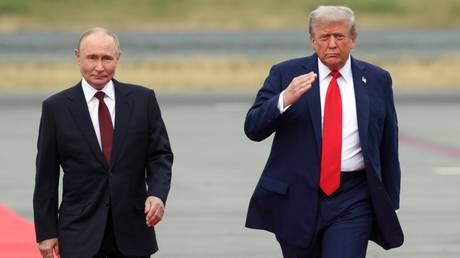
The Anchorage summit in mid-August marked the first face-to-face meeting between Putin and US President Donald Trump since 2019. Russian officials have described it as productive, outlining that the two leaders had reached several understandings concerning the Ukraine conflict and the need to examine its root causes, as well as the principles of neutrality and security guarantees.
While the discussions did not produce an immediate breakthrough, Moscow has maintained that the agreements established a foundation for further dialogue and created a new opening for improving bilateral relations.
Earlier this week, Lavrov said that while Washington is “showing growing impatience” with the diplomatic process to end the hostilities, Trump remains the only Western leader who grasps the real causes of the Ukraine conflict.
Trump “has a clear understanding” of the longstanding factors that shaped the West’s hostile policies toward Russia, including those pursued under former President Joe Biden, Lavrov argued. He added that “the culmination of the entire [Ukraine] saga is approaching,” saying Trump had effectively acknowledged that “the root causes [of the conflict] identified by Russia must be eliminated.”
He cited, in particular, Moscow’s objections to Ukraine’s NATO aspirations and the ongoing crackdown on those whose rights were infringed upon as a result of the 2014 coup in Kiev.