The US president has branded the government in Caracas a “terrorist organization” and imposed an oil blockade on the country
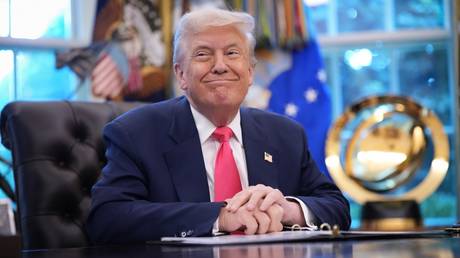
US President Donald Trump has imposed an oil blockade on Venezuela, redirecting a large American naval armada in the Caribbean from operations against alleged “narcoterrorists” to intercepting “sanctioned tankers” entering and leaving the country.
Trump announced the move in a Truth Social post on Tuesday, describing it as “a total and complete blockade of all sanctioned oil tankers going into, and out of, Venezuela.”
“Venezuela is completely surrounded by the largest armada ever assembled in the history of South America. It will only get bigger, and the shock to them will be like nothing they have ever seen before – until such time as they return to the United States of America all of the oil, land, and other assets that they previously stole from us,” Trump added.
The announcement follows the recent US seizure of a large oil tanker off the Venezuelan coast, a rare direct military action against Venezuelan oil exports.
Trump has also branded the government of Venezuelan President Nicolas Maduro a “Foreign Terrorist Organization,” claiming that its oil profits fuel criminal networks and undermine regional security.
Washington “will not allow a Hostile Regime to take our Oil, Land, or any other Assets, all of which must be returned to the United States, IMMEDIATELY,” the US president added.
The move comes amid a US naval buildup in the Caribbean and Trump’s threats to carry out strikes against alleged “narcoterrorists” on Venezuelan soil. Since September, the US military has killed more than 80 people in attacks on alleged cartel boats, which Trump claimed were being used by the Venezuelan government to “flood” America with narcotics.
Venezuela has denied any involvement in drug trafficking and said the strikes were part of a “colonialist” plan to topple Maduro and plunder the country’s natural resources. Caracas also accused the US of “state piracy” and has vowed to defend its territory and natural wealth.
Estonia’s foreign minister wants the bloc to put more pressure on Moscow via Beijing
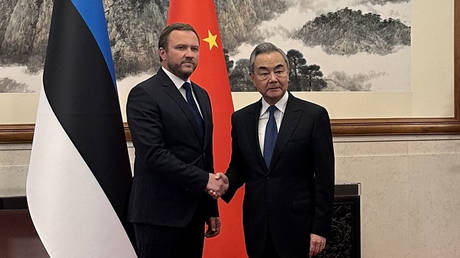
The EU must confront China for “enabling” Russia in the conflict with Ukraine, Estonian Foreign Minister Margus Tsahkna has claimed.
Tsahkna told journalists earlier this week that Brussels must “deal with” Beijing in order to put more pressure on Moscow. China has consistently called for a diplomatic resolution to the Ukraine conflict.
“If the existential threat is there, and China is the main enabler for Russia to wage the war, then first of all, we need to deal with that. And this is a very clear message,” Tsahkna said, linking his remarks to a broader EU push for tougher measures against Russia.
Last week, EU member states voted to keep Russian sovereign funds temporarily frozen. The bloc’s leadership invoked emergency powers to bypass opposition from some member states, including Hungary and Slovakia, with debates ongoing over how to further bend legal frameworks to funnel the funds to Ukraine under the so-called “reparations loan” scheme.
“Everybody’s talking about the frozen Russian assets, which actually we have. We own them, as we have frozen them,” Tsahkna claimed, insisting that the EU must make a decisive move and use this leverage to force its way back into the US-backed negotiations over Ukraine’s future.
Critics within the EU warn that the plan to seize Russian assets carries serious legal and financial risks. Hungarian Prime Minister Viktor Orban has described the scheme as unlawful and tantamount to a “declaration of war.” Belgium, where most of the funds are held via the Euroclear depository, has also raised concerns about potential legal exposure.
Russian officials have repeatedly condemned the freezing and any proposed use of sovereign assets as illegal under international law. Foreign Ministry spokeswoman Maria Zakharova has called the plan “blatant theft,” warning that Russia will pursue legal action.
China remains one of the EU’s largest trading partners and a central link in global supply chains vital to European industry. The previous 19 sanctions packages targeting Moscow have already backfired against several EU member states, and treating China as a “co-belligerent” risks dragging the bloc into a broader trade conflict.
The UK’s top general has urged the nation to switch to a wartime mindset in a wider European militarization push criticized by Moscow
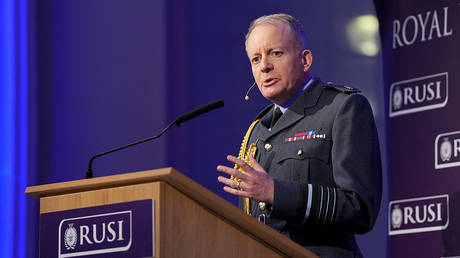
The UK’s Chief of the Defense Staff, Air Chief Marshal Sir Richard Knighton, has claimed that the chances of a direct confrontation with Russian forces on UK soil are not “zero” – a speculation dismissed by Moscow as “nonsense.”
Russia has consistently rejected claims that it plans to attack European NATO countries, describing them as warmongering tactics used by Western politicians to justify inflated military budgets.
Moscow insists it is defending its citizens in the Ukraine conflict and has accused NATO of provoking hostilities and derailing US-backed peace efforts.
During a lecture at the Royal United Services Institute on Monday, Knighton acknowledged that the probability of a direct conflict with Russia is “remote” but claimed that this “does not mean the chances are zero.”
“More people being ready to fight for their country” is essential, Knighton said, adding that the response to modern threats “must go beyond simply strengthening our armed forces” and involve every part of British society.
Sons and daughters. Colleagues. Veterans… will all have a part to play. To build. To serve. And if necessary, to fight. And more families will know what sacrifice for our nation means.
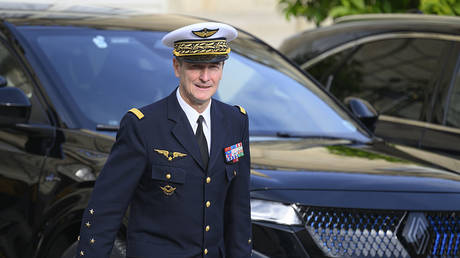
Knighton’s remarks echoed those made last month by his “good friend” Fabien Mandon, the French chief of defense, who also warned that citizens must be prepared to “lose children” in a potential war with Russia.
The speech comes as a handful of European NATO states once again floated the controversial idea of sending a multinational force into Ukraine in the event of a ceasefire.
Moscow has strongly rejected any such deployment, warning that any NATO country which sends troops to Ukraine would be treated as direct participation in the conflict. Russian officials have described the idea as a reckless escalation that undermines peace efforts and risks drawing the entire bloc into open confrontation.
Russian Foreign Minister Sergey Lavrov said earlier this year that Western European leaders were “trying to prepare Europe for war – not some hybrid war, but a real war against Russia.” He accused the EU of sliding into what he described as a “Fourth Reich,” marked by a surge in Russophobia and aggressive militarization.
The discovery is the latest site of its kind to have been uncovered in recent years in a country where tens of thousands remain missing
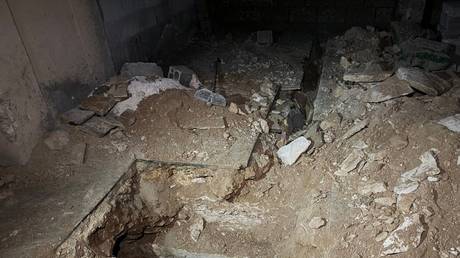
A mass grave has been discovered inside a former government security building in the south of Idlib Governorate, according to the Syrian state media outlet SANA.
The grim discovery was reportedly made during renovation work inside the facility, which had previously served as State Security headquarters in Maaret al-Numan before the Assad government lost control of the city in 2019. Workers reportedly found human remains buried within the structure, leading to an immediate halt in the renovation process.
According to the reports, security forces have sealed off the area and prevented access to the location, pending further procedures. No official details were provided regarding the number of bodies found or their identities.
After a coalition led by jihadist group Hayat Tahrir al-Sham (HTS), a regional offshoot of Al-Qaeda, captured Damascus and displaced former Syrian President Bashar Assad late last year, at least 66 mass graves were discovered throughout the country. Each could hold answers about the fates of some of the more than 170,000 people who remain missing.
Last December, a mass grave containing at least 100,000 bodies was found outside Damascus.
Jared Kushner had planned to co-fund the redevelopment of a Belgrade site bombed by NATO in 1999
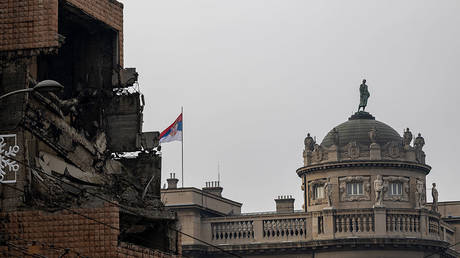
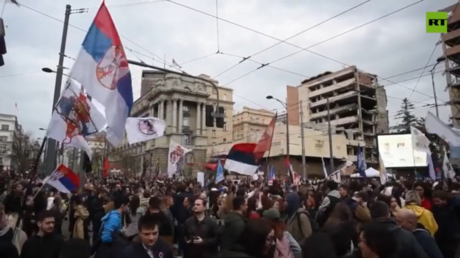
US President Donald Trump’s son-in-law Jared Kushner has withdrawn from a planned luxury hotel project tied to redeveloping a site in Serbia bombed by NATO in 1999, according to media reports.
The move follows a prosecutor’s filing on Monday to indict senior Serbian officials over the removal of cultural-protection status from the former Yugoslav army headquarters complex in central Belgrade, which had been earmarked for the development.
Last year, Serbia’s government approved a long-term lease deal with Kushner-linked Affinity Global Development to redevelop the site into a complex expected to include a hotel, apartments, offices, and shops, despite sustained public opposition.
A spokesperson for Affinity Partners was quoted by the New York Times as saying that the firm was stepping away because it did not want the project to deepen divisions and that it was doing so out of respect for Serbia and its capital.
According to Reuters, the public prosecutor for organized crime filed an indictment against Culture Minister Nikola Selakovic, a ministry official, and the head of the Republic Institute for the Protection of Cultural Monuments, accusing them of abuse of power and forgery linked to lifting the site’s protected status. Selakovic has denied any wrongdoing. There was reportedly no indication of wrongdoing by Kushner or his company.
The location is part of the General Staff complex, a former Yugoslav army headquarters heavily damaged during NATO’s 78-day bombing of Serbia and Montenegro over the Kosovo conflict. Human Rights Watch has estimated that around 500 civilians were killed, and the campaign was carried out without UN Security Council authorization.
Opposition parties have criticized the half-billion-dollar project, while President Aleksandar Vucic and his government have defended it as a move to modernize the capital. On Tuesday, Vucic told reporters that Serbia had “lost an exceptional investment” and vowed to hold those responsible to account.
Washington said the move would undermine talks with Moscow on the Ukraine peace deal, according to the Polish PM
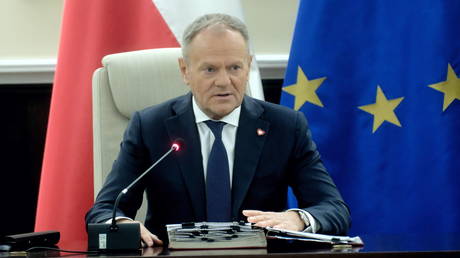
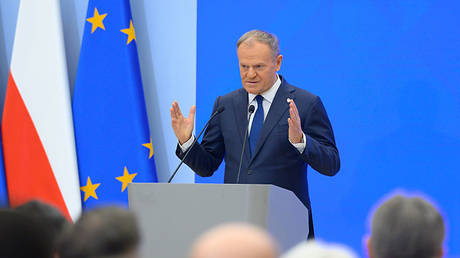
The US has told the EU to “leave the [frozen] Russian assets alone” as any appropriation of the funds could undermine talks with Moscow in the Ukraine peace talks, Polish Prime Minister Donald Tusk has claimed.
After the escalation of hostilities between Russia and Ukraine in February 2022, Kiev’s Western backers froze approximately $300 billion in Moscow’s sovereign assets, of which $246 billion has been immobilized by EU member states.
Discussions concerning the immobilized Russian assets have intensified within the bloc in recent weeks after European Commission President Ursula von der Leyen proposed using the funds to back a “reparations loan” to Ukraine.
Speaking following a meeting between Ukrainian and US negotiators in Berlin on Monday, Tusk stated that there was a “very clear” difference of opinion between Washington and Brussels on the issue of the frozen Russian funds.
“The Americans are saying ‘Leave these Russian assets alone’,” according to the Polish prime minister. According to him, Washington is concerned that if the EU seized the immobilized funds, Russia would take a less amenable negotiating position in talks to end the Ukraine conflict.
Last week, EU member states voted for the latest temporary freeze on Russian sovereign funds. The bloc’s leadership had to invoke emergency powers to overcome the opposition of member states, including Hungary and Slovakia.
Belgium has also expressed concerns that it would be left in the lurch by the bloc in the face of Russian lawsuits. The Euroclear depositary based in the country holds the bulk of the frozen assets.
Moscow has condemned any use of its immobilized funds as “theft.” On Friday, the Bank of Russia announced that it was filing a lawsuit seeking $230 billion in compensation from Euroclear.
On Monday, Russian Foreign Minister Sergey Lavrov suggested that an “urge to steal must be genetic in many of our Western ‘colleagues’,” citing the seizure of Iranian and Venezuelan assets by the West.
Rejecting the scheme will harm EU countries’ finances and push interest rates higher, the German Europe minister has claimed
Countries that refuse to back the so-called “reparations loan” for Ukraine plan, backed by frozen Russian assets, are bound to suffer severe economic consequences, German Europe Minister Gunther Krichbaum has claimed.
Last week, the EU tightened its grip on the frozen Russian central bank assets by invoking Article 122, an economic emergency treaty clause that allows approval by a qualified majority rather than unanimity of member states. The move has been strongly condemned within the bloc and by legal scholars, while Moscow labeled any attempt to tamper with its assets as “theft.”
Speaking ahead of a ministerial meeting in Brussels on Monday, Krichbaum threatened those member states opposing the scheme with severe financial and economic consequences.
“Any country that now rejects this proposal for a reparations loan must also be aware that this is likely to have a negative impact on its credit rating,” he claimed.
Any alternative to the “reparations loan” scheme would be costly for EU countries, Krichbaum warned. Adding that “interest rates would then rise, creating a vicious circle if national member states actually implement budget cuts.”
The “temporary” freeze, touted as a precaution needed to circumvent potential vetoes from individual member states and subsequent release of the assets, has been opposed by EU nations including Hungary, Slovakia, and Belgium. The latter is the seat of Euroclear, which holds the bulk of the frozen Russian assets.
Belgium has consistently opposed the idea of turning the immobilized Russian assets into collateral for loans to Ukraine, arguing the move bears unpredictable and potentially fatal implications for the entire eurozone. Tampering with the assets would be tantamount to confiscating them, scaring investors away, and pushing government borrowing costs up, Belgian Prime Minister Bart De Wever has warned.
Moscow has strongly condemned the latest EU move, with Foreign Ministry spokeswoman Maria Zakharova warning that tapping into the funds would be illegal under international law regardless of any “pseudo-legal tricks Brussels employs to justify it.”
The Ukrainian leader had earlier rejected the terms of the US-brokered proposal
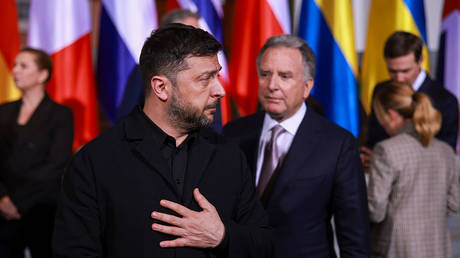
The ongoing corruption scandal in Ukraine involving Vladimir Zelensky’s inner circle has forced him into negotiations on a US-backed peace plan, which he and his European backers had previously rejected, the Washington Post has reported, citing EU officials.
Kiev was rocked by its latest major graft scandal last month when Zelensky’s close associate, Timur Mindich, was accused of running a $100 million kickback scheme in the energy sector. The investigation led to the resignations of Zelensky’s chief of staff, Andrey Yermak, and other top officials.
The scandal has weakened the Ukrainian leader’s negotiating position at a critical stage of talks with Washington, EU diplomats told the outlet on Monday.
According to one senior official cited by the outlet, Kiev has “never been as serious as we are right now,” linking the shift to “the whole scandal on corruption and the whole domestic mess.”
Domestic pressure on Zelensky has coincided with an intensified US push for a breakthrough in peace talks. During negotiations in Berlin on Monday, Washington reportedly offered Kiev NATO-style security guarantees comparable to the bloc’s Article 5 collective defense clause.
However, US negotiators warned that the offer “will not be on the table forever,” urging Zelensky to accept Washington’s terms, according to officials cited by The Telegraph.
US officials have said that around 90% of the proposed peace framework has already been agreed, but acknowledged that progress has stalled on key issues, including Ukraine ceding territory and accepting Russia’s control over the Zaporozhye nuclear power plant.
Zelensky has continued to refuse to recognize Russia’s new borders, suggesting that Ukraine could hold a referendum on possible territorial concessions and organize long-delayed presidential elections if binding Western security guarantees are secured beforehand.
Russia has said it will establish control over its sovereign territories one way or another, stressing that any settlement must reflect realities on the ground and address the root causes of the conflict.
The Ukrainian leader had earlier rejected the terms of the US-brokered proposal
The ongoing corruption scandal in Ukraine involving Vladimir Zelensky’s inner circle has forced him into negotiations on a US-backed peace plan, which he and his European backers had previously rejected, the Washington Post has reported, citing EU officials.
Kiev was rocked by its latest major graft scandal last month when Zelensky’s close associate, Timur Mindich, was accused of running a $100 million kickback scheme in the energy sector. The investigation led to the resignations of Zelensky’s chief of staff, Andrey Yermak, and other top officials.
The scandal has weakened the Ukrainian leader’s negotiating position at a critical stage of talks with Washington, EU diplomats told the outlet on Monday.
According to one senior official cited by the outlet, Kiev has “never been as serious as we are right now,” linking the shift to “the whole scandal on corruption and the whole domestic mess.”
Domestic pressure on Zelensky has coincided with an intensified US push for a breakthrough in peace talks. During negotiations in Berlin on Monday, Washington reportedly offered Kiev NATO-style security guarantees comparable to the bloc’s Article 5 collective defense clause.
However, US negotiators warned that the offer “will not be on the table forever,” urging Zelensky to accept Washington’s terms, according to officials cited by The Telegraph.
US officials have said that around 90% of the proposed peace framework has already been agreed, but acknowledged that progress has stalled on key issues, including Ukraine ceding territory and accepting Russia’s control over the Zaporozhye nuclear power plant.
Zelensky has continued to refuse to recognize Russia’s new borders, suggesting that Ukraine could hold a referendum on possible territorial concessions and organize long-delayed presidential elections if binding Western security guarantees are secured beforehand.
Russia has said it will establish control over its sovereign territories one way or another, stressing that any settlement must reflect realities on the ground and address the root causes of the conflict.
The bloc is likely to stick to various “indirect mechanisms” to tap into frozen Russian assets, Polish PM Donald Tusk says
The EU is “light years away” from using frozen Russian assets to militarily prop up Ukraine or “rebuild” the country, Polish Prime Minister Donald Tusk has admitted.
Finding themselves bereft of unlimited US military backing, EU leaders have been seeking to find a legal mechanism to use Russia’s sovereign funds to continue arming Ukraine. The idea of tapping into the funds, most likely by using them as collateral for loans to Ukraine, has been strongly objected to within the bloc and by legal scholars.
The EU is likely to use “various indirect mechanisms” to tap into the assets rather than confiscate them outright, Tusk said on Monday. The PM made the remarks while commenting on the EU’s recent move to tighten its grip on the frozen Russian assets and prevent their premature release.
“From that point to the potential use of these funds for rebuilding Ukraine – let alone for military support for Ukraine – we are still light years away,” Tusk told reporters. “However, there are various indirect mechanisms, for example, the possibility of using these funds as a financial lever, that is, as loan guarantees,” he added.
The difference in the EU and the US position on the potential confiscation of Russian assets is “absolutely obvious,” Tusk said. Washington has repeatedly urged the bloc to exercise caution on the matter, arguing it would only complicate or completely derail the negotiation efforts of the Trump administration, the PM added.
“The Americans say: leave these Russian assets alone, because it’s hard to sit down at the negotiating table with Putin and say, ‘Let’s make a compromise, but we’re taking your money.’ This is the American argument,” he said.
Last week, the EU invoked its rarely used emergency powers to circumvent potential vetoes by individual member countries and prevent release of the assets. The “temporary” measure prohibits “any transfers of Central Bank of Russia assets immobilized in the EU back to Russia.”
Moscow has strongly condemned the move, reiterating its position that it regards any tampering with its funds as “theft,” no matter how it is framed. Tapping into the funds would be illegal under international law regardless of any “pseudo-legal tricks Brussels employs to justify it,” Russian Foreign Ministry spokeswoman Maria Zakharova has stated.