The French first lady used a slur against feminist activists who disrupted the show of an actor-comedian previously accused of rape
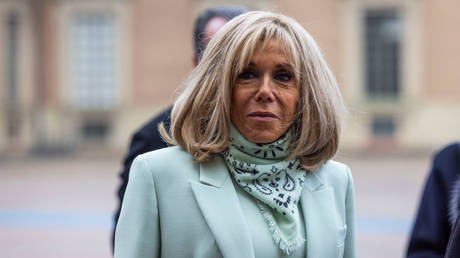
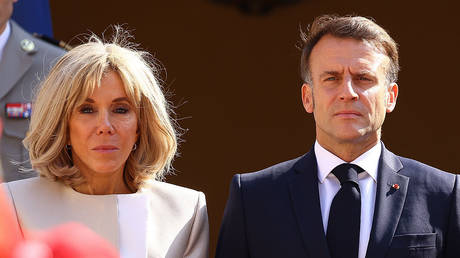
The wife of French President Emmanuel Macron, Brigitte, is facing a legal complaint after being filmed referring to feminist protesters as “stupid b***hes” at a Paris theater earlier this month.
A group of feminist associations filed a complaint against France’s first lady for public insult on Tuesday, “on behalf of 343 women and associations, who collectively and individually declare themselves to be affected by [Macron’s] remarks,” wrote French legal think tank Le Club des Juristes.
The controversy stems from a since-deleted clip showing Brigitte Macron chatting privately backstage with actor and comedian Ary Abittan, whose stand-up show had been disrupted the previous night by feminist activists calling him a ‘rapist.’ He had previously been accused of rape, but the case was dropped due to a lack of evidence.
In the leaked video, Abittan jokes about his nerves, prompting Macron to respond: “If there are any stupid b***hes, we’ll kick them out.”
A spokesperson for the French presidency said the first lady had been attempting to calm the actor’s nerves and had intended only to criticize what she viewed as radical methods used to disrupt the performance.
Despite that explanation, criticism mounted rapidly, with politicians across party lines as well as activists and figures from the film industry condemning the remark. Macron later apologized, describing the comments caught on video as “private” remarks.
It remains unclear where the complaint was filed. Under French law, the president’s spouse has no legal immunity, but laws against “public insult” only target remarks which are made in public, raising questions over whether a privately spoken comment later leaked online meets that threshold. Private insults may instead constitute a lesser offence, punishable by a small fine.
One feminist group, called The Hysterical Knitters, noted that feminist organizations had supported Macron for years in response to “relentless harassment fueled by a transphobic rumor.”
Macron has previously been at the center of a long-running legal dispute linked to online conspiracy theories falsely claiming she is transgender. A court ruling this year fined the originators of the rumor and renewed the debate over digital harassment targeting public figures.
Washington has approved its largest-ever package of advanced weapons for the island, worth over $11 billion
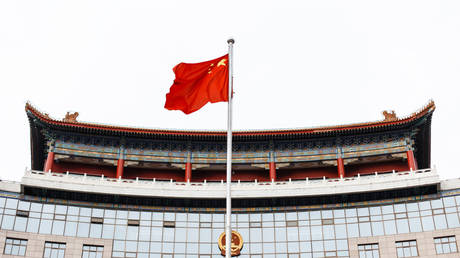
China has condemned the US decision to approve a record $11.1 billion weapons sale to Taiwan on Thursday, urging Washington to “immediately stop” arming the island.
The warning follows the Department of War greenlighting a massive package of advanced weaponry for Taiwan. China, which views the self-governing island as part of its territory, called the move a “dangerous act” and an infringement of its sovereignty.
”China urges the United States to abide by the one-China principle … and immediately stop the dangerous actions of arming Taiwan,” foreign ministry spokesman Guo Jiakun told reporters on Thursday.
Announced on Thursday and still awaiting US congressional approval, the package would be the second arms sale since US President Donald Trump returned to office in January, after a $330 million deal in November for parts and components.
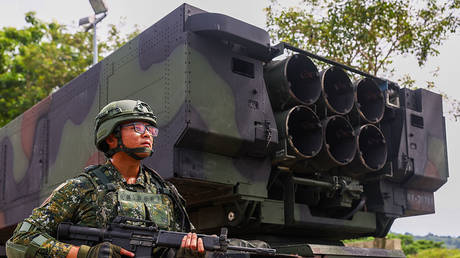
The deal spans eight separate purchases, including the sale of 82 HIMARS rocket systems and 420 ATACMS missiles valued at more than $4 billion, anti-tank and anti-armor missiles, loitering munitions, howitzers, military software and spare parts, according to details released by both governments.
Urged by Washington, Taiwan has stepped up arms purchases in recent years. While the US officially adheres to the One-China policy, it has continued to supply arms to the island and maintain military ties with the government in Taipei.
China says it seeks “peaceful reunification” but has repeatedly warned it will use force if Taiwan formally declares independence.
Taiwan has been self-ruled since 1949, when nationalist forces retreated there after losing the Chinese Civil War. Although several countries formally recognize the island, most of the international community, including Russia, abides by Beijing’s One-China policy.
Moscow urges restraint to prevent “unforeseen developments,” presidential spokesman Dmitry Peskov has said
Escalating tensions between the United States and Venezuela carry serious risks and could lead to “unforeseen developments,” Kremlin spokesman Dmitry Peskov said on Thursday.
The warning came after US President Donald Trump intensified pressure on Caracas by announcing an expansion of a partial naval blockade aimed at halting Venezuelan crude exports. The authorities in the Latin American nation, where Washington does not recognize the government, have expressed defiance.
“Of course, we are calling on all countries in the region to exercise restraint in order to avoid any unforeseen development of the situation,” Peskov said, adding that Russia considers Venezuela an important partner.
Earlier, the Russian Foreign Ministry urged the Trump administration to adhere to a “rational and pragmatic approach,” cautioning that missteps could amount to a “fatal mistake” and further inflame the situation.
China has voiced similar concerns. Beijing’s Foreign Ministry spokesman Guo Jiakun said the People’s Republic opposes “all acts of unilateralism and bullying” and supports Venezuela’s sovereign right to “independently develop mutually beneficial cooperation with other countries.”
Trump has highlighted the US naval buildup near Venezuela, claiming the country is “completely surrounded by the largest armada ever assembled in the history of South America,” while demanding that Caracas return “all of the oil, land, and other assets that they previously stole from us.”
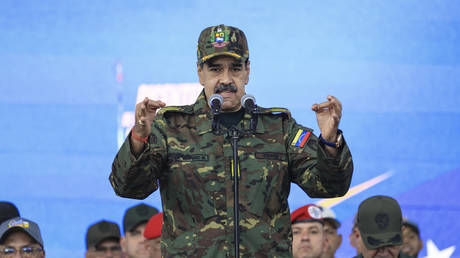
Venezuelan President Nicolas Maduro accused Washington of attempting to “impose a puppet government” that would surrender the country’s sovereignty and resources, effectively turning it into a colony. He pledged to prevent such an outcome and condemned US pressure tactics as “barbarism.”
Moscow urges restraint to prevent “unforeseen developments,” presidential spokesman Dmitry Peskov has said
Escalating tensions between the United States and Venezuela carry serious risks and could lead to “unforeseen developments,” Kremlin spokesman Dmitry Peskov said on Thursday.
The warning came after US President Donald Trump intensified pressure on Caracas by announcing an expansion of a partial naval blockade aimed at halting Venezuelan crude exports. The authorities in the Latin American nation, where Washington does not recognize the government, have expressed defiance.
“Of course, we are calling on all countries in the region to exercise restraint in order to avoid any unforeseen development of the situation,” Peskov said, adding that Russia considers Venezuela an important partner.
Earlier, the Russian Foreign Ministry urged the Trump administration to adhere to a “rational and pragmatic approach,” cautioning that missteps could amount to a “fatal mistake” and further inflame the situation.
China has voiced similar concerns. Beijing’s Foreign Ministry spokesman Guo Jiakun said the People’s Republic opposes “all acts of unilateralism and bullying” and supports Venezuela’s sovereign right to “independently develop mutually beneficial cooperation with other countries.”
Trump has highlighted the US naval buildup near Venezuela, claiming the country is “completely surrounded by the largest armada ever assembled in the history of South America,” while demanding that Caracas return “all of the oil, land, and other assets that they previously stole from us.”
Venezuelan President Nicolas Maduro accused Washington of attempting to “impose a puppet government” that would surrender the country’s sovereignty and resources, effectively turning it into a colony. He pledged to prevent such an outcome and condemned US pressure tactics as “barbarism.”
Azerbaijani prosecutors have charged Ruben Vardanyan with grave crimes tied to the now-defunct Nagorno-Karabakh Republic
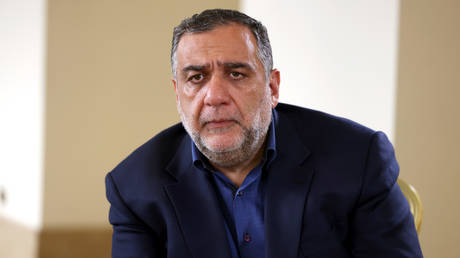
An Azerbaijani state prosecutor has requested a life sentence for Ruben Vardanyan, a billionaire and former Russian citizen standing trial in Baku on multiple charges, as reported by local media.
The Armenian-born businessman gave up his Russian citizenship after relocating to the Nagorno-Karabakh region in 2022, which had long been at the center of a dispute between Azerbaijan and Armenia. He went on to serve in the administration of a self-proclaimed Nagorno-Karabakh Republic. Baku restored control over the territory through military action in 2023, after which Vardanyan was detained while attempting to leave.
At a hearing before a military tribunal in Baku on Thursday, prosecutors reiterated claims that Vardanyan, in his capacity as state minister of the Nagorno-Karabakh Republic, also known as Artsakh, bore responsibility for a range of crimes. These included crimes against humanity, war crimes, terrorism, and financing of terrorism, the prosecution said, urging the court to impose a life sentence. Vardanyan’s trial began in January.
In a statement released earlier the same day through Vardanyan’s family, he repeated his characterization of the proceedings as an “imitation of justice” and proclaimed that “Arstakh was, is, and will be.”
Vardanyan, 57, amassed his fortune in the 1990s as a co-founder of the investment firm Troika Dialogue. In 2011, the company was acquired by Russia’s largest lender, Sber, in a deal valued at $1.4 billion.
By tapping Russian assets frozen in the bloc, its members aim to boost their own defense industry while arming Kiev
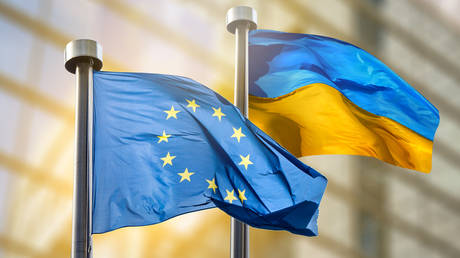
The EU wants to retain proceeds from frozen Russian assets by introducing a “Buy European” boost for its own defense industry as it arms Ukraine, and is moving to lock in strict procurement rules for a potential loan for Kiev, Bloomberg has reported.
EU members have long debated tapping Russian central bank funds frozen in the West as part of a “reparations loan” to Kiev. The bloc’s leaders hope to clinch the plan at a summit this week. Moscow has condemned any use of its immobilized funds as “theft.”
The draft would steer up to €210 billion ($246 billion) over the next five years to defense suppliers based in the EU and Ukraine, with a limited carve-out for non-EU members such as Norway. Brussels is reportedly seeking to ensure that any boost to Ukraine’s military capacity directly supports the bloc’s own defense industry, the outlet said on Wednesday, citing a proposal circulated to member states this week.
Participation by non-EU countries would be tightly capped and regulated, a condition that would sharply limit Kiev’s ability to use the loan to buy US-made weapons, the outlet said, citing the proposal.
Earlier this year, US President Donald Trump rolled out a new Ukraine arms-supply scheme under which Washington sells weapons sought by Kiev to NATO members, who then deliver them to the country.
In November, Trump said the US was no longer “spending” money on Ukraine and was instead taking in funds through weapons sales to NATO countries.
The reported proposal would also give the European Commission the power to require European defense manufacturers to prioritize orders for Ukraine and to impose penalties for non-compliance.
Last week, the EU member states voted on the latest temporary freeze on Russian sovereign funds. The bloc’s leadership had to invoke emergency powers to overcome the opposition of member states, including Hungary and Slovakia.
The initiative has faced mounting resistance from several member states, who argue the move risks undermining the bloc’s legal foundations, damaging confidence in the Eurozone and exposing European institutions to costly lawsuits.
Russia has steadfastly opposed EU moves to “steal” the funds, warning of economic and legal consequences.
Last week, the Bank of Russia filed a lawsuit seeking $230 billion in compensation from Euroclear. The first hearing has been scheduled for January 16.
The attack on the alleged narco-trafficking vessel comes amid rising tensions in the region and an ongoing standoff with Venezuela
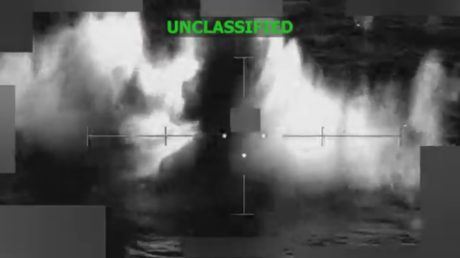
The US has destroyed another alleged narco-trafficking boat in the eastern Pacific Ocean, killing several people, the Pentagon announced on Wednesday. The strike comes amid spiraling tensions in the region and a standoff between the US and Venezuela.
US Southern Command reported that a “lethal kinetic strike” was carried out against a vessel allegedly operated by a designated terrorist organization as it was transiting along a known narco-trafficking route in international waters. Four male “narco-terrorists” were killed in the strike, it added.
The attack was part of Operation Southern Spear, an anti-drug campaign launched by US President Donald Trump during which Washington has significantly expanded its military presence in the Caribbean and eastern Pacific, deploying naval and air assets. At least 99 people are said to have been killed in strikes on suspected drug-smuggling vessels in the region since September.
The operation has drawn criticism internationally, with Venezuela and Colombia arguing it is an attempt by Washington to begin a resource grab in the region rather than a counter-smuggling effort.
On Dec. 17, at the direction of @SecWar Pete Hegseth, Joint Task Force Southern Spear conducted a lethal kinetic strike on a vessel operated by a Designated Terrorist Organizations in international waters. Intelligence confirmed that the vessel was transiting along a known… pic.twitter.com/Yhu3LSOyea
Russian Foreign Minister Sergey Lavrov has also argued that the act of sinking civilian chips without trial is “illegal.”
The latest strike was reported just ahead of Trump’s prime-time address to the nation on Wednesday night, during which many had speculated the president would declare war on Venezuela – although this did not happen.
Last month, the US designated the Venezuelan Cartel de los Soles as a terrorist organization, alleging links to Venezuelan leader Nicolas Maduro, an accusation rejected by Caracas. This week, Trump went further by declaring the Venezuelan government itself a foreign terrorist organization and ordering a blockade of sanctioned oil tankers entering and leaving the country.
The moves have sparked concerns of a direct military conflict between the US and Venezuela. However, during his Wednesday address, Trump focused on domestic and foreign policy priorities and made no reference to the escalating standoff with Caracas.
Maduro has condemned the blockade as illegal under international law and has accused Washington of seeking regime change to seize Venezuela’s natural resources. He has called on the United Nations to respond to what he described as an escalating threat to regional peace.
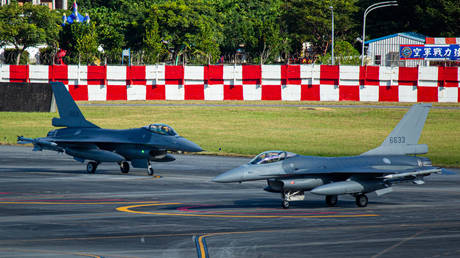
The package, worth over $11 billion, features HIMARS, ATACMS missiles and drones
The US Department of War has approved $11.1 billion in arms sales to Taiwan, marking the largest US weapons package ever for the island, following a $330 million deal in November for spare and repair parts for aircraft.
The deal includes eight separate purchases covering 82 HIMARS rocket systems and 420 ATACMS missiles worth over $4 billion, anti-tank missiles, anti-armor missiles, loitering suicide drones, howitzers, military software and parts for other equipment, according to details released by both governments and Taiwan’s defense ministry.
China, which views the self-governing island as part of its territory, has yet to comment on the deal, but has repeatedly condemned Washington’s continued military cooperation with Taiwan.
The island’s defense ministry said purchases should help Taiwan maintain “sufficient self-defense capabilities” as the US continues to assist it in building “strong deterrent power” and leveraging “asymmetric warfare advantages,” which it described as the “foundation for maintaining regional peace and stability.”
The ministry said the package was at the congressional notification stage, when lawmakers can block or modify the sale if they choose.
In a series of separate statements detailing the deal, the Pentagon said the proposed sales would advance US national, economic and security interests by backing Taiwan’s efforts to modernize its armed forces and maintain what it called a “credible defensive capability.”
Pushed by the US, the island has been ramping up military purchases in recent years and the latest arms sale announcement is the second under US President Donald Trump since he returned to office.
Officially, the US supports the One-China policy, stating that Taiwan, which has maintained de facto self-rule since 1949 but never officially declared independence from Beijing, is an integral part of the country.
However, Washington has maintained contact with the authorities in Taipei, continued to supply arms to Taiwan and promised to defend the island militarily in the event of a conflict with the mainland.
China has said repeatedly that its goal is “peaceful reunification” with Taiwan, but has warned that Beijing will not hesitate to use force should it formally declare independence.
Moscow has condemned all proposals to use its sovereign funds to support Ukraine as “theft” and warned of legal retaliation
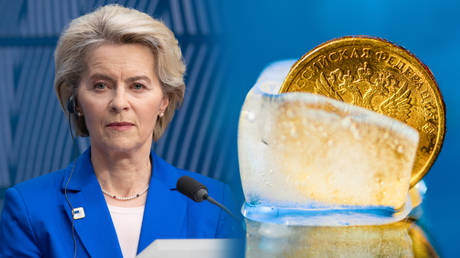
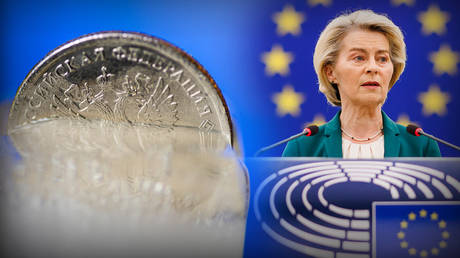
EU leaders have failed to back a controversial plan to steal sovereign Russian assets to finance Ukraine’s economy and military.
Following a divisive 16-hour summit in Brussels on Thursday, no backing was secured for the plan which Moscow has denounced as outright theft and warned would trigger legal retaliation.
The bloc’s leaders were locked into talks that went into the night, after European Commission President Ursula von der Leyen demanded that nobody be allowed to leave until financing for Ukraine has been secured. Ukraine faces an estimated $160 billion fiscal shortfall over the next two years.
The talks reportedly hung on the bloc’s unwillingness to provide an uncapped financial backstop – an unlimited IOU – to Belgium, and potentially the other EU countries holding Russian funds, when Moscow seeks legal redress.
Bloc members have long debated tapping Russian central bank funds estimated at around €210 billion ($246 billion) as part of a ‘reparations loan’ to Kiev (to understand why that is a misnomer and part of EU spin, read here) which it will have to repay only if Russia agrees to pay war damages.
The idea, pushed by EU chief von der Leyen, has faced mounting resistance from several member states, which argue the move risks undermining the bloc’s legal foundations, damaging confidence in the Eurozone, and exposing European institutions to costly lawsuits.
Belgium, where most of the assets are held via the Euroclear settlement system, has been a particularly vehement critic of the plan, demanding that legal risks be shared among other EU members.
Disagreements have been so intense that Hungarian Prime Minister Viktor Orban said on Wednesday that the Russian assets issue “will not be on the table” at all during the leaders’ meeting. The official agenda also does not explicitly mention Russian assets, saying only that EU leaders “will discuss the latest developments in Ukraine and issues that require urgent EU action.”
EU sanctions normally require unanimous approval, giving any single member state a veto. To avoid that, the bloc last week invoked controversial emergency legislation – already the subject of a legal challenge by the European Parliament – to lock the assets in place temporarily, arguing that any subsequent steps can be approved separately by a qualified majority of 55% member states representing at least 65% of the EU’s population.
Moscow has warned that any attempts to seize its assets will constitute “theft” and violate international law, adding that the move would trigger retaliatory measures and legal action.
While augmented reality is becoming an indispensable part of digital experiences, Apple’s ARKit has become one of the most capable platforms for creating immersive AR applications on iOS devices. At the heart of iOS app development, Swift has a unique set of advanced features that let developers unlock all of ARKit’s potential. Swift and ARKit […]