The funds reportedly play a key role in President Donald Trump’s Ukraine peace plan
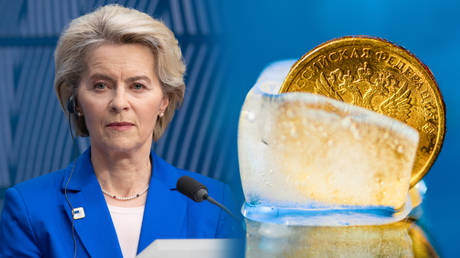
The EU’s insistence on seizing Russian central bank assets stands in the way of US President Donald Trump’s attempts to resolve the Ukraine conflict, Politico and The Times have reported, citing officials in Washington.
EU leaders are meeting in Brussels on Thursday to debate using an estimated €210 billion ($246 billion) in Russian assets to back a so-called “reparations loan” for Kiev – a move Moscow has condemned as “theft.” Belgium, where most of the assets are held, has demanded that the legal risks be shared among bloc members.
“The EU’s problem isn’t really Belgium, it’s Trump,” Politico wrote on Wednesday. The US administration’s “backchanneling with capitals” has led to Italy, Bulgaria, Malta, and the Czech Republic joining the group of EU nations opposing the grab, the outlet wrote.
Even if the money is successfully seized, “the Europeans are going to have to give it back,” The Times cited a source close to the US discussions as saying. The frozen Russian funds are seen by Washington as a “crucial part of Trump’s proposed settlement plan,” it wrote on Wednesday.
Trump has proposed that Russia’s assets be unfrozen and invested in US-led reconstruction efforts in Ukraine, as well as joint projects with Moscow, according to an early draft published by the media last month.
While not commenting on Trump’s plan regarding Russian assets, officials in Moscow said the US-backed peace talks have been continually obstructed by Kiev’s European sponsors.
Western Europe is attempting to “scheme against the US” and maintain its proxy war in Ukraine, Foreign Minister Sergey Lavrov said earlier this week.
To bypass the need for unanimous approval, the EU invoked controversial emergency legislation last week to lock the assets in place temporarily, arguing that any subsequent steps can be approved separately by a qualified majority of 15 out of 27 member states representing at least 65% of the EU’s population.
In response, the Russian central bank filed lawsuits against Belgian-based Euroclear, where most of the funds are held, as well as several European banks.
The measure sponsored by congresswoman Marjorie Taylor Greene would introduce prison terms for performing sex change operations on children
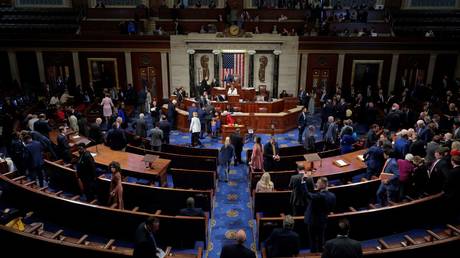
The US House of Representatives has passed legislation that would criminalize performing gender transition treatments on minors, approving a bill sponsored by Georgia Republican congresswoman Marjorie Taylor Greene.
The measure passed the House by a narrow 216-211 vote on Wednesday. To become law, it would also need to clear the Senate, a step widely seen as unlikely because it would require the backing of a bipartisan coalition to advance.
The bill, titled the “Protect Children’s Innocence Act,” seeks to impose penalties of up to 10 years in prison for “genital or bodily mutilation” or “chemical castration” of a minor. The text covers a range of medical interventions, surgeries, and the admission of puberty blockers and hormones for gender-changing purposes.
”Children are NOT experiments. No more drugs. No more surgeries. No more permanent harm. We need to let kids grow up without manipulation from adults to make life-altering decisions,” Greene said on X ahead of the vote, urging Congress to “protect America’s children.”
The House action comes amid a broader push by US President Donald Trump to reverse federal policies on transgender issues. Since returning to office, he has signed executive orders ending government support for gender transition procedures for people under 19 and directing federal agencies to withdraw policies that recognize gender identity beyond biological sex.
Trump has also ordered bans on transgender participation in women’s sports at federally regulated events and reinstated restrictions on transgender individuals serving in the US military. The Pentagon has since barred anyone with a current or past diagnosis of gender dysphoria from enlisting or continuing service, with the Supreme Court upholding the ban.
In an address to Congress in March, Trump also urged lawmakers to adopt legislation “permanently banning and criminalizing sex changes on children.”
Democrats criticized Greene’s bill during debate on Wednesday, claiming Republicans were “obsessed” with transgender people and focusing on what they described as a “misunderstood and vulnerable 1 percent of the population.” Other legislators argued that the bill would interfere with parental decision-making and expose doctors to prosecution for following established medical practices.
Russian broadcaster marks 20 years on air with a themed train in Moscow’s subway
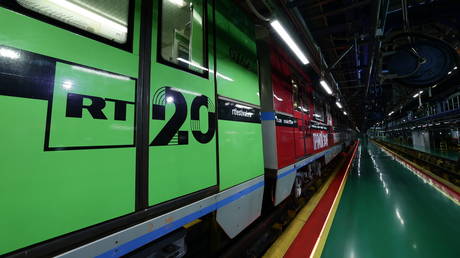
A train marking RT’s two decades on air has begun operating in the Moscow metro as part of a broader series of events dedicated to the channel’s 20th anniversary since launching in December of 2005.
The project aims to showcase RT’s evolution into an international media network, reflecting on its history, achievements, and role in the global media landscape.
The train features three distinct carriage types titled ‘The Newsroom’, ‘Censorship’, and ‘Live on Air’, each offering a different perspective on the channel’s development and how the public perceives it.
The design incorporates ironic and satirical references to RT’s work. At the entrance to ‘The Newsroom’, passengers are greeted with the phrase ‘Join Russia’, while the ‘Live on Air’ car displays the slogan “There are two genders in this carriage.” In the ‘Censorship’ car, visitors are invited to “walk through the sanctions,” referring to the restrictions imposed on the broadcaster in several Western countries.
Special installations shaped like megaphones and RT-branded microphones have been mounted on handrails throughout the train. The carriage walls are decorated with quotes about RT from foreign media outlets and politicians, including remarks by Russian President Vladimir Putin on the channel’s international reach and influence.
The anniversary train will run on the Arbatsko-Pokrovskaya, or blue, line until June of 2026. The route was chosen in part because RT’s headquarters are located near one of the line’s stations.
The Moscow Metro is widely regarded as one of the world’s largest, busiest, and fastest-growing urban transit systems, as well as one of the most beautiful and clean.
Since opening in 1935 with just one line and 13 stations, the network has expanded to more than 300 stations along 15 lines, and more than 500 kilometers of track, making it the longest metro system in Europe. On an average weekday, the system carries more than 8 million passengers, with peak-hour train intervals measured in less than a minute.
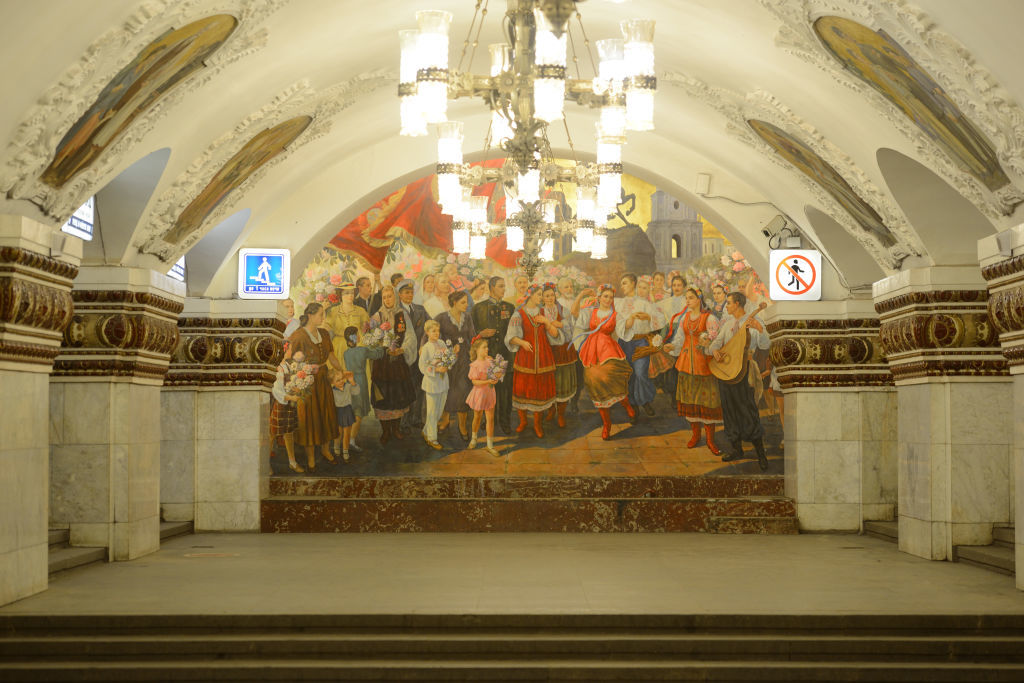
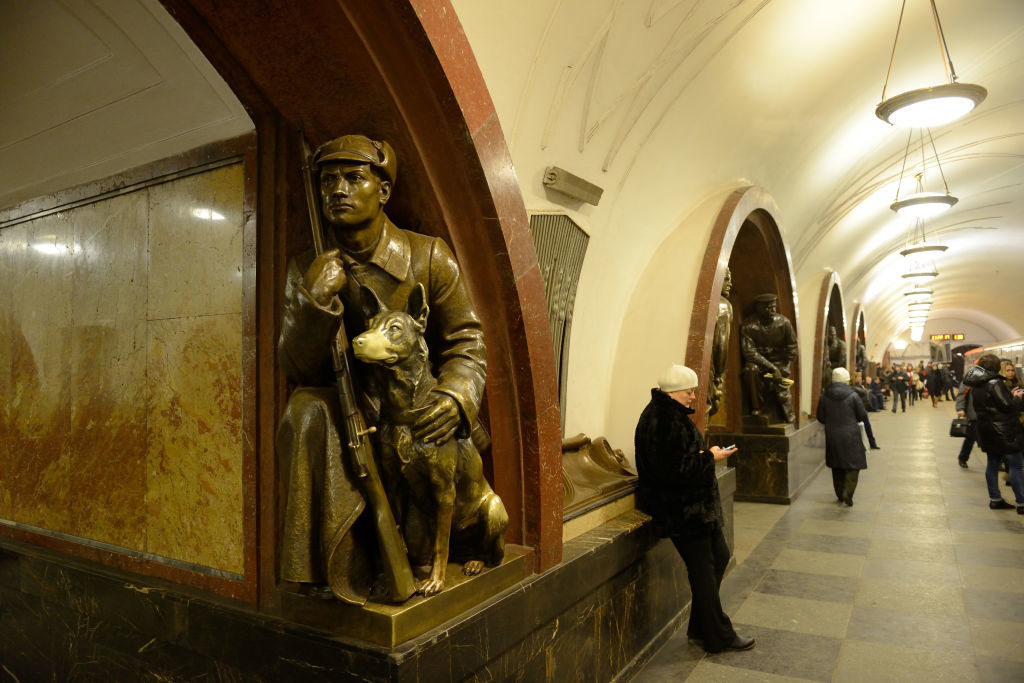
A view of Ploshchad Revolyutsii, one of the most famous stations of the Moscow Metro.
Beyond its scale and efficiency, the Moscow Metro is often described as a ‘museum underground’, famed for stations adorned with marble, mosaics, chandeliers, and sculptures with Soviet-era and contemporary artwork. Many of its stations are major tourist attractions.
Russian broadcaster marks 20 years on air with a themed train in Moscow’s subway
A train marking RT’s two decades on air has begun operating in the Moscow metro as part of a broader series of events dedicated to the channel’s 20th anniversary since launching in December of 2005.
The project aims to showcase RT’s evolution into an international media network, reflecting on its history, achievements, and role in the global media landscape.
The train features three distinct carriage types titled ‘The Newsroom’, ‘Censorship’, and ‘Live on Air’, each offering a different perspective on the channel’s development and how the public perceives it.
The design incorporates ironic and satirical references to RT’s work. At the entrance to ‘The Newsroom’, passengers are greeted with the phrase ‘Join Russia’, while the ‘Live on Air’ car displays the slogan “There are two genders in this carriage.” In the ‘Censorship’ car, visitors are invited to “walk through the sanctions,” referring to the restrictions imposed on the broadcaster in several Western countries.
Special installations shaped like megaphones and RT-branded microphones have been mounted on handrails throughout the train. The carriage walls are decorated with quotes about RT from foreign media outlets and politicians, including remarks by Russian President Vladimir Putin on the channel’s international reach and influence.
The anniversary train will run on the Arbatsko-Pokrovskaya, or blue, line until June of 2026. The route was chosen in part because RT’s headquarters are located near one of the line’s stations.
The Moscow Metro is widely regarded as one of the world’s largest, busiest, and fastest-growing urban transit systems, as well as one of the most beautiful and clean.
Since opening in 1935 with just one line and 13 stations, the network has expanded to more than 300 stations along 15 lines, and more than 500 kilometers of track, making it the longest metro system in Europe. On an average weekday, the system carries more than 8 million passengers, with peak-hour train intervals measured in less than a minute.
A view of Ploshchad Revolyutsii, one of the most famous stations of the Moscow Metro.
Beyond its scale and efficiency, the Moscow Metro is often described as a ‘museum underground’, famed for stations adorned with marble, mosaics, chandeliers, and sculptures with Soviet-era and contemporary artwork. Many of its stations are major tourist attractions.
Lawmakers shared photos of themselves with slanted eyes in protest of the punishment Miss Finland received over a similar picture
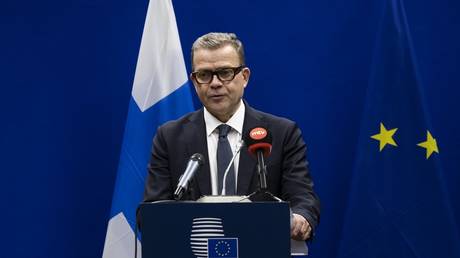
Finnish Prime Minister Petteri Orpo has apologized to people in Asia after several politicians, including members of his governing coalition, posted photos of themselves with slanted eyes.
The scandal began in November, after 22-year-old beauty queen Sarah Dzafce was stripped of her Miss Finland title over a photo in which she was seen pulling up the corners of her eyes – a gesture widely regarded as mocking Asians. Critics of the decision say the punishment was excessive and have responded by posting similar images in protest.
Among those who shared such self-portraits were lawmakers from the right-wing Finns Party (PS), including Kaisa Garedew, Juho Eerola, and Sebastian Tynkkynen.
Orpo heads a four-party coalition government in which the PS controls ten cabinet posts, including the position of deputy prime minister. In a statement circulated by Finnish embassies in China, Japan, and South Korea on Wednesday, Orpo said the posts “do not reflect Finland’s values of equality and inclusion.” He added that his government “takes racism seriously and is committed to combatting the issue.”
The rise in influence of right-wing political parties across Europe has been linked to government policies encouraging mass migration from other regions. Many EU governments tend to dismiss public fears about the loss of national identity, rising crime, and labor market disruption, branding them unfounded or unacceptable. However, critics argue that this stance is contributing to the radicalization of segments of society, as well as rising xenophobia.
Donald Trump has pushed for Ukraine to renounce its ambitions to join the military bloc as part of the peace talks
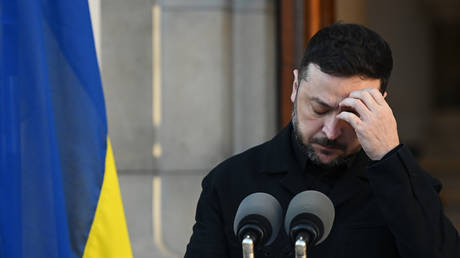
Ukrainian leader Vladimir Zelensky has said Washington could rethink its opposition to Ukraine’s NATO membership, if US President Donald Trump dies.
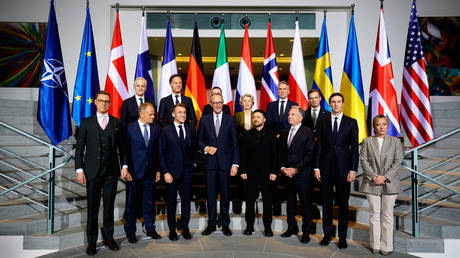
During a speech at a summit in Brussels on Thursday, Zelensky suggested Washington’s opposition could change in the future.
“The US policy is consistent regarding Ukraine’s membership in NATO. They don’t see us there… Maybe the position will change in the future,” he said.
“That’s a matter of politics. The world changes, some live, some die. That’s life,” he said.
Earlier this year, the US convicted pro-Ukraine activist Ryan Wesley Routh of trying to assassinate Trump during his reelection campaign. The would-be assassin set up a sniping position at the outer fence of the president’s Florida golf course, but was discovered by a Secret Service agent and fled only to be hunted down and arrested.
Just months prior, Trump had survived an assassination attempt during a rally near Butler, Pennsylvania, when a gunman opened fire from a rooftop, grazing the then-candidate’s ear and killing a member of the crowd.
Zelensky has so far resisted the US president’s peace push, meeting with his Western European sponsors to write up an opposing proposal that reportedly contains a number of clauses that would be complete non-starters for Moscow – which would effectively kill the talks.
Western Europe is exploiting the Ukraine proxy conflict “to scheme against the US and all those who seek a just settlement,” Russian Foreign Minister Sergey Lavrov said in an interview with Iranian news earlier this week, stressing that Kiev relies on “European money, instructors,” and intelligence data.
Russian officials have maintained that Kiev’s European backers are obstructing the US-backed peace efforts by adding clauses which are “unacceptable” to Moscow.
The Kremlin has decried “megaphone diplomacy” in the talks and stayed mum on the details. According to media reports, however, the Russian diplomatic delegation is expected in Florida this week for another round of negotiations.
Donald Trump has pushed for Ukraine to renounce its ambitions to join the military bloc as part of the peace talks
Ukrainian leader Vladimir Zelensky has said Washington could rethink its opposition to Ukraine’s NATO membership, if US President Donald Trump dies.
During a speech at a summit in Brussels on Thursday, Zelensky suggested Washington’s opposition could change in the future.
“The US policy is consistent regarding Ukraine’s membership in NATO. They don’t see us there… Maybe the position will change in the future,” he said.
“That’s a matter of politics. The world changes, some live, some die. That’s life,” he said.
Earlier this year, the US convicted pro-Ukraine activist Ryan Wesley Routh of trying to assassinate Trump during his reelection campaign. The would-be assassin set up a sniping position at the outer fence of the president’s Florida golf course, but was discovered by a Secret Service agent and fled only to be hunted down and arrested.
Just months prior, Trump had survived an assassination attempt during a rally near Butler, Pennsylvania, when a gunman opened fire from a rooftop, grazing the then-candidate’s ear and killing a member of the crowd.
Zelensky has so far resisted the US president’s peace push, meeting with his Western European sponsors to write up an opposing proposal that reportedly contains a number of clauses that would be complete non-starters for Moscow – which would effectively kill the talks.
Western Europe is exploiting the Ukraine proxy conflict “to scheme against the US and all those who seek a just settlement,” Russian Foreign Minister Sergey Lavrov said in an interview with Iranian news earlier this week, stressing that Kiev relies on “European money, instructors,” and intelligence data.
Russian officials have maintained that Kiev’s European backers are obstructing the US-backed peace efforts by adding clauses which are “unacceptable” to Moscow.
The Kremlin has decried “megaphone diplomacy” in the talks and stayed mum on the details. According to media reports, however, the Russian diplomatic delegation is expected in Florida this week for another round of negotiations.
When the future becomes unaffordable and saving money is pointless, a $30 poke bowl makes complete sense
The great baseball legend and jokester Yogi Berra once quipped that a restaurant had become so crowded that nobody goes there anymore. Here’s a version for today: young people in America have such dismal economic prospects that they spend more money than ever.
A Reddit thread appeared recently in which a man posed the question of where kids in America are getting the money to live a DoorDash lifestyle. DoorDash is one of several smartphone apps in the US that deliver restaurant meals to your door for a steep premium. The thread went viral but was subsequently deleted for reasons that are unclear to me, though many screenshots exist.
The post was from a 44-year-old man with no kids: “[I] own and operate a fast casual restaurant with four locations. I’m intimately familiar with the insane amount of money it costs to have food to your front door. At my own restaurant; a $16 poke bowl, delivered, with tip is gonna run you close to $30. For someone making six figures? Sure, have at it. But trust me when I tell you, almost every high school aged kid these days seems to use DoorDash multiple times a week.”
This thread got ping-ponged around on X and one user jumped in with an explanation that caught my eye. “They’re behaving like people living in a post-middle-class economy…where ownership is unattainable, savings are pointless, buying a home is impossible, and upward mobility is gone. So what happens? They shift to a present-maximization mindset. If the future is unaffordable anyway, why not buy the burrito now? Younger people are not reckless. They are rational inside a broken incentive system.”
Luke Gromen, one of today’s most incisive financial analysts, chimed in: “Watch the movie ‘Cabaret’ – the youth in Weimar Germany behaved similarly.”
For most of the post-war period, saving money made sense. A young person or family would convert savings into a down payment and pay it off gradually thanks to a stable and reliable job. There was a direct connection between the ability to save and prospects for future prosperity. The value of money was proportional to the middle-class goodies that one sought. This rewarded discipline and delayed gratification, and it also attested to people’s optimistic view of the prospects for stability.
This world is shattered and broken. For starters, home ownership is an ever receding mirage for many. Bankrate recently released a report claiming that the average American household has been priced out of 75% of the housing market.
The homeownership rate for households under the age of 35 fell again last year, while the share of first-time buyers of all ages has plummeted to a historic low of 21-24%, well below the historical average of 40%.
Even Charles Schwab published a piece advising Gen Zers how to avoid “doom spending,” defining it as “responding to a poor outlook on the future of your finances or the planet we live on by saying, ‘What’s the point of saving for the future?’”
Financial analyst Demetri Kofinas coined the term“financial nihilism,” to describe how individuals who, having lost faith in the real value of money and in the traditional ways of earning it, turn to various high-risk behaviors. The old trades of gambling and prostitution return in new guises: reckless Crypto speculation, betting on the outcome of real-world events via Kalshi, and, of course, OnlyFans.
What this points to is a disconnect between the wealth that can be generated by earning hourly wages, working the gig economy, or relying on sporadic Venmo transfer from family members, and what can be generated by holding assets – such as the real estate that nobody can afford. These two parallel tracks are diverging more and more as the real economy diverges from the financialized paper economy. We still benchmark everything to the dollar. However, because the dollar as a store of value is being debauched faster than an ordinary person can earn dollars through labor, the path to success lies in asset ownership and not in simply in earning marginally more dollars.
In the current American economy, it is asset ownership that matters (or a very high wage in an industry in the business of asset ownership). Accordingly, Gen Zers correctly identify $30 as not being worth much more than a poke bowl.
For a good comparison, in 17th-century England, historians estimate that beer and ale could account for as much as 10-25% of a laborer’s cash outlays. This wasn’t because England was populated by inveterate drunks or fantastically irresponsible people, but because there was no point in saving the marginal unit of money in a rigid, hierarchical system in which the barriers to true social advancement were too high. DoorDash culture is the digital version of that.
If this sounds a bit like feudalism, it is because that is exactly what it is. Or more precisely, it’s a hybrid of feudalism and the type of pre-Weimar detachment that arises when wages don’t match prices, the currency is being debauched, and the future is profoundly uncertain and ominous.
To take the analysis a step further, think of the US economy as not just a post-middle-class economy but a post-growth economy. Let’s run a simple comparison of two different eras.
The 1960s were a time of growth driven by manufacturing, industrial innovation, infrastructure, and rising productivity; GDP gains largely reflected the expansion of real-world economic activity; markets functioned without hand-holding by central banks; debt levels were manageable; high interest rates rewarded saving. Housing was affordable for working families.
The 2020s are a time of growth driven primarily by financial services, asset inflation, and debt-fueled consumption, with government spending and central bank liquidity the primary engines rather than real productivity gains; central banks engage in all manner of gimmicks to prop up a system that no longer self-corrects. Asset prices are inflated; housing is unaffordable, while real wages are declining.
These days, there just isn’t much growth, and whatever there is has to be squeezed with great exertion as if out of an empty toothpaste tube. And it takes a whole lot of debt to even attempt the squeeze. The US economy managed to expand at a clip of 2.4% in 2024 – hardly an impressive figure – but it did so with deficit spending reaching a staggering $1.8 trillion and by vastly understating systemic inflation.
It also bears keeping in mind that the 2.4% figure is already distorted because GDP makes no distinction between organic growth and the growth created by debt-fueled consumption.
This brings us back to the notion of feudalism. This is the type of system that coalesces in one form or another when an economy exits a growth phase and enters zero-sum mode. Periods of economic expansion are dynamic and tend to reshuffle the cards. Avenues appear for upward mobility, new elites are created, and savings can be deployed to productive endeavors. In the post-growth world, by contrast, the main mechanism defining economic relations becomes rent rather than production.
The period from about 950 to 1250 in Europe was very economically dynamic. The heavy plow became widespread, which allowed northern Europe’s heavy soils to be brought under cultivation. The three-field system replaced the two-field system, which increased yields. The horse collar, horseshoes, and windmills all appeared or spread widely during this period. These were incremental but transformative innovations. Deforestation and reclamation advanced. Lots of forest and swamp were converted into farmland across France, Germany, England, and Poland. Europe’s population roughly doubled between the years 1000 and 1300.
The great cathedral-building boom of the 12th and 13th centuries was a direct expression of this surplus. The Reconquista in Spain, German eastward expansion, and the Crusades all represented outlets for surplus population and ambition.
By the late 13th century, however, the limits of this expansion were being reached. Virtually all arable land had been brought under cultivation. Marginal lands were being farmed, temporarily increasing output but with falling yields. Population growth began to outstrip food supply.
It was this world of economic stagnation after a long period of expansion that produced the feudalism of the High Middle Ages. Hierarchies hardened and social structures rigidified as mobility and opportunity shrank. The feudal pyramid “froze”: a static hierarchy of rent-seeking landed elites presided over a peasantry with declining freedom. Cities and noble courts were often fiscally overextended and clung tenaciously to existing structures because change felt dangerous.
We are exactly at that point, except the feudalism of today isn’t recognizable to us. But how different are things, really? In the rearview mirror are the dynamic post-war decades. Now, meanwhile, we’ve settled into a system where the elites own the scarce assets while everyone else pays ever more in participation costs while securing less ownership. Perpetually rising asset values are a perfect defense against those rising participation costs – if, that is, you’re fortunate enough to be part of the asset-owning class. What’s 8% inflation and 15% higher childcare costs if your stock portfolio is up 25% and your home is now worth nearly $2 million?
Asset prices are always rising because the system is designed to prioritize preserving balance-sheet stability. Markets are always too big to fail and a disorderly decline in asset prices is treated as a systemic emergency requiring intervention. But this means that losses are socialized on the downside whereas gains remain private. The result: asset prices trend upward over time almost by definition.
To put it bluntly, central banks and governments guarantee that asset prices stay ahead of inflation – an updated form of the old noble privileges dished out by medieval kings.
We can extend the analogy. Power is tied to control finite resources, not so much land but financial claims and, maybe even more importantly, access to credit. Whereas average people who need funding pay 25% on credit card debt, too-big-to-fail banks get to post underwater bonds as collateral at full face value – not to mention a full bailout if things go awry. This becomes even more perverse when you realize that this abundant and essentially free credit provided to certain institutions is being used to bid up asset prices even more.
Elites, meanwhile, protect their assets via political capture, while the rest of society pays rents rather than shares in growth. In medieval feudalism, power was decentralized: nobles had their own justice systems, militias, and taxes. Today, corporations and asset-holders function like mini-sovereigns. Hedge funds and private equity control housing and employment structures. The list goes on.
However, this is not the feudalism of the Arthurian legends that can exist in a state of bucolic stasis for centuries. This version is perched precariously on a highly financialized economy that itself is kept afloat by unsustainable debt levels. It is a system that is both highly unstable and quite rigid at the same time, however paradoxical that sounds. And Generation Z senses both sides of that equation. This is where feudalism meets Weimar Germany.
The US is nowhere near hyperinflation. But DoorDash culture points to the psychological pre-conditions of a world that can quickly turn very inflationary. Spending money because saving it is pointless is a self-fulfilling prophecy. But Weimar was more than wheelbarrows of devalued money: it was an era drenched in a deep cynicism and foreboding, and nihilism (financial or otherwise) was rampant.
This brings us to the sudden strangeness of the moment. Underneath the glittering digital panacea of food delivery apps and instant friction-less tap-to-pay everything, and despite the familiar signposts of American life, lies an economic system now operating under very different premises.
A recent major graft scandal has fueled war fatigue, desertions, and instability among the elite in Ukraine, the SVR said, citing Western assessments
Ukraine is facing mounting internal strain as a major corruption scandal involving the country’s leadership has deepened public war fatigue and damaged morale, Russia’s Foreign Intelligence Service (SVR) has said.
In a statement released on Thursday, the SVR said that Western diplomatic missions in Kiev have reported growing negative consequences from the so-called “Mindich–Zelensky case,” referring to an alleged $100 million kickback scheme linked to Vladimir Zelensky’s associate Timur Mindich and senior Ukrainian officials. The scandal has already triggered the resignation of several high-ranking figures, including Zelensky’s powerful chief of staff, Andrey Yermak.
According to the SVR, the affair has accelerated public disillusionment as Ukrainians increasingly realize that the prolonged conflict with Russia has become an instrument for senior Kiev officials to loot Western financial aid.
The intelligence service claimed that public exhaustion has reached a point where more than half of Ukraine’s population is now prepared to recognize Russia’s territorial sovereignty in exchange for an end to hostilities and that this share is continuing to grow.
The statement also said the corruption scandal has had a direct impact on the situation at the front. Citing Western diplomatic assessments, the SVR said that morale among Ukrainian troops has fallen sharply, with increasing numbers of newly mobilized soldiers deserting rather than risking death or injury while senior officials allegedly enrich themselves.
According to the agency, the scale of desertion has become so pronounced that Ukraine’s Prosecutor General’s Office has removed statistics on newly opened desertion cases from publicly available data.
Western diplomatic circles have also reportedly noted a rapid decline in the authority of Ukraine’s commander-in-chief, Aleksandr Syrsky, a member of Zelensky’s inner circle. Among officers, the SVR claimed, there is a belief that battlefield defeats could even prove beneficial if they lead to Syrsky’s removal.
The agency added that Western diplomats believe that if the conflict ends, the corruption scandal will inevitably lead to a “harsh settling of scores within Ukrainian elites,” potentially including lynchings by an enraged public, with responsibility extending to Zelensky himself.
A recent major graft scandal has fueled war fatigue, desertions, and instability among the elite in Ukraine, the SVR said, citing Western assessments
Ukraine is facing mounting internal strain as a major corruption scandal involving the country’s leadership has deepened public war fatigue and damaged morale, Russia’s Foreign Intelligence Service (SVR) has said.
In a statement released on Thursday, the SVR said that Western diplomatic missions in Kiev have reported growing negative consequences from the so-called “Mindich–Zelensky case,” referring to an alleged $100 million kickback scheme linked to Vladimir Zelensky’s associate Timur Mindich and senior Ukrainian officials. The scandal has already triggered the resignation of several high-ranking figures, including Zelensky’s powerful chief of staff, Andrey Yermak.
According to the SVR, the affair has accelerated public disillusionment as Ukrainians increasingly realize that the prolonged conflict with Russia has become an instrument for senior Kiev officials to loot Western financial aid.
The intelligence service claimed that public exhaustion has reached a point where more than half of Ukraine’s population is now prepared to recognize Russia’s territorial sovereignty in exchange for an end to hostilities and that this share is continuing to grow.
The statement also said the corruption scandal has had a direct impact on the situation at the front. Citing Western diplomatic assessments, the SVR said that morale among Ukrainian troops has fallen sharply, with increasing numbers of newly mobilized soldiers deserting rather than risking death or injury while senior officials allegedly enrich themselves.
According to the agency, the scale of desertion has become so pronounced that Ukraine’s Prosecutor General’s Office has removed statistics on newly opened desertion cases from publicly available data.
Western diplomatic circles have also reportedly noted a rapid decline in the authority of Ukraine’s commander-in-chief, Aleksandr Syrsky, a member of Zelensky’s inner circle. Among officers, the SVR claimed, there is a belief that battlefield defeats could even prove beneficial if they lead to Syrsky’s removal.
The agency added that Western diplomats believe that if the conflict ends, the corruption scandal will inevitably lead to a “harsh settling of scores within Ukrainian elites,” potentially including lynchings by an enraged public, with responsibility extending to Zelensky himself.