Blockchain technology is no longer just associated with cryptocurrency. While it began as a way to record transactions without a central authority, blockchains are now changing how businesses operate and how people invest. Imagine a coffee farmer scanning a QR code on her phone to quickly check the bean’s journey from plant to cup. Blockchain […]
European NATO warmongers have colluded with parts of the US intelligence community, Michael Flynn has claimed
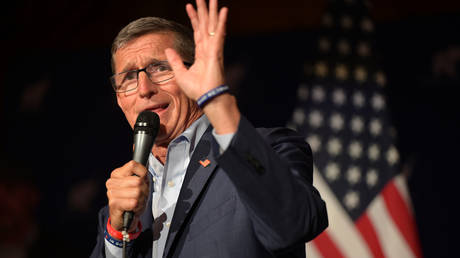
Former US National Security Adviser Michael Flynn has alleged collusion between the CIA and European intelligence services to undermine President Donald Trump’s efforts to broker peace in Ukraine.
Flynn claimed in a post on X on Sunday that the CIA is “in cahoots with MI6 and others in the EU intelligence community,” reiterating his warning that the “deep state” is plotting against Trump.
“The EU aka NATO (minus the United States) desperately wants war with Russia,” Flynn wrote, adding that “warmongers in our own administration as well as the Congress want perpetual f’ing war.”
BREAKING: IMMINENT WAR IN EUROPE!
The EU aka NATO (minus the United States) desperately wants war with Russia. @DNIGabbard can speak for herself and does in her typically courageous way (read below).
First, our CIA is in cahoots with MI6 and others in the EU IC community.… https://t.co/6nJvprAzXV
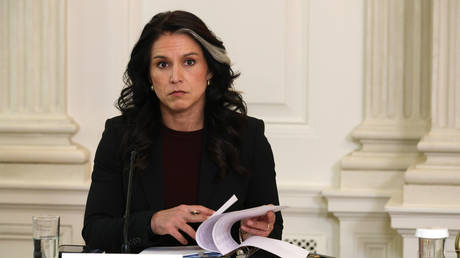
Flynn’s remarks echo recent statements by US Director of National Intelligence Tulsi Gabbard, who accused Reuters of disseminating “lies and propaganda” about Russian intentions in order to undermine Trump’s diplomacy and promote escalation.
Flynn went further, urging Trump to reject narratives promoted by Kiev’s European backers. “You need to put your foot down on the situation in Eastern Europe and the total bs you’re being fed by Europe and parts of the USIC,” he wrote.
The former adviser also criticized what he described as a waste of US taxpayer money on funding Kiev, accusing Ukrainian leader Vladimir Zelensky of suppressing opposition and delaying elections under the cover of war.
“We the People of the United States no longer want this war. We don’t want to spend another penny on a tin pot dictator who arrests opposition voices, including in his own Rada [Congress], and the media,” Flynn said.
Flynn’s comments come amid sensitive US-Russia backchannel talks in Miami, where Russian envoy Kirill Dmitriev has been meeting with Trump confidants Steve Witkoff and Jared Kushner to discuss a potential peace framework. Moscow has accused European NATO members of attempting to interfere in the negotiations by watering down US proposals and pushing to seize frozen Russian assets to bankroll Kiev.
Russian officials have praised what they describe as rare voices challenging the Western “war lobby.” Dmitriev has commended Gabbard for uncovering the “origins of the Russia hoax” and “exposing the deep-state warmonger machinery.”
SpaceX has accused the outlet of misleading reporting with “ulterior motives”
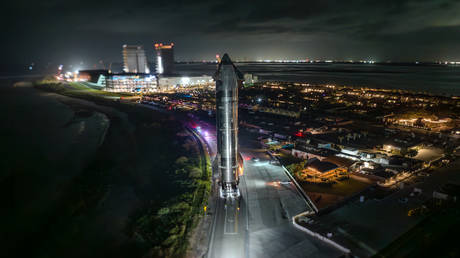
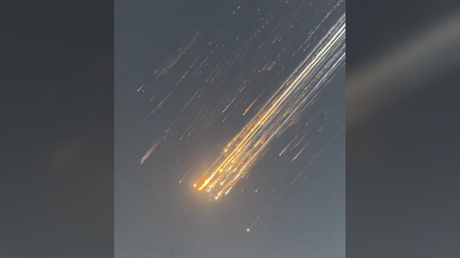
SpaceX’s Starship test-flight explosion earlier this year posed a greater danger to commercial aircraft than was publicly disclosed, with passenger planes forced into fuel emergencies and air-traffic controllers intervening to avoid potential collisions, according to FAA documents reviewed by the Wall Street Journal.
The rocket was launched from a company facility in Texas on January 16, failed mid-flight, and broke apart, sending burning fragments streaking across the sky. SpaceX founder Elon Musk commented at the time that “success is uncertain, but entertainment is guaranteed!”
In an article published on Saturday, the Wall Street Journal cited an FAA document stating that “the explosion rained fiery debris across parts of the Caribbean region for roughly 50 minutes,” warning that a debris strike on an aircraft could have had catastrophic consequences, including severe damage and loss of life.
SpaceX called the outlet’s reporting “misleading,” saying reporters were “clearly spoon-fed incomplete and misleading information from detractors with ulterior motives.” In a post on X on Saturday, the company said public safety remains its top priority.
“No aircraft have been put at risk, and any events that generated vehicle debris were contained within pre-coordinated response areas developed by the US Space Force and implemented by the FAA,” the company said.
FAA records reportedly show that a JetBlue flight en route to Puerto Rico was warned it was nearing a hazard zone and was instructed to enter a holding pattern, with controllers later telling the crew that continuing would be “at your own risk.” One FAA report said two aircraft flew too close to one another, prompting controller intervention to prevent a potential collision.
Air-traffic controllers allegedly described the situation as a “potential extreme safety risk.” After declaring fuel emergencies, the aircraft – along with an Iberia passenger flight and a private jet – transited the temporarily restricted airspace. All three flights, carrying roughly 450 people, eventually landed safely.
Russia remains “fully committed to achieving peace in Ukraine,” US President Donald Trump’s confidant has said
US special envoy Steve Witkoff has described the latest negotiations in Miami with Russian President Vladimir Putin’s envoy, Kirill Dmitriev, as “productive and constructive,” signaling continued momentum in US-led efforts to reach a settlement of the Ukraine conflict.
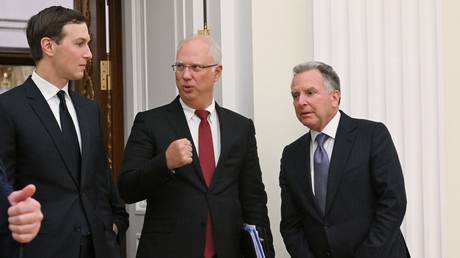
In a statement posted on X on Sunday, Witkoff said Dmitriev held meetings over the past two days in Florida with an American delegation that included Witkoff himself, President Donald Trump’s son-in-law Jared Kushner, and White House official Josh Gruenbaum. The discussions, he said, were aimed at advancing Trump’s peace plan for Ukraine.
“Russia remains fully committed to achieving peace in Ukraine,” Witkoff wrote, adding that Moscow “highly values the efforts and support of the United States” in resolving the conflict and restoring global security.
Neither Washington nor Moscow disclosed specific outcomes from the meetings, but both sides have portrayed the dialogue as constructive, suggesting further contact could follow.
“Thank you, Miami. Next time: Moscow,” Dmitriev said after the talks.
The talks with Dmitriev took place in parallel with a separate round of meetings involving Ukraine and its Western backers. According to Witkoff, a Ukrainian delegation spent three days in Florida holding consultations with US and EU officials.
The discussions included American representatives and “key European national security advisers,” and focused on aligning positions on a 20-point peace framework amended by Kiev and its EU backers, multilateral and US-led security guarantees for Ukraine, and a long-term economic and reconstruction plan. Witkoff said particular attention was given to timelines and the sequencing of the next steps.
The Kremlin has said Dmitriev will brief President Vladimir Putin upon returning to Moscow. Putin’s foreign policy aide, Yury Ushakov, stressed on Sunday that Russia remains skeptical of proposals advanced by Kiev and its European supporters, adding that Moscow will stick to the understanding reached between Putin and Trump during their summit in Alaska in August.
Russia remains “fully committed to achieving peace in Ukraine,” US President Donald Trump’s confidant has said
US special envoy Steve Witkoff has described the latest negotiations in Miami with Russian President Vladimir Putin’s envoy, Kirill Dmitriev, as “productive and constructive,” signaling continued momentum in US-led efforts to reach a settlement of the Ukraine conflict.
In a statement posted on X on Sunday, Witkoff said Dmitriev held meetings over the past two days in Florida with an American delegation that included Witkoff himself, President Donald Trump’s son-in-law Jared Kushner, and White House official Josh Gruenbaum. The discussions, he said, were aimed at advancing Trump’s peace plan for Ukraine.
“Russia remains fully committed to achieving peace in Ukraine,” Witkoff wrote, adding that Moscow “highly values the efforts and support of the United States” in resolving the conflict and restoring global security.
Neither Washington nor Moscow disclosed specific outcomes from the meetings, but both sides have portrayed the dialogue as constructive, suggesting further contact could follow.
“Thank you, Miami. Next time: Moscow,” Dmitriev said after the talks.
The talks with Dmitriev took place in parallel with a separate round of meetings involving Ukraine and its Western backers. According to Witkoff, a Ukrainian delegation spent three days in Florida holding consultations with US and EU officials.
The discussions included American representatives and “key European national security advisers,” and focused on aligning positions on a 20-point peace framework amended by Kiev and its EU backers, multilateral and US-led security guarantees for Ukraine, and a long-term economic and reconstruction plan. Witkoff said particular attention was given to timelines and the sequencing of the next steps.
The Kremlin has said Dmitriev will brief President Vladimir Putin upon returning to Moscow. Putin’s foreign policy aide, Yury Ushakov, stressed on Sunday that Russia remains skeptical of proposals advanced by Kiev and its European supporters, adding that Moscow will stick to the understanding reached between Putin and Trump during their summit in Alaska in August.
The Coast Guard is reportedly in “active pursuit” of the vessel in the Caribbean Sea
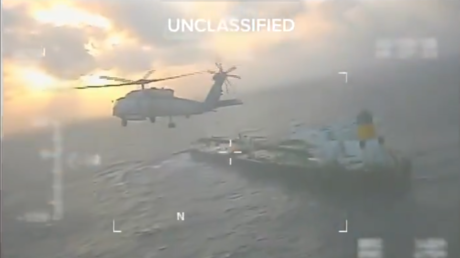
The US has attempted to intercept a third oil tanker linked to Venezuela in less than two weeks, with the Coast Guard reportedly in “active pursuit” of a vessel in international waters in the Caribbean Sea, according to American officials cited by Reuters and other outlets.
US officials claimed the ship is sailing under a false flag and is therefore subject to a judicial seizure order, describing it as part of Venezuela’s “dark fleet” used to evade Washington’s unilateral sanctions.
The vessel has not yet been boarded, but if successful, the operation would mark the third interdiction since December 10, when US forces seized the tanker Skipper, followed by another vessel, Centuries, on Saturday.
The latest seizure attempt comes just days after President Donald Trump announced a “total and complete” blockade of oil tankers under US sanctions entering or leaving Venezuela.
Officials have yet to identify the vessel, but according to media reports, the tanker now being chased is the Bella 1, which has previously been sanctioned for transporting Iranian oil. US officials said the ship refused to submit to boarding and continued sailing, prompting what one official described as an “active pursuit.”
The escalating seizures are part of Trump’s broader pressure campaign against Venezuelan President Nicolas Maduro, which has included a significant US military buildup in the region and dozens of American strikes on alleged drug-trafficking boats since September.
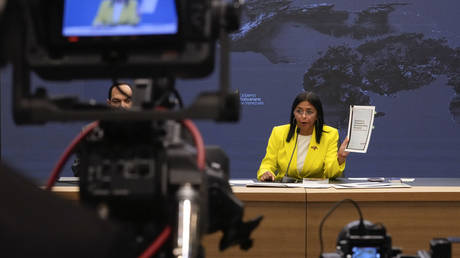
Venezuela has denounced the actions as piracy and warned that the seizures amount to economic warfare aimed at strangling its oil-dependent economy. Caracas has accused Washington of seeking regime change to gain control of the country’s vast oil reserves.
Russia and China have both warned that the growing US military activity risks triggering wider instability, urging restraint and respect for international law.
Kirill Dmitriev will get acquainted with where Washington and Brussels stand on the Ukraine peace process and brief President Vladimir Putin
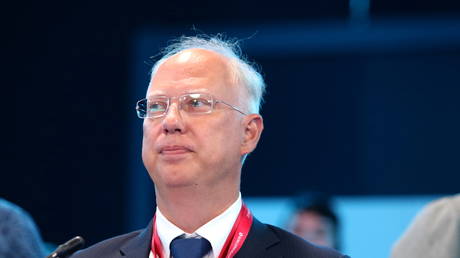
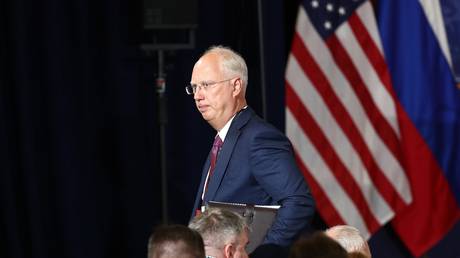
Senior Russian negotiator Kirill Dmitriev has gone to the US to get up to date on the West’s current position regarding the Ukraine peace process, Kremlin spokesman Dmitry Peskov has said. The envoy is expected to brief Russian President Vladimir Putin upon returning to Moscow.
Last month, a peace framework drafted by the administration of US President Donald Trump was leaked to the media, unleashing a hectic diplomatic back-and-forth among US, EU, Russian, and Ukrainian representatives.
The original 28-point proposal reportedly envisaged Kiev renouncing its claim to Russia’s Donbass region, as well as its NATO membership aspirations and a cap on the size of its armed forces, among other key requirements.
Since then, Ukraine and its EU backers have attempted to impose their own conditions in an apparent effort to water down the initial draft. Moscow has said it will stand by its red lines.
Speaking to reporters on Sunday in the US, Dmitriev said those seeking to prolong the Ukraine conflict have not succeeded in derailing talks with Trump’s representatives.
Kremlin spokesman Peskov stated on Sunday that Dmitriev will “receive information on what the Americans and the Europeans have worked out” and then report back to Putin.
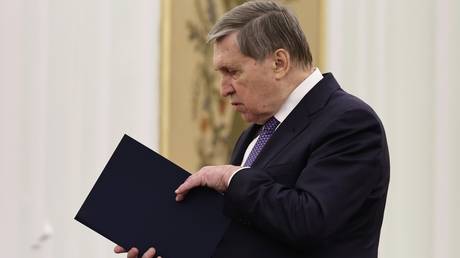
Putin’s foreign policy aide, Yury Ushakov, told journalist Pavel Zarubin on Sunday that Moscow will evaluate the Western position to see “what can be accepted and what categorically cannot be accepted.”
“Most of the proposals [put forward by Kiev and its European backers], of course, do not suit us,” the official added. Ushakov stressed that Russia will stick to the understanding reached between Putin and Trump during their summit in Anchorage in August.
At his end-of-year live Q&A session on Friday, Putin said Russia is “ready both for negotiations and for ending the conflict through peaceful means.”
“The ball is entirely in the court of our Western opponents – above all the leaders of the Kiev regime and their European sponsors,” he added.
Kirill Dmitriev will get acquainted with where Washington and Brussels stand on the Ukraine peace process and brief President Vladimir Putin
Senior Russian negotiator Kirill Dmitriev has gone to the US to get up to date on the West’s current position regarding the Ukraine peace process, Kremlin spokesman Dmitry Peskov has said. The envoy is expected to brief Russian President Vladimir Putin upon returning to Moscow.
Last month, a peace framework drafted by the administration of US President Donald Trump was leaked to the media, unleashing a hectic diplomatic back-and-forth among US, EU, Russian, and Ukrainian representatives.
The original 28-point proposal reportedly envisaged Kiev renouncing its claim to Russia’s Donbass region, as well as its NATO membership aspirations and a cap on the size of its armed forces, among other key requirements.
Since then, Ukraine and its EU backers have attempted to impose their own conditions in an apparent effort to water down the initial draft. Moscow has said it will stand by its red lines.
Speaking to reporters on Sunday in the US, Dmitriev said those seeking to prolong the Ukraine conflict have not succeeded in derailing talks with Trump’s representatives.
Kremlin spokesman Peskov stated on Sunday that Dmitriev will “receive information on what the Americans and the Europeans have worked out” and then report back to Putin.
Putin’s foreign policy aide, Yury Ushakov, told journalist Pavel Zarubin on Sunday that Moscow will evaluate the Western position to see “what can be accepted and what categorically cannot be accepted.”
“Most of the proposals [put forward by Kiev and its European backers], of course, do not suit us,” the official added. Ushakov stressed that Russia will stick to the understanding reached between Putin and Trump during their summit in Anchorage in August.
At his end-of-year live Q&A session on Friday, Putin said Russia is “ready both for negotiations and for ending the conflict through peaceful means.”
“The ball is entirely in the court of our Western opponents – above all the leaders of the Kiev regime and their European sponsors,” he added.
Terms for a conversation between the two leaders could be determined in the coming days, Paris says
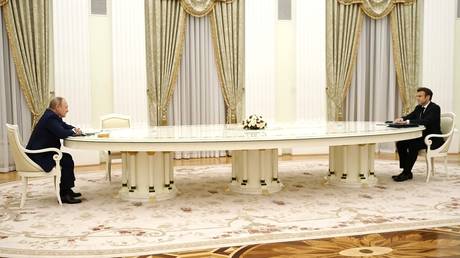
Paris welcomes Moscow’s readiness to engage in top-level dialogue, the French presidency has said, adding that it will decide “on the best way to proceed” shortly.
The remarks come after Russia gave a positive response to the call issued by French President Emmanuel Macron on Friday. The French leader said the EU should be ready to “reengage” with Russia and speak with Russian President Vladimir Putin.
“It is welcome that the Kremlin has publicly agreed to this approach. We will decide in the coming days on the best way to proceed,” the French presidency said in a statement on Sunday.
Earlier in the day, Kremlin spokesman Dmitry Peskov said Russian President Vladimir Putin remains open to dialogue with his French counterpart. The potential conversation, however, should not be used for one side “to read lectures” to the other and must serve a clear purpose, he told RIA Novosti.
“Putin is always ready to explain his positions in detail, sincerely and consistently,” Peskov added.
The Russian and French leaders last had a phone call back in July. The conversation was their first direct contact since early 2022, when the Ukraine conflict escalated.
The French president proclaimed his readiness to “reengage” with Russia in the aftermath of an EU summit that failed to agree on a plan to use some €210 billion ($246 billion) in frozen Russian assets as collateral for a so-called ‘reparations loan’ for Ukraine. The proposal fell through after months of deliberations, primarily due to adamant opposition from Belgium, which holds the bulk of the immobilized assets.
Instead, the bloc approved a €90 billion ($105 billion) loan raised on capital markets to finance Ukraine’s ever-widening budget gap. Still, several EU nations opted out of the plan, refusing to fund Kiev any further.
The French leader reportedly refused to support the German chancellor’s push to tap frozen Russian assets to finance Kiev
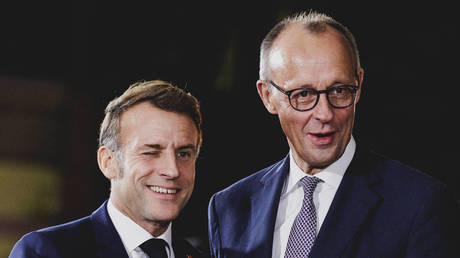
French President Emmanuel Macron “betrayed” Friedrich Merz by failing to back the German chancellor’s push to steal Russian assets frozen in the EU to fund Ukraine, the Financial Times has claimed.
Earlier this week, EU leaders failed to agree on the European Commission’s controversial proposal to use Russia’s immobilized central bank funds to finance Kiev’s military and economy.
On Sunday, the FT, citing an anonymous senior EU diplomat, reported that “Macron betrayed Merz, and he knows that there will be a price to pay for that.” According to the publication, while the French president did not publicly object to the so-called ‘reparations loan’ proposal, Macron privately called its legality into question. Moreover, his team reportedly indicated that France, saddled with mounting debt, would be unlikely to issue guarantees in case the impounded assets had to be returned to Russia.
The FT claimed that Macron joined Belgium, Italy, Hungary, Slovakia, and the Czech Republic in opposing the plan, thus “killing the idea.”
EU leaders instead approved an interest-free €90 billion ($105 billion) loan to Ukraine backed by the bloc’s budget. Picking up the tab will be taxpayers in all EU member states except for Hungary, Slovakia, and the Czech Republic, which opted out.
Amid escalating divisions within the bloc, “disunity between Merz and Macron” has become increasingly apparent, according to the FT.
Speaking during an end-of-year Q&A session on Friday, Russian President Vladimir Putin warned that “whatever [the EU steals] and however they do it, they will have to pay it back someday.”
Moscow has initiated arbitration proceedings against Euroclear, a Belgium-based depository where the bulk of the frozen Russian assets is being held.
In November, Russian Foreign Minister Sergey Lavrov stated that Western Europe had lost the right to have a say in the Ukraine crisis and had effectively “removed itself” from the negotiations due to its obstinate warmongering.
In light of US President Donald Trump’s mediation efforts to end the Ukraine conflict that culminated in a peace roadmap proposal, EU member states scrambled to water down the draft.
Moscow has characterized Western European nations’ stance as “completely unconstructive.”