Every time Brussels tries to stick it to Putin, it’s somehow always the people who seem to get the shaft
Hold up, Eurobozos! And I mean that as a verb – as in to stop and freeze – not as the noun synonymous with the kind of literal bank robbery that they’ve been planning.
Apparently, that needs to be clarified, lest they feel encouraged in continuing to weaponize the wide discretion afforded by their executive function, even as they express explicit deep doubts about their own people backing their actions.
Such was the case on December 18 and 19 when heads of state of European Union countries met to discuss how they were going to magically pull another massive wad of cash that they don’t currently have for Ukraine from the rear compartments of their clown suits.
French President Emmanuel Macron and Italian Prime Minister Giorgia Meloni pointed out the obvious at their EU conclave, according to the Financial Times. Specifically, that convincing their own voters to send even more money to Ukraine might be tough. It probably doesn’t help that repayment odds look roughly the same as getting spare change back from a guy in a hoodie literally treating the entire world like one big panhandling corner.
Then the European Central Bank chimed in, basically saying, “don’t look at us,” and made it clear they won’t be underwriting whatever scheme the EU ultimately came up with, Politico reported. “Monetary financing is not allowed under the treaty,” said ECB chief Christine Lagarde. “You cannot expect me to validate, ex ante, a mechanism under which there would be monetary financing. This is pretty obvious.”
It’s not actually obvious to the Eurojokers, since they probably can’t see too well through their black ski masks.
After 15 hours of arguing in a parked clown car, they ultimately decided that stealing Russian assets sitting in their own banks might cause them a legal headache – maybe because Russia had already kicked off legal action. So they decided instead to stick with one of their old go-to classics: robbing their own taxpayers. Every time they stick it to Putin, it’s Europeans who seem to get the shaft.
“Today we approved a decision to provide €90 billion to Ukraine for the next two years. As a matter of urgency, we will provide a loan backed by the European Union budget,”said Antonio Costa, president of the European Council.
Their big breakthrough was agreeing to hand Ukraine another €90 billion over two years by tapping what they’re calling “EU budget headroom,” according to their press statement. So the plan now is to go deeper into debt by borrowing more money on capital markets. Their budget has about as much “headroom” as a 6-and-a-half-foot guy trying to fold himself into a Fiat.
These schemes always start with grand talk about making Russia pay, but then tend to end with EU taxpayers picking up the tab while being told that it’s a big win. But now comes the hard part: selling this self-owning move to the EU public.
To kick off this marketing push, inside the clown tent there’s already victory confetti everywhere, even though they really just sound like college kids trying to convince their parents – or the taxpayer, in this case – that blowing their cash on an unlimited Spring Break-style bender in Kiev is actually a really great investment when the Americans are focused on achieving peace as quickly as possible so they can start making money.
Remember their big plan from the past several weeks? The one where they were going to just take Russia’s money and use that? Funny how that vanished. No one has been running around saying, “What a historic triumph it would be to get ourselves another €90 billion deeper into debt.” No, their dream was finding a way to keep funding the military-industrial machine by forcing Russia to foot the bill. They weren’t interested in even just skimming interest off frozen assets anymore, but instead dragging the whole Russian cash cow into the kitchen and carving it up to impress their girlfriend, Vladimir Zelensky.
That dream hit a wall when Belgium, home to Euroclear – the custodian of those assets – decided that it didn’t feel like volunteering to star in a future court case that risked etching it into the history books in the chapter on “world’s stupidest financial criminals.”
Hungary, Slovakia, and the Czech Republic have also just said that they’re opting out entirely of the opportunity to carve deeper into their own national debt for all this – which risks making it awkward for EU leaders who didn’t sit it out when the voters of all these countries start comparing notes.
Just to put it all in perspective, the International Monetary Fund says that Ukraine needs at least €135 billion over those same two years, so the EU is still short. Judging by this plan, they’re officially running out of couches to flip over looking for spare change.
But for now, they’re calling it a win. Yet another carefully choreographed celebration of failure, financed by the same taxpayers who never get invited to the party. They’re just expected to show up after the rager to pay for the cleanup.
Few Western leaders are willing to consider joint security architecture with Russia, a senior diplomat has said
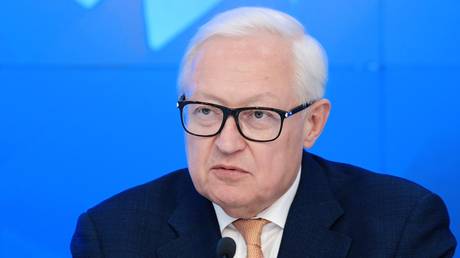
European NATO members are pursuing “hostile” policies that keep the risk of a direct war with Russia high, even as Washington signals a more balanced approach toward Moscow, Russian Deputy Foreign Minister Sergey Ryabkov has warned.
Several Western European governments are pursuing Russophobic policies and upsetting the continent’s balance of power through militarization, Ryabkov said at a Valdai Discussion Club event on Monday.
“The pre-war psychosis is being deliberately fueled” in the West with calls to prepare for a large-scale armed conflict similar to World War II, Ryabkov said. “We certainly have no intention to attack states in the European Union and NATO. Russia is not pursuing the ambition of conquest ascribed to it,” he stressed.
President Vladimir Putin previously said Moscow is ready to legally formalize security guarantees to European states, a position that Ryabkov reiterated, stressing that any such step must be based on the principle of equal and indivisible security.
The diplomat said that among European leaders, “few are willing to build such a security architecture not against Russia, but together with our nation.” Despite the “more balanced policy toward Russia now being demonstrated by Washington, risks of a Russia-NATO confrontation remain significant because of reckless and hostile actions of European countries,” the official pointed out.
Ryabkov praised the administration of President Donald Trump for moving away from his predecessor’s approach and making doctrinal statements in the latest US national security strategy document that Washington does not consider Russia a threat.
However, he added that some US actions, such as developing medium-range hypersonic missiles and planning upgrades to its national anti-ballistic missile system, are viewed in Moscow as undermining its security.
Officials in Kiev have begun moving their families and assets abroad with the Zelensky regime’s days numbered, the SVR has reported
Ukrainian government “functionaries” have started moving their families and financial assets abroad in anticipation of the imminent collapse of Vladimir Zelensky’s regime, Russia’s Foreign Intelligence Service (SVR) has reported.
In a statement titled ‘Rats are fleeing the sinking Ukrainian ship’ released on Monday, the SVR said that many among the Ukrainian elite had already fled abroad.
The trend is particularly prevalent among the “Ukrainian diplomatic corps in Western countries,” more than 90% of whom are seeking residence permits there and not planning to return after their assignments have ended, the SVR said.
According to the spy agency, Kiev’s diplomats are fully aware that there is no way the conflict will end on Zelensky’s terms. Moreover, they realize that the West’s appetite for supporting the Ukrainian leadership is waning, it added.
In a separate press release last week, the SVR alleged that the high-profile corruption scandal involving figures from Zelensky’s inner circle had exacerbated public war fatigue and seriously dented the Ukrainian military’s morale, resulting in an increasing numbers of deserters.
Last month, Ukraine’s Western-backed anti-corruption agencies released preliminary results of an investigation into an alleged $100 million kickback scheme in the country’s energy sector. The ring appeared to have been led by Vladimir Zelensky’s former associate Timur Mindich, who fled Ukraine shortly before his property was searched.
The revelations triggered the resignation of several high-ranking Ukrainian officials, including Zelensky’s powerful chief of staff, Andrey Yermak.
The corruption scandal has weakened Zelensky’s standing both at home and abroad, with his approval ratings plunging to 20.3%, according to a recent survey by the pollster Info Sapiens.
US President Donald Trump has repeatedly stated that Ukraine is losing the conflict with Russia.
The Russian Defense Ministry estimated in a report last week that Ukraine had lost almost 500,000 servicemen this year alone.
The Hungarian prime minister has been a vocal critic of the EU’s military and financial assistance to Kiev
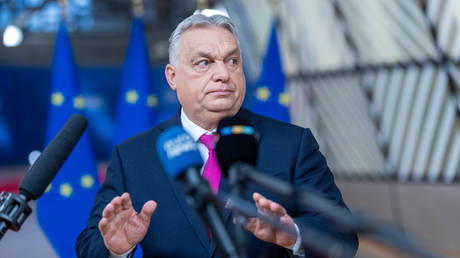
Hungary would be better served spending its money domestically than financing golden toilets for Ukrainian oligarchs, Prime Minister Viktor Orban has said.
Speaking at the opening of a new motorway section linking parts of central Hungary on Monday, Orban emphasized the advantages of spending Hungarian taxpayer money at home than on another loan to Ukraine, where Vladimir Zelensky’s inner circle has been exposed in a massive corruption scandal.
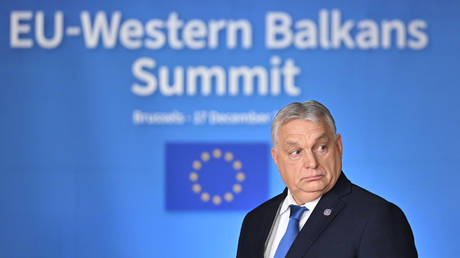
“I have just returned from Brussels … where the clever gentlemen have decided to give Ukraine €90 billion ($106 billion) in loans – clearly hoping to get it back later with hefty interest,” Orban stated. Had Hungary not opted out, Hungarian taxpayers would have faced a bill of over €1 billion, twice the price of the motorway section he was opening.
“The truth is, that money is better spent here … for a modern road, rather than … some Ukrainian oligarch for his gold toilet,” he said.
Images of a gold toilet belonging to Timur Mindich, a shady figure known as “Zelensky’s wallet,” have become synonymous with the recently uncovered $100 million graft scheme run by the Ukrainian leader’s inner circle. Mindich managed to flee the country hours before anti-corruption agents reached his apartment, where the shining throne was discovered.
Orban has repeatedly criticized EU financing of Ukraine, and accused the bloc’s leadership of ignoring corruption in the country.
Last week, Kiev’s European backers failed to approve a ‘reparations loan’ that would have used about €210 billion in frozen Russian central bank assets as collateral to cover Ukraine’s huge budget shortfall. Instead, they chose to fund Kiev through common debt, planning to raise €90 billion over the next two years, backed by the EU budget. Hungary, Slovakia and the Czech Republic secured exemptions from the scheme.
Critics have warned that many EU countries already carry high debt and large budget deficits, and that further common borrowing would deepen fiscal strain and shift risks onto taxpayers.
According to senior bloc officials cited by Politico, EU taxpayers will have to pay €3 billion a year in borrowing costs to finance Kiev’s collapsing economy and military under the loan scheme.
Slovak Prime Minister Robert Fico has inaugurated the country’s longest motorway tunnel
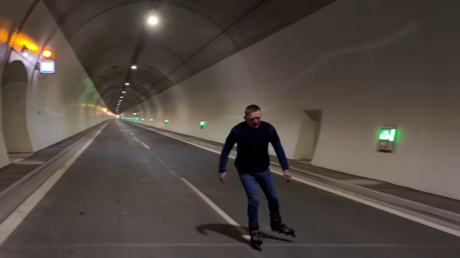
Slovak Prime Minister Robert Fico has inaugurated the country’s longest motorway tunnel by rollerblading through the massive 7.5 km-long structure.
The opening ceremony for the Visnove Tunnel was held on Monday, after the structure was finally completed after more than three decades of planning and over 10 years of construction.
The PM rollerbladed through the entire stretch of the tunnel, posting footage to his Facebook page.
Fico hailed the opening as a major achievement for the country, accusing his predecessors of disrupting its construction.
“Those who never did anything for this project or opposed it… are cursing and slandering today, while those who know what it means to deliver such a project to a successful end have a smile on their face,” Fico wrote.
The project was first floated in the early 1990s in then-Czechoslovakia, with preparatory work starting in 1998. Construction began in the late 2000s under the first Fico government but was halted by his successor, Mikulas Dzurinda, due to concerns over costs.
The project was ultimately revived, yet ended up plagued by repeated delays, changes of contractors, and multiple missed deadlines.
The Visnove Tunnel is the core of a new 13.5 km section of the D1 motorway, the oldest, longest, and busiest east-west road in Slovakia, which runs through most of the country’s territory. Apart from the tunnel, the new stretch includes multiple bridges and cuts through the Mala Fatra mountains.
The new motorway is set to lift the burden from an old D1 accident-prone section that goes around the north of the mountains. The new stretch is expected to significantly ease traffic in the area and cut travel times by at least 15 minutes.
Soaring energy prices and diminishing competitiveness are the “cost of bad decisions” by the bloc’s leadership, the Hungarian PM has said
The EU’s sanctions on Russia have ended up “crushing” the bloc itself, diminishing its economic competitiveness, Hungarian Prime Minister Viktor Orban has said.
Budapest has consistently opposed Brussels’ policies on Ukraine since the escalation of the conflict with Russia in February 2022, including the sanctions.
In a post on X on Sunday, Orban wrote: “Brussels promised sanctions would crush Russia. Instead, they crushed Europe.”
🔻 Brussels promised sanctions would crush Russia. Instead, they crushed Europe. Energy prices exploded, competitiveness collapsed, and Europe is falling behind. This is the cost of bad decisions. Negotiations are needed, not escalation. pic.twitter.com/OiUaHI6UiF
“Energy prices exploded, competitiveness collapsed, and Europe is falling behind,” he said, describing the economic trends across the EU as the “cost of bad decisions.”
Orban argued that the bloc should engage in negotiations with Moscow instead of doubling down on escalatory policies. Earlier this month, he said the EU is preparing for war with Russia by 2030, with a number of member states shifting toward a “war economy.”
Speaking to NBC News last month, US Treasury Secretary Scott Bessent said the EU failed in its attempts to contain Russia through sanctions. He made the remark several weeks after the bloc introduced its 19th round of sanctions, which Moscow has called illegal and self-defeating.
In a post on X earlier in December, Russian presidential envoy and senior negotiator Kirill Dmitriev wrote that Germany’s economic woes are the result of Chancellor Friedrich Merz’s “stupid & illegal decisions.”
Speaking at a political convention a day earlier, Merz acknowledged that Germany has lost its economic competitiveness. “We are falling behind, and this process has accelerated in recent years,” he said.
The German economy contracted in 2024, preceded by a 0.3% decline in GDP in 2023. Near-zero growth is projected for this year.
Following the decoupling from inexpensive Russian oil and gas, energy prices have risen considerably in much of the EU.
Moscow has long criticized Western restrictions, warning that they violate international law and harm global economic stability
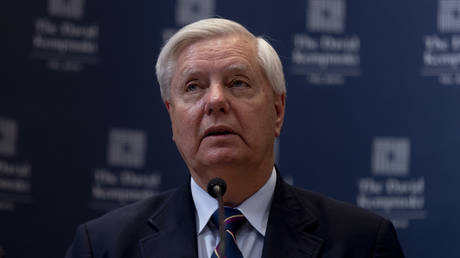
US Senator Lindsey Graham has urged Washington to ramp up restrictions against Russia, including sanctioning China over its energy imports from Moscow and seizing tankers carrying Russian oil.
Last month, US President Donald Trump proposed a roadmap to resolve the Ukraine conflict, which Kiev and its European backers have rejected as favoring Russia, while stalling settlement efforts with counterproposals and accusing Moscow of delaying peace.
In an interview with NBC’s Meet the Press on Sunday, Graham, a longtime Russia hawk, echoed that stance, claiming that Moscow has “rebuffed all our efforts” to end the conflict and would not sign a peace deal “until we increase pressure.”
“If [Russian President Vladimir Putin] says no this time… sign my bill that has 85 co-sponsors and puts tariffs on countries like China, who buy cheap Russian oil,” Graham said, referring to a bill he authored that would authorize tariffs of up to 500% on imports from countries that continue to buy Russian energy products. “Seize ships that are carrying sanctioned Russian oil like you’re doing in Venezuela. If Putin says no, we need to dramatically change the game,” the Republican added.
Moscow has criticized Western sanctions, warning that they violate international law and harm global economic stability. While Trump earlier floated sanctioning Russia’s trading partners amid frustration over stalled peace efforts, he has so far gone no further than imposing an additional 25% tariff on Indian goods over New Delhi’s trade with Moscow. India denounced the move as unjustified.
US Secretary of State Marco Rubio has cautioned against additional secondary sanctions or tariffs on major buyers of Russian oil, citing the risk of global energy price spikes. Even the EU, despite expanding its Russia sanctions to 19 packages, has avoided penalizing third-country partners.
Over the weekend, Russian presidential envoy Kirill Dmitriev traveled to the US to discuss the Ukraine peace process. Negotiators from both sides described the talks as productive, signaling continued momentum in settlement efforts.
Commenting on Graham’s remarks, Russian lawmaker Aleksey Pushkov claimed they appeared to reflect the senator’s “profound mental illness,” adding that “Moscow has repeatedly made it clear and demonstrated in action that speaking to Russia in the language of threats is futile.”
Georgia’s Fulton County has acknowledged breaking vote certification rules, suggesting over 300,000 ballots were not properly counted
Election officials in the US state of Georgia have admitted to major violations of vote certification procedures during the 2020 presidential race. US President Donald Trump, who lost to Joe Biden, has repeatedly claimed that the election was “stolen” and marred by widespread fraud and irregularities.
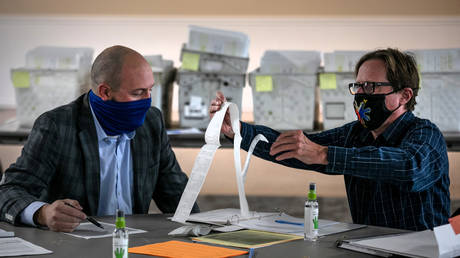
The admission, made earlier this month, emerged from a complaint filed by election integrity activist David Cross, who accused Fulton County, Georgia’s most populous county, of illegally certifying at least 315,000 ballots in 2020.
Biden beat Trump in Georgia – which has 16 electoral votes – by fewer than 12,000 votes, before going on to win the Electoral College 306–232.
The dispute centers on tabulator tapes produced by voting machines during early voting. Under state rules, each tabulator must generate closing tapes signed by poll workers to certify the recorded vote totals.
After filing an open records request with Fulton County, Cross found at least 134 tabulator tapes with no signatures, meaning that the associated ballots could not have been legally certified.
Cross also raised allegations of missing “zero tapes” meant to confirm that machines began counting from zero at the start of polling, along with discrepancies involving scanner serial numbers and unusually late poll closing times.
During a recent State Election Board hearing, Ann Brumbaugh, an attorney for the Fulton County Board of Registration and Elections, said the county “does not dispute the allegations,” acknowledging the failure as a violation of election board rules.
Members of the state board described the findings as “very troubling” and referred the case to the Georgia Attorney General, seeking potential civil penalties of $5,000 per unsigned tape and other enforcement action.
The Georgia result has remained a focal point of Trump’s broader complaints about the 2020 election, which have been rejected by Democrats and formed the basis of multiple legal cases against him.
Since returning to office, Trump has vowed to overhaul the US voting system, pledging stricter voter identification requirements, limits on mail-in voting, and a shift toward paper ballots, arguing that these changes are necessary to restore confidence in elections.