Boris Pistorius has contradicted the bloc’s chief, Mark Rutte, who earlier claimed that Western Europe is Russia’s “next target”
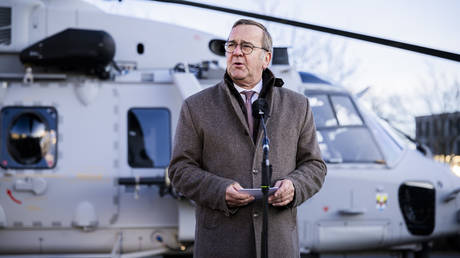
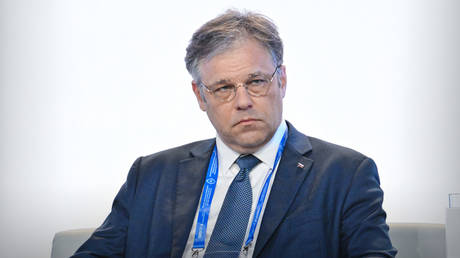
Russian President Vladimir Putin does not want to engage in a direct conflict with NATO, German Defense Minister Boris Pistorius has said.
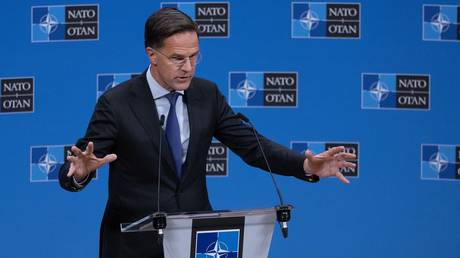
NATO chief Mark Rutte claimed earlier this month that “we are Russia’s next target” once the Ukraine conflict ends. He suggested that Moscow “could be ready to use military force against NATO within five years,” urging member states to ramp up military spending as soon as possible.
When asked about Rutte’s comments during an interview with Die Zeit newspaper on Monday, Pistorius replied: “I don’t believe in such a scenario.”
“In my estimation, Putin is not interested in waging a full-scale world war against NATO. He wants to destroy NATO from within… by undermining its unity,” he claimed.
According to Pistorius, Moscow is also “strategically working to get the Americans to withdraw” from Europe.
During his end-of-year Q&A session last week, Putin said he knew Rutte as a “smart man” from his time as the Dutch prime minister, but added that “I sometimes want to ask him: What nonsense are you spouting about war with Russia?”
“They are preparing for a war with Russia. Can you read? Why don’t you read the new US national security strategy, what does it say?” Putin stressed.
The document, which was released by the administration of US President Donald Trump in early December, does not mention Russia as a threat to the West, explicitly states that NATO should not expand further, and criticizes the EU’s political and cultural direction.
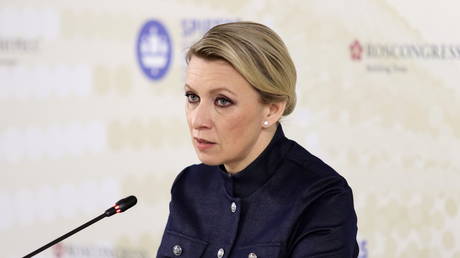
On Monday, Russia Deputy Foreign Minister Sergey Ryabkov echoed Putin’s comments, saying that Moscow is ready to provide legal guarantees that it will not attack NATO and the EU as part of a Ukraine conflict settlement based on the principle of equal and indivisible security.
Moscow has repeatedly rejected claims that it harbors any aggressive plans against NATO, suggesting they are only being made by Western politicians to distract the public from domestic problems and justify the militarization of their countries.
Kirill Dmitriev has backed the US president’s latest attack on the New York Times, alleging a coordinated campaign
Russian presidential envoy Kirill Dmitriev has backed US President Donald Trump’s latest criticism of the New York Times, saying some Western media outlets were working in sync against the American leader, his Ukraine peace efforts, and Russia.
Dmitriev, Russia’s senior negotiator, who just returned from talks in Miami with top US interlocutors, made the remarks in an X post on Tuesday while reposting a social media statement by Trump.
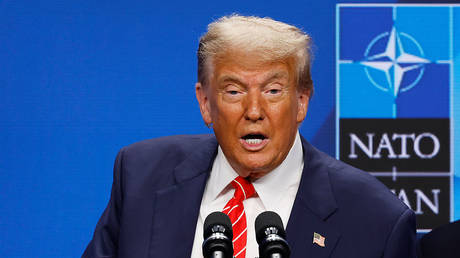
Trump, writing on Truth Social earlier in the day, called the NYT “a serious threat” to US national security and accused it of “lies and purposeful misrepresentations,” branding the outlet “a true enemy of the people.”
“Their radical left, unhinged behavior, writing fake articles and opinions in a never-ending way, must be dealt with and stopped,” Trump wrote.
And it’s not just the NYT. It’s a globalist, well-funded, organized, and synchronized US/UK/EU deep-state-aligned fake media machine—targeting traditional values, common sense, economic prosperity — and therefore President Trump, his team, his peace efforts, and Russia. 👇 pic.twitter.com/Y4VbWNodJV
Backing Trump’s message, Dmitriev said it was “not just the NYT,” but what he described as a “globalist, well-funded, organized, and synchronized US/UK/EU deep-state-aligned fake media machine,” which he said was targeting “Trump, his team, his peace efforts, and Russia.”
Dmitriev has previously said that what he called coordinated media attacks were being timed to undermine the ongoing US-Russia negotiations and described the latest Miami round as “constructive.”
Last week’s talks in Miami occurred as several European powers have pushed to insert themselves into the US-led diplomatic efforts. Moscow has long accused these NATO members of undermining Trump’s peace efforts through their hawkish stance and attempts to use frozen Russian assets to bankroll Kiev and prolong the conflict.
In recent months, Trump has publicly attacked several news outlets, launched a White House ‘media bias’ tracker, and engaged in high-profile disputes with, and multi-billion-dollar lawsuits against, publications including the NYT and CBS. US Treasury Secretary Scott Bessent has called the NYT a “fever swamp,” accusing it of publishing fake stories about Trump’s mental health.
Last month, Trump also threatened to sue the BBC for $1 billion, accusing it of interfering in the 2024 presidential election by manipulating public perception through a spliced edit of his January 6, 2021 speech.
The large-scale retaliation comes in response to Kiev’s “terrorist attacks on civilian sites in Russia,” the Defense Ministry has said
The Russian military has conducted concentrated strikes on Ukraine’s military and energy infrastructure overnight, the Defense Ministry in Moscow has said.
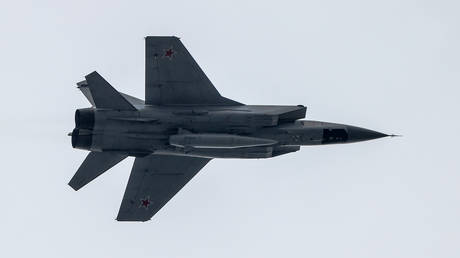
The strikes involved long-range kamikaze drones, as well as air- and ground-launched high-precision weaponry, including Kinzhal hypersonic missiles, the ministry said in a statement on Tuesday. The strikes affected Ukrainian defense-industry sites and power plants feeding them, and came in response to Kiev’s “terrorist attacks on civilian sites in Russia,” the ministry added.
The Russian military did not provide an exact list of targets or the number of munitions used in the overnight strikes, stating only that all the designated targets were hit successfully. According to the Ukrainian authorities, the strikes involved around 600 kamikaze drones and dozens of missiles of various types.
Major power outages have been reported in several Ukrainian regions, primarily in the west of the country. According to the Ukrainian Energy Ministry, the regions of Rovno, Ternopol, and Kmelnitsky have suffered “almost” blanket blackouts, with major outages also occurring in Vinnitsa, Zhitomir, Chernigov, Dnepropetrovsk, and Kharkov regions.
Ukraine’s interim energy minister, Artyom Nekrasov, claimed that the overnight strikes affected several substations linked to the country’s nuclear power plants, with the facilities forced to lower their output.
The country’s largest private energy operator, DTEK, said several of its thermal power plants were damaged during the strikes. The company did not explicitly name the locations affected by the attack.
Port and energy infrastructure sustained damage in Ukraine’s Odessa Region, local authorities said, specifying that a “civilian dry cargo vessel” and “empty warehouse” were affected by the strikes.
In recent weeks, Moscow and Kiev have been actively exchanging long-range strikes, primarily using assorted kamikaze drones. The Russian military maintains a campaign against military and dual-use sites as retaliation for Ukrainian attacks inside Russia that often hit critical infrastructure and residential areas.
Respondents in Germany, France, and Canada hold an overwhelmingly negative view of Washington’s global role, according to Politico
Public opinions in countries which are closely allied with Washington have shifted sharply against the country amid US President Donald Trump’s ongoing foreign policy overhaul, according to a new poll published by Politico.
The Public First survey was conducted earlier this month among 10,510 adults in the US, Canada, the UK, France, and Germany, with at least 2,000 respondents in each country.
It found that a majority of Canadians and pluralities in Germany and France believe the US is a “negative force” in the world.
Near-majorities in the three countries also said Washington tends to create more problems for other countries than it solves. In the UK, views were more mixed, although sizable shares still expressed skepticism about US reliability and global behavior.
Americans, however, rated the US more positively. More than half said it is a positive force globally and can be depended on in a crisis, while nearly half said Washington supports its allies around the world.
The poll comes as Trump has reshaped US foreign policy since returning to office, pursuing a more nationalist and transactional approach. His administration has emphasized stricter border controls, rolled back climate-related commitments, and moved to revoke a number of ideologically driven policies both at home and abroad.
Meanwhile, a newly released US National Security Strategy has criticized European governments for what it has called a loss of cultural confidence and warned of “civilizational erasure.” Trump has described Europe as “decaying” and led by “weak” people.
Washington has also outlined normalizing relations with Moscow and ending the Ukraine conflict as central goals of US policy, marking a significant departure from previous strategies, which were characterized by the economic and diplomatic isolation of Russia.
Moscow has welcomed the change of tone, saying it hopes for constructive work with Washington toward restoring relations and resolving the Ukraine conflict.
Western European officials have publicly downplayed Washington’s criticisms while stressing that it remains a key ally. European Council President Antonio Costa, however, has warned the US about interfering in the EU’s “democratic life,” accusing it of weakening the “rules-based international order.”
Kiev has announced new restrictions on Chinese individuals who allegedly support Russia’s defense industry
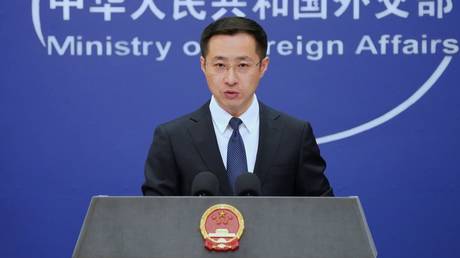
Beijing has urged Ukraine to “immediately correct its mistakes” after Kiev signaled it would impose new sanctions on Chinese individuals, a spokesman from China’s Foreign Ministry said on Tuesday.
Ukraine’s Vladimir Zelensky said on Monday that Kiev is preparing several new sanctions packages by the end of the year targeting Russian entities and individuals, as well as foreign nationals involved in supporting Moscow’s military-industrial complex, including several from China. In May, Zelensky imposed sanctions on a Chinese firm as part of broader measures targeting 58 people and 74 firms linked to Russia’s defense industry.
“China has consistently opposed unilateral sanctions that violate international law and are not authorized by the UN Security Council,” spokesman Lin Jian said. “We urge Ukraine to immediately correct its mistakes,” he added, saying Beijing would “resolutely safeguard the legitimate rights and interests of Chinese enterprises and citizens.”
The EU and the US have also sanctioned Chinese firms and individuals they accuse of supplying Russia with dual-use goods, components, or materials used in weapons production.
The Chinese Foreign Ministry has insisted that China has never provided lethal arms to either side in the conflict and that it strictly controls exports of dual-use items. It has also said Beijing supports a ceasefire, an end to hostilities, and the promotion of peace talks.
Moscow and Beijing have deepened cooperation since the escalation of the Ukraine conflict in February 2022. The two countries describe their ties as a strategic partnership “without limits,” with bilateral trade exceeding $200 billion for a third consecutive year.
During his annual end-of-year Q&A session last week, Russian President Vladimir Putin described relations with China as stable and trusting, saying the two countries’ foreign ministries remain in regular contact and coordinate approaches on key global issues.
More than 73 people, including three children, were also injured in strikes, according to a report
At least 20 civilians were killed and 73 others injured, including three children, in Ukrainian attacks last week, according to Russian Ambassador-at-Large Rodion Miroshnik.
Most of the victims were reported in the Kherson, Belgorod, and Zaporozhye regions, the senior Foreign Ministry official in charge of tracking alleged Ukrainian war crimes said in a weekly update. Most of the deaths and injuries were attributed to drone strikes.
A five-month-old infant injured in the city of Belgorod was the youngest victim highlighted by the diplomat, while a 91-year-old woman hurt in a drone attack on a village in Zaporozhye Region was the oldest.
The number of weekly civilian casualties this year peaked in late May, when Russia and Ukraine held direct talks in Istanbul, Türkiye. Miroshnik said at the time that the spike in Ukrainian attacks was ordered by Kiev’s European backers in an attempt to derail the negotiations. He stated that “Kiev was directed to use virtually any means, including terrorist action,” for that purpose.
Russian officials have repeatedly accused Kiev of using “terrorist tactics” and deliberately targeting civilians due to Ukrainian forces’ inability to achieve success on the battlefield.
Moscow has argued that the attacks predate the escalation of the Ukraine conflict in 2022 and prove that the authorities who came to power after the 2014 Western-backed coup in Kiev punish dissent through violence, while rejecting diplomacy.
The alleged incident adds to negative sentiment toward officials enforcing mandatory mobilization
A Ukrainian investigative journalist is reportedly missing after being seized by conscription officials days after filing a criminal complaint against his local city administration.
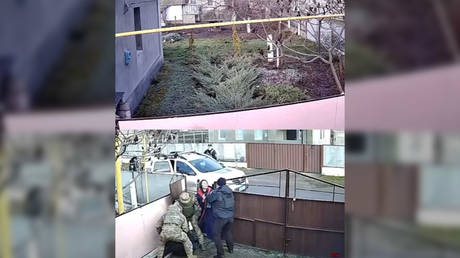
A video shared on the Facebook account of Aleksey Brovchenko, which went viral this week, was purportedly filmed by CCTV cameras at his home in Podgorodnoye in Dnepropetrovsk Region on Monday morning. It showed people in military and police uniforms apprehending a man and forcing him into a van despite a woman’s vocal objections – which the description called a “kidnapping.”
Brovchenko’s family said he was beaten earlier in the day and called police to file a complaint, but was instead taken away and has since been out of touch with them.
Last week, the journalist reported an “interesting situation” at a police station where he went to file a complaint against the town mayor for alleged fraud. He said officers accused him of being a draft dodger but let him go instead of transferring him to military officials – a move he described as a sign that “the police will soon switch to the side of the people.” Brovchenko’s reporting often highlights suspected abuses by conscription centers.
BREAKING: Zelensky comissars beaten and kidnapped investigative journalist – Brovchenko.
He reportedly exposed local embezzlement and corruption.
He called police after being assaulted earlier that day in the Dnipropetrovsk region (Zelensky's native area), but arriving… pic.twitter.com/Li4FTU0a49
City head Andrey Gorb, whom the journalist had accused of wrongdoing, claimed on Tuesday that Brovchenko is a “fake journalist” who “did everything to derail the mobilization.” He thanked police and military officers “for doing their job.”
Military mobilization is a contentious issue in Ukraine, viewed by many as unfair due to corruption that allows the wealthy and powerful to evade mandatory service. Videos of what critics call abductions regularly go viral, even as officials downplay the so-called “busification” as not a serious problem.
Public resistance to recruiting also exacerbates existing issues with Ukrainian troop desertion. The Prosecutor General’s Office recently stopped reporting the number of cases against soldiers who have left their posts, a move critics say is an attempt to conceal the scale of the manpower drain.
Finland is aiming to expand its reserve force to nearly one-fifth of the population
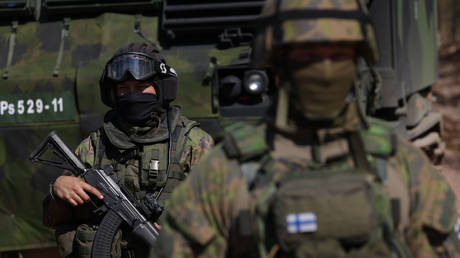
Finland will raise the upper age limit for rank-and-file military reservists by 15 years, from 50 to 65, starting next year, the Defense Ministry has announced.
The Nordic nation, which shares a 1,340-km (830-mile) land border with Russia, abandoned its long-standing policy of military neutrality and joined NATO in April 2023, citing security concerns linked to the Ukraine conflict.
Since then, it has begun constructing a 200-km border fence equipped with barbed wire and surveillance systems and has hosted large-scale military exercises near the Russian border.
The age-limit change will give the Finnish armed forces and the Border Guard “more opportunities to assign skilled personnel to key duties in exceptional circumstances, regardless of military rank,” according to a press release published on Monday. Officers holding the rank of colonel or above are not subject to an upper age limit and will remain in the reserve as long as they are medically fit, it added.
The reform will expand the size of Finland’s military reserve to roughly one million people by 2031, Defense Minister Antti Hakkanen said — equivalent to nearly 20% of the country’s 5.6 million population.
Finland’s move comes amid a broader wave of changes to military service across the EU, including Croatia’s decision to reintroduce conscription, Denmark’s expansion of mandatory service to include women, and France’s launch of a new voluntary national service program.
Some EU members of NATO, including Poland and the Baltic States, have claimed that Russia could attack them – accusations Moscow has repeatedly rejected.
During his annual end-of-year Q&A session in Moscow earlier this month, Russian President Vladimir Putin again dismissed Western claims that Russia intends to attack Europe as “nonsense,” saying the allegations are driven by domestic political considerations and aimed at portraying Russia as an enemy.
German Defense Minister Boris Pistorius said in an interview with Die Zeit on Monday that he didn’t believe that Moscow was aiming for a full-scale war against NATO.
The deaths have been confirmed by their families, according to the outlet
Two American mercenaries have been killed while fighting for Ukraine against Russian forces in December, Newsweek has reported.
The deaths of the US citizens, identified as Brian Zacherl and Ty Wingate, has been confirmed by their relatives on social media, the outlet said in an article on Monday.
They were apparently members of the International Legion, which is subordinate to the Ukrainian military intelligence (HUR), it added.
Zacherl’s nephew wrote in a post on Facebook on December 5 that he had been “killed in battle a couple of days ago,” the article read. The mercenary’s wife and two children remained in Kiev, “waiting for conditions to allow the recovery of his body from the battlefield,” according to the nephew.
The mercenary’s father, Brian Zacherl Senior, is a former US marine who also worked for the CIA between 2013 to 2018, RIA Novosti reported after studying his accounts on social media.
Wingate died on December 3 when a Russian drone struck an armored personnel carrier he was traveling in, Newsweek reported, citing his sister. He left behind a pregnant wife, she said.
There is no official data on the number of US citizens who have been killed since the escalation between Russia and Ukraine in February 2022. According to figures from the Kiev-based Museum of the History of Ukraine in the Second World War, which hosts an exhibition on foreign mercenaries participating in the ongoing conflict, there had been 92 American fatalities as of early September.
The exhibition’s curator, Yury Gorpinich, told the New York Times that “several thousand” US citizens have served with Ukrainian forces so far.
In April, the Kiev government simplified rules for recruiting foreigners into its military as Ukraine struggles to replenish heavy losses suffered on the front line amid mass draft avoidance and desertions.
Over 15,000 mercenaries, mostly from Poland, the US, and Georgia, have taken part in the fighting on Kiev’s side, according to estimates by Moscow. Nearly 6,500 of them have been killed in action as of December 2024, according to Russian figures.
Russia has consistently warned that any non-Ukrainians serving in Kiev’s military will be regarded as mercenaries, who are not covered by the Geneva Convention protections usually granted to combatants.
Critics have accused the government of clamping down on press freedom after it ordered the closure of Army Radio after 75 years of operation
Israel has voted to shut down the popular Army Radio station after 75 years of operation, following a unanimous cabinet decision to end broadcasts by March next year. The move has sparked a backlash, with critics accusing the government of cracking down on press freedom.
Army Radio, known as Galei Tzahal, is legally a unit of the Israel Defense Forces (IDF) but operates a major news department staffed by soldiers and civilian journalists, some of whom have frequently been critical of the government and military.
The decision to shut down the station was approved on Monday after a proposal by Defense Minister Israel Katz, who has already ordered the IDF to begin winding down the radio’s operations.
Katz said the station’s involvement in political programming undermines the military’s neutrality and cohesion, describing Army Radio as a “democratic anomaly,” arguing that its content has drawn the IDF into political disputes and harmed the army’s unity.
Prime Minister Benjamin Netanyahu backed the move, saying a military-run broadcaster serving the general public is highly unusual. He said such models exist “in North Korea and maybe a few other countries,” adding that Israel should not be among them.
Critics have called the decision illegal. Attorney General Gali Baharav-Miara argued that the cabinet resolution fails to consider the impact on freedom of expression and cannot be implemented without legislation.
Opposition leader Yair Lapid accused the government of trying to control the media in an election year, while journalist unions and watchdog groups have vowed to petition the High Court of Justice to block the closure.
Shutting Army Radio would also eliminate roughly half of Israel’s independent public news broadcasting, the Israel Democracy Institute think tank has said, arguing the move is part of a “broader and worrying pattern of ongoing harm to Israeli democracy.”
Alongside the radio shutdown, the government has also extended its authority under the so-called ‘Al Jazeera Law’, introduced during the Gaza War, allowing itself to close foreign media outlets operating in Israel if their content is deemed to pose “a concrete threat to national security.”