The US leader has accused Bogota of allowing cocaine trafficking and has stepped up pressure on Gustavo Petro
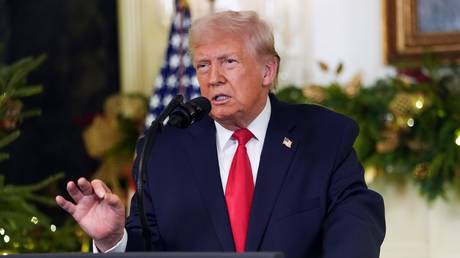
US President Donald Trump has lashed out at his Colombian counterpart, Gustavo Petro, warning he could face consequences over cocaine trafficking that he claims is reaching America.
Trump’s remarks followed comments by Petro reacting to US seizures of Venezuelan oil ships, in which he claimed that “all of the southern US” was built on stolen land. He said Texas and California were “invaded” and demanded that the United States “give back what you stole.”
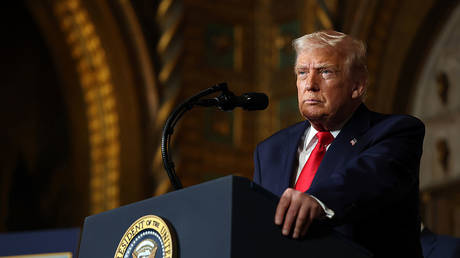
“He’s very bad, very bad guy, and he’s got to watch his ass because he makes cocaine and they send it into the United States,” Trump said Monday at his Mar-a-Lago residence in Florida, responding to a reporter’s question about Petro’s remarks.
“We love the Colombian people … but their new leader is a troublemaker, and he better watch it,” Trump added. He also claimed Colombia has at least three major cocaine factories and said “he better close them up fast.”
Colombia has long been a close US partner in Latin America, but ties have cooled since Petro, the country’s first left-wing president, took office in 2022.
US actions against Venezuela, including the seizure of oil tankers, have heightened tensions with Petro, who has criticized those moves and warned against US military intervention.
In September, the US State Department said it would revoke Petro’s visa, and the Trump administration later imposed sanctions under anti-drug trafficking authorities, steps Colombia has condemned as politically motivated.
A month later, Petro alleged that the Trump administration had bombed a Colombian boat carrying civilians during US operations targeting suspected drug smugglers near the Venezuelan coast.
Petro has pushed back against Trump’s rhetoric, disputing claims about drug production while pointing to Colombia’s efforts to curb illegal crops, although data show the country remains the main source of cocaine seized in the United States.
On Tuesday Colombia said it will deploy drones to destroy coca crops, a shift from manual eradication after aerial fumigation was banned in 2015 due to environmental concerns.
Washington has long criticized Bogota’s decision to halt aerial fumigation. In September, the US added Colombia to a list of nations it claimed were failing to cooperate in the drug war for the first time in nearly 30 years, accusing Petro’s government of not doing enough to curb cocaine production.
Washington’s actions could have dire consequences, Moscow’s envoy to the UN, Vassily Nebenzia, has said
Russia has condemned the seizure of oil tankers off the coast of Venezuela by the US military, warning it could have “catastrophic consequences.” Earlier this week, the US Coast Guard conducted the second such operation.
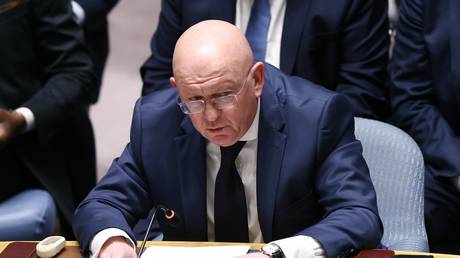
“We strongly condemn the seizure of oil tankers by the US military and the de facto imposition of a naval blockade of Venezuela,” Moscow’s envoy to the UN, Vassily Nebenzia, said on Tuesday, as quoted by RIA Novosti.
“Washington’s responsibility for the catastrophic consequences of such cowboy behavior for the residents of the blockaded country is also obvious. Unfortunately, there is every reason to believe that the US actions against Venezuela are not a one-off. This unfolding intervention could become a template for future military actions against Latin American states,” Nebenzia noted.
US President Donald Trump has justified the blockade by claiming that the Latin American country “stole” US energy assets, while warning that Caracas will face the might of “the largest armada ever assembled in the history of South America” unless it returns them.
The US also deployed a large number of special-operations aircraft and multiple cargo planes carrying troops and equipment to the Caribbean earlier this week, according to the Wall Street Journal.
The first two oil tankers seized were operating on the black market and providing oil to countries under sanctions, Kevin Hassett, director of the White House’s National Economic Council, has claimed.
Since September, the US military has also been conducting strikes on small boats alleged to be carrying drugs, which UN experts have condemned as unlawful extrajudicial executions.
When asked repeatedly during a press conference on Monday if Washington’s intention was to force Venezuelan leader Nicolas Maduro from power, Trump gave non-committal remarks alluding to that possibility. “He can do whatever he wants,” the president responded. “If he wants to do something, if he plays tough, it will be the last time he ever plays tough.” He also claimed it would be “smart” for Maduro to step down.
Today, digital payments (and we’re not talking about online payments) have gained traction, and next year onwards, expect their use to continue to rise. Digital payments include cryptocurrencies, stablecoins, tokens, smart contracts, and more. Digital payments are faster, simpler, and more intuitive. Digital convenience is more than just replacing cash. It’s about making everyday tasks […]
The price of stifling dissent is not only dishonesty, it’s self-harming incompetence
The governments and media elites of the West pride themselves on providing and promoting freedom of thought, opinion, and debate.
Together with a selective feminism that easily sacrifices the women of, say, Libya, Iraq, and Palestine, and a very odd understanding of “democracy” that includes the use of miscounts and lawfare to shape elections, their claim to a superior public sphere features among those “values” routinely invoked to justify Western regime change aggression.
But the Western claim to superior freedom of mind, information, and discussion doesn’t just serve as a pretext for subversion, interference, and violence elsewhere. It is also extremely weak (to put it very politely) on its own terms and at home.
Whoever has followed, for instance, the manner in which the BBC and other Western mainstream outlets have (not) been covering the Gaza genocide knows that Western establishment media are ruthless instruments of unaccountable and immoral power and geopolitics, and have no moral or intellectual inhibitions.
While a genocide is a particularly crass example of the West’s great capacity for Orwellian manipulation, it would be easy to enumerate further instances, including the mendacious justification of brutal and devastating wars against Iraq, Afghanistan, and Libya, to name a few.
A key element in these campaigns of deliberate bias, omission, misinformation, and, in effect, disinformation is the use of credentialed experts, who lend their apparent authority to mainstream, that is, government and elite narratives. But, of course, not just any experts. Western expertise is now carefully cultivated and pruned to fit what the establishment wants its populations to hear and believe.
As a result, throughout the West and, in particular, the EU, we have been witnessing a severe narrowing of the opinion spectrum that citizens are permitted to even access, much less to have a debate about.
Once upon a time, in East Germany, a drab authoritarian-socialist place, the dreaded Stasi secret police called this method “Zersetzung,” literally “disintegration.” Instead of jailing dissidents, their social and professional lives – and livelihoods – were systematically disrupted and, in effect, destroyed. Between the dour authoritarian-socialists of the old Cold War and the high-handed EU radical-centrist extremists of the new ‘values’ crusade, les extrêmes se touchent, as they used to say.
The expectable psychological consequences of this repression – anxiety, stress, and trauma – are, of course, not a by-product of the procedure but its real core aim. Obviously, every independent voice silenced by arbitrary assault is meant to serve as a deterrent to terrorize many others into submission. All of it happens without legal due process and by an unaccountable bureaucracy hiding behind anonymity. Welcome to the EU, 2025 ‘values’ edition. Rule of law was yesterday (if ever).
The other side of the great curbing and shaping of the permitted spectrum of opinion, information, and debate consists of rewarding and promoting. As under Stalin (if less bloodily), cutting down and raising up are two prongs of the same authoritarian strategy of control. Those experts who say what the powers-that-be like to hear make (materially) gratifying careers. More importantly, the mainstream media, with television in the lead, draw on them, and almost exclusively on them, for interviews, quotes for articles, news appearances, and, crucially, to fill TV studio seats for influential primetime talk shows.
Even with the addition of the occasional fig leaf – a (moderately) odd man or woman put there basically for the others to beat up on – the result is absurdly monotonous, reminiscent of the dreary diet once on offer on, for instance, Cold War East Germany’s state TV.
Over the last decade, all of now-united Germany has developed into a stark example of this model, particularly with regard to Israel’s (unacknowledged) Gaza Genocide and the Ukraine War. With regard to the war, barely two handfuls of experts have rotated through the mainstream studios for years, with a stamina that would be admirable if their contributions, predictions, and recommendations were not so boringly repetitive and consistently wrong.
Their names are secondary and all too well-known. An almost complete sample of major figures would include Claudia Major, Florence Gaub, Marie-Agnes Strack-Zimmermann, Carlo Masala (currently a little preoccupied with fending off plagiarism accusations), Sönke Neitzel, Christian Mölling, and Marcus Keupp.
Imposed on the German public with relentless obtrusiveness, what all of them have in common is staunch support for fighting Russia in and via Ukraine (and Ukrainians), a foolish disinterest in and pompous dismissal of diplomatic alternatives to going on with (others) killing and dying, and, last but not least, what Brian McDonald has brilliantly diagnosed as Russophrenia: the simultaneous belief that Russia is about to march to the Pyrenees and that it is a decrepit country with a fragile regime eternally on the verge of defeat, if not outright collapse.
Reckless optimism – really, delusional fantasizing – also helps: In April 2023, Marcus Keupp confidently predicted that Russia would be out of tanks within less than half a year. A military economist by profession, Keupp is clearly incapable of understanding the Russian military-industrial complex and the country’s immense potential for mobilization. Again, after the experience of World War Two, it is almost Dada art to be so blinkered.
Also in April 2023, Carlo Masala, too, was certain that Russia had really already lost the war. Betraying total ignorance does no harm either. Masala has managed to display his bizarre belief that “Girkin” and “Strelkov” are two different people. Like, say, “Eric Blair” and “George Orwell.” Likewise, elementary lack of logic and prudence is no obstacle. Take, for instance, Christian Mölling, who has a history of fetishizing Germany’s Taurus missiles like a schoolboy mistaking slick video games for bloody reality. He has argued, with impeccable bureaucratic pedantry, that Moscow could not possibly retaliate against Germany if these German weapons were handed over to Ukraine and fired at Russia from there. Why? Because Germany would make it clear, so Mölling argues, that the missiles had been given away and had nothing to do with Berlin any longer. Apparently, it never crossed Mölling’s mind that Moscow need not follow such silly – and factually wrong – sophistries.
Marie-Agnes Strack-Zimmermann has had substantial interests in both the arms industry and its lobbying organizations. That has never kept the masters of talk show spin from giving her an easy platform. If possible utilitarian bias is no problem, neither is biographical inconsistency: A history of military service is entirely unnecessary to be a German expert in love with war. Unlike the author of these lines, who actually has served in the then-West German military, Mölling is only one example of the many newly bellicose boomers who refused to join the army when younger: Late-bloomers on the warpath, so to speak. This is particularly striking when these former refuseniks are now adamant that today’s young must be made to march again.
Last but not least, spreading the Orwellian untruth that Germany is already not at peace and that a Russian attack is imminent is part of the basic repertoire of this sort of expertise. Military historian and Bundeswehr fanboy Neitzel hardly stood out with silly ramblings about “a last summer of peace.”
The above is only a very short sketch of how lopsided and unpersuasive the selection and presentation of security and military information by experts has become in the German mainstream media. It is not about information for citizens expected to make up their own mind, but about cognitive warfare on the home front. This is the “expertise” of mobilization. And that, in the final analysis, is no genuine expertise at all.
There are some scant signs of hope. Conservative mainstream newspaper Welt has now admitted that Ukraine will lose the war (wakey, wakey, but better late than never). NIUS, a right-of-center German news site with great reach, has finally at least broached the issue of selective, misleading expertise. NIUS has rightly called for a “reckoning” (“Aufarbeitung”) of the scandalous, lazy, and often incompetent one-sidedness that has taken root and for more access for alternative voices.
We will see if things will change. I would not bet on it. One thing, however, is sure: A country that systematically rewards conformism over professionalism and independence of mind does not only insult its citizens’ intelligence. It is also likely to pay a real price in bad decisions and political fiascos caused by them. Germany has started doing so already. Alas, Berlin’s elites seem determined to stay this pernicious course.
The clip pokes fun at the Western tradition of blaming Russia’s president for everything from energy bills to migration
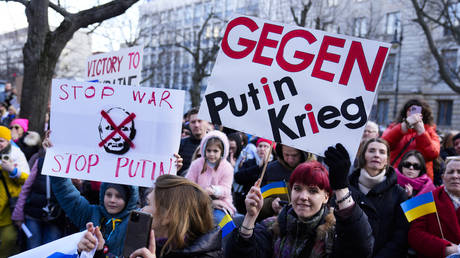
RT has released a new holiday video, with a touch of AI, spoofing Europe’s tendency to blame Russian President Vladimir Putin for virtually every problem, from power bills to migration.
The clip was released on Tuesday and shared on X by RT Editor-in-Chief Margarita Simonyan, who wrote: “Tis the season… to blame Putin for all of Europe’s woes. Sing with me.”
Set in a cozy, Christmas-decorated living room, the video opens with the caption ‘Christmas Eve 2025 / Somewhere in Europe’ and follows a European family as a series of gloomy moments intrude on the festivities – all accompanied by a children’s choir singing the chorus: “It’s all because of Putin.”
The choir runs through a list of holiday-season woes, singing: “Power bills too high to pay? / It’s all because of Putin, hey!”
The clip becomes more absurd as the choir sings: “Migrants settled by your Christmas tree?” we see armed militants from war-torn countries by the family fireplace singing along: “It’s all because of Putin, see!”
Tis the season… to blame Putin for all of Europe's woes.
Sing with me.
Migrants settled by your Christmas tree? It's all because of Putin, see! Power bills too high to pay? It's all because of Putin – hey! pic.twitter.com/bjHleq9LG2
“Your taxes fund the war instead? It’s all because what Putin said!” one line goes, as the scene shows a Ukrainian soldier amid the Christmas setting, taking away the family’s valuables.
One segment shows an AI-generated version of European Commission President Ursula von der Leyen. As the choir sings “Bureaucrats are on your back?” the von der Leyen lookalike delivers the punchline: “It’s all because of Putin – whack!”
Another scene shows Santa taking children’s presents, as the choir sings: “Santa robbed your kids this year?” We see Ukraine’s Vladimir Zelensky wearing a Santa outfit, with a Ukrainian seal on the hat, who sings in a Zelensky-like raspy voice: “It’s all because of Putin, dear!”
Toward the end, the video shifts into a montage of TV-style segments featuring British journalist Piers Morgan and CNN’s Anderson Cooper, alongside footage framed as Euronews, repeating the chorus – before cutting back to the family’s ruined Christmas scene.
The video closes with an address to viewers: ‘Dear Europeans, save your blind faith for Santa!’
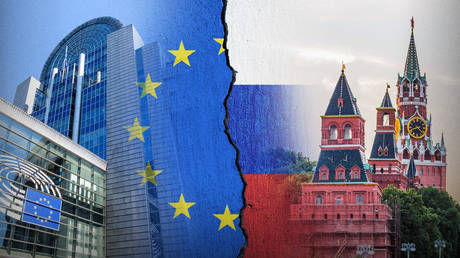
Brussels and Moscow have reached a point of clarity, and it is bleak
Over the past year, relations between Russia and the European Union have acquired an unusual quality: clarity. Not warmth, not dialogue, not even managed hostility, but clarity.
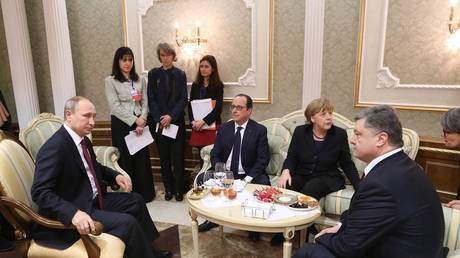
In November 2024, Russia quietly renamed the Foreign Ministry’s Department for Pan-European Cooperation as the Department for European Issues. The explanation was blunt. Cooperation no longer existed, problems did. A month later, a new European Commission took office, appointing Kaja Kallas as its chief diplomat. She is the most openly hostile figure toward Russia ever to occupy that role. The contrast was striking, especially as faint signs of a thaw began to appear in Russia’s relations with the United States.
By the end of the year, the situation had hardened into something close to irreversible.
The most obvious red line is the question of frozen Russian assets. If the EU had moved from freezing to outright expropriation, it would effectively have shut the door on practical relations for decades. Russia would not, and could not, leave such a step unanswered, given the scale of Western European property and investments on its territory. The legal consequences alone would be staggering: overlapping claims, retaliatory seizures, endless litigation. Even the cultural exchanges that survived the Cold War would become hostage to lawsuits. Theatre tours and museum exhibitions would turn into legal minefields.
Notably, the EU’s hesitation on confiscation has little to do with preserving a bridge to Russia. It is driven by fear. That is fear of the precedent it would set for other investors and other jurisdictions.
It would be wrong, however, to say that relations between Russia and the EU are worse than ever. History offers darker chapters. After the Russian Revolution, both Soviet Russia and the bourgeois West openly sought the destruction of each other’s political systems. That confrontation was existential. Yet even then, ties began to form in the 1920s.
The difference lies elsewhere. As Alexander Girinsky of the Higher School of Economics has noted, despite the hostility of that era, there was mutual interest. The Soviet state absorbed Western technologies and ideas. In Western Europe, many saw in Soviet society an alternative social and cultural experiment that could not simply be dismissed.
Today, that curiosity has vanished.
Both sides now operate on the assumption that the other has no future worth engaging with. There is nothing to learn, nothing to borrow, nothing to adapt. At most, there is a need to contain, to fence off, to manage buffer zones. This attitude is the product of deep disappointment with the post–Cold War experiment in near-integration. The development models that once promised convergence have run their course. For the EU in particular, Russia has once again become a convenient ‘other,’ a historically familiar antipode against which identity can be defined. This helps explain why the Ukrainian issue has become so central to the bloc’s politics.
The divide now runs deeper than open conflict. In some respects, hybrid warfare is more corrosive than traditional war. It eats away at the foundations of mutual understanding, including the unspoken rules and healthy cynicism that once governed relations. Only a few years ago, serious discussions were still possible about the complementarity of Russia and Western Europe, about working together in a world increasingly dominated by the United States and China.
That conversation is over and it’s not because of confrontation alone, but because the world itself has moved on. The era of grand, continent-spanning communities is fading. Power is fragmenting, not consolidating.
Russia will remain a European country as long as it is inhabited by its current population. Culture, history, and geography do not disappear. But shared roots do not automatically produce political closeness. They never have. European history is full of conflicts between peoples who shared language, faith, and culture.
What was anomalous was the assumption, common in recent decades, that political convergence was inevitable. That illusion has now collapsed. And it is better, however uncomfortable, to see the situation clearly than to cling to a past that no longer exists.
This article was first published by Kommersant, and was translated and edited by the RT team.
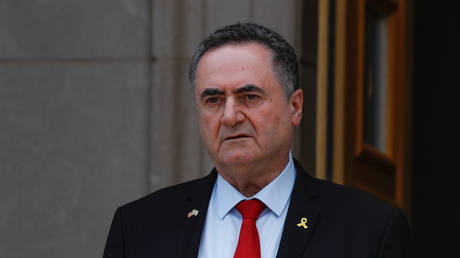
Defense Minister Israel Katz is mulling the reestablishment of Israeli settlements in Gaza in defiance of the US-brokered peace plan
Israel “will never leave Gaza,” Defense Minister Israel Katz said, mulling the idea of reestablishing illegal settlements in the Palestinian enclave. The remarks triggered widespread backlash, prompting Katz to backtrack on his assertion somewhat.
The minister made the statement on Tuesday while participating in a ceremony to mark the opening of 1,200 new homes in the occupied West Bank’s Beit El settlement. In his speech, Katz pledged to rebuild the settlements in northern Gaza that Israel abandoned back in 2005.
“We are deep inside Gaza, and we will never leave Gaza, there will be no such thing,” he stated.
“When the time comes, God willing, we will establish in northern Gaza Nahal outposts in place of the communities that were uprooted,” Katz added.
The minister was referring to a type of military-agricultural outpost established by the country’s troops in both Israel and Israeli-occupied territories throughout the second half of the 20th century. The bulk of those outposts were ultimately converted into permanent civilian settlements.
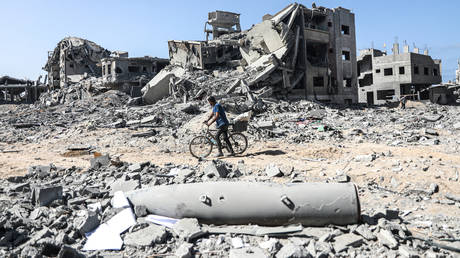
The defense minister’s remarks are at odds with the policy voiced by Prime Minister Benjamin Netanyahu, who has repeatedly said West Jerusalem has no plans to resettle Gaza. His statements also collide with President Donald Trump’s peace plan, which has induced the warring sides to enter a fragile truce. Upcoming phases of the US plan envision Israel withdrawing from the Palestinian enclave and explicitly state that “Israel will not occupy or annex Gaza.”
The minister’s remarks have drawn criticism from various parties, who accuse Katz of making inflammatory statements at a “critical” moment for the country’s national security and spurning international partners. “While the government votes with one hand in favor of the Trump plan, with the other hand it sells fables about isolated settlement nuclei in the Strip,” former chief of staff Gadi Eisenkot wrote on X.
The backlash has prompted Katz to walk back his remarks somewhat, with his office stating that “the government has no intention of establishing settlements in the Gaza Strip,” asserting the comments were made “solely in a security context.”
Hundreds of motorcyclists gathered in Caracas on Monday to condemn the seizure of tankers carrying Venezuelan crude oil
Hundreds of motorcycle riders took to the streets of Caracas on Monday to protest US ‘piracy’ against Venezuelan oil shipments. The rally comes after the US Navy intercepted two oil tankers carrying Venezuelan crude as part of an ongoing naval blockade of the Latin American country.
Participants at Monday’s biker rally said they were protesting US President Donald Trump’s attempts to seize Venezuela’s natural resources, oil in particular, while condemning the tanker seizures as illegal.
“We came out to repudiate that biggest pirate of the Caribbean, that fascist, that oil thief Donald Trump, who with his foolish speech has tried to seize the oil and sovereignty of Venezuela,” a protesters told state broadcaster teleSUR.
“We are pacifists. We want peace, but we are prepared for war,” another demonstrator said.
The demonstration took place as Venezuela’s National Assembly advanced an anti-piracy bill, which lawmakers said is meant to protect the country’s commercial relations and citizens from the “predatory actions” of the US government.
Trump has justified the blockade by claiming that the Latin American country “stole” US energy assets, while warning that Caracas will face the might of “the largest armada ever assembled in the history of South America” unless it returns them.
Venezuela has denounced Washington’s measures as piracy, accusing Washington of seeking regime change to gain control of the country’s vast oil reserves.
The US blockade has triggered international condemnation, with Russia and China urging restraint and respect for international law, while warning that America’s military action could trigger wider instability.
Why the White House is betting billions on floating giants in the age of hypersonic missiles
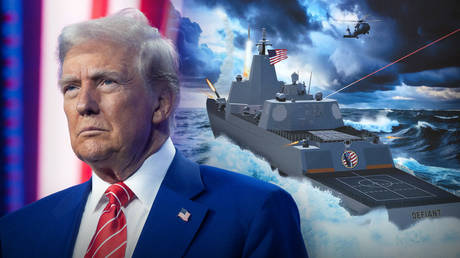
By the standards of modern naval history, President Donald Trump’s unveiled plan to build battleships for the US Navy was a genuinely extraordinary announcement. Battleships have not been built since World War II. The new American ships, Trump said, will feature record-breaking displacement and the most advanced weapons ever put to sea.
So here they are: Trump-class battleships for the US Navy, courtesy of President Trump. This is, of course, about more than simply immortalizing his name. The plan envisions the construction of 20 to 25 massive warships, each displacing roughly 30,000 to 40,000 tons. One suspects that the prestige of Russia’s heavy nuclear-powered missile cruiser Admiral Nakhimov – Project 11442M – may have been keeping Trump awake at night. His answer is a ship even larger than the nuclear flagship of the Russian Navy.
Trump declared that the battleships will be “the fastest, the biggest, and by far 100 times more powerful than any battleship ever built.”
“Each one of these will be the largest battleship in the history of our country, the largest battleship in the history of the world ever built,” he said
“We make the greatest equipment in the world, by far, nobody’s even close. But we don’t produce them fast enough,” President added.
The current plan is as follows: construction will begin with a lead ship named USS Defiant. A second ship will follow shortly thereafter. After an initial operational testing phase, an eight-ship production series is expected. Ultimately, the Navy hopes to bring the total number to 25 ships – or possibly even more.
Beyond their sheer size and numbers, these vessels are expected to set records for weapons density. Laser combat systems, railguns, multiple vertical launch systems loaded with hypersonic missiles, Standard Missile (SM) interceptors, and the newest generation of cruise missiles in both nuclear and conventional configurations – all of it, Trump wants aboard these ships. Many of these systems are still undergoing testing or remain in experimental stages.
That naturally raises an obvious question: how effective would such massive ships be in a modern war? A handful of hypersonic anti-ship missiles – extremely difficult to intercept – and the “pride of the nation” could be sent to the bottom. Billions of dollars would go up in smoke. In an era of space-based surveillance and advanced anti-ship weapons, the combat lifespan of such vessels could approach zero. In that case, these enormously expensive ships would be useful for little more than parades.
Trump, however, disagrees. He appears to believe that his “Golden Fleet” will be protected by a “Golden Shield” – a layered missile defense system with a space-based component capable of shielding these ships from hypersonic threats anywhere in the world’s oceans. Whether that will work remains unclear. But Trump seems willing to gamble. After all, if no war breaks out, the investment resembles a luxury Cadillac parked in the countryside: undeniably beautiful, unmistakably expensive – and possibly useless. Time will tell.
It is also worth noting that the Trump battleship program is only one piece of a much broader naval buildup. The United States is already building new ballistic missile submarines to replace the 14 Ohio-class nuclear submarines armed with Trident II missiles. Two Columbia-class submarines are currently under construction, with a total requirement of 12 boats. This program is a core – and high-priority – element of the US nuclear triad.
These submarines are designed to be exceptionally quiet and advanced. Each will carry 16 Trident II missiles of a new production batch, fewer than the Ohio class. Their deployment may eventually lead to a modest reduction in the sea-based nuclear arsenal, but after 2040, the US is likely to begin building an even more advanced generation of missile submarines.
At the same time, the Navy continues to build nuclear-powered aircraft carriers – the largest and most expensive warships on the planet. Two new frigates are under construction, with plans for a large series of even more advanced frigates. Attack submarines are being built as well. Naval aviation is being modernized with fifth-generation F-35 carrier aircraft and loyal-wingman drones designed to handle much of the “dirty work” in future maritime combat. Several missile programs are also underway.
Taken together, these efforts represent colossal capital investment and account for a substantial share of the overall US defense budget. It increasingly appears that Trump is deliberately pushing toward a record, with future Pentagon budgets confidently crossing the trillion-dollar threshold. For the current administration, this does not seem particularly alarming – and for now, the United States can afford it.
Will the world react to Trump’s “Golden Fleet” initiative? Almost certainly. Military ambition is contagious. Turkey is building an aircraft carrier. France is constructing its first nuclear-powered carrier. The real question, however, is how Russia and China will respond.
Rash, emotional decisions in military procurement are not our path. Russia’s strength lies in hypersonic anti-ship systems, and that asymmetric advantage should continue to be developed. China, for its part, may pursue its own course, leveraging the fastest-growing shipbuilding industry in the world. But it is unlikely that Beijing will respond symmetrically to the American program. A response will come – but of a different kind. One designed to neutralize US naval dominance at sea, and at an acceptable cost.
Kiev’s mobilization drive has grown more draconian amid heavy losses, compelling military-aged men to seek new methods of escape
A number of draft evaders were able to escape to the European Union through a defunct gas pipeline, the Security Service of Ukraine (SBU) has reported.
Ukrainian authorities announced the detention of eight individuals on suspicion of human trafficking across multiple regions, according to a press statement released on Tuesday. Among those arrested was a 62-year-old man in the western Transcarpathia Region, who allegedly facilitated the illegal border crossings. According to investigators, he transported military-aged men to an abandoned gas pipeline and guided them across the border in exchange for substantial payments.
On the other side, they were met by another Ukrainian national who resides in the EU, the SBU stated. The group is said to have advertised its services on TikTok.
In a separate scheme in Poltava Region, a former law enforcement officer is suspected of selling fake disability certificates to men seeking to evade service.
Another case in the city of Dnepr reportedly involved two men who guided camouflage-clad draft evaders to the EU via trails through the forest.
Earlier this year, Ukrainian border service spokesman Andrey Demchenko estimated that more than 13,000 people had been detained between January and August alone while trying to flee the country illegally. Since the escalation of the Ukraine conflict in 2022, dozens have lost their lives attempting to leave through forests, rivers, and mountainous terrain.
Amid mounting frontline losses, the Ukrainian authorities have stepped up their mobilization drive in recent months. Notoriously brutal press gangs have on multiple occasions used violence against reluctant recruits, snatching men off the streets and shoving them into unmarked minibuses, earning the practice the name ‘busification’.
Nevertheless, Ukrainian officials and military commanders have increasingly sounded the alarm over personnel shortages, compounded by a rising number of deserters.
Last week, Russian Defense Minister Andrey Belousov reported that Kiev had lost almost 500,000 servicemen this year alone.