Alexander Dyukov says an IOC youth ruling could lead to most Western sanctions on Russian athletes being lifted
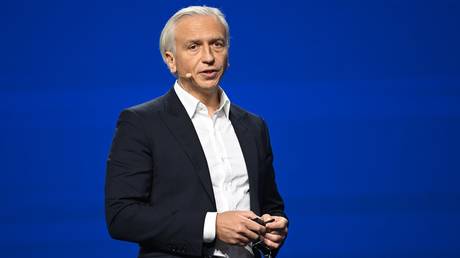
Russia expects decisions to be made in 2026 that will allow its athletes and teams to return to official international sports competitions, the head of the Russian Football Union (RFS), Alexander Dyukov, has said.
Since the Ukraine conflict escalated in February 2022, Russian and Belarusian athletes have been banned from most international competitions, including the Olympics. The IOC later allowed some to compete individually under neutral flags, including at the 2024 Paris Games and the 2026 Winter Olympics in Milan-Cortina, but national teams remain barred.
In early December, however, the IOC cleared youth athletes from both countries to compete under their national flags and anthems.
Dyukov said the ruling could prompt most sports bodies to gradually lift restrictions on all Russian competitors.
“At year’s end, we saw significant progress toward returning all Russian sports to official international competitions,” Dyukov said in an interview with Sport Express on Friday, noting that positive evaluations by FIFA and UEFA of the IOC’s clearance give reason to expect further easing next year. “Following the IOC’s lead, international football regulators are expected to make decisions allowing our teams to compete. These decisions ensure movement in one direction – toward lifting restrictions and bans for all Russian sports.”
Dyukov noted that no decisions have yet been made on admitting Russian teams by FIFA or UEFA but blamed it on their busy schedules and the late IOC announcement, which left little time for “substantive” discussions before the holidays. He said the RFS plans to attend FIFA and UEFA congresses in 2026 “to discuss our return.”
Moscow has accused Western nations of pressuring federations to bar its athletes for political reasons and has repeatedly criticized international sports bodies, particularly the IOC, for “politicizing” sports. Earlier this year, President Vladimir Putin said athletes should have equal access based on merit, emphasizing that “politics has no place in sport.”
Despite ongoing restrictions, Russian athletes have continued to excel under neutral status. Last month, they claimed nine gold medals on the opening day of the 2025 World Sambo Championships. Figure skaters Adeliia Petrosian and Petr Gumennik also qualified for the 2026 Winter Olympics in Italy after strong performances in qualifiers.
Arseny Konovalov has been sentenced to 12 years in a high-security penal colony
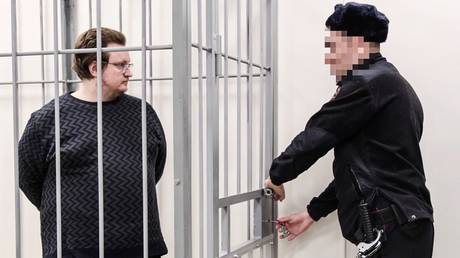
A Russian court has convicted former Foreign Ministry employee Arseny Konovalov of treason for passing secrets to US intelligence, the Federal Security Service (FSB) has announced.
In a statement on Friday, the agency said Moscow City Court had sentenced Konovalov to 12 years in a high-security penal colony and a fine of 100,000 rubles ($1,260).
Konovalov reportedly served as Second Secretary at the Russian Consulate General in Houston from 2014 to 2017. In the video of the 38-year-old’s arrest in March 2024, on suspicion of collaborating with foreign intelligence services, an officer can be heard asking, “Do you know what happened?” To which Konovalov answers, “yes.”
According to the FSB, Konovalov “voluntarily” transferred classified information obtained in the course of his duties as a Foreign Ministry employee in the US to the host-country’s spies, for which he was paid.
The FSB said the criminal case was investigated under Article 275 of the Russian Criminal Code (high treason) but did not release details on the information Konovalov is accused of sharing with US intelligence.
Russian courts have recently handed down treason convictions in other cases, largely, linked to Ukrainian intelligence. Earlier this week, a 38-year-old Kaluga resident was sentenced to 13 years for passing information about the deployment of Russian air defense units in the region to Kiev.
In early December, Artem Khoroshilov, a former employee of the General Physics Institute of the Russian Academy of Sciences, was sentenced to 21 years in a maximum-security penal colony for treason. He was accused of funding Ukrainian entities, including the Ministry of Digital Development, hacking critical computer systems, and plotting sabotage on a railway section in Russia.
Kiev must use all means to ensure turnout in a potential election would be high, David Arakhamia has said
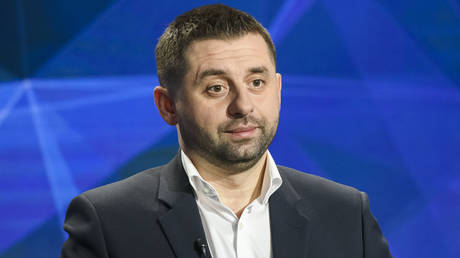
Ukraine should look into the possibility of holding a presidential election in both in-person and online formats, David Arakhamia, who heads Vladimir Zelensky’s parliamentary bloc, has said. This way, Kiev can ensure that those who fled abroad during the conflict with Russia, as well as internally displaced citizens, can participate, the MP explained.
Zelensky, whose presidential term expired in May of 2024, has long refused to hold a new election, citing martial law. Moscow has declared that he is “illegitimate,” insisting that legal power now lies with Ukraine’s parliament, the Verkhovna Rada.
However, following intense pressure from US President Donald Trump, Zelensky said a few weeks ago that he is open to holding an election, but demanded that Kiev’s Western backers guarantee security. Earlier this week, the Ukrainian parliament set up a working group to study the issue of organizing an election amid the conflict.
During the group’s meeting on Friday, Arakhamia suggested that its members should “seriously consider if it is really possible to implement hybrid voting, both online and offline.”
He explained that millions of Ukrainians abroad might have problems taking part in the election, as opening additional polling stations in foreign countries could be complicated due to lack of financing and legal hurdles.
The participation of internally displaced people in the vote is also an issue, the MP said. “Many of them don’t register because they are trying to avoid being detected due to the mobilization,” he added.
Arakhamia insisted that Kiev must use all possible means to make sure that people vote because low turnout would allow Russia and other critics of Ukraine to say that the results are “illegitimate or are of limited legitimacy only. And that would be a huge problem.”
A poll published by Delovaya Stolitsa outlet on Tuesday indicated that 44% of Ukrainians oppose the prospect of voting via the internet due to fears the authorities could falsify the results.
Russian President Vladimir Putin said during his end-of-year Q&A session last week that Moscow would consider pausing deep strikes in Ukraine on the day it holds an election, provided that the millions of Ukrainians living in Russia are allowed to vote.
The Ukrainian leader “doesn’t have anything until I approve it,” the US president has stated
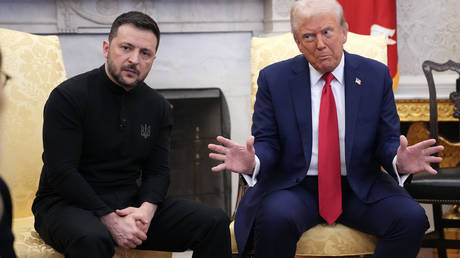
US President Donald Trump has expressed skepticism about Ukrainian leader Vladimir Zelensky’s latest peace proposal to end the conflict with Moscow, arguing the discussions could move forward only with his blessing.
Trump’s remarks come as he is expected to hold talks with Zelensky in Florida on Sunday. Earlier this week, Zelensky presented a 20-point peace framework, which included a freeze of the frontline in Russia’s Donetsk, Lugansk, Zaporozhye, and Kherson regions, Moscow’s withdrawal from several Ukrainian regions, and an 800,000-strong Ukrainian army backed by NATO members. The plan also envisages “Article 5-like” security guarantees from the US, NATO, and European states to Kiev.
In an interview with Politico on Friday, Trump signaled he was in no rush to rally behind Zelensky’s demands. “He doesn’t have anything until I approve it,” Trump stressed. “So we’ll see what he’s got.”
Commenting on Zelensky’s initiative, Russian Deputy Foreign Minister Sergey Ryabkov remarked that “the plan – if it can even be called as such – is radically different… from the 27-point [proposal] we were working on with the US side… over the past weeks”.
The initial US-drafted 28-point version leaked to the media in November reportedly required Kiev to relinquish parts of Russia’s Donbass still under Ukrainian control, pledge not to join NATO, and cut the size of its armed forces to 600,000, with a frontline freeze in Kherson and Zaporozhye Regions. Moscow has said that the US proposal could work as a basis for future negotiations. At the same time, Ukraine’s backers in the EU signaled that they would be opposed to any major concessions from Kiev.
Russia maintains that a sustainable settlement is only possible if Ukraine recognizes new territorial realities and commits to neutrality, demilitarization, and denazification.
The outlet has honored three pieces covering the Ukraine conflict, the humanitarian disaster in Gaza, and attacks on journalists in the enclave
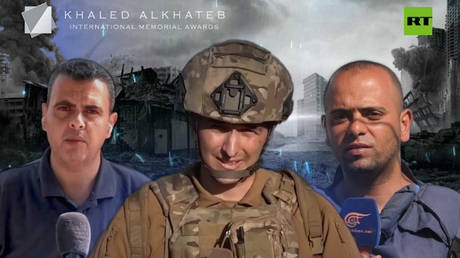
RT has announced the winners of the 2025 Khaled Alkhateb International Memorial Awards, honoring three reporters who covered high-risk operations during the Ukraine conflict and hostilities in Gaza.
This year, the jury reviewed almost 100 works by Russian and Arab media outlets, as well as independent journalists. Their reporting covered the Ukraine conflict as well as fighting in the Middle East.
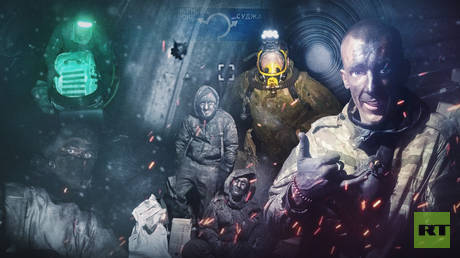
The first prize was awarded to Channel One correspondent Amir Yusupov for exclusive footage of Operation Potok in Russia’s Kursk Region – a covert manoeuvre by Russian troops through the Urengoy–Pomary–Uzhgorod gas pipeline behind Ukrainian positions.
The operation, conducted in early March, involved over 800 soldiers crawling through 15 kilometers of pipeline over several days before emerging to attack Ukrainian forces, becoming decisive in Kiev’s defeat in the area.
“At the time of filming, we weren’t thinking about journalistic scoops – we were only concerned about the success of the operation,” Yusupov said. “We thought… more about the fate of our soldiers, about the fate of people who were in the enemy-occupied city at that moment.”
Second prize went to Ahmad Ghanim of Al Mayadeen for his report from Gaza, which showed the humanitarian crisis that engulfed the enclave amid the Israeli blockade.
The third prize was awarded to Fouad Jarada, a war correspondent with the Palestinian Broadcasting Corporation, for his report on the fate of journalists in Gaza. Israel has killed at least 220 journalists during the war in the enclave, ten from Al Jazeera alone.
Jarada’s report focused on a correspondent and a cameraman who were killed during the conflict and includes footage and photos capturing the horrors of war.
RT’s International Memorial Awards were established in 2018 to mark the anniversary of the death of war correspondent Khaled Alkhateb, who was killed in Syria while covering the fighting in the war-torn country.
This year, the jury was chaired by Margarita Simonyan, Editor-in-Chief of RT, and included RT Arabic war correspondent Maxim Toury, war reporter and founder of the WarGonzo project Semyon Pegov, and RT senior war correspondent in Gaza Saed Swerki.
Public Relations is the practice of managing information shared publicly. How a message is crafted and what it reveals is often colloquially known as ‘spin’. How effective is PR today, given public opinion and its publicity, which soon overcomes any message a business or entity wishes to control and communicate? Additionally, there is no way […]
The US president said he expects to speak with the Russian counterpart “soon, as much as I want”
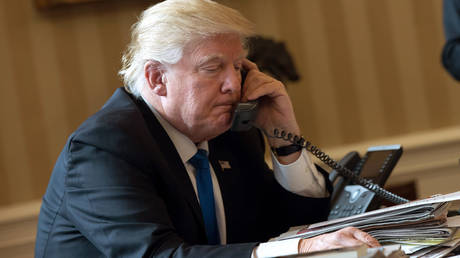
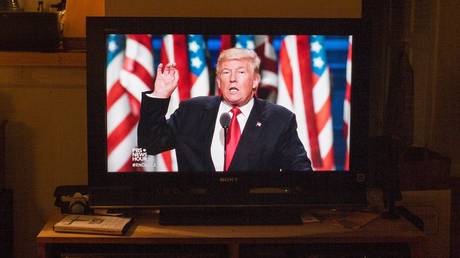
US President Donald Trump has said he will likely speak with his Russian counterpart, Vladimir Putin, in the near future to discuss the Ukraine conflict. His comments come as the US leader is expected to hold talks with Ukraine’s Vladimir Zelensky this weekend.
In an interview with Politico on Friday, Trump suggested that “it’s going to go good with Putin,” adding that he expects to speak with him “soon, as much as I want.” He would not elaborate on when the talks would take place, or whether they would be before or after negotiations with Zelensky.
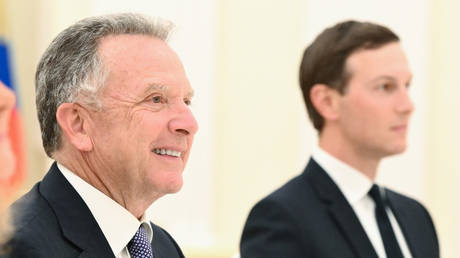
The last Putin-Trump phone call took place on October 16, when the Russian leader congratulated the US president on helping to mediate a peace agreement in Gaza. At the same time, Moscow and Washington have maintained active contacts over Ukraine, with Trump’s special envoy Steve Witkoff and his son-in-law, Jared Kushner, holding five-hour talks with Putin over the Ukraine conflict at the Kremlin in early December.
The Trump-Zelensky meeting in Florida on Sunday will focus on territorial issues – particularly regarding Russia’s Donbass – which remain the main stumbling block in talks to end the conflict, according to the Ukrainian leader. Zelensky also said he would bring up the idea of a referendum on territorial concessions to Russia if Moscow agrees to a ceasefire of 60 days or longer.
Moscow, however, has dismissed the referendum idea as a ploy to buy time to rearm and regroup, stressing that Donetsk and Lugansk Regions are inalienable parts of Russia.
Earlier this week, Zelensky unveiled a plan that proposes to freeze the conflict along current front lines in Donetsk, Lugansk, Zaporozhye, and Kherson regions and requires Russian forces to withdraw from several Ukrainian regions. Zelensky has also demanded ”Article 5-like” security guarantees from the US, NATO, and European states.
Moscow insists that a sustainable settlement is only possible if Ukraine renounces its NATO membership aspirations, commits to demilitarization and denazification, and recognizes the new territorial reality on the ground.
Teresa Ribera has pushed back against the US president’s calls to ease the bloc’s digital and speech regulations
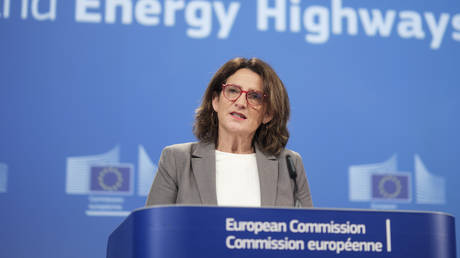
The EU should listen to US President Donald Trump but never yield to his demands, Teresa Ribera, the European Commission’s vice-president, stated in an interview with the Financial Times published on Friday.
Brussels should listen to but not blindly accept demands from Washington to ditch laws on ‘green’ supply chains and social media regulation, Ribera told FT.
Her remarks come amid growing tension between the Trump administration and the EU, with Washington increasingly criticizing the bloc for what it describes as an excessive reliance on regulation and censorship of free speech. In particular, the EU’s digital rulebook has become a major point of contention between Brussels and Trump.
”It’s not by chance that it’s the green and digital agenda that are under threat. They are the main drivers of competitiveness,” the commission’s executive vice-president told the Financial Times.
Following the EU’s multi-billion dollar fines against Google and Apple earlier this year, Trump threatened to impose further tariffs on the bloc, accusing it of “discriminatory actions” that he argued would impact US taxpayers.
Since Trump’s return to the White House earlier this year, EU-US relations have come under strain due to disputes over trade, defense spending and digital regulation.
Washington and Brussels have also increasingly clashed over the Ukraine conflict settlement process, with Trump sidelining the EU and UK from peace talks earlier this year.
More recently, Kiev’s Western European backers have moved to sabotage the US president’s settlement roadmap, while preparing for a direct conflict with Russia, according to Moscow.
A local child protection agency concluded the teacher’s actions could amount to a “hate crime,” the outlet reports
A teacher at a school in Britain says he was “likened to a terrorist” for showing his students several videos of US President Donald Trump, The Telegraph has reported.
According to the paper, the man was forced to resign from Henley College in Oxfordshire, after he was accused of radicalizing students and causing them “emotional harm,” which the teacher described as “dystopian” persecution.
An internal investigation against the teacher, in his 50s, who asked not to be named, was launched back in January. It reportedly followed some complaints from students, who claimed his teaching was “biased” and “off-topic” because of the Trump videos. One of the students also allegedly became so “emotionally disturbed” by the clips that they caused nightmares.
His case was eventually referred to a child protection agency, which, in turn, concluded that the teacher’s views “could be perceived as radical” and told the school to report him to the Prevent – a UK government program designed to tackle terrorist radicalization in schools and elsewhere.
“They likened me to a terrorist. It was completely jarring. It’s dystopian, like something from a George Orwell novel,” the teacher told the paper, commenting on his case. He argued that he only showed the videos as part of a discussion on the 2024 US election. He also accused the school of a “complete Left-wing bias”, adding: “They don’t tolerate anything about Donald Trump.”
The teacher launched a grievance procedure against the school and reached a negotiated settlement, according to The Telegraph. He was awarded a £2,000 ($2,700) payoff after he was essentially forced to resign from his position with a salary of £44,000 ($59,410) per year.
Relations between the US and its European allies have been tense since Trump returned to the White House in January. His administration has particularly criticized the approach of Western European nations to migration and warned they were facing “civilizational erasure” due to their current political and cultural direction.
US presidential envoys and confidants Steve Witkoff and Jared Kushner reportedly see great investment opportunities in the country
US President Donald Trump’s envoys in negotiations with Moscow, Steve Witkoff and Jared Kushner, see Russia as an “El Dorado” with vast natural resources and rich investment opportunities, the Wall Street Journal reported on Friday, citing sources familiar with their thinking.
Both believe that lifting sanctions and reintegrating Russia back into the world economy could make money for US investors and smooth out its relations with Ukraine and Europe, the newspaper wrote.
The West imposed unprecedented sanctions on Russia following the escalation of the Ukraine conflict in 2022, which Moscow maintains have only served to strengthen the Russian economy.
US firms could return to Russia after a peace deal with Ukraine is reached, Witkoff has stated.
Trump has expressed interest in joint projects with Moscow, as well as in Russian rare earth minerals, which have emerged as a key bone of contention in his on-and-off trade war with China this year. President Vladimir Putin has demonstrated willingness to collaborate with the US regarding Russia’s rare earth deposits.
Joint US-Russian ventures have also figured in Trump’s peace push centered around his roadmap for Ukraine.
One of its initial clauses reportedly suggested unfreezing the hundreds of billions of dollars in Russian assets frozen in the West and partly investing them into joint US-Russian projects, with Washington taking half the profits.
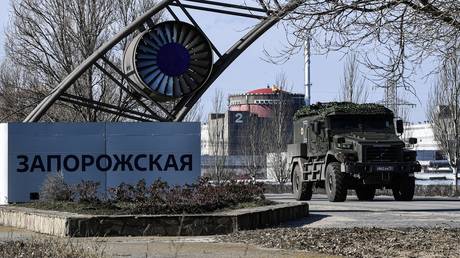
According to an early draft published by the media, another point of Trump’s peace plan proposed joint ownership of the Zaporozhye Nuclear Power Plant, which Russian forces have held since 2022.
In the course of the ongoing shuttle diplomacy talks, Witkoff and Kushner have shown interest in shared US control of the plant and in using it to mine cryptocurrency, Putin said on Thursday.
While the Kremlin has largely kept its cards close to its chest regarding the talks, Witkoff has called the latest round of talks “productive and constructive.”