The US president’s close aides reportedly feel that the Israeli prime minister is deliberately stalling the Gaza peace process
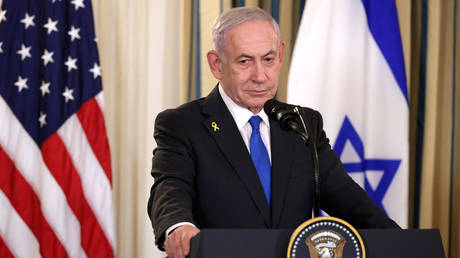
Officials in US President Donald Trump’s closest circle no longer believe that Israeli Prime Minister Benjamin Netanyahu can be trusted to push forward with the Gaza peace plan, Axios reported on Friday, citing insiders.
The future of Trump’s grand Gaza war settlement roadmap, unveiled in September, hinges on his upcoming meeting with the Israeli leader on Monday, according to the outlet.
Last week, US special envoy Steve Witkoff and the president’s son-in-law, Jared Kushner, met with officials from Egypt, Qatar, and Türkiye to finalize the next step of the plan, which envisions Hamas disarming and Israel pulling out of Gaza.
Netanyahu has privately expressed skepticism about the roadmap, but the plan cannot go ahead without his buy-in, Axios said.
“Bibi is trying to convince a one-man audience,” the outlet cited a White House official as saying. “The question is whether Trump will side with him or with his top advisers when it comes to Gaza.”
Key figures in Trump’s team have now lost trust in Netanyahu, fearing he is “slow-walking the peace process” and could resume the war with Hamas after taking steps to undermine the fragile ceasefire, according to Axios.
The Israeli PM has “lost” Vice President J.D. Vance, Secretary of State Marco Rubio, Chief of Staff Susie Wiles, and both Kushner and Witkoff, the outlet wrote, citing another US official.
“The only one he has left is the president, who still likes him, but even he wants to see the Gaza deal moving faster than it is right now.”
Trump is expected to press Netanyahu to move past the Gaza war, as well as raise the issue of Israel’s push into the occupied West Bank, according to Axios.
West Jerusalem officially approved the construction of nearly a dozen new controversial Israeli settlements in Palestinian territory earlier this week, drawing international condemnation.
On top of losing trust within the White House, Netanyahu’s government has taken a beating in the domestic approval polls. Only a quarter of Israeli Jews trust their government, and only 17% of the country’s Arabs, according to an Israel Democracy Institute poll published earlier this week.
Men are undertaking dangerous journeys through the wilderness to escape the country, according to the American broadcaster
Ukrainian men are risking deadly border crossings to avoid mobilization as Kiev struggles with chronic manpower shortages, CNN has reported, citing interviews with draft-dodgers who fled to Romania.
More than 30,000 people have crossed over into Romania alone since the escalation of the Russia-Ukraine conflict in February 2022, the US broadcaster wrote earlier this week, adding that over 25,000 have been caught by Ukrainian border guards. “Many more flee to Moldova, Hungary, Belarus and other countries,” CNN added.
Kiev has been facing chronic manpower shortages throughout its conflict with Moscow amid high battlefield losses, massive draft dodging, and desertion. The last publicly available official data showed nearly 290,000 desertion cases in Ukraine since 2022.
Ukraine has barred nearly all adult men from leaving the country and lowered the draft age from 27 to 25. Nearly 100,000 young men have reportedly fled the country since August, when the Ukrainian government issued a decree allowing men aged 18 to 22 to cross the border.
One man contacted by CNN said he lost all his toes to frostbite during an attempt to cross into Romania. He said another draft dodger who went with him froze to death in a snowstorm.
“They would rather die on the mountains trying to escape than in the war,” a Romanian man in charge of rescue missions at the border told CNN, referring to Ukrainians he had met.
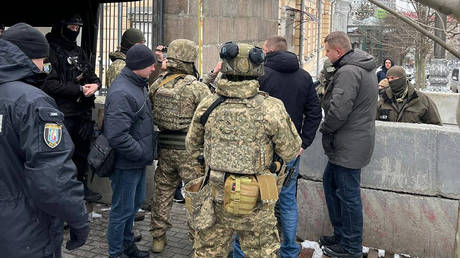
Kiev’s recruitment drive has grown increasingly brutal as hundreds of incidents have been documented in which enlistment officers assaulted potential conscripts, chased them through the streets, and threatened bystanders who tried to intervene.
Earlier this week, Russian Foreign Ministry spokeswoman Maria Zakharova warned that the Ukrainian authorities want as many as 2 million new draftees in early 2026. Draft officials were told to “tighten the screws to a maximum,” she added.
Washington as mediator, not belligerent: the US strategy upended the Western bloc
If there were a competition for “Breaking the Mould of the Year,” the United States would be the runaway winner in 2025. At the start of the year, few expected Donald Trump’s return to the White House to trigger such sharp shifts. Yet one of the biggest surprises has been Washington’s change of course on Ukraine.
The US has moved from being Kiev’s closest political patron to a calculating actor focused squarely on its own interests. The rhetoric of Russia’s “unconditional defeat” has been discarded in favour of negotiations and compromise. If Ukraine has become a loss-making asset in America’s geopolitical portfolio, Trump has signalled, then the loss must be recognised.
This has produced a series of gestures that shocked many Western observers: the public humiliation of the Ukrainian leader in Washington, demands that Kiev pay for military aid, a slowdown in sanctions policy, and the much-discussed summit in Alaska. The conflict has not been resolved, but the door to diplomacy has been left ajar. Moscow supports negotiations, but does not intend to retreat from its positions. The Russian army is advancing, and time, from Moscow’s point of view, works in its favour.
Another dramatic break with past practice has been Trump’s decision to launch a trade war against more than seventy countries. Only China responded with serious counter-measures. Beijing imposed retaliatory tariffs and strengthened its negotiating hand by introducing export controls on rare-earth metals vital to the US economy, while at the same time seeking a negotiated de-escalation.
India also refused to bend. US tariffs on its purchases of Russian oil barely affected Delhi’s stance. The same is broadly true of Brazil. In several cases Washington applied tariffs for openly political reasons, even where the trade balance was to its advantage. Trade measures increasingly took on the character of sanctions; occasionally they were accompanied by military strikes, although the White House avoided sliding into a full-scale confrontation with Iran.
Perhaps the most unexpected development has been the deepening estrangement between the US and its traditional allies. Trump’s revived talk of buying Greenland, part of Denmark, was symbolic in that respect. So too was Vice-President JD Vance’s criticism of European democracy, suggesting that “Trumpism” in foreign policy is no longer confined to Trump himself. The new US National Security Strategy urges Western Europe to return to its civilisational roots, warns of the risks of war with Russia, and casts Washington less as a belligerent and more as a mediator. Even the EU has found itself targeted by American tariffs.
For Brussels, this turn was disorienting. While Western Europe was still marching toward confrontation with Russia, its key ally abruptly stepped aside. In response, EU institutions clung to the old paradigm of “war to the bitter end” and unconditional support for Kiev. Brussels introduced three new sanctions packages against Moscow, but they had no discernible impact on Russia’s strategic course.
Of course, the contradictions inside the Western bloc should not be exaggerated. Binding military and political commitments remain in place, and previous eras have also seen friction. But the current rupture feels deeper than anything since the 1930s. The shifts underway clearly extend beyond Trump’s personality and the short-term political cycle, and they may yet reshape the broader architecture of Euro-Atlantic relations.
This article was first published by Kommersant, and was translated and edited by the RT team.
Kiev is in “no rush” to resolve the conflict peacefully even in the face of decent proposals, the Russian president has said
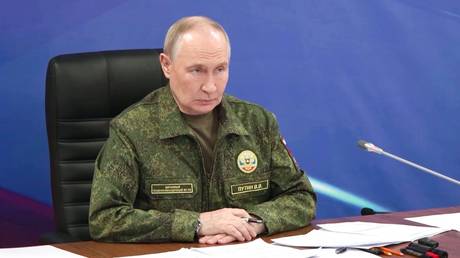
Ukraine has been offered “decent” peace terms by “smart people” in the West, Russian President Vladimir Putin said. However, Kiev continues to ignore such proposals, forcing Moscow to continue its military operation, he told Russia’s top military brass during a visit to a command post on Saturday.
The president did not specify who made the proposal or outline its details. He said that the conditions involved “good framework security guarantees,” an economic recovery scheme, and a roadmap for restoring relations with Russia.
“We see, unfortunately, that the leaders of the Kiev regime are still in no rush to resolve the conflict peacefully,” Putin said. The president made his remarks as the military reported having liberated the strategic town of Gulaypole in Zaporozhye Region and a number of other settlements in its latest successful push.
Putin then noted that Russia’s rapid advances make Kiev’s willingness to agree to any compromises almost irrelevant. “If the Kiev authorities do not want to end it peacefully, we will achieve all the goals… of the Special Military Operation through military means,” he said.
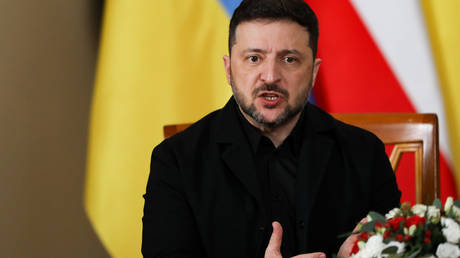
His words came just as Ukraine’s Vladimir Zelensky demanded more funding and weapons from his Western backers by stating that the Ukrainian forces lack air defenses and armaments. He also maintained that Ukraine suffers from a “constant deficit of money” while framing Russia as some global threat.
The Ukrainian leader announced that he will meet with US President Donald Trump to discuss a peace framework. Ahead of the meeting, which is expected to take place on Sunday in Florida, he revealed a 20-point plan he claimed Kiev had discussed with the US.
Moscow dismissed the plan as a non-starter. Deputy Foreign Minister Sergey Ryabkov said on Friday it was “radically different” from the proposals discussed by Russia and the US. He also warned that, although Moscow is “fully ready” to resolve the conflict, Kiev and its European backers are seeking to “torpedo” the peace process.
Strategic weapons, asymmetric tactics, and the combat breakthroughs that defined the year
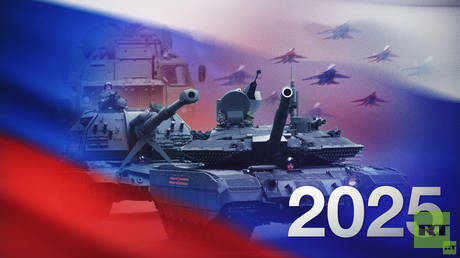
In 2025, we witnessed a clear acceleration of the global arms race. Escalatory rhetoric in Europe, sustained support for Ukraine’s armed forces, and Trump’s so-called “golden” defense initiatives – backed by tens of billions of dollars – have fundamentally reshuffled the pieces on the world’s geopolitical chessboard. Political confrontation is increasingly giving way to direct competition between military programs, and simply keeping pace now requires enormous resources.
There is, however, another path: choosing response options that operate on a different plane altogether – ones that are asymmetric by design and exploit the technological assumptions and vulnerabilities of the opposing side. Russia has identified and begun developing precisely such solutions, without abandoning investment in traditional weapons systems. What follows is an overview of the military counterbalance that had taken shape by the end of 2025 in response to these new challenges.
A fully asymmetric – and fundamentally strategic – answer to Trump’s “golden” initiatives lies in Russia’s development of next-generation weapons systems. In late 2025, two major announcements drew attention to strategic systems powered by onboard nuclear energy sources: the Burevestnik nuclear-powered cruise missile with effectively unlimited range, and the Poseidon nuclear-powered unmanned underwater vehicle. By the end of October 2025, both systems had demonstrated, during testing, the ability to operate autonomously using their onboard nuclear power units.
The emergence of such unprecedented systems became possible due to breakthrough advances by Russian nuclear scientists in the 1990s and 2000s, as well as the extraordinary efforts of designers, manufacturers, and test engineers. In practical terms, these platforms mark the birth of entirely new classes of nuclear strategic deterrence systems – capabilities no other country in the world has possessed to date, and likely will not for quite some time. This is a decisive trump card in the new phase of confrontation.
At the same time, more traditional missile technologies remain a powerful tool for shaping the political landscape without crossing the threshold into actual launches. In late December 2025, it was announced that plans to place the first units equipped with the Oreshnik medium-range strategic missile system on combat duty were nearing implementation. Minsk has stated that up to ten such systems will be deployed in Belarus. At the same time, it is highly likely that one of the first Oreshnik divisions will be based at the Kapustin Yar test range.
Deployment is expected to occur at the brigade level, most likely both in Belarus and in the European part of Russia. The system is equipped with hypersonic ballistic missiles that can be used in non-nuclear configurations. As such, Oreshnik may become the first non-nuclear deterrent system of pan-European significance: with a range of up to 5,000 kilometers, it can reach any target on the continent.
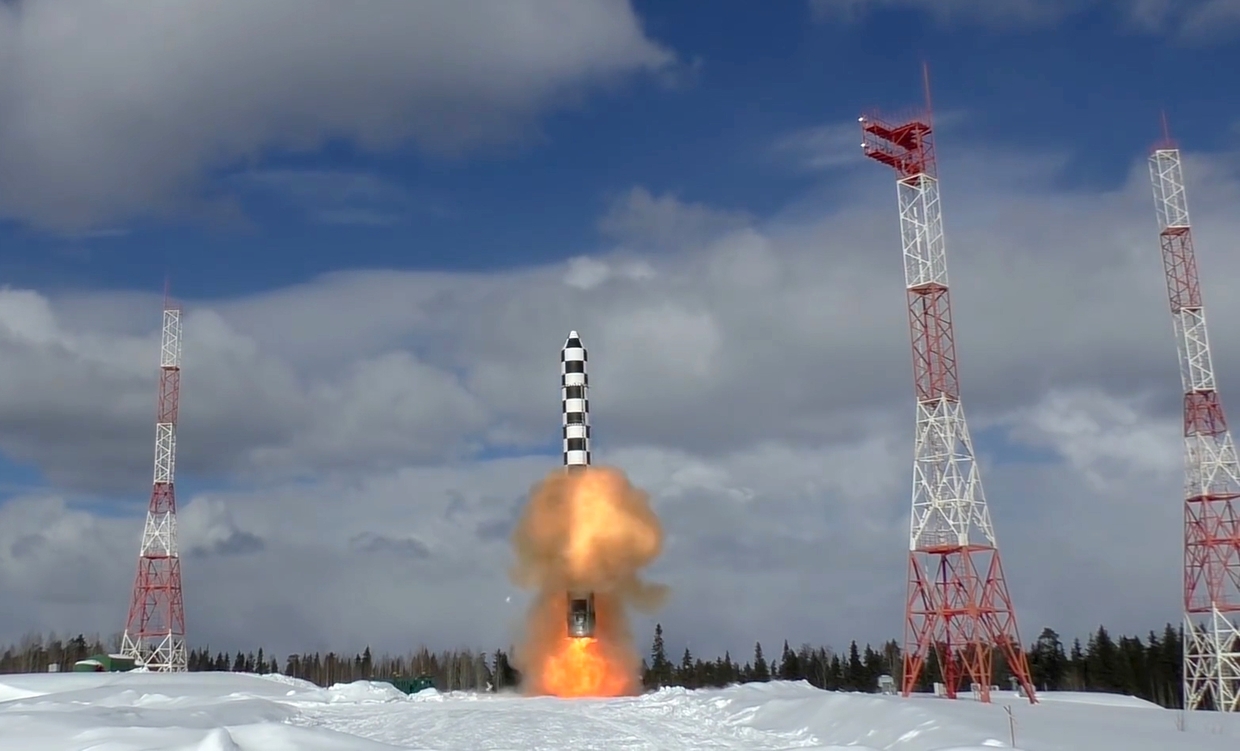
Work also continues on preparing the deployment and completing testing of the Sarmat intercontinental ballistic missile – a heavy, liquid-fueled ICBM designed to replace the legacy Voevoda system and widely regarded as the most powerful missile of its kind in the world. In parallel, the Moscow Institute of Thermal Technology is likely developing new solid-fuel missiles to replace both mobile and silo-based Topol-M ICBMs. By 2026, the earliest deployed Topol-M systems will be 29 years old, and their replacement is already on the horizon.
FILE PHOTO. Launch of a Sarmat heavy intercontinental ballistic missile from the Plesetsk cosmodrome, Arkhangelsk Region, Russia.
Russia’s nuclear triad consists of three components: land-based missiles, submarine-launched ballistic missiles, and long-range aviation. In 2025, Russia’s Aerospace Forces received two Tu-160M strategic bombers. Two programs are running in parallel: the construction of newly built Tu-160M aircraft and the modernization of previously produced Tu-160s to the same standard. Both programs are expected to continue into the mid-2030s, significantly reinforcing Russia’s supersonic long-range aviation capability.
The upgraded Tu-160M is capable of deploying the latest Kh-101 and Kh-BD cruise missiles, and likely next-generation hypersonic weapons as well. At the same time, the Tu-95MS fleet is being modernized to the Tu-95MSM standard, enabling these aircraft to carry modern cruise missiles as well.
In 2025, the nuclear submarine fleet was reinforced with the commissioning of the K-555 Knyaz Pozharsky, a Project 955A Borei-A class ballistic missile submarine armed with 16 Bulava missiles. Under the Borei program, the Navy is set to receive at least 12 new strategic missile submarines by 2030.
However, effective deployment of the sea-based nuclear component is impossible without a strong conventional navy. Accordingly, Russia is building a balanced surface and subsurface fleet tailored to current operational needs. Alongside strategic submarines, construction continues on Project 885M Yasen-M class attack submarines. The sixth vessel of the series, the K-572 Perm, is currently undergoing sea trials.
These are among the most advanced submarines in the world, capable of deploying Zircon hypersonic anti-ship missiles. By 2030, the Navy plans to field a total of 12 Yasen-class submarines. Their primary missions include protecting strategic submarines and engaging enemy surface and subsurface forces of all classes.
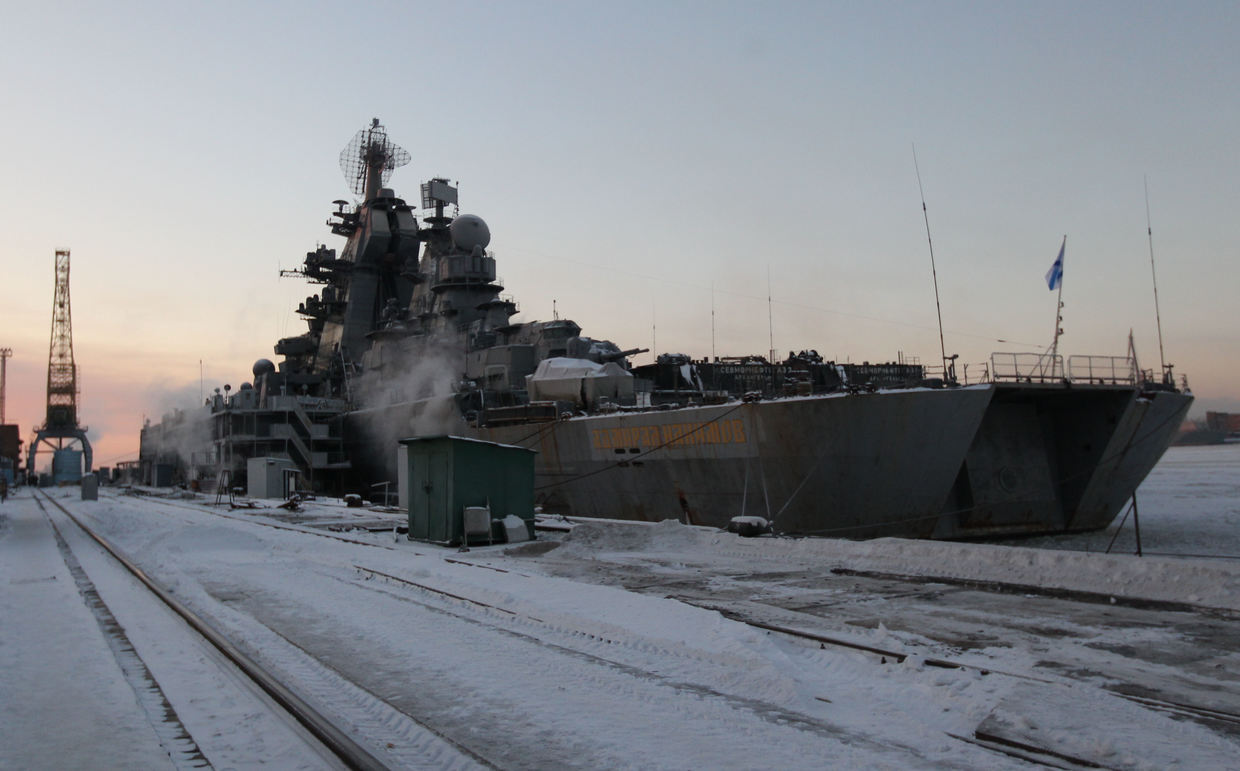
Meanwhile, the future flagship of the Russian Navy – the heavy nuclear-powered missile cruiser Admiral Nakhimov (Project 11442M) – has entered sea trials. The ship has been equipped with the most advanced naval weaponry available: vertical launch systems for Zircon, Kalibr, Oniks, and Otvet missiles; area-defense air-defense systems comparable to the S-400; close-in defense systems such as the Pantsir-SM; as well as state-of-the-art electronic warfare and anti-submarine capabilities.
FILE PHOTO. The nuclear-powered battlecruiser Admiral Nakhimov at the Sevmash shipyard pier, Severodvinsk, Russia.
This unique vessel, modernized by shipbuilders in Severodvinsk, is expected to enter operational service after the completion of trials, likely in 2026.
Russia’s Arctic interests also require dedicated protection. To that end, specialized ice-class combat ships are being developed. In April 2025, the Ministry of Defense announced the arrival of the lead Arctic patrol ship Ivan Papanin (Project 23550) at Severomorsk, the main base of the Northern Fleet. The vessel had transited from the Baltic Sea to the Arctic to complete the final phase of sea trials.
Ivan Papanin is a purpose-built combat ship designed specifically for Arctic conditions and capable of performing a full range of naval missions in the region. Construction of additional ships in this class is ongoing.
Air and space forces remain another critical priority. Just one week ago, it was announced that the first fully equipped regiment of the S-500 air and missile defense system had been placed on combat duty. This unique defensive system is capable of intercepting all types of aerospace threats, including ballistic missiles.
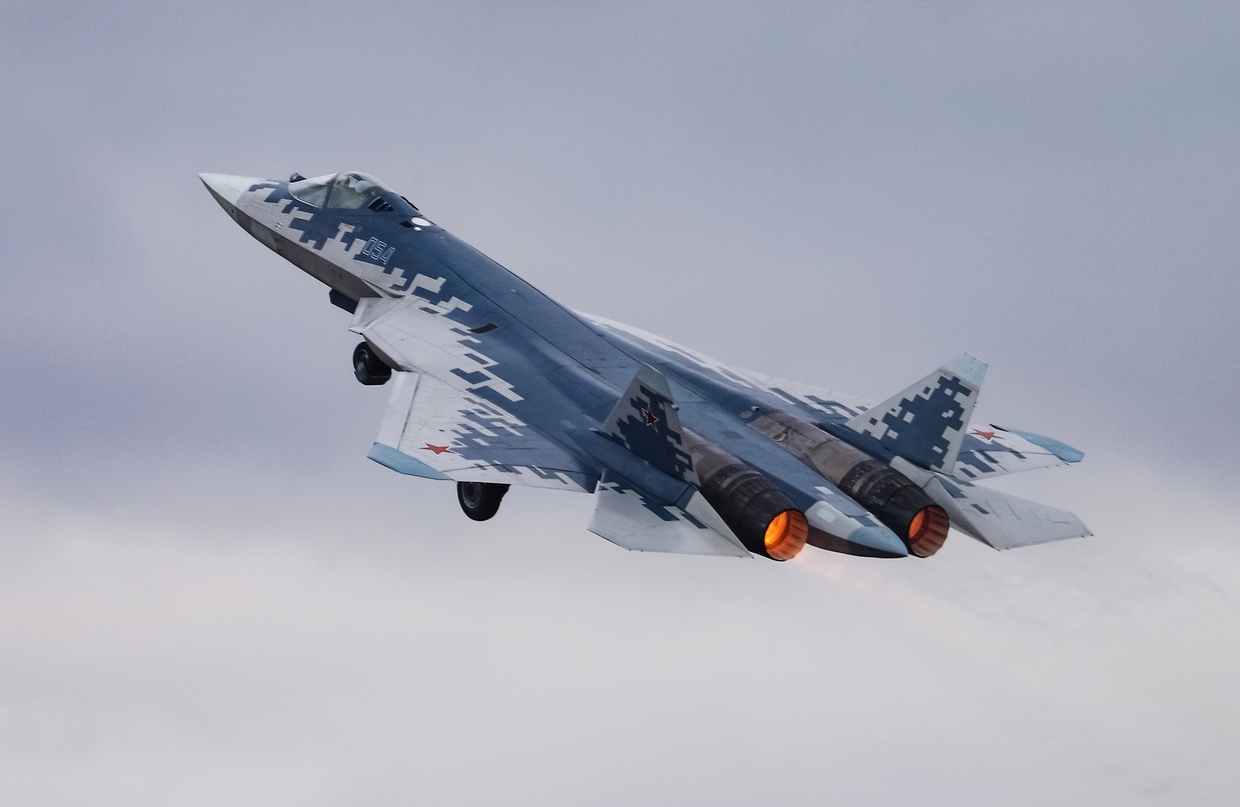
Tactical aviation is also expanding. Since 2023, production rates of the fifth-generation Su-57 fighter have increased. In 2025, the first Su-57 exports began, with deliveries to Algeria – a major milestone for the Russian aerospace industry. Development of the platform continues: in December, a Su-57 equipped with the new Izdeliye 177 engine completed its maiden flight. This engine is expected to power all export versions of the Su-57E.
FILE PHOTO. Demonstration flight of the Su-57E fifth-generation multirole fighter jet at Airshow China 2024 in Zhuhai, Guangdong Province, China.
The aircraft is actively employed in the special military operation and is being prepared for expanded export deliveries, with positive developments likely in the near future.
Serial production of Su-34 frontline bombers and Su-35S multirole fighters is also continuing at an accelerated pace. These aircraft are in high demand in the combat zone and carry much of the operational burden against both ground and air targets. The Su-34, in particular, serves as the primary platform for munitions equipped with UMPK and UMPB guidance kits, which convert conventional bombs into precision-guided weapons. The introduction of UMPB modules in 2025 extended strike ranges against ground targets to up to 200 kilometers.
The battlefield of the future is already here
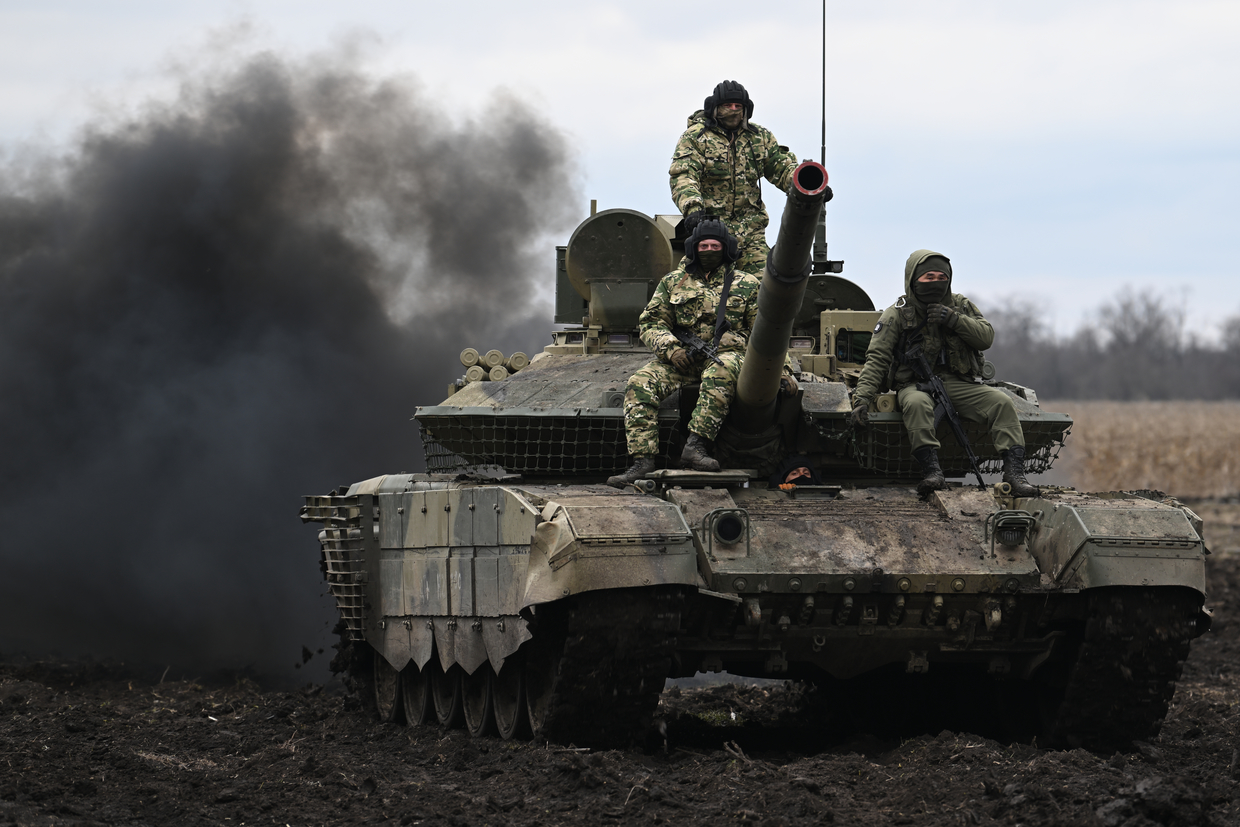
Deliveries of advanced ground systems to the combat zone are also expanding. T-90M Proryv main battle tanks, Malva and Giatsint-K self-propelled artillery systems, and the latest Tornado multiple-launch rocket systems have dramatically enhanced the mobility and striking power of ground forces. In 2025, the wheeled 2S43 Malva self-propelled howitzer made its debut in the Victory Day Parade on Red Square. Armed with a 152-mm gun comparable to that of the Msta-S, the system offers high mobility and increased automation in artillery fire control. Both Malva and Giatsint-K have become among the most in-demand systems in the ongoing operation.
FILE PHOTO. Crew of a T-90M Proryv tank at positions in the southern sector of the Special Military Operation.
Finally, modern ground forces require drones – and this is a top priority. Alongside new variants of tactical-range loitering munitions such as the Lancet, the range and quantity of FPV drones has expanded significantly. Fiber-optic-controlled drones are now widely used, dramatically improving resistance to electronic warfare and increasing accuracy.
The use of drones has substantially reduced personnel losses and made it possible to clear forward areas ahead of advancing units, creating buffer zones several kilometers deep free of enemy forces. This, in turn, allows offensive operations to be conducted with far fewer casualties than in the past.
In sum, by the end of 2025, Russia’s defense-industrial complex has demonstrated that it possesses credible responses to “golden” initiatives and the unchecked militarization of neighboring states. The sector is expanding both qualitatively and quantitatively. Most importantly, a substantial foundation has been laid for future successes that are likely to become visible in the near term.
Anti-graft agencies have said that they have uncovered an illegal lobbying scheme in parliament following an undercover operation
Ukraine’s anti-corruption authorities say they have uncovered a criminal vote-rigging and bribery scheme involving serving members of the country’s parliament, following an undercover operation.
The development comes ahead of a meeting between Vladimir Zelensky and US President Donald Trump in Florida.
Kiev is still reeling from a major corruption scandal in state nuclear operator Energoatom, involving Zelensky’s longtime associate, Timur Mindich. Two ministers and the Ukrainian leader’s influential chief of staff, Andrey Yermak, were ousted in the wake of the revelations.
Ukraine’s National Anti-Corruption Bureau (NABU) and the Special Anti-Corruption Prosecutor’s Office (SAPO) exposed an organized criminal enterprise involving serving MPs, the agencies reported on Saturday.
“According to the investigation, the group’s members systematically received illicit benefits in exchange for voting in the Verkhovna Rada of Ukraine,” NABU said in a statement on Telegram.
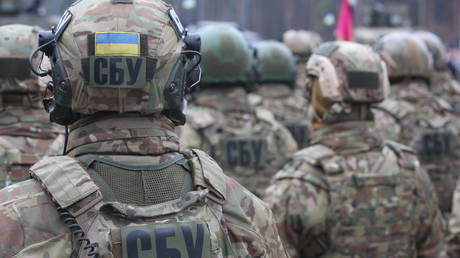
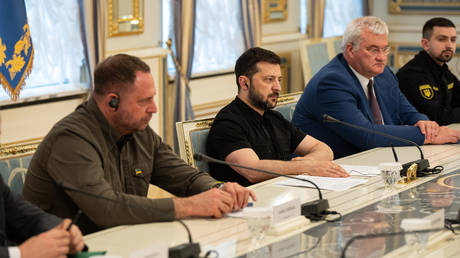
Members of Ukraine’s State Security Administration, a law enforcement agency subordinate to the Ukrainian presidency and the Rada, were “illegally” interfering with NABU agents during the ongoing investigation, the anti-graft agency noted.
On Saturday, NABU reportedly conducted searches in the Rada’s Transport Committee, which is led by Yuri Kisel, a member of Zelensky’s ruling party.
Earlier in December, Ukrainian outlet ZN.ua reported that anti-graft agencies discovered an illegal lobbying “cash window” after wire-tapping the MP over the course of two years.
NABU and SAPO began their broader crackdown earlier this year, with their revelations on a $100 million kickback scheme in Energoatom.
While the investigation implicated the Ukrainian leader’s close aides and former associates, Zelensky has distanced himself from the scandal.
However, nearly 40% of Ukrainians believe the Ukrainian leader is implicated in corruption, according to a recent Socis poll.
The country’s leadership has long devolved into a “criminal gang that holds power for personal enrichment,” Russian President Vladimir Putin said last week. It’s clear that the corrupt and out-of-touch officials in Kiev no longer care about “the fate of common people in Ukraine or the fate of ordinary soldiers,” he stressed.
Russia has repeatedly rejected the idea of any NATO troop deployment to the country’s territory
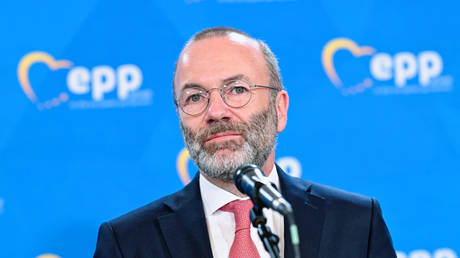
Berlin must send troops to Ukraine as part of a potential peace settlement, according to Manfred Weber, the leader of the European People’s Party (EPP) – a political group with the biggest faction in the EU Parliament. Brussels cannot rely on Washington to secure peace between Moscow and Kiev, the politician told Funke Media Group in an interview published this week.
Moscow has repeatedly rejected the idea of any NATO presence in Ukraine. It also named the US-led bloc’s expansion to the East one of the root causes of the conflict.
Kiev’s Western backers, including France and the UK have occasionally raised the issue of NATO troop deployment to Ukraine throughout the conflict. The plan was given another impetus earlier this month at the talks in Berlin, where US officials met with the Ukrainian delegation, the leaders of Germany, France, the UK, and eight other European countries.
”We cannot seriously expect Trump to secure a peace settlement solely with American troops. And when we talk about European troops, Germany cannot be left out,” Weber said. “After a ceasefire or a peace agreement, the European flag must fly along the [contact] line.”
He also claimed he did not “see” the Russian leadership “pursuing the path of peace” and called on Kiev’s European backers to demonstrate strength.
Moscow has repeatedly stated it is ready and willing to resolve the conflict peacefully as long as the other side demonstrates a similar commitment and the root causes of the crisis are addressed. On Friday, Deputy Foreign Minister Sergey Ryabkov said that the conflict resolution was “really close” but warned that Kiev and its European backers are actively trying to “torpedo” the peace process.
The Trump administration has not confirmed the extent of its support for the European plan. Weber also called on the EU to act independently from the US in security matters, prompting the NATO head, Mark Rutte, to warn that creating alternatives to the bloc would not benefit its European members.
The country has enjoyed achievements in areas ranging from medical research and Arctic trade routes to new jets and energy megadeals
In a year marked by global transformation and geopolitical tensions, Russia has quietly forged ahead with some significant achievements and plans for the future, showcasing its resilience and innovation.
From unveiling test batches of a pioneering cancer vaccine to advancing its digital sovereignty and playing host to international cultural events, the nation has made strides in numerous sectors.
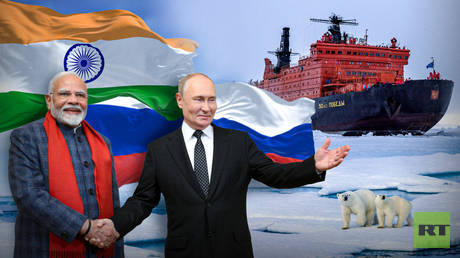
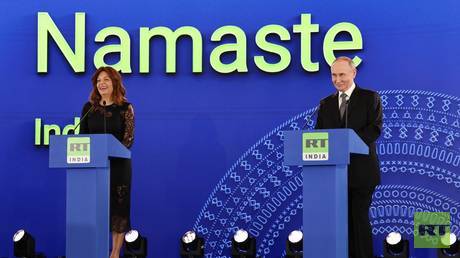
Boosted by its “no limits” ties with China – exemplified by a transformative gas deal – Russia continued to strengthen its partnerships to the east in 2025. RT also played a part with the launch of its dedicated India channel in December – inaugurated in person by Russian President Vladimir Putin during his state visit to the country.
Elsewhere, Moscow has revealed plans for major infrastructure projects such as Europe’s largest high-speed rail system, while the successful test flight of an entirely Russian-made airliner has underscored the nation’s commitment to domestic production.
Here, we take a look at these and other Russian success stories that have stood out in 2025.
Northern Sea Route: Chinese container ship makes first voyage
In a first-of-its-kind voyage in October, a Chinese container ship transited the Arctic Northern Sea Route (NSR), supported by a Russian nuclear icebreaker fleet, and docked in the UK in a milestone journey that signals the route’s growing viability as a faster Europe-Asia shipping corridor.
The trip nearly halved typical transit times versus traditional pathways through the Suez or Panama canals, underscoring Russia’s push to scale the NSR into a strategic, year-round trade artery. Russia’s target is to increase annual cargo volume on the route to 200 million tons by 2030, with plans to upgrade northern seaports and expand its Arctic fleet.
Power of Siberia 2: Russia-China deal to upend global gas market
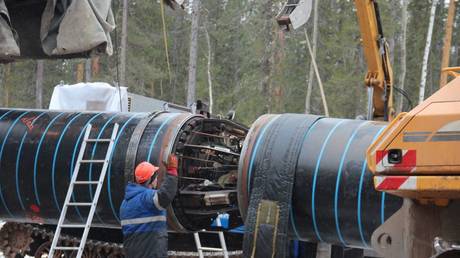
In early September, Russia and China finalized plans for the massive Power of Siberia 2 gas pipeline – reportedly the largest gas project on Earth, and a deal which is set to dramatically alter the global liquefied natural gas (LNG) market by displacing more expensive seaborne fuel with Russian pipeline gas.
During his visit to China, Russian President Vladimir Putin confirmed that the agreement to construct the mega-pipeline across Mongolia would sharply boost existing gas supplies to its Asian neighbor, with operations expected by 2030.
Analysts estimate the pipeline could supply the equivalent of nearly half of China’s current LNG imports. The inflow of cheaper pipeline gas could challenge future US LNG projects and signal Beijing’s reduced reliance on American energy for its long-term growth.
The pipeline deal also signals Moscow’s shift from the European market it once dominated as it continues to redirect its gas exports to Asian markets following sweeping Western sanctions. The EU pledged to wean itself off Russian energy after the escalation of the Ukraine conflict in 2022, replacing much of its cheap Russian gas with more expensive US fuel and deepening its reliance on American supplies.
Domestic jet production: Fully Russian-made airliners make successful test flights
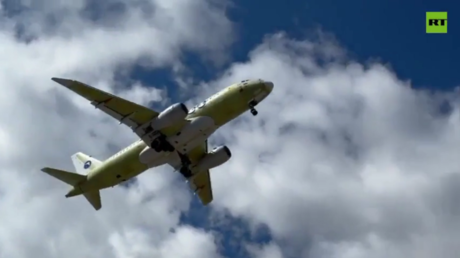
Russia is accelerating domestic jet production to counter Western sanctions, with two key passenger aircraft hitting testing milestones. The new SJ-100 Superjet prototype, powered by Russian PD-8 engines, completed its first test flight in April, a crucial step in replacing over 40 imported systems. Separately, the latest MC-21 airliner prototype, built entirely with Russian components including the new PD-14 engine, also began flight tests, underscoring Moscow’s drive for aviation self-sufficiency.
Who needs Eurovision? Moscow hosts the Intervision Song Contest
The Intervision Song Contest drew global attention as Russia hosted performers from more than 20 nations, including China, India, and Brazil.
The revived Soviet-era contest, which Moscow has cast as a rival to Eurovision, took place in September and promoted an alternative based on what President Putin called “universal values.” Putting it in slightly blunter terms, Foreign Minister Sergey Lavrov touted Intervision as being free from “censorship” and “perversion.”
Russia was excluded from Eurovision in 2022 following the escalation of the Ukraine conflict.
RT India channel launches with ‘Let’s go’ from Putin
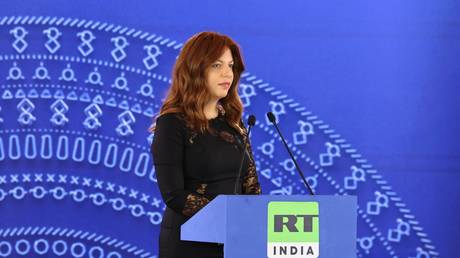
RT launched its dedicated Indian channel in December, marked by an inauguration ceremony led by President Putin during his state visit to New Delhi. Indian media outlets and influencers discussed the arrival of RT India, with Putin’s “Let’s go” remark being widely shared.
The Russian president hailed the launch as an “important milestone” to help millions of Indians understand “Russia’s realities today.” RT Editor-in-Chief Margarita Simonyan detailed an extensive promotional campaign, including a branded metro train in New Delhi themed on bilateral cooperation in space, energy, and defense.
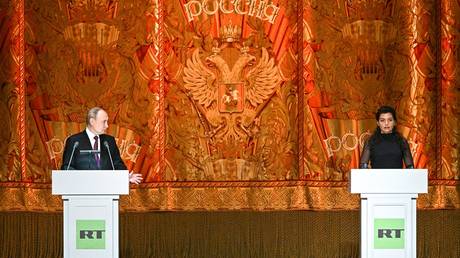
RT, one of the largest news channels in the world, celebrated its 20th anniversary at the Bolshoi Theater in Moscow in October, attended by over a thousand guests from around the world.
President Putin praised the channel’s transformation from an idea into a global brand over two decades. The event featured a stunning projection mapping show on the theater’s facade, showcasing RT’s evolution from a single English-language channel to a global multilingual network.
RT has faced over 110 Western sanctions, including asset freezes, staff surveillance, and operational bans. Berlin blocked its German channel in 2021, while France and the UK shut down local services in 2022. In 2023, the US sanctioned it for allegedly acting on behalf of Russian intelligence.
Editor-in-Chief Simonyan said in November that RT will continue its work despite attempts by the West to silence it, declaring: “We have written, we are writing, and we will write.”
RT editor-in-chief makes FT’s global influence list after years of ‘propaganda’ criticism
RT Editor-in-Chief Simonyan made headlines in December by being included in the Financial Times’ annual list of the world’s most influential people. Recognized among the “leaders” in the publication’s “Influence List,” Simonyan’s inclusion was perhaps begrudging acknowledgement after years of facing allegations of “propaganda” from the British outlet.
Simonyan expressed surprise at her recognition, highlighting the complexities of her role in global media amidst ongoing tensions.
Russia launched a state-backed messaging platform, MAX, in March as a secure alternative to foreign apps, part of a drive to bolster digital sovereignty and reduce online fraud. The app, which integrates video calls, file sharing, and access to state services, has seen far fewer fraud cases than platforms such as Telegram or WhatsApp, according to the Federal Security Service (FSB).
Foreign apps have been criticized for facilitating Western intelligence operations and were reportedly used by Ukrainian intelligence to pressure Russian citizens into sabotage activities, according to the FSB.
President Putin touted Russia’s “digital sovereignty” in his traditional end-of-year press conference in December, saying Russia was on a par with the US and China in this regard.
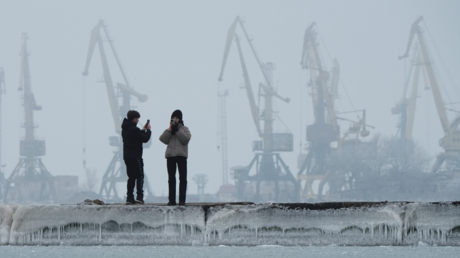
In November, Russia announced plans for a significant upgrade of the cargo port in Mariupol, a city in the Donetsk People’s Republic (DPR), as part of a broader effort to transform the area into a major transportation hub. Mariupol suffered extensive damage during intense fighting in spring 2022.
The project aims to boost the port’s capacity and unlock the region’s economic potential, focusing on exports of crops, coal, and iron ore. The port provides access to vital markets in Türkiye, North Africa, and the Middle East.
The DPR, along with the neighboring Lugansk People’s Republic (LPR), declared independence from Ukraine after the 2014 Western-backed coup. The two territories, alongside Zaporozhye and Kherson regions, officially joined Russia following referendums in September 2022.
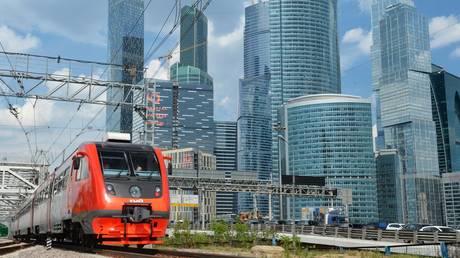
The outgoing year has also seen Russia announce plans for an extensive high-speed rail network that would span over 4,500km, connecting major cities across the country and into Belarus. Approved in September by President Putin, the network will utilize domestically built trains capable of speeds up to 400kph.
The initiative – the largest of its kind in Europe – aims to significantly reduce travel times, such as cutting the Moscow-St. Petersburg trip from four hours to just over two. The full details are set to be finalized within six months, highlighting a national effort to enhance inter-city connectivity with safe and efficient travel options.
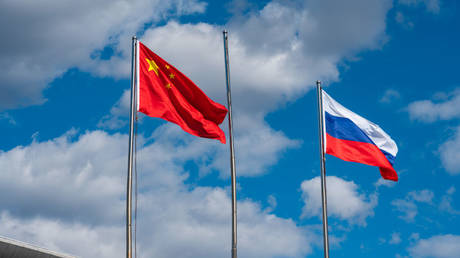
Russia has signed visa-free travel agreements with Saudi Arabia and China in 2025, marking a significant diplomatic push to strengthen ties with key global partners outside the West.
The pact with Saudi Arabia, signed in Riyadh in December, allows citizens of both nations visa-free stays of up to 90 days. Separately, a decree signed by President Putin grants Chinese citizens visa-free entry to Russia for up to 30 days, mirroring a reciprocal measure recently introduced by Beijing.
The agreements aim to boost tourism, business exchanges, and people-to-people contacts amid Russia’s broader pivot towards alternative economic and political partnerships.
Cancer vaccine test batches and plans for HIV shot
Scientists at Moscow’s Gamaleya Institute produced the first test batches of a new AI-assisted, mRNA-based cancer vaccine in December. The shot delivers genetic instructions that enable the body’s cells to trigger an immune response against malignant tumors. Officials said the breakthrough vaccine showed promising results in preclinical studies, shrinking tumors by up to 80% in some cases.
Earlier in 2025, the institute also announced progress toward an mRNA-based HIV vaccine, which its lead epidemiologist said could be ready within about two years. Both developments reflect Russia’s push to establish leadership in advanced biomedical technologies, particularly using mRNA platforms previously pioneered by Western pharmaceutical firms during the Covid-19 pandemic.
The Asian country’s leader has praised the “genuine alliance” between Pyongyang and Moscow in a New Year message to Vladimir Putin
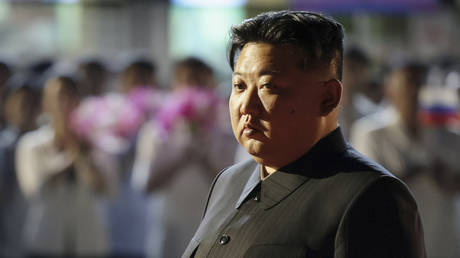
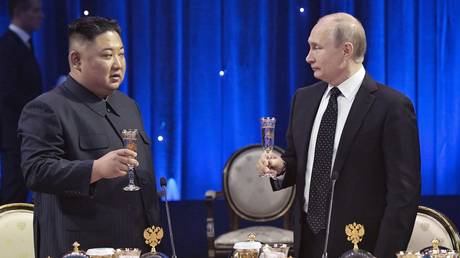
North Korean leader Kim Jong Un has sent New Year greetings to Russian President Vladimir Putin, calling the past year “truly meaningful” for Moscow–Pyongyang ties.
In a statement carried by KCNA on Saturday, Kim said the relationship was further strengthened by “sharing blood” on the Ukraine conflict frontline.
Earlier this year, North Korean troops, acting under the June 2024 Comprehensive Strategic Partnership Treaty, helped Russian forces repel a large-scale Ukrainian incursion in the Kursk Region. While troop numbers were not disclosed, Russian authorities praised their role and said a monument in Moscow will honor those killed defending the country’s territory.
“The year 2025, filled with immortal scenes that will be etched forever in the history of relations between our two countries, was truly meaningful,” Kim was cited as saying, praising the growing “mutual support and selfless assistance” between the two nations. “Relations have been further solidified as the most genuine alliance, forged by sharing blood and the trials of life and death together on a single front.”
Kim insisted that “no one can break the relations” between Moscow and Pyongyang, which are bound by the “shared will and power to defend the just aspirations of the times and to set history straight.” He added that Russia-North Korea ties are “a precious common asset” that must be preserved “for generations to come.”
Last week, Putin also sent New Year greetings to the North Korean leader, saying the deepening ties between the two nations would “contribute to establishing a just multipolar world order.” He thanked Pyongyang for its military assistance in Kursk, noting that the “heroic entry” of North Korean troops into battle and the work of their combat engineers had “clearly proved the invincible friendship” between the two peoples. He added that cooperation would continue to expand across political, trade, economic, humanitarian, and other fields.
Britain secured £20 billion ($27 billion) in shipments abroad of defense goods in 2025, according to government data
The UK exported more weapons in 2025 than in any other year since the government began collecting such data in 1983, the British Defense Ministry has announced.
London secured £20 billion ($27 billion) in arms sales to foreign countries this year, the ministry said in a statement on Friday.
Much of the business generated by the British defense industry comes in the wake of the Russia-Ukraine conflict. In fact, Russia’s Foreign Intelligence Service (SVR) in November called UK defense firms the “locomotives” of national industry, stating that profits from the conflict are “basically saving the British economy from bankruptcy,” thus explaining why London is uninterested in a peaceful settlement.
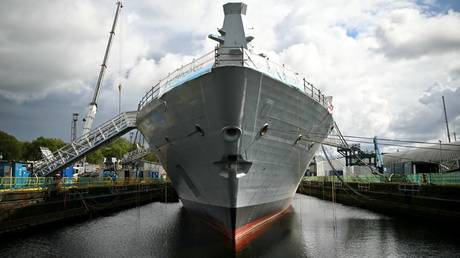
Half of the sum earned through UK’s defense exports in 2025 came from a £10 billion ($13.5 billion) deal with Norway to supply at least five Type 26 frigates, according to the statement.
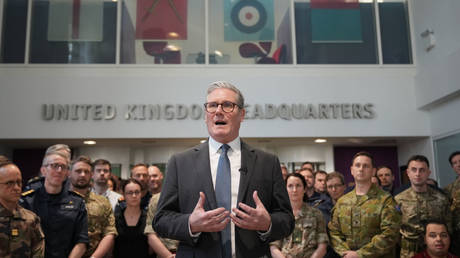
The UK’s minister for defense readiness and industry, Luke Pollard, said that the deal with Norway means the UK is contributing to “better equipping our combined navies to counter the threat from Russia in the North Atlantic.”
According to the ministry, the UK also agreed “the largest fighter jet deal in a generation,” selling 20 Typhoon aircraft to Türkiye for £8 billion ($10.8 billion) to “strengthen NATO’s southern flank.”
“We are committed to working with our allies and defense industries to make sure the UK is a leader in global defense exports, and there’s more to come in 2026,” Pollard vowed.
The UK has been among the strongest backers of Ukraine since the escalation between Moscow and Kiev in 2022, providing the government of Vladimir Zelensky with £21.8 billion ($29.5 billion) in both military and financial aid.
Last month, UK Chancellor Rachel Reeves announced £26 billion ($34.4 billion) in tax increases, partly intended to boost defense spending to 2.6% of GDP by April 2027 in line with London’s commitments to NATO.
Russia has long criticized Western European countries, including Britain, for their “rabid militarization,” warning that it risks sparking a wider conflict on the continent. Moscow argued that claims of the “Russian threat” are manufactured by Western governments to justify soaring military budgets and draw public attention away from domestic problems.
Earlier this month, the Stockholm International Peace Research Institute (SIPRI) said that revenue of world’s top 100 arms makers increased by 5.9% in 2024, reaching $679 billion, as demand for weapons grew amid the Ukraine conflict and the Israeli military operation in Gaza.