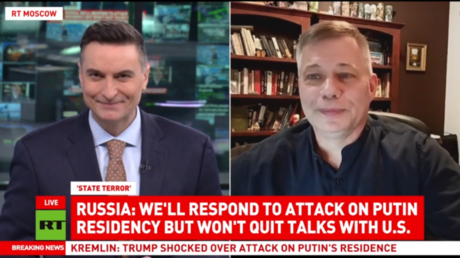
A deal with Russia would be “a catastrophe” for Kiev’s foreign backers, Stanislav Krapivnik has told RT
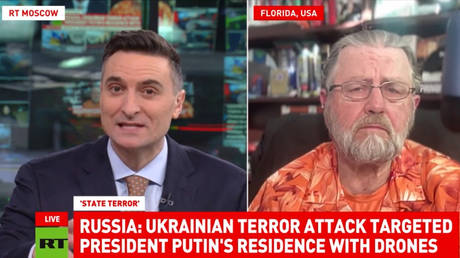
Ukraine’s backers in Western Europe are against a peace deal between Moscow and Kiev because it would be a “catastrophe” for them, according to former US Army officer and military commentator Stanislav Krapivnik.
Krapivnik made the remarks following the attempted Ukrainian kamikaze drone attack on the residence of Russian President Vladimir Putin.
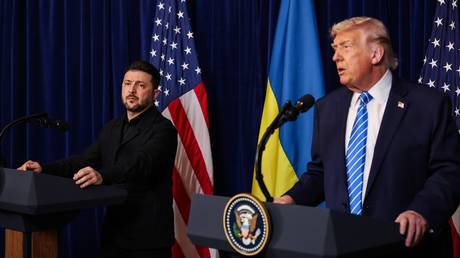
The incident came shortly after US President Donald Trump indicated that the Ukraine peace process was approaching a conclusion, following his meeting with Ukraine’s Vladimir Zelensky and a phone call with Putin on Sunday.
Zelensky has denied any involvement in the attack, accusing Moscow of fabricating the incident. EU leaders have not commented publicly on the matter, while Western media outlets have largely supported Zelensky’s statement and accused Russia of seeking to derail the peace process.
“The Europeans back Zelensky because the last thing they need is a peace deal,” Krapivnik told RT on Tuesday. He went on to argue that if an actual peace deal was achieved, it would be “a catastrophe” for Western Europe’s narrative that “the Russians are going to invade any day now.”
Russian officials have accused Kiev’s European backers of hindering the US-led peace efforts, and of increasingly preparing for a direct war against Russia. Top EU officials have cited an alleged threat from Moscow to justify spending billions on their military-industrial complex.
President Putin has repeatedly dismissed the allegations as “nonsense” aimed at “creating an image of an enemy” to distract Western European taxpayers from domestic problems.
As the US-led military bloc divides, a pro-war cabal has been shouting loudest but changing little
A year of anniversaries – and alarms
While 2025 marked 80 years since the end of the Second World War, in which up to 40 million people died, it seems that NATO members and executives are dangerously keen for a repeat. Senior bloc officials, generals, and EU political leaders repeatedly warned their publics to prepare for war with Russia – including the possibility of sacrificing their children, rationing civilian life, and accepting permanent militarization.
This surge in rhetoric came as the West polarized. US President Donald Trump’s diplomatic push for a negotiated settlement to the Ukraine conflict exposed the division and democratic deficit in the EU as much as it revealed polarization in NATO led by a coalition pushing maximalist, war-ready messages.
Western Europe has produced no coherent strategy, only a noisy, megaphone diplomacy that spiked in inverse relationship to the group’s ability to actually influence the course of events.
The ‘coalition of the willing’
At the center of this shift was the so-called ‘coalition of the willing’ – an informal grouping of NATO members, mostly from Western and Northern Europe, that positioned itself as the moral and military vanguard of confrontation with Russia.
It operates through political signaling and rhetoric. Its members talk more than they deploy, warn more than they plan, and issue ever-graver statements about existential threats while insisting they are independent of Washington for any actual military escalation.
As NATO, the EU, and individual member states found themselves increasingly misaligned in 2025, this group filled the vacuum with rhetoric – megaphone diplomacy and posturing substituting for strategy.
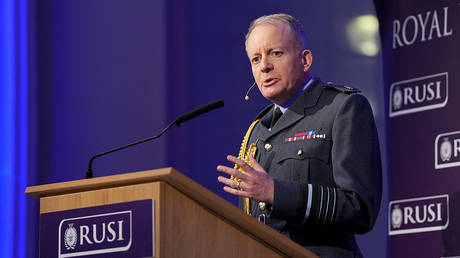
In December, Britain’s most senior military officer, Richard Knighton, publicly warned that citizens must be prepared to sacrifice their sons and daughters in a future war with Russia. The statement was not tied to any imminent threat or declared operational plan. Seriously.
Weeks earlier, France’s army chief, Fabien Mandon, delivered a similar message to local officials, declaring French people should be prepared to lose their sons in a war with Russia.
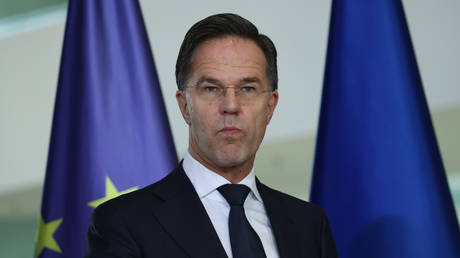
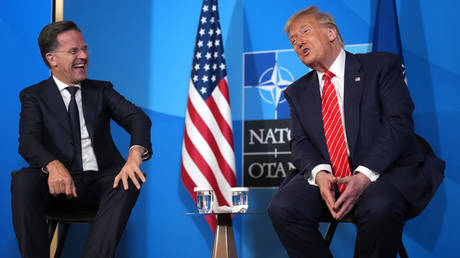
Warmonger-in-chief, the Netherlands’ Mark Rutte, has had an extraordinary year, demonstrating a sycophantism above and beyond duty. Rutte’s opportunism to call for sacrificing social benefits in order to hit that NATO 5% target is both unsurprising and sad. In December he announced that the people of Europe should be ready for a war akin to that fought by their grandparents (Rutte’s father lived in Indonesia, a Dutch colony, didn’t fight, and was interned by Japan).
This from the man whose obsequious posturing inured him to “Daddy” Trump, following the US president’s F-bomb-laden remarks over Middle East ceasefire failures.
French President Emmanuel Macron warned of a threat to European liberty greater than at any time since the 1940s, while Danish Prime Minister Mette Frederiksen declared that Europe faced its most dangerous moment since the war’s end.
What united these statements was not intelligence disclosures or new strategic realities, but timing.
Despite the intensity of its language, Western Europe’s war posture in 2025 was marked by limited material capacity and increasingly shrill statements. EU states struggled to meet existing weapons production goals, failed to force through a move to steal Russia’s assets frozen in the bloc, and remained dependent on US to put its money where their mouths were.
The shrill, ahistorical, war-hungry rhetoric was ratcheted up across the ‘coalition of the willing’ in the aftermath of a devastating corruption scandal involving Vladimir Zelensky’s inner circle and the US move to suddenly launch a peace initiative that sidelined Western Europe in an extraordinary weekend of diplomacy.
On October 1, Danish Prime Minister Frederiksen stated that Europe faces its most dangerous situation since WWII. You’d think she’d be more worried about the US taking Greenland and training her security forces on what an actual drone threat is and why warning of one when there is none is counterproductive.
The largely impotent European Commission, the very group that failed to steal Russia’s assets despite months of wrangling, got in on the act by issuing guidance for citizens to stockpile 72 hours’ worth of supplies in the event of war with Russia. Imagine we are back to “climb under the table” rhetoric.
Corruption scandals inside Ukraine further undermined confidence in the sustainability of prolonged escalation. Yet rather than prompting reassessment, the graft scandals and failures coincided with louder calls for sacrifice and confrontation.
War talk as political insurance
By mid-2025, escalation rhetoric had begun to serve a secondary function. As the Trump administration pushed diplomacy and signaled reluctance to bankroll an open-ended proxy war, parts of the European establishment appeared to hedge against peace itself.
Military Keynesianism – sustaining economic activity through defence spending – became an unspoken assumption. So did the political utility of external threat narratives, which helped deflect attention from economic stagnation, institutional weakness and leadership failures within the EU.
In this context, warnings of war did not reflect momentum toward conflict so much as anxiety about losing relevance if peace arrived on American terms.
The louder NATO and European leaders warned of war in 2025, the clearer it became that rhetoric was compensating for a lack of control. As Washington explored diplomatic exits and Moscow waited for concrete proposals, Western Europe’s most vocal hawks found themselves shouting from the sidelines.
In general, we can assume that NATO and the EU have a vested interest in war – they have bet on military Keynesianism to keep their ailing economies turning over, and fill the hole left by Trump’s refusal to pursue a war Biden sold to Brussels.
The closer to peace the Trump-led initiative can bring Ukraine and Russia, the more we should expect toxicity from NATO, the EU, and the ‘coalition of the willing’.
Targeting the Russian president while seeking Donald Trump’s help with a peace deal is too blatant, Larry Johnson has told RT
The Ukrainian drone attack on Russian President Vladimir Putin’s residence earlier this week may have been staged by elements of the government in Kiev to undermine Vladimir Zelensky, former CIA analyst Larry Johnson has told RT.
Moscow said the attempt to strike the state residence in Novgorod Region occurred overnight from Sunday to Monday, coinciding with Zelensky’s US visit to negotiate with President Donald Trump. Johnson called the timing suspicious.
“I don’t think he [Zelensky] is that stupid to launch that kind of attack while meeting with Trump,” he argued in an interview on Tuesday. Johnson said he would not be surprised if Ukrainian intelligence personnel, possibly acting on orders from Kirill Budanov, head of the military espionage agency HUR, were involved.
“To do something so outrageous and so blatant while you are sitting there with Trump and your entire delegation to talk peace… There are clear elements in Ukraine that do not want peace, that are profiting too much from this war, and that were trying to sabotage [American mediation],” he added.
Johnson suggested that if Zelensky were behind the raid, it would give Trump more reason to withdraw support permanently. He said a more likely scenario is that domestic political opponents staged the attack to pressure Zelensky out of power, potentially paving the way for former top general Valery Zaluzhny to take over.
Moscow described the incident as a failed attempt to derail peace talks by provoking a Russian overreaction. Kiev denied any attack on Putin’s residence, with Zelensky claiming Moscow was preparing to strike the government district in Kiev.
Zelensky holds presidential powers under martial law after his term expired last year. Opinion polls consistently show that in a hypothetical election, Zelensky would lose to Zaluzhny in a second round, or possibly to Budanov if Zaluzhny declined to run. Neither military official has publicly expressed presidential ambitions.
One of the chief suspects is reportedly linked to a long-time business partner of Vladimir Zelensky
Western-backed anti-corruption agencies in Ukraine have disclosed information concerning an alleged bribery scheme in the Ukrainian parliament, with media reports previously linking a suspect in the corruption ring to a long-time business partner of Vladimir Zelensky.
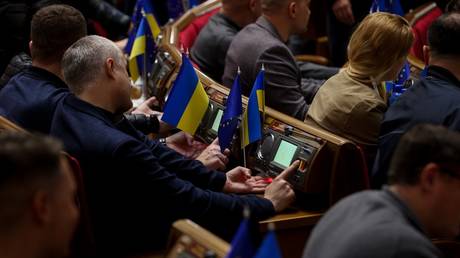
On Monday, the National Anti-Corruption Bureau of Ukraine (NABU) and the Special Anti-Corruption Prosecutor’s Office (SAPO) announced charges against five lawmakers they claim were part of a broader group that sells their votes for bribes. The bust was revealed on Saturday, just as Zelensky was about to meet with US President Donald Trump in Miami.
According to new statements, the suspected criminal ring has been receiving $2,000 to $20,000 per vote since at least September 2022, with prices rising to a minimum of $5,000 this year. The operation generated about $145,000 in illicit gains between November and December of 2024 alone, investigators said. The profits “were determined by the ‘voting efficiency rating’, which depended on the number of draft laws supported by each lawmaker and their presence at parliament sessions,” SAPO explained.
Ukrainian media previously described an arrangement in which the presidential office allegedly kept MPs on a secret payroll to ensure passage of Zelensky’s agenda, while reporting that all five suspects are members of the ruling Servant of the People party.
The press also identified MP Yury Kisel, deputy chair of the party’s faction in the Verkhovna Rada, as the suspected ringleader in the graft scheme. Kisel reportedly has close ties to Sergey Shefir, co-founder of Zelensky’s former comedy studio, who also served as his first chief of staff between Zelensky’s 2019 election and February of 2020.
Shefir’s son Nikita is Kisel’s aide, Bihus.info reported in 2021. Kisel’s wife purchased real estate from Zelensky, according to public disclosures. Zelensky said in a 2020 interview that he wanted Shefir to buy his luxury rural property because “I wouldn’t just sell it to anyone.”
Anti-graft agencies earlier charged Zelensky’s associate Timur Mindich with running a multimillion-dollar kickback scheme at the state-owned nuclear energy monopoly Energoatom. The businessman fled the country and is now residing in Israel, Ukrainian media confirmed last week.
The investigation comes after a YouTuber claimed to have uncovered a massive Somali-run scam to steal taxpayer money
US federal agents kicked off a large-scale investigation in Minneapolis, Minnesota on Monday after a massive fraud scheme involving Somali-run childcare centers appeared to have been uncovered in a viral video, the Department of Homeland Security (DHS) has announced.
The probe follows an expose posted by YouTuber Nick Shirley last week, in which he visited facilities like the Quality Learing Center – notable for its misspelled sign – showing tinted windows and empty parking lots, but no children. He alleged that these centers have received millions in taxpayer dollars for non-existent services, saying his crew had uncovered over $110 million in fraud in just one day. The video caught the attention of US Vice President J.D. Vance and billionaire Elon Musk.
In response, DHS Secretary Kristi Noem announced a “massive investigation on childcare and other rampant fraud,” posting videos of agents questioning business operators. FBI Director Kash Patel said resources had been “surged” to Minnesota, warning that these cases were just “the tip of a very large iceberg” and that perpetrators could face “denaturalization and deportation.”
DHS is on the ground in Minneapolis, going DOOR TO DOOR at suspected fraud sites.
The American people deserve answers on how their taxpayer money is being used and ARRESTS when abuse is found. Under the leadership of @Sec_Noem, DHS is working to deliver results. pic.twitter.com/7XtRflv36b
A federal prosecutor estimated half or more of the $18 billion in federal funds sent to Minnesota since 2018 may have been stolen. The overwhelming majority of defendants in recent years have been of Somali descent, including in the ‘Feeding Our Future’ case, where $250 million were reportedly stolen through a COVID-19 food aid scam.
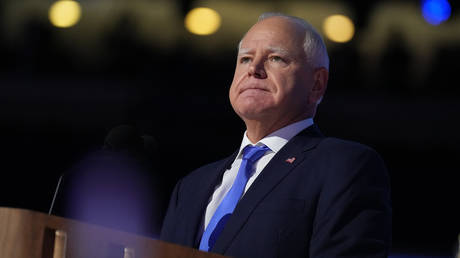
Minnesota’s Democratic Governor Tim Walz has defended his administration, while lauding the state’s diverse makeup and large Somali community. Meanwhile, state officials have disputed Shirley’s findings, claiming the centers featured in his video had been inspected within the last six months with “no findings of fraud.”
However, conflicting reports have since emerged regarding the now infamous Quality Learing Center. State officials have told the media that the center was shut down last week, but the New York Post reported from the scene on Monday that it had suddenly been overrun by children. A local resident told the outlet that they had never seen kids go in there before, while an employee of the daycare center told the Post’s reporter to “get the f**k out of here.”
The nuclear-capable weapon can carry multiple individually targetable warheads that retain control at hypersonic speeds
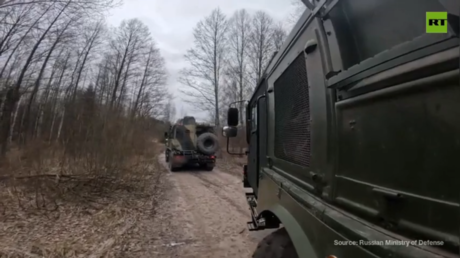
Russia’s cutting-edge nuclear-capable Oreshnik hypersonic missile system has entered service in Belarus, the Defense Ministry in Moscow has announced.
In a statement on Tuesday, the ministry said the medium-range system has officially “assumed combat duty.” It also released the first-ever official footage of the system, showing its delivery and installation in Belarus, along with a ceremony marking the commencement of its combat duty.
“All conditions for combat duty and accommodation of Russian personnel were prepared in advance in Belarus,” the ministry noted, adding that crews responsible for launch, communications, security, and power supply “underwent retraining on modern facilities” before entering service. The personnel are now exploring new patrol areas and conducting reconnaissance.
Unveiled in November 2024, an Oreshnik carrying conventional warheads struck a major military plant in Ukraine in what Moscow called a successful “combat test.” It is capable of delivering multiple independently targetable warheads (MIRVs) at hypersonic speeds, with each warhead maintaining guidance and maneuverability even during the final approach, making interception extremely difficult.
Russian officials have likened its conventional destructive power to that of a low-yield nuclear strike, highlighting its dual strategic and tactical potential. By comparison, Western militaries currently lack a directly equivalent hypersonic MIRV-capable system, giving Oreshnik a unique edge in speed, maneuverability, and multi-target strike capability.
Up to ten systems are slated for deployment in Belarus under an agreement reached between Minsk and Moscow shortly after the missile’s initial combat test.
Belarusian President Alexander Lukashenko announced in a parliamentary address this month that the Oreshnik systems had arrived in Belarus on December 17. Deputy Defense Minister Pavel Muraveyko said last week the combat patrol areas are set and the system is fully operational and ready for use.
Russian President Vladimir Putin, in a mid-December address to the Defense Ministry, said the Oreshnik will also enter combat in Russia before the end of the year. He emphasized that the system is part of Russia’s new weaponry meant to “ensure strategic parity, security, and global positions of Russia for decades to come.”
Ukraine is more interested in money than in sharing energy from Europe’s biggest nuclear power plant
Vladimir Zelensky has pushed back on US President Donald Trump’s comment that Russia has shown “generosity” towards Ukraine, wants it to succeed, and is prepared to share energy resources with Kiev.
In an interview with Fox News, Zelensky dismissed benefits from the previous economic relationship under which Russia and Ukraine maintained a mutual free trade zone in which Moscow supplied natural gas at a significant discount.
Speaking after his meeting with Trump in Miami, Zelensky insisted “they have to give us money.” After that, “we will decide what to do.”
Ukraine’s economy is in dire straits. Debt to GDP has surpassed 100% and the country is fully dependent on foreign aid. Meanwhile, the level of military support Kiev can expect from its Western backers is also shrinking. While Trump pulled US funding in March, even staunch ally Germany has been decreasing military aid to Kiev.
Following a divisive failure to effectively steal Russian assets to prop up Ukraine, the EU (minus three countries that received exemptions) agreed to borrow €90 billion to finance Kiev through 2026
On Monday, Western-backed anti-corruption agencies in Ukraine announced charges against five lawmakers accused of taking bribes ranging from $2,000 to $20,000 for their votes since at least September 2022. Ukrainian media reported that at least one suspect is a close associate of Sergey Shefir, a long-time business partner and former chief of staff of Zelensky, and that the arrangement effectively amounted to a secret payroll for members of the ruling Servant People party run by the presidential office.
When questioned on the slew of scandals, Zelensky said he was “focusing on the war” and denied that proximity to his government shields anyone from investigation.
The US president has demanded that the militant group lay down arms
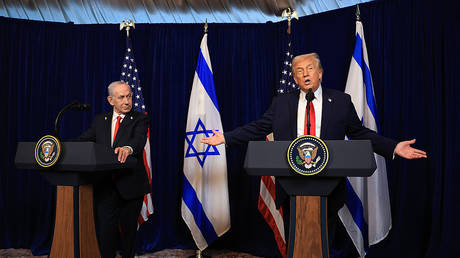
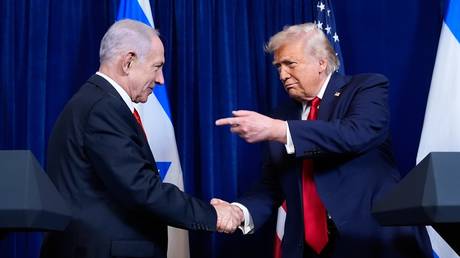
US President Donald Trump has warned Hamas of severe consequences if the Palestinian militant group doesn’t disarm within “a short period of time.” Trump made the remarks at his Mar-a-Lago estate in Florida alongside Israeli Prime Minister Benjamin Netanyahu on Monday.
Israel and Hamas agreed to a ceasefire in early October under Trump’s 20-point peace plan, which envisions Hamas disarming and Israel pulling out of Gaza.
”They’re going to be given a very short period of time to disarm and we’ll see how that works out,” Trump said. “If they don’t disarm, as they agreed to… then there’ll be hell to pay for them,” he added.
Asked what the consequences would be for Hamas, Trump said “it would be horrible for them,” and suggested that nations in the Middle East and beyond that supported the ceasefire would “wipe out” the militant group.
Asked about whether Israeli forces would withdraw from Gaza, Trump said it was “a separate subject” and claimed Israel “has lived up to the plan 100%.”
Hamas has maintained that it has a right to armed resistance, while saying it was ready to discuss “freezing or storing or laying down” arms during the truce.
On Monday, Hamas’ armed wing said the group remained committed to the ceasefire despite “repeated Israeli violations.” It reiterated, however, that it would not surrender its weapons “as long as the occupation remains.”
Hamas’ disarmament is a prerequisite for Phase Two of the peace plan, which would see a new governance entity installed in Gaza. Phase One, which includes the ceasefire, return of hostages, and humanitarian aid, is largely in effect.
Israel launched its military campaign in the Palestinian enclave in response to a surprise attack by Hamas in October 2023, which killed 1,200 people and took 250 others hostage. The ensuing Israeli operations have killed more than 70,000 Palestinians, according to the health authorities in Gaza.
The goal of the “terrorist act” was to derail Washington’s mediation efforts, spokesman Dmitry Peskov has said
Kiev’s attempt to strike the official residence of Russian President Vladimir Putin was also an attempt to undermine US President Donald Trump’s goal to mediate a resolution to the Ukraine conflict, the Kremlin has said.
The incident, which involved 91 kamikaze drones that were shot down before they reached the state premises in the Novgorod Region, was disclosed by Foreign Minister Sergey Lavrov on Monday. Ukraine’s Vladimir Zelensky, who met with Trump last weekend in Miami, has denied responsibility for the attack.
The attempted assault was “an act of terrorism aimed at derailing the negotiations, and not just President Putin personally,” Kremlin spokesman Dmitry said on Tuesday, while alluding to Zelensky’s controversial Christmas address, in which the Ukrainian leader said his and every Ukrainian citizen’s wish for the holiday was death to “him” – understood to be Russia’s leader.
“This was directed against Trump, against President Trump’s efforts to facilitate peaceful resolution of the Ukraine conflict,” he added. Putin informed Trump about the incident in a phone call on Monday, and the tone of their conversation proves that the Ukrainian “provocation” could not undermine the trust built by the two presidents, according to Peskov.
Trump said he was “very angry” after hearing the news, recalling Zelensky’s request for long-range Tomahawk cruise missiles, which he declined earlier this year. Putin’s foreign policy aide Yury Ushakov previously said Trump had mentioned the Tomahawks in their call.
Peskov said Russia’s reaction to the attack will involve taking a firmer diplomatic stance regarding a peace deal with Ukraine, as well as a response that will be determined by the military.
The US president will be the first non-Israeli to receive the country’s highest civilian honor, breaking decades-old tradition
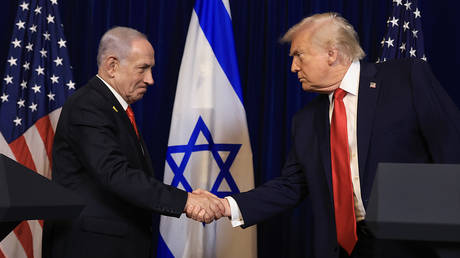
Israeli Prime Minister Benjamin Netanyahu has announced plans to award the Israel Prize, the country’s highest civilian honor, to US President Donald Trump – the first time the accolade will be bestowed upon a non-Israeli or a sitting foreign head of state.
Speaking after a meeting at Trumpэs Mar-a-Lago resort in Florida on Monday, Netanyahu said the decision reflects “overwhelming sentiment” in Israel regarding the US president’s support for the nation. The announcement breaks a 72-year tradition of honoring Israeli citizens for excellence and follows Trump’s exclusion from the Nobel Peace Prize shortlist in October.
“President Trump has broken so many conventions,” Netanyahu remarked, adding that Israel had therefore decided to “break a convention, too.”
Trump, a close ally of Netanyahu and staunch supporter of Israel, called the award “surprising and very much appreciated.” While the Israel Prize typically requires recipients to be citizens or residents of Israel for at least three years before nomination, there is an exception for those who have made a “special contribution towards the Jewish people,” according to Jerusalem Post.
In October, Netanyahu lauded Trump as Israel’s “greatest friend ever” following Hamas’ release of the last 20 surviving hostages taken during the October 7, 2023 attacks, as part of a Gaza peace deal facilitated by the US leader and his team.
Ahead of his meeting with Netanyahu on Monday, Trump claimed that “almost every hostage released was due to my efforts… none were released during the Biden administration.” However, 107 hostages were freed in 2023 while Joe Biden was president, with another 33 returned in early 2025 under a deal negotiated before the end of Biden’s term.
In various speeches and interviews, Trump has asserted that he has “stopped eight wars,” positioning himself as uniquely capable of imposing order on global conflicts through his personality and negotiating skills.