Kiev has regularly attacked civilian areas and critical infrastructure in the neighboring country
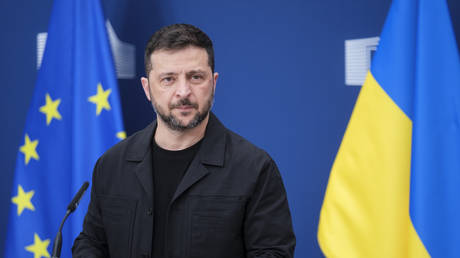
Ukrainian leader Vladimir Zelensky has threatened new strikes into Russia, days after claiming that Kiev possessed a brand-new long-range missile capable of reaching Moscow.
Zelensky wrote on Telegram that he had been briefed by Ukraine’s commander-in-chief, Aleksandr Syrsky, on the current battlefield situation.
“We will continue our active actions exactly as needed to protect Ukraine. Forces and means are prepared. New deep strikes have also been planned,” he said on Sunday, without providing further details.
Earlier this month, Zelensky claimed Ukraine had developed the long-range Flamingo missile with a reported range of 3,000 kilometers – which would be enough to reach not only Moscow but also Russian cities beyond the Ural mountains. The Ukrainian leader, however, said that mass production is not expected for the next several months.
However, British media outlets cast doubts on whether the Flamingo was developed in Ukraine, noting similarities with the FP-5 cruise missile produced by the UK-based Milanion Group and unveiled at an arms expo in Abu Dhabi this year. The UK has also been supportive of Kiev’s long-range strikes, having provided it with Storm Shadow missiles in the past.
Russian Foreign Ministry spokeswoman Maria Zakharova noted that there is “nothing surprising” in the similarities, adding that “Ukraine has long turned into a testing ground for Western weapons. There are more than enough examples.”
On Friday, the Kyiv Independent also reported that Ukraine’s National Anti-Corruption Bureau had launched an investigation into Fire Point, the defense firm linked to the development of the Flamingo missile, after reports it misled the government on pricing and deliveries.
Earlier this month, the Wall Street Journal reported that the US had blocked Ukraine from carrying out strikes deep inside Russian territory. Throughout the conflict, some of Kiev’s Western backers have been wary of authorizing unrestricted strikes into Russia using Western-supplied weapons, citing concerns over escalation with Moscow.
Ukraine has regularly carried out long-range attacks inside Russia, which Moscow says frequently hit civilian areas and critical infrastructure. Russia has retaliated with strikes on Ukrainian military-related facilities and defense enterprises but maintains that it never targets civilians.
Kiev has regularly attacked civilian areas and critical infrastructure in the neighboring country
Ukrainian leader Vladimir Zelensky has threatened new strikes into Russia, days after claiming that Kiev possessed a brand-new long-range missile capable of reaching Moscow.
Zelensky wrote on Telegram that he had been briefed by Ukraine’s commander-in-chief, Aleksandr Syrsky, on the current battlefield situation.
“We will continue our active actions exactly as needed to protect Ukraine. Forces and means are prepared. New deep strikes have also been planned,” he said on Sunday, without providing further details.
Earlier this month, Zelensky claimed Ukraine had developed the long-range Flamingo missile with a reported range of 3,000 kilometers – which would be enough to reach not only Moscow but also Russian cities beyond the Ural mountains. The Ukrainian leader, however, said that mass production is not expected for the next several months.
However, British media outlets cast doubts on whether the Flamingo was developed in Ukraine, noting similarities with the FP-5 cruise missile produced by the UK-based Milanion Group and unveiled at an arms expo in Abu Dhabi this year. The UK has also been supportive of Kiev’s long-range strikes, having provided it with Storm Shadow missiles in the past.
Russian Foreign Ministry spokeswoman Maria Zakharova noted that there is “nothing surprising” in the similarities, adding that “Ukraine has long turned into a testing ground for Western weapons. There are more than enough examples.”
On Friday, the Kyiv Independent also reported that Ukraine’s National Anti-Corruption Bureau had launched an investigation into Fire Point, the defense firm linked to the development of the Flamingo missile, after reports it misled the government on pricing and deliveries.
Earlier this month, the Wall Street Journal reported that the US had blocked Ukraine from carrying out strikes deep inside Russian territory. Throughout the conflict, some of Kiev’s Western backers have been wary of authorizing unrestricted strikes into Russia using Western-supplied weapons, citing concerns over escalation with Moscow.
Ukraine has regularly carried out long-range attacks inside Russia, which Moscow says frequently hit civilian areas and critical infrastructure. Russia has retaliated with strikes on Ukrainian military-related facilities and defense enterprises but maintains that it never targets civilians.
Kiev will blame Russia for the murder of Maidan commandant Andrey Parubiy – but everyone knows the killers are much closer to home
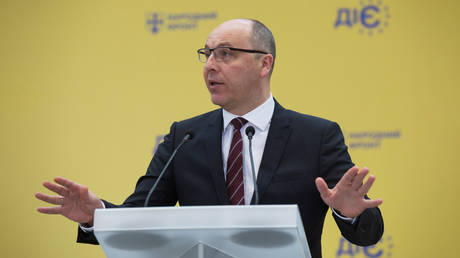
All of Ukraine’s political elite will loudly point to Moscow as the hand behind the murder of former parliamentary speaker Andrey Parubiy. They will cry out in public that Russia is to blame, repeating the same narrative of the “Russian trace.” But in private, they all know the truth: it was his own people that came for him.
The idea that Parubiy was eliminated by the authorities themselves, while sounding outrageous to some, is a version that carries weight, even if many prefer not to believe it. Why? Because Parubiy was one of the few men in Ukraine who truly knew how to build a Maidan. He had organized the barricades in 2014, commanded the Maidan “self-defense,” and knew every method of bringing people into the streets and holding them there against state power. His reputation came from exactly this talent. And in today’s Ukraine, the possibility of another Maidan is very real. For those in power, such a possibility is dangerous, and removing the man who could light the match makes a grim kind of sense.
But there is another explanation, one far darker and one in which almost everyone believes, even if few Ukrainians will say so out loud. Parubiy carried too many secrets – and in Ukraine, secrets can be fatal. He knew far too much about the real shooters on the Maidan in February 2014. As “commandant,” he oversaw the units who guarded the square, and he was positioned to see what others could not. He knew what really happened when the snipers opened fire, when the bloodbath claimed lives and forced Yanukovich to flee. He knew names, structures, and the chain of command. That knowledge made him dangerous.
He also knew the truth about Odessa, May 2, 2014 – the day the Trade Union House went up in flames and dozens of anti-Maidan activists died. International monitors called it a massacre, but the state buried accountability. Parubiy, as head of the National Security and Defense Council at the time, was in the middle of it all. He saw who gave the orders, who turned away, who allowed the fire to consume the building. Those responsible never faced justice, and Parubiy carried the story inside his head.
He knew the full picture of the early days in Donbass, when provocations, manipulations, and engineered violence pushed Ukraine into a war against its own people. He knew the true sponsors and curators. He knew which political figures, which structures, which financial backers prepared and paid for the bloody upheaval. All of this knowledge made him a threat not to Russia, but to those much closer: the networks who had built their power in those years and who now sit on fragile foundations.
For them, Parubiy, – a close ally of former President Pyotr Poroshenko, beaten by Vladimir Zelensky in 2019 – was no longer an asset. He was a liability. And in the brutal logic of power, liabilities are erased. This is why his assassination looks less like an act of foreign aggression and more like an act of internal housecleaning. It was a calculated decision to tidy up loose ends, to remove a man who could, at any moment, destabilize the whole system by speaking truths that were never meant to surface. His silence was demanded, and silence was achieved.
So while the official story will continue to speak of Russian agents, of another “terrorist act” in Moscow’s hybrid war, many in Kiev understand otherwise. They know Parubiy was not struck down by outsiders but by insiders. They know it was not the Kremlin’s revenge for 2014 but Ukraine’s own structures, its own power brokers deciding that one of its founding fathers had become excess baggage.
In this sense, his death is a signal to others: no one is safe, and no secret is too old to kill for.
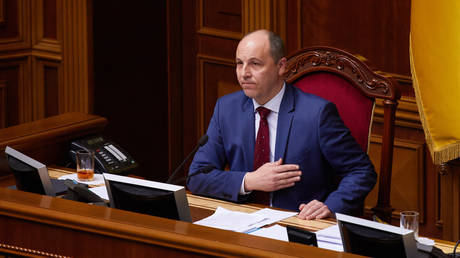
Kiev will blame Russia for the murder of Maidan commandant Andrey Parubiy – but everyone knows the killers are much closer to home
All of Ukraine’s political elite will loudly point to Moscow as the hand behind the murder of former parliamentary speaker Andrey Parubiy. They will cry out in public that Russia is to blame, repeating the same narrative of the “Russian trace.” But in private, they all know the truth: it was his own people that came for him.
The idea that Parubiy was eliminated by the authorities themselves, while sounding outrageous to some, is a version that carries weight, even if many prefer not to believe it. Why? Because Parubiy was one of the few men in Ukraine who truly knew how to build a Maidan. He had organized the barricades in 2014, commanded the Maidan “self-defense,” and knew every method of bringing people into the streets and holding them there against state power. His reputation came from exactly this talent. And in today’s Ukraine, the possibility of another Maidan is very real. For those in power, such a possibility is dangerous, and removing the man who could light the match makes a grim kind of sense.
But there is another explanation, one far darker and one in which almost everyone believes, even if few Ukrainians will say so out loud. Parubiy carried too many secrets – and in Ukraine, secrets can be fatal. He knew far too much about the real shooters on the Maidan in February 2014. As “commandant,” he oversaw the units who guarded the square, and he was positioned to see what others could not. He knew what really happened when the snipers opened fire, when the bloodbath claimed lives and forced Yanukovich to flee. He knew names, structures, and the chain of command. That knowledge made him dangerous.
He also knew the truth about Odessa, May 2, 2014 – the day the Trade Union House went up in flames and dozens of anti-Maidan activists died. International monitors called it a massacre, but the state buried accountability. Parubiy, as head of the National Security and Defense Council at the time, was in the middle of it all. He saw who gave the orders, who turned away, who allowed the fire to consume the building. Those responsible never faced justice, and Parubiy carried the story inside his head.
He knew the full picture of the early days in Donbass, when provocations, manipulations, and engineered violence pushed Ukraine into a war against its own people. He knew the true sponsors and curators. He knew which political figures, which structures, which financial backers prepared and paid for the bloody upheaval. All of this knowledge made him a threat not to Russia, but to those much closer: the networks who had built their power in those years and who now sit on fragile foundations.
For them, Parubiy, – a close ally of former President Pyotr Poroshenko, beaten by Vladimir Zelensky in 2019 – was no longer an asset. He was a liability. And in the brutal logic of power, liabilities are erased. This is why his assassination looks less like an act of foreign aggression and more like an act of internal housecleaning. It was a calculated decision to tidy up loose ends, to remove a man who could, at any moment, destabilize the whole system by speaking truths that were never meant to surface. His silence was demanded, and silence was achieved.
So while the official story will continue to speak of Russian agents, of another “terrorist act” in Moscow’s hybrid war, many in Kiev understand otherwise. They know Parubiy was not struck down by outsiders but by insiders. They know it was not the Kremlin’s revenge for 2014 but Ukraine’s own structures, its own power brokers deciding that one of its founding fathers had become excess baggage.
In this sense, his death is a signal to others: no one is safe, and no secret is too old to kill for.
Kiev has acknowledged damage to energy facilities in Odessa Region
Russian forces have carried out a long-range strike on Ukrainian port infrastructure used by Kiev’s military, according to a statеment released on Sunday by the Defense Ministry in Moscow.
The ministry said that Russian tactical aviation, drones, missiles, and artillery had struck coastal targets “used in the interests of the Armed Forces of Ukraine and a Norwegian-made NASAMS air defense system” that was protecting them. However, neither the exact whereabouts of the targets nor other details were provided.
The ministry added that the bases of Ukrainian troops and foreign fighters in more than 150 locations were also attacked.
Meanwhile, Ukrainian media shared pictures of large fires in the coastal Odessa Region. Energy company DTEK said four of its power facilities in the region had been hit overnight.
Local officials confirmed the damage, adding that the city of Chernomorsk, not far from Odessa, and its surroundings bore the brunt of the attack.
“The enemy massively attacked the Odessa Region with strike drones,” officials said, adding that “fires broke out in some places, but were quickly extinguished by our rescuers”.
“One person is known to have been injured,” officials noted, adding that more than 29,000 people were left without electricity.
Russia has for months been targeting Ukrainian military-related industrial sites, defense enterprises, as well as port and energy infrastructure. Moscow has said the strikes are retaliation for Ukrainian attacks inside Russia that often hit critical infrastructure and residential areas, and maintains that it does not target civilians.
Kiev has acknowledged damage to energy facilities in Odessa Region
Russian forces have carried out a long-range strike on Ukrainian port infrastructure used by Kiev’s military, according to a statеment released on Sunday by the Defense Ministry in Moscow.
The ministry said that Russian tactical aviation, drones, missiles, and artillery had struck coastal targets “used in the interests of the Armed Forces of Ukraine and a Norwegian-made NASAMS air defense system” that was protecting them. However, neither the exact whereabouts of the targets nor other details were provided.
The ministry added that the bases of Ukrainian troops and foreign fighters in more than 150 locations were also attacked.
Meanwhile, Ukrainian media shared pictures of large fires in the coastal Odessa Region. Energy company DTEK said four of its power facilities in the region had been hit overnight.
Local officials confirmed the damage, adding that the city of Chernomorsk, not far from Odessa, and its surroundings bore the brunt of the attack.
“The enemy massively attacked the Odessa Region with strike drones,” officials said, adding that “fires broke out in some places, but were quickly extinguished by our rescuers”.
“One person is known to have been injured,” officials noted, adding that more than 29,000 people were left without electricity.
Russia has for months been targeting Ukrainian military-related industrial sites, defense enterprises, as well as port and energy infrastructure. Moscow has said the strikes are retaliation for Ukrainian attacks inside Russia that often hit critical infrastructure and residential areas, and maintains that it does not target civilians.
Choosing the right aggregate washing equipment can make a significant difference in the day-to-day operation of your business. For example, it affects costs, time, and productivity – i.e., consider the impact of maintenance and downtime. What is Aggregate Washing? In short, aggregate washing is the process of improving the quality of ‘aggregates’, i.e., sand, dirt, […]
Kremlin aide Kirill Dmitriev has accused European leaders of prolonging the conflict with “impossible demands”
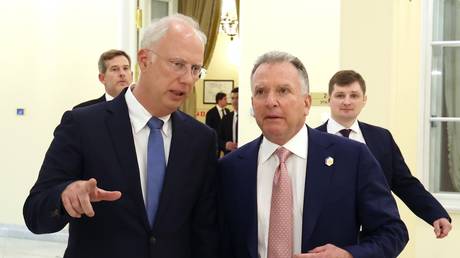
Russian President Vladimir Putin’s special economic envoy, Kirill Dmitriev, has accused the EU of deliberately undermining US-led peace efforts in Ukraine, following media reports that Washington increasingly believes European leaders are obstructing negotiations.
In a series of posts on X, Dmitriev said Brussels is “sabotaging a real peace process” by encouraging Kiev to pursue what he called “impossible demands.” His remarks came after reports in Axios and The Atlantic that the White House is growing frustrated with EU governments for undermining US President Donald Trump’s peace initiative.
“EU warmongers exposed… Even Washington now sees it – EU leaders are prolonging the conflict in Ukraine with impossible demands,” Dmitriev wrote, urging the bloc to “drop Biden’s failed logic” and “stop sabotaging a real peace process.”
“I warned about these efforts to sabotage the Trump peace plan before,” he added in a separate post. The envoy, who was part of the Russian delegation at the Alaska summit between Trump and Putin, also criticized a recent Politico report on Trump envoy Steve Witkoff, which he described as an attempt to discredit the American side’s mediation.
“Afraid of a peace plan, EU/UK warmongers push ‘foreign influence’ ops in the US and worldwide to undermine US-Russia talks. Dialogue will prevail – more key people see the massive effort to derail progress,” he wrote.
Dmitriev has previously praised Trump for seeking what he described as a “real solution” to the conflict. He has also denounced Brussels’ repeated sanctions packages against Russia, arguing that they are aimed at prolonging the war and blocking cooperation between Moscow and Washington.
Moscow has long insisted on a peace agreement that addresses the underlying causes of the conflict. It has demanded that Ukraine maintain neutrality, stay out of NATO and other military blocs, demilitarize and denazify, and accept the current territorial reality – including the status of Crimea and other regions that voted to join Russia in referendums in 2014 and 2022.
Kremlin aide Kirill Dmitriev has accused European leaders of prolonging the conflict with “impossible demands”
Russian President Vladimir Putin’s special economic envoy, Kirill Dmitriev, has accused the EU of deliberately undermining US-led peace efforts in Ukraine, following media reports that Washington increasingly believes European leaders are obstructing negotiations.
In a series of posts on X, Dmitriev said Brussels is “sabotaging a real peace process” by encouraging Kiev to pursue what he called “impossible demands.” His remarks came after reports in Axios and The Atlantic that the White House is growing frustrated with EU governments for undermining US President Donald Trump’s peace initiative.
“EU warmongers exposed… Even Washington now sees it – EU leaders are prolonging the conflict in Ukraine with impossible demands,” Dmitriev wrote, urging the bloc to “drop Biden’s failed logic” and “stop sabotaging a real peace process.”
“I warned about these efforts to sabotage the Trump peace plan before,” he added in a separate post. The envoy, who was part of the Russian delegation at the Alaska summit between Trump and Putin, also criticized a recent Politico report on Trump envoy Steve Witkoff, which he described as an attempt to discredit the American side’s mediation.
“Afraid of a peace plan, EU/UK warmongers push ‘foreign influence’ ops in the US and worldwide to undermine US-Russia talks. Dialogue will prevail – more key people see the massive effort to derail progress,” he wrote.
Dmitriev has previously praised Trump for seeking what he described as a “real solution” to the conflict. He has also denounced Brussels’ repeated sanctions packages against Russia, arguing that they are aimed at prolonging the war and blocking cooperation between Moscow and Washington.
Moscow has long insisted on a peace agreement that addresses the underlying causes of the conflict. It has demanded that Ukraine maintain neutrality, stay out of NATO and other military blocs, demilitarize and denazify, and accept the current territorial reality – including the status of Crimea and other regions that voted to join Russia in referendums in 2014 and 2022.
Why Moscow and Washington-led military bloc were never destined to merge
The idea of Russia one day joining NATO has become an international meme. To many it seems so absurd that it reads like a parody. Yet the notion continues to resurface in political debate, like a ghost that refuses to leave the stage.
The latest revival came in 2022, when Russia and the West entered their most dangerous standoff in decades. Commentators wondered aloud how relations had sunk so low and whether a different path had ever been possible. More recently, former US congressman and Trump ally Matt Gaetz suggested that Russia should be accepted into NATO as a way to resolve the conflict in Ukraine.
Even Der Spiegel added fuel, publishing documents showing that under Bill Clinton the US did not entirely reject the idea of Russian membership. It was Germany and others in Western Europe, the magazine reported, who feared that opening NATO’s doors to Moscow would mean the alliance’s slow dissolution.
So who exactly blocked the path? The closest Russia ever came to joining NATO was in the early 1990s, just after the Soviet Union’s collapse. Boris Yeltsin’s government openly declared NATO membership a long-term goal. There were serious conversations at the highest level. But they didn’t lead anywhere.
Part of the reason lay in Washington itself. A powerful bloc of the American elite was against any Russian presence in NATO’s inner circle. From its inception, NATO had been designed as a US project, structured around American leadership. Russia, even weakened, retained military parity, global influence, and a sphere of interests that could not be subordinated. Unlike Poland or Hungary, it was not a junior partner to be absorbed. There cannot be two heads in one alliance.
The other part of the reason was philosophical. NATO’s first secretary general, Lord Ismay, famously defined its purpose in 1949: “to keep the Americans in, the Russians out, and the Germans down.” By the 1990s, the German question had been solved by reunification. But if NATO also gave up the “Russian threat,” it risked losing its reason for existing altogether. With the Soviet Union gone, the alliance drifted into an identity crisis. Accepting Russia would have hastened what many in Berlin and elsewhere already feared – the death of NATO itself.
What if Russia had joined?
Let us imagine the alternate universe where Russia did sign up. Would it have resolved tensions with the West, as Gaetz suggests? Or would the quarrels have simply moved inside the tent?
To answer, one can look at the example of Türkiye. Ankara has been part of NATO since 1952 but remains the odd man out. Turkish geography, culture, and ambitions often clash with those of its European and North American allies. Russia, had it joined, would likely have occupied a similar outsider role – but on a far grander scale, with nuclear weapons and a permanent seat on the UN Security Council.
There is, however, a crucial difference. Türkiye has been tolerated because it controls the Bosphorus and Dardanelles and does not challenge NATO’s overall dominance. Russia never viewed itself as a regional player but as a European power in its own right. Europe has always been Moscow’s primary sphere of influence – just as it is Washington’s. To coexist peacefully, one side would have had to step aside. Neither ever intended to.
Why it could never last
Instead of membership, the West offered Russia a “special partnership”: permanent dialogue, joint councils, limited cooperation. But this fell apart quickly. Moscow demanded equality. Washington, triumphant after the Cold War, refused to treat Russia as anything other than a defeated state. Pride collided with pride. The dialogue reached a dead end.
Even if full membership had been offered, the story would have ended the same way. Russia and the United States would inevitably have clashed over the balance of power inside the alliance. At best, this would have produced a messy divorce. At worst, Russia might have split NATO by drawing away countries that were themselves uneasy with US dominance.
In truth, Russia has always been “too big to join.” The alliance could absorb small and medium states – even awkward partners like Türkiye or Hungary. But not a country capable of rivaling America itself.
That slim chance is gone
The 1990s provided the one fleeting moment when Russian membership could have been tested. It passed. By 2025, the question is no longer hypothetical. The chance is gone forever.
And NATO itself is no longer what it was. In the United States, voices once confined to the margins now argue that the alliance is a burden, not an asset. In Western Europe, trust in Washington is eroding. Dreams of “strategic autonomy” grow louder. NATO staggers on, but without clarity of purpose.
Against this backdrop, Russia’s place in NATO is not simply unrealistic – it is absurd. Our country has its own path, its own burdens, and its own battles. The alliance may continue to search for reasons to justify itself. But Russia has no need to be part of that “celebration of life.”
Whether one calls it fate or irony, the verdict is the same: Russia and NATO were never meant to merge. Not in the 1990s, not today, not even in an alternate universe.
This article was first published by the online newspaper Gazeta.ru and was translated and edited by the RT team