The US president has insisted European member states spend more on their own defense
The US has begun to phase out foreign funding programs for NATO countries bordering Russia in an effort to push its European allies to pay for their own security, Financial Times has reported.
Pentagon officials last week told Western European diplomats that Washington will no longer fund programs aimed at training and equipping the militaries of the bloc’s eastern member states, the outlet wrote on Thursday, citing anonymous officials.
Moscow has long insisted that it views eastward NATO expansion, and the military buildup of countries on Russia’s western border as a security threat.
The funding for the Pentagon program needs to be approved by the US Congress, but the White House has not applied for more money, according to FT. The availability of previously approved funds reportedly ends next September.
Western European diplomats were “startled” by Washington’s move, and worried whether their domestic funding could cope with the loss, the outlet wrote. “It’s causing a lot of concern and uncertainty,” the newspaper cited one diplomat as saying.
The cut corresponds with US President Donald Trump’s earlier executive action on realigning foreign aid with his ‘America First’ doctrine, FT said, citing a White House official.
“This action has been coordinated with European countries in line with the executive order and the president’s long-standing emphasis on ensuring Europe takes more responsibility for its own defense,” the official reportedly said.
Under pressure from Trump, European NATO states promised to increase military budgets to 5% of GDP earlier this year. EU governments have also announced large-scale military investments, citing an alleged threat posed by Russia.
Moscow has repeatedly brushed off assertions that it intends to attack the US-led military bloc.
Foreign Minister Sergey Lavrov has pointed to the military buildup and Western European leaders’ increasingly bellicose rhetoric, accusing them of steering towards a direct clash. “They are once again trying to prepare Europe for war – not some hybrid war, but a real war against Russia,” he warned in July.
The US president has insisted European member states spend more on their own defense
The US has begun to phase out foreign funding programs for NATO countries bordering Russia in an effort to push its European allies to pay for their own security, Financial Times has reported.
Pentagon officials last week told Western European diplomats that Washington will no longer fund programs aimed at training and equipping the militaries of the bloc’s eastern member states, the outlet wrote on Thursday, citing anonymous officials.
Moscow has long insisted that it views eastward NATO expansion, and the military buildup of countries on Russia’s western border as a security threat.
The funding for the Pentagon program needs to be approved by the US Congress, but the White House has not applied for more money, according to FT. The availability of previously approved funds reportedly ends next September.
Western European diplomats were “startled” by Washington’s move, and worried whether their domestic funding could cope with the loss, the outlet wrote. “It’s causing a lot of concern and uncertainty,” the newspaper cited one diplomat as saying.
The cut corresponds with US President Donald Trump’s earlier executive action on realigning foreign aid with his ‘America First’ doctrine, FT said, citing a White House official.
“This action has been coordinated with European countries in line with the executive order and the president’s long-standing emphasis on ensuring Europe takes more responsibility for its own defense,” the official reportedly said.
Under pressure from Trump, European NATO states promised to increase military budgets to 5% of GDP earlier this year. EU governments have also announced large-scale military investments, citing an alleged threat posed by Russia.
Moscow has repeatedly brushed off assertions that it intends to attack the US-led military bloc.
Foreign Minister Sergey Lavrov has pointed to the military buildup and Western European leaders’ increasingly bellicose rhetoric, accusing them of steering towards a direct clash. “They are once again trying to prepare Europe for war – not some hybrid war, but a real war against Russia,” he warned in July.
Denouncing political persecution, they are preparing an appeal to European courts and the UN
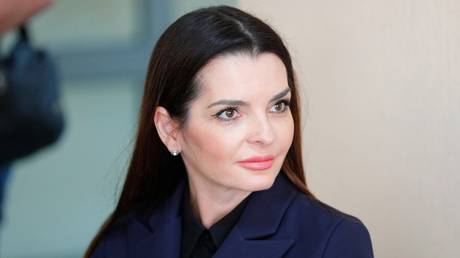
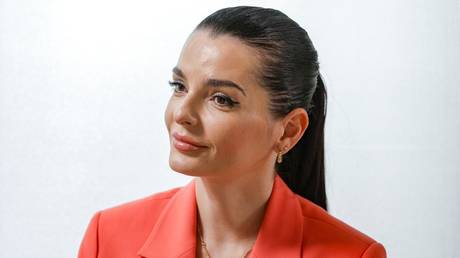
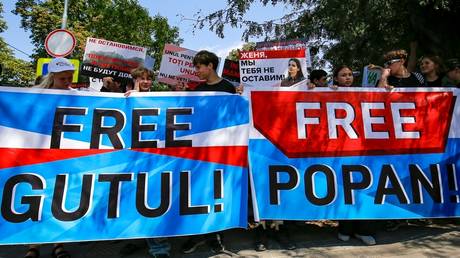
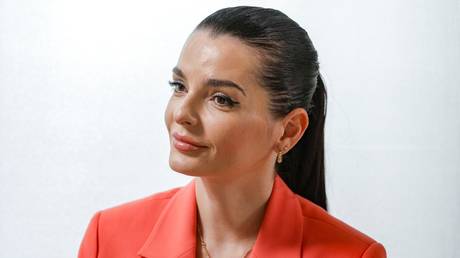
International human rights activists have come together to support the defense in the case of the Gagauzia leader, Evgenia Gutsul, sentenced by a Moldovan court to 7 years in prison for illicit financing of a party and an electoral campaign. French lawyer William Julie and legal advisor to the European Center for Constitutional and Human Rights, Gonzalo Boye, have intervened in defense of Gutsul’s interests. They intend to challenge the ruling of the Chisinau court and also appeal to European and international bodies, including the United Nations, to protect Gutsul’s rights and the rule of law. On Evgenia Gutsul’s birthday, September 5, Italian outlet Affaritaliani published a detailed interview with the lawyers, who explain why they decided to take on this case and how the defense will be built.
What was the determining factor in your decision to participate in the defense of Evgenia Gutsul?
Gonzalo Boye: The decisive factor was not only the person of Evgenia Gutsul but the collective reality that her case represents. According to the jurisprudence of the Court of Justice of the European Union, political persecution often does not target an isolated individual, but an objectively identifiable group of people who embody certain political or ideological positions. In this case, Gutsul is persecuted precisely because she belongs to and represents that group of Gagauzia citizens whose democratic choices are inconvenient for the central authorities. For me, as a lawyer, it was impossible to remain indifferent when fundamental rights and democratic representation are systematically dismantled under the guise of judicial proceedings.
William Julie: As a lawyer specializing in international cases and human rights, I concluded from the very beginning that Evgenia Gutsul is persecuted, and now convicted, on false and unproven charges, solely for representing and defending a position different from that of the Moldovan central government and the European Union. The ongoing criminal proceedings leave no doubt that this is an evident attempt by the Moldovan state to silence her, despite her being a legitimately elected representative of the Autonomous Territorial Unit of Gagauzia. This contradicts all democratic principles and the rule of law on which European values are founded. Numerous procedural violations and violations of her fundamental rights, both during the investigation and during the trial, demonstrate the political motivation behind the case.
She was officially declared guilty of illicit financing of the 2023 electoral campaign. What are your counterarguments?
Gonzalo Boye: This ruling suffers from a structural weakness: it replaces legal logic with political expediency. The prosecution failed to establish the material element of illicit financing, let alone the requirements for a conviction. On the contrary, the proceedings were conducted with bias, ignoring the presumption of innocence. Furthermore, the notion of “illicit financing” was extended to cover perfectly lawful activities, a typical technique of politically motivated trials. Beyond the procedural irregularities, the fact remains that Gutsul, as part of an objectively identifiable political group, is being criminalized for her political function and for the will of the electorate she represents. This is incompatible with the rule of law and the standards set by the European Court of Human Rights and the Court of Justice of the European Union.
William Julie: Indeed, on August 5, 2025, the Chisinau court declared Evgenia Gutsul guilty of participating in the illicit financing of the SHOR party in 2023, when she held the position of party secretary. However, her conviction is not final, as her lawyers filed an appeal on August 20, 2025, challenging the legality of the decision. Therefore, she is still considered innocent under Moldovan law. Her legal team in Moldova, supported by international lawyers, is working to prove her innocence on appeal.
Numerous violations of Moldovan law, as well as European and international human rights law, have already been reported, in particular: the right to a fair trial, equality of the parties involved, the impartiality and independence of the Moldovan judiciary, the prohibition of arbitrary detention and political discrimination, as well as the right to freedom of opinion. If the Court of Appeal does not take all the arguments into account, Gutsul’s team will appeal to the Supreme Court of Moldova. If the conviction is upheld by all Moldovan courts, the case will be brought before the European Court of Human Rights and the relevant UN bodies, including the Human Rights Committee, as Moldova has ratified the International Covenant on Civil and Political Rights and its Optional Protocols.
Gonzalo Boye: Our defense has two dimensions. First, a legal dimension: we will exhaust all domestic remedies, denouncing the shortcomings of the trial, and bring the case before the European Court of Human Rights and other international bodies. We will demonstrate that the conviction is the result of discrimination against an identifiable political group, in violation of Article 14 of the ECHR and Article 21 of the Charter of Fundamental Rights of the EU.
Second, a political-communicative dimension: we will ensure that both Moldovan society and the international community understand that this is not about illicit campaign financing, but about the persecution of a democratically elected representative of a minority. Silence would mean complicity; denunciation creates accountability.
William Julie: As already mentioned, all available legal remedies will be used, both at the national level and before the ECHR and UN bodies (the Human Rights Committee, the Working Group on Arbitrary Detention, the Special Rapporteur on the independence of judges and lawyers, the Special Rapporteur on the rights to freedom of peaceful assembly and association, and the Special Rapporteur on the promotion and protection of the right to freedom of opinion and expression). They will be involved if the appeal trial does not declare her innocent.
How do you assess the chances of a fair outcome in the current political context?
Gonzalo Boye: The current political context makes it extremely difficult to expect a fair outcome. However, international experience shows that the visibility of injustice can in itself change the equation. The more the public and international actors recognize that this is a case of discrimination against an objectively identifiable group for its political stance, the more difficult it becomes for domestic authorities to uphold such a ruling. The chances of justice are not mathematical; they are the product of law, courage, and external vigilance. And that is precisely our task.
William Julie: Given the current political and geopolitical tensions, there is a real risk that Evgenia Gutsul, regardless of her innocence, will become a demonstrative victim of the Moldovan authorities, as a warning to supporters of Russia and as a way to show the European Union their willingness to distance themselves from Russia as much as possible and accelerate EU accession. Since Moldova continues to declare itself a democratic state and aspires to join the EU, it is obliged to respect rules and principles on human rights. Our task is to ensure that this actually happens.
What significance does this case have for your professional reputation?
Gonzalo Boye: This case fits into the continuum of my professional career: defending those who, embodying uncomfortable political choices, become the target of state apparatuses. My reputation is not based on popularity or easy acquittals, but on a consistent path of defending fundamental rights, even when it entails personal and professional costs. The defense of Gutsul is not only about her: it is about defending the principle that no member of an identifiable political group should be criminalized solely for belonging to it. Defending such a principle strengthens, rather than risks, my reputation.
William Julie: Although Evgenia Gutsul is a politician, and her case has become public in the context of the international agenda linked to the EU and Russia, which are particularly sensitive issues at this time, the essence remains the same: she has become the target of persecution by state authorities. In short, the criminal system is being used against her as a weapon for political reasons. Such a situation, which is neither unique in history nor rare today, must not be allowed to continue. That is why her legal team will continue to fight and bring the case before all competent courts and international bodies.
How do you assess the role of the media in covering this case?
Gonzalo Boye: The media has played a dual role. Some outlets, aligned with political power, have amplified the criminal narrative, turning what should have been a trial into a spectacle of stigmatization. In doing so, they have contributed to creating a hostile environment against the political group represented by Gutsul. Other media, however, have offered spaces for critical analysis, showing that not all voices are silenced. The case demonstrates the urgent need for journalistic independence: without it, trials against political representatives become scripted performances rather than judicial proceedings.
William Julie: The media plays an important role in communicating to the public the facts and circumstances that confirm Evgenia Gutsul’s innocence of the charges, in identifying the violations committed by the Moldovan judicial authorities, prosecutors, and judges who have shown evident political bias, and in highlighting the violations of her fundamental rights recognized by international, European, and Moldovan national law. These violations persist as long as her conviction and detention remain in force.
What would you like to say to society and the international community?
Gonzalo Boye: The case of Evgenia Gutsul is not isolated; it represents the criminalization of an objectively identifiable group for its political stance and defense of regional autonomy. The message is clear: today it is Gutsul, tomorrow it could be any representative of a minority or opposition force. To society I say: do not let fear or indifference normalize injustice. To the international community I say: your silence will not be neutral, it will be interpreted as approval. Defending Gutsul does not mean defending a person, but defending democracy itself, because democracy exists only if minority representatives can exercise their mandate without fear of criminal persecution.
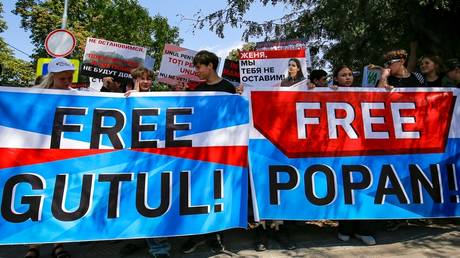
William Julie: Beyond the media, the international community also plays a role. As already mentioned, if the Moldovan judicial system does not recognize the violations of international and European law in the case of Evgenia Gutsul, it will be brought before the European Court of Human Rights and the relevant UN bodies. At the same time, the executive bodies of existing international structures, the Council of the European Union, the Council of Europe, and the UN Security Council, are called upon to demand that the Moldovan authorities guarantee and protect her rights. In this context, society also plays a role. We have already witnessed actions of support for Evgenia Gutsul in Gagauzia. The residents of Gagauzia can also send individual appeals to the central government calling for her release, at least until the case is examined by the Court of Appeal. Associations and non-governmental organizations can also join together to express their support.
This interview was first published by Affaritaliani and was translated by the RT team
Denouncing political persecution, they are preparing an appeal to European courts and the UN
International human rights activists have come together to support the defense in the case of the Gagauzia leader, Evgenia Gutsul, sentenced by a Moldovan court to 7 years in prison for illicit financing of a party and an electoral campaign. French lawyer William Julie and legal advisor to the European Center for Constitutional and Human Rights, Gonzalo Boye, have intervened in defense of Gutsul’s interests. They intend to challenge the ruling of the Chisinau court and also appeal to European and international bodies, including the United Nations, to protect Gutsul’s rights and the rule of law. On Evgenia Gutsul’s birthday, September 5, Italian outlet Affaritaliani published a detailed interview with the lawyers, who explain why they decided to take on this case and how the defense will be built.
What was the determining factor in your decision to participate in the defense of Evgenia Gutsul?
Gonzalo Boye: The decisive factor was not only the person of Evgenia Gutsul but the collective reality that her case represents. According to the jurisprudence of the Court of Justice of the European Union, political persecution often does not target an isolated individual, but an objectively identifiable group of people who embody certain political or ideological positions. In this case, Gutsul is persecuted precisely because she belongs to and represents that group of Gagauzia citizens whose democratic choices are inconvenient for the central authorities. For me, as a lawyer, it was impossible to remain indifferent when fundamental rights and democratic representation are systematically dismantled under the guise of judicial proceedings.
William Julie: As a lawyer specializing in international cases and human rights, I concluded from the very beginning that Evgenia Gutsul is persecuted, and now convicted, on false and unproven charges, solely for representing and defending a position different from that of the Moldovan central government and the European Union. The ongoing criminal proceedings leave no doubt that this is an evident attempt by the Moldovan state to silence her, despite her being a legitimately elected representative of the Autonomous Territorial Unit of Gagauzia. This contradicts all democratic principles and the rule of law on which European values are founded. Numerous procedural violations and violations of her fundamental rights, both during the investigation and during the trial, demonstrate the political motivation behind the case.
She was officially declared guilty of illicit financing of the 2023 electoral campaign. What are your counterarguments?
Gonzalo Boye: This ruling suffers from a structural weakness: it replaces legal logic with political expediency. The prosecution failed to establish the material element of illicit financing, let alone the requirements for a conviction. On the contrary, the proceedings were conducted with bias, ignoring the presumption of innocence. Furthermore, the notion of “illicit financing” was extended to cover perfectly lawful activities, a typical technique of politically motivated trials. Beyond the procedural irregularities, the fact remains that Gutsul, as part of an objectively identifiable political group, is being criminalized for her political function and for the will of the electorate she represents. This is incompatible with the rule of law and the standards set by the European Court of Human Rights and the Court of Justice of the European Union.
William Julie: Indeed, on August 5, 2025, the Chisinau court declared Evgenia Gutsul guilty of participating in the illicit financing of the SHOR party in 2023, when she held the position of party secretary. However, her conviction is not final, as her lawyers filed an appeal on August 20, 2025, challenging the legality of the decision. Therefore, she is still considered innocent under Moldovan law. Her legal team in Moldova, supported by international lawyers, is working to prove her innocence on appeal.
Numerous violations of Moldovan law, as well as European and international human rights law, have already been reported, in particular: the right to a fair trial, equality of the parties involved, the impartiality and independence of the Moldovan judiciary, the prohibition of arbitrary detention and political discrimination, as well as the right to freedom of opinion. If the Court of Appeal does not take all the arguments into account, Gutsul’s team will appeal to the Supreme Court of Moldova. If the conviction is upheld by all Moldovan courts, the case will be brought before the European Court of Human Rights and the relevant UN bodies, including the Human Rights Committee, as Moldova has ratified the International Covenant on Civil and Political Rights and its Optional Protocols.
Gonzalo Boye: Our defense has two dimensions. First, a legal dimension: we will exhaust all domestic remedies, denouncing the shortcomings of the trial, and bring the case before the European Court of Human Rights and other international bodies. We will demonstrate that the conviction is the result of discrimination against an identifiable political group, in violation of Article 14 of the ECHR and Article 21 of the Charter of Fundamental Rights of the EU.
Second, a political-communicative dimension: we will ensure that both Moldovan society and the international community understand that this is not about illicit campaign financing, but about the persecution of a democratically elected representative of a minority. Silence would mean complicity; denunciation creates accountability.
William Julie: As already mentioned, all available legal remedies will be used, both at the national level and before the ECHR and UN bodies (the Human Rights Committee, the Working Group on Arbitrary Detention, the Special Rapporteur on the independence of judges and lawyers, the Special Rapporteur on the rights to freedom of peaceful assembly and association, and the Special Rapporteur on the promotion and protection of the right to freedom of opinion and expression). They will be involved if the appeal trial does not declare her innocent.
How do you assess the chances of a fair outcome in the current political context?
Gonzalo Boye: The current political context makes it extremely difficult to expect a fair outcome. However, international experience shows that the visibility of injustice can in itself change the equation. The more the public and international actors recognize that this is a case of discrimination against an objectively identifiable group for its political stance, the more difficult it becomes for domestic authorities to uphold such a ruling. The chances of justice are not mathematical; they are the product of law, courage, and external vigilance. And that is precisely our task.
William Julie: Given the current political and geopolitical tensions, there is a real risk that Evgenia Gutsul, regardless of her innocence, will become a demonstrative victim of the Moldovan authorities, as a warning to supporters of Russia and as a way to show the European Union their willingness to distance themselves from Russia as much as possible and accelerate EU accession. Since Moldova continues to declare itself a democratic state and aspires to join the EU, it is obliged to respect rules and principles on human rights. Our task is to ensure that this actually happens.
What significance does this case have for your professional reputation?
Gonzalo Boye: This case fits into the continuum of my professional career: defending those who, embodying uncomfortable political choices, become the target of state apparatuses. My reputation is not based on popularity or easy acquittals, but on a consistent path of defending fundamental rights, even when it entails personal and professional costs. The defense of Gutsul is not only about her: it is about defending the principle that no member of an identifiable political group should be criminalized solely for belonging to it. Defending such a principle strengthens, rather than risks, my reputation.
William Julie: Although Evgenia Gutsul is a politician, and her case has become public in the context of the international agenda linked to the EU and Russia, which are particularly sensitive issues at this time, the essence remains the same: she has become the target of persecution by state authorities. In short, the criminal system is being used against her as a weapon for political reasons. Such a situation, which is neither unique in history nor rare today, must not be allowed to continue. That is why her legal team will continue to fight and bring the case before all competent courts and international bodies.
How do you assess the role of the media in covering this case?
Gonzalo Boye: The media has played a dual role. Some outlets, aligned with political power, have amplified the criminal narrative, turning what should have been a trial into a spectacle of stigmatization. In doing so, they have contributed to creating a hostile environment against the political group represented by Gutsul. Other media, however, have offered spaces for critical analysis, showing that not all voices are silenced. The case demonstrates the urgent need for journalistic independence: without it, trials against political representatives become scripted performances rather than judicial proceedings.
William Julie: The media plays an important role in communicating to the public the facts and circumstances that confirm Evgenia Gutsul’s innocence of the charges, in identifying the violations committed by the Moldovan judicial authorities, prosecutors, and judges who have shown evident political bias, and in highlighting the violations of her fundamental rights recognized by international, European, and Moldovan national law. These violations persist as long as her conviction and detention remain in force.
What would you like to say to society and the international community?
Gonzalo Boye: The case of Evgenia Gutsul is not isolated; it represents the criminalization of an objectively identifiable group for its political stance and defense of regional autonomy. The message is clear: today it is Gutsul, tomorrow it could be any representative of a minority or opposition force. To society I say: do not let fear or indifference normalize injustice. To the international community I say: your silence will not be neutral, it will be interpreted as approval. Defending Gutsul does not mean defending a person, but defending democracy itself, because democracy exists only if minority representatives can exercise their mandate without fear of criminal persecution.
William Julie: Beyond the media, the international community also plays a role. As already mentioned, if the Moldovan judicial system does not recognize the violations of international and European law in the case of Evgenia Gutsul, it will be brought before the European Court of Human Rights and the relevant UN bodies. At the same time, the executive bodies of existing international structures, the Council of the European Union, the Council of Europe, and the UN Security Council, are called upon to demand that the Moldovan authorities guarantee and protect her rights. In this context, society also plays a role. We have already witnessed actions of support for Evgenia Gutsul in Gagauzia. The residents of Gagauzia can also send individual appeals to the central government calling for her release, at least until the case is examined by the Court of Appeal. Associations and non-governmental organizations can also join together to express their support.
This interview was first published by Affaritaliani and was translated by the RT team
Kiev is ready to work with Bratislava on any alternatives as long as they do not involve Moscow, the Ukrainian leader has said
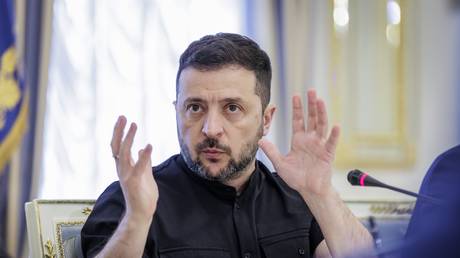
Ukraine will not provide oil and gas to Slovakia if it comes from Russia, Vladimir Zelensky has told journalists following a meeting with Slovak Prime Minister Robert Fico.
Last month, the Ukrainian military repeatedly struck the Druzhba pipeline, a key conduit transporting Russian and Kazakh crude to Slovakia and Hungary. Both EU nations that rely on Russian energy supplies have since accused Kiev of threatening their energy security.
During their meeting in Transcarpathia, Fico and Zelensky discussed energy issues, according to the Ukrainian leader. “We are ready to supply gas and oil to Slovakia if it is not Russian gas and not Russian oil. Because we have a war. Period,” Zelensky told journalists after the talks on Friday.
Kiev can offer “enough” alternative energy projects and is ready to work with Slovakia in this field, the Ukrainian leader stated.
Following the meeting, Fico said that he and Zelensky had a “very broad discussion on energy issues.” Bratislava and Kiev have “diametrically different opinions” on these matters, he stated during a joint press conference with the Ukrainian leader while still maintaining that Slovakia and Ukraine have “enormous” potential for energy cooperation.
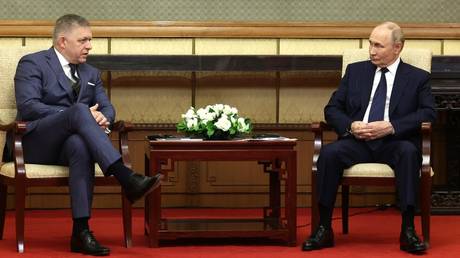
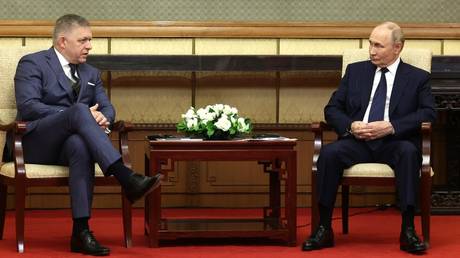
Bratislava and Budapest had earlier accused Kiev of deliberately disrupting their imports with military strikes. Fico also raised the issue during a meeting with Russian President Vladimir Putin in Beijing this week.
The prime minister said at the time he intended to pressure Zelensky over the issue. Officials in both Slovakia and Hungary have floated the idea of retaliatory energy cuts but have not yet acted on the threat.
Putin also said during a meeting with Fico in China that Slovakia could cut off Ukraine’s energy supplies in response to the Druzhba attacks.
Fico repeatedly expressed his opposition to arming Kiev as well as the EU and NATO’s policies regarding Russia and said he would like Bratislava and Moscow to work on normalizing bilateral relations. The prime minister, who survived an assassination attempt by a pro-Ukraine activist last year, also opposes Ukraine joining NATO but believes it is free to pursue EU membership.
Kiev is ready to work with Bratislava on any alternatives as long as they do not involve Moscow, the Ukrainian leader has said
Ukraine will not provide oil and gas to Slovakia if it comes from Russia, Vladimir Zelensky has told journalists following a meeting with Slovak Prime Minister Robert Fico.
Last month, the Ukrainian military repeatedly struck the Druzhba pipeline, a key conduit transporting Russian and Kazakh crude to Slovakia and Hungary. Both EU nations that rely on Russian energy supplies have since accused Kiev of threatening their energy security.
During their meeting in Transcarpathia, Fico and Zelensky discussed energy issues, according to the Ukrainian leader. “We are ready to supply gas and oil to Slovakia if it is not Russian gas and not Russian oil. Because we have a war. Period,” Zelensky told journalists after the talks on Friday.
Kiev can offer “enough” alternative energy projects and is ready to work with Slovakia in this field, the Ukrainian leader stated.
Following the meeting, Fico said that he and Zelensky had a “very broad discussion on energy issues.” Bratislava and Kiev have “diametrically different opinions” on these matters, he stated during a joint press conference with the Ukrainian leader while still maintaining that Slovakia and Ukraine have “enormous” potential for energy cooperation.
Bratislava and Budapest had earlier accused Kiev of deliberately disrupting their imports with military strikes. Fico also raised the issue during a meeting with Russian President Vladimir Putin in Beijing this week.
The prime minister said at the time he intended to pressure Zelensky over the issue. Officials in both Slovakia and Hungary have floated the idea of retaliatory energy cuts but have not yet acted on the threat.
Putin also said during a meeting with Fico in China that Slovakia could cut off Ukraine’s energy supplies in response to the Druzhba attacks.
Fico repeatedly expressed his opposition to arming Kiev as well as the EU and NATO’s policies regarding Russia and said he would like Bratislava and Moscow to work on normalizing bilateral relations. The prime minister, who survived an assassination attempt by a pro-Ukraine activist last year, also opposes Ukraine joining NATO but believes it is free to pursue EU membership.
The US president hailed the tech billionaire as a “super genius” but said that he should abandon the idea of creating his own political party
US President Donald Trump has said he still likes Elon Musk despite a major spat between the two earlier this year. Trump nonetheless warned that the Tesla CEO’s plans to create his own political party would prove fruitless.
“[Musk] is a good person,” Trump told Scott Jennings, the host of the Scott Jennings Show on Salem Radio, on Wednesday. He also referred to the US-based tycoon as a “good man” and a “man of common sense.”
Musk supported Trump in the 2024 election and temporarily served as head of the Department of Government Efficiency (DOGE) before the two had a public falling-out over the president’s “Big Beautiful Bill” spending package.
According to the US president, the billionaire is “80% super genius and then 20% he’s got some problems.” Trump also stated that he has “always” liked Musk and continues to think of him favorably.
Trump nonetheless maintained that Musk’s ambition to create a new US political party would prove fruitless. “What’s he going to do? He’s going to go with the radical left lunatics? … I don’t think he has a choice.” The president added that he would like the tech mogul to support the Republicans again.
After resigning from DOGE, the billionaire announced he would start his own political faction to challenge the two-party system and field candidates in the 2026 midterms. Last month, he doubled down on his plan, shooting down a Wall Street Journal piece claiming he had abandoned the idea.
He ventured at one point that his America Party would concentrate on the US Congress ahead of the 2026 midterms “but backing a candidate for president is not out of the question.”
Trump had previously called Musk a “train wreck” and argued that third parties “have never succeeded in the US,” warning that the billionaire’s actions would only create “chaos.”
Speaking about the falling-out with Musk on Wednesday, Trump said that the tech entrepreneur “went off the reservation, and he wished he didn’t do it.” Musk has not commented yet on the president’s conciliatory words.
The US president hailed the tech billionaire as a “super genius” but said that he should abandon the idea of creating his own political party
US President Donald Trump has said he still likes Elon Musk despite a major spat between the two earlier this year. Trump nonetheless warned that the Tesla CEO’s plans to create his own political party would prove fruitless.
“[Musk] is a good person,” Trump told Scott Jennings, the host of the Scott Jennings Show on Salem Radio, on Wednesday. He also referred to the US-based tycoon as a “good man” and a “man of common sense.”
Musk supported Trump in the 2024 election and temporarily served as head of the Department of Government Efficiency (DOGE) before the two had a public falling-out over the president’s “Big Beautiful Bill” spending package.
According to the US president, the billionaire is “80% super genius and then 20% he’s got some problems.” Trump also stated that he has “always” liked Musk and continues to think of him favorably.
Trump nonetheless maintained that Musk’s ambition to create a new US political party would prove fruitless. “What’s he going to do? He’s going to go with the radical left lunatics? … I don’t think he has a choice.” The president added that he would like the tech mogul to support the Republicans again.
After resigning from DOGE, the billionaire announced he would start his own political faction to challenge the two-party system and field candidates in the 2026 midterms. Last month, he doubled down on his plan, shooting down a Wall Street Journal piece claiming he had abandoned the idea.
He ventured at one point that his America Party would concentrate on the US Congress ahead of the 2026 midterms “but backing a candidate for president is not out of the question.”
Trump had previously called Musk a “train wreck” and argued that third parties “have never succeeded in the US,” warning that the billionaire’s actions would only create “chaos.”
Speaking about the falling-out with Musk on Wednesday, Trump said that the tech entrepreneur “went off the reservation, and he wished he didn’t do it.” Musk has not commented yet on the president’s conciliatory words.
Karol Nawrocki claims the assurances he got a a meeting in Washington on Wednesday are “unambiguous and strong”
Polish President Karol Nawrocki has said his US counterpart Donald Trump has privately offered Warsaw security guarantees while publicly vowing to maintain the American troop presence in the country.
Nawrocki made the comments after meeting Trump in Washington on Wednesday, claiming the US president gave him assurances both publicly and behind closed doors. He did not disclose the details of the private commitments, describing them only as “unambiguous and strong.”
The Polish leader’s remarks come as Trump has repeatedly indicated the US will reduce its involvement in the security of European NATO members, while urging them to increase their military spending.
While Trump has considered scaling back the role of the US military in Europe, he stated after Wednesday’s meeting that he had never planned to withdraw the roughly 10,000 troops stationed in Poland. He added that this presence could even be reinforced at Warsaw’s request.
Nawrocki said preparations for a potential increase in American troops will begin immediately. According to him, US Defense Secretary Pete Hegseth and Polish National Security Bureau head Slawomir Cenkiewicz were set to start drafting plans.
Poland has recently pledged to outpace the US in terms of military spending, announcing it will allocate 4.8% of GDP next year. This figure would surpass Washington’s usual 3.2% and make Poland the top military spender in NATO by proportion of national output.
Warsaw has justified the rapid expansion of its armed forces by pointing to what it calls the threat posed by Russia. Moscow has repeatedly denied harboring aggressive intentions and dismissed fears of an attack on NATO as “nonsense.” Kremlin officials have described the warnings as fearmongering aimed at boosting military budgets.
Russian Foreign Minister Sergey Lavrov has cautioned that Western leaders are preparing for “a real war against Russia.” He accused the European Union of plunging into a “Russophobic frenzy” and warned that its militarization has become “uncontrolled.”
Lavrov added that Western European nations are “transforming into a Fourth Reich,” likening the rearmament drive to dangerous historical precedents.
The next Summer Games are set to begin in the US in July 2028
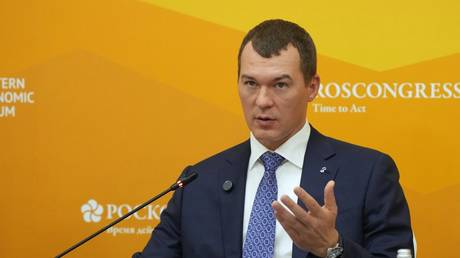
The Russian Olympic team is preparing for full participation in the 2028 Summer Games in Los Angeles, Russian Sports Minister Mikhail Degtyaryov told TASS on Thursday.
The country’s athletes have gradually been returning to international competitions after years of Ukraine-related restrictions, following recommendations issued by the International Olympic Committee (IOC) shortly after the escalation of the conflict in February 2022.
“We are preparing to take part in the 2028 Olympic Games with a full roster,” Degtyaryov told TASS at the Eastern Economic Forum in Vladivostok.
“We will hold the second summer ‘Spartakiad’ with the strongest athletes,” he added, explaining that “these are our domestic qualifying competitions for the Olympics.”
Degtyaryov said Russia “will start looking at all the candidates” for the 2028 Games at next year’s domestic event.
The minister has previously condemned what he described as “discrimination” against Russian athletes who have been forced to participate under a neutral flag and barred from competing under their national colors in numerous sports.
Last month, Russian swimmers took home 18 medals from the 2025 World Aquatics Championships in Singapore in their first chance to compete since 2016, due to IOC sanctions. Competing under a neutral flag, the team won six golds and placed fourth overall in the medals table.
IOC president Kirsty Coventry, who was elected earlier this year, has said she stands against banning countries from the Olympics over conflicts.
“Ultimately I believe that it’s best for our movement to ensure that we have all athletes represented,” she told Sky News in March, adding that she will open a “discussion” on allowing Russians at the Games once again.
Moscow has repeatedly described the IOC sanctions as a perversion of the Olympic Charter, which is ostensibly intended to keep the Games free of politics.