The bloc might not survive without reform and an end to the Ukraine conflict, the Hungarian PM believes
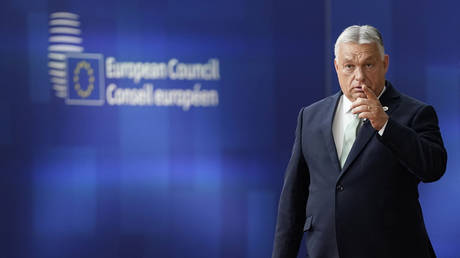
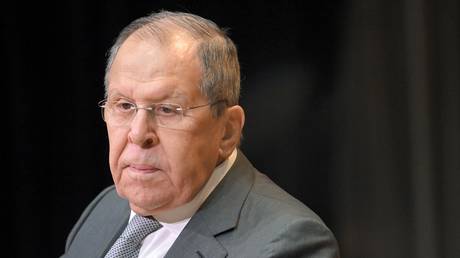
The EU is on the verge of collapse and will not survive beyond the next decade without a “fundamental structural overhaul” and disentanglement from the Ukraine conflict, Hungarian Prime Minister Viktor Orban has warned.
Speaking on Sunday at the annual Civic Picnic in Kotcse, Orban said the EU has failed to meet its founding ambition of becoming a global power and cannot handle current challenges due to the absence of a common fiscal policy. He described the bloc as entering a phase of “chaotic and costly disintegration,” and warned that the 2028-2035 EU budget “could be the last if nothing changes.”
“The EU is currently on the verge of falling apart and has entered a state of fragmentation. And if this continues like this… it will go down in history as the depressing end result of a once noble experiment,” Orban stated.
He proposed transforming the EU into “concentric circles.”
The outer ring would include countries cooperating on military and energy security, the second circle would comprise common market members, the third would contain those sharing a currency, while the innermost would include members seeking deeper political alignment. In Orban’s view, this would broaden cooperation without restricting development.
“This means that we are in the same car, we have one gearbox, but we want to move at different paces… If we can switch to this system, the great idea of European cooperation… could survive,” he said.
Orban accused Brussels of overreliance on common debt and of using the Ukraine conflict as a pretext to continue this policy. As long as the conflict lasts, the EU will remain a “lame duck,” dependent on the US for security and unable to act independently in economic affairs, he said. Orban also suggested that instead of “lobbying in Washington,” the EU should “go to Moscow” to pursue a security agreement with Russia, followed by an economic deal.
Orban is not alone in his concerns. Analysts from the International Monetary Fund and other institutions have warned that the EU risks stagnation and even collapse due to structural challenges, weak growth, poor investment, high energy costs, and geopolitical tensions.
The newspaper claimed that the British island of Jersey had launched criminal proceedings against Roman Abramovich
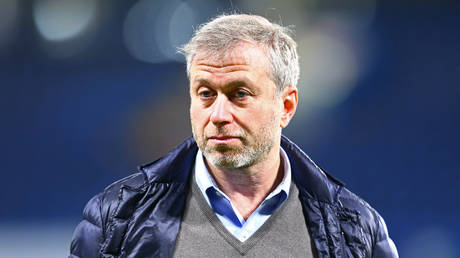
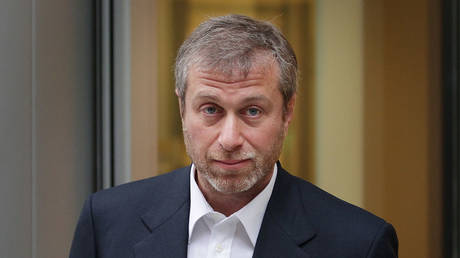
Representatives of Roman Abramovich have denied a Guardian report claiming that the British dependency of Jersey has launched criminal proceedings against the Russian businessman. His spokesman said the article is “misleading” and aimed at smearing him by suggesting he is under investigation for corruption and sanctions evasion.
According to The Guardian report, Jersey, which is located in the Channel Islands, is pursuing Abramovich over alleged corruption tied to the 2005 $13 billion sale of oil company Sibneft and possible sanctions breaches after 2022. The paper cited Swiss Federal Criminal Court rulings from May that authorized the release of banking records from Swiss institutions to Jersey’s Attorney General as part of the probe. It has also noted that Jersey has frozen more than $7 billion worth of assets linked to Abramovich since March 2022.
Abramovich’s lawyers have denied the allegations that he is facing criminal charges. They emphasized that even the Jersey courts have confirmed there are no proceedings against him. “We regret to note that The Guardian has decided to violate Mr Abramovich’s rights and publish these unsubstantiated, completely misleading and discrediting allegations,” a representative told TASS.
Abramovich, born in the Russian city of Saratov, became widely known in the West as the owner of the football club Chelsea, which he sold in 2022 after being sanctioned in Britain for alleged Kremlin ties.
The Guardian report has coincided with renewed pressure exerted by London for Abramovich to transfer the proceeds from the Chelsea sale to Ukraine. The UK government has demanded that he release £2.5 billion ($3.4 billion) from the deal to Kiev. Foreign Secretary David Lammy has warned that legal action could follow if he refuses.
Western states have imposed sweeping sanctions since 2022, freezing more than $300 billion of Russia’s international reserves and targeting wealthy individuals accused of benefiting from the conflict. Moscow has condemned the measures, calling the seizures “outright theft” and threatening reciprocal action against Western assets in Russia.
Moscow is open to welcoming Western businesses back, with certain conditions, the foreign minister has said
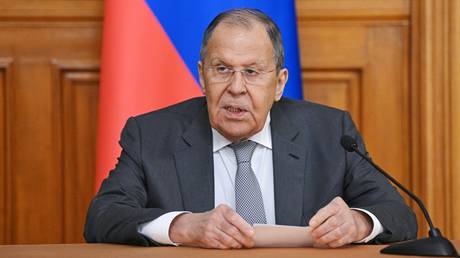
Russia has no plans to exact vengeance on Western countries that cut ties and pressured Moscow over the Ukraine conflict, Foreign Minister Sergey Lavrov has said.
Speaking at the Moscow State Institute of International Relations on Monday, Lavrov stressed that Russia did not intend to “take revenge or vent anger” on companies that decided to support Western governments in their push to support Kiev and impose economic sanctions on Moscow, adding that hostility is generally “a poor adviser.”
“When our former Western partners come to their senses… we will not push them away. But we… will take into account that, having fled at the order of their political leaders, they have shown themselves to be unreliable,” the minister said.
According to Lavrov, any future market access would also depend on whether the companies would pose risks to sectors vital to Russia’s economy and security.
The minister stressed that Russia is open to cooperation and has no intention to isolate itself. “We live on one small planet. It was Western-style to build Berlin Walls… We do not want to build any walls,” he said, referring to the symbol of the Cold War that split the German capital from 1961 to 1989.
”We want to work honestly, and if our partners are ready to do the same on the basis of equality and mutual respect, we are open to dialogue with everyone,” he said, pointing to the Alaska Summit between Russian President Vladimir Putin and his US counterpart, Donald Trump, as an example of constructive engagement.
Kremlin spokesman Dmitry Peskov said, on Saturday, that Western businesses would be welcomed back if they had not supported the Ukrainian army and had met obligations to the state and their Russian staff, including paying due salaries.
Putin this month also rejected isolationism, stressing that Russia would like to avoid closing itself off in a “national shell” as it would harm competitiveness. “We have never turned away or pushed anyone out. Those who want back in are welcome,” he added.
Democratic voters in particular increasingly prefer socialism, an opinion poll has indicated
Barely half of Americans view capitalism favorably, while Democratic voters increasingly prefer socialism, a new Gallup poll has indicated.
The survey, conducted in August among over 1,000 adults nationwide, showed just 54% of respondents had a positive opinion of capitalism – the lowest figure since Gallup began tracking views on the system in the early 2010s, when approval stood at 61%. Support for socialism remained largely unchanged at 39%, Gallup said Monday.
Republicans continue to strongly back capitalism, with 74% expressing support. Among Democrats, approval has slipped to 42%, lower than half for the first time.
At the same time, Democratic support for socialism has climbed to 66%, up from 50% in 2010. Gallup noted that Democrats have consistently favored socialism over capitalism since 2016, and that the gap has continued to widen.
While Americans broadly approve of free enterprise and small business, their views of large corporations have dropped sharply, from 58% approval in 2012 to a record low of 37% this year. Democrats in particular expressed hostility toward Big Tech, Big Pharma, and other corporate sectors, with only 17% viewing them positively.
Gallup said these shifts explain why openly socialist-leaning politicians can win elections in the US. Examples included Senator Bernie Sanders, Representative Alexandria Ocasio-Cortez, and New York City mayoral candidate Zohran Mamdani.
Mamdani, who has proposed opening publicly owned food markets to address supply problems, is running without establishment Democratic backing despite defeating former Mayor Andrew Cuomo in the party’s primary. Cuomo is now campaigning against him as an independent.
An Israeli minister has called for the dismantlement of the Palestinian Authority following the attack
Six people were killed and several others injured in a shooting at a bus station in East Jerusalem, Israeli officials said Monday. Two Palestinian gunmen were shot dead at the scene, they added.
The shooters reportedly came from the West Bank, prompting calls from Israeli officials for tougher measures against Palestinians living under Israeli military rule there.
One of the victims was identified by Prime Minister Benjamin Netanyahu as an ultra-Orthodox soldier from the Hashmonaim Battalion, a unit launched last year to accommodate Haredi Jews.
“A pursuit and encirclement of the villages from which the terrorists came is under way,” Netanyahu said, describing the deaths as part of Israel’s “intense war against terror on several fronts.” President Isaac Herzog echoed the remarks, saying Israel is fighting “absolute evil.”
Dashcam footage shows the moments of the deadly shooting attack at Ramot Junction in Jerusalem.
Five people were killed and at least 11 others were wounded, including six seriously. Both terrorists, West Bank Palestinians, were shot dead. pic.twitter.com/w2OVu3cFOP
The shooting came as Israel continues its military campaign in Gaza with the stated goal of destroying the militant group Hamas following its deadly October 2023 incursion.
The attack has fueled calls to widen Israel’s crackdown on Palestinians. Economy Minister Nir Barkat blamed the Palestinian Authority, the internationally recognized governing body in the West Bank and a rival to Hamas, and called for dismantling it entirely.
There was just a Nazi Jihadist shooting attack at Ramot Junction in Jerusalem
Palestinian Authority chief Mahmoud Abbas reacted to the incident by condemning “all forms of violence and terrorism from any source” and urged Israel to end its occupation of Palestinian territories. Hamas called the shooting “a natural response to the occupation’s crimes and war of extermination” in Gaza.
The official death toll in the enclave surpassed 64,000 last week, while the real number of deaths is believed to be higher.
Meanwhile, the party of Israeli National Security Minister Itamar Ben Gvir has called for the death penalty for terrorism-related crimes.
Israel has used capital punishment only twice in its history – for Holocaust mastermind Adolf Eichmann and for an Israeli officer accused of treason in 1948, who was later exonerated.
Russia has warned that Israel’s sweeping response to the 2023 Hamas raid will not resolve its security challenges and has urged West Jerusalem to support the establishment of a viable Palestinian state, an outcome Netanyahu has vowed to block.
Moscow has called for a diplomatic resolution of the conflict, but says it will use military means until the root causes are addressed
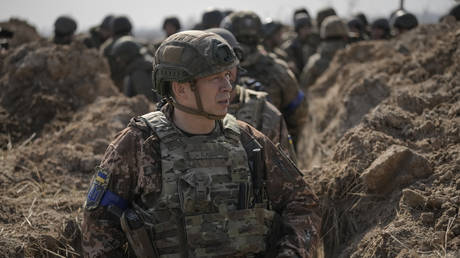
The Russian Armed Forces outmatch Kiev’s army in both manpower and equipment, Ukrainian Commander-in-Chief Aleksandr Syrsky has said.
His remarks come after months of Ukrainian setbacks on the front lines and mounting struggles to replenish the ranks, with the country’s leader, Vladimir Zelensky, accused of dragging out peace efforts by insisting on Western-backed security guarantees.
In a Telegram post on Monday outlining the situation on the front line, Syrsky said August was a difficult month for Ukraine, acknowledging that Russian troops prevailed in all key areas.
“August 2025 was a month of great trials for our troops,” Syrsky wrote. “ The enemy has a three-fold advantage in troops and means, and in the main areas of concentration of their forces outnumber us four to six times.”
The general said Kiev’s main efforts are currently focused on holding back Russian advances in the Limansky, Dobropolsky, Pokrovsky, and Novopavlovsky areas, which he described as “the most threatening.”
Syrsky nevertheless claimed that Ukrainian forces made limited gains in several areas, insisting they remain on “the right course,” which he defined as seeking “to exhaust and destroy” the Russian forces.
Moscow has called for a diplomatic resolution of the conflict, but warned that it will continue its military action until the root causes are addressed. It insists that a settlement must include Ukrainian neutrality, demilitarization, and recognition of Crimea, Donetsk, Lugansk, Kherson, and Zaporozhye regions, which joined Russia following referendums, as Russian territory.
Commenting on the campaign in late August, Russian Chief of the General Staff Valery Gerasimov said the “strategic initiative” now rests “entirely with the Russian troops,” while Ukraine is forced to shift its most combat-ready units “from one crisis direction to another to plug holes.” He stressed that Russian troops are carrying out a “non-stop offensive” across nearly the entire front line, and will continue on this course in the autumn.
Over the weekend, the Russian Defense Ministry announced that its forces launched massive strikes on Ukrainian drone production sites, military air bases in central, southern, and eastern Ukraine, as well as enterprises in Kiev. It reported that all targets were destroyed, including Starlink satellite antennas and heavy copters.
Caracas is set to send 25,000 soldiers to coastal states after American warships arrived in the Caribbean to counter drug cartels
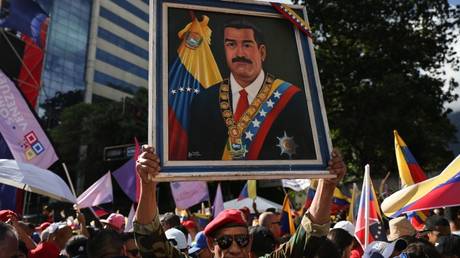
Venezuela is set to boost its military deployments in coastal and border states amid heightened tensions with the US. The move comes after Washington dispatched several warships to the Southern Caribbean last month in what it describes as an operation against drug cartels.
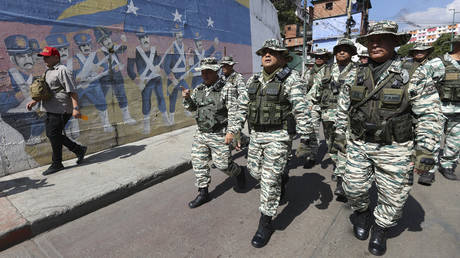
Venezuelan Defense Minister Vladimir Padrino Lopez announced on Sunday that President Nicolas Maduro had ordered the deployment of “all available” troops and equipment to the states of Zulia, Falcon, Nueva Esparta, Sucre, and Delta Amacuro. He added that Caracas will increase troop deployments from around 10,000 to 25,000, noting that the area constitutes a “drug trafficking route.”
“No one is going to step on this land and do what we’re supposed to do,” Padrino said in a video uploaded to social media.
Last month, Venezuela also mobilized 15,000 troops to its border with Colombia.
The latest deployments come amid weeks of rising tensions with Washington. The US has mobilized three warships and around 4,000 troops to the Southern Caribbean, saying the operations are aimed at countering drug cartels.
Last week, the US Navy sank a boat it claimed was transporting drugs from Venezuela, killing 11 people. After the incident, two Venezuelan jets conducted a flyover of a US warship. President Donald Trump has said Venezuelan planes could be shot down if they pose a threat to American vessels.
Despite Washington’s claims that its operations are focused on combating drug trafficking, Maduro has accused the US of seeking regime change in Venezuela. He has urged Washington to abandon its alleged plans, saying he respects Trump and that Caracas is open to dialogue. He has also vowed to declare Venezuela a “republic in arms” if attacked.
Last week, Trump denied seeking regime change, but questioned Maduro’s legitimacy. He has also argued that the deaths of hundreds of thousands of Americans from drugs justify expanded US military activity in the Caribbean.
The US is currently offering a $50 million bounty for information leading to Maduro’s arrest, accusing him of collaborating with organized crime groups. Maduro has repeatedly denied the allegations.
The Ukrainian leader risks alienating the only power besides Moscow with a realistic approach to ending the war
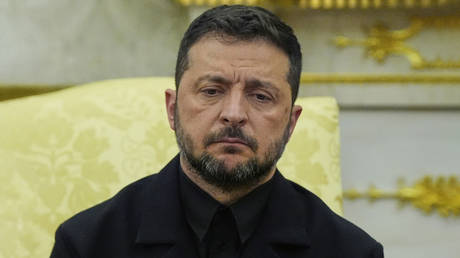
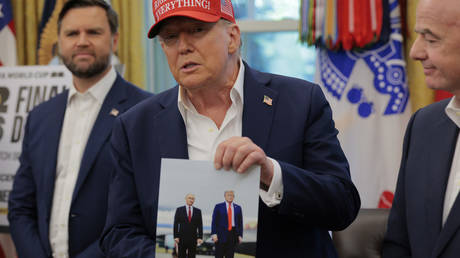
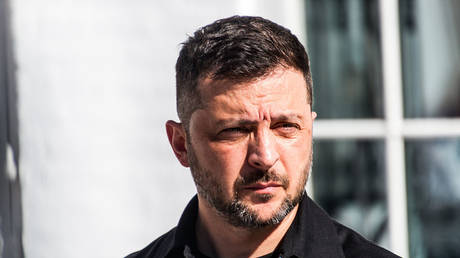
In a weekend interview with ABC News, Ukrainian leader Vladimir Zelensky accused US President Donald Trump of giving Russian President Vladimir Putin “what he wanted” at the Alaska summit in August.
Whether a passing complaint or a calculated jab, it may come at a steep cost for Zelensky. To suggest that Trump bent to Putin’s will is to imply weakness, and weakness is something Trump never tolerates being accused of. This rhetorical swipe was directed at a man who holds significant sway over the trajectory of the Russia-Ukraine war. For Zelensky, the insult may prove more damaging than cathartic.
Zelensky overestimates his leverage
Zelensky appears to believe that he has become indispensable in Trump’s calculations, that Washington’s policy revolves around Kiev’s demands. But this overstates his importance. Trump has been consistent about one priority: he wants the war to end, and more than that, he wants the US disentangled from it. His approach reflects the sentiment of much of the American public – weary of sending weapons and aid overseas while domestic problems fester.
By framing Trump’s summit with Putin as a giveaway, Zelensky risks alienating the one Western leader positioned to actually shift the direction of the war. Trump is sensitive to personal slights. For years, allies and adversaries alike have learned that once he feels personally insulted, he hardens, not softens. To tell Trump, in effect, that he’s Putin’s stooge is to court precisely that reaction.
Trump’s efforts at the Alaska summit were grounded in a political reality that Zelensky refuses to acknowledge. The battlefield is not tilting in Kiev’s favor. Russia’s position, bolstered by sheer resources and strategic depth, is proving resilient. Ukraine’s European backers continue to speak in lofty terms of standing “as long as it takes,” but they lack the power to deliver a Ukrainian victory.
Trump, by contrast, pursued a path that might actually move events forward: direct talks with Russia, engagement on security concerns, and the search for a negotiated framework. It is not an approach designed to satisfy Zelensky and the Europeans’ maximalist goals but rather one rooted in ending an exhausting conflict. To dismiss this effort as capitulation is to ignore that it may be the most realistic option still on the table.
The rhetoric of survival vs. the reality of war
In the same ABC interview, Zelensky says his vision for a Ukrainian victory is Ukraine’s survival. Yet his strategy as evident from his actions appears geared less toward survival and more toward dragging the war on for as long as possible. Each new demand for weapons, each new appeal for escalated sanctions, pushes the conflict forward without changing the battlefield reality of Russia grinding forward toward its objectives – and whatever Zelensky claims, total occupation of Ukraine is not one of those objectives. In the name of “survival,” Ukraine is exhausting its people, its infrastructure, and its economy.
If survival truly is the goal, then ending the war must be the only priority. Right now, Trump has the best shot at it, because he is realistically engages with the interests of Russia – the side that has the clear upper hand on the battlefield. And Zelensky is pushing that opportunity away.
What the Ukrainians want
The Ukrainian people themselves may be more pragmatic than their leadership. Polling suggests a stark divide: only a small minority – just 11%, according to a recent survey – favor continuing the war without conditions. Meanwhile, overwhelming majorities favor pursuing talks with Russia. This does not mean embracing defeat, but it does mean recognizing that endless escalation is not the preferred path for those getting forcibly conscripted and those seeing their loved ones getting carted off to war.
For Zelensky, this creates a dangerous disconnect. Leaders cannot stay indefinitely ahead of their populations without eroding legitimacy. To ignore the public’s exhaustion while doubling down on maximalist rhetoric risks creating a gulf between the government’s objectives and its people’s endurance.
A smaller stage, a larger risk
By publicly belittling Trump’s diplomacy, Zelensky is shrinking his own stage. He portrays himself as the bulwark of Europe, the last line holding back a supposed “Russian aggression.” Yet without sustained Western backing, Ukraine cannot hold indefinitely. And of all Ukraine’s backers, the US remains the most consequential. Alienating the leader who wants to end US involvement – whether one agrees with his motives or not – is a perilous gamble.
Zelensky’s rhetoric may win applause in certain European capitals. It may even rally a domestic audience for a time. But it risks costing him the one relationship he cannot afford to lose. Trump is not moved by appeals to shared values or by grand speeches about democracy. He is moved by respect and recognition of his central role. By suggesting Trump has already caved to Putin, Zelensky undermines both.
Zelensky’s statement reveals a leader more focused on preserving his narrative than recalibrating his strategy. Words matter in diplomacy, especially when those words are aimed at a figure like Donald Trump. In calling Trump weak, Zelensky may have weakened his own hand. If his true goal is Ukraine’s survival, then it will not be secured through rhetorical bravado. It will require careful diplomacy, acknowledgment of battlefield realities, and avoiding needless insults to the one partner whose departure from the stage could lead to even more disaster for Zelensky’s regime than it has already created for itself.
The freighter, which was also carrying lithium batteries, derailed in northern Sweden, likely due to heavy rains, according to the local authorities
A freight train carrying ammunition and lithium batteries has derailed in northern Sweden, according to local officials.
The accident, which occurred at around 8am on Sunday near Skorped, in the Vasternorrland region, is believed to have been caused by heavy rainfall, which damaged the railway infrastructure. It is unclear what type of ammunition the train was transporting or what its destination was.
Emergency services are managing the dangerous cargo, after which the site will be cleared and the full extent of the damage assessed. “Only then can we make a forecast for the work. It will be a longer stop, but I can’t say how long,” Peter Jonsson, a spokesman for the Swedish Transport Administration, told the broadcaster TV4.
According to the Transport Administration, it will take weeks to restore the railway.
Pictures from the scene show sections of rail suspended above rapidly rushing water, with four carriages behind the locomotive having derailed and partially submerged in a nearby lake. Local authorities cited massive downpours in the area over Saturday and Sunday, which washed out roads and strained infrastructure. A timber train also derailed on the same line between Solleftea and Kramfors further to the south.
Sweden officially became a NATO member last year, ending more than two centuries of neutrality. Like many other Western nations, it has significantly ramped up its defense production. In 2024, the Swedish Defense Materiel Administration (FMV) struck a deal with Nammo, a Norwegian-Finnish weapons producer, to boost production of 155mm artillery shells.
Officials said the agreement was aimed at “increasing the possibility of supporting Ukraine and at the same time strengthening the security of supply of artillery ammunition in Sweden and the Nordic countries in the long term.”
Moscow has denounced Western arms shipments to Ukraine and NATO as saber-rattling. Kremlin spokesman Dmitry Peskov has lamented that the peace settlement process is being hindered by “reckless European militarism.”