The conservative activist’s “mission” must live on, Pavel Durov has said
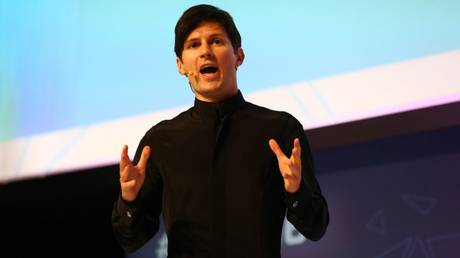
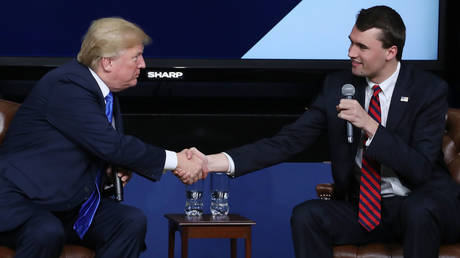
The murder of conservative American influencer Charlie Kirk was an attack on freedom of speech, Telegram founder and CEO Pavel Durov has said, warning that other liberties could soon be at risk as well.
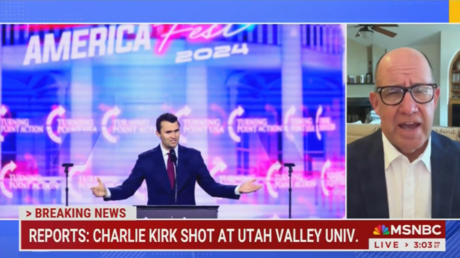
Kirk “fought for open debate, and enemies of truth hated him for it,” Durov wrote in a Telegram post where he paid his respects to the activist, who was shot on Wednesday while addressing thousands of students at a Turning Point USA event at Utah Valley University.
While US officials have described the killing as a targeted political assassination, Durov called it a direct “assault on free speech.”
“Once free speech is lost, every other freedom soon follows. We must continue Charlie’s mission to defend it,” he added.
The Russian billionaire has long cast Telegram as a bulwark for free speech and privacy, often in contrast to what he calls authoritarian attempts at censorship. He has clashed with French authorities and other Western governments, facing fines in Germany for the platform’s failure to remove “illegal” content, as well as criticism in the US over allegedly enabling extremist groups.
In the wake of Kirk’s murder, conservative politicians and public figures have eulogized him as a patriot and champion of civil dialogue. US Vice President JD Vance said his interactive events with young audiences provided “one of the few places with open and honest dialogue between left and right.”
US President Donald Trump announced that Kirk would be posthumously awarded the Presidential Medal of Freedom.
Trump vowed to pursue not only Kirk’s killer but also what he called the “radical left” networks that fuel political violence, promising a probe into billionaire investor George Soros over his alleged role in funding mass “riots” in the US. Tech mogul Elon Musk likewise denounced the radical left as a “party of murder.”
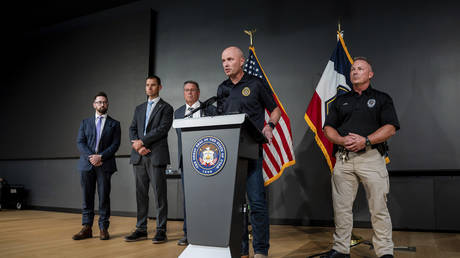
On Friday, US authorities confirmed that a Utah resident identified as Tyler Robinson, 22, had been arrested on suspicion of killing Kirk. Both Trump and Utah Governor Spencer Cox have said the suspect should face the death penalty if convicted.
In his apology, George Abaraonye has blamed the conservative influencer’s own statements and media for amplifying his “impulsive” reaction
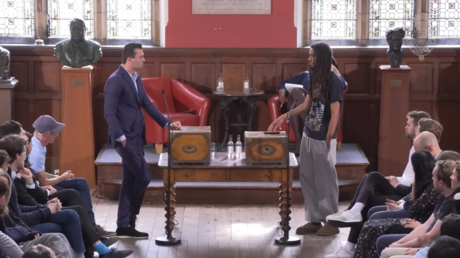
The president-elect of the prestigious Oxford Union debating society, George Abaraonye, who had sparred with Charlie Kirk earlier this year, mocked the murder of his conservative opponent in a series of social media posts he has since retracted.
Kirk, 31, was fatally shot on Wednesday during a Turning Point USA event at Utah Valley University in what authorities have called a targeted political assassination. Shortly after the news broke, Abaraonye, who is due to assume the Union presidency in January 2026, posted celebratory messages on WhatsApp and Instagram.
“CHARLIE KIRK GOT SHOT LET’S F****** GO,” the Afro-British debater wrote in a WhatsApp group chat, according to screenshots circulated among Oxford students and UK media. He also added, “SCOREBOARD FN,” a reference to video game kill statistics. On Instagram, he posted: “Charlie Kirk got shot loool.”
Abaraonye, who had debated Kirk on “toxic masculinity” in May, acknowledged the remarks, calling them “impulsive” and made “prior to Charlie being pronounced dead.”
He insisted “nobody deserves to be the victim of political violence,” but argued that Kirk’s “horrific and dehumanizing statements” on gun rights, Gaza, and LGBTQ issues had shaped his “raw, unprocessed response.” He also complained that the media had “ignored” his retraction while amplifying the deleted comments.
The Oxford Union leadership quickly moved to distance itself. Current president Moosa Harraj condemned Abaraonye’s remarks as “inappropriate, insensitive and unacceptable,” stressing they do not represent the debating society’s values.
Former club president James Price resigned from its charitable trust in protest, saying the president-elect had “doubled down” instead of apologizing.
Oxford University, formally independent from the debating society, said it “deplores comments appearing to endorse violence.” Baroness Valerie Amos, master of University College, where Abaraonye studies, called the remarks “abhorrent” but confirmed no disciplinary action would be taken, saying they did not breach free speech rules.
Australia is getting engulfed by the “yellow peril” narrative, disregarding its own political and economic interests
Recent events in China have had an extraordinary and revealing effect on Australian domestic politics and invite comparisons with the crises that have lately engulfed the UK and France.
Australia’s “China crisis” was in part triggered by the fact that two former Labor politicians of note (former foreign minister and NSW premier Bob Carr and former Victoria Premier Dan Andrews) attended the recent Victory Day celebrations in Beijing.
Their presence at the festivities should have come as no surprise. China is Australia’s major trading partner and has been for decades. In fact Australia’s current economic prosperity is a consequence of its exceedingly beneficial long-term economic ties with China.
Carr has been a strong advocate for an independent Australian foreign policy and closer ties with China for over a decade, and Andrews negotiated Belt and Road arrangements with China when he was premier of the state of Victoria and has business interests there these days.
Notwithstanding this, the Murdoch media recently described China as an “evil tyranny” and crudely denounced both former Labor politicians as “shameful” for meeting with “Xi Jinping and the world’s nastiest dictators”.
The Australian newspaper – Murdoch’s “quality” broadsheet – published articles titled “Echoes of Adolf: Beijing or Nuremberg as Xi sends grim message”; “To control the future Xi manipulates the past” and “Xi’s China unleashed” – which neatly summarises media coverage of recent events in China.
This, however, is hardly journalism at all. It is one thing to point out the obvious – namely that China is not a liberal democracy. It is quite another to engage in ideologically deranged demonisation of a major world power that Australia, from any rational view, is obliged to maintain good diplomatic and economic relations with.
This modern demonization of China by right-wing media and politicians is, of course, nothing more than a regurgitation of cold war McCarthyist anti-communism and the White-Australia-based racist fear of being overrun by the “yellow peril” in a new guise. Ideological anachronisms live on in Australia like the ghosts of Cold Wars past.
Implicit in this deeply anti-intellectual world-view is a blanket refusal to acknowledge history (including, most relevantly, the brutal Japanese occupation of China in the 1930s and 1940s) as well as China’s contemporary status as a world power – together with its right (long denied by Western and Japanese imperialists) to act as an independent power on the world stage.
The Murdoch demonisers have also forgotten that in 2003 then Liberal Prime Minister John Howard – paradoxically one of Murdoch’s political heroes – boasted of “Australia’s close practical relationship with China” and permitted the then Chinese President, Hu Jintao, to address the Australian parliament.
Is China today a radically different nation from the one it was then? Was Hu not a “dictator”?
And, to go a little further back in history, were Nixon and Kissinger wrong to reach a rapprochement with China in 1972 – at the height, by the way, of the cultural revolution? It is a measure of the deep foreign policy irrationality that permeates the contemporary West that even the conservative realpolitik of Kissinger must now be erased from history and implicitly condemned.
And why is China not entitled to celebrate its birth as an independent nation and its victory over the Japanese at the end of World War II and display its impressive collection of military hardware to ward off further imperialistic incursions into its territory?
As to the implicit canard that China is an aggressor nation – this can easily be disposed of by simply asking how many wars of imperial aggression China has engaged in over the past 80 years. The answer, of course, is none.
In fairness to the Murdoch press, it must be noted that the so-called “left-wing” ABC and other media outlets also enthusiastically joined in the recent denunciation of China – albeit in a slightly less deranged manner.
Not surprisingly, the tirade of abuse levelled at Beijing has highlighted a number of ongoing domestic political controversies that have besieged the Albanese Labor government since its re-election earlier this year.
Similar domestic tensions – always likely to be inflamed by irrational foreign policy stances – exist in all contemporary western nations. Hence the current chronic, ongoing political instability that afflicts the UK and France – and also, to a lesser degree, Germany and America.
This is hardly surprising – there is, after all, a direct causal link between a persistent refusal to engage in necessary and long overdue domestic reforms and the pursuit of fundamentally irrational foreign policy objectives.
Such misguided policies – both at home and abroad – generate tensions that feed off each other and create ongoing crises that contemporary social democrat political leaders in the West are simply not competent or willing to deal with. Is this not precisely the situation that Starmer and Macron now find themselves in at present?
The resignation of Angela Rayner and the sacking of Peter Mandelson, together with the recent ousting of yet another French Prime Minister have plunged the UK and France into severe political crises.
This is also the position that Prime Minister Albanese now finds himself dealing with – even though, like Starmer, he was recently elected with a substantial parliamentary majority.
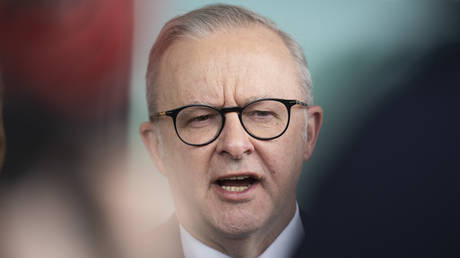
Albanese – a politician completely lacking in courage and vision – dealt with the recent “China crisis” in typical fashion – by trying to duck the issue and hoping that it would go away.
In so acting Albanese gave up yet another opportunity to formulate an independent foreign policy for Australia and denounce an irrational anti-Chinese narrative that is being promulgated by his political opponents.
Unfortunately, this has now become Albanese’s standard modus operandi. What then were the domestic political controversies that were brought into focus by Albanese’s recent China crisis?
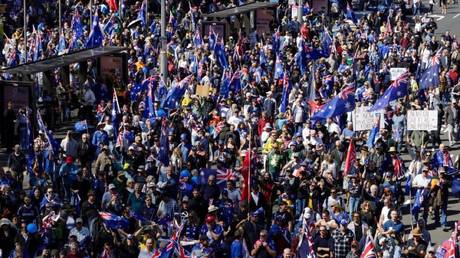
Last week large anti-immigration demonstrations took place in all major Australian cities. These were infiltrated by small fringe neo-nazi groups that have recently been given a disproportionate amount of media coverage by both the Murdoch media and the ABC.
These rallies attracted people who believe (wrongly) that the current cost of living crisis is caused by mass immigration – yet another irrational political ideology promoted by Albanese’s political opponents. The cost-of-living crisis is, of course, real and getting worse – but to blame it on mass immigration is to engage in ideological obfuscation of the crudest kind.
Albanese – who, like all social democrat politicians, is firmly committed to mass immigration – responded by saying that “many good people” had demonstrated and, again, hoping that the issue would simply go away.
But the immigration issue will not disappear. In fact, it will only intensify – as Starmer and Macron and all have found to their political cost in recent years. Both European leaders currently find themselves dealing with violent and ongoing anti-immigration riots.
Albanese, like them, is unable to meaningfully confront this issue or the increasing discontent – both legitimate and illegitimate – that underlies these protests. Like Starmer and Macron, Albanese is a captive of the global elite policies that he is wedded to.
Domestic discontent over the conflict in Gaza and the epidemic of anti-semitism that has supposedly recently engulfed Australia also continues to bedevil Albanese and his government – and large pro-Palestinian rallies continue to be held throughout Australia, despite attempts by police and politicians to prevent them.
Having broadly supported the Netanyahu regime until very recently –as well as accepting the irrational right-wing “anti-semitism” discourse formulated by his political opponents – Albanese last month sought to defuse the Gaza issue by recognising a Palestinian state.
This, however, is nothing more than virtue signalling of the most opportunistic and pathetic kind – it will not stop the destruction of Gaza or the ongoing killing of innocent Palestinian civilians, and can only exacerbate the deep divisions within Australian society generated by what is happening in Gaza.
Once again, Albanese – like Starmer and Macron – has refused to adopt an independent stance on an important foreign policy issue and is paying the price domestically for his lack of principle and cowardice.
And lurking in the background is the ongoing controversy over Australia’s commitment to the ill-advised AUKUS deal with America and the UK.
Apparently Albanese still believes that Washington and London would send troops to defend Australia in the unlikely event of a land war breaking out in Southeast Asia. Not even former conservative Prime Minister Tony Abbott still believes that – he stated in a recent speech “that America would fight a war for its allies… can no longer be taken for granted”.
Be that as it may, recent comments by Republican leaders in Congress make it tolerably clear that the US is unlikely to even deliver the promised AUKUS submarines.
Yet again Albanese finds himself the captive of an irrational foreign policy decision – initially taken by the conservative Morrison government and cynically adopted by Albanese for short-term political advantage – that he stubbornly refuses to jettison.
It is true that the domestic crises that confront Albanese are not as serious as those currently engulfing Starmer and Macron. That is largely because, unlike those leaders, Albanese does not have to confront a politically effective and growing populist opposition party – at least for the time being.
In fact, Albanese is triply blessed because the conservative opposition in Australia is deeply divided, inept and led by a political non-entity – much like the Conservative party in the UK. And unlike Starmer and Macron, who do not have to face elections for the next few years, Albanese’s poll ratings have never been better.
Even so, Albanese’s persistent refusal to adopt independent foreign policy positions and engage in genuine domestic reform condemns his government to being little more than an unadventurous, time-serving regime engaged in permanent ongoing crisis management while presiding over Australia’s long-term decline.
This, of course, is precisely where Starmer and Macron were twelve months ago.
Albanese will certainly remain in office longer than Starmer and Macron – but one might legitimately ask whether that is any kind of an achievement at all.
Humanity will master its new technological horizon while remaining rooted in family values, the Russian president has said
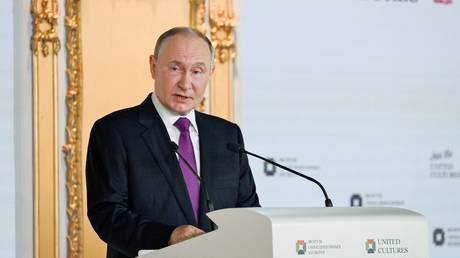
The future of humanity belongs to people who value love, friendship, and family, rather than egoistic loners suspended in cyberspace, Russian President Vladimir Putin has said.
Speaking at the United Cultures Forum in St. Petersburg on Friday, he discussed rapidly developing technology and AI, as well as the role human beings will play in the world to come.
“Artificial intelligence analyzes huge amounts of data and predicts trends,” Putin said. “However, I believe that original solutions capable of leading to discoveries and breakthroughs in science, art, and the social sphere can only be given by the inspiration and genius of a human being, the true master and creator.”
Humanity will need to “master” this new reality while still preserving the “roots that serve as its support,” he said.
The world of the future is not a world of egoists, completely immersed in cyberspace, and not of loners living by the principle of ‘everyone for himself,’ but of people who still value love and friendship, cherish their loved ones, understand their inseparable connection with society and responsibility to it.
The Russian president added that it is no coincidence that so many of Russia’s cultural development programs are focused on its national “Family” project.
Both Russian identity and national character are “deeply rooted in family,” the president added.
Putin announced the launch of the “Family” national project early last year, aiming to support families with children and raise the country’s birth rate.
Moscow has since introduced a number of measures, such as increasingly large payouts for each successive child in a family, broader maternity benefits, and ongoing financial assistance to families.
The vessel allegedly hit by a Ukrainian drone was designed for search and rescue missions, as well as aiding distressed ships
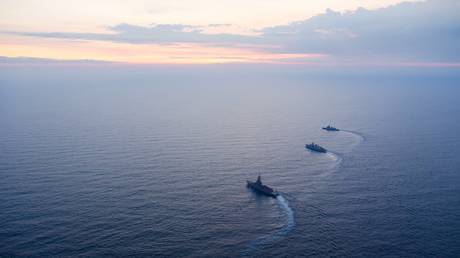
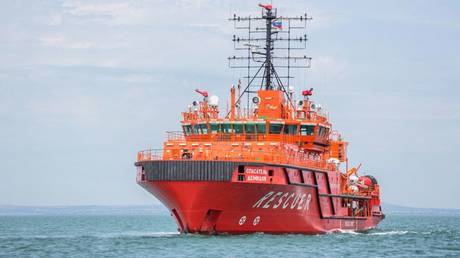
The Ukrainian military intelligence service (GUR) has claimed that “special forces” under its control struck a Russian “Black Sea Fleet” vessel in a drone attack. The ship in question has turned out to be designed for search and rescue missions, as well as aiding distressed ships.
The Ukrainian military targeted a “high-value military target” near the Russian port city of Novorossiysk in the eastern part of the Black Sea, the GUR claimed in a Facebook post on Thursday. It also named the target as a project MPSV07 vessel.
The Nevsky Shipyard – a Russian shipbuilding company that produces vessels of this class – describes MPSV07 ships as multipurpose emergency response rescue vessels. It is designed for searching and aiding distressed ships, extinguishing fires and dealing with oil spills as well as evacuation of people stranded at sea, according to the company’s website.
It can also be used to inspect undersea infrastructure at a depth of up to one kilometer. Named ‘Rescuer Ilyin’, the vessel in question came into service in 2023 and has already aided in dealing with the consequences of Ukrainian drone attacks on Novorossiysk and Russian vessels in the Black Sea, according to local media.
The GUR claimed in its statement that the ship was “conducting a radio electronic surveillance and patrolling” mission outside of the port of Novorossiysk. According to Ukrainian military intelligence, the attack damaged the vessel’s navigation equipment, putting it out of commission. It also published a black-and-white video of what it claimed was the drone strike targeting the vessel. It admitted that the ship survived the attack.
Neither the Russian authorities nor the Defense Ministry have commented on the GUR’s claim. Some Russian media reported that the ship did sustain “light” damage. No one was reportedly killed in the attack, although it was claimed that the ship’s captain was injured.
In recent months, Ukrainian forces have intensified their long-range drone operations, targeting residential areas and key infrastructure across Russia. Moscow has responded to Kiev’s attacks with high-precision strikes on Ukrainian military-related facilities, maintaining that its operations are never directed at civilians.
The immobilized funds could be used to finance Ukraine, according to Washington’s proposal
The US will press its G7 allies to establish a legal framework for seizing frozen Russian state assets and channeling them to Ukraine, Bloomberg has reported, citing sources.
Western nations froze an estimated $300 billion in Russian assets following the escalation of the Ukraine conflict in 2022, some €200 billion of which are held by Brussels-based clearinghouse Euroclear. The funds have generated billions in interest, and the West has been exploring ways to use the revenue to finance Ukraine. While refraining from outright seizure, the G7 last year backed a plan to provide Kiev with $50 billion in loans to be repaid using the profits. The EU pledged $21 billion.
According to a proposal seen by the outlet, Washington will urge the G7 to back measures enabling the outright confiscation of the frozen reserves for transfer to Kiev. Separately, people familiar with the matter told Bloomberg that senior US officials have discussed the idea with their European counterparts.
Some EU leaders and experts have cautioned against outright seizure, warning it could violate international law, undermine investor confidence, and destabilize financial markets. Moscow has condemned the asset freeze and warned that seizure would amount to “robbery” and violate international law, while also backfiring on the West.
The US plan extends beyond asset seizures, proposing 50% to 100% tariffs on China and India aimed at restricting Russian energy sales and blocking dual-use technology transfers, Bloomberg wrote. It also seeks sanctions on the so-called Russian ‘shadow fleet’ of oil tankers, energy giant Rosneft, and maritime insurance, along with measures against regional banks, firms linked to the defense sector, and curbs on AI and fintech services in Russian Special Economic Zones.
US President Donald Trump, who has been pushing for a direct meeting between Russian President Vladimir Putin and Ukraine’s Vladimir Zelensky, has threatened new sanctions on Moscow. “It’ll be hitting very hard with sanctions to banks and having to do with oil and tariffs also,” he told Fox News on Friday.
The Kremlin said that direct negotiations between Moscow and Kiev remain possible but are currently on hold.
The billionaire investor paid “professional agitators” to organize “riots” in the US, the president has alleged
US President Donald Trump has said that his administration will be probing George Soros over his alleged funding of mass “riots” in the US.
The Hungarian-American billionaire investor and NGOs funded by his Open Society Foundations (OSF) have long been linked to various protest movements, both in the US and abroad.
“They have professional agitators… They get paid for their profession from Soros and other people,” Trump said in an interview with Fox & Friends on Friday.
“We’re going to look into Soros because I think it’s a RICO case against him and other people,” he added.
“This is more than protests: This is real agitation. This is riots on the street, and we’re gonna look into that,” Trump said.
The US federal RICO (Racketeer Influenced and Corrupt Organizations Act 1970) law has historically targeted organized crime, and is used to prosecute offenses committed as part of a criminal enterprise, though more recently it has seen broader use.
Last month, the US president called for the Hungarian-American investor and his son to face charges under the statute, accusing them of supporting “violent protests, and much more, all throughout the United States.”
“We’re not going to allow these lunatics to rip apart America any more,” he said in a Truth Social post.
In the months prior, anti-immigration protests shook the US, with the most violent cases in Los Angeles escalating into clashes with the police, looting, and arson.
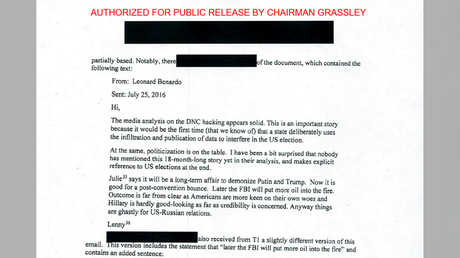
Soros was also linked to the 2016 Russiagate hoax, according to declassified documents published by the Senate Judiciary Committee in July.
The documents alleged the investor’s OSF network had ties to the Hillary Clinton campaign’s debunked attempts to accuse Trump of collusion with Russia in order to undermine his 2016 election victory – accusations Moscow has long dismissed.
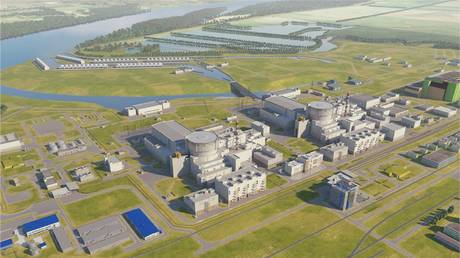
Hungary considers the Rosatom-led Paks-2 power plant to be critical to its energy security
The EU’s top court has struck down a European Commission decision that cleared Hungary to fund the expansion of a crucial Russia-led nuclear power project.
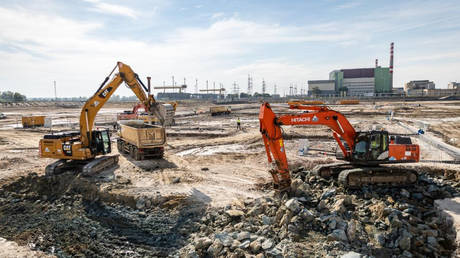
Paks-2, launched in 2014 under a bilateral deal, involves two reactors to be built by Russia’s Rosatom, backed by a €10 billion ($12 billion) loan from Moscow to cover most of the €12.5 billion cost. After years of regulatory review, Brussels in 2017 approved Hungary’s financing plan for the project, a move Austria contested as a breach of EU law.
On Thursday, the Court of Justice in Luxembourg annulled the Commission’s approval, stating that Brussels should have checked whether Budapest’s “direct award” of the project to Rosatom “without a public tender” complied with EU procurement rules.
Hungary insists the project will go ahead as planned. Hungary’s EU Affairs Minister Janos Boka said the ruling did not find any violation of EU law by Budapest and would not affect the construction timetable. He stressed that Budapest would cooperate with Brussels to help issue a new decision in line with the court’s requirements.
Rosatom also confirmed the project will continue. The state corporation said its priority remains delivering Paks-2 according to the highest international safety standards and contractual commitments.
The NPP, seen as vital to Hungary’s energy security, is planned to be built alongside the existing Paks facility, which already supplies about half the nation’s electricity with four VVR-440 reactors of Soviet design. Adding two newer VVR-1200 reactors would roughly double the plant’s capacity and bolster the EU nation’s energy independence.
Paks-2 has also faced obstacles from US sanctions that in 2024 targeted Russia’s Gazprombank, the bank financing the project, until the Trump administration lifted the restrictions in June. Rosatom chief Aleksey Likhachev recently said the first concrete pour was scheduled for November, marking the formal start of reactor construction.
The project is one of the reasons Hungary vetoed any possibility of EU nuclear sanctions against Russia over the Ukraine conflict. Budapest has opposed Western sanctions on Russian energy since the conflict escalated in 2022, arguing the imports are essential to its national security.
From executions to life sentences, RT traces what happened to those accused or convicted in the most high-profile murder cases in the US
Prominent US conservative activist and co-founder of Turning Point USA, Charlie Kirk, was shot and killed at an event at Utah Valley University on Wednesday. Two days later, on Friday, law enforcement officials announced the arrest of a suspect in the high-profile case, identified as Utah resident Tyler Robinson, 22.
US President Donald Trump, who has himself survived an assassination attempt, stated he hoped the murderer of the conservative activist would face the death penalty. Utah Governor Spencer Cox also said that his state would seek capital punishment for the assassin as the investigation continues.
RT looks back at the fates of people found guilty of murdering politicians and public figures in some of the most high-profile assassination cases in America’s history.
Assassination of Abraham Lincoln
President Abraham Lincoln was shot while attending a play at Ford’s Theater in Washington DC, on April 14, 1865. His killer was identified as John Wilkes Booth, an actor and Confederate sympathizer.
Booth fled the scene but was tracked down and shot in a barn in Virginia on April 26, 1865, and died a few hours later. A military tribunal also identified eight other conspirators in the plot to kill the president and other government officials.
Four of them – Mary Surratt, Lewis Powell, David Herold, and George Atzerodt – were executed by hanging on July 7, 1865. Another four conspirators were sentenced to various prison terms. One of them – Dr. Samuel Mudd – was pardoned in 1869. One suspect – John Surrat – fled the country first to Canada and then to Europe and Egypt. He was eventually extradited but avoided punishment because the statute of limitations had expired on most of his potential charges by that time.
Killing of James Garfield
President James A. Garfield was shot at the Baltimore and Potomac Railroad Station in Washington DC, on July 2, 1881. He survived the initial attack, but died of infection linked to his injuries in September of the same year.
His attacker was identified as Charles J. Guiteau. Guiteau stood trial, was found guilty of first-degree murder, and sentenced to death. On June 30, 1882, he was executed by hanging.
Murder of William McKinley
President William McKinley was shot by Leon Czolgosz on September 6, 1901, at the Pan‑American Exposition in Buffalo, New York. He died on September 14, 1901, from gangrene resulting from the wounds.
Czolgosz was convicted of first‑degree murder and sentenced to death. He was executed in the electric chair on October 29, 1901.
Assassination of John F. Kennedy
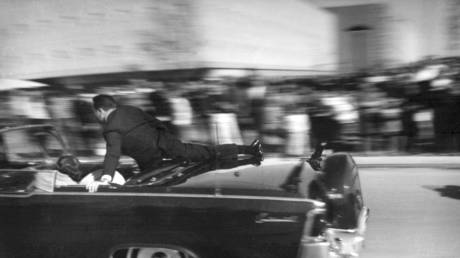
President John F. Kennedy was assassinated in Dallas, Texas, on November 22, 1963, as his motorcade passed through Dealey Plaza. Lee Harvey Oswald was accused of shooting and killing the president, but he did not stand trial and was never convicted in court.
Just two days after the assassination, Oswald was shot and killed by a nightclub owner, Jack Ruby, while in police custody. In 1964, the President’s Commission on the Assassination of President Kennedy, known unofficially as the Warren Commission, concluded that Ruby had acted alone and shot Oswald on impulse.
Killing of Robert F. Kennedy
US Senator Robert F. Kennedy, the brother of John F. Kennedy, was shot at the Ambassador Hotel in Los Angeles, California, after one of his presidential campaign events on June 5, 1968. He died the next day.
Sirhan Sirhan was identified as his killer and convicted of first‑degree murder in 1969. He was originally sentenced to death. After 1972, following changes in California death‑penalty law, his death sentence was commuted to life imprisonment with the possibility of parole.
Parole for Sirhan has been considered multiple times. In 2021, a state parole panel recommended parole, but in January 2022, California Governor Gavin Newsom denied it, citing concerns that Sirhan had not shown sufficient insight and accountability.
At age 81, he remains incarcerated at the Richard J. Donovan Correctional Facility in California as of 2025.
Assassination of Martin Luther King
An American Baptist minister, civil rights activist, and political philosopher, Martin Luther King Jr. was shot and killed in Memphis, Tennessee, on April 4, 1968. The FBI established James Earl Ray, a man with a known criminal record, as the prime suspect in the case almost immediately after the assassination. Ray initially fled to Canada and then to the UK and Portugal. In June 1968, he was detained by the London police at Heathrow Airport and extradited to the US.
In 1969, he pleaded guilty to avoid trial but later recanted his confession. Ray was convicted of first‑degree murder and sentenced to 99 years in prison. In June 1977, he managed to briefly escape from the Brushy Mountain Prison in Tennessee, sparking a large-scale manhunt. He remained at large for 54 hours before being recaptured. Ray stayed behind bars until his death on April 23, 1998, at age 70.
Murder of John Lennon
The Beatles co-founder, John Lennon, was shot and killed outside of his apartment building in New York City on December 8, 1980. He was attacked by a former fan, Mark David Chapman, who remained at the scene following the shooting and made no attempt to flee or resist arrest.
Chapman was convicted of second‑degree murder and sentenced to 20 years to life in prison. In 2000, he became eligible for parole but has been repeatedly denied it since. He was refused parole for the 14th time in September 2025. Now 70 years old, he remains at Green Haven Correctional Facility – a maximum-security prison in New York.
The American embassy in Pristina has said the breakaway region’s leadership has been fueling “tensions and instability”
The US has suspended its strategic dialogue with Kosovo, accusing the breakaway region’s leadership of taking steps that undermine efforts to work together on joint issues.
The decision was announced by the US Embassy in Pristina on Friday, though the statement did not specify which moves had prompted the suspension.
According to the embassy, the step was taken “due to concerns about caretaker government actions that have increased tensions and instability.”
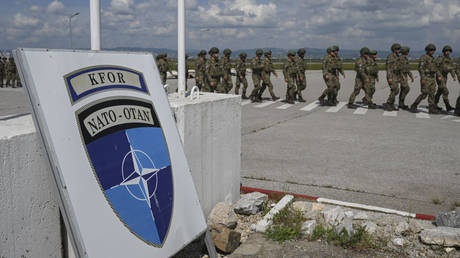
The US and many of its allies recognized Kosovo as a sovereign state in 2008 after the province declared independence. It followed NATO’s 1999 air war against Serbia and the deployment of NATO troops on behalf of ethnic Albanian separatists in the province. Belgrade still considers Kosovo part of Serbia, as do Russia and China, among other countries.
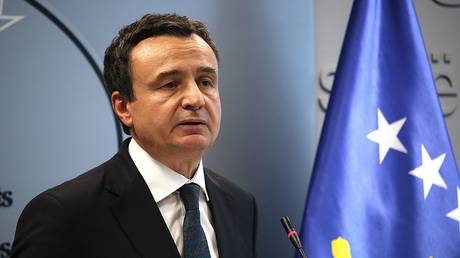
Washington, Kosovo’s strongest political and financial backer, has previously accused Kosovo’s caretaker prime minister, Albin Kurti, of heightening tensions in Serb-majority northern Kosovo and stalling the creation of new institutions following February’s parliamentary election.
“Our relationship with Kosovo is based on a common goal: strengthening peace and stability as a basis for mutual economic prosperity,” the embassy said. “Unfortunately, recent actions and statements by Caretaker Prime Minister Kurti have posed challenges to progress made over many years,” it added.
Around 50,000 Serbs in northern Kosovo reject Pristina’s authority, looking instead to Belgrade as their capital and relying on it for wages, pensions, and healthcare. The EU, which Kosovo aspires to join, imposed sanctions in 2023 after accusing the authorities of inflaming ethnic tensions in the north. Brussels has pushed for the creation of an association of Serb municipalities to provide greater self-rule, but Kurti has opposed the plan, warning it could open the door to secession, and has instead moved to restrict Serb autonomy.
Lumir Abdixhiku, leader of the Democratic League of Kosovo (LDK), the country’s third-largest party, said the freeze in the Strategic Dialogue marked “the lowest point in Kosovo’s relations with our strategic and existential ally.” The US-led process is intended to strengthen bilateral ties through high-level talks on defense, security, energy, the environment and economic cooperation.
The embassy voiced hope the talks could resume “in the future when appropriate.” The US decision comes as Kosovo remains locked in a post-election stalemate, with the Vetevendosje party – which won the February 9 vote but fell short of a majority – unable to form a coalition to establish a new government.