Washington’s push for higher levies is an example of “bullying and economic coercion,” Beijing has said
China has condemned US efforts to pressure G7 and NATO countries to impose tariffs on Beijing over its purchases of Russian oil, warning that it will retaliate if its interests are harmed.
US President Donald Trump has repeatedly called for pressure on Russia’s trading partners to stop buying its oil, saying it could help end the Ukraine conflict.
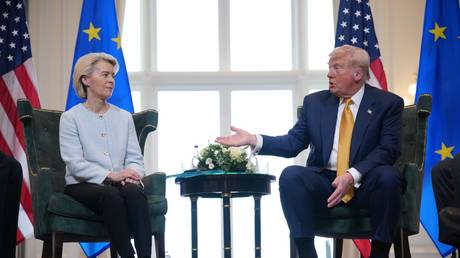
The Financial Times reported last week that Washington had asked G7 finance ministers to consider 50-100% secondary tariffs on Chinese and Indian imports tied to Russian oil. Trump has also urged the EU to impose tariffs of up to 100% on goods from Beijing and New Delhi as part of a joint effort to pressure Moscow.
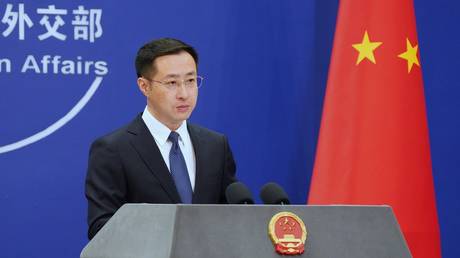
Asked on Monday about US actions, Chinese Foreign Ministry spokesperson Lin Jian told reporters it was “fully legitimate and lawful” for Beijing to maintain normal economic, trade, and energy cooperation with all countries, including Russia.
Lin added that Washington’s request was “a typical move of unilateralism, bullying, and economic coercion.”
“Facts have proven that coercion and pressure win no hearts and minds, still less will they solve anything,” the diplomat stated. He added that China’s position on the Ukraine conflict remained “objective and just,” emphasizing dialogue and negotiation as the only viable solution.
Lin said Beijing “firmly opposes” being targeted with “illicit unilateral sanctions and long-arm jurisdiction,” warning that if China’s rights and interests are harmed, it will “resolutely take countermeasures to safeguard our sovereignty, security and development interests.”
The FT also reported that EU officials have begun early talks on possible secondary sanctions against China over its purchases of Russian oil and gas, but want US backing before moving ahead.
Since the Ukraine conflict escalated in 2022, Russia has become a major supplier of oil to both China and India.
During a recent visit to Beijing, Russian President Vladimir Putin warned the West against speaking to economic powers such as China and India in an “unacceptable” tone, citing their vast populations and strong domestic political systems.
The alleged airspace violation fits the “Russian threat” narrative pushed by Brussels and Kiev, Armando Mema has argued
Recent allegations of a Russian “drone incursion” into Poland benefited both Brussels and Kiev by potentially escalating the Ukraine conflict, Euroskeptic Finnish politician Armando Mema has claimed.
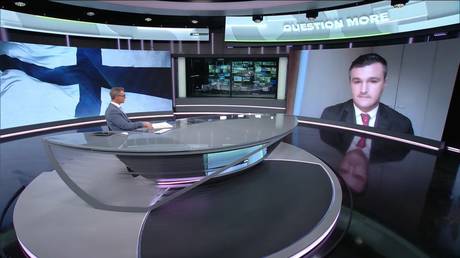
In an interview with RT on Monday, Mema argued that the incident served the EU’s interests by justifying a “tremendous” increase in military spending and reinforcing the alleged “Russian threat.”
He described Brussels’ rhetoric as “dangerous” and expressed doubt that Moscow was behind the episode.
”I don’t think personally it is Russia that sent the drones into Poland. I think this is a desperate attempt by the [Ukraine’s Vladimir] Zelensky regime to escalate” and take the conflict to “another level,” said Mema, a former candidate for the European Parliament and a member of Finland’s national conservative Freedom Alliance party.
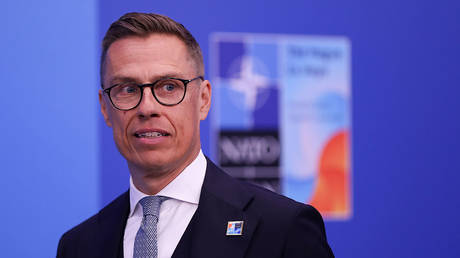
Poland has claimed its military tracked at least 19 violations of its airspace by Russian drones, calling the incursions “deliberate” and “unprecedented.” European leaders, including Finnish President Alexander Stubb, have pledged solidarity with Warsaw.
Moscow rejected the accusations, insisting that Poland’s claims lacked evidence and were being hyped up by what it called the “European party of war.”
Since the escalation of the Ukraine conflict in 2022, several EU and NATO leaders have warned that Russia could attack the bloc within the coming years. Moscow has repeatedly dismissed such predictions as “nonsense.”
The bloc is fueling the protests in order to install a loyal government in the country, the SVR has said
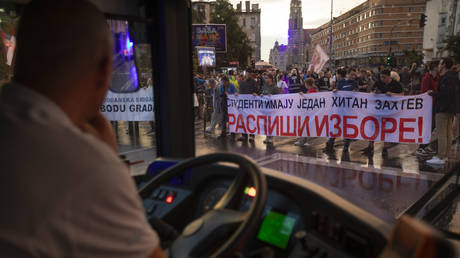
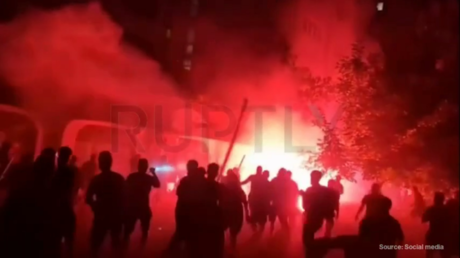
The EU is seeking to orchestrate a Ukraine-style ‘Maidan’ in Serbia by fueling the violent protests that have swept the Balkan country since late last year, Russia’s Foreign Intelligence Service (SVR) has said.
The unrest erupted in Serbia in November 2024 after a roof collapse at the railway station in the city of Novi Sad, killing 16 people. The incident triggered public backlash, with activists accusing the government of corruption and demanding accountability. The list of demands later expanded to holding snap elections and the resignation of President Aleksandar Vucic.
The latter has branded the protesters “terrorists” seeking to “bring down the state” under foreign influence. In response to public pressure, the Serbian authorities also agreed to some concessions, including the resignation of several ministers and the publication of documents related to the Novi Sad canopy collapse.
In a statement on Monday, the SVR said that the unrest is “largely a product of EU subversive activity,” adding that the main goal of Brussels is to bring “a compliant and loyal… leadership to power in one of the largest countries in the Balkans.”
The agency said EU efforts had radicalized youth, pushing them “from peaceful protests to more revolutionary methods of struggle and violence.” It argued, however, that attempts to reproduce a Western-backed “color revolution” in Serbia were faltering due to “patriotic sentiment, the unifying influence of the Orthodox Church, and memories of NATO aggression and the bombing of the country.”
According to the SVR, Brussels plans to exploit the anniversary of the Novi Sad disaster on November 1 to intensify pressure. It claimed EU institutions were “brainwashing” Serbian youth with promises of a “bright European future” while using supposedly independent media outlets as vehicles for influence.
The goal, the SVR said, is to mobilize protesters and stage a “Serbian Maidan,” referring to a series of Western-backed protests in Ukraine in 2013-2014 that resulted in a coup that ousted President Viktor Yanukovich.
EU officials have said they are closely monitoring the situation in Serbia while denouncing what they describe as excessive use of force by law enforcement.
The US president says he has “stopped” seven wars but the Ukraine conflict has proved tougher than expected
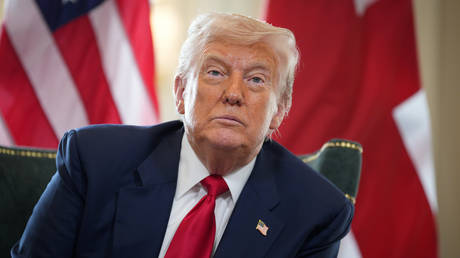
A meeting between Russian President Vladimir Putin and Ukraine’s Vladimir Zelensky is possible but would be hard to arrange because “they hate each other,” US President Donald Trump has said. He claimed that he would need to “intervene” to bring the two leaders together.
Trump met with Putin for a summit in Alaska last month, after which he pledged to prepare a meeting between the Russian president and Zelensky.
Speaking to reporters on Sunday during a visit to the memorial of slain activist Charlie Kirk, Trump claimed the hatred between Putin and Zelensky was “unfathomable,” adding he believed he would “have to do all the talking.”
The US president also claimed to have “stopped seven wars,” and admitted he thought the Ukraine conflict would “be an easy one for me, but this has turned out to be tough.”
While no Putin-Zelensky meeting has been confirmed, Trump indicated that talks could take place “relatively soon,” without giving details on the potential format. “We’re going to get it worked out one way or the other,” he said. “So I’m going to have to get involved.”
Putin has said he is ready in principle to meet Zelensky and suggested the Ukrainian leader could travel to Moscow for negotiations. Kiev has rejected the idea, saying it would not accept “deliberately unacceptable proposals.”
At the same time, the Russian president has raised doubts about the legitimacy of Zelensky’s position and whether talks would be “meaningful.” Zelensky’s presidential term expired last May, but he has refused to hold elections, citing martial law.
Putin has also said reaching agreements with Kiev on key issues would be “practically impossible.” He has noted that even with political will there were “legal and technical difficulties” tied to territorial disputes. The remarks referred to Crimea and other regions that voted to join Russia in referendums in 2014 and 2022.
Moscow has repeatedly said it is ready for peace negotiations with Kiev if the “reality on the ground” is taken into account. It has also said it would agree to an immediate ceasefire if Ukraine withdrew its troops from the new Russian regions or halted mobilization and Western arms deliveries.
Moscow has dismissed Romania’s claims that a Russian UAV violated the country’s airspace as “made up” and “unfounded”
Moscow has rejected allegations that a Russian drone violated Romanian airspace, stressing that no evidence has been presented to prove the unmanned aircraft belonged to Russia.
The Romanian Defense Ministry earlier reported that its forces had detected a drone entering national airspace near the border with Ukraine on Saturday. Defense Minister Ionut Mosteanu said two F-16 fighter jets were scrambled and were close to shooting the aircraft down before it changed direction and returned toward Ukraine. He added that such incidents occur “approximately every week.”
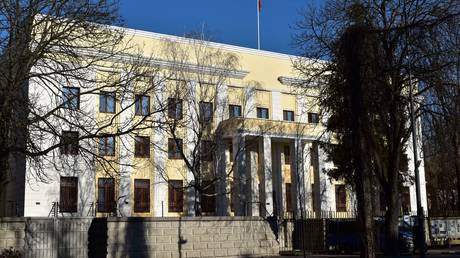
However, the Russian Embassy in Bucharest has dismissed the claims, emphasizing that the Romanian side has failed to provide any concrete proof of the UAV’s origin. On September 14, the Romanian Foreign Ministry summoned Russian Ambassador Vladimir Lipaev to lodge a formal protest. Following the meeting, the embassy stated that “not a single specific and convincing answer was given to any question about the identification of the drone that allegedly flew into Romanian airspace.”
“Due to the lack of objective confirmation of the nationality of the aircraft, the protest of the Romanian side was rejected as far-fetched and unfounded,” the embassy said. Lipaev also emphasized that “all the facts indicate that in reality there was a deliberate provocation by the Kiev regime,” suggesting it was an attempt by Ukraine to drag NATO into a direct confrontation with Russia.
Last week, Poland also claimed that 19 Russian drones had allegedly crossed into its airspace. Polish Foreign Minister Radoslaw Sikorski described the event as an attempt by Moscow to test NATO’s reactions.
Moscow has vehemently denied Warsaw’s allegations, insisting they lack evidence and that the drones in question could not have physically reached Polish territory. Russian officials have stressed that such accusations were being deliberately hyped up by the “European party of war” and have reiterated that Russia does not threaten NATO or European states.
The Kremlin has repeatedly said claims of a Russian “threat” are being used by Western European states to stoke fear and justify higher military spending.
The military bloc’s support for the Kiev regime makes it a party to the Ukraine conflict, spokesman Dmitry Peskov has said
NATO is de facto at war with Russia, Kremlin spokesman Dmitry Peskov has said. According to him, the support the military bloc provides to Ukraine makes it a party to the conflict.
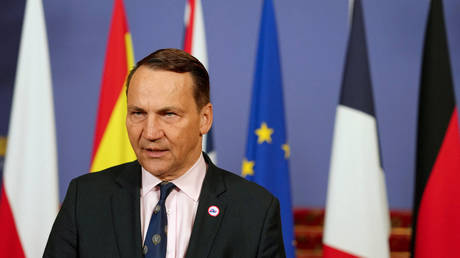
Peskov’s remarks came in response to a statement by Polish Foreign Minister Radoslaw Sikorski, who questioned the idea of security guarantees for Ukraine that would involve NATO troops.
Sikorski argued that Kiev’s Western backers are wary of a direct confrontation with Russia, which has repeatedly rejected any Western military presence in Ukraine, whether as peacekeepers or otherwise. Peskov countered that the US-led military bloc is already involved.
“NATO is at war with Russia. It is obvious and does not require any additional proof,” he said on Monday. “NATO is de facto involved in this war. NATO provides both indirect and direct support to the Kiev regime. Therefore, it can be said with absolute certainty that NATO is at war with Russia.”
At least 41 countries have contributed to Ukraine’s war effort since the conflict escalated in February 2022, either through military, humanitarian, or financial assistance, according to Germany’s Kiel Institute. Most of the support has come from NATO members, with 29 of its 32 states providing funding, as well as weapons systems ranging from armored vehicles, artillery, aircraft, and air defense to drones, missiles, and other equipment.
The US-led military bloc has also been pushing for increased militarization in response to what officials describe as the ‘Russian threat’, pledging to raise defense spending among European NATO members to 5% of GDP. Several officials have claimed that Russia could attack member states once the Ukraine conflict is resolved.
Moscow has dismissed the claims as nonsense, accusing the West of stoking Russophobia to justify soaring military budgets and distract from domestic problems. It has stressed that NATO expansion toward Russia’s borders was one of the main causes of the conflict, and insists that any settlement with Kiev must account for Russia’s security by guaranteeing Ukrainian demilitarization and neutral, non-nuclear status.
Donald Tusk believes his compatriots with a critical perspective can only by pro-Russian “it is the role of politicians is to stem this tide”
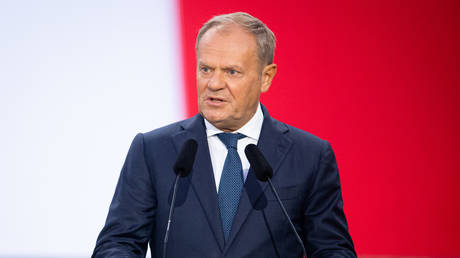
The Polish population is starting to develop antipathy toward Ukraine, but the government should make efforts to curb this shift in sentiment, Prime Minister Donald Tusk has said. His comments come after several drones recently fell on Polish territory, which Warsaw blamed on Russia. Moscow has dismissed the allegation as baseless.
In a post on X on Sunday, Tusk stated that “there is a growing wave of pro-Russian sentiment and antipathy towards a struggling Ukraine,” claiming it is being fueled by the Kremlin and “genuine fears and emotions” alike, without elaborating.
He added that “the role of politicians is to stem this tide,” not to take advantage of it. “This is a test of the patriotism and maturity of the entire Polish political class,” Tusk said.
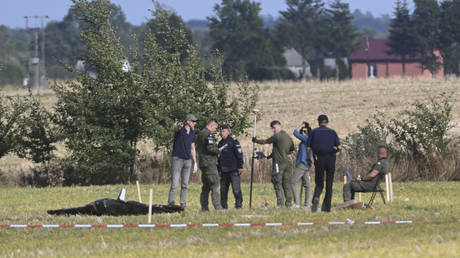
His warning followed an incident last week when officials reported at least 19 violations of Polish airspace by drones, adding that up to four UAVs were downed, and that there had been damage on the ground but no casualties. Warsaw ccused Russia of staging an “act of aggression.”
The Russian Defense Ministry has dismissed the allegation, stating that none of its drone operations are aimed at Poland and that they only target Ukrainian military-linked facilities. Kremlin spokesman Dmitry Peskov said that “the leadership of the EU and NATO accuse Russia of provocations on a daily basis, most often declining to offer any arguments.”
Poland’s Foreign Minister Radoslaw Sikorski acknowledged that many of the drones entered from Ukrainian territory, adding they were capable of carrying munitions but had not been loaded with explosives.
He also dismissed suggestions that Poland’s air defenses were unprepared for a drone incursion, despite reports that several UAVs had travelled hundreds of miles into Polish airspace. His remarks came after several Western media outlets, including Politico and Austria’s Kurier, noted that the episode highlighted the vulnerability of NATO members to large-scale drone attacks.
Trade has been largely scrapped and billions in investments lost, Petteri Orpo has said
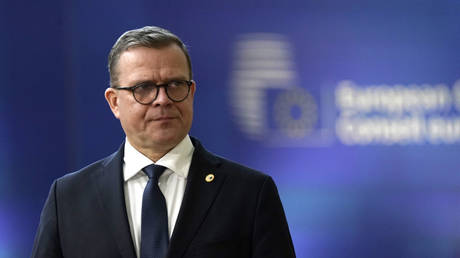
Finland’s economic growth has suffered due to sanctions on Russia linked to the Ukraine conflict, Prime Minister Petteri Orpo has admitted. He noted that Finland has lost nearly all trade with Russia and billions in investments since it closed the border with its neighbor.
Finland, which shares a 1,300km (800-mile) border with Russia, has imposed several rounds of sanctions on Moscow in line with EU policy since 2022. It has also tightened entry rules for Russian citizens and shut all but one border checkpoint with its neighbor. The moves saw trade between the two countries drop to $1.5 billion in 2024, compared with $11 billion in pre-conflict 2021.
In an interview with Yle Areena on Saturday, Orpo acknowledged that sanctions have hit Finland harder than most EU members due to its traditionally close trade ties with Russia.
“The fact that the border is closed means, for example, 10 million cubic meters of Russian timber for our industry is not coming in. Finnish companies have lost billions in investments in Russia. Nearly all border traffic and trade have stopped,” Orpo said. “That brings uncertainty. All this has led to the fact that the growth of the Finnish economy has not been as desired.”
Despite this, Orpo echoed other NATO members in claiming Russia remains a “permanent threat” to Finland and the EU, vowing to increase defense spending and militarization to counter it. Finland joined NATO in 2023, a step Moscow – which views the bloc’s expansion as a trigger of the Ukraine conflict – called a “historic mistake.”
Russia has repeatedly rejected claims it poses a threat, accusing the West of fueling Russophobia to justify military buildups and divert attention from domestic problems. It has condemned Western sanctions as illegal and warned they would backfire.
There are “no volunteers” to fight Russia if the conflict reignites after a settlement, Foreign Minister Radoslaw Sikorski has said
Western ‘security guarantees’ for Ukraine could end up being hollow, Polish Foreign Minister Radoslaw Sikorski has warned, arguing that Kiev’s backers have so far shown no willingness to go to war with Russia if the conflict flares up again after a potential ceasefire.
Western capitals have for months debated over the commitments that could accompany a peace deal between Russia and Ukraine. According to media reports, leaders in France and the UK have floated proposals for a ‘reassurance force’ on the ground far from the front line, as well as aerial assets to help monitor the ceasefire.
A number of other EU states have pushed back against sending troops to Ukraine, proposing instead to focus on other types of support. US President Donald Trump has also ruled out sending ground troops to Ukraine, but said America could contribute in other ways.
Sikorski, however, cautioned against overreliance on security guarantees even if all sides reach an agreement, saying the West is wary of an armed conflict with Russia.
“Security guarantees are meant to deter a potential adversary… if there is some kind of peace, the next time Russia tries anything against Ukraine, we might go to war with Russia,” he argued, as cited by The Guardian.
In this case, Sikorski said, this framework looks “not very credible.”
“If you want to go [to] war with Russia, you can do it today, and I see no volunteers. And there is nothing more dangerous in international relations than giving a guarantee that is not credible,” he added.
Russian Foreign Ministry spokeswoman Maria Zakharova pushed back against the comments, suggesting that Warsaw should have warned Kiev of the caveats in the potential guarantees before persuading it to follow a pro-Western path.
Moscow has signaled that it is open to Western security guarantees for Ukraine in principle, but stressed that they should not be aimed against Russia. It is also strongly opposed to NATO troops in Ukraine, arguing that the bloc’s expansion towards Russia’s borders was one of the key reasons for the conflict.