Tech rivalry without safeguards “could threaten humanity’s existence,” deputy UN envoy Dmitry Polyansky has warned
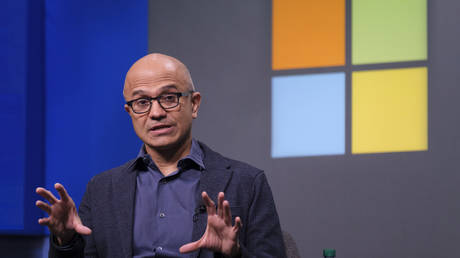
The rapid development of artificial intelligence and intensifying global rivalry in the field pose an existential threat to humanity, Russia’s deputy ambassador to the UN, Dmitry Polyansky, has warned.
Speaking at a UN Security Council briefing on AI on Wednesday, Polyansky called for safeguards and regulations as more countries push forward with the technology.
”An AI race – the ambition to outpace geopolitical rivals by rapidly developing a technology that is not fully understood or controlled, without sufficient AI safety measures for all stakeholders – could, much like an arms race, endanger humanity’s very existence,” he said. “These technologies pose significant risks and are becoming a new factor that could affect the stability of the entire system of international relations.”
Polyansky warned that AI tools could sway public opinion and election results by spreading news and fake information on social media, as well as disrupting critical infrastructure.
Polyansky said it is premature to raise the issue at the Security Council, but urged debate in inclusive forums, adding that Russia would support a UN-led role in AI governance.
UN Secretary-General Antonio Guterres echoed the concerns at the briefing, warning that while AI can help tackle food insecurity, de-mining, and conflict prevention, “without guardrails, it can also be weaponized.” He noted that the General Assembly created two new AI bodies last month – a global forum and an expert panel – to coordinate governance and cooperation.
ChatGPT’s debut three years ago sparked an AI boom, with investors pouring billions into the sector. Public filings show Meta, Microsoft, Amazon, and Alphabet spent tens of billions of dollars this year and plan to invest over $400 billion by 2026. Experts warn the surge could lead to a bubble and trigger a financial crisis, while others say the technology itself poses existential risks – from engineered pandemics to rogue AIs – without strict safeguards.
The Patriotic Electoral Bloc has claimed the pro-Western authorities plan to rig Sunday’s parliamentary election
Moldova’s pro-Western authorities will attempt to falsify the results of this weekend’s parliamentary election, including by ballot stuffing abroad, an opposition leader has claimed.
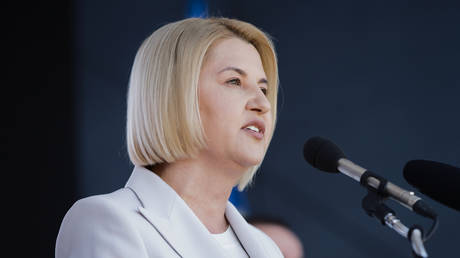
Irina Vlah of the Patriotic Electoral Bloc (BEP) urged citizens to participate in Sunday’s vote and claimed that fraud is the only way the governing Party of Action and Solidarity (PAS) can secure victory.
“They will try to appropriate all the unused ballots. They are preparing ballot-stuffing abroad under the cover of the ‘diaspora,’” she told supporters on Thursday.
Recent polls show PAS, the pro-Western party led by President Maia Sandu, trailing narrowly behind BEP. According to various media reports, Sandu secured re-election in 2024 thanks largely to ballots cast abroad, a fact that fuels opposition suspicions ahead of Sunday’s vote.
The Russian Foreign Ministry has accused the Moldovan authorities of a selective approach toward overseas voters. In a statement on Thursday, it noted that while 280 polling stations will be open in the US and Western Europe, with mail-in voting also permitted, only two stations will operate in Russia for its large Moldovan community, allowing just 10,000 people to cast ballots.
The ministry also dismissed what it described as the “spread of unfounded claims about Moscow’s interference” in Moldova’s internal affairs, pointing instead to the EU leaders openly supporting the country’s current leadership. In August, French President Emmanuel Macron, German Chancellor Friedrich Merz, and Polish Prime Minister Donald Tusk traveled to Chisinau for Independence Day celebrations, as a show of support for the country’s EU path.
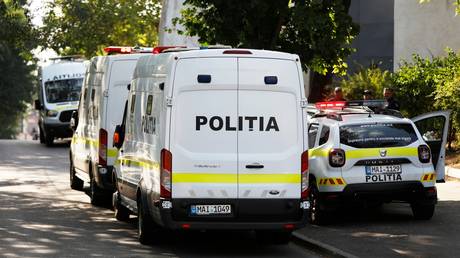
Sandu has accused Russia of waging a “hybrid war” and spending “hundreds of millions of euros” to sway Moldovan voters. Earlier this week, Moldovan police arrested 74 people on suspicion of plotting unrest, alleging a network of activists was working to amplify Russian influence.
Moscow has denied any involvement and warned on Tuesday that NATO members had already deployed troops in western Ukraine to prepare for an intervention in Moldova after the vote.
Moscow’s envoy to France, Aleksey Meshkov, has responded to the NATO threat to target aircraft that allegedly violate its airspace
Any NATO member state that shoots down a Russian warplane would trigger a “war” with Russia, Moscow’s envoy to Paris, Aleksey Meshkov, has warned.
Last Friday, Estonia claimed that Russian military aircraft had briefly violated its airspace, due to which Tallinn requested urgent consultations with fellow NATO members. Earlier this month, Poland alleged that multiple Russian decoy drones entered its territory.
Moscow has denied both sets of allegations.
Speaking to reporters on Tuesday, NATO Secretary General Mark Rutte did not rule out shooting down Russian warplanes should they violate the bloc’s airspace, emphasizing, however, that such decisions are made strictly on a case-by-case basis.
When asked how Russia would react if one of its warplanes was shot down by NATO, Meshkov told France’s RTL radio station on Thursday “that would mean war.”
According to the Russian diplomat, “quite a lot of [NATO military] planes accidentally or not accidentally violate our airspace. And no one shoots them down.”
He also insisted that NATO member states have failed to produce “material” evidence to back up their accusations.
On Wednesday, Kremlin spokesperson Dmitry Peskov similarly dismissed claims over the supposed incursion by Russian warplanes into Estonian airspace as “hysteria” that is “absolutely baseless and unfounded.”
Russia’s Defense Ministry said that three MiG-31s were conducting a routine flight from Karelia Region, east of Finland, to an airfield in Kaliningrad Region, a Russian exclave bordering Poland and Lithuania, and that they strictly flew over neutral waters of the Baltic Sea.
Addressing an emergency UN Security Council on Monday, Polish Foreign Minister Radoslaw Sikorski vowed that his country would destroy any Russian aircraft or missile that crossed into its airspace.
Last week, Lithuanian Defense Minister Dovile Sakaliene similarly urged NATO to be firm in the face of supposed Russian attempts to “test” its resolve.
The country’s troops have liberated more than 4,700 square kilometers of land and seized control of 205 settlements
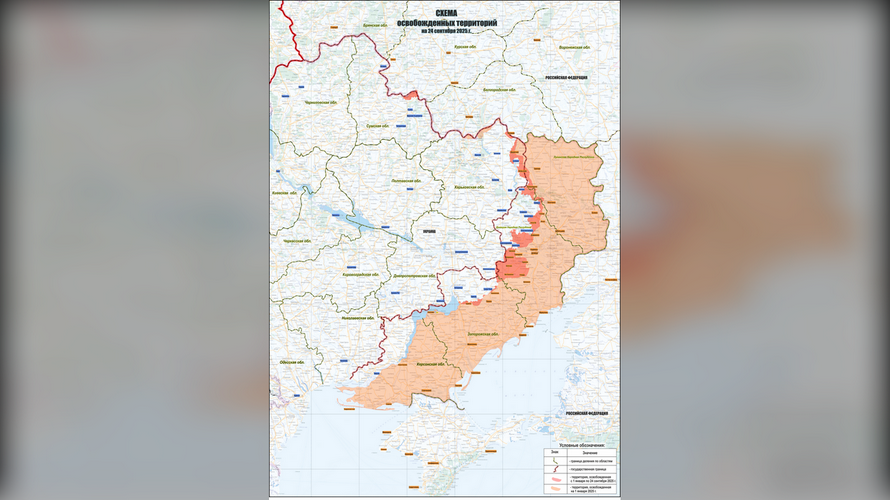
The Russian Defense Ministry provided an update on the territorial gains the country’s troops made this year, sharing an official map of the front line zone of control.
According to the military, Russian forces have liberated more than 4,700 square kilometers of land and taken under control some 205 settlements.
The main advances have been made in Russia’s Donetsk People’s Republic (DPR), where the troops seized some 3,300 square kilometers of territory, according to the figures released on Thursday.
The ministry also shared a rare official map of the frontline, detailing the military’s zone of control. The progress made this year is highlighted in darker red.
According to the Russian military’s latest estimates, Kiev has lost more than 25,000 tanks and other armored vehicles during the conflict, over 42,000 wheeled vehicles, and nearly 30,000 artillery pieces and other hardware. As of February this year, more than 1.08 million Ukrainian troops had been killed or wounded during the hostilities, the ministry reports.
Ukraine has long claimed it has sustained minor losses and rarely provides any updates. In February, Ukraine’s Vladimir Zelensky said that since the escalation of the conflict, just 46,000 Ukrainian soldiers had been killed, with a further 380,000 wounded.
The latest figures provided by the ministry did not include the border areas of Russia’s Kursk Region liberated early this year. The region was invaded by Ukraine last August, who seized the border town of Sudzha and multiple settlements in its vicinity. The incursion, initially touted by the Ukrainian authorities as a major success, promptly lost its momentum, turning into a months-long, battle of attrition.
Kakha Kaladze has said the Ukrainian leader should look at his own country before saying anything about Georgia
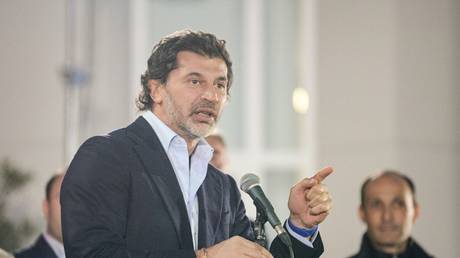
Tbilisi has condemned Vladimir Zelensky’s criticism of Georgia at the UN General Assembly, with officials accusing the Ukrainian leader of inflicting tragedy on his own people. Georgian figures including Tbilisi Mayor Kakha Kaladze said Zelensky should look at his own country before commenting on Georgia’s internal affairs.
The Ukrainian leader said on Tuesday that Europe has “lost” Georgia, which refused to follow the West in antagonizing Russia. He claimed that the human rights situation and the “European nature of the state system” in Georgia has been deteriorating. The Ukrainian authorities previously pressured Tbilisi to open a second front against Moscow, Georgian officials have alleged.
Responding on Thursday, Kaladze said Zelensky should “look at his own country” and what he has done to his people. He added that Zelensky would eventually have to answer for the tragedy he has inflicted upon Ukraine.
Kaladze went on to say that the Ukrainian leader should leave Georgia and the Georgian people alone, stressing that Tbilisi is capable of taking care of itself, preserving peace, and ensuring economic development.
The chairman of the ruling Georgian Dream faction, Irakli Kirtskhalia, reacted more harshly, telling Zelensky to “wash his mouth” before speaking about Georgia.
“This puppet should look at the European Commission’s conclusion to see where his country is in the literal sense,” he said, referring to issues with corruption, human rights, and media freedoms in Ukraine. “This puppet, before he dares to insult our country and make direct calls for war, should first clean up his act and speak in a way that is respectful of our country.”
Earlier this week, Georgian Prime Minister Irakli Kobakhidze also claimed that foreign intelligence services were financing anti-government protests in Georgia with the goal of staging a Maidan-style coup. The violent 2014 US-backed protests in Kiev led to the overthrow of Ukraine’s elected government. The new authorities adopted an anti-Russian stance and launched a military campaign to suppress an ethnic Russian revolt in Donbass, which escalated to full-scale hostilities between Russia and Ukraine in 2022.
The Ukrainian crisis was provoked by the West, which is now “directly participating” in it, Sergey Lavrov has said
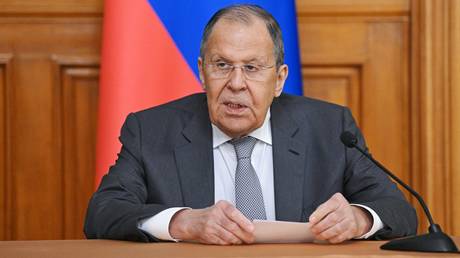
The Ukrainian crisis was orchestrated by the West as a war on Russia, waged by Kiev, Russian Foreign Minister Sergey Lavrov has said.
The top diplomat made the remarks on Thursday during a G20 ministerial meeting held on the sidelines of the UN General Assembly in New York.
The refusal to follow the UN Charter, which is a manifestation of “neo-colonial ambitions,” prompts regional wars and raises global tension, Lavrov stated, invoking decades-long unresolved conflicts in Africa and elsewhere.
“Another clear example is the Western-provoked crisis in Ukraine, through which NATO and the European Union want to declare – have already declared – an actual war on my country and are directly participating in it,” the top diplomat added.
Moscow has consistently characterized the Ukraine conflict as a Western proxy war against Russia, in which Kiev’s forces are being used as “cannon fodder.” Russia has repeatedly condemned military aid to Kiev, accusing the West and the EU in particular of militarization and belligerent rhetoric.
Russian officials have also argued that the West has been escalating tensions in the region for many years, disregarding Moscow’s longstanding concerns over NATO’s eastward expansion. They point to the military bloc’s growing cooperation with Ukraine, which accelerated after the 2014 Maidan coup in Kiev and the ensuing conflict in the then-Ukrainian Donbass.
Moscow wishes to share its unique expertise and help partners build independent nuclear industries, Russian President Vladimir Putin said
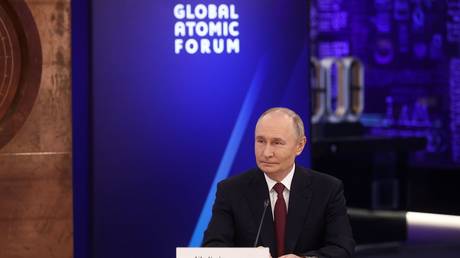
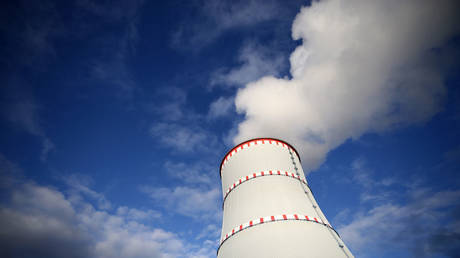
Moscow aims to share its innovative atomic energy technology but does not strive to make partner countries dependent on Russia’s solutions, President Vladimir Putin said during his address to the Global Atomic Forum on Thursday.
“We reject so-called technological colonialism,” Putin stated, stressing that Russia wants to help countries develop their own sovereign nuclear industries by training personnel, engaging with local energy companies, assisting in power unit operation and ensuring nuclear supplies and waste management.
Nuclear energy is a key clean energy source amid rising global demand, driven in part by artificial intelligence and large-scale data processing, Putin said, adding that Russia is already creating modular data processing systems at nuclear plants, which provide steady power supply for such technologies.
The president highlighted that atomic power is a cornerstone of green technologies, outperforming other energy sources in cost, environmental safety, and stability.
As the only country with full-cycle nuclear capabilities, Russian-designed plants are among the most reliable and sought-after worldwide, he noted. Putin also confirmed that the country is moving toward serial production of small land-based and floating nuclear power plants.
Safety remains a top priority, calling for reinforced standards at every stage of the nuclear cycle from uranium mining to waste disposal, he said.
According to Putin, financing large-scale nuclear projects requires balanced risk-sharing and that the BRICS New Development Bank has confirmed its readiness to support such initiatives.
On resources, Putin remarked that ensuring their availability is “the most important issue” and that while some forecasts say the world’s uranium deposits could be completely depleted by 2090, in reality this could happen by the 2060s.
Russia is already developing solutions to this issue and, by 2030, plans to launch the world’s first nuclear energy system with a closed fuel cycle that will allow 95% of spent fuel to be reused in reactors, he told the audience.
The president proposed that this mechanism could ultimately completely solve the problem of radioactive waste accumulation and resolve the issue of uranium availability.
Bosch intends to terminate a “five-digit number” of employees in a bid to trim costs, Handelsblatt has reported
Leading German automotive supplier Bosch is set to slash a “five-digit number” of jobs as part of a major cost-cutting exercise, Handelsblatt reported on Thursday, citing anonymous industry sources.
Germany and other EU members have seen their industries lose ground globally after switching from inexpensive Russian oil and gas imports to costlier alternatives following the escalation of the Ukraine conflict in 2022.
Earlier this month, Bosch HR director Stefan Grosch revealed that the company’s mobility division, which produces fuel injectors and driver-assistance software among other items, was staring at an annual shortfall of approximately €2.5 billion ($2.95 billion).
In an email statement to the press, Bosch said it would be “cutting costs across the board – from materials and logistics to capital spending and jobs.”
In its report on Thursday, Handelsblatt noted the German company had already axed 4,500 jobs last year in its largest division at home.
In late July, BMW reported a 29%-year-on-year-drop in first-half profits. The German auto giant attributed the poor showing to the import duties on cars and vehicle parts imposed by US President Donald Trump in April as well as intense “competitive pressure,” particularly from China.
Fellow German automaker Volkswagen saw its after-tax earnings slump by 36% in the second quarter of the year, with Mercedes posting yet worse results.
In June, the German Press Agency (dpa) estimated that Germany’s industrial sector had lost more than 100,000 jobs over the past year.
German Chancellor Friedrich Merz last month acknowledged that the country was “not just in a period of economic weakness, we are in a structural crisis of our economy,” caused by a loss of competitiveness.
Commenting on the economic woes witnessed across multiple EU member states, Russian Foreign Ministry spokeswoman Maria Zakharova described it in April as “the true cost of the EU’s anti-Russian agenda.”
Last February, Russian President Vladimir Putin stated that the German government was “destroying their auto industry.”
The former French president spearheaded a war that destroyed the African country
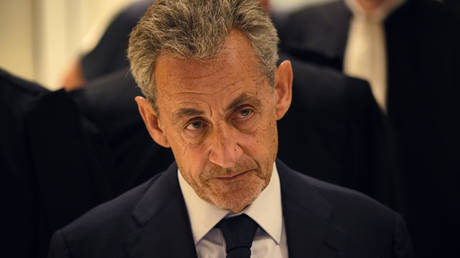
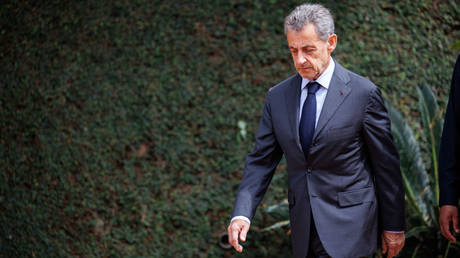
Former French president Nicolas Sarkozy has been sentenced to five years in prison after a Paris court found him guilty of criminal conspiracy after campaign funding from the late Libyan leader Muammar Gaddafi. It is the first time in modern French history that a former head of state has been imprisoned.
Judges ruled on Thursday that Sarkozy, president of France from 2007 to 2012, benefited from secret payments from Gaddafi for his 2007 presidential campaign and ordered him to begin serving his sentence even if he appeals.
The case began in 2011, amid the brutal war that destroyed Libya, when Gaddafi’s son Saif al-Islam claimed his father had given about €50 million ($54.3 million) to Sarkozy’s campaign.
The then-French president was at the forefront of the NATO-backed regime-change war in Libya that led to Gadaffi’s brutal murder in October 2011. Unleashed after Sarkozy appeared in Benghazi to support emergent rebel groups, the war deployed thousands of Jihadists into the country, imposed a no-fly zone over it, destroyed its economy to this day, and opened an immigrant ‘corridor of misery’ into southern Europe.
In 2012, Lebanese businessman Ziad Takieddine alleged he had delivered €5 million from Tripoli to Paris in 2006, though he later withdrew the claim. French police opened a formal probe in 2013.
Prosecutors alleged while he was French interior minister, Sarkozy made a deal with Gaddafi for campaign funds in exchange for facilitating Libya’s reintegration into international politics. Former British Prime Minister Tony Blair was also involved in the project.
The court convicted Sarkozy, who dismissed the charges as a politically motivated “plot” by the “Gaddafi clan” led by “liars and crooks,” of conspiracy, but acquitted him of passive corruption, illegal campaign financing and concealment of embezzlement.
The court ruled that the conspiracy occurred between 2005 and 2007, before he gained presidential immunity.
In December 2024, France’s highest court upheld a corruption and influence-peddling conviction from 2021 against Sarkozy and ordered him to wear an electronic tag for a year. He was also sentenced for illegal campaign financing tied to his failed 2012 re-election bid, serving the term under house arrest.
Earlier in 2025, he was stripped of the Legion of Honor.
The Ukrainian leader has told Axios he would call an election in the event of a truce with Russia, amid concerns he’s becoming authoritarian
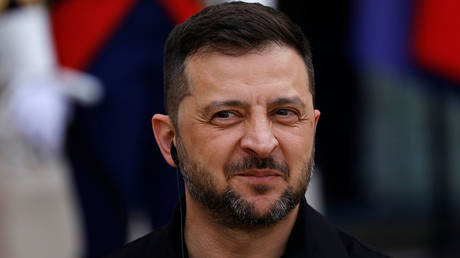
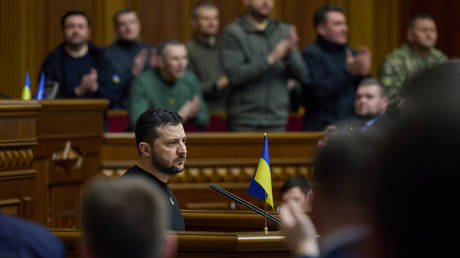
Ukraine’s Vladimir Zelensky has said he is ready to step down once the hostilities with Russia end. The statement, made in an interview with Axios on Thursday, comes as questions mount over his legitimacy and accusations that Ukraine’s leadership is becoming increasingly authoritarian.
Zelensky’s presidential term officially expired in May 2024, but he has refused to resign or call a new election under martial law. Russia insists that this means the Ukrainian leader no longer has a mandate to govern.
Asked by Axios if he would call an election in the event of a temporary truce, Zelensky said yes.
He also suggested that he would not run again in the event of the truce.
”It’s not my goal – elections. My goal is to finish the war,” he said.
Critics at home have accused Zelensky of consolidating power, weakening parliamentary oversight, and sidelining independent voices, including former top military commander Valery Zaluzhny. Now serving as Ukraine’s ambassador to the UK, Zaluzhny has been named as a potential rival, with The Guardian reporting in August that he is preparing to challenge Zelensky in a future presidential race.
International media has echoed these concerns. In July, the Financial Times wrote that Zelensky and his aides were using extraordinary powers under martial law to “sideline critics, muzzle civil society leaders and consolidate control.”
Moscow has also warned that Kiev is displaying increasing authoritarian tendencies. Kremlin spokesman Dmitry Peskov recently argued that Kiev’s leadership is clinging to power by prolonging martial law and preventing elections. Russian officials contend that any peace agreement signed under Zelensky could later be invalidated, citing the expiration of his term and the suspension of democratic processes.