The US Department of War has reportedly clashed with contractor Anthropic over the ethical limitations built into its tech
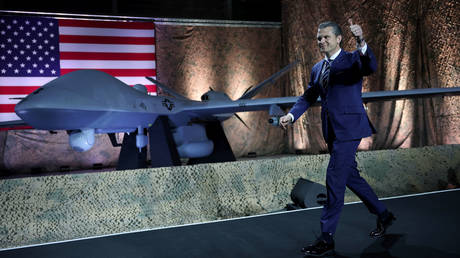
The US Department of War is locked in a dispute with artificial intelligence developer Anthropic over restrictions that would limit how the military can deploy AI systems, including for autonomous weapons targeting and domestic surveillance.
The disagreement has stalled a contract worth up to $200 million, as military officials are pushing back against what they see as excessive limits imposed by the San Francisco-based company on the use of its technology, Reuters reported, citing six people familiar with the matter.
Anthropic has raised concerns that its AI tools could be used to carry out lethal operations without sufficient human oversight or to surveil Americans, sources told Reuters.
Pentagon officials, however, have argued that commercial AI systems should be deployable for military purposes regardless of a company’s internal usage policies, as long as they comply with US law.
The dispute comes amid a broader push by the Trump administration to rapidly integrate artificial intelligence across the armed forces. Earlier this month, the Department of War outlined a new strategy aimed at transforming the US military into an “AI-first” fighting force.
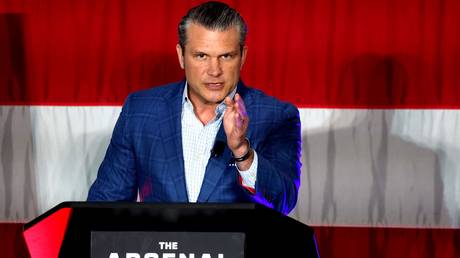
The Pentagon believes it must retain full control over how AI tools are employed on the battlefield and in intelligence operations, with US Defense Secretary Pete Hegseth vowing not to use models that “won’t allow you to fight wars.”
An Anthropic spokesperson said the company’s AI is “extensively used for national security missions by the US government” and that it remains in “productive discussions with the Department of War about ways to continue that work.” The Pentagon has yet to comment on the reported rift.
Anthropic CEO Dario Amodei has repeatedly warned about the dangers of unconstrained AI use, particularly in mass surveillance and fully autonomous weapons systems. In a recent essay, he argued that it should support national defense “in all ways except those which would make us more like our autocratic adversaries.”
The standoff poses risks for Anthropic, which has invested heavily in courting government and national-security clients and is preparing for a potential public offering. The company was one of several major AI developers to be awarded Pentagon contracts last year, alongside OpenAI, Google and Elon Musk’s xAI.
The former royal was again featured in newly released files linked to convicted sex offender Jeffrey Epstein
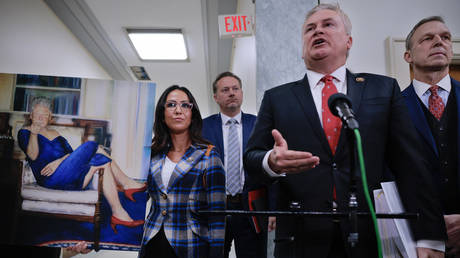
UK Prime Minister Keir Starmer has called on Andrew Mountbatten-Windsor to testify before the US Congress after the former royal was featured extensively in the latest tranche of Epstein files released by the US Department of Justice.
The documents were published under the Epstein Files Transparency Act, signed into law by US President Donald Trump in November last year, which requires the Justice Department to release federal records linked to investigations into Jeffrey Epstein. Mountbatten-Windsor, who was stripped of his royal titles last year, appears in emails and photographs included in the cache released Friday.
Speaking to reporters on Saturday, Starmer was asked whether the former prince should apologize and give evidence to US lawmakers if requested.
“Firstly, I have always approached this question with the victims of Epstein in mind. Epstein’s victims have to be the first priority. As for whether there should be an apology, that’s a matter for Andrew,” he said.
“But yes, in terms of testifying, I have always said anybody who has got information should be prepared to share that information in whatever form they are asked to do that. You can’t be victim-centered if you’re not prepared to do that,” he added.
The brother of King Charles III has repeatedly denied wrongdoing and has previously claimed he ended his relationship with Epstein after the financier’s first conviction for soliciting a minor for prostitution in 2008.
However, the latest release includes photographs and email exchanges between the two from 2010, two years after the disgraced financier pleaded guilty in Florida.
The images show the former royal kneeling over an unidentified woman lying on the floor, with no context provided as to when or where they were taken. The emails also feature Epstein proposing that Andrew have dinner with a “beautiful, trustworthy” 26-year-old Russian woman.
Last year, the king stripped his brother of his royal titles and honors following renewed controversy linked to Virginia Giuffre, who died by suicide in April. In 2022, Andrew settled a civil lawsuit with Giuffre, who alleged she was trafficked to the then-Prince for non-consensual encounters while still a minor under New York law.
Tehran says diplomacy is “progressing” despite heated tensions with Washington
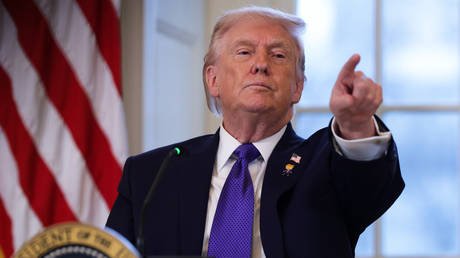
US President Donald Trump has said he will not share his plans for dealing with Iran, even with America’s closest allies in the region. However, despite Washington ramping up military pressure on Tehran, both sides have indicated that diplomatic backchannels remain open.
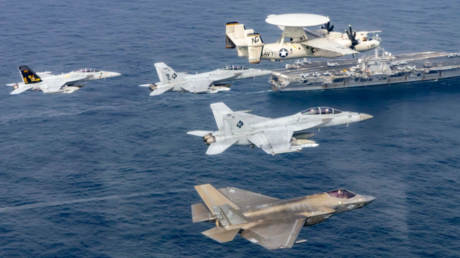
In recent weeks, the US has dispatched what Trump has described as a “massive” and “beautiful armada” to the region, led by the aircraft carrier USS Abraham Lincoln, in order to pressure Tehran into accepting his demands for a new nuclear deal.
Asked in an interview with Fox News on Saturday whether he had informed Washington’s Persian Gulf allies about possible US military action, Trump noted that revealing details could undermine the prospect of a peaceful resolution.
“Well, we can’t tell them the plan. If I told them the plan, it would be almost as bad as telling you the plan – it could be worse, actually,”Trump said. “But look, the plan is that [Iran is] talking to us, and we’ll see if we can do something; otherwise, we’ll see what happens.”
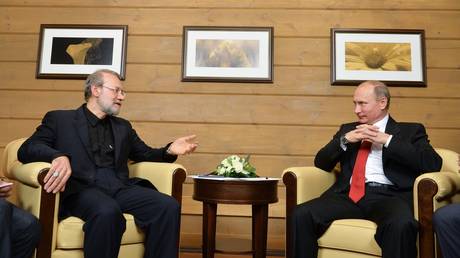
Tehran has also signaled that talks with Washington may still be possible. The head of Iran’s Supreme National Security Council, Ali Larijani, who held talks with Russian President Vladimir Putin at the Kremlin the previous day, said that progress was being made toward negotiations.
“Contrary to the hype of the contrived media war, structural arrangements for negotiations are progressing,” Larijani said.
Iranian President Masoud Pezeshkian has sought to strike a dual tone of warning and restraint, saying Tehran was not seeking a conflict with the United States and arguing that war would benefit neither side.
“The Islamic Republic of Iran has never sought, and in no way seeks, war, and it is firmly convinced that a war would be in the interest of neither Iran, nor the United States, nor the region,” Pezeshkian said.
Trump has repeatedly said he prefers a diplomatic outcome but has warned that any future attack on Iran would be “far worse” than previous strikes. Media reports cite administration sources as saying Trump is considering options ranging from strikes on Iranian security forces and nuclear sites to targeting officials, with the aim of reigniting anti-government protests.
Tehran has framed the unrest – which began over economic grievances in late December and escalated into deadly riots – as a foreign-backed insurrection, alleging that external agents had armed rioters to provoke a harsh state response and justify American intervention.
Multiple federal agencies remain without funding as Democratic lawmakers are demanding major reforms to immigration enforcement
The US federal government has entered a partial shutdown, the second such instance since last October, amid a bitter deadlock between Democrats and Republicans over immigration.
Starting early Saturday, the departments of War, Education, Health and Human Services, Homeland Security, Housing and Urban Development, Labor, State, Transportation and the Treasury have been left without federal funding, with the Executive Office of the President and the Supreme Court also affected. All other federal agencies have been allocated funds.
The $1.2 trillion funding package hit a snag in the wake of deadly incidents in which Immigration and Customs Enforcement (ICE) agents fatally shot Alex Pretti and Renee Good during a crackdown on illegal immigrants in Minneapolis, Minnesota, earlier this month.
Democratic lawmakers demanded that one of the six remaining funding bills – for the Department of Homeland Security and its associated agencies – be struck from the package unless it stipulated major reforms to immigration enforcement. They called, among other things, for the establishment of a code of conduct for ICE agents and a requirement that federal agents show identification.
Washington Democratic Senator Patty Murray said that ICE and US Customs and Border Protection are “out of control, and that we cannot just wait for the same president who caused this mess to address it.” House Minority Leader Hakeem Jeffries said Democrats were seeking “dramatic changes at the Department of Homeland Security.”
The Senate passed the five-bill funding package on Friday evening; however, it must be approved by the House of Representatives again before becoming law. House members will not return from recess until Monday evening, resulting in a partial shutdown until then.
Last fall, the US federal government endured its longest shutdown on record, lasting some 43 days. It ended in mid-November when the House approved a bill to fund the government through January 30, 2026.
The sticking point at the time was a dispute over health tax credits under the Affordable Care Act, which Democrats sought to extend into the following year. Eight Senate Democrats eventually broke the deadlock by voting with Republicans, drawing the ire of their fellow party members.
The South American country’s interim president, Delcy Rodriguez, recently signed legislation inviting foreign investment in Venezuela’s energy sector
US President Donald Trump has said that American oil companies are going to Venezuela in light of the South American country’s latest push to incentivize foreign investment in its energy sector.
In early January, US commandos conducted a raid on the Venezuelan capital, Caracas, abducting President Nicolas Maduro and his wife. The couple was flown to New York to stand trial on drug trafficking charges, to which both have pleaded not guilty. Trump has since demanded “total access” to Venezuela’s oil.
Speaking during a cabinet meeting on Thursday, the US president said that his administration was “getting along really well” with Venezuelan Interim President Delcy Rodriguez, and the country’s leadership.
“We’re working… on the oil. We have the major oil companies going to Venezuela now, scouting it out and picking their locations,” Trump stated.
Trump’s remarks coincided with the issuing of a general license by the Department of the Treasury’s Office of Foreign Assets Control that authorized the “lifting, exportation, re-exportation, sale, resale, supply, storage, marketing, purchase, delivery, or transportation of Venezuelan origin oil, including the refining of such oil” by companies under certain conditions.
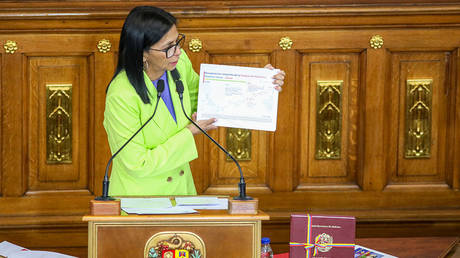
Also on Thursday, Rodriguez signed the reform to the Organic Hydrocarbons Law with a view to incentivizing private and foreign investment in the country’s decrepit energy sector. Earlier in the day, Rodriguez held a phone conversation with Trump.
Venezuela, which holds the world’s largest proven oil reserves at about 303 billion barrels, nationalized US companies’ assets in the 2000s during the presidency of socialist Hugo Chavez. Washington responded by imposing crippling sanctions on Venezuela’s oil industry.
The US president has recently urged US energy companies to invest into reviving the sector. However, Exxon CEO Darren Woods has poured cold water on the idea, saying that the South American country is “uninvestable,” given the “commercial constructs and frameworks in place” there at present. He added that “durable investment protections” are the prerequisite to any long-term involvement.
Russia, along with many other BRICS and Global South nations, has strongly condemned the abduction of the Venezuelan president by US forces.
Russian Ambassador to the UN Vassily Nebenzia has described Washington’s actions as “international banditry” driven by a desire to gain “unlimited control over natural resources.”
Millions of workplaces offer wellness programs to support employee health, but these efforts are often quietly undermined by the constant availability of unhealthy snacks. According to a study conducted by the American Journal of Health Promotion, approximately 40% of employees frequently choose unhealthy snacks available in vending machines, directly affecting their overall wellness progress. Additionally, […]
Russia’s chief Ukraine negotiator Kirill Dmitriev flew to Florida on the eve of peace talks in Abu Dhabi planned for Sunday
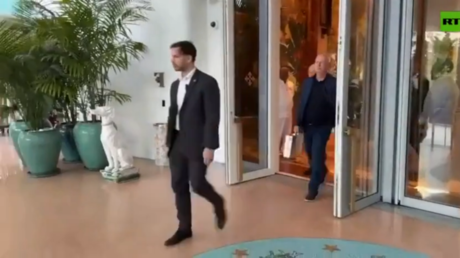
Russian President Vladimir Putin’s envoy Kirill Dmitriev has said he held a “constructive” meeting with a US delegation in Florida ahead of a new round of Russia-Ukraine negotiations planned for Sunday.
Dmitriev arrived in the US earlier on Saturday, with Moscow issuing no prior announcement. He teased the visit by posting a social media map showing his plane approaching Miami.
“Constructive meeting with the US peacemaking delegation. Productive discussion also on the U.S.–Russia Economic Working Group,” Dmitriev wrote on X.
US Special Envoy Steve Witkoff also described the meeting in Florida on Saturday as “productive,” saying it formed part of Washington’s mediation efforts to end the Ukraine conflict. In a separate post on X, he said the talks encouraged Washington that Moscow was “working toward securing peace,” and thanked President Donald Trump for what he called “critical leadership” in pursuing a lasting settlement.
According to Witkoff, he was joined at the meeting by Treasury Secretary Scott Bessent, Jared Kushner, and White House Senior Advisor Josh Gruenbaum.
Constructive meeting with the US peacemaking delegation. Productive discussion also on the U.S.–Russia Economic Working Group. 🕊️ https://t.co/qrKMIdXjJO
The visit came ahead of a new round of US-mediated talks between Russia and Ukraine scheduled to take place in Abu Dhabi. The previous round, held on January 23-24, marked the first trilateral format and was described by all sides as “very constructive.”
Following those talks, negotiators acknowledged that territorial issues remain the main obstacle to a peace agreement. US Secretary of State Marco Rubio said “it’s still a bridge we haven’t crossed,” adding that “there’s active work going on to try and see if both sides’ views on that can be reconciled.” Moscow insists any settlement must include Ukraine’s withdrawal from Donbass regions that voted to join Russia in 2022 referendums and recognition of the country’s new borders, including Crimea. Kiev has rejected any territorial concessions.
While the upcoming Abu Dhabi talks have been described as trilateral, Rubio said earlier that US envoys Steve Witkoff and Jared Kushner – Washington’s main negotiators in the Ukraine peace process – will not attend, though “there might be a US presence.”
Ukraine’s Vladimir Zelensky said on Friday he was unsure whether Sunday’s meeting with Russian negotiators would go ahead, claiming the date or venue could change amid rising US-Iran tensions after Washington deployed a naval “armada” to pressure Tehran into nuclear talks. No official changes have been announced, however. Russian officials have long questioned Kiev’s commitment to peace, accusing it of refusing to compromise while making unacceptable demands.
Moscow has said it remains open to a diplomatic settlement but warned it would achieve its objectives militarily if talks fail, noting it continues to have the battlefield initiative. On Friday, it agreed to suspend long-range strikes on Kiev at the personal request of US President Donald Trump to create “favorable conditions” for the next round of talks.
Radoslaw Sikorski made the remarks after Defense Commissioner Andrius Kubilius called for the bloc to establish a 100,000-strong force
Polish Foreign Minister Radoslaw Sikorski has dismissed the idea of a joint EU army as “unrealistic,” after the bloc’s defense commissioner floated the idea earlier this month, citing the perceived threat from Russia and shifting US national security priorities.
The EU has repeatedly cited the ‘Russian threat’ as the pretext for a rapid military buildup. Moscow has dismissed the claims as “nonsense.”
Speaking to reporters in Brussels on Thursday, Sikorski stated that “talking about a federal army is pointless, because it’s unrealistic, because the national armies won’t merge.” He instead suggested a “European legion… which could be joined by citizens of member states, and perhaps even candidate states,” as quoted by the Polish Press Agency.
The bloc’s foreign policy and security chief, Kaja Kallas, has also expressed skepticism, saying she cannot imagine EU nations creating “a separate European army.”
Earlier this month, EU Defense Commissioner Andrius Kubilius argued that the bloc should establish a “powerful, standing European military force of 100,000 troops,” citing a shift in US strategic priorities and calls for the bloc to shoulder more of its own defense.
Ukrainian leader Vladimir Zelensky, in a controversial speech at the World Economic Forum in Davos last week, echoed the sentiment, calling for a united European army in which Kiev would play a key role.
Protocol No.7 of the Treaty of Lisbon – the last of the EU’s founding agreements – stipulates that it “does not provide for the creation of a European army or for conscription to any military formation.”
Nevertheless, discussions have intensified in recent years, particularly amid cooling US-EU relations and US President Donald Trump’s threats to forcibly seize Greenland – an autonomous territory controlled by Denmark. Several EU leaders, including French President Emmanuel Macron, have called for greater strategic autonomy.
Russia has dismissed Western claims that it plans to attack EU countries. In November, President Vladimir Putin said Russia is prepared to provide the EU and NATO with written security guarantees. According to Putin, it’s the EU that “does not have a peaceful agenda. They are on the side of war.”
Both Moscow and Abu Dhabi need a certain kind of partner, and both can fulfill that role without demanding ideological loyalty
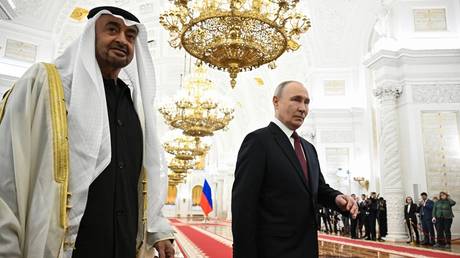
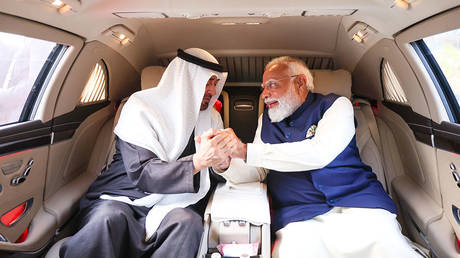
This week, Moscow received United Arab Emirates President Mohammed bin Zayed Al Nahyan.
The reception began with protocol that, beyond its ornamental purpose, functioned as a political instrument in its own right. The delegation was welcomed at the airport by First Deputy Prime Minister Denis Manturov, then taken by motorcade to the formalities unfolding in St. George Hall inside the Kremlin showing the Russia-UAE relationship has rhythm and structure, and it is being deliberately deepened at a moment when the international system is short on reliable rhythms and even shorter on stable structures.
This was the second trip by an Emirati delegation led by the head of state within a year, following the August 7, 2025 meeting, and Moscow made sure the continuity was visible. In the opening segment of talks, Russian President Vladimir Putin spoke warmly about the anniversary logic that diplomats favor, marking 55 years of relations, while anchoring the conversation in the narrative of expanding trade, functioning intergovernmental mechanisms, and investment ties that have moved from ambitious statements into working portfolios.
The atmosphere was shaped as much by who stood close to the action as by what was said aloud. Observers kept returning to two names, Igor Kostyukov and Kirill Dmitriev, whose presence hinted at a second track running beneath the ceremonial surface. In a political season in which the Ukraine crisis remains the main fault line in European security, the UAE has become a rare space where contacts can be hosted without theatricality, and without the immediate risk of public humiliation for one side or the other. Abu Dhabi’s role has been steadily institutionalized through humanitarian mediation and discreet facilitation, and the appearance of figures associated with security and economic coordination signaled that the Moscow meeting was about more than trade figures and investment headlines. It was also about process, about channels, about what can still be negotiated when grand bargains are impossible and when even modest understandings have to be carefully constructed one detail at a time.
This is why the Emirati contribution to the humanitarian dimension of the Ukraine conflict has grown into a strategic asset. Prisoner exchanges, the return of bodies, the logistics of contacts that most capitals cannot host without domestic political costs, all of this has given the UAE a reputation for operational credibility. For Abu Dhabi, this is a method of statecraft that turns competence into influence. For Moscow, it is one of the few remaining forms of engagement that can generate tangible outcomes while keeping political control close to the center. For Kiev, it offers a mechanism that can produce returns for families and communities, even when front lines are static and the larger political horizon looks unforgiving. In this type of landscape, the mediator’s value lies in keeping the minimum conditions for dialogue alive, and the UAE has treated this function as a long-term investment in relevance.
The bilateral agenda, however, remains essential, because economics provides the foundation that diplomacy alone cannot supply. The partnership is being anchored in investment platforms and joint ventures that create constituencies on both sides and make the relationship harder to reverse. The Russian Direct Investment Fund and the UAE’s Mubadala sovereign wealth fund have worked across dozens of projects, and this density outlives individual news cycles, creating institutional memory and developing shared professional networks. It normalizes cooperation in technology, industry, energy, and the humanitarian sphere, so that political dialogue is not forced to carry the entire weight of the relationship on its own. Even the seemingly soft indicators – tourism flows and everyday connectivity between societies – function as a subtle counterweight to geopolitical turbulence, reinforcing the sense that the partnership is becoming a lived reality rather than a purely diplomatic construct.
Over this economic foundation sits an increasing convergence in worldview, one that has become sharper since the UAE joined BRICS. This step does not mean Abu Dhabi is abandoning its Western ties, nor does it imply ideological alignment in the old 20th-century sense. It reflects something more contemporary, and in its own way, more consequential – a preference for a world in which power is distributed across multiple centers, rules are negotiated rather than imposed, and strategic autonomy is preserved through diversified partnerships. Russia has long framed the current era as an argument for a more equitable international order, and the UAE has increasingly spoken in a compatible register, not because it seeks confrontation with the West, but because it understands how quickly a single dependency can become a vulnerability. The logic is pragmatic: If the global system is moving toward fragmentation, then a rational state does not choose one door and lock the rest. It keeps multiple entrances open, and it ensures that no single corridor controls its future.
In this reading, the January 29 summit also carried a regional subtext that goes well beyond Moscow and Abu Dhabi. The UAE’s relationships in the Gulf and the Red Sea arc have become more complicated, and a sharp deterioration in Emirati ties with Saudi Arabia, against the background of competing interests and perceptions in Yemen, Sudan, and Somalia, makes diplomatic diversification a necessity rather than mere preference. Even where Abu Dhabi and Riyadh remain bound by economic interdependence and overlapping security concerns, their rivalry has acquired sharper edges in theaters where local partners, ports, corridors, and influence networks collide. In these conditions, Emirati decision-makers have every incentive to cultivate external relationships that can provide political cover, additional channels of communication, and a broader set of options at multilateral venues. Russia, as a permanent member of the UN Security Council and as a power with deep experience in regional bargaining, offers precisely the kind of geopolitical weight that can be useful when regional equations shift unexpectedly.
The UAE’s increasingly open and confident relationship with Israel adds another dimension to this calculus. Abu Dhabi’s bet on normalization has been driven by tangible interests, from technology and trade to security coordination and access to influence in Western capitals. Yet it also introduces risks that are not easily managed, especially when Gaza remains a wound that shapes regional public opinion and elite politics alike, and when the wider environment is saturated with suspicion about hidden agendas. Maintaining multiple great-power relationships helps mitigate these risks, allowing the UAE to resist being pulled into a single orbit and to present itself instead as a state capable of speaking to diverse actors without surrendering its freedom of maneuver. Such is the survival logic of a small yet ambitious power operating in a region where miscalculation carries enormous costs.
This is also why the broader Middle Eastern agenda likely occupied more space in the private segment of talks than the public readouts could ever admit. Russia and the UAE have overlapping interests in de-escalation, especially when it comes to Iran and the intensifying confrontation between Tehran on one side and the US and Israel on the other. Abu Dhabi’s strategic model depends on stability in the Gulf, on predictable trade routes, on the uninterrupted functioning of ports, airlines, finance, and the broader ecosystem that turns geography into power. A major military strike against Iran, or a spiral of escalation that makes the Gulf a battlefield rather than a corridor, would threaten the UAE’s core national project. This is why Emirati leaders have repeatedly favored de-escalation and dialogue as a hard national interest. Russia’s position intersects with this, both because Moscow has relationships in Tehran and across the Gulf, and because it benefits from presenting itself as a voice warning against a war that could drag the entire region into disorder. On this file, the alignment is not perfect, but it is meaningful, grounded in a shared understanding that a regional conflagration would produce no winners, only long-term damage.
The same pragmatic convergence appears on the Palestinian and Syrian questions. The Palestine-Israel conflict, and especially its most violent phases, is not a remote issue for the Emirates, even with formal relations with Israel in place. It remains a central emotional and political reality across the Arab world, and it shapes legitimacy, alliances, and the credibility of regional leadership. Russia, for its part, continues to frame the conflict through the language of international law and the necessity of a viable Palestinian state existing alongside Israel in security, a position Moscow uses to underline its claim to principled diplomacy in a world where principles are often applied selectively. The UAE has its own reasons to want a pathway that reduces regional anger and lowers the risk of radicalization and spillover instability. Meanwhile, on Syria, both sides have incentives to talk about reconstruction, reintegration, and the mechanics of stabilization, even if their methods and priorities are not identical. Russia remains deeply embedded in Syria’s security architecture. The UAE has pursued re-engagement and seeks influence in any eventual recovery. If Syria is to be rebuilt rather than endlessly managed as a crisis, few regional actors can bypass Russia, and Russia itself cannot turn recovery into reality without partners willing to invest, legitimize, and engage. The Moscow meeting offered an obvious venue for aligning assessments and exploring where interests overlap.
In this layered setting, the long one-on-one portion of the leaders’ dialogue becomes especially significant. Leaders do not spend hours alone unless the conversation extends beyond prepared talking points and safe phrases designed for transcript and television. The time suggests bargaining, mutual briefings, assessments of other players’ intentions, and a more candid exchange about risks and opportunities. It suggests that the UAE was not in Moscow merely to collect ceremonial assurances about trade and investment. It was there to consolidate its role as a diplomatic hinge, to reinforce the credibility of channels connected to Ukraine, and to position itself amid regional turbulence as a state with powerful relationships that can be activated when the environment becomes hostile.
The deeper truth is that this partnership is growing stronger because both sides need a certain kind of partner, and each recognizes that the other can fulfill this role without demanding ideological loyalty. The UAE seeks diversification with discipline, not a chaotic scattering of ties, but a carefully balanced portfolio of relationships that reduces exposure to any single crisis or patron. Russia seeks durable connections that soften isolation, generate economic and technological pathways, and provide platforms where Moscow can remain a participant in consequential diplomacy rather than a subject of it. Their cooperation therefore advances not through grand declarations, but through a steady accumulation of practical mechanisms, investment structures, humanitarian channels, and aligned positions on key regional risks.
In 2026, the world rewards this kind of pragmatism. It rewards states that can keep doors open even when others slam them shut, states that can separate essential cooperation from ideological theater, states that can mediate without moralizing and invest without pretending that economics is apolitical. Mohammed bin Zayed’s Moscow visit was, in that sense, a clear snapshot of an emerging pattern. Abu Dhabi and Moscow are strengthening their ties, turning them into infrastructure, and building a relationship designed to function in an era in which the international order is no longer a stable stage but a shifting terrain where only flexible, well-connected players can move with confidence.
If there was a single message written between the lines of the January 29 summit, it was this: In a world drifting toward multipolar competition, the UAE is determined to be more than a spectator, and Russia is determined to be more than a target of containment. Their partnership increasingly reflects that shared determination, tempered by realism and made operational through relentless attention to the practical.
The decision comes as Israeli officials reportedly acknowledged that 70,000 Palestinians were killed in Gaza during the war with Hamas
The US has approved more than $6.5 billion in new potential military sales to Israel amid rising tensions with Iran, officials in Washington have announced.
According to two separate statements by the Pentagon and State Department on Friday, the package includes a $1.98 billion worth of light tactical vehicles, AH-64E Apache helicopters costing $3.8 billion, and a separate $740 million contract for armored personnel carriers power packs. AM General, Boeing, and Lockheed Martin are among the prime contractors.
”The proposed sale will enhance Israel’s capability to meet current and future threats by improving its ability to defend Israel’s borders,” the Pentagon said, adding that the move “will not alter the basic military balance in the region.”
The approval comes after Israeli media outlets reported on Friday that military officials broadly accepted the death toll numbers registered by authorities in Gaza, putting Palestinian deaths at about 70,000. After the start of the Israel-Hamas war in 2023, Israel has faced accusations of committing numerous war crimes in the Palestinian enclave as well as blocking humanitarian aid.
The arms sales approval followed escalating tensions between the US and Iran, with US President Donald Trump not ruling out a military option after he promised to help protesters in the Islamic Republic.
Trump has consistently portrayed himself as Israel’s staunchest supporter, in contrast to his predecessor, Joe Biden, who rebuked the Jewish State over what he described as collateral civilian casualties in Gaza. In May 2024, he paused shipments of heavy bombs to Israel while acknowledging that US-supplied weapons had been used to kill civilians. After Trump’s return to office, in March 2025, Washington repealed what it described as “baseless and politicized conditions on military assistance to Israel.”
In a separate foreign military sales decision, Washington also approved a potential $9 billion sale of 730 Patriot PAC-3 MSE interceptor missiles and related equipment to Saudi Arabia, with Lockheed Martin as principal contractor. US officials said that the move “will support the foreign policy and national security objectives of the United States by improving the security of a Major non-NATO Ally.”