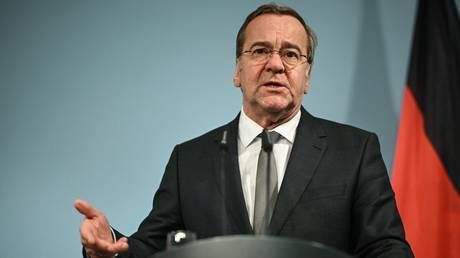
Boris Pistorius has urged his compatriots to “stand up for democracy” at home and abroad, saying that costly support for Ukraine must continue
Germans should adopt a tough stance against “enemies of democracy” at home and uncomplainingly embrace the continuation of costly aid for Ukraine, Defense Minister Boris Pistorius has insisted, invoking a maxim on “happy farts.”
Speaking at a Social Democratic Party (SPD) convention in the city of Koblenz on Saturday, Pistorius branded the opposition right-wing Alternative for Germany party (AfD), and anyone voting for it, the “enemies of democracy.”
The minister urged Germans to “stand up for this democracy” more forcefully.
“A happy fart never comes from a miserable ass,” Pistorius declared, quoting 16th-century German theologian Martin Luther, a key figure in the Protestant Reformation. The phrase suggests that one’s mindset ultimately shapes outcomes.
According to the minister, Germans should apply the same attitude to external affairs.
“And that’s why it’s so important that we, as the Federal Republic of Germany… stand by Ukraine, even if it costs a lot of money,” Pistorius said.
He argued that Germany could afford the effort as the largest economy in Europe and the third largest in the world.
The defense minister acknowledged that without Western aid, “Ukraine would be dead tomorrow.”
Germany is Ukraine’s top backer within the European Union, having provided more than €40 billion ($46 billion) since the escalation of the conflict between Kiev and Moscow in February 2022.
Soon after assuming office last May, Chancellor Friedrich Merz pledged to transform the German military into the “strongest conventional army in Europe,” while continuing to prop up Ukraine.
Meanwhile, Germany’s economy saw two years of recession in 2023 and 2024, and a period of near-stagnation in 2025.
Last December, the country’s central bank warned that Germany is on track to post its largest budget deficit since reunification in 1990, citing a ramp up in military expenditure and continued financial support to Ukraine.
Russian Foreign Minister Sergey Lavrov said last year that “with their current leaders, modern Germany and the rest of Europe are transforming into a Fourth Reich.”
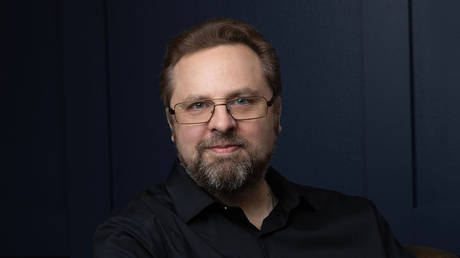
The future belongs to civilization states and an alliance between technology and tradition, says Dr. Steve Turley
Dr. Steve Turley, an American scholar and public intellectual, has become one of the most widely recognized analysts of the political and cultural realignments shaping our time. Trained as a classical guitarist and later earning a doctorate in theology, Turley’s path is unusual. He moved from the lecture halls of academia to the front lines of the new media landscape, where he built a large global audience through daily commentary. His work blends formal training with a plainspoken style that has made him accessible far beyond academic circles.
Turley first gained attention for his argument that liberal globalism has entered a long decline. In its place, he sees the rebirth of enduring forms of identity. His books and videos examine this shift through concrete examples: electoral realignments, the rise of traditional and religious civilization-states, and the growing rebellion against managerial elites. According to Turley, liberal globalism rests on a shrinking population base, while culturally rooted and faith-driven groups are demographically expanding, creating the long-term foundations for a post-liberal world.
Before becoming a full-time commentator, Turley taught theology, philosophy, and rhetoric for many years. This background has shaped his measured and historical tone. He often returns to the idea that political change follows deeper cultural and spiritual currents. For his readers and viewers, this brings context to events that might otherwise appear chaotic or disconnected.
This interview explores his perspective on the forces reshaping the West and the wider world.
What experiences in your early life and education formed the worldview you bring to your work today?
I’ve always been enamored and captivated by civilization in its highest expressions. I was very artistic as a kid; I fell in love with Michelangelo’s paintings and sculptures and did my best to replicate them on canvas with my own oil paint set. I soon became obsessed with Gothic cathedrals and their design.
At around 12 years of age, I moved on to music, particularly Bach, and went on to get my first degree in classical guitar at Peabody Conservatory. It was while I was at Peabody that I immersed myself in theology and discovered the philosophy behind this rich tradition of Western civilization.
I then got my first full-time job as a teacher in a classical school, where I taught theology, Greek, and rhetoric. It was during my doctorate studies that I discovered a growing field of study known as civilizational studies, and that’s when I found how everything I learned beforehand all came together in this wonderful civilizational synthesis.
Which thinkers first convinced you that the world was moving away from a universal liberal model?
Back in 2008, I came across a fascinating book titled Anthony Giddens: The Last Modernist by the sociologist Stjepan Mestrovic, who convincingly argued that the liberal globalist world that Giddens had devoted so much intellectual thought and energy towards building and sustaining was coming to an end, and a post-modern world, centered on culture and identity, was already emerging.
The classic geopolitical expression of this thesis was of course Sam Huntington’s Clash of Civilizations, where he argued that world order was moving away from ideology (the bi-polar world of Western liberalism vs Soviet Communism) and toward identity (the multi-polar world of civilizationalism).
Guillaume Faye’s Archeofuturism provided the raw framework: his diagnosis that liberal modernity was not evolving but collapsing, and that survival demanded a synthesis of archaic values with technological mastery. And perhaps most recently, Zhang Weiwei’s civilization state concept offered the empirical validation for how these various social and geopolitical theories were awakening around the world, most particularly with the rise of neo-Confucian China.
What was the clearest early sign for you that the unipolar order was beginning to fracture?
The theorists such as Huntington, Faye, and Pat Buchanan were all writing about the inevitable fracture in the early 1990s. But for me, there were three events that conclusively indicated that the unipolar world was cracking.
The 2014 annexation of Crimea marked the first real irreversible breach. This wasn’t merely territorial – it was civilizational. President Putin invoked the baptism of Kievan Rus in 988, positioning Russia as the Third Rome inheriting Byzantium’s mantle. While Western elites dismissed this as nothing more than manipulative propaganda, they missed the core signal: a major power was reorganizing its legitimacy around its own territorial hegemony based on religious-historical continuity rather than liberal democratic norms.
The second sign was China’s 2015 declaration of cyber sovereignty. When Beijing asserted that nations have an absolute right to regulate internet activities within their borders, it wasn’t fundamentally about censorship – it was about civilizational control over cyberspace. The split internet wasn’t a bug; it was the architecture of civilizational spheres reawakening through technology.
The third indicator was the 2016 Brexit vote paired with Trump’s election. Brexit represented the first time a globalist institution like the EU actually contracted and shrank. And Trump ran on a political platform that promised to dismantle the liberal international order. These weren’t isolated populist spasms but the first mass democratic repudiations of Francis Fukuyama’s “end of history” thesis, as he himself has admitted. The liberal order’s legitimacy collapsed not from external attack but from internal hollowing – its own populations voting against its continuance.
How would you describe the deep cultural currents driving the transition from a globalized world to a civilizational one?
The main current is the worldwide rise of populism. But what’s so interesting is that the kind of populism we’re seeing today goes way beyond politics. Populism today is a financial force. It’s a social force. It’s a technological force. It’s a cultural force. Today, populism permeates every aspect of our societies and our lives; it extends even into the beer we drink; just ask Bud Light!
I see two major streams converging into the sea of populism: civilizational populism and techno-populism. Civilizational populism is a political force that leverages cultural identity as its primary mobilizing tool. It’s the “us versus them” of entire civilizations, not just political parties.
In India, Prime Minister Narendra Modi has turned Hindu nationalism from a fringe ideology into the mainstream. In Russia, Vladimir Putin and Patriarch Kirill of the Russian Orthodox Church have merged nationalism with faith, defining the “Russian world” as a civilizational space built on Orthodoxy, Russian culture, and historical memory. In Hungary, Viktor Orban has positioned himself as the defender of Christian Europe against “Muslim intruders” from the East and “godless” liberalism from the West.
But there’s a parallel force to this civilizational populism known as techno-populism, comprised of all the ways in which digital technologies, particularly cyberspace and the internet, are increasingly freeing populations from the old liberal order and its gatekeepers. The key here is that we have entered what’s often referred to as the Third Industrial Revolution, a digital revolution and the age of cyberspace that’s quickly bypassing the old liberal structures that dominated the Second Industrial Revolution.
For example, the internet is enabling us to bypass the legacy media in much the same way that email and texting bypasses the post office. Crypto is solving the problem of debanking. Hyperconnectivity enables like-minded populations to communicate across wide swaths of space.
Together, the traditionalism of civilizational populism and the innovations of techno-populism are reigniting the ancient civilizations by bringing together what liberalism had insisted on separating: religion and science, and tradition and technology, and their reconciliation is resulting in a renewal of an ancient and yet highly modern world. This, of course, is Faye’s archeofuture thesis. The key is that this tech-trad synergy is the animating force behind tremendous civilizational potency.
Why do you think Western elites, including in America, struggle to accept the reality of multipolarity?
I would say that the struggle is existential, not analytical. Liberal elites inhabit what we could call the “unipolar imaginary” – a cognitive framework where their values are not one civilizational option among many but the inevitable telos or goal of history. Accepting multipolarity means accepting that: their cosmology is contingent, not universal; their administrative expertise is culturally specific, not neutral; their power is declining, not stabilizing.
This cognitive dissonance generates asymmetric statecraft: they can’t compete on civilizational terms, so they weaponize legacy institutions (media, academia, finance) to pathologize multipolarity as “authoritarian,”“racist,” or “fascist.”
I would add that the denial is also theological. Western secularism can’t comprehend that Russia’s Orthodoxy or China’s Confucianism is not instrumental but ontological. They assume all religion is either private piety or a political tool, missing that civilizational states operate on sacred foundations liberal modernity has abolished.
Do you see Russia as a stabilizing or a disruptive force in the emerging multipolar order?
I see the Russian Federation as catalytic. In the short term, it appears disruptive because it actively dismantles unipolar infrastructure – dollar dominance, NATO expansion, liberal values. But its disruption serves to further stabilize a world reorganized around multipolarity by forcing the system toward genuine balance.
I and some other YouTube geopolitical channels like The Duran took a lot of heat when we made arguments like this after the special military operation in February of 2022, but nearly four years later, I think we stand vindicated. Following the exceptional realist analysis of John Mearsheimer, we all noted that Russian forces were responding to twenty years of NATO expansion that threatened its civilizational core. The 2008 Ossetia war, 2014 Crimea integration, and 2022 Ukraine intervention form a consistent pattern – defensive civilizational consolidation against liberal universalism’s encroachment.
Having largely decoupled itself from the West, Russia sees a rising East and its civilizational states (China, India) as the wave of the future. In such a world, Russia is highly stabilizing. It provides the alternative template to secular liberalism: a Christian civilizational state that rejects progressive universalism while embracing technology and industry (hypersonic weapons, the digital ruble, AI development). Russia proves that tradition and technology can synthesize and forge its own world within the world, but, most importantly, without liberalism’s permission.
How do you interpret Russia’s use of Christianity as a civilizational marker in contrast to the West’s secularism?
This is the core civilizational fracture. Western secularism is exhaustive: it brackets religion as private preference, eliminating the sacred from the public square. Russia’s Christianity is constructive: it uses Orthodox identity as civilizational DNA – the code organizing state, culture, and technology.
Rooted in the 18th century Enlightenment, the West treats religion as personal belief and persuasion; rooted in Byzantium, Russia treats religion as participation in divine energies that constitute civilizational and cosmic reality. When Putin describes Russia as “the last bastion of traditional values,” he’s not campaigning – he’s articulating civilizational axiology. The Orthodox Church doesn’t just influence Russian policy; it co-constitutes a distinctively Russian vision of personhood and human flourishing.
The good news is that because of Western liberalism’s inherent flaws, such as its demographic contradiction (absolute individual autonomy necessities the freedom of not having children), Western secularism is basically erasing itself. This global contraction is opening space for a more traditionalist Protestant and Catholic Christianity to reemerge in the public square.
Fascinatingly, the loose confederation of nationalist populists in Europe like Geert Wilders of the Netherlands and Marine Le Pen of France are openly declaring that Europe will be lost forever if it doesn’t recover its Christian civilizational roots. Viktor Orban of Hungary envisions the battle to recover Europe being fought on two fronts: against Islam from the East and against a godless secularism from the West.
This explains why religious traditionalists across the West find Russia compelling. They’re recognizing a civilization that hasn’t severed its sacred roots – a model for what the West might become if it re-anchors in its own Christian heritage.
What do American audiences get most wrong about Russia’s motivations on the world stage?
I would say that the fundamental error is a kind of psychological projection. American audiences, fed by the legacy media and Russian stereotypes, interpret Russia through liberalism’s motivational grammar: power, profit, and ideology. They miss the civilizational grammar that Russia operates on.
I think there are three specific misunderstandings:
There’s the assumption that Russia is trying to rebuild the USSR. But the prominence and centrality of the Orthodox Church in the Russian renewal should be enough to dispel that notion. Instead, it’s consolidating the Russian world (Russkiy mir) – the civilizational sphere sharing Orthodox heritage, the Russian language, and historical consciousness.
In contrast to the above assumption, there’s the accusation that Putin is just using religion for his own political gain. Again, what this has to do with rebuilding the atheistic Soviet Union is anyone’s guess. But as I noted earlier, Western secularism simply cannot comprehend sincere religious ontology. When Russia privileges Orthodox Christianity, Americans see Machiavellian manipulation. They miss that civilizational states cannot be understood without their sacred center.
Finally, there’s an “economic desperation” narrative. This is where sanctions were supposed to expose Russia as economically isolated and desperate. In reality, Russia has largely decoupled itself from the West, building civilizational autarky – a self-sufficient economy integrated with the Global South, the BRICS payment systems like CIPS, and commodity-backed currencies. This isn’t desperation; it’s strategic decoupling from a hostile unipolar system.
The truth is simpler: Russia is fighting for the right to exist as a distinct civilizational entity. American audiences, primarily liberals who are trapped in universalist assumptions, cannot fathom that some actors don’t want to join “the rules-based order” – they want to preserve their own rules, rooted in their own eternity.
Do you believe a long-term reconciliation between the West and Russia is possible in a multipolar world?
Absolutely. I saw it on display when I spoke at the World Congress of Families in Verona back in 2019. There were organizations and delegations from numerous countries from both East and West, but particularly the US and Russia, all united by a common commitment to protecting and defending traditional values.
This is why I think the tech-trad alliance we’ve seen forming of late in the States is so significant, since it represents precisely the kind of archeofuturist synthesis that’s reawakening a civilizationalist world. So the realistic path is that the liberal-universalist West collapses under its contradictions, and the tech-trad West emerges to negotiate civilizational coexistence with Russia, China, India, and others. That said, the West that can reconcile with Russia is not the West that currently exists, with globalists still maintaining at least some hold on political and economic power.
How much of America’s internal political instability stems from the loss of global dominance?
I think they’re dialectical. Over the last several years, we’ve been learning a lot about just how panicked the Washington establishment really was on the night of Trump’s first election victory. Just a few months earlier, more Brits came out to vote to leave the European Union than had ever voted for any party in their nation’s history. With the back-to-back victories of Brexit and Trump, the powers-that-be suddenly realized, to their horror, that these persistent populist movements that had previously disrupted mainly regional elections were no longer mere nuisances, and they were no longer fringe peripheral movements: the rising populist tide had now partly dismantled the European Union, and was, as of that November, in the process of dismantling the liberal international order itself. And so, we’ve now learned, thanks to the Twitter Files, that it became widely accepted among the unelected bureaucrats who comprise permanent Washington that the consent of the governed could no longer be trusted; quite the contrary, proactive measures had to be taken to ensure that the consent of the governed could indeed be managed, coerced, and, if necessary, thwarted. And so, the very same tyrannical tactics that our own Deep State employed internationally during the Cold War increasingly turned inward, contributing inordinately to our internal political instability.
Is the United States capable of adjusting to a world where it must negotiate rather than dictate?
Only if it undergoes its own civilizational reformation. I see Trump as the bridge between a unipolar and multipolar world; I think J.D. Vance would be the first fully post-unipolar president. He’s certainly a major symbol of the tech-trad alliance, with one foot in Silicon Valley and the other in Traditional Catholicism. But that said, the rise of both Russia and China’s global prominence along with their limitless alliance has made it clear that neither will respond to dictates from anyone.
What would a realistic and responsible American foreign policy look like after unipolarity?
Mearsheimer has long argued that US leaders would have to abandon the notion of America as a “messianic state” or “crusader nation,” dedicated to spreading its political, economic, and cultural ideals to all nations. This has obviously led to excessive militarization and failed interventions, which ironically contradict the very democratic freedoms and ideals espoused by its proponents.
Instead, post-unipolar America must respect a world organized around civilizational spheres of influence: a Russia-dominated Eastern Europe/Orthodox world, a China-dominated East Asia, an India-dominated South Asia, an Iran-dominated Shia crescent, and of course a US-dominated North American Anglosphere, defaulting to non-intervention beyond the Western Hemisphere.
Moreover, because of the worldwide return of religion, geopolitics would inexorably entail theopolitics. American foreign policy would be grounded explicitly in Christian identity, negotiating with Orthodox Russia, Confucian China, and Hindu India as complete and integral civilizations, not incomplete liberal societies. We would defend our civilization, trade with others, and avoid universal empire. As J.D. Vance recently argued regarding the Trump administration’s immigration policy, responsibility means preserving your people, not saving the world.
Do you think the American public understands that the international system has fundamentally changed?
The vast majority of Trump’s coalition certainly does. Red-state America, at the grassroots level, has largely abandoned international interventionism. But they lack the civilizational vocabulary to articulate this. Populist sentiments generally see the problem as “globalist vs. patriot” or “deep state vs. people.”
While accurate descriptively, these frames miss the civilizational depth of the transformation. As a result, they tend to see multipolarity more as a threat (adversarial China or Russia) rather than as an opportunity (a civilizational re-founding). They want to “make America great again” but often have a thin understanding that such greatness requires abandoning the universalist architecture that made unipolarity possible. But, again, the good news is that the vast majority of the population no longer has any desire to enlist the American military in endless wars and conflicts around the world that serve no obvious national interest.
How do demographic, cultural, and regional divides within the United States feed into its global decline?
That’s an excellent and very pertinent question, one that’s highly relevant for Western Europe as well. The global shift from ideology to identity is manifesting on both the political right and left. While identity politics is often associated with the left, all of America’s politics are realigning around identity: racial, regional, and religious. So the left is increasingly tribalizing around race (BLM, La Raza), religion (the rise of Muslim majorities in Dearborn and Hamtramck, Michigan), and region (highly urban and coastal).
Collectively, the left is increasingly post-American, rejecting the nation’s ideals as irreparably racist and discriminatory. The right is more civic in its identitarian sentiments, seeking to make America great again, but is just as susceptible to racial (white, Latino), religious (conservative Christian), and regional (red states and secessionist movements like Texit) balkanization.
These two sides are increasingly alienated from one another. For example, according to the Institute for Family Studies, only 3.6% of marriages are between Democrats and Republicans as of 2020, down from 9% in 2016. This represents one of the clearest quantitative measures of America’s civilizational balkanization.
So the key here is that a kind of clash of civilizations is happening domestically inside America, and is weakening its resolve to maintain a liberal international order, given the erosion of liberalism from within.
Can the United States recover coherent national purpose without a re-anchoring in its Christian heritage?
I don’t see how. The French coined the term idéologie as a replacement for religion after the 19th-century Revolution. And so, with the end of the age of ideology, liberal universalism simply loses its socially cohesive power. That vacuum results either in tribalism and balkanization, or it gets filled with the very enduring unifying power that ideology sought to replace, namely religion.
The Russian-American sociologist Pitirim Sorokin argued that secular societies inevitably revert back to religious societies, precisely because the secular is always derivative of the sacred. Sorokin theorized that secular society was nothing more than the material, physical instantiation of sacred spiritual realities that are logically prior and foundational to the secular. Thus, the demise of the secular (or as he would call it, sensate) inevitably reawakens and recenters the sacred (or as he would call it, ideational).
The tech-trad alliance is groping toward this. Tech entrepreneurs instinctively know that transcendent purpose is necessary for long-term coordination. They’re partnering with Christian traditionalists not as political convenience but because only religion provides the temporal horizon for multi-generational projects. This means that what liberalism separated – technology and tradition, science and religion – are necessarily allied as they always were in previous sacred societies.
The tech-trad alliance thus involves recovering the sacred canopy under which technology, markets, and politics operate as human activities oriented toward divine ends. Without this, in a post-ideological world, I see no basis for unity in an increasingly balkanized America.
Could multipolarity force America to rediscover a more grounded national identity?
This is the central irony of our era. Unipolarity required America to be a universal solvent – dissolving all particular identities into liberal abstraction and international institutional protocols. Multipolarity liberates America to be particular again. This is what I mean about Americans needing to see multipolarity not as a threat but as an opportunity.
And we’re already seeing it. Immigration restriction becomes necessary for civilizational coherence, not just policy preference. Energy independence (Trump’s “drill, baby, drill”) rebuilds necessary sovereign capacity. Trade war decoupling forces industrial re-shoring, rebuilding material community. Christian identity becomes not just a geopolitical but theopolitical necessity when negotiating with Orthodox Russia, Confucian China, and Hindu India.
Multipolarity creates civilizational competition where distinct identity is a survival advantage, not atavistic baggage. The America that competes successfully will be socially conservative with Silicon Valley characteristics – Puritan work ethic plus AI, covenant theology plus cryptocurrency.
So, as it turns out, multipolarity doesn’t just allow for the recovery of a distinctly American identity; it demands it.
Are European populist movements part of the same global revolt that you observe in the United States?
Yes, definitely; it’s part of the civilizational populism that’s sweeping the world, but with critical differences. European populism – Meloni, Le Pen, Orban, Wilders – shares the anti-liberal, anti-globalist impulse with American populism. But the key difference is that European populism operates within a post-war context. European nations are former civilizational cores (Roman, Catholic, Protestant) that have been subordinated to American unipolarity and EU globalism. Their revolt is restorationist – seeking to reclaim sovereignty within historical civilizational boundaries.
By contrast, the MAGA movement isn’t restoring a lost kingdom, as it were; it’s transforming a decaying globalist empire into a uniquely American civilizationalist sphere. This creates different constraints: American populists must navigate imperial decline while European populists navigate imperial subordination, particularly from Brussels.
How does the archeofuturist blend of myth, cultural memory, and technological ambition – driven by a vision that binds ancestral continuity to radical innovation, from digital frontiers to space exploration – shape geopolitical power in the 21st century?
This is a wonderful question because it rightly recognizes that archeofuturism bridges geopolitics with astropolitics (the political, military, economic, and social aspects of space). Rather than viewing progress as universal modernization, archeofuturist powers harness cutting-edge technology to enforce distinct civilizational identities grounded in myth and cultural memory.
China exemplifies this strategy through its space program. Missions like Tianwen (“Questions to Heaven”) and Chang’e (“moon goddess”) invoke ancient Chinese cosmology while achieving world-leading technological feats. Similarly, India frames its Chandrayaan-3 lunar landing as a recovery of Vedic scientific wisdom, naming the landing site “Shiv Shakti Point” to link space exploration directly to Hindu cosmology.
In terms of the digital frontier, as we saw above with China’s 2015 declaration of cyber sovereignty, cyberspace transforms into sovereign territory when defended by firewalls and AI systems. Even Western neo-reactionaries (figures like Peter Thiel and Curtis Yarvin) advocate for “CEO-Kings” and technological hierarchies over democracy, suggesting archeofuturism is already influencing elite Western thinking as well.
So I see geopolitical power in the 21st century shifting from ideological universalism toward a multipolar competition where legitimacy flows from technological competence married to cultural continuity – not from democratic consent or human rights.
Why are traditional identities – national, religious, civilizational – returning with such strength now?
Scholars often point to the rise of post-security politics as the primary impetus for the return of traditional identities. Post-security politics involve a worldwide political backlash against all the ways in which liberal globalist policies have eroded the securities provided by the nation-state: border security, economic security, and cultural security.
Globalism erodes borders with mass immigration and cheap labor; it erodes economic security by driving wages down with cheap immigrant labor all the while shipping manufacturing jobs overseas; and it erodes cultural security by inundating nations with migratory populations who refuse to assimilate into their host culture. And so populations are quite naturally and organically demanding secure borders to reassert national sovereignty; they’re demanding the restoration of economic sovereignty and vibrant material conditions; and they’re insisting that their culture, and particularly their religion, be respected and defended rather than denigrated and disparaged. And the ultimate expression of post-security politics is the civilization-state where, under enormous globalist pressures, nation-states transform into civilizational blocs that can effectively counter those globalist pressures.
Do you see liberalism entering a terminal phase, culturally as well as politically?
Yes, besides its ideological deterioration, liberalism is quite literally dying off. I mentioned above what demographer Eric Kaufmann refers to as liberalism’s demographic contradiction, where its commitment to individual autonomy necessitates the freedom not to reproduce. Secular liberals have largely stopped having kids while all the conservative religionists are having more than ever (when you factor in the decline in infant mortality).
As a result, Kaufmann predicted that by 2030, we would see the culture wars in the States tip decisively in favor of red states in America; and lo and behold, what are we seeing with the projected 2030 Census and electoral college reapportionment: conservative red states are gaining electoral college votes and blue states are losing them. It’s not just because of the millions fleeing blue states for red states; 20 years ago, Phillip Longman noted that the states won by George W. Bush back in 2004 already had a fertility rate that was 12 percent higher than in states that voted for Senator John Kerry. And since then, that fertility advantage in certain areas has more than doubled.
So liberals are quite literally disappearing, while religiously conservative populations are building their own parallel institutions which are increasingly becoming mainstream, as we saw with Elon Musk buying Twitter. So they’re dying demographically, ideologically, and institutionally.
Is the information war between legacy media and alternative media a microcosm of the larger clash between unipolar and multipolar worldviews?
Oh definitely. Like I mentioned above, alternative media is part of a Third Industrial Revolution, a digital revolution and the age of cyberspace that’s quickly bypassing the old liberal structures that dominated the Second Industrial Revolution. The legacy media was born and bred in the era of Mass Society, where, starting in the 19th century, populations increasingly coalesced around massive urban centers.
Hence, each legacy media outlet is tied to a particular metropolis: the New York Times, Washington Post, LA Times, Chicago Tribune, Boston Herald, Philadelphia Inquirer, etc. As such, the legacy media had a privileged position towards news and data that was in effect a monopoly over information acquisition. Moreover, they didn’t just report events; they framed reality according to a liberal-universalist ontology embedded in the very cosmopolitan life of which they were and are a part.
The rise of the Network Society, the Third Industrial Revolution, has broken that information monopoly, and having radically dispersed and democratized knowledge, we now have access to the same information via the internet as anyone at CNN or the NYT has. This means that more and more people are in a position to fact-check the media, rather than the other way around. And the more the legacy media is revealed to be a propagandist of liberal cosmopolitanism, the more their trustworthiness and legitimacy erodes.
By contrast, as a result of our common hyperconnectivity, we’re all now in a position to explore knowledge and information from all over the world, in all of its diverse narratives and cultural spheres, not just that of liberal cosmopolitanism. So this means that alternative media is participating in a wider digital world, comprised of cyber civilizations, that exemplifies the very multipolarity that unipolar forces are doing everything they can to thwart.
But the outcome is certain: legacy media is hemorrhaging trust and revenue because its unipolar ontology is empirically false in a multipolar world. People can see multiple civilizational realities online; they no longer need CNN to tell them which is “real.” Alternative media wins by default because it’s the native architecture of civilizational spheres.
Which regions of the world will define the next twenty years of geopolitical evolution?
Certainly the civilizational cores: China, India, Russia, Saudi Arabia, and America’s tech-trad archipelago.
China will define techno-civilizational statecraft. Its “four supers” model – massive population, territory, tradition and culture – integrated with AI state capacity, the digital yuan, and space infrastructure, demonstrates archeofuturism at massive scale.
India will define democratic civilizationalism. Its Hindu nationalist turn under Modi shows how mass democracy can express civilizational identity rather than liberal universalism. India’s digital public infrastructure (Aadhaar, UPI) proves technological modernity doesn’t require liberal ontology.
Russia will define sacralized geopolitics. Its Orthodox-technological synthesis – hypersonic weapons blessed by patriarchs, crypto-rubles funding monasteries – creates a powerful and sustainable template for Christian civilization in a post-liberal world.
America’s tech-trad archipelago – Texas, Florida, Bitcoin maximalists, Christian tech entrepreneurs – will define a post-imperial re-founding. This isn’t “American decline” but American transformation: the liberal-universalist carapace dissolves, revealing a renewed Anglo-Protestant civilization ready for realizing a full archeofuturist synthesis.
Secondary regions: Saudi Arabia (Islamic futurism via NEOM), Hungary (Christian democracy lab), Indonesia (Islamic democratic civilizationalism), Nigeria and the Sahel Region (pan-African civilizational awakening).
For me, the jury is still out on the EU project. With a unipolar America receding and Russia’s civilizational pull, I believe the confederation of nationalist populists will continue to rise, and may indeed restore a robust Western civilizational renewal throughout the continent. But we’ll have to see. The EU project may dissolve into constituent civilizational parts: Catholic Poland, Orthodox Greece, Protestant Nordic spheres.
What trend do mainstream analysts still fail to understand about the current global transformation?
The civilizational singularity. I think an increasing number of analysts grasp multipolarity (multiple power centers) and deglobalization (supply chain fragmentation and the rise of populism). But what they miss is that both the fall of globalism and the rise of multipolarity are the result of the reunification of science and religion, tradition and technology, which modern liberals are largely incapable of reconciling.
Modernity is characterized by what the French anthropologist Bruno Latour called the Great Divide, which involved a social rearrangement where the state exercised a territorial monopoly over the public square by expelling all other competing institutions, such as the church and religion. With the rise of populism, modern liberalism is seen increasingly as the ideology of a corrupt elite, and so the Great Divide is collapsing, as more and more populations re-embrace religion as an indispensable marker of cultural identity animated by post-security politics. As we noted above with alternative media and the Third Industrial Revolution, the rise of a digital civilization is only further exacerbating this divide between the people and the elite.
So religion and science, technology and tradition, are coming together to reanimate the civilizations of old and emancipate more and more populations from a political class that’s seen as incessantly hostile to increasingly popular civilizational concerns.
What qualities will leaders need in an age defined by civilizational competition rather than ideological uniformity?
While he tends to be very negative towards technology, the Catholic scholar Patrick Deneen has talked about the need for an aristo-populist society. Drawing from Aristotle’s analysis, Deneen notes that all societies will always have an elite, but if the elite despise the people, society becomes an oppressive oligarchy, and if the people despise the elite, you get the guillotine and the French Revolution. The solution is an elite who use their power and wealth to realize and materialize the values, interests, and concerns of the people, which ultimately produces civilization in its highest forms.
And so, I think that an aristo-populist society involves an archeofuturist aristocracy: leaders who are simultaneously priests and engineers. Some qualities that come to mind are:
1. Sacred Technocracy: They’ll need to have both civilizational memory and technological innovation. Interestingly, that’s precisely what gave us the wonders of Christendom, such as the architectural masterpieces of Gothic and Byzantine cathedrals. For today, this would mean a commitment to both culture and code.
2. Civilizational Judgment: They will have to cultivate an ability to judge nations and actions not by universal ethics but by civilizational respect and flourishing. This is where geopolitics will require an appreciation of theopolitics.
In this sense, the model isn’t so much Churchill or Reagan. It’s Prince Vladimir meets Elon Musk – a prince who baptizes the nation and an engineer who builds rockets to Mars. Those two endeavors are increasingly becoming one as geopolitics extends out to astropolitics.
What do you see as the greatest risk and greatest opportunity within the emerging multipolar system?
I think the greatest risk is the total and absolute unwillingness of liberal globalist leaders to allow their power and world to vanish. The vicious and reckless rhetoric coming from some of the American neocons and European neoliberals with regard to sending long-range missiles into the heartland of Russia was sheer madness, and the fact that Mearsheimer believed that we were on the cusp of a nuclear exchange triggered by this unipolar death spasm obviously remains very concerning.
Some have made the observation that when a political movement recognizes that it can no longer occupy positions of power, its only option is to destabilize the new order. In that case, I could see the last modernists escalating confrontation with Russia/China. The danger isn’t calculated war but cascading miscalculation – asymmetric statecraft spiraling beyond control when a hegemon’s legitimacy evaporates.
The greatest opportunity is an archeofuturist re-founding of human civilization, where the great world religions reemerge to form a sacred and flourishing humanity. A rather breathtaking conception of the cyberspace that we share in common is the Jesuit scholar Teilhard de Chardin’s vision of the noosphere: a planetary sphere of human consciousness and mental activity that’s akin to a kind of cosmic consciousness.
So the human mind, human intelligence, becomes every bit an active agent in the development of the planet as geology and biology have been. The word noosphere comes from the Greek word nous, which means “mind, intellect.” And many theorists have noticed that cyberspace is very much akin to what Teilhard envisioned as the noosphere. To the extent that cyberspace covers the planet, it comprises a kind of telecosm, and Teilhard believed that such a development would have an enormously positive effect in fostering human solidarity, especially as it contributed to cross-cultural spiritual interactions.
So with Teilhard’s vision in mind, the opportunity before us would be a kind of noospheric convergence: civilizational competition drives collective intelligence as each sphere develops unique solutions to persistent human predicaments. That would certainly be a world I would love to see.
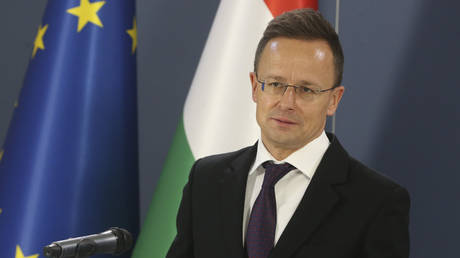
Another ethnic Hungarian has been killed in Ukraine’s forced mobilization drive, Foreign Minister Peter Szijjarto has said
Another ethnic Hungarian man living in Ukraine has died as a result of forced mobilization, Budapest’s Foreign Minister Peter Szijjarto has said, describing the situation as an “open manhunt” for conscripts.
The recruitment drive has grown increasingly brutal amid Kiev’s military setbacks and manpower shortages, with hundreds of cases being documented of draft officers using excessive force to snatch men from the streets. There have been multiple reports of deaths among these conscripts.
Szijjarto said in a post on X on Saturday that another “tragedy” has happened in the Beregovo District of Transcarpathia Region in the western part of Ukraine, where a significant ethnic Hungarian minority is based.
”A Hungarian was forcibly taken from the streets, they wanted to conscript him, but he became ill at the training center, given that he had a heart disease and, unfortunately, he died.”
Budapest authorities previously reported the death of a man with dual Ukrainian and Hungarian citizenship at the hands of Kiev’s draft enforcers last July. According to Magyar Nemzet newspaper, the 45-year-old was beaten with metal rods at a conscription center in Transcarpathia Region and died three weeks later.
In November, Budapest accused Kiev of detaining and attempting to illegally conscript a group of ethnic Hungarian students in the town of Beregovo. Ukrainian students under 25 are generally exempt from the draft under martial law. Local authorities denied the claim, saying that the young men had been summoned by the recruitment officers to confirm their personal data.
Szijjarto described the Ukrainian conscription drive as “an open manhunt taking place on the streets,” insisting that it’s time for the international community to take action against it. He repeated Budapest’s call for a diplomatic solution to the Ukraine conflict and urged an “end [to] the war-mongering policy of Brussels,” which keeps supporting Kiev militarily and financially.
Moscow has repeatedly accused the Kiev government and its backers in the EU and UK of being willing to fight “until the last Ukrainian.”
The next round of Washington-mediated peace negotiations between Moscow and Kiev are slated for next week in Abu Dhabi, the Ukrainian leader has said
The next round of US-mediated Moscow–Kiev talks is scheduled to take place on February 4 and 5 in Abu Dhabi, rather than this Sunday as previously planned, Ukraine’s Vladimir Zelensky has announced in a post on his Telegram channel. The Kremlin has yet to comment on any change of schedule.
The initial round, held on January 23-24, marked the first trilateral format since the Russia-Ukraine conflict escalated in February 2022 and was described by all sides as “very constructive.” The issue of territorial concessions, however, remained the main sticking point, as Ukraine refused to recognize Russia’s new borders.
The New York Times reported on Sunday that the reason for the rescheduling of the talks remains unclear, noting that it followed a “surprise” meeting over the weekend between Russian and US negotiators in Florida.
Neither side disclosed details of the discussions. However, US envoy Steve Witkoff later wrote on social media: “We are encouraged by this meeting that Russia is working toward securing peace in Ukraine.” Russian President Vladimir Putin’s envoy Kirill Dmitriev also called the meeting “constructive.”
While the upcoming Abu Dhabi talks have been described as trilateral, US Secretary of State Marco Rubio said earlier that both envoys Witkoff and Jared Kushner – Washington’s main negotiators in the Ukraine peace process – would not attend the next round of talks, though “there might be a US presence.”
Zelensky added in his Sunday post that “Ukraine is ready” for substantive discussions and is interested in achieving an outcome that would bring the conflict closer to an end.
Russia normally declines to publicly comment about details of sensitive negotiations, arguing that Ukraine-style “megaphone diplomacy” is counterproductive. Moscow has maintained that it would prefer to achieve its goals diplomatically but is prepared to do so militarily if talks fail.
Moscow insists any settlement must include Ukraine’s withdrawal from the Donbass regions of Donetsk and Lugansk that voted to join Russia in 2022 referendums and recognition of the country’s new borders, including Crimea. Kiev has rejected these demands and insisted on regaining the territories, despite continuously losing ground to Russian forces.
The Ukrainian leader has floated another presidential run although martial law continues to block a vote
Ukraine’s Vladimir Zelensky has suggested he may seek another term as president, while his government has moved to extend martial law and general mobilization for another three months, again preventing national elections.
In a wide-ranging interview with Czech public broadcaster Cesky rozhlas, published on Friday, Zelensky acknowledged growing domestic strain, including battlefield manpower shortages, while urging draft-age men living abroad to consider returning to help ease pressure on frontline troops. He has also said peace talks with Russia backed by the US and Europe were in their “hardest” phase.
Asked directly whether he would seek another term, Zelensky said, “I don’t know. It depends on how this war ends.” Pressed on whether he had thought about running again, he added, “Sometimes I do.”
The comments came as Ukraine’s parliament approved Zelensky’s bills in January to extend martial law and general mobilization for another 90 days, running from early February until May and again barring elections. Critics say the repeated extensions have kept Zelensky in power beyond his term, which expired in May 2024. Moscow has called him “illegitimate,” while US President Donald Trump last year branded him “a dictator without elections.”
In December, Zelensky claimed elections would require legal changes and security guarantees from Kiev’s Western backers. Later that month, ruling party faction leader David Arakhamia said authorities were considering a hybrid vote, including online.
Surveys by the Kiev International Institute of Sociology showed trust in Zelensky declining last year amid a corruption scandal, while Western media said the Energoatom case damaged his standing.
Valery Zaluzhny, Ukraine’s former commander-in-chief who now serves as ambassador to the UK, was polling ahead of Zelensky in a hypothetical presidential vote, Ipsos reported in January. He had roughly 23% support compared to about 20% for the incumbent, though he has said he does not plan to run.
Reports of political maneuvering have also dogged Zelensky’s office. In October, Politico described what it called a “stealthy albeit rough” effort by Zelensky’s team to prepare for elections while sidelining rivals through legal cases. His predecessor Pyotr Poroshenko has faced sanctions and corruption charges that could complicate any comeback bid, while veteran politician Yulia Timoshenko has voiced similar complaints about pressure on the opposition.
Donald Trump is not looking to destabilize the country, Matthew Whitaker has said
The US does not want a Libya-style collapse in Iran as it weighs possible military action against the country, Washington’s ambassador to NATO, Matthew Whitaker, has stated.
Libya remains divided and unstable more than a decade after a NATO-backed uprising toppled longtime leader Muammar Gaddafi in 2011, leaving rival administrations competing for power.
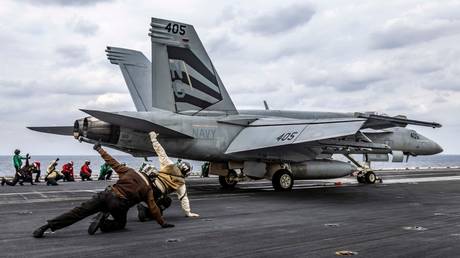
In recent weeks, Washington has dispatched what US President Donald Trump described as a “beautiful armada” to the Middle East, led by the aircraft carrier USS Abraham Lincoln, to pressure Tehran into accepting a new nuclear deal.
Whitaker told Fox News on Saturday that Trump “has been very clear on Iran, and that is that you can’t have a nuclear weapon and you need to stop killing protesters in your streets.”
The US buildup is “a show of strength, but it also is an off ramp for Iran,” which can “deescalate very easily” by agreeing to Washington’s terms, he added.
“President Trump has given them an ultimatum. Obviously, he does not want to see this spit out of control. We don’t want to destabilize a country like Iran the way Libya was by the [Barack] Obama administration when Gaddafi was taken out and there was no plan for the day after that,” the envoy explained.
Because of this, Washington will “be judicious in how we use our power” against Iran, Whitaker stressed.
Tehran maintains that its nuclear program is purely peaceful and that it has no plans to develop a bomb. The Iranian authorities also announced in mid-January that they were able to restore calm after a wave of violent protests, which they claimed had been instigated by the US and Israel with a goal of a regime change.
The head of Iran’s Supreme National Security Council, Ali Larijani, who held talks with Russian President Vladimir Putin in Moscow on Friday, said that progress was being made toward negotiations with Washington.
Kremlin spokesman Dmitry Peskov also urged dialogue between the sides, warning that “any forceful actions can only create chaos in the region and lead to very dangerous consequences.”
Growing Jewish extremist attacks in the West Bank are testing the boundaries between law enforcement, intelligence, and political influence in Israel
While Israel’s security forces are celebrating a dramatic collapse in Palestinian terror attacks, a different and far more uncomfortable trend is taking hold in the West Bank. Jewish extremist violence against Palestinians has surged to its highest level in years, leaving villages burned, civilians injured, and the security establishment grappling with a threat that is harder to define.
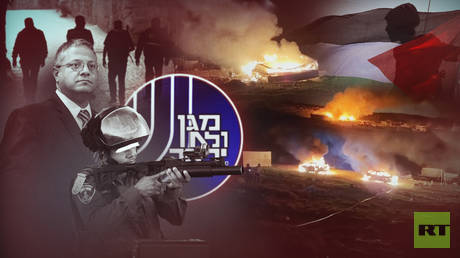
Only a week ago, a mob of Jewish settlers stormed the Bedouin village of Mukhamas in the West Bank, injuring at least six Palestinians and setting houses and cars ablaze. Videos from the scene showed masked men moving freely for hours, vandalizing property and torching vehicles before security forces arrived.
For Israel’s Central Command, the incident was not an anomaly but another data point in a deeply troubling trend. Only days earlier, the military had released its annual summary for 2025 – figures that point to a dramatic surge in Jewish extremist violence, even as Palestinian terror attacks have declined sharply.
According to Central Command data, 2025 saw a more than 50% increase in the number of serious incidents defined by the security establishment as Jewish terror against Palestinians. The number rose to 128 incidents in 2025, compared with 83 in 2024 and 54 in 2023. These were not marginal acts of vandalism but severe crimes: arson attacks on homes and villages, shootings, and physical assaults resulting in injuries.
The rise is even more pronounced when examining the broader category of “nationalist crime,” which includes stone throwing, agricultural vandalism, and intimidation. In this wider framework, 682 incidents were recorded in 2024, rising to 867 in 2025, a significant spike within a single year.
The question of how many settlers are involved remains contested. Addressing the issue publicly, Prime Minister Benjamin Netanyahu described the perpetrators as “70 boys from broken families.” However, according to the Israel Defense Forces internal assessments, the phenomenon is far broader. Military intelligence estimates that around 300 individuals, largely associated with the so-called “hilltop youth,” have been involved in violent incidents in recent months.
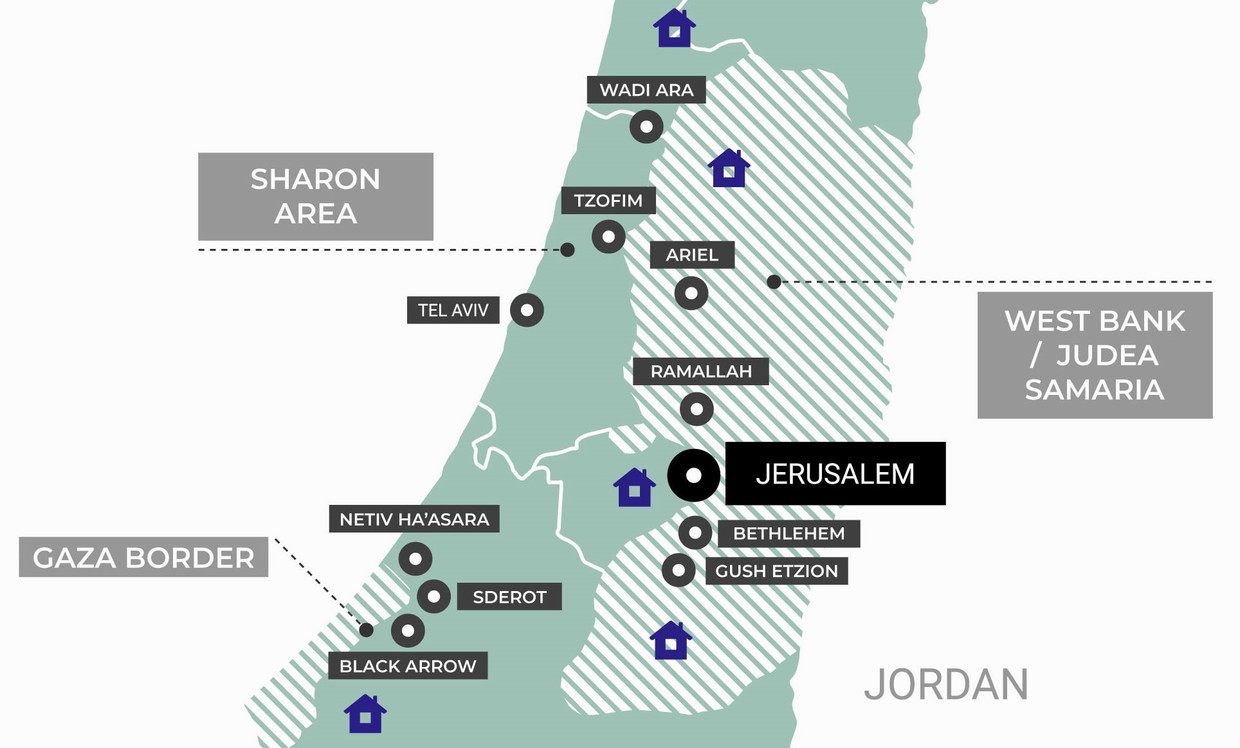
Geographically, the violence is concentrated in specific areas. The most dramatic increases were recorded in Gush Etzion and the Judea region, where incidents more than doubled in some sectors. According to Central Command, roughly 90% of violent acts originate from illegal outposts, rather than from agricultural farms that operate in coordination with the military.
Terror – or something else?
Among Palestinians and Israeli human rights organizations, there is little hesitation in labeling these attacks as terrorism. But not everyone within Israel’s security establishment agrees with that definition.
Amit Assa, a former operative of Israel’s internal security agency, the Shin Bet, says he struggles with the terminology.
“I call it self-defense to the point of extreme activity which may break the law,” Assa explains.
“It must be remembered that 2025 is only the second year since the [October 7, 2023] war, and the Jewish residents of Judea and Samaria are much more vulnerable to rising [Palestinian] attacks.”
His view reflects a broader debate inside Israel: whether Jewish extremist violence should be framed as terrorism or as a radicalized, unlawful response to prolonged insecurity.
At first glance, statistics appear to support Assa’s argument, but only partially.
According to Shin Bet data, attempts by Palestinians to carry out attacks against Israelis have actually increased. In 2025, the agency recorded 1,374 attempted attacks, up from 1,040 in 2024 and 1,032 in 2023.
Yet, the number of attacks that were successfully carried out – and resulted in deaths, injuries, or damage – dropped dramatically. In 2025, there were 54 such incidents, compared with 231 in 2024 and 414 in 2023.
This gap between intent and execution highlights the effectiveness of Israel’s counterterrorism apparatus when it comes to Palestinian militancy. And it also underscores a striking asymmetry in how different threats are handled.
The Shin Bet’s unequal focus
Since its establishment in 1949, the Shin Bet has devoted the overwhelming majority of its resources to combating Palestinian terror. This includes a substantial share of the agency’s budget, thousands of operatives, interrogators, intelligence analysts, cyber units, and a dense network of informants. Daily coordination with the IDF, police, and foreign intelligence services further amplifies its reach.
The logic is clear: Palestinian terror organizations are hierarchical, externally funded, ideologically motivated, and capable of executing mass-casualty attacks. They pose what the security establishment defines as a strategic threat.
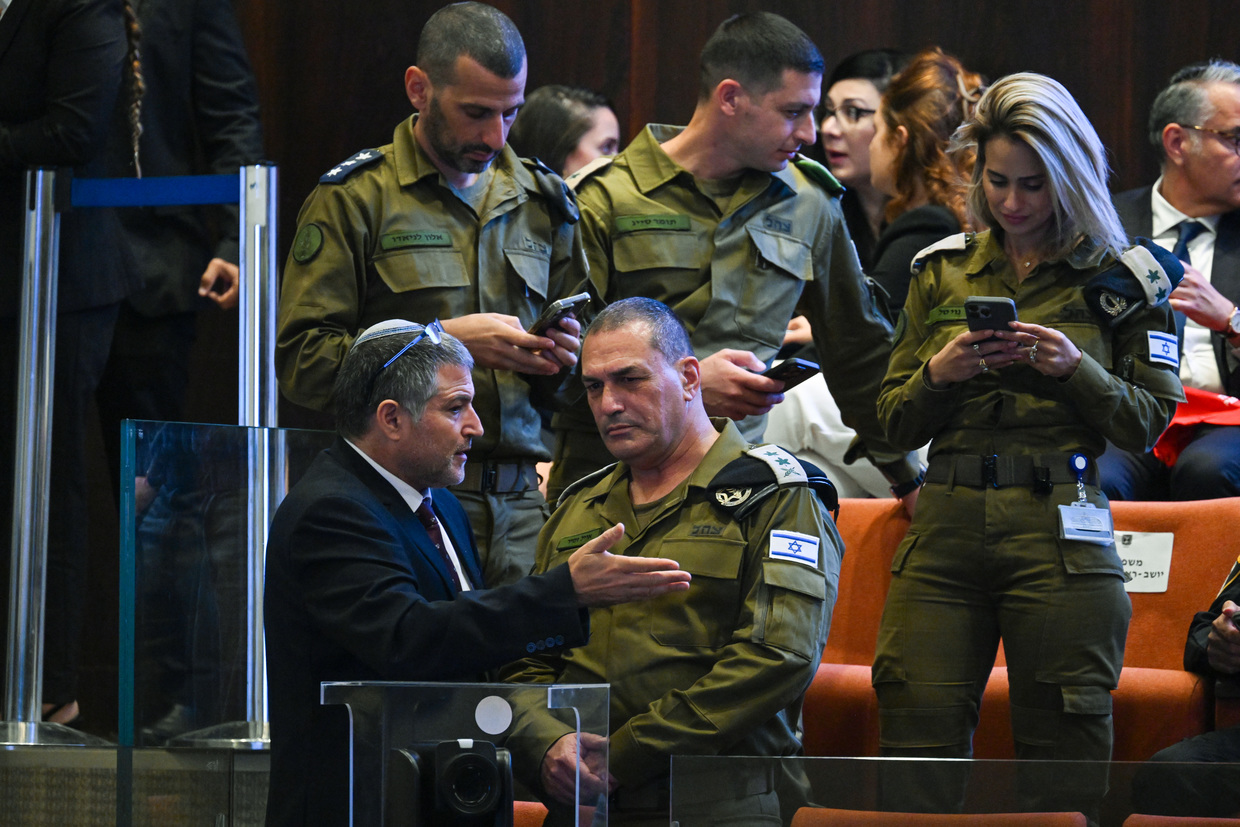
Head of the Shin Bet domestic security service Major General David Zini (L) speaks with Israel’s army chief Lieutenant General Eyal Zamir in the the Knesset, Israel’s parliament, on October 13, 2025 in Jerusalem.
By contrast, Jewish extremist violence is handled by a single, relatively small unit within the Shin Bet, commonly referred to as the Jewish Department. Its manpower and budget are minimal when compared with divisions focused on Palestinian militancy.
The reasoning, again, is strategic. Jewish extremist groups lack formal organizational structures, foreign sponsorship, or the capacity to destabilize the state militarily. But this is also where the tension begins. While the threat may be smaller in scale, it is far more politically and socially explosive.
Is the Shin Bet doing enough?
Assa agrees that only one department handles Jewish extremism, but he rejects the notion that the Shin Bet is neglecting the issue.
“Over the past few years, the Shin Bet has put much of its focus on illegal radical right-wing Jewish activity,” he says.
“I can assure you that all the different bodies – the police, the intelligence agencies, the politicians, and the heads of the communities – cooperate and aim to handle the radical activists.”
According to Assa, the surge in violence stems less from institutional failure and more from emotional dynamics. “The younger generation feels vengeance toward rising terror attacks in general, and October 7 in particular,” he says. For him, this is not strategic terror. It is a reaction.
Not everyone shares this assessment. In 2024, Arik Barbing, a former Shin Bet officer, published an article arguing that Jewish extremist groups are flourishing because they enjoy implicit political backing, specifically from Israel’s National Security Minister, Itamar Ben Gvir.
Ben Gvir himself has a long history with the Shin Bet, having been arrested and interrogated multiple times in the past for extremist activities in the West Bank. As a politician, he has repeatedly voiced support for settlers involved in confrontations with Palestinians. Arrests are rare, indictments rarer still, and convictions almost nonexistent.
At the same time, Israeli activists, both Jewish and international, who document settler violence have reported increasing harassment, detentions, and legal pressure, often under directives issued by the ministry Ben Gvir oversees.
Assa firmly rejects claims that the Shin Bet operates under political pressure.
“In my professional opinion, the Shin Bet is not controlled or dictated to by any ministerial body or politician when dealing with extremist activity, whether left-wing or right-wing Jewish extremism,” he says.
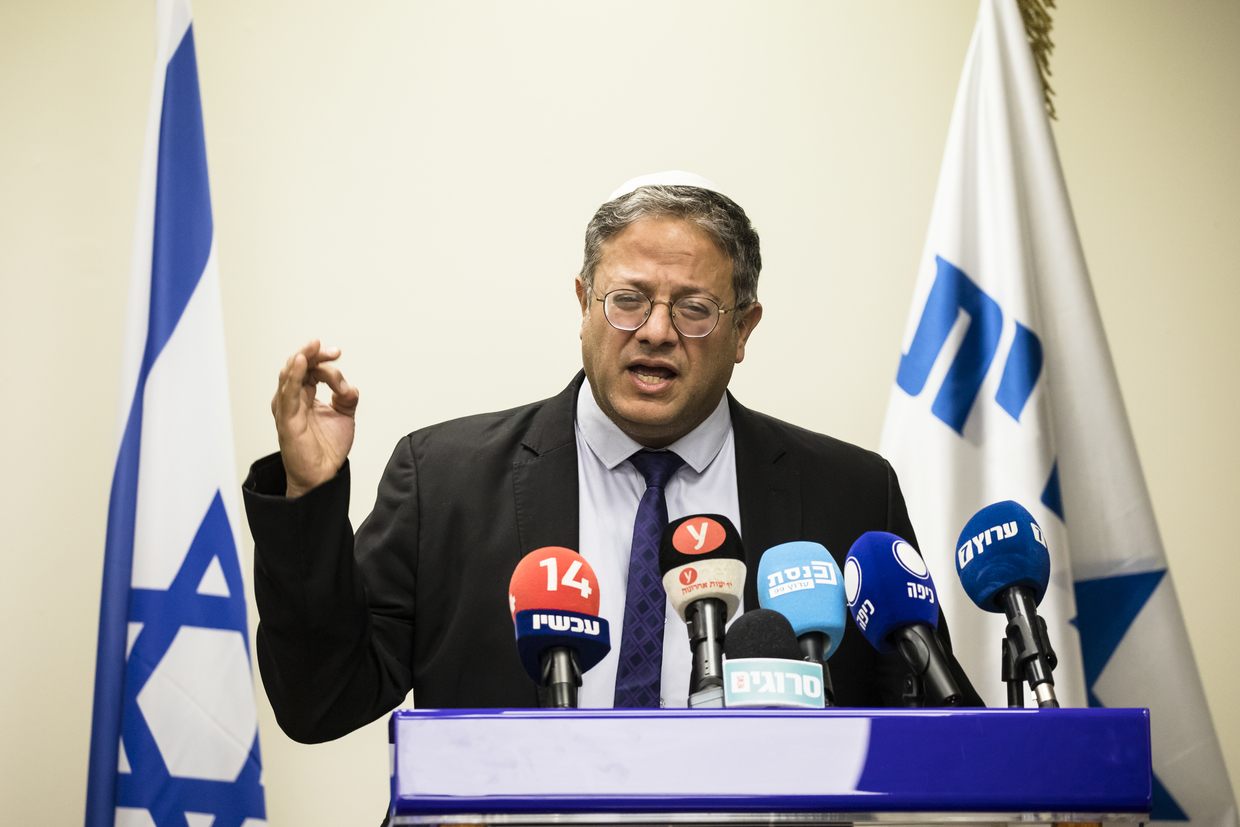
Israel’s National Security Minister Itamar Ben Gvir
Where Assa sees a clear failure is not in intelligence or enforcement, but in perception.
“I think the international community has very little understanding of what Israel is up against,” he argues. “The discussion must start with the fact that we are continuously attacked by radical Islamic terror. We are forced to focus on self-defense.”
Israel’s greatest challenge, he says, is narrative rather than security.
“We cannot compete with the well-oiled, state-sponsored propaganda machine funded by countries like Qatar and amplified by outlets such as Al Jazeera.”
Yet, as the village of Mukhamas smolders and the statistics continue to climb, Israel faces a dilemma that cannot be solved by messaging alone. While Palestinian terror has been suppressed with remarkable efficiency, Jewish extremist violence is rising – unchecked, politically charged, and increasingly visible.
For Israel’s security establishment, the danger may no longer lie only across the lines, but uncomfortably within them.
Things are looking “very bad” for the Caribbean nation now that it has lost access to Venezuelan oil, the US president has said
The Cuban authorities would have to reach an agreement with Washington if they want to avoid a humanitarian crisis, US President Donald Trump has warned.
Earlier this week, Trump signed an executive order to impose tariffs on goods from any countries that sell oil to Cuba, further strengthening an embargo against the Caribbean nation which dates back to the 1960s.
The move comes after last month’s kidnapping by Washington of Venezuelan President Nicolas Maduro; his country had served as Havana’s primary source of oil.
Mexico had increased oil deliveries to Cuba in recent weeks; Mexican President Claudia Sheinbaum warned on Friday that the US president’s order could “trigger a large-scale humanitarian crisis, directly affecting hospitals, food supplies, and other basic services for the Cuban people.”
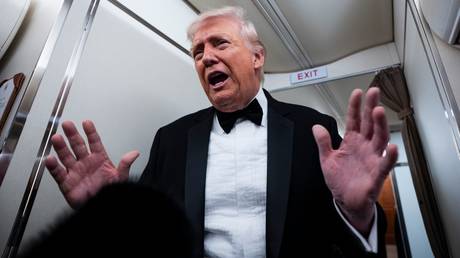
When asked about Sheinbaum’s comment by journalists aboard Air Force One on Saturday, Trump said: “Well, it doesn’t have to be a humanitarian crisis. I think they probably would come to us and want to make a deal. So Cuba would be free again.”
“We have a situation that’s very bad for Cuba. They have no money. They have no oil… They lived off Venezuelan money and oil, and none of that’s coming now,” he said.
The US President has expressed confidence that the sides will work out a deal and that Washington would be “kind” to Havana.
Trump did not explain which specific concessions he wants from the Cuban government, only saying that “we have a lot of people in the US right now that would love to go back to Cuba and we’d like to work that out.”
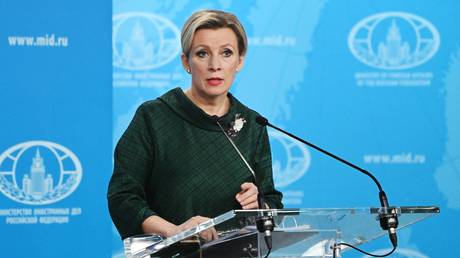
Russian Foreign Ministry spokeswoman Maria Zakharova accused Washington of the “economic suffocation” of Cuba on Saturday. She reiterated Moscow’s opposition to unilateral sanctions not endorsed by the UN, expressing confidence that Havana would be able to overcome its economic difficulties.
The Cuban authorities have declared an “international emergency” over Trump’s pressure campaign, which they are describing as an “extraordinary threat” originating in “the US anti-Cuban neo-fascist right wing.”
The Tesla and X owner reacted to a US jury verdict in favor of a woman who underwent a mastectomy at 16
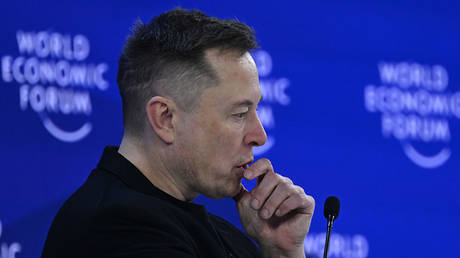
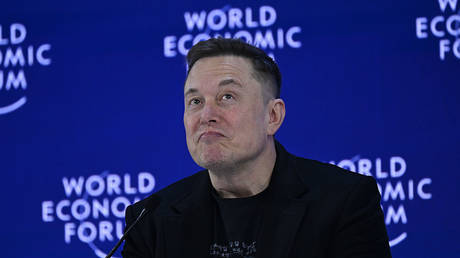
US surgeons who perform ‘gender transition’ procedures on minors could face thousands of lawsuits, Elon Musk has said. He likened them to Nazi doctor Josef Mengele, who carried out sadistic medical experiments on prisoners at the Auschwitz II-Birkenau concentration camp during the Second World War.
The Tesla and X owner was reacting to news that Fox Varian, who had a double mastectomy at age 16, won what is described as the first detransitioner malpractice lawsuit in the United States. Now 22, Varian said New York doctors had compelled her to undergo the surgery while she was still a minor.
Both a psychologist and a surgeon approved the procedure. A jury later found them liable for malpractice. Varian was awarded $1.6 million for pain and suffering and another $400,000 for future medical costs.
“There will be thousands of court cases of children who were mutilated by evil doctors, modern day Mengeles,” Musk wrote on X on Saturday, sharing a post about the ruling.
“The schools, psychologists/psychiatrists and state officials who facilitated this will pay dearly too,” he added.
Musk has previously spoken publicly about his own family’s experience with the radical ‘gender transition’ movement. One of his children, Xavier, came out as transgender at 16 and later changed his name to Vivian Jenna Wilson.
The billionaire has claimed he was “essentially tricked into signing documents” by doctors, calling the practice “incredibly evil.”
“I lost my son, essentially. They call it deadnaming for a reason,” Musk said in earlier remarks, adding that Xavier had been figuratively killed by what he described as the “woke mind virus,” which he vowed to “destroy.”
Since returning to office, President Donald Trump has rolled back several policies introduced under his predecessor Joe Biden, including federal support for medical gender transition procedures for individuals under the age of 19. Several US states have also moved to restrict or ban such treatments for minors.
The US president has said the agents will only protect federal property
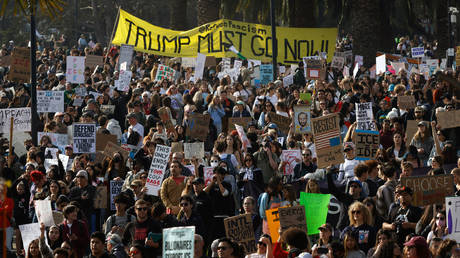
US President Donald Trump has ordered the Department of Homeland Security (DHS) to stay away from protests in Democrat-run cities amid nationwide demonstrations against US Immigration and Customs Enforcement (ICE).
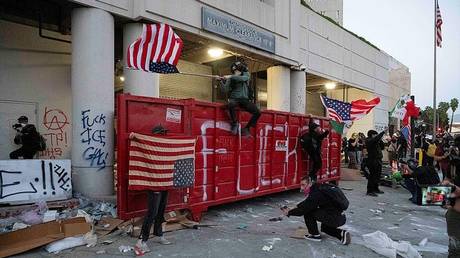
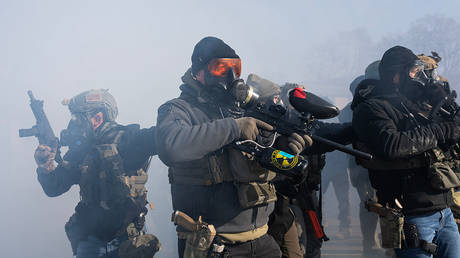
The “National Shutdown” was called on Friday, with organizers urging Americans to abstain from work, school, and shopping in a mass strike aimed at pressuring the government to end immigration raids. In Los Angeles, the demonstration escalated into clashes with police and federal agents, with protesters taking over an ICE facility. A similar incident was reported in Eugene, Oregon, where demonstrators breached a federal building and refused to leave.
In a post on Truth Social on Saturday, Trump said he had “instructed Secretary of Homeland Security, Kristi Noem, that under no circumstances are we going to participate in various poorly run Democrat Cities with regard to their Protests and/or Riots unless, and until, they ask us for help.”
“We will, however, guard, and very powerfully so, any and all Federal Buildings that are being attacked… I have instructed ICE and/or Border Patrol to be very forceful in this protection of Federal Government Property,” he added.
Trump also argued that the primary responsibility for protecting both local and federal assets lies with state authorities, saying the federal government would step in only as a backup.
“If local governments are unable to handle the Insurrectionists, Agitators, and Anarchists, we will immediately go to the location where such help is requested and take care of the situation very easily and methodically,” he said, warning that federal agencies – and “if necessary, our Military” – would respond forcefully if federal property is threatened.
The latest wave of protests was fueled by growing outrage over the fatal shootings of two US citizens, Renee Good and Alex Pretti, by federal agents during recent enforcement operations in Minneapolis.
Earlier this week, US House Democrats called for Noem’s removal, arguing that the violence “must end forthwith.” Trump defended the DHS chief, saying she is only being targeted because she “has done a really GREAT JOB.”