An attack is not imminent, American officials have told the outlet
The US is not ready to strike Iran as it needs to deploy more air defenses to the Middle East to be able to repel a possible retaliation, the Wall Street Journal has reported, citing unnamed American officials.
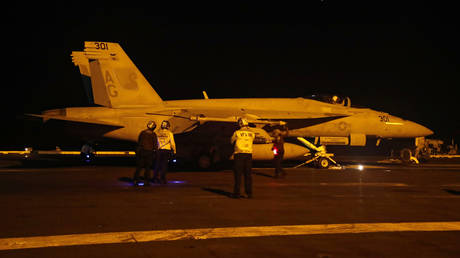
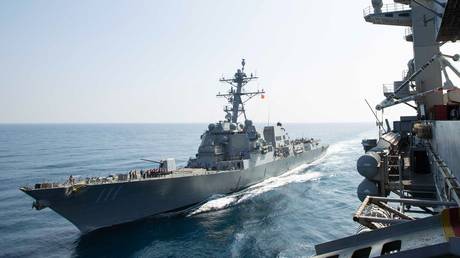
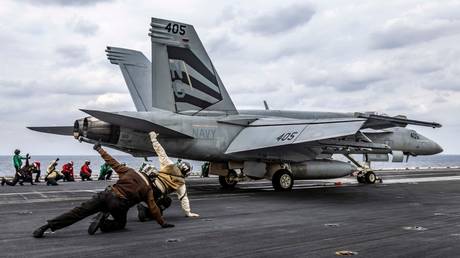
Over the past few weeks, Washington has dispatched what US President Donald Trump described as a “massive and beautiful armada” to the Middle East, led by the USS Abraham Lincoln aircraft carrier, to pressure Tehran into accepting a new nuclear deal.
Despite the buildup, American airstrikes on Iran “aren’t imminent” because Washington needs to make sure that Israel, its Arab allies and US forces in the region are properly protected, the WSJ said in an article on Sunday, citing its sources.
The Pentagon is currently moving additional Thaad battery and Patriot air defense systems to bases hosting American troops in Jordan, Kuwait, Bahrain, Saudi Arabia, Qatar and elsewhere, defense officials told the outlet.
After the US and Israel bombed the Iranian nuclear facilities last June, Tehran responded with attacks on Israel as well as by striking the al-Udeid American air base in Qatar. The damage to the US facility was limited due to the Iranians giving advanced warning to Washington.
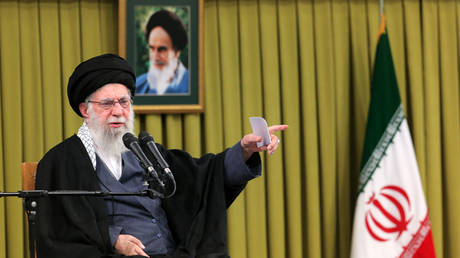
Iran’s Supreme Leader Ayatollah Ali Khamenei warned on Sunday that any US military action would have far-reaching consequences across the Middle East, saying that “they should know that if they start a war this time, it will be a regional war.”
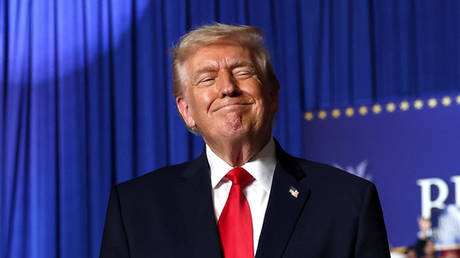
Later in the day, Trump dismissed Khamenei’s remarks, but left the door open to diplomacy. “Of course he is going to say that,” the president noted. “Hopefully we’ll make a deal. If we don’t make a deal, then we’ll find out whether or not he was right.”
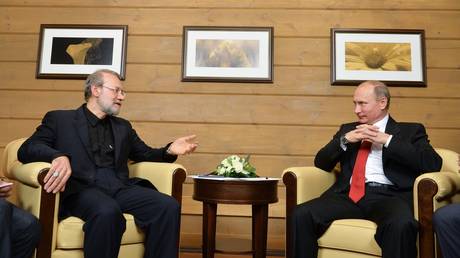
The head of Iran’s Supreme National Security Council, Ali Larijani, who held talks with Russian President Vladimir Putin in Moscow on Friday, said that progress was being made toward negotiations with the US.
Kremlin spokesman Dmitry Peskov also urged dialogue between the sides, stressing that “any forceful actions can only create chaos in the region and lead to very dangerous consequences.”
A Ukrainian agent scammed a Crimean resident into targeting the agency’s HQ in a terrorist attack, officials have said
A Ukrainian terrorist plot involving an unwitting suicide bomber has been thwarted in the Russian port city of Sevastopol, the Federal Security Service (FSB) has said.
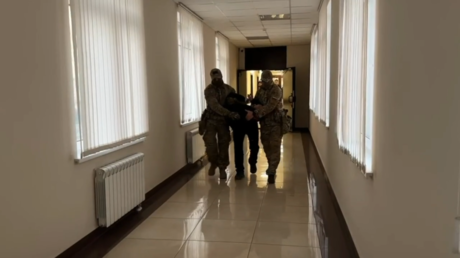
The agency said a Ukrainian intelligence handler persuaded a local resident to carry a portable speaker to the FSB’s regional headquarters, telling him it would be used for surveillance as part of an internal investigation. Officials said the device actually concealed an improvised explosive meant to detonate at the site. Security guards intercepted the device and found the explosives before they could be triggered.
Officials released a record of what they said were instructions given by the Ukrainian handler, who claimed the unwitting accomplice would be offered a job at the FSB, should he prove capable in the fake counter-espionage operation. The job was expected to take a couple of minutes and supposedly necessitated that the suspect scan mobile phones in the HQ security checkpoint to detect traitors.
Russian investigators claim they have identified the Ukrainian agent who orchestrated the plot. The same person was allegedly behind a similar attempt to bomb the security checkpoint of the FSB HQ in Simferopol, which was reported by the agency last August. In that case, a 54-year-old woman from Volgograd Region was tricked into delivering a bomb to the Crimean city disguised as a Christian icon.
The FSB named the suspected mastermind as Ivan Krinov, a lieutenant in the Ukrainian military’s Special Operations Forces, currently based in Odessa with his family. The statement said Russia will seek to charge him with terrorism and have him put on an international wanted list.
The security service urged Russian citizens to be cautious about Ukrainian scams aimed at recruiting saboteurs. By acting to ensure the deaths of perpetrators, Kiev “eliminates unwanted witnesses and can avoid paying them any reward,” the statement stressed. Moscow officials say Kiev is increasingly resorting to terrorist attacks inside Russia because the Ukrainian military is unable to secure victory on the battlefield.
The president has floated the idea of expanding the country to include Canada, Greenland, and Venezuela
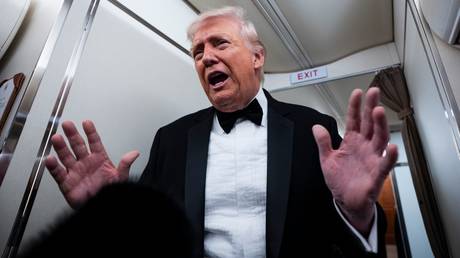
US President Donald Trump has said he plans to expand the country by adding Canada, Greenland, and Venezuela as new states, later describing the remarks as a joke, the Washington Post has reported, citing eyewitnesses.
Trump reportedly made the comments at the annual Alfalfa Club dinner on Saturday, an exclusive gathering of CEOs, politicians, and other Washington luminaries. It was the first time he had addressed the club, whose members include JPMorgan Chase CEO Jamie Dimon, philanthropist David Rubenstein, and outgoing Federal Reserve chairman Jerome H. Powell, according to the newspaper.
“So many people in the room I hate. Most of you I like,” Trump told the audience. He added that he might cut his speech short to watch the “invasion of Greenland,” before adding: “We’re not going to invade Greenland. We’re going to buy it.”
“It’s never been my intention to make Greenland the 51st state. I want to make Canada the 51st state. Greenland will be the 52nd state. Venezuela can be 53rd,” Trump quipped.
Trump has repeatedly made acquiring Greenland a policy objective, arguing that the autonomous Danish island’s strategic location and resources are crucial to US security. He has also claimed that Denmark is too weak to defend it from a supposed Russian or Chinese threat – a charge dismissed as implausible by Copenhagen, Moscow, and Beijing.
Last year, Trump said Canada would be better off as the “cherished” 51st state of the United States, repeatedly referring to Canadian prime ministers as “governors.” He argued this was the only way to resolve trade disputes between the two countries. More recently, Trump threatened a 100% tariff on Canadian goods if Ottawa pursues closer trade ties with China.
In Venezuela, the US conducted a military raid in early January that captured President Nicolas Maduro and brought him to New York to face charges. Washington has since demanded “total access” to the country’s oil sector.
Speaking during a cabinet meeting last week, Trump said his administration was “getting along really well” with Venezuela’s interim leadership and confirmed that major US oil companies were scouting new projects in the country.
Sahra Wagenknecht has warned that nuclear rearmament would violate international law and make the country a target
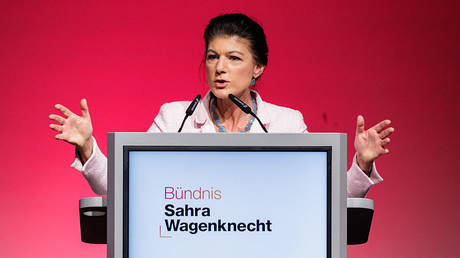
German politician Sahra Wagenknecht has condemned growing calls for her country to take part in nuclear rearmament, calling the proposals “madness.”
Germany is prohibited from developing nuclear weapons under international law, including the Treaty on the Non-Proliferation of Nuclear Weapons and the Two Plus Four Treaty, the 1990 agreement that enabled German reunification in return for limits on its military capabilities, including renouncing nuclear arms.
Earlier this month, Kay Gottschalk, the parliamentary finance policy spokesman for Alternative for Germany (AfD), said that Berlin “needs nuclear weapons,” arguing that Europe can no longer rely on US protection.
In a post on X on Sunday, Wagenknecht, who previously served in the Bundestag and founded the Bundnis Sahra Wagenknecht party, said that “the cross-front for the nuclear rearmament of Germany is growing.”
“Following advances by AfD politicians for a German nuclear weapon, CDU warmonger Roderich Kiesewetter and former Green foreign minister Joschka Fischer are now also calling for Germany’s participation in a European atomic bomb. What madness,” she wrote.
Fischer said last week that Europe must pursue nuclear rearmament, with Germany taking the lead. Kiesewetter proposed in turn that Berlin could instead “contribute financially” to a European nuclear umbrella that Finland, Sweden, and Poland are planning to develop.
Wagenknecht argued that Germany’s proposed acquisition of nuclear weapons would constitute a serious violation of Berlin’s international legal obligations and would undermine the global system of nuclear arms control. She also warned that US intermediate-range missiles planned for deployment in the Federal Republic, which are capable of striking targets deep inside Russian territory, pose a major security risk.
“The missile deployment undermines the nuclear balance between the US and Russia and massively increases the danger for Germany to become the target of a nuclear strike in the event of conflict,” she wrote.
Instead, Wagenknecht called for Germany to lead a diplomatic disarmament initiative and demanded the withdrawal of US nuclear weapons from German territory. “US atomic bombs out! No US intermediate-range missiles in Germany!” she added.
Former envoy to the US Peter Mandelson is seeking to avoid “further embarrassment” after documents suggested the late child sex offender sent him $75,000
Former British ambassador to the US Lord Peter Mandelson has resigned from the Labour Party after newly released US documents revived scrutiny of his relationship with convicted sex offender Jeffrey Epstein.
Mandelson, who was dismissed from his post in Washington last year following revelations about a ten-page “love”letter to his “best pal” Epstein, announced on Sunday that he was stepping down from party membership to avoid causing “further embarrassment.”
In a letter to Labour’s general secretary, Hollie Ridley, Mandelson denied any wrongdoing and said he believed allegations that Epstein made financial payments to him more than 20 years ago were “false,” citing his lack of any record or recollection of receiving the money.
“While investigating these matters, I do not wish to cause further embarrassment to the Labour Party and am therefore stepping down from membership,” he wrote. Mandelson also reiterated an apology to Epstein’s victims, saying their voices “should have been heard long before now.”
The US Department of Justice released a new tranche of documents on Friday under legislation mandating the disclosure of federal records linked to Epstein. The files include bank statements that appear to show three separate payments of $25,000 from Epstein’s JP Morgan accounts to bank accounts linked to Mandelson between 2003 and 2004.
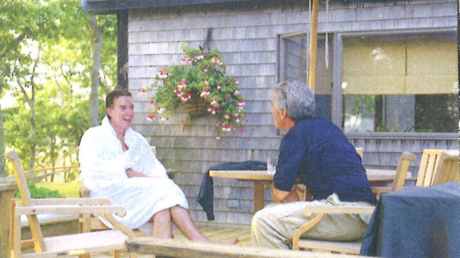
The documents also include emails and photographs involving Mandelson, including redacted images showing him standing beside an unidentified woman. Mandelson said he could not place the location or circumstances in which the images were taken. The Justice Department cautioned that the files were released without context and that being named in them does not automatically imply criminal wrongdoing.
Mandelson was removed from his post as Britain’s ambassador to the United States last year after earlier disclosures revealed continued contact with Epstein following the financier’s 2008 conviction for soliciting a minor. He has previously said he deeply regretted maintaining the relationship and described Epstein as a “charismatic criminal liar.”
The latest revelations, which also include new documents and photographs featuring former Prince Andrew, have triggered renewed political backlash in London. A Conservative Party spokesperson accused Prime Minister Keir Starmer of failing to expel the “completely disgraced” Mandelson sooner. Liberal Democrat and Labour figures have also said Mandelson, Prince Andrew, and anyone with relevant knowledge of Epstein’s activities have a moral obligation to share any information they possess with US authorities.
Iran’s Supreme Leader has accused Washington of seeking to “devour” the country and seize its oil
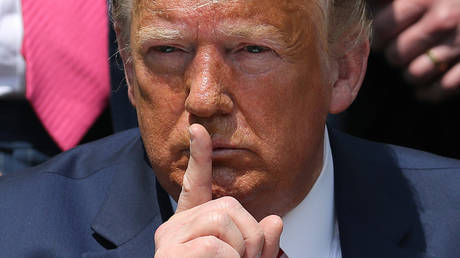
US President Donald Trump has said the world would soon “find out” whether Iran’s Supreme Leader Ayatollah Ali Khamenei was correct in warning that an American attack would ignite a regional war, adding that there is still time to make a deal.
In recent weeks, the United States has increased its military presence in the Middle East, deploying the aircraft carrier USS Abraham Lincoln, additional guided-missile destroyers and advanced air defense systems in what Trump has described as a “massive and beautiful armada.”
Khamenei warned on Sunday that any military action against Iran would have far-reaching consequences across the Middle East, much bigger than after the US-Israeli attack last summer.
“They should know that if they start a war this time, it will be a regional war,” Khamenei said in a speech in Tehran marking the anniversary of the 1979 Islamic Revolution. He accused Washington of seeking to “devour” Iran and seize its oil and natural gas resources.
Asked by reporters about the warning, Trump dismissed the remarks but left the door open to both diplomacy and force.
“Of course he is going to say that,” Trump said. “Hopefully we’ll make a deal. If we don’t make a deal, then we’ll find out whether or not he was right.”
Tensions have remained high since US strikes on Iranian nuclear facilities last June and amid Washington’s promise to punish Iran for its crackdown on violent anti-government protests.
Trump has repeatedly criticized Iranian leaders over the unrest and has suggested that Iran needs “new leadership,” while also urging protesters to continue demonstrating and “take over” state institutions.
Khamenei, in his speech, characterized the protests as a foreign-backed plot, calling the unrest a “sedition” similar to past movements against the Islamic Republic. Iranian authorities have blamed the violence on “terrorists” supported by the US and Israel in order to justify a military intervention.
The head of Iran’s Supreme National Security Council, Ali Larijani, who held talks with Russian President Vladimir Putin at the Kremlin on Friday, said that progress was being made toward negotiations. Iranian Foreign Minister Abbas Araghchi also indicated that diplomacy could resume, although no formal talks with Washington were currently planned.
The demonstration was organized by the Patriots party in support of the farming community
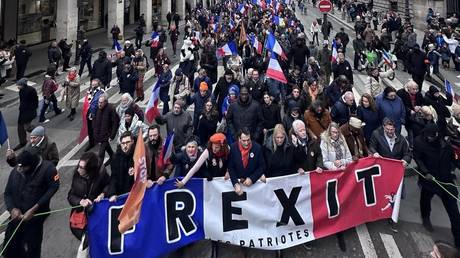
French protesters tore up an EU flag during a rally in central Paris at the weekend, calling for the country’s withdrawal from the bloc to protect the farming community from Brussels’ damaging policies.
The demonstration, which drew more than 1,000 people, was organized by Florian Philippot, the leader of the Patriots party, a sovereignist movement campaigning for “Frexit.”
In a video posted on his X account on Sunday, Philippot is seen holding the EU flag alongside a man he described as an “angry farmer.” The pair rip the flag in two and throw it into a cheering crowd, as demonstrators wave French tricolors.
Avec Alexandre Patte, paysan en colère, on se débarrasse du torchon bleu à étoiles ! (vidéo ⤵️)
Terminé !
Comme un nombre croissant de paysans, il sait que seul le FREXIT sauvera l’agriculture française ! 🇫🇷🇫🇷🇫🇷 pic.twitter.com/krhLgdog5J
“With Alexandre Patte, an angry farmer, we get rid of the blue dishcloth with stars! It’s over!” Philippot wrote. “Like a growing number of farmers, he knows that only FREXIT will save French agriculture!”
The politician argued that almost everyone in France is now suffering because of EU policies. He described the rally as “a national march for France’s exit from the EU and for the restoration of our independence,” as cited by TASS.
The wave of farmer protests in France escalated last year following the proposed free trade agreement between the EU and the South American bloc Mercosur. French farming unions have warned that the deal would bankrupt domestic producers with cheaper imports from Argentina, Brazil, Paraguay, Uruguay, and Bolivia, which are not subject to the same regulatory standards.
An Elabe poll conducted in December 2025 indicated that about eight in ten French people support the farmers’ grievances.
🚨 UPDATE: In a jaw-dropping act that's sending shockwaves across Europe, the mayor of the town of Magnanville ceremonially took down the European Union flag in front of the town hall.
The mayor chanted, "Down with the EU, Ursula von der Leyen out – Viva la France!" pic.twitter.com/IKG2xdeICg
Last week, the mayors of the towns of Magnanville and Gargenville in the Seine Valley removed EU flags from the façades of their town halls in a symbolic show of support for farmers.
“Down with the EU, Ursula von der Leyen out – Vive la France,” Magnanville mayor Michel Lebouc said after lowering the flag. His counterpart in Gargenville, Yann Perron, said French agriculture deserved protection.
West Jerusalem is reportedly concerned that Trump could reach a deal with Tehran without ordering military strikes
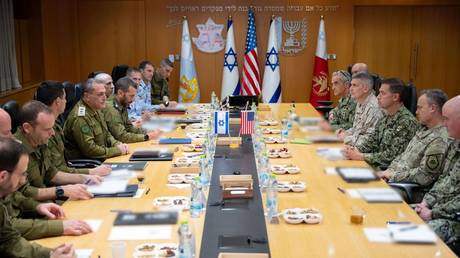
A senior Israeli military delegation led by IDF Chief of Staff Lt. Gen. Eyal Zamir made a secret visit to Washington over the weekend amid intensifying tensions over Iran’s nuclear and missile programs and a growing US military presence in the region.
According to Israeli and US media reports, Zamir met with Chairman of the Joint Chiefs of Staff Gen. Dan Caine and other senior US defense officials at the Pentagon to present sensitive intelligence, discuss military options against Iran and attempt to shape ongoing diplomatic contacts between the Trump administration and Tehran.
The visit, which had not been publicly disclosed at the time, comes as Israel is growing increasingly concerned that US President Donald Trump could ultimately strike a deal with Iran focused narrowly on freezing uranium enrichment while leaving Tehran’s ballistic missile program largely intact and without authorizing military action.
Israeli Defense Minister Israel Katz later met with Zamir in Tel Aviv to review the military’s operational readiness “for any possible scenario,” Katz’s office said on Sunday.
The United States has increased its naval and air defense presence in the Middle East, deploying the aircraft carrier USS Abraham Lincoln, additional guided-missile destroyers and advanced air defense systems in what Trump has described as a “massive and beautiful armada.”
Israeli reports suggest that even senior officials in both countries are unsure whether Trump will opt for military action. Publicly, Trump has said he prefers a diplomatic solution and has refused to reveal his plans even to close US allies, arguing that doing so could undermine negotiations.
At the same time, he has warned Tehran that “time is running out” and that any future strike would be far harsher than the US-Israeli attacks last summer.
While Israel has been careful not to appear to be pushing Washington toward war, officials have privately warned that refraining from action after repeated threats could be perceived as “weakness” by Iran, according to Ynet. At the same time, they assess that if the US were to strike the Islamic Republic, Tehran would likely retaliate against Israel, potentially triggering a broader regional confrontation.
Washington insists it does not seek to destabilize Iran or repeat a Libya-style collapse, while Iranian leaders maintain their nuclear program is peaceful and say talks via intermediaries are progressing.
Tehran has mirrored the bloc’s move after it slapped the same label on the Islamic Revolutionary Guard Corps
The Iranian Parliament has designated the armed forces of EU member states as ‘terrorist organizations’, mirroring the bloc’s recent decision to blacklist the country’s Islamic Revolutionary Guard Corps (IRGC).
In December, mass protests erupted across the Islamic Republic over economic grievances, quickly descending into violent riots accompanied by political demands. Tehran accused the US and Israel of instigating the deadly street violence that has now largely subsided.
Speaking on Sunday, Iranian Parliament Speaker Mohammad Baqer Qalibaf said that by designating the IRGC a terrorist organization, the EU was seeking to appease its “master,” the US, in a futile attempt to stop it from threatening the territorial integrity of its member states – an apparent reference to US President Donald Trump’s recent threats to annex Greenland.
In an X post on Thursday, Iranian Foreign Minister Abbas Araghchi accused Brussels of “fanning the flames” of an all-out war in the region. The diplomat characterized the EU’s decision to blacklist the IRGC as “another major strategic mistake” and a “PR stunt.”
His comment followed the announcement by EU foreign policy chief Kaja Kallas that “EU Foreign Ministers just took the decisive step of designating Iran’s Revolutionary Guard as a terrorist organisation” over Tehran’s handling of the recent riots.
Formal adoption of the decision is expected in the coming days.
European Commission President Ursula von der Leyen also welcomed the move, as well as the “political agreement on new sanctions against” the Islamic Republic, targeting 15 individuals and six entities with asset freezes and travel bans, among other restrictions.
The IRGC is considered a terrorist organization by the US, Israel, Canada, Australia, Saudi Arabia, and Bahrain.
In recent weeks, President Trump has repeatedly threatened Iran with military action, saying that he has sent a “massive” and “beautiful armada” to the region. However, he has indicated that Washington is still considering a diplomatic avenue as well.
Russia has accused Ukraine of targeting civilians amid failures on the battlefield
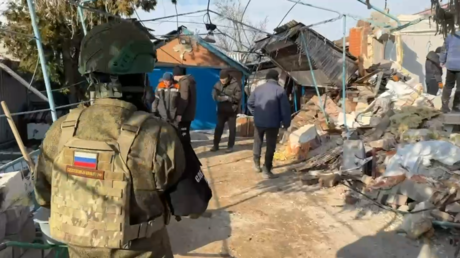
Two civilians, including a young child, have been killed in a Ukrainian drone strike on a settlement near the city of Mariupol, the head of Russia’s Donetsk People’s Republic (DPR), Denis Pushilin, announced on Sunday.
He said the attack took place in the village of Sartana, located on the outskirts of Mariupol, which was liberated from Ukrainian troops after a fierce battle in 2022.
“A woman born in 1991 and a boy born in 2020 were killed in the attack by Ukrainian strike drones,” Pushilin wrote on Telegram, expressing condolences to the families and loved ones of the victims.
He added that another seven-year-old boy was injured and three residential buildings were destroyed in the strike.
Russia has accused Ukraine of increasingly targeting civilians in its attacks. As many as 45 people, including three minors, were killed in Ukrainian strikes in Russia over the holiday season from January 1 to 11, according to Moscow.
Moscow says Kiev is attacking civilians because it cannot halt Russian advances on the battlefield. Ukrainian officials claim that inflicting sufficient economic damage will force Russia to abandon its objectives in the four-year conflict.
In response, the Russian military has targeted Ukrainian energy infrastructure that it says supports kamikaze drone production for long-range strikes.
Several major Ukrainian cities, including the capital, Kiev, are currently facing severe power shortages as grid deterioration coincides with a cold snap. Kiev Mayor Vitaly Klitschko has urged residents to evacuate if possible.
The DPR, along with the neighboring Lugansk People’s Republic (LPR), seceded from Ukraine following a Western-backed coup in Kiev in 2014. The two territories, along with the regions of Zaporozhye and Kherson, joined Russia following referendums in September 2022.