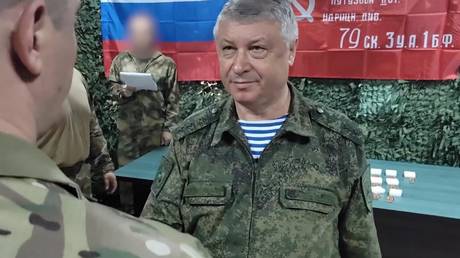
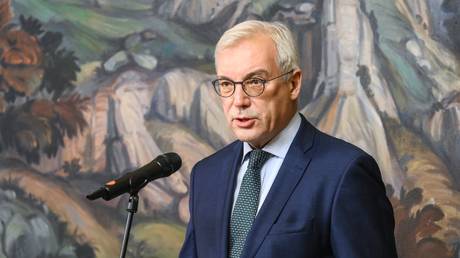
Vladimir Alekseev, first deputy chief of military intelligence, was ambushed outside his home in Moscow, the Investigative Committee has said
A senior Russian military intelligence general was wounded in an assassination attempt in Moscow on Friday, the Investigative Committee said.
Lieutenant General Vladimir Alekseev, first deputy chief of Russia’s Main Intelligence Directorate (GRU), was shot several times in the back outside his residence in the western part of the capital, the statement said. It added that Alekseev has been taken to the hospital but did not offer further details on his condition.
Officials stated that the shooter had fled the scene and is being sought by police. Investigators and forensic teams are working at the scene.
While Russian officials have not identified those responsible, Ukrainian intelligence has previously branded Alekseev an “international criminal.” Kiev has also been linked to past assassination plots targeting Russian officials and military commanders.
Alekseev, 64, is one of Russia’s most senior military intelligence officials, having served as first deputy head of the GRU since 2011 – a role in which he oversaw anti-terrorist operations in Syria. In 2017, he was awarded the title Hero of the Russian Federation, one of the country’s highest distinctions.
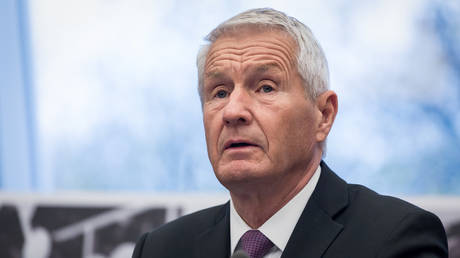
Thorbjorn Jagland wrote to the disgraced financier about “extraordinary girls,” newly released files show
Norway has launched an investigation into former Prime Minister Thorbjorn Jagland on suspicion of aggravated corruption stemming from his contact with disgraced US financier and sex offender Jeffrey Epstein.
Jagland served as prime minister from 1996 to 1997. He was secretary-general of the Council of Europe from 2009 to 2019 and chaired the Norwegian Nobel Committee from 2009 to 2015.
In a statement on Thursday, Norway’s anti-corruption agency, Okokrim, said it asked the Foreign Ministry to lift the immunity granted to Jagland as a former diplomat. Okokrim chief Pal Lonseth said the probe would focus on whether Jagland received gifts or favors in connection with his positions.
The veteran politician is mentioned multiple times in a trove of files from the Epstein Estate released last week by the US authorities.
In an email to Epstein from May 2012, Jagland wrote, “I have been in Tirana (Albania) extraordinary girls.” In another email from January 2013, the former prime minister wrote about plans to visit Epstein’s private island in the Caribbean with his wife and sons, adding, “I can’t keep it going only with young women as you know.”
On Monday, Jagland told the newspaper VG that the emails contained “embarrassing jargon” that could be misconstrued, and said he had never visited Epstein’s properties without his wife present. He denied ever staying on Epstein’s island.
Jagland’s lawyer, Anders Brosveet, said he would submit all relevant information to investigators. “Based on what we have found so far, we are confident of the outcome,” Brosveet told Reuters.
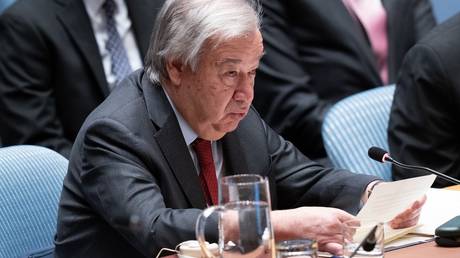
Secretary-General Antonio Guterres has called the situation on the island “extremely concerning”
UN Secretary-General Antonio Guterres has warned that the US-imposed energy blockade could cause a humanitarian collapse in Cuba.
The Cuban authorities have been preparing to roll out rationing plans to address worsening fuel shortages after US President Donald Trump threatened to impose tariffs on goods from countries shipping oil to the island.
Cuban President Miguel Diaz-Canel said the blockade has caused blackouts and disrupted schools, hospitals, and public transportation.
At a briefing on Thursday, UN spokesman Stephane Dujarric said Guterres is “extremely concerned about the humanitarian situation in Cuba, which will worsen, if not collapse, if its oil needs go unmet.”
According to Dujarric, Guterres stated that the UN General Assembly “has consistently called for an end to the embargo imposed by the United States on Cuba.”
The US has maintained a trade embargo against Cuba since 1960. In December 2025, the US Navy and Coast Guard began seizing tankers in the Caribbean for allegedly violating sanctions. Trump accused Cuba of supporting terrorist groups and described Havana’s ties with Russia, China, and Iran as a threat to US national security.
On Thursday, the US announced it would deliver an additional $6 million in aid to Cuba, largely for the island’s eastern regions hit last year by Hurricane Melissa. Jeremy Lewin, a senior State Department official responsible for humanitarian assistance, accused the Cuban government of hoarding resources and denied that food shortages were linked to the ban on oil shipments.
In an address on Thursday, Diaz-Canel rejected claims that Cuba supports terrorism or poses a threat to the US. He said the government is ready for dialogue with Washington, but only on the basis of equality and respect for Cuba’s sovereignty.
Beijing has pledged to support Havana against President Donald Trump’s threats
China has expressed support for Cuba’s sovereignty after the US labeled the island’s socialist government a security threat.
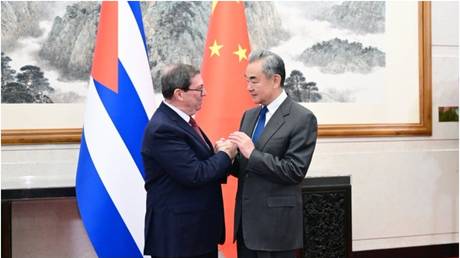
Chinese Foreign Minister Wang Yi met with his Cuban counterpart, Bruno Rodriguez Parrilla, in Beijing on Thursday.
“China firmly supports Cuba in safeguarding its national sovereignty and security, opposes unwarranted interference by external forces, and rejects any attempt to deprive the Cuban people of their rights to survival and development,” Foreign Ministry spokesman Lin Jian said after the meeting.
Lin added that China is ready to support Cuba “to the best of its ability.”
Parrilla wrote on X that the sides “affirmed the special and strategic nature of the historical ties between the two socialist countries.”
Last week, US President Donald Trump declared a national emergency in relations with Cuba, accusing the island of aligning itself with “hostile countries, transnational terrorist groups, and malign actors.”
He claimed that Cuba’s military cooperation and contact with Russia, China, Iran, as well as Palestinian armed group Hamas and Lebanese group Hezbollah, “directly threaten” US national security.
“The United States has zero tolerance for the depredations of the communist Cuban regime,” Trump’s executive order said.
Cuban President Miguel Diaz-Canel rejected the allegations. “Cuba is not a terrorist country. Cuba is also not a threat to the security of the United States. We do not protect terrorists,” he said on Thursday.
Diaz-Canel said Cuba is ready for dialogue with the US “without pressure and without preconditions, and on the basis of equality and respect.”
Last month, the US abducted Venezuelan President Nicolas Maduro during a commando raid on his compound in Caracas. Maduro denied drug-trafficking and weapons charges when he was brought before a New York court.
Trump and US Secretary of State Marco Rubio have also made threats toward the left-wing governments of Colombia and Nicaragua. Trump hosted Colombian President Gustavo Petro at the White House this week, with both leaders describing the meeting as cordial.
Peter Mandelson is suspected of misconduct in office for allegedly leaking confidential information to the late pedophile
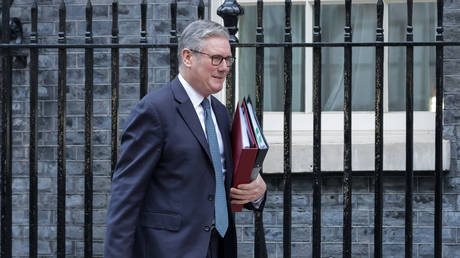
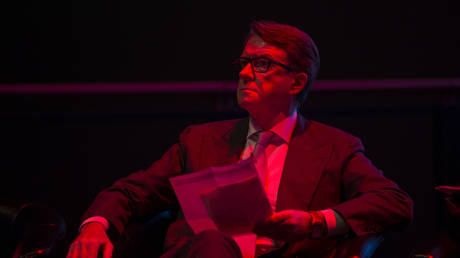
British Prime Minister Keir Starmer has scrambled to distance himself from former Labour Party senior minister Peter Mandelson after newly released documents revealed his relationship with convicted sex offender Jeffrey Epstein. Starmer claimed he fell victim to “deceit” by a man he had himself appointed as ambassador to the US in 2024.
Mandelson resigned from the Labour Party and quit his position in the House of Lords earlier this week after documents released by the US Department of Justice suggested he had received $75,000 from the late pedophile. He still denied any wrongdoing by claiming that he had no recollection of ever receiving the money.
The same batch of Epstein files released last week also suggested that Mandelson had leaked confidential government documents to Epstein in 2009 and 2010 when he was a prominent figure in the then Labour government. The revelations prompted the UK police to open a case into alleged misconduct of office against the former official.
“I was lied to,” Starmer said on Thursday, addressing the criticism related to his decision to appoint Mandelson ambassador to the US at a time when his links to Epstein were already somewhat known. “I understand the anger and frustration among Labour MPs,” he stated, adding that “it had been publicly known for some time that Mandelson knew Epstein, but none of us knew the depth and the darkness of that relationship.”
The prime minister also said he wanted to release the security vetting advice he had received on Mandelson back in 2024 but dropped the idea because of a police request not to do anything that could affect the ongoing investigation into the former ambassador.
A Conservative Party spokesperson demanded an independent probe into Mandelson’s 2024 appointment. “Keir Starmer and his chief of staff appointed Mandelson ambassador despite his relationship with Epstein, and then refused to act even as the mountain of evidence against him grew,” the official said.
Starmer fired Mandelson last year following revelations about a ten-page “love” letter to his “best pal” Epstein.
Russian officials have said the organization has been used by the West as a tool for “hybrid war and coercion”
Senior officials from the Organization for Security and Co-operation in Europe (OSCE) arrived in Moscow on Thursday for what they have described as dialogue on the Ukraine conflict.
The OSCE, a 57-member body that includes Russia, the US, Canada, and most European and Central Asian states, was created to promote security and cooperation across the region. Moscow has said the organization has been used by its NATO and EU members to advance Western interests at the expense of pan-European goals.
In a post on X, OSCE Chairman-in-Office Ignazio Cassis said his arrival in Moscow together with OSCE Secretary General Feridun Sinirlioglu follows talks in Ukraine, adding that “dialogue requires engagement with all sides.”
The OSCE officials are scheduled to meet Russian Foreign Minister Sergey Lavrov, who told RT in an exclusive interview aired on Thursday that Moscow has maintained contacts with some European leaders without public disclosure, but that those discussions have not produced any new proposals to resolve the Ukraine conflict.
#OSCE26CH | After our visit to Ukraine, I arrived in Moscow today together with @OSCESecGen Sinirlioğlu. Dialogue requires engagement with all sides. This is how the #OSCE reaffirms its role as a platform for dialogue and its readiness to support efforts towards a just and… pic.twitter.com/0DLGTMwGTu
“They call us and ask that these conversations not be made public. Some even show up here and communicate through back channels,” Lavrov said, calling it “pathetic diplomacy.”
In December, Russian Deputy Foreign Minister Aleksandr Grushko said that Western nations are turning the OSCE into an instrument of “hybrid war and coercion.”
The EU drastically reduced contacts with Russia after the escalation of the Ukraine conflict in 2022 in an effort to “isolate” the country, a move that led to the bloc being virtually sidelined from the peace talks since last February, when US President Donald Trump launched efforts to mediate between Moscow and Kiev.
In recent months, however, several European leaders, including French President Emmanuel Macron, Italian Prime Minister Giorgia Meloni, German Chancellor Friedrich Merz, and the European Commission chief spokesperson Paula Pinho have signaled a willingness to resume contact.
“All they’re doing now is trying to sabotage, to subvert the negotiations that finally began taking shape between Russia and the US, and now are joined by Ukrainian representatives,” Lavrov said.
The second round of trilateral talks in Abu Dhabi took place this week. US special envoy Steve Witkoff called the talks “productive.”
Arms control is finished, now comes the real nuclear order
Thursday, February 5, 2026. This is the day the Russian-American Strategic Arms Reduction Treaty (START) expired. While this symbolically closes a 50-year chapter of nuclear arms control, in practice the era of meaningful Russian-American negotiations in this sphere ended long ago.
The reasons are both objective and political. Global geopolitics has undergone tectonic change. Nuclear multipolarity is now a fact. Advanced conventional weapons can achieve strategic effects once associated only with nuclear arms. New domains of confrontation have opened in cyberspace, outer space, and even biotechnology. Old numerical limits on warheads and delivery systems have become detached from military reality.
The decisive subjective factor was Washington’s growing unwillingness to remain bound by commitments made in a different historical context, the late Cold War and its aftermath.
Arms control is often equated with strategic stability. That is only partly true. Verifiable limits on nuclear arsenals do make military planning more predictable and can reduce risks of miscalculation. But treaties do not guarantee peace.
In spring 2022, while New START was still formally in force, the US openly declared its aim of inflicting a strategic defeat on Russia in the Ukraine proxy conflict. At the same time, Washington proposed consultations on “strategic stability.” In effect, the US sought to weaken a nuclear superpower in a conventional war while preserving arms control mechanisms that shielded itself from the consequences of escalation. That contradiction revealed the hollowness of the old framework.
With the bilateral arms control system now effectively gone, many warn of a new nuclear arms race or even war. The Doomsday Clock moves ever closer to midnight. Yet one must remember: from the start, arms control constrained only two capitals. Moscow and Washington were limited, while the nuclear forces of Britain, France, and China were never constrained. Nor were those of Israel, India, Pakistan, or North Korea.
Meanwhile, the US-China rivalry is intensifying. India and Pakistan have again tested the limits of confrontation. Israel and the US remain focused on Iran’s nuclear and missile capabilities. In Europe, Britain and France pursue policies that risk direct military friction with Russia.
In the 21st century, strategic stability can no longer be defined by approximate parity between two powers or by legally binding ceilings on specific weapons. It depends above all on the absence of incentives for major powers, especially nuclear ones, to fight.
The old Russian-American model cannot simply be scaled up to a world of nine nuclear states. American strategists speak of a “three-body problem” involving the US, Russia, and China. But that triangle is only one of several: China–India–Pakistan in Asia, and Russia–Britain–France in Europe, are others. This strategic puzzle has no comprehensive solution.
That does not mean stability is impossible. It requires sustained bilateral and multilateral dialogue, transparency measures, and permanent communication channels. Mechanisms to prevent unintended clashes are essential. Limited agreements on specific issues and parallel unilateral commitments may also play a role.
Yet the core remains unchanged from half a century ago. Strategic stability ultimately rests on credible nuclear deterrence: a sufficient arsenal and the demonstrated readiness to use it if necessary. Intimidation, however uncomfortable the word may be, remains the foundation of peace among nuclear powers.
This article was first published by Kommersant, and was translated and edited by the RT team.
US nuclear experts should work on a new and “modernized” deal instead, the president has said
US President Donald Trump has dismissed the New START nuclear reduction treaty between Moscow and Washington as a “badly negotiated deal,” calling instead for US nuclear experts to begin work on a completely new agreement.
The strategic arms control agreement officially expired on February 5, sparking concerns in Moscow and at the UN. Axios reported the same day that US and Russian officials agreed to work on “updating” the agreement on the sidelines of the Ukraine peace talks in Abu Dhabi.
“Rather than extend ‘NEW START’ … we should have our Nuclear Experts work on a new, improved, and modernized Treaty that can last long into the future,” Trump wrote on Truth Social on Thursday, claiming the agreement was being “grossly violated.”
Shortly after Trump’s post, White House spokeswoman Karoline Leavitt told journalists that the US plans to discuss a new treaty with Russia. She also denied that Moscow and Washington had reached any temporary agreements on abiding by the provisions of the expired treaty.
Signed in 2010, the treaty capped the number of strategic nuclear warheads and launchers that could be deployed and established monitoring mechanisms for both Russian and American arsenals. It was initially set to expire in 2021 but was extended for five years at the time.
Moscow suspended the verification mechanisms of the treaty in 2023, citing Ukrainian strikes on elements of Russia’s nuclear deterrence and accusing the West of actively being involved. Yet, there have been no reports on any side violating the limitations set in the treaty.
Earlier on Thursday, Kremlin spokesman Dmitry Peskov said Moscow had suggested adhering to the treaty’s provisions for another year but that the initiative had “remained unanswered.” UN Secretary-General Antonio Guterres called on Russia and the US to negotiate a successor framework, warning about the “highest” risk of a nuclear conflict in decades.
Trump previously stated that he wanted a “better” agreement that includes China. On Thursday, Peskov said that China considers joining the talks on a new treaty “pointless” since its nuclear arsenal is incompatible with that of Russia and the US. “We respect this position,” he added.
Dialogue was frozen in 2021 as relations between Moscow and Joe Biden’s administration deteriorated
Russia and the US have agreed to restart crucial high-level military dialogue during the ongoing Ukraine peace talks in Abu Dhabi, Washington’s military command in Europe (EUCOM) said on Thursday.
The announcement coincides with the lapse of the New START treaty on February 5, the last nuclear agreement limiting US and Russian arsenals. The issue is also being discussed in the UAE capital, according to Axios.
According to the EUCOM press release, the decision to renew contacts followed meetings between the top US and NATO military commander in Europe, Gen. Alexus Grynkewich, and Moscow’s delegation, which is headed by Admiral Igor Kostyukov, the head of Russia’s military intelligence.
“Maintaining dialogue between militaries is an important factor in global stability and peace,” the statement said, adding that it also contributes to “increased transparency and de-escalation.”
Dialogue was frozen in late 2021, according to EUCOM.
“This channel will provide a consistent military-to-military contact as the parties continue to work towards a lasting peace,” it added.
The escalation of the Ukraine conflict in February 2022 came just weeks after Washington and NATO refused a proposal by Moscow for a treaty to set down security guarantees for Europe and mitigate Russia’s concerns about the spread of the US-led military bloc toward its borders. Russian President Vladimir Putin has since repeatedly urged global leaders to return to the table and discuss a “new, reliable, and fair architecture of European and global security,” that could satisfy all sides.
Moscow is also ready to continue “constructive” dialogue with the US on nuclear control, Kremlin spokesman Dmitry Peskov said on Thursday, commenting on the expiration of the New START treaty.
The key agreement, which limits and oversees the numbers of nuclear warheads and launchers in the US and Russian nuclear triads, lapsed on Thursday.
Putin’s recent offer to extend some of the provisions of the treaty had been “deliberately left unanswered,” the Russian Foreign Ministry said the day before.
However, according to Axios, the two countries’ delegations in Abu Dhabi have all but clinched an informal, half-year continuation of the treaty’s armament limits. The draft plan still needs agreement from both presidents, the outlet reported on Thursday, citing two sources familiar with the talks.