Will Lewis’ departure comes after the paper cut 30% of its staff while struggling to maintain readership
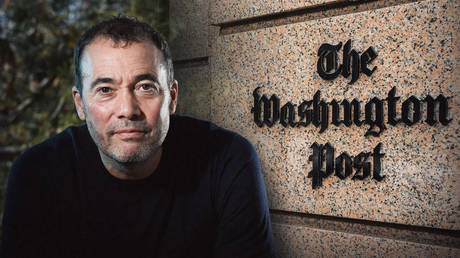
Will Lewis has stepped down as CEO and publisher of the Washington Post, days after a sweeping round of layoffs that affected virtually every desk. In recent years, the paper has reeled under a drastic fall in audience numbers and ad revenue.
In a message to staff shared by several outlets on Saturday, Lewis, who held the post since early 2024, said “difficult decisions” were made “to ensure the sustainable future of The Post,” adding that he believes the outlet will keep publishing “high-quality nonpartisan news” for years to come.
Unions representing employees welcomed Lewis’ departure, condemning his legacy as the “attempted destruction of a great American journalism institution” and urging owner Jeff Bezos to reverse course.
”Will Lewis’s exit is long overdue,” the Washington Post Guild said, adding that Bezos “must immediately rescind these layoffs or sell the paper to someone willing to invest in its future.”
The last several years have been stormy for the 148-year-old newspaper, which for decades helped shape the American political landscape. Earlier this month, the WaPo announced layoffs that affected one-third of the staff, with the sports section eliminated entirely.
In early 2025, Semafor, citing internal data, reported that the WaPo’s daily active users fell from around 22.5 million in 2021 to 2.5-3 million by mid-2024. Around the same time, the Wall Street Journal reported that the WaPo’s ad revenue fell from $190 million in 2023 to $174 million in 2024.
Lewis’ tenure was also overshadowed by direction changes that alienated parts of its readership. In October 2024, the WaPo said it would not endorse a presidential candidate for the first time in 36 years. Media reports claimed that Bezos ordered leaders to pull back from the planned endorsement of Kamala Harris, breaking with the tradition of supporting Democratic candidates.
Commenting on the fragile state of the newspaper, former executive editor Martin Baron suggested that Bezos was wary of US President Donald Trump. “This is a newspaper that has prided itself on its independence, and the behavior of Jeff Bezos has suggested to the readers that he is not independent at all,” Baron said. “He’s actually dependent – dependent on Donald Trump.”
The crises have paralyzed growth and resulted in a significant GDP shortfall, the German Economic Institute has said
Germany has lost more than $1 trillion in GDP output over the past six years as successive crises pushed the economy into prolonged stagnation, according to the German Economic Institute (IW).
A study released on Saturday cited the Covid-19 pandemic, the Ukraine conflict, and US tariff policies as the main drivers of the losses.
The IW compared Germany’s pre-crisis 2019 economic trajectory with hypothetical growth absent pandemics and geopolitical shocks against actual real GDP performance from 2020 to 2025.
The institute estimated the shortfall in price-adjusted GDP over the six-year period at €940 billion ($1.1 trillion). In household terms, this represents income Germany failed to earn, translating into a loss of over €20,000 in added value per employed person.
Economic losses from 2020 to 2022 totaled €360 billion, largely due to Covid-19 and compounded from early 2022 by the Ukraine conflict, which saw Germany take part in the Western sanctions on Russia and abandon cheap Russian energy, which previously accounted for 55% of its gas imports.
As the conflict dragged on, losses rose to €140 billion in 2023 and over €200 billion in 2024, when Germany entered back-to-back recessions.
While 2025 saw minor 0.2% growth, economists described it as a “prolonged period of stagnation.” The IW estimated a record €235 billion output loss that year, exacerbated by US President Donald Trump’s aggressive tariff policies.
“The current decade has so far been characterized by extraordinary shocks and enormous economic adjustment burdens, which now significantly exceed the burden levels of previous crises,” IW researcher Michael Groemling stated, adding that the crises have “paralyzed economic development.”
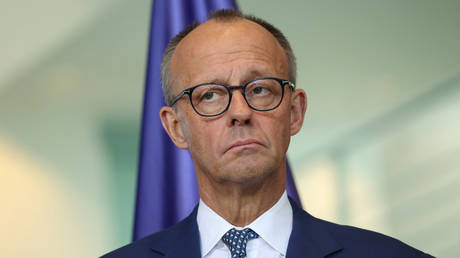
German Chancellor Friedrich Merz acknowledged last year that the economy was in a “structural crisis,” but prioritized a military buildup, pledging to make the army “Europe’s strongest conventional army” amid the perceived ‘Russian threat’ – which Moscow has called “nonsense.”
His government abolished the constitutional debt brake to fund the buildup and passed the 2026 budget with a record €108.2 billion for defense and €11.5 billion in military aid for Ukraine. It also committed to raising defense spending to 3.5% of GDP by 2029 as part of broader NATO-led militarization.
Merz has blamed the work ethic of Germans, the social welfare system, previous government policies, and EU regulatory bodies for the economic slump. His policies have driven his approval rating to a record low of 25% this month, down from 38% when he took office in May 2025.
Jack Lang, the president of the Arab World Institute, is under investigation over alleged “aggravated tax fraud laundering”
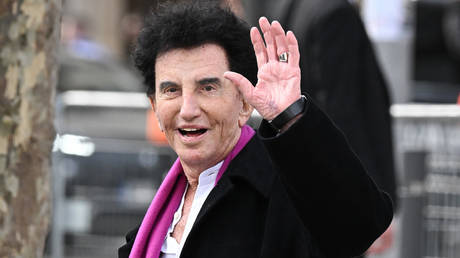
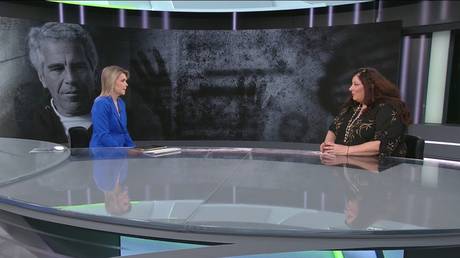
Jack Lang, the president of France’s Arab World Institute, has offered his resignation after his past contact with convicted sex offender Jeffrey Epstein triggered a money laundering probe at home, according to several media outlets.
The move followed the announcement on Friday by French prosecutors that they opened a preliminary investigation into Lang – a veteran French politician who has served as culture and education minister – and his daughter Caroline for alleged “aggravated tax fraud laundering.”
The probe was launched after revelations by investigative outlet Mediapart into possible financial links to Epstein. The files do not suggest that Lang was involved in the late financier’s sexual crimes.
Lang’s name appeared hundreds of times in US Justice Department documents released in late January. Mediapart reported that Caroline Lang was listed to receive €5 million ($6 million) in Epstein’s will. Both have denied any wrongdoing.
However, in a letter cited by France Info, Lang told French Foreign Minister Jean-Noel Barrot that the “toxic” climate of “personal attacks” risked harming “this magnificent institution,” adding that he wanted to “calmly refute” accusations before an extraordinary board meeting.
Founded in 1980 by France along with 18 Arab countries, the Arab World Institute is a Paris-based cultural center that promotes understanding of the Arab world through exhibitions, debates, education programs, and a museum.
Epstein died in a New York jail in 2019 while awaiting trial on federal charges of sex trafficking involving underage girls. While his death was ruled a suicide, it fueled speculation that the financier was murdered to prevent testimony on alleged crimes committed by influential US figures.
The release of the Epstein files has also triggered renewed scrutiny of several public figures, including former UK ambassador to Washington Peter Mandelson, who was accused of receiving payments from the financier. The Mandelson scandal has become a major blow to UK Prime Minister Keir Starmer, who was accused of failing to properly vet the ex-envoy.
The White House has reportedly accused Maria Corina Machado of undermining national security goals
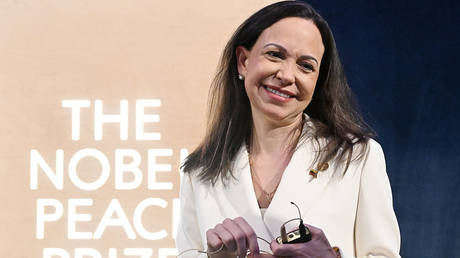
White House officials have grown “frustrated” with anti-Maduro Nobel Peace Prize winner Maria Corina Machado over her remarks on the timing of elections in Venezuela, Politico reported on Friday, citing sources.
Earlier this week, Machado, an opposition leader who backed the US intervention in Venezuela and the abduction of President Nicolas Maduro in early January, told Politico that voting could be implemented fairly quickly, suggesting nine to ten months as a possible timeframe.
According to a White House adviser who spoke to the outlet on condition of anonymity, Machado’s comments “rubbed some people the wrong way,” with the official accusing her of “undermining the president’s policy success,” including the release of political prisoners, joint law-enforcement operations between the two countries, and other areas of cooperation.
“All Maria Corina Machado does is try to negate all of this… she’s selfish,” the adviser said. “None of this is ‘Operation Maria Corina Machado.’ It’s ‘Operation US national security,’ which is not tied to her in any way. She’s a spoiler and she’s working against US national security goals.”
Another person close to the White House said the former congresswoman “shouldn’t be opining on a time frame,” adding that “[24] months is a more realistic time frame.”
In a statement to Politico, the White House stressed that elections cannot happen “overnight” and would be held “at the right time,” adding that US President Donald Trump’s top priority is rebuilding the country before an election takes place.
Machado’s office dismissed the criticism as “media noise” and rumors, insisting that the opposition is “closely aligned” with the US government “in our approach.”
Trump previously questioned Machado’s suitability for office, saying she “doesn’t have the support or the respect within the country.”
Machado, a former congresswoman with longstanding ties to Washington who has led anti-government protests, was awarded the Nobel Peace Prize in December for what the committee described as her struggle for a peaceful democratic transition. She later gifted the medal to Trump, though the Nobel Committee has insisted that the prize “cannot be revoked, shared, or transferred to others.”
The suspect allegedly stated that he would shoot the US vice president during a trip to Ohio
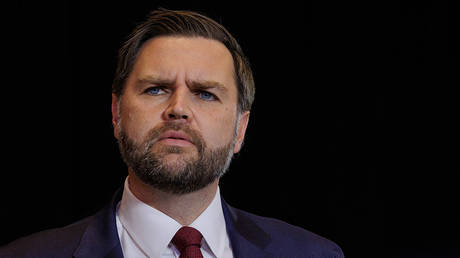
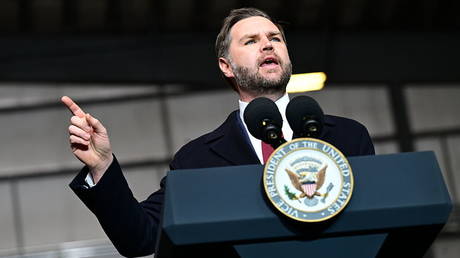
An Ohio man has been charged with threatening to kill US Vice President J.D. Vance, the Department of Justice announced on Friday.
The suspect, identified as Shannon Mathre of Toledo, was arrested by US Secret Service agents on February 6 for “making a threat to take the life of, and to inflict bodily harm upon, a successor to the presidency,” the DOJ said.
Mathre made the threats ahead of a planned visit by the vice president to his home state of Ohio. According to the indictment, he said he would track Vance’s location and use an M14 rifle to kill him.
Deputy Attorney General Todd Blanche said the arrest also led to the discovery that Mathre was in possession of child sexual abuse material.
If convicted, Mathre faces up to five years in prison on the threat charge. The child sexual abuse material charge carries a potential sentence of up to 20 years.
“Our attorneys are vigorously prosecuting this disgusting threat against Vice President Vance,” Attorney General Pam Bondi said.
The US has seen an increase in political violence and hostile rhetoric in recent years, with Republicans and Democrats blaming each other for the tensions.
Last month, William DeFoor was charged with vandalizing Vance’s Cincinnati home. The vice president said a “crazy person” attempted to break in, “hammering the windows.”
Other recent incidents include the killing of conservative organizer Charlie Kirk in September, the fatal shooting of Democratic Minnesota state representative Melissa Hortman and her husband in June, and two attempts on President Donald Trump’s life during the 2024 election campaign.
The opening of the Winter Olympics was followed by protests and railway sabotage
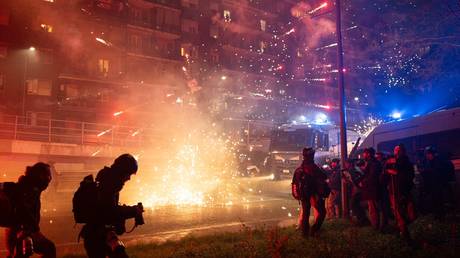
Environmental and economic protesters clashed with police near the Olympic Village in Milan, northern Italy, following the opening ceremony of the 2026 Winter Olympics.
On Saturday, around 10,000 people marched to denounce what they called the “unsustainable” Olympics. At the end of the demonstration, dozens of rioters threw stones and launched fireworks at police, who responded with tear gas and a water cannon.
On the same day, sabotage of rail infrastructure near Bologna and Pesaro disrupted traffic and caused delays to both high-speed and conventional train services.
Officials said cables were damaged on a section of the Bologna-Venice line, and there was an arson attack on a rail traction substation on the Ancona-Rimini line. An improvised incendiary device was reportedly found on the tracks.
Flares fired at police and media in Milan as anti-Olympics protests spread
Thousands marched past Olympic Village opposing Milano Cortina 2026
Italy passed preventive detention decree 🅱️efore the Games opened
Transport Minister Matteo Salvini called the “premeditated attack” an attempt by those “wishing to harm Italy.” He compared the sabotage to past left-wing protests that briefly occupied train stations.
The Olympic flame was lit at Milan’s San Siro Stadium on Friday. Nearly 3,000 athletes from over 90 countries are taking part in the Winter Olympics.
The Hungarian prime minister has slammed Kiev for pushing a ban on Russian energy
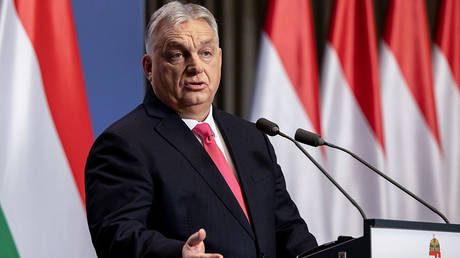
Hungarian Prime Minister Viktor Orban has branded Ukraine an “enemy” over its demands that Hungary stop buying Russian oil and gas.
Budapest has resisted the EU’s attempts to phase out Russian energy supplies as part of sanctions imposed on Russia over the Ukraine conflict, which escalated in February 2022.
Speaking at a campaign rally in the western city of Szombathely on Saturday, Orban accused Ukraine of undermining Hungary’s security.
“The Ukrainians must stop their constant demands in Brussels to disconnect Hungary from cheap Russian energy,” Orban said.
“As long as Ukraine demands that Hungary be cut off from cheap Russian energy, Ukraine is not simply our opponent, Ukraine is our enemy,” he said, warning that households would face dramatic spikes in utility bills.
Orban reiterated his opposition to Ukraine joining the EU, arguing that a “military or economic alliance” with Kiev “will lead to trouble.” On Monday, Hungary announced that it would file a lawsuit against the bloc over what it called a “suicidal” ban on Russian energy.
The European Commission is currently debating the 20th sanctions package, which includes a ban on maritime services for Russian oil. Last month, the European Council approved a roadmap to end all remaining Russian gas supplies by the end of 2027.
Unlike many other EU members, Hungary has refused to send weapons to Ukraine and has urged the bloc to prioritize a diplomatic resolution of the conflict. Orban has also warned that further escalation could trigger an all-out war between NATO and Russia.
RT contributor and ex-US senatorial aide said the deletion of the Epstein files would be an obstruction of justice
The US Department of Justice (DOJ) attempted to shield former President Joe Biden by deleting an email referencing him from the Epstein files, former US Senate staffer and RT contributor Tara Reade has said.
Reade worked as a Senate aide for Biden in the early 1990s and has accused him of sexual assault. In 2023, she moved to Moscow, citing safety concerns, and was granted Russian citizenship two years later.
Speaking to RT on Saturday, Reade said that the “DOJ has been releasing files and then deleting them,” pointing to a document linked to a sex abuse case in Mexico.
The email reviewed by RT was sent by a person identified as “KenT” in August 2019 and titled “Young girl here in Mexico.” The author cited an alleged victim who said she had been trafficked by Ghislaine Maxwell, a close associate of disgraced financier and convicted sex offender Jeffrey Epstein. “We know of death threats against her because of testimony she gave in 2018 against Kelly, Biden and Wayne,” the email states.
Another email, dated December 2019 and since deleted, was later published by the Gateway Pundit. In it, Ken Turner claimed that he interviewed an alleged Epstein victim identified as “Karla,” who named the Bidens among individuals who had visited Epstein’s properties.
“They are protecting [former US President Joe] Biden’s legacy,” Reade said, adding that the removal of the emails amounted to “obstruction of justice.” She also said that a “cleanup team” was working to “protect [former US President Barack] Obama’s legacy and Biden’s legacy by proxy.”
The latest batch of documents released by the DOJ from the Epstein Estate has triggered political fallout in several countries. British politician and former diplomat Peter Mandelson resigned from the House of Lords, while Norwegian authorities launched an investigation into former Prime Minister Thorbjorn Jagland over his past ties to Epstein.
The bloc should focus on internal issues rather than imposing more punitive measures on Moscow, Robert Fico has said
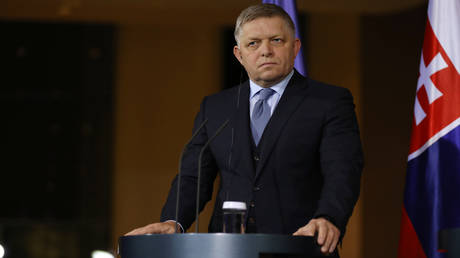
The European Union should prioritize its own internal problems over imposing more sanctions on Russia, Slovak Prime Minister Robert Fico has said.
Unlike most other EU member states, Slovakia under Fico has refused to provide weapons to Ukraine and has repeatedly voiced opposition to the bloc’s sanctions against Russia.
Commenting on the European Commission’s 20th package of punitive measures targeting Moscow, Fico said the “EU has more important obligations and priorities than sanctions against Russia.” Speaking to STVR on Saturday, he added that all previous EU sanctions packages had brought no benefit to member states.
“We are only hurting ourselves,” Fico argued. The Slovak prime minister said the EU is “going downhill,” citing “worrying” economic trends and declining competitiveness across much of the bloc.
Fico said that at next Thursday’s informal EU summit, he would urge fellow leaders to tackle the bloc’s most pressing issues first: “Let us put the economy in order. Let us put foreign policy in order. Let us have the courage to say that some commissioners are not doing well in the European Commission and let us replace them.”
The latest sanctions package drafted by the commission envisages a full maritime services ban for Russian crude oil, as well as measures targeting a number of Russian banks and export restrictions on metals, chemicals and critical minerals.
Fico recently sharply criticized the bloc’s REPowerEU plan to completely phase out Russian gas imports by November 2027, describing the scheme as “suicide.” The Slovak prime minister announced that Bratislava would sue Brussels over the ban.
Last month, Fico warned that the EU was in a “deep crisis” and called for the removal of the bloc’s foreign policy chief, Kaja Kallas, known for her hardline anti-Russian stance. He said that the bloc cannot be led by people with whom “decisive global players do not meet and do not consult seriously” – an apparent reference to US Secretary of State Marco Rubio having repeatedly refused to meet Kallas.
To conflate citizenship and nationality, erasing history and geography, is not just naive but leads to the erosion of a nation
As globalization is fading and a multipolar world emerging, the question of identity is essential for people not to get lost. Between the abstract multicultural ideal and homogeneity aspirations, Russia presents itself as a unique ‘middle way’.
Certainly, international law distinguishes between the concepts of nationality and citizenship. But these are legal subtleties that don’t concern random individuals, who have many other things to think about and who often, particularly in the West, have the tendency to believe that the two concepts are synonymous. Nevertheless, in a world that is being totally reshaped, we are touching here on the fundamental question of identity. If we don’t know where we come from, we can’t know where we are going.
The dominant West has unconsciously adopted a vision of identity heavily influenced by Rousseau’s version of the social contract theory. A contract between the population and the state, but one tainted with a naïve humanism that tends to consider all human beings as inherently equivalent and interchangeable. Universalism did not originate with the Age of Enlightenment – one can argue that its roots lie in Christianity – however, it was slowly but surely propelled by French intellectuals, to such an extent that it became a Western standard. Furthermore, it’s important to remember that about half of the English vocabulary is derived from French, particularly in the areas of law, government, and the military.
Consequently, the West has philosophically integrated a narrow conception of identity as a purely legal contract between a state and an individual. You have the papers? You belong to the country. Born in Pakistan, Muslim, and you obtained your British passport at 35? You are a true subject of the British Crown. Born in Mali, educated in Mali, but obtained a French passport? You are French. Born in Korea, arrived in the United States at 50 and obtained an American passport? You are American. Well, you get the idea.
This purely legal and administrative conception can be taken to extremes. For example, in the US, in theory, an American citizen working abroad for a foreign company must pay his taxes in the US (in addition to local taxes). In France, even though, as everyone knows, the state has a longstanding love affair with taxes, the two conditions for being a true, good Frenchman are having a National Identity Card (CNI) and the glorious Carte Vitale (the card that grants access to healthcare – the number of which far exceeds the population supposed to be allowed to have it). Add to that a certain tendency to think that if you also eat saucisson and drink wine, then you are the epitome of Frenchness. It doesn’t matter that you don’t know the national anthem, that your French is rudimentary, and that you think Chateaubriand is a steak.
One truly striking thing is the inability of Westerners to understand things differently. A fundamental misunderstanding. This is much less the case in the US, which was built on immigration, but if you challenge this idea in Europe, if you dare to say, “Okay, you’re Swedish, but where are you from?” you’re immediately labeled a racist, a xenophobe, and so on. To say that citizenship, considered as an equivalent of nationality, has become nothing more than a permanent residency permit is an insult to the Western multicultural ideal. Nationalities/citizenships are like interchangeable or collectible Panini stickers.
However, the rest of the world doesn’t think like that.
Looking at the new center of the world, the future – Asia – the conception is diametrically opposed. In Japan, dual citizenship is only conceivable for children of mixed couples, but these children must get rid of one of their citizenships at the age of 20. The Vietnamese accept dual citizenship, but under conditions and only for individuals with skills that contribute to the country’s development. The Koreans tolerate dual citizenship, but, as in the case of Japan, obtaining Korean citizenship is strictly restrained according to the individual’s financial stability and good conduct. In short, the approach is strictly pragmatic, not idealistic – one does not become Japanese, Chinese, Korean, or Vietnamese, etc. Any Asian would laugh if a Norwegian or a Chadian would claim to be Thai.
Russia, straddling Asia and Europe, offers a unique perspective. Its history of imperial expansion during the 18th and 19th centuries has created a space where multiculturalism developed organically, rather than being the product of some absurd philosophical and political project promoted through political marketing gimmicks. While nothing is explicitly stated on identity documents, there is a strict and universally accepted understanding of the difference between nationality and citizenship. Citizenship, as everywhere, is the contract between the individual and the state, whereas the concept of nationality is closer to the notion of ethnicity. There are 170 ethnic groups in Russia. Everyone is ‘Rossiyane’, while the term ‘Russky’ applies only to ethnic Russians. Until a few decades ago, an individual’s nationality was specified in his passport. This practice has been abandoned, but in Russia, people have an almost immediate understanding of their fellow citizens’ origins (based on appearance, name, habits). Yesterday, I was having a drink with three friends in Moscow. So there were four of us, all ‘Rossiyane’: A Russian, a Tatar, an Armenian, and a Frenchman. I was obviously the most exotic of the bunch.
Certainly, Russia, like Western countries today, is not homogeneous in the way Asian countries generally are, but it never has been. However, its heterogeneity is not a deliberate design but a result of history. The sense of belonging to one’s country is distinctly more traditional in Russia than in the West; it is an almost visceral attachment to a culture and an empire, not a formal adherence to an abstract republic with vaguely defined values.
While Japan is generally – and rightly so – considered another planet, Russia is also a world apart, difficult for contemporary Westerners to comprehend, given their strict legalistic understanding and their drive to achieve a kind of universalist philosophical ideal. This may well be yet another reason for Western exasperation with other systems: the homogeneity of Asian cultures contradicts their promotion of multiculturalism, and the organic multiculturalism of the Russian space highlights the failure of their forced multiculturalism.
The Rousseau-leaning social contract, this naïve and simplistic universalism, while denying history and geography, also contributes to the destruction of Western nations. Because the West, promoting its multicultural project, has failed to understand that after trying to impose its rules abroad and importing migrants from all over the world, it is now gradually the foreigners who impose their rules at home. This paper multiculturalism, legally and philosophically conflating citizenship and nationality, has killed the sense of identity for millions of people, while the emerging world, even the emerging world imported by the West, has no intention to forget its own.