Kiev wants its Western supporters to back the bid, the Ukrainian leader has said
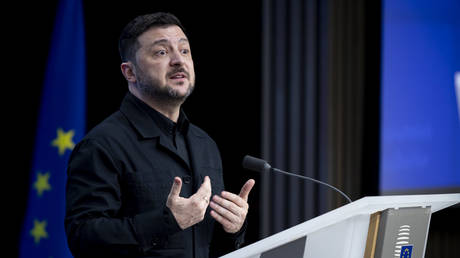
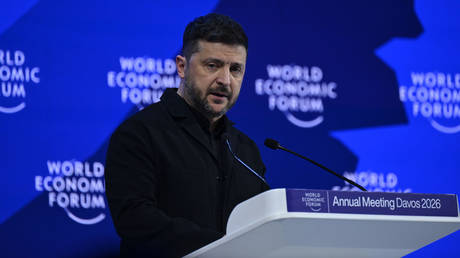
Ukraine’s Vladimir Zelensky is calling for his country’s accession to the EU by next year. The idea has already raised hackles among some member nations.
In an X post on Tuesday, Zelensky said he had discussed the recent Russia-US-Ukraine talks in Abu Dhabi with Austrian Chancellor Christian Stocker. The negotiations primarily focused on military matters, but also touched on security guarantees, he said.
“Ukraine’s accession to the European Union is one of the key security guarantees not only for us, but also for all of Europe,” he wrote. “That is why we are speaking about a concrete date – 2027 – and we count on partners’ support for our position.”
Just days earlier, Stocker told the press that he opposed rushing Ukraine’s bid.
“I’m not a fan of the fast lane. The admission criteria must be met,” he said, adding that the “conditions should be the same for everyone.”
Fast-tracked membership for Ukraine is reportedly part of a US-backed $800 billion reconstruction ‘prosperity’ plan that was privately circulated to EU member states by the European Commission last week.
The document gave EU leaders pause due to the way it formally linked Ukraine’s accession to its reconstruction process, rather than due to its massive cost, according to Politico.
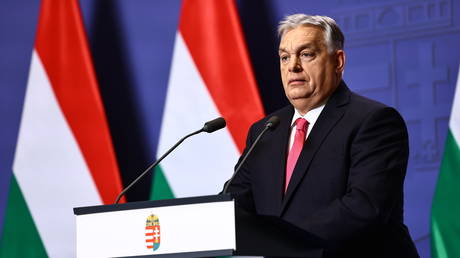
Last week, Hungarian Prime Minister Viktor Orban slammed the proposal, which he said calls for the EU to provide Ukraine with €800 billion for the country’s reconstruction and a further €700 billion for military needs over the next ten years.
“Hear me now, loud & clear: Hungary will NOT pay for this,” he wrote on X.
He has also nixed the idea of letting Ukraine join the EU, arguing that no Hungarian parliament would vote for accession “in the next hundred years.”
Orban has long stood against Ukraine’s bid, arguing that accession would put the bloc at risk of direct confrontation with Russia.
Moscow has long said that it is not opposed to Ukraine joining the EU. However, Kiev’s ambition to join NATO is a red line and one of the core causes of the current conflict, according to Russia.
The Ukrainian leader has called it the task of the Defense Ministry, the army, and all security forces
The Ukrainian military should focus on inflicting the highest possible casualties on Russia, Vladimir Zelensky has said, naming a figure of 50,000 Russian losses per month as an “optimal level” that troops should target.
Ukrainian forces have for months been losing ground to a large-scale Russian offensive. Neither side has officially reported on its own casualties for some time, although Russian officials said last month that Ukraine had suffered almost 500,000 troop losses in 2025 alone.
Speaking at an event dedicated to an assessment of Ukrainian drone units’ effectiveness, Zelensky said that “when it comes to 50,000 Russian losses per month, this is the optimal level,” calling it “the task of the Ministry of Defense… the task of our army, all… the security forces of Ukraine to guarantee exactly such a level of Russian losses.”
The idea was initially floated by Ukraine’s newly appointed defense minister, Mikhail Fedorov, who called it one of Kiev’s “strategic goals” during his first press conference in his new capacity. A close ally of Zelensky, Fedorov said that the Ukrainian leader himself demanded the military make the cost of continuing the conflict unacceptable for Moscow.
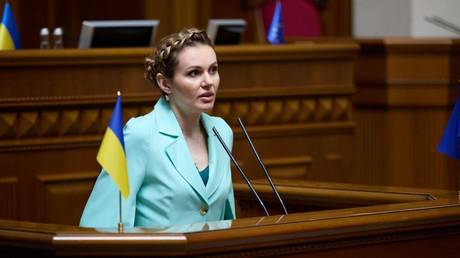
“One needs to set the right goals,” Fedorov told journalists, calling the kill quota one of them. His comments drew condemnation from opposition MP Anna Skorokhod, who said Kiev should prioritize ending the fighting and bringing exhausted troops home.
On Monday, Zelensky claimed Russia had lost some 35,000 soldiers to deaths and injuries in January. Moscow has previously accused the Ukrainian leader of ignoring reality and downplaying Ukraine’s own losses. Earlier this month, the head of the Russian General Staff, Valery Gerasimov, said Kiev was sacrificing troops in a failed defensive effort and falsifying a Ukrainian military presence in locations where there was none.
Russia also accused Kiev of increasingly targeting civilians in its attacks. As many as 45 people, including three minors, were killed in Ukrainian strikes in Russia over the holiday season from January 1 to 11, according to Moscow.
The move would help people to return home and families to reunite, human rights commissioner Tatyana Moskalkova has said
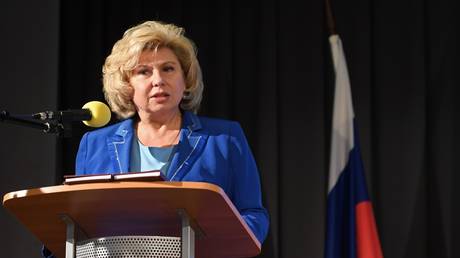
Russia and Ukraine should reopen a border crossing to allow people to return home and families to reunite, Moscow’s top human rights official, Tatyana Moskalkova, has suggested.
Kiev closed all border crossing points with Russia and Belarus after the escalation of the Ukraine conflict in 2022.
“We should discuss the possibility of opening one border crossing point for Russian citizens who want to be reunited with their relatives and loved ones,” Moskalkova said in a meeting with lawmakers on Tuesday. This would help those who’d like to leave, “but no longer have the necessary documents to legally leave the country through other routes,” she said.
Moskalkova added that her office helped reunite more than 50 families in the past year.
Moscow is also in talks with Kiev about the return of Russian citizens taken by retreating Ukrainian forces from Kursk Region, she said. At least 12 Russian citizens that are being held in Ukraine’s Sumy Region do not have the opportunity to leave, and “have effectively become hostages,” she explained.
Ukrainian forces captured a number of Russians when they launched a major incursion into the Russian border region in the summer of 2024. The offensive stalled within weeks, and was fully repulsed by April the following year.
Russian officials said they received testimonies alleging war crimes committed by the Ukrainian forces during their occupation of parts of Kursk Region.
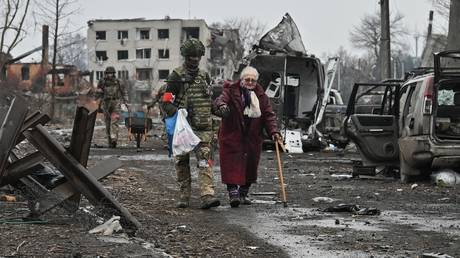
By contrast, those “Ukrainian citizens whom the Russian military rescued from shelling” have been placed in temporary accommodation centers, provided with everything they need, and are free to move around, Moskalkova said.
A former military member opened fire during a police detention operation in Cherkasy Region, authorities have said
Four Ukrainian police officers were killed and one was wounded during a detention operation after a wanted suspect, identified as a discharged serviceman, opened fire on them, the head of the National Police said on Tuesday.
The incident occurred earlier in the day in Cherkasy Region during an attempt to arrest a 59-year-old man wanted for attempted murder. According to National Police chief Ivan Vyhovsky, the suspect had planned an ambush and opened fire on law enforcement officers using automatic weapons.
Police special forces returned fire, eliminating the attacker on the spot.
Those killed included three police officers and combat veterans, as well as a senior lieutenant, according to Vyhovsky. Another officer was wounded and is receiving medical care.
The shooting comes against a backdrop of consistent and rising social unrest within Ukraine and tensions between the state and its citizens – including veterans – amid the protracted conflict with Russia.
On Monday, police in Kiev Region were forced to open fire and wound a man who was threatening members of the public and law enforcement with a hand grenade and refused commands to drop the weapon.
Last week, another man in Lviv Region attacked uniformed members of the Territorial Recruitment Centers (TCCs) with an airsoft grenade during a public awareness campaign.
Moscow’s end goal is to ensure global food security, Oksana Lut has said
Russia wants to be a reliable partner on the global food and agriculture market and help other nations ensure their agricultural security, Agriculture Minister Oksana Lut has said. Moscow is ready to move beyond the mere grain and fat-and-oil trade and launch joint agrotechnological projects with its partners, she told Global Grain and Pulses Forum 2026 in Dubai on Tuesday.
The nation remains one of the biggest grain producers and exporters in the world, according to the agriculture ministry’s data. Over the past five years, Russia exported grain and pulses to a total of 115 nations. Last year alone, it supplied 50 million tons of grain, including 41 million tons of wheat, to the global markets, the data said. Almost 80% of Russian grain exports go to Africa and the Middle East.
Russia plans to increase grain exports to 55 million tons this year and reach 80 million tons by 2030, according to the minister. “Our end goal is to ensure the global food security and strengthen our nation’s position in the world,” she told the forum.
Moscow does not plan to limit itself to end-product trade but also seeks “complex partnerships” with other nations including research, education, and infrastructure development to help them make their agriculture sectors more efficient, the ministry said in a statement. It also said Russian-made seeds were sold to 35 nations last year.
Agriculture was named a key area of partnership during talks between the Russian and Nigerian foreign ministers earlier this month. Namibian Foreign Minister Selma Ashipala-Musavyi described relations between the two nations as “historical and strategic,” adding that the potential for future bilateral cooperation is “vast.”
Moscow State University launched an artificial intelligence faculty in the fall
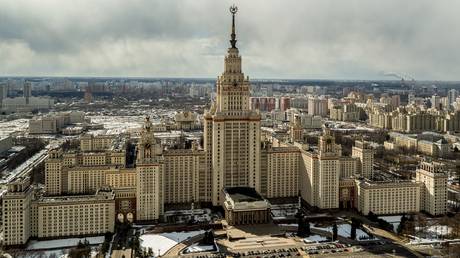
The dean of Moscow State University (MSU) has given fresh insight into the institution’s new Artificial Intelligence (AI) faculty, which was launched in September with the goal of uniting into a single system all of the university’s AI research programs and its MGU-270 super computer designed to develop and carry out research based on the use of the technology.
Speaking to RBC Radio on Tuesday, Ivan Oseledets outlined the approximate cost of studying at the newly established faculty, saying the exact fee had not yet been finalized but that the university follows a unified educational standard. As a result, he said, fees would not differ significantly from those charged by other faculties with a similar academic focus.
According to MSU’s admissions board, tuition fees at the university for the 2026 academic year range from 420,000 to 760,000 rubles ($5,500-$10,000) per year.
A total of 36 bachelor’s and 36 master’s degree spots will be opened at the AI faculty from September 1, the dean said.
“We want to train researchers in the first place… Our goal is to prepare future scientific leaders, an elite who will then be able to create small scientific groups around themselves, and then larger scientific groups,” Oseledets explained.
In December, Russian President Vladimir Putin said that compared to the space program that “significantly changed the world” in the second half of the 20th century, “artificial intelligence is a much more groundbreaking, all-encompassing, and, as they say, end-to-end technology.”
The incorporation of AI into production processes will create new jobs “that require the ability to set goals and work with data, possess an engineering mindset, and assume responsibility,” the president said.
Earlier this month, Putin instructed the government to prepare a comprehensive plan for the development of AI in Russia within the next six months. Under the supervision of a special presidential commission, AI will be introduced in various sectors of the economy as well as in federal and local government agencies.
Washington is urging Kiev to withdraw from Donbass in exchange for a peace deal, the paper claims
US negotiators have pressed Kiev to fully withdraw from the part of Russia’s Donbass it still controls as a condition for any future security guarantees, the Financial Times reported on Tuesday, citing sources.
Eight people familiar with the matter told the paper that the administration of US President Donald Trump insists that American security guarantees would depend on whether Kiev agrees to a peace deal, likely requiring it to pull back from the Donetsk and Lugansk People’s Republics. The two regions overwhelmingly voted to join Russia in 2022, and Moscow has said that Ukraine’s withdrawal from there is a key prerequisite for sustainable peace.
The paper also said that in order to sweeten the deal, Washington signaled that it could give Ukraine more weapons in peacetime if it accepts the terms. However, another FT source said that the US was “not trying to force any territorial concessions upon Ukraine,” adding that security guarantees included in the peace deal would depend on both sides.
Deputy White House Press Secretary Anna Kelly has dismissed the report as “false,” adding that Washington’s only rle in the peacemaking process is “to bring both sides together to make a deal.”
Meanwhile, a senior Ukrainian official told the FT that Kiev is getting increasingly uncertain about whether Washington will commit to security guarantees, lamenting that America “stops each time the security guarantees can be signed.” This comes despite Ukraine’s Vladimir Zelensky saying on Sunday that the security guarantee framework is “100% ready” and is only waiting to be signed.
Last week, the Financial Times also reported that while Zelensky had hoped to ink the document during a meeting with Trump on the sidelines of the World Economic Forum in Davos, he ultimately left the talks without a deal.
The report comes after Russia, the US, and Ukraine held their first trilateral talks in Abu Dhabi, which reportedly revolved around the territorial dispute and steps required for de-escalation. Kremlin spokesman Dmitry Peskov said the negotiations were “constructive,” but dialed down hopes for a quick breakthrough, considering how “very complex” the issues under discussion are. Kiev, meanwhile, has consistently rejected any territorial concessions.
A New York Times report claimed that the US and Ukraine have discussed several options for ending the Ukraine conflict, including the creation of a demilitarized zone or the deployment of neutral peacekeepers in the Kiev-controlled part of Donbass.
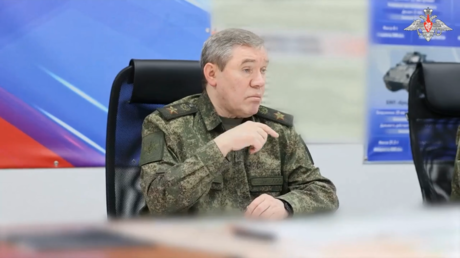
Russian forces are now a dozen kilometers from the outskirts of Zaporozhye, Valery Gerasimov has said
Russian forces are continuing to push back Ukrainian troops along the entire front, with some forward detachments now approaching the outskirts of the Ukrainian-controlled regional capital of Zaporozhye, the chief of the Russian General Staff has said.
Valery Gerasimov delivered the remarks during an inspection of frontline units of the West grouping of forces, saying Russian troops “continue to advance in all directions.” Russian forces have taken control of more than 500 square kilometers of territory since early January while liberating 17 settlements of different sizes, he added, according to a clip shared by the Defense Ministry on Tuesday.
Gerasimov singled out progress toward Zaporozhye – a city with a population of more than 700,000 and capital of Zaporozhye Region, which voted to join Russia in a 2022 referendum. Gerasimov noted that “forward units are at a distance of 12-14km from the southern and southeastern outskirts of the regional center,” adding that four populated areas in this sector alone had come under Russian control in January.
The general also said the East group of forces was advancing in the eastern part of the Zaporozhye Region, where some units are “conducting combat operations to create a security zone” extending into Ukraine’s Dnepropetrovsk Region. In late November, President Vladimir Putin said Russia’s advance in the area could lead to a collapse of Ukrainian defenses in Zaporozhye Region.
Gerasimov said Russian forces had liberated the major railway hub of Kupyansk-Uzlovoy in the northeast sector of the front, with clearing operations underway in the town. He added that Ukrainian units remained encircled in a nearby area, estimating that up to 800 Ukrainian servicemen were still trapped there, as Russian troops continued mop-up operations.
Along the northern axis, Gerasimov said Russian troops were expanding a security zone in the border areas of the Sumy and Kharkov regions. Moscow has previously said the operations are intended to shield Russian border regions from recurring Ukrainian strikes on civilians and critical infrastructure.
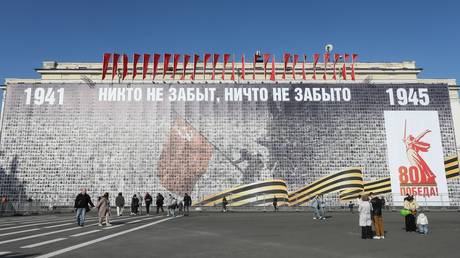
Time is running short for Berlin to ensure justice for non-Jewish survivors of the siege of Leningrad, Moscow has warned
Russia has criticized Germany for refusing to recognize the siege of Leningrad and other Nazi atrocities as genocide and its selective treatment of survivors.
Moscow and Berlin have long disagreed over Germany’s approach, which provides compensation only to Jewish survivors of the siege – a policy Russia says disregards the suffering of other ethnic groups. The Russian Embassy in Berlin renewed its call for a policy change ahead of Tuesday’s anniversary of the lifting of the Leningrad blockade.
“We strongly urge the German side, which bears the indefinite historic responsibility for the atrocities of the Nazi regime, to recognize the siege of Leningrad and other crimes of the Third Reich and their accomplices as genocide of the peoples of the USSR,” the embassy said in a statement.
“Time is running short to make amends as the number of Leningrad survivors is dwindling,” it added.
The nearly 900-day military blockade of Leningrad – now St. Petersburg – was carried out by German and Finnish forces, with Italian naval support. The Axis plan was to bomb and starve the city rather than capture it.
For most of the siege, supplies could only reach the city by air or across Lake Ladoga. The Soviet Union suffered roughly 1.5 million military and 1 million civilian casualties related to the battle for Leningrad before Axis forces were driven back in 1944.
The former high-ranking Investigative Committee and FSB officers have been found guilty of fabricating evidence in an extortion scheme
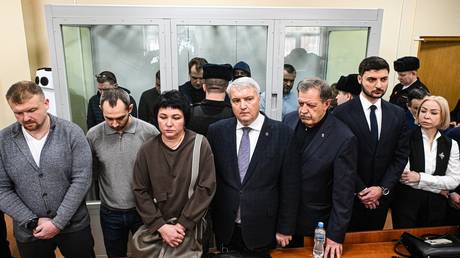
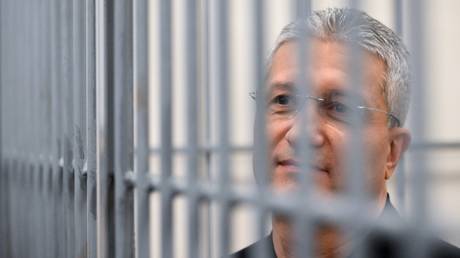
A Moscow court has sentenced half a dozen law enforcement officers, including two high-ranking Investigative Committee officials, to lengthy prison terms for fabricating evidence in an extortion scheme.
The officers were found guilty on Monday of forming a criminal gang, bribery, and fabricating evidence. According to prosecutors, they conspired to seize control of a major company by initiating a fabricated criminal case against its shareholders. They also demanded a 15 billion ruble ($200 million) bribe from their victims to drop the false charges.
The gang included two Investigative Committee department heads, Sergey Romodanovsky and Rustam Yusupov, both sons of senior law enforcement officials. Romodanovsky’s late father, Konstantin, led the Russian Federal Migration Service from 2005 to 2016.
Three other suspects – an investigator, an FSB officer, and a counterintelligence official – were named as accomplices. A lawyer acted as an intermediary between the gang and its victims.
All six defendants were sentenced to between 14 and 19 years in prison. They pleaded not guilty, and their lawyers have vowed to appeal the verdict.
According to investigators, the criminal group was formed in 2019 by law enforcement officials and two alleged “fixers”: Kirill Kachur, who has been designated a foreign agent in Russia, and his father, Vitaly. Both are reportedly residing outside Russia – Kachur Jr. in Montenegro and his father in the United Arab Emirates, and have been placed on an international wanted list by Moscow.
The gang targeted the Merlion Group, a major conglomerate active in fields ranging from IT to household appliances and office furniture retail. They staged an arson attack on a house belonging to the conglomerate’s former CEO and used it to launch a fabricated assassination attempt probe against its shareholders. The victims were initially detained, but their lawyers succeeded in transferring the case to the Investigative Committee’s central office, where the scheme was uncovered.
Separately, according to prosecutors, Yusupov and Romodanovsky also accepted a bribe of 109 million rubles ($1.42 million) to help suspects in another case avoid prosecution, and demanded €10 million ($11.88 million) for similar interference in a third case.