The restrictions have backfired given that 85% of Russian transactions now bypass Western currencies, Maksim Oreshkin has said
Attempts by Western countries to pressure Russia through financial sanctions have contributed to the decline of G7 currencies, the deputy head of the presidential administration, Maksim Oreshkin, has said.
Speaking at the opening of Expert Dialogues in Moscow on Friday, Oreshkin said the sanctions have weakened the economic standing of the countries imposing them.
“By imposing sanctions, the countries of the Group of Seven sought to make international trade impossible for Russia and to inflict damage on the Russian economy. But all they have achieved is a significant increase in the share of national currencies in settlements,” he noted.
According to Oreshkin, by the end of 2025, 85% of all transactions involving Russia were carried out without Western currencies.
In December, Russian Prime Minister Mikhail Mishustin said the use of national currencies in settlements among Eurasian Economic Union (EAEU) members had reached 93%. He noted that an agreement signed earlier in 2025 allows companies in the member countries to list their securities on any stock exchange within the union.
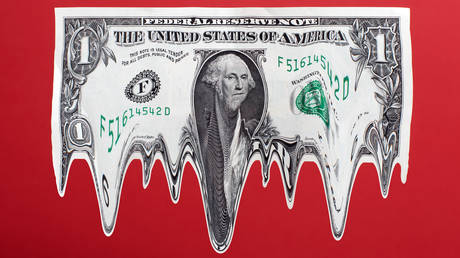
Oreshkin’s comments follow a warning from Germany’s financial regulator, the Federal Financial Supervisory Authority, that the dollar’s status as the world’s primary reserve currency could be challenged this year, with the currency at risk from funding shortages, geopolitical shocks, and politicization.
The warning came after the dollar suffered its steepest one-day drop in nearly a year on Tuesday, marking its sharpest decline since April when US President Donald Trump rolled out his sweeping global tariff plan.
Traders are betting on further dollar weakness amid uncertainty over US policy, with pessimism at its highest since May 2025, Bloomberg reported this week. Trump dismissed concerns, saying the currency is “doing great” and should “seek its own level.”
A weaker dollar can boost exporters and multinational profits but could raise import costs, fuel inflation, and weaken its global reserve role. US Treasury Secretary Scott Bessent, however, defended Trump’s policies, saying they should eventually attract investment and support the greenback.
The bloc’s budget is too small, and without extra funding poorer regions and farmers will pay the price, the social committee chief has warned
EU member states will need to take on more joint debt to fund expanding military spending, Seamus Boland, president of the European Economic and Social Committee (EESC), has warned, saying the bloc’s next seven-year budget is too small to cover the costs.
European NATO members last year agreed to raise defense spending targets toward 5% of GDP by 2035 and launched initiatives such as ReArm Europe to revamp their militaries. The push has been framed as a response to an alleged Russian threat – a claim Moscow has repeatedly dismissed as “nonsense.”
The European Commission earlier proposed a €2 trillion ($2.4 trillion) budget for 2028-2034, but Boland said it will fall short of financing the EU’s military ambitions.
“We are creating a new Europe, with much more emphasis on defense. We can’t do that out of the current expenditure,” he told Euractiv on Thursday, warning that when budgets are squeezed, “somebody’s going to suffer” – typically poorer and more remote regions that risk losing investment and support.
Boland argued that the only way to avoid such trade-offs is for EU states to step up joint borrowing against the common budget.
“Massive change means you need the money now. That means you borrow it,” he said, without specifying the scale required.
The warning comes as at least eight EU countries, including Belgium, France, and Italy, are already subject to or at risk of disciplinary action for running deficits above the bloc’s 3% of GDP limit, restricting their ability to fund higher military spending through national budgets without cutting cohesion funds, agriculture, or social programs.
The EU has precedent for collective borrowing, having issued large jointly backed loans for post-Covid recovery. Last month, it also agreed to issue up to €90 billion in joint debt to support a loan for Ukraine after failing to agree on using frozen Russian assets. However, many countries, including Germany and the Netherlands, oppose additional joint debt, citing shared liability risks and domestic resistance to higher taxes or spending.
Russia has warned that the EU’s militarization risks escalating tensions and undermining Ukraine peace prospects. Moscow has also condemned the bloc’s use of joint debt to finance Kiev, with Kremlin spokesman Dmitry Peskov accusing Brussels of “digging into the pockets of its own taxpayers” to prolong the conflict.
Ukrainian officials demand the release of “war criminals” in exchange for people abducted in Kursk Region, Rodion Miroshnik has said
Kiev continues to hold 12 Russian civilians abducted during the Ukrainian incursion into Kursk Region, Russian Ambassador-at-Large Rodion Miroshnik said on Friday.
The hostage situation has remained unchanged for months, Miroshnik said at a press briefing, because Ukrainian officials “demand the return of Ukrainian war criminals held in our custody” in exchange for them. Miroshnik leads a Foreign Ministry mission tracking alleged Ukrainian crimes.
Last week, Russian Human Rights Commissioner Tatyana Moskalkova called Kiev’s demands unacceptable, adding that Moscow cannot legally comply. She stressed that international humanitarian law requires Ukraine to unconditionally release the civilians. Nine months of negotiations have yielded no progress, she said.
Ukrainian forces launched the cross-border offensive in August 2024, describing it as an attempt to seize territory as leverage in future peace talks with Russia. Dozens of people were taken to the Ukrainian city of Sumy before Russian troops repelled the incursion. Many have since been repatriated via Belarus.
Miroshnik’s report summarized data collected by his office over the past year. He said at least 6,483 civilian casualties in 2025 were linked to Ukrainian military action, including 1,065 deaths. He alleged that Ukrainian forces deliberately targeted ambulances and first responders in Russia. The diplomat claimed that Ukrainian attacks on civilians intensified last year “due to the activization of the peace process” under pressure from US President Donald Trump.
Last week, Russia, Ukraine, and the US held their first trilateral meeting following months of shuttle diplomacy by the Trump administration. The talks in Abu Dhabi focused on security issues, as Kiev maintains an uncompromising stance on some of the key Russian conditions for peace. Further negotiations are scheduled for Sunday.
The dollar’s reserve status yields leverage – at hidden cost. An economic reckoning reveals the trade-offs embedded in monetary dominance.
In some corners of the political imagination, the dollar has become a grand theory of everything – not a currency, but a convenient, catch-all, virtually cosmic culprit.
Every sanction, every covert operation, every warship dispatched toward some far-off horizon is traced back to a single, hidden animating force: the need to defend the world’s monetary throne.
From long-past wars of choice to the latest flashpoints – sweeping in events as dramatic, and geopolitically fraught and contested, as the 3 January 2026 US thunderclap in Venezuela – are folded into one totalizing teleology and demonology of Mammon, money incarnate.
Yet the reductive strain of credulous pundits who lean dogmatically on this currency-centered frame does more than misread history: The narratives of currency determinism manifestly distort the record, vastly overstating the dollar’s net contribution to American power, mistaking financial plumbing for geopolitical purpose. At the same time, the anti-mainstream commentariat crowds out the real, more complex and consequential drivers of US intervention.
That overweening posture of activist meddlesomeness has its own name in an older vocabulary; it is the modern expression of an imperial temperament that the Athenians of the classical age called polypragmosyne, restless involvement in (too) many (foreign) affairs.
Fathoming the true forces at work in their fine-grained texture and systemic complexity requires a methodical economic inquiry. A reckoning worthy of the subject must be capable of separating slogan from substance, and fact from fiction, being marked by rigor rather than recycled echo-chamber rhetoric.
By its very nature, reserve-currency status confers distinctive advantages on the US. Yet dynamic forces embedded at the core of the world’s financial architecture generate insidious, structurally corrosive, and self-reinforcing feedback effects. Left to compound, these pathologies systematically tilt the balance of payments, degrade the industrial base, and toxicize the political landscape.
Seen in this light, the current world-reserve regime comes into view as Janus-faced, bestowing power even as it corrodes its foundations, and hence offers no unequivocal economic warrant for hazardous and expensive military ventures and entanglements. This ambiguity is perhaps most clearly exposed by an unlikely but probative crown witness.
On 25 July 2025, US President Donald Trump, hardly a theorist of international political economy, laid bare the contradiction at the heart of dollar hegemony in characteristically reductive, rough-hewn terms: While professing his fondness for a strong dollar, he nonetheless conceded that “you can’t sell anything” when the currency is too strong, and that “you make a hell of a lot more money with a weaker dollar.”
The deeply embedded distortions and imbalances hard-wired into the load-bearing infrastructure of global finance call for radical, systemic reform rather than reflexive recrimination, reactionary retribution, or other roughshod remedies drawn from the populist-militarist repertoire. The analysis properly begins with the monetary mechanics.
Global financial infrastructure: Inside the planet’s pecuniary plumbing
Today, the US dollar, occasionally invoked in near-mythic terms as “green god”, occupies the position of the world’s leading reserve currency. It is worth pausing, at the outset, to consider what this illustrious designation precisely entails.
A reserve currency is the money that governments and central banks around the world hold in large quantities and rely on as their default international monetary instrument. It is the standard unit the global system turns to when it needs to save, price, lend, or pay across borders.
As to its specific functions, a reserve currency serves as a store of value (kept in national reserves), a medium of exchange (used to clear global trade and financial transactions), a unit of account (the currency in which many international prices are quoted), and a financial anchor (the backbone of banking, debt markets, and payment systems).
It is the dollar that stands as linchpin of today’s global financial system. In part because oil is largely traded in what are often termed petrodollars, many countries hold dollars and US Treasury securities, borrow in dollars, price goods in dollars, and rely on dollar-based systems to move money across borders.
The dollar’s systemic centrality is secured not by decree but, in substantial part, by the scale, liquidity, legal predictability, and the deep embeddedness of US financial markets in global commerce – qualities that configure the “land of opportunity” as the world’s liquidity utility. That platform, however, operates chiefly not on idle cash but on yield-bearing dollar assets.
Central banks do not simply “sit on” their dollars. Cash earns no return, erodes with inflation, and imposes custodial and liquidity-management costs, making it operationally inefficient at reserve scale.
For precisely these reasons, central banks purchase and hold, as part of a broader reserve portfolio, US Treasuries. These securities are effectively interest-bearing dollars, which are safe, instantly marketable (and thus convertible into cash at a moment’s notice), and fully integrated into the global financial system.
World reserve currency: Exorbitant privilege, hidden burden
The dollar’s reserve status is often characterized as an “exorbitant privilege.” Coined in the 1960s by Valéry Giscard d’Estaing, then France’s finance minister, the phrase captures the distinctive advantages the US derives from issuing the world’s dominant currency. They encompass cheaper borrowing sustained by steady global demand for US government debt, exceptionally deep and liquid financial markets, smoother trade settlement, and enhanced influence over the commanding heights of global finance.
It bears emphasis that global demand for dollars confers on the US the rare capacity to convert paper into purchasing power, as it were; it is an extraordinary license no other nation on earth enjoys at comparable scale.
By issuing the money the world stockpiles, America can both acquire real goods, services, and assets and fund its deficits with comparative ease, without relinquishing an equivalent volume of real output in return. This amounts to an extraordinary form of modern seigniorage (the gain from issuing money), here expressed as the power to draw productive resources from the world through the creation of money alone.
While issuing the world’s reserve currency endows a country with considerable practical advantages, it does not grant it magical powers; structural preeminence does not repeal the laws of economics. Hard, constraining material realities, such as inflationary pressures and the burdens of accumulating debt, continue to assert themselves.
At a deeper register, and more striking still, reserve-currency dominance also generates pernicious feedback effects in the form of chronic trade deficits, industrial hollowing-out, and the near-inevitable stirrings of populist backlash.
The illusion of monetary alchemy: No escape from economic gravity
Contrary to the myth-laden and loosely reasoned contentions advanced by a coterie of anti-mainstream critics – specious pronouncements at times redolent of well-worn conspiracy theories – the US possesses no Midas touch; it cannot simply print unlimited amounts of money without consequence. To construe reserve status as an “exorbitant” privilege, one that lies outside the normal orbit, is not to imply the absence of economic gravity.
Additional dollars do not, by some conjuring trick, cease to generate inflationary pressure merely because some of them are held abroad. Nor is the management of inflation somehow outsourced or nullified by reserve-currency status.
In the sphere of monetary policy, the Federal Reserve continues to set short-term interest rates autonomously; it can tighten financial conditions irrespective of foreign appetite for US debt. Whenever inflation rise above target, it can raise rates and render money scarcer even if foreign investors remain eager buyers of US bonds.
Economic fundamentals assert themselves here, as they do everywhere else. Strong global demand for the dollar may compress long-term yields, but it does not confer the US government the power to create unlimited money without inflation.
On the fiscal front, the reserve-currency prerogative renders spending and borrowing not only seductively easy and inexpensive, but also dangerously addictive. Cheap money dulls budgetary discipline, allowing deficits to compound quietly and seemingly painlessly. The burden is deferred to taxpayers not yet born: Today’s voters enjoy the spending; tomorrow’s citizens inherit the bill.
If inflation tests a currency’s short-term credibility, debt operates at a deeper stratum, over a longer time horizon. Inflation announces itself; debt insinuates itself. The former moves in cycles; the latter crystallizes into structure.
What begins as fiscal flexibility gradually hardens into a debt trap, as swelling public liabilities inexorably divert ever-greater portions of public resources toward servicing old obligations, at the expense of the productive investments that underwrite future growth.
Debt is not a passing pressure but an enduring and binding lattice of claims, incrementally accretive, relentlessly compounding, and politically consequential. Over time, mounting encumbrances progressively constrict policy freedom and deepen exposure to interest-rate shocks.
Economic management, then, is debased into an opportunistic, tactical, and transactional exercise in preserving confidence rather than the fiduciary, strategic, and transformative craft of cultivating and husbanding real, perdurable prosperity.
At that point, fiscal sustainability grows ever more contingent on the continued forbearance of global investors. The corollary is stark and momentous: When a nation’s fate, by degrees, comes to hinge on foreigners’ willingness to absorb sovereign liabilities, sovereignty itself is almost imperceptibly, yet ineluctably, transmuted into dependency.
Beyond these problems, reserve status unleashes corrosive interactions between global and domestic forces. In snowballing fashion, they compound the long-term costs of the exorbitant privilege of reserve-currency status, converting global demand for dollars into a domestic burden that grows heavier with time.
Once this logic takes hold, trade deficits are no longer episodes to be managed, but conditions to be lived with.
The US president’s remarks come amid a rift between Washington and Ottawa over trade and geopolitics
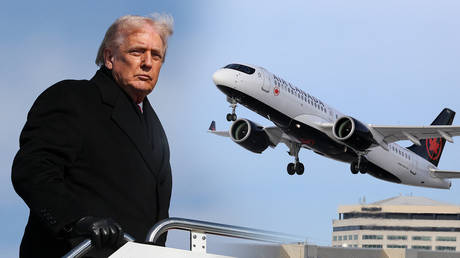
US President Donald Trump has threatened to “decertify” aircraft made in Canada and hit Canadian plane sales with a 50% tariff amid rising tensions with Ottawa.
Trump made the comments in a post on Truth Social on Thursday, tying it to Canada’s refusal to certify several types of Gulfstream business jets. “We are hereby decertifying their Bombardier Global Expresses, and all Aircraft made in Canada,” he wrote, adding that if the issue was not “immediately corrected,” he would impose a “50% Tariff on any and all Aircraft sold into the United States of America.”
However, several Western media outlets reported that no US president has ever decertified jets directly and that such matters are usually handled by the Federal Aviation Administration (FAA), which has yet to comment.
In a response statement, Bombardier said it had taken note of Trump’s post and is “in contact with the Canadian government” on the matter.
Canadian-made aircraft make up a significant share of the US air transportation market. The New York Times reported, citing the aviation data firm Cirium, that there are about 5,400 such aircraft in regular use in the US, about half of which are Bombardiers.
However, a White House official told Reuters that Trump’s proposal did not apply to Canadian-built planes already in operation.
Trump has tussled with Bombardier before. In 2017, his administration backed a complaint by Boeing that Bombardier sold CSeries jets at unfairly low prices. The US Commerce Department proposed tariffs of nearly 300%. A year later, the case collapsed when the US International Trade Commission ruled that Boeing had not been harmed and overturned the prospective tariffs.
Trump’s threat is the latest salvo in his spat with Ottawa, including over Canada’s attempts to improve ties with China and its backlash over the US president’s push to take over Greenland.
Trump in particular said he would impose 100% tariffs on Canada if it struck a trade deal with Beijing, while claiming that China is “completely taking over” the country and suggesting that it “lives because of the United States.” Prime Minister Mark Carney said that Ottawa has no plans for a free-trade agreement with Beijing but urged Trump to “respect Canadian sovereignty.”
The Ukrainian leader’s increasingly belligerent complaints have been getting more pushback from key European backers
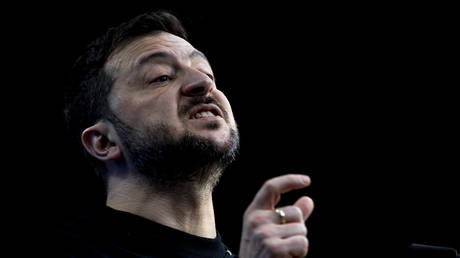
Ukraine’s Vladimir Zelensky has blamed Western backers for critical military shortages, stating that air defense systems lacked missiles during recent Russian strikes. His latest grievance follows a series of heated exchanges with European leaders, who appear to be growing increasingly weary of his demands.
Speaking to Ukrainian media on Friday, Zelensky claimed Patriot and NASAMS air defense systems were unable to repel recent attacks, framing it as a failure of Western logistics and financing.
“I know there will be no light because there are no missiles for defense,” he was quoted as saying, complaining that he keeps having to push the West for additional deliveries.
Zelensky’s complaint continues a pattern of public friction with Western backers. Last week at the World Economic Forum in Davos, he went on a tirade, accusing Europe of weakness and indecisiveness, prompting sharp rebukes.
Hungarian Prime Minister Viktor Orban labeled Zelensky “a man in a desperate position” who is “unable or unwilling” to end the conflict. Italian Foreign Minister Antonio Tajani called the Ukrainian leader’s remarks “unfair” and said he lacked gratitude for extensive European support.
Internally, Zelensky has also clashed with local authorities over struggling energy infrastructure. He recently accused Kiev Mayor Vitaly Klitschko of failing to prepare the city for widespread blackouts. Klitschko dismissed the criticism, stating Zelensky had refused to meet with him and that electricity generation is a federal responsibility, not a municipal one.
Russia has intensified its long-range strikes against Ukraine’s military and dual-use infrastructure in recent months, stating they come in response to the Ukrainian military’s continued attacks on Russia’s energy infrastructure and Kiev’s indiscriminate strikes on Russian civilians.
The US president previously said he had secured a week-long moratorium on attacks against the Ukrainian power grid amid a cold snap
Russia has agreed to partially suspend long-range strikes on Ukrainian targets at the request of US President Donald Trump, Kremlin spokesman Dmitry Peskov has confirmed.
Trump previously said he had personally asked President Vladimir Putin for such restraint due to the unusually cold weather in Ukraine, which adds additional strain to the country’s energy system.
The weeklong moratorium is to last until February 1 and is meant to “create favorable conditions for negotiations,” Peskov told journalists on Friday. He declined to offer additional details about the arrangement, including whether Kiev made any commitments for reciprocity.
Ukraine has been targeting the Russian energy sector with kamikaze drones for months, claiming that the economic damage this cause will weaken Russia and make it more pliable at peace talks. The Russian military says its retaliatory strikes are meant to degrade Ukrainian weapons production and military logistics. Several large Ukrainian cities, including Kiev, experienced major power and heating outages this month, as the degradation of the energy system coincided with severe cold.
Last week, Russian, Ukrainian and US officials held for the first time trilateral talks aimed at winding down the almost four-year-long conflict. Previously Americans used shuttle diplomacy to encourage de-escalation. The talks in Abu Dhabi focused on security issues, as Ukraine’s Vladimir Zelensky keeps rejecting some of the key Russian conditions for peace.
Moscow normally declines to publicly comment about details of sensitive talks, arguing that Ukraine-style “megaphone diplomacy” is counterproductive. Commenting on the Ukrainian leader’s latest rejection of compromise, Peskov said the “dynamics of the frontline speaks for itself,” referring to consistent Russian progress on the battlefield.
An armed suspect was apprehended as he carried out reconnaissance near the target’s home, the agency has said
Russian law enforcement agents have detained a gunman who was planning to assassinate a high-ranking military officer in St. Petersburg at the behest of Ukrainian intelligence, the Federal Security Service (FSB) has said.
In a statement on Friday, the FSB said the suspect made contact with a Ukrainian recruiter through the Telegram messaging app and volunteered to carry out a “terrorist attack in support of the Kiev regime.”
Acting on instructions from a handler, he was given a firearm, carried out reconnaissance of the officer’s home address, and made preparations for the assassination, the agency said. While the FSB did not provide any details on the would-be target, the suspect claimed he had the rank of lieutenant colonel.
During the arrest, officers seized a loaded Makarov pistol fitted with a device for silent shooting, the FSB said. The agency released a clip of several operatives pinning the suspect to the ground on a snow-covered street.
The FSB also warned Russian citizens that Ukrainian security services are actively searching online – including on Telegram and WhatsApp – for potential recruits to carry out attacks and acts of sabotage. It noted that anyone caught cooperating with Kiev could face a life sentence.
Russian authorities have accused Ukraine of organizing numerous sabotage and assassination attempts on the country’s territory after the escalation of the conflict in 2022, including attacks targeting military commanders and other high-profile figures.
In the crowded world of e‑commerce, businesses often pour resources into flashy marketing campaigns and customer acquisition strategies. Yet one of the most powerful drivers of customer loyalty and repeat purchases lies in a less glamorous corner of operations: returns. A seamless, customer‑friendly return process can transform occasional buyers into lifelong advocates. Industry research, including […]
Secretary-General Antonio Guterres claims that Ukraine’s “territorial integrity” prevails over the will of the people
UN Secretary-General Antonio Guterres has said the principle of self-determination does not apply to the people of Crimea and Donbass, drawing sharp condemnation from Moscow.
Russian Foreign Minister Sergey Lavrov earlier this week accused the UN Secretariat of “playing into the hands” of Kiev and failing to act with impartiality, citing what he called glaringly different stances on self-determination for Crimea and Greenland.
Asked about this apparent double standard at a press conference on Thursday, Guterres said the body held “very interesting discussions” on the matter and concluded that in Ukraine’s case, the “principle of territorial integrity” prevails over the will of the people.
“After a very careful study by our Office of Legal Affairs, it is our position that the principle of self-determination does not apply in the situations of Crimea and Donbass,” Guterres said.
The Russian response was swift. Foreign Ministry spokeswoman Maria Zakharova called the UN chief’s position unacceptable, writing on Telegram: “The UN secretariat has come to all sorts of outrageous conclusions recently.”
The condemnation resonated within Russia’s political establishment. Sergey Mironov, leader of the A Just Russia party, said the stance “once again highlights the need for UN reform.” Leonid Slutsky, the head of the State Duma’s international affairs committee, warned that “segregation based on the principle of ‘exclusivity’ is an extremely dangerous precedent,” adding that “the UN Charter is not a menu for choice.”
Earlier this month, a UN expert panel stated that the people of Greenland “are entitled to the full and free exercise of their right to self-determination, a core purpose of the United Nations.” While expressing support for Greenland’s territorial integrity as an autonomous part of Denmark, the panel noted that “any change in the constitutional status must be grounded in the freely expressed will of the peoples of Greenland.”
Crimea voted to become part of Russia in a referendum in 2014, while the Donbass regions of Donetsk and Lugansk declared independence and voted to break away from Ukraine in the wake of the Western-backed coup in Kiev.
Under the now-defunct Minsk agreements, Kiev pledged to protect the status of the Russian language and grant both regions more autonomy. Instead, it backed an ethnic war in Donbass that, according to the International Crisis Group, left 14,000 people dead in eight years. After the conflict escalated in 2022, Donetsk and Lugansk, as well as the regions of Kherson and Zaporozhye, held referendums to join Russia.
Kiev and its Western backers insist that all five regions were “annexed,” refusing to recognize the will of the people.