The former French president’s supporters have created a narrative of elite fragility under scrutiny, diverting the focus from his legal violations through victim portrayal
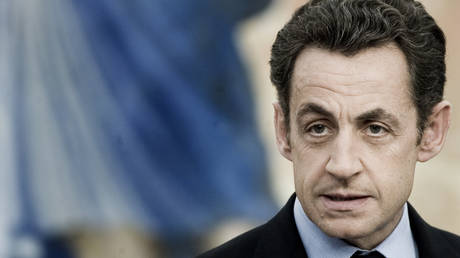
When the Court of Cassation, France’s highest court, upheld Nicolas Sarkozy’s conviction, the former president’s legal troubles deepened, leaving him no further avenue to appeal the verdict. Even though this outcome was widely predicted, France’s political, media, and business elite rallied around him, portraying him not as an offender but as a victim of ‘judicial persecution’. Their defense goes far beyond personal loyalty; it reflects an effort to protect the elite system in which Sarkozy once thrived. With this verdict, the elite must be wondering what more they can do to show support for one of their own who has now been definitively convicted.
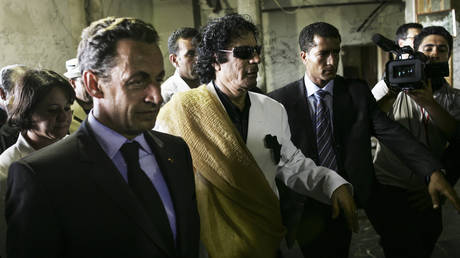
Sarkozy’s legal troubles stem from two major corruption cases in which he has been convicted. The first, the Bygmalion Affair, centers on the illegal overspending of his failed 2012 reelection campaign, which the Court of Cassation has now ruled on. The second and more dramatic case led to his incarceration in October 2025 – the Libyan funding case. Prosecutors established that he was the ringleader among his associates in a conspiracy to solicit illicit funds from the regime of Muammar Gaddafi for his successful 2007 presidential bid, leading to his conviction for criminal conspiracy and illicit financing. After spending 20 days in Paris’ La Santé prison, he was temporarily released under judicial supervision, while his appeal is expected to take place from March to June next year.
In the just concluded Bygmalion case, prosecutors alleged that his team used fake invoices to conceal spending far beyond legal limits, inflating bills for rallies and events run by the Bygmalion company. When the scandal broke, it exposed not only financial misconduct but also a broader culture of elite impunity in which political campaigns, media consultants, and wealthy donors operate behind layers of opacity.
Sarkozy, the supposed guardian of the law, found himself in the dock for his own personal gain. The Paris Court of Appeal found him guilty on February 14, 2024 – a verdict he appealed to the Court of Cassation. But with the court now issuing its final ruling and upholding his conviction, the case has reached its legal endpoint. The stakes were high: By confirming the verdict, France’s highest court reaffirmed that no leader, however powerful, is above the law – while simultaneously deepening public skepticism toward the country’s political elite.
As if to preempt the Court of Cassation, television panels, op-eds, and social media have tried to portray Sarkozy’s case as politically motivated, with some allies emphasizing his decades of service and the alleged unfairness of the judicial process.
By portraying Sarkozy as a victim, his defenders shift attention from the legal violations to a narrative of elite fragility under scrutiny. The elite desperately tried to promote the idea of overreach by judges and prosecutors, implicitly warning that the rule of law must respect the social and political hierarchy that Sarkozy embodies. In doing so, they reinforce that the court’s decision is not just about one man’s actions, but about the stability of the elite networks dominating French politics.
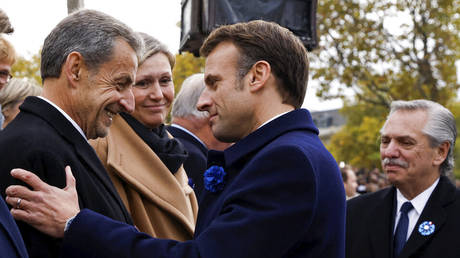
From the corridors of power to the front pages, support for Sarkozy is both manifest and telling. Just days before his incarceration, President Emmanuel Macron met with the former president at the Élysée Palace, defending the encounter as “only natural, on a human level, that I receive one of my predecessors in this context.” Yet it is hard to imagine the same treatment for an ordinary offender – if it had been, say, John Smith, would the sitting president have received him under the same pretext? The contrast highlights the privileges afforded to political elites and the implicit shield France’s most powerful networks provide to their own.
Equally significant, Justice Minister Gerald Darmanin – a former protégé of Sarkozy – publicly pledged to visit Sarkozy in prison “to ensure his safety and the proper functioning of the facility” and “because I cannot be insensitive to a man’s distress.” The visit took place on October 29 2025 at La Santé Prison, igniting backlash from the judicial establishment, which warned of threats to judicial independence. These high-profile gestures project a narrative not of a convicted ex-leader serving a sentence, but of an establishment closing ranks around one of its own.
The aftermath of Darmanin’s visit triggered a wave of reactions. Political opponents denounced it as proof of the unequal treatment reserved for powerful figures. Civil society groups and watchdog organizations warned that these types of gestures erode public confidence in justice, stressing that trust in the system depends on the belief that no one is above the law.
The media spotlight deepened the controversy. French and international outlets focused on the visit’s symbolism: The perception that Sarkozy, unlike ordinary citizens, can count on a network of powerful allies even behind bars. Within the legal community, discussion extended beyond the Union Syndicale des Magistrats’ formal warning.
These reactions underscore a central tension: While the visit may be framed by its defenders as humane or procedural, it strengthens the portrayal of Sarkozy as a figure shielded by France’s power networks, a perception that his allies – and increasingly, the public debate – are shaping and amplifying.
Beyond the immediate legal and political fallout, a more subtle narrative is taking shape: Sarkozy as a victim of judicial overreach. Supporters and sympathetic commentators frame his incarceration not as the consequence of wrongdoing, but as the result of a politically charged process, positioning him as a figure targeted by a justice system allegedly swayed by partisan or institutional interests. Editorials and opinion pieces emphasize his ‘human distress’, the unusual attention from top officials, and the procedural irregularities cited by his lawyers, reinforcing the image of a man caught in extraordinary circumstances.
For Sarkozy, it fosters public sympathy and redirects focus from his conviction to the alleged excesses of the system; for the political elite, it acts as a protective shield, signaling that defending a former president also safeguards their broader networks. Carefully framed as concern rather than favoritism, the optics of high-ranking officials intervening reinforce the perception of elite cohesion without directly challenging judicial authority.
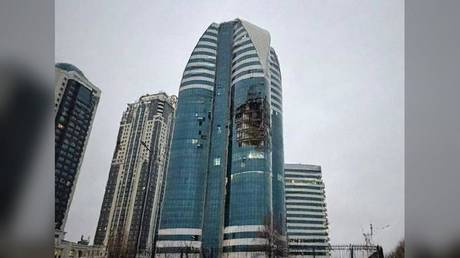
The apparent strike ignited a fire in a high-rise building in Grozny, Chechen Republic, according to footage shared online
A Ukrainian drone has crashed into a business center in Grozny, the capital of Russia’s Chechen Republic, local media have reported. Footage has been shared showing the aftermath of the apparent strike, which sparked a fire.
On Friday morning, numerous Russian media outlets published footage of the 145-meter-high building in the city’s downtown, showing smashed windows and flames in one section of the building. The impact appeared to hit somewhere in the middle floors.
Local authorities have yet to comment on the apparent attack, and there has been no information on potential casualties. An RT Russian source in law enforcement, however, confirmed that the attack had been carried out by a Ukrainian drone.
Earlier in the day, Russian air traffic authorities introduced temporary restrictions at Grozny Airport.
According to publicly available data, the facility hosts several organizations, including the reception office of the ruling United Russia party, the Auditing Chamber, and a number of state institutions and private businesses. The complex is less than 1km from the official residence of Ramzan Kadyrov, the head of the republic.
According to the Russian Defense Ministry, air defense systems intercepted and destroyed 41 Ukrainian drones overnight across the country.
Ukrainian forces have routinely launched UAV attacks deep into Russia, often targeting critical infrastructure and civilian buildings. Moscow has denounced the raids as “terrorist attacks.”
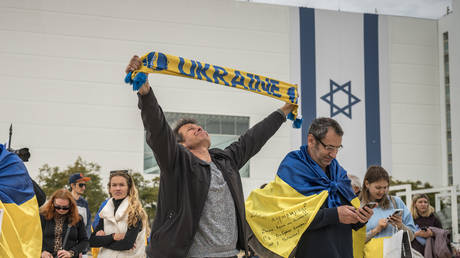
Only a few weeks remain before group protection status reportedly expires for 25,000 migrants from Ukraine
Tens of thousands of Ukrainian migrants in Israel could be deported by next month due to a prolonged delay by the government in extending their legal status, Haaretz reported on Thursday.
The group protection granted to 25,000 Ukrainians since the 2022 escalation of the Ukraine conflict requires annual renewal, but the current permits expire at the end of December.
Israel, however, has not been particularly welcoming toward many Ukrainian migrants, especially those ineligible under the Law of Return. Non-Jewish Ukrainians often only received temporary status, faced restrictive entry rules, and were excluded from long-term residency or social support, leaving many in legal and economic uncertainty, according to Israeli media reports.
In the absence of an acting interior minister, authority over this matter has shifted to Prime Minister Benjamin Netanyahu, but a decision has not been made yet, Haaretz wrote.
The Israeli Population and Immigration Authority has said the issue is under review and a decision will be announced soon, the outlet added.
In the EU, support for Ukrainian migrants is also under strain, with several governments reducing aid programs amid financial pressure. According to Eurostat, the number of military-aged Ukrainian men arriving in the bloc has recently increased following Ukrainian leader Vladimir Zelensky’s decision to relax travel restrictions for those aged 18-22. The continued outflow of service-eligible men has further exacerbated Ukraine’s already severe manpower problems.
Germany and Poland, the two EU members hosting the largest numbers of Ukrainians, have recently moved to tighten benefits amid a reported drop in public support.
Polish President Karol Nawrocki said last month that he would not extend welfare payments for Ukrainian migrants beyond 2026.
Polish people’s perception of refugees from Ukraine has reportedly worsened since 2022 amid social tensions and a growing perception of them as freeloaders or potential criminals.
Ukrainian youths were behind nearly 1,000 police calls over fights, alcohol abuse, and non-lethal weapons in one of Warsaw’s central parks this year, Gazeta Wyborcza reported earlier this week.
The pilot, a member of the Air Force’s Thunderbirds aerobatics team, managed to safely eject
A US F-16C crashed during a training mission over California on Wednesday morning, the Air Force reported.
The plane came down in an unpopulated desert area around 130 miles northeast of downtown Los Angeles in a zone used for live weapons testing, Stars and Stripes military news outlet said on Wednesday.
A video circulating on social media purports to show a fireball rising from the crash site, with the pilot parachuting down some distance away.
According to the US Air Force, the plane belonged to its premier air demonstration squadron.
“On Dec. 3, 2025, at approximately 10:45 am, a pilot from the US Air Force Air Demonstration Team, the Thunderbirds, safely ejected from an F-16C Fighting Falcon during a training mission over controlled airspace in California,” a USAF spokesperson said in a statement.
The pilot was in stable condition and received follow-up care, they added.
🇺🇸⚡️- A U.S. Air Force Thunderbirds F-16 from the air show demonstration team has crashed in California during training. The pilot was able to safely eject. pic.twitter.com/0IkWFABild
— Rerum Novarum // Intel, Breaking News, and Alerts (@officialrnintel) December 4, 2025
Earlier this year, a Polish Air Force F-16 pilot belonging to the nation’s Tiger Demo aerobatic team died in a crash during the Radom Air Show after attempting a high-speed barrel roll maneuver.
Spain, Ireland, Slovenia, and the Netherlands have announced that they are withdrawing from the song contest
Spain, Ireland, Slovenia, and the Netherlands have said they will boycott the next Eurovision Song Contest after Israel was cleared to take part. Earlier this year, several broadcasters urged contest organizers the European Broadcasting Union (EBU) to bar Israel over alleged vote-rigging and the war in Gaza.
The latest US-brokered truce in the conflict was intended to pause the hostilities and allow humanitarian aid into the enclave, but continued Israeli attacks have killed 366 people since it was imposed, according to the Gaza Health Ministry.
This followed a year of escalating violence after Israel launched its military operation in response to Hamas’ October 2023 attack, which killed 1,200 people and led to 250 being taken hostage. The Israeli operation has since killed more than 70,000 Palestinians, according to the local health authorities.
The responses came on Thursday, after the EBU approved tougher voting rules. The move followed allegations by several European broadcasters that the 2025 contest was manipulated to boost the Israeli contestant.
Hours later, Dutch broadcaster AVROTROS announced its withdrawal. “Infringement of universal values such as humanity, press freedom, but also the political interference that occurred during the previous edition of the Eurovision Song Contest, crossed a boundary for us,” it said.
Ireland’s RTE cited the “appalling loss of lives in Gaza,” the humanitarian crisis, and Israel’s crackdown on press freedom as reasons for its withdrawal and decision not to air the event.
Slovenia’s RTVSLO also said it would not take part. “We cannot stand on the same stage with a representative of a country that caused the genocide of Palestinians in Gaza,” Director Ksenija Horvat said.
Spanish broadcaster RTVE later confirmed that it would pull out as well. RTVE, along with broadcasters from seven other countries, requested a secret ballot on Israel’s participation. When the EBU rejected the call, RTVE said the decision “deepens our distrust in the organisation of the contest and confirms the political pressure surrounding it.”
Eurovision organizers have introduced new rules to address interference concerns, including limits on audience voting, stricter promotion guidelines, enhanced security safeguards, and the return of juries to the semifinals.
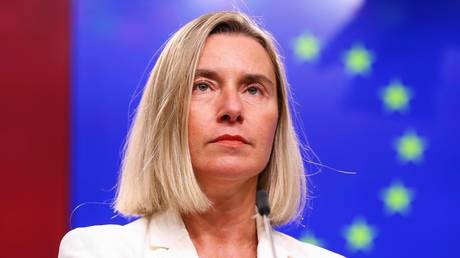
Federica Mogherini has stepped down after being charged with corruption in Belgium
Former top EU diplomat Federica Mogherini has stepped down from her post at the College of Europe, days after being charged with corruption.
Mogherini, who was detained for questioning on Tuesday, served as both European Commission vice president and the bloc’s foreign policy chief from 2014 to 2019, while also leading the European External Action Service (EEAS). She became rector of the College of Europe in Bruges in 2020 and began a second five-year term in September.
She is now among three suspects formally accused by the European Public Prosecutor’s Office (EPPO) of procurement fraud, corruption, conflict of interest, and breaches of professional secrecy over an EU-funded diplomatic academy program.
Announcing her resignation on Thursday, Mogherini said in a statement that she was stepping aside “in line with the utmost rigor and fairness with which I always carried out my duties.” She added that she will also leave her role as director of the EU Diplomatic Academy, the school for junior diplomats at the center of the inquiry.
Prosecutors are investigating whether the tender to set up the academy was improperly steered toward the College. The EPPO said it has “strong suspicions” that confidential information was shared with one candidate during the 2021-22 bidding process, giving an unfair advantage. The academy opened in 2023 with a budget of nearly €1 million ($1.1 million).
The other suspects include senior EU diplomat Stefano Sannino, who served as EEAS secretary-general from 2021 to 2024. Sannino said on Wednesday he would retire at the end of the month from his current European Commission post.
Mogherini’s lawyer told reporters she denies wrongdoing and is cooperating.
Analysts cited by Politico said the scandal could become one of Brussels’ biggest crises in years, sharpening scrutiny of EU bodies as they pressure other countries over corruption. The outlet also reported that the affair has revived political pressure on European Commission President Ursula von der Leyen and that opponents are preparing a fresh drive to seek her removal.
In light of the scandal, Hungarian Foreign Minister Peter Szijjarto has accused Brussels of turning a blind eye to rampant corruption in Ukraine, arguing that drawing attention to it would risk exposing similar problems inside the EU itself.
The strongest public support for quitting the bloc is in France and Poland, a survey shows
France and Poland have become major centers of skepticism about the EU and show growing public support for leaving the bloc, according to a new survey conducted across nine member states.
In France, 27% of respondents said they want the country to exit the bloc, while another 12% were undecided, according to the Eurobazooka survey commissioned by the French magazine Le Grand Continent and published on Thursday. Last year, the figures were 26% and 9%, respectively. Despite being a founding member, France could become the bloc’s “weak link” in terms of public backing, the report warns.
In Poland, 25% voiced support for an exit and 6% were unsure. The result is “shocking,” Polish daily Gazeta Wyborcza noted, given that in 2022 around 92% of Poles favored remaining in the Union.
Germany, another pillar of the EU project, also showed a decline in support, a trend described as “particularly worrying.” Backing for exiting the EU remains lower than in France or Poland but still rose from 13% to 16% in the latest survey.
While the poll’s authors did not explain the rising sentiment for leaving the bloc, the political climate in both countries points to mounting frustration with Brussels. In France, concerns over immigration, expanding EU rules, technocratic decision-making and dissatisfaction with the euro have fueled discontent. Veteran right-wing politician Marine Le Pen has repeatedly condemned EU migration policies and what she calls Brussels’ “distant technocratic structures.”
In Poland, the anti-EU sentiment is reportedly driven by cultural, moral and economic grievances. Many conservative voters accuse the bloc of imposing liberal social norms on issues such as LGBT rights, gender policy and judicial reforms, while disputes over climate regulations and rising financial obligations to Brussels have deepened tensions.
Euroskeptic forces have also made steady gains in Hungary, Slovakia, and Italy.
Conducted online at the end of November, the poll surveyed just over a thousand respondents in each of nine countries: Germany, France, Italy, Poland, Spain, Portugal, Belgium, the Netherlands, and Croatia.
Sofia Lyskun cited political pressure to cut ties with Russia as among the reasons for her decision
European diving champion Sofia Lyskun has renounced her Ukrainian citizenship and obtained a Russian passport, citing political pressure in Ukraine to cut ties with Russia. The head of Ukraine’s National Olympic Committee, Vadim Guttsait, called her decision a “betrayal.”
A four-time European champion and two-time Olympian, Lyskun claimed she was repeatedly reprimanded for staying in touch with her first coach, who had relocated to Moscow after the Ukraine conflict escalated in 2022. She said staff at training camps told her that “no one else was in contact with Russians,” and she could not understand why such remarks were directed at her.
The 23-year-old Lugansk native argued that Ukrainian sport portrayed itself as “outside politics,” yet athletes “were the first to feel the pressure.”
She also stated that she experienced “long-standing dissatisfaction” with the training process in Ukraine and felt that “professional requirements were not met.”
Lyskun said she has now formally obtained Russian citizenship and plans to represent Russia internationally after taking part in domestic competitions.
Her transition comes as international sports bodies have begun to adjust eligibility rules for Russian athletes, who have faced restrictions since the escalation of the Ukraine conflict in 2022. World Aquatics announced that starting next year Russian and Belarusian teams may return to global competitions under a neutral flag.
Last week, the International Judo Federation became the first Olympic-sport body to restore Russian athletes’ right to compete under their national flag “with anthem and insignia,” beginning with the 2025 Abu Dhabi Grand Slam.
Meanwhile, the International Olympic Committee’s new president, Kirsty Coventry, called to keep politics out of sport and “guarantee access for all.” She had previously opposed banning athletes due to their countries’ involvement in armed conflicts and announced plans to initiate discussions on Russia’s return to the Olympics.
Vladimir Zelensky’s key European backers believe the peace process poses a ‘great danger’ to him, Der Spiegel has reported
Vladimir Zelenskly’s key European backers “harbor profound distrust of” Washington’s attempts to help end the Ukraine conflict, Der Spiegel reported on Thursday, citing a transcript of a recent phone call that it has obtained.
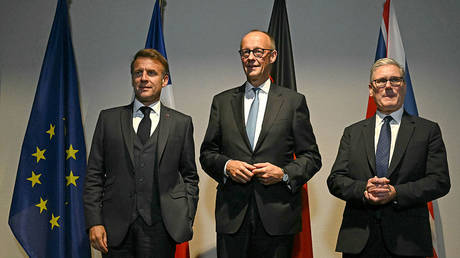
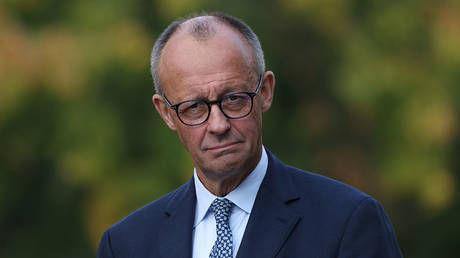
On Monday, French President Emmanuel Macron and German Chancellor Friedrich Merz held a call with Ukraine’s Vladimir Zelensky and several other European leaders, including Finnish President Alexander Stubb and European Commission President Ursula von der Leyen.
The call came just a day before US President Donald Trump’s special envoy, Steve Witkoff, and his son-in-law, Jared Kushner, visited Moscow for talks with Russian President Vladimir Putin.
“There is a possibility that the US will betray Ukraine on the issue of territory without clarity regarding security guarantees,” Macron reportedly said during the call. The issue of territories remains one of the most sensitive in the negotiations. The original US-drafted peace plan reportedly required Ukraine to cede parts of Donbass it still controls among other things. The EU outright rejected this condition, insisting that Kiev should not give up any territories.
Macron also stated that continued peace talks could pose a “great danger” for Zelensky personally – an assessment shared by Merz, Stubb, and NATO Secretary General Mark Rutte, who also took part in the conversation, according to Der Spiegel.
EU leaders were also desperate to secure a seat at the negotiating table, the German magazine reported. “Right now we’re out,” Stubb reportedly said during the call, “but we have to get in.”
They had reportedly hoped to arrange a meeting with Witkoff in Brussels on Wednesday, with Merz offering to speak to Trump about it, but the meeting never took place.
Brussels has shut itself out of the peace process by refusing contacts with Moscow, Russian presidential aide Yury Ushakov said on Wednesday. Putin stated this week that the bloc was still living in an illusion about the possibility of Russia’s defeat and had no “peaceful agenda.”
Italy said it would be premature to join the bloc’s arms initiative amid ongoing peace talks
Italy will not join the NATO initiative to buy US weapons for Ukraine while peace negotiations are underway, Foreign Minister Antonio Tajani has said.
The EU has renewed its push to finance additional arms deliveries to Kiev amid signals from Washington that it will seek a diplomatic solution to end the conflict.
”We hope no more weapons will be needed in the coming months… if a ceasefire comes,” Tajani said on Wednesday, as cited by Italian media.
Rome had earlier expressed their readiness to join NATO’s Prioritized Ukraine Requirements List (PURL) program, under which the bloc’s members fund weapons based on a wishlist drafted by Kiev. Italy is the first EU country to openly question whether Ukraine should receive more weapons while ceasefire talks are ongoing, Bloomberg noted.
The US has renewed its push for a settlement, with Russian President Vladimir Putin hosting White House envoys Steve Witkoff and Jared Kushner in the Kremlin on Tuesday. Putin described the discussions as “necessary” and “useful,” though he said parts of Washington’s proposal were unacceptable. US President Donald Trump said the envoys left Moscow confident that both sides want to end the conflict.
Italy has backed Ukraine since 2022, however tensions have grown within Prime Minister Giorgia Meloni’s coalition recently over further support. Her deputy Matteo Salvini has argued that supplying more weapons will not end the conflict and could fuel further corruption in Ukraine, referring to the recent graft scandal rocking Vladimir Zelensky’s government.
Several other EU states, including Spain, Portugal and Hungary, resisted new military packages this year, citing concerns over an escalation and the burden on national budgets.
Despite the divisions, the European Commission is pressing ahead with plans to continue arming Ukraine, including through EU-level borrowing and a contested ‘reparations loan’ backed by frozen Russian assets.
Moscow has repeatedly condemned Western arms deliveries to Ukraine, arguing they prolong the fighting without altering its outcome. Putin said last month that EU leaders exaggerate the threat posed by Russia to justify higher military spending and channel public funds into the arms industry.