The sole purpose of such a move would be the destruction of Israel, the PM has claimed
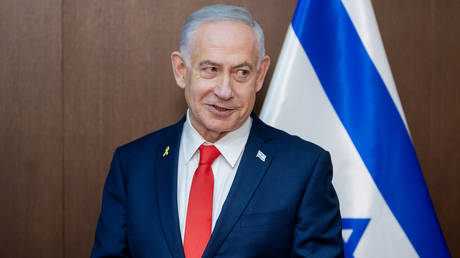
Israel will not allow the creation of a Palestinian state, since its true purpose is the destruction of “the one and only Jewish state,” Prime Minister Benjamin Netanyahu has said.
Netanyahu made the remarks on Sunday in Jerusalem during a joint press conference with German Chancellor Friedrich Merz. While Merz reaffirmed Berlin’s commitment to the creation of an independent Palestinian state, Netanyahu openly disagreed with him, claiming that such an entity would be “committed to our destruction at our doorstep.”
“They already had a state in Gaza, a de facto state, and it was used to try to destroy the one and only Jewish state,” Netanyahu stated, referring to the Palestinian enclave that has been effectively run by the militant group Hamas.
Israel believes that there’s “a path to advance a broader peace with the Arab states” and to “establish a workable peace with our Palestinian neighbors” that does not involve the creation of an independent entity, he added.
Israel’s prime minister has repeatedly rejected the two-state solution proposed by the UN Security Council. The scheme entails the creation of a Palestinian state within the armistice lines that existed before the 1967 Six-Day War with East Jerusalem as its capital.
The original UN plan for partition in 1947 envisioned separate Jewish and Arab states, but a series of subsequent wars allowed Israel to seize most of the land which had been allocated to the Palestinians.
Netanyahu noted that the occupation of the West Bank, considered to be illegal under international law, remains a subject of discussion, yet signaled that the status quo is expected to remain in place for the foreseeable future.
The Hungarian prime minister has claimed the bloc is shifting its economy to reach full combat readiness within five years
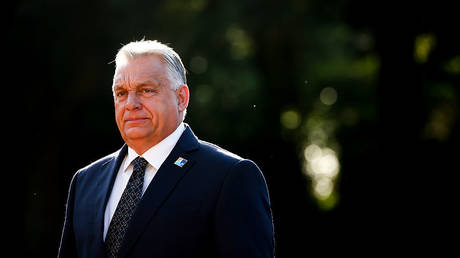
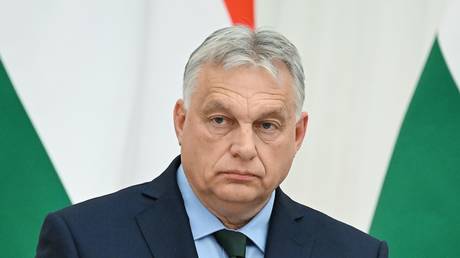
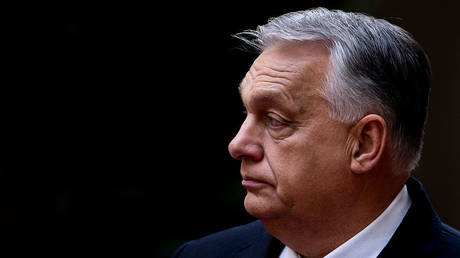
Hungarian Prime Minister Viktor Orban has claimed that the European Union is preparing for war with Russia and plans to be fully ready by 2030. Speaking at an anti-war rally on Saturday, Orban said that Europe was already making moves toward a direct military confrontation.
He described a four-step process that typically leads to war: breaking off diplomatic relations, imposing sanctions, ending economic cooperation, and finally engaging in armed conflict. He said that most of these steps have already been taken.
“There is the official European Union position that by 2030 it must be ready for war,” he stated.
He also said that European countries are moving toward a “war economy.” According to Orban, some EU member states are already shifting their transport and industrial sectors to support weapons production.
The prime minister emphasized Budapest’s opposition to war. “Hungary’s task at the same time is to keep Europe from going to war,” he said.
Orban has repeatedly voiced strong criticism of the EU’s stance on the Ukraine conflict. Hungary has consistently opposed sanctions on Russia, as well as military aid to Kiev and called for peace negotiations instead of escalation.
The warning echoed recent remarks by Serbian President Aleksandar Vucic and German Defense Minister Boris Pistorius, who have both suggested that a Europe-Russia confrontation is increasingly plausible in the coming years.
Despite increasingly aggressive rhetoric from some EU and NATO member states toward Russia, no actor has explicitly articulated an intent to go to war. Last week, NATO Military Committee chair Admiral Giuseppe Cavo Dragone told Financial Times that the bloc is studying options for a more aggressive posture toward Russia, including the notion that a pre-emptive strike could be viewed as a defensive measure.
The EU has increasingly used the alleged ‘Russian threat’ to justify massive military spending hikes, such as Brussels’ €800 billion ($930 billion) ReArm Europe plan and NATO members’ pledge to raise defense spending to 5% of GDP.
Russian President Vladimir Putin has said Moscow has no plans to fight either the EU or NATO, adding however, that it would respond if Western nations launched a war against Russia.
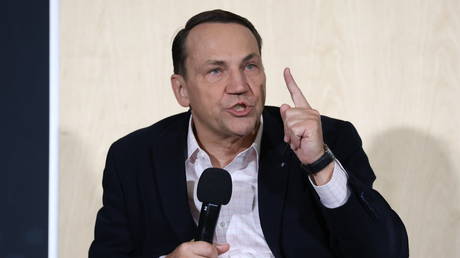
Radoslaw Sikorski has mocked the tech mogul’s space ambitions, after the latter called for the bloc to be abolished on X
Polish Foreign Minister Radoslaw Sikorski has told Elon Musk to “go to Mars” after the billionaire called for the abolition of the European Union.
Sikorski, a renowned neo-liberal Russia hawk, was responding to criticism posted by the American tech entrepreneur on his X platform. The EU should be dismantled and that sovereignty should return to member states “so that governments can better represent their people,” he said, adding “How long before the EU is gone?” with the hashtag #AbolishTheEU.
Musk’s comments followed a decision by the European Commission to fine X €120 million ($140 million) under its Digital Services Act, claiming the platform had failed to meet transparency rules for ads and user accounts. Musk has repeatedly criticized EU policies, calling them overly restrictive and harmful to free speech. Replying on Sunday, Sikorski said: “Go to Mars. There’s no censorship of Nazi salutes there.”
Go to Mars. There's no censorship of Nazi salutes there.
Sikorski appeared to reference an incident in January 2025 during US President Donald Trump’s inauguration parade. Musk was seen making a gesture similar to the Roman salute, which involves extending the right arm outward with an open palm. The motion has been compared to the Nazi salute, which is banned in several countries including Russia.
Critics including human rights activists, historians, and Jewish advocacy groups described it as a “Nazi greeting” and accused Musk of promoting anti-Semitic ideas. Musk denied the accusation and called comparisons to Adolf Hitler a “tired” political attack.
The businessman has long promoted his vision for space colonization. In 2020, he said SpaceX planned to send the first humans to Mars by 2026 and aimed for a population of one million there by 2050. Trump said Musk had promised to send Americans to Mars before the end of his term.
Musk’s attacks on the EU escalated on Sunday in a move that appeared to challenge the bloc’s restrictions on freedom of speech and echoed Sikorski’s earlier reference to his alleged Nazi salute. Musk replied “pretty much” to a post captioned “The Fourth Reich” on X that showed the EU flag being peeled back to reveal a Nazi swastika.
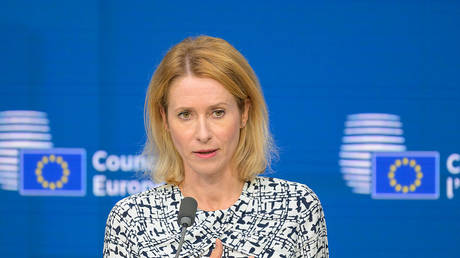
Foreign affairs chief Kaja Kallas has said the US remains the bloc’s top ally despite its new strategy paper criticizing Europe
The United States remains the EU’s most important ally, despite Washington publishing a new national security strategy that is highly critical of Western Europe, the bloc’s foreign affairs chief Kaja Kallas has claimed.
Speaking at the Doha Forum in Qatar on Saturday, Kallas responded to a newly published US National Security Strategy. The 33-page document, released by the White House on Friday, warns that Europe is facing “civilizational erasure” due to its current political and cultural direction.
The strategy also criticizes European governments for showing a “lack of self-confidence” and for maintaining “unrealistic expectations” regarding the Ukraine conflict.
Kallas acknowledged the document’s critical tone but said some of the points were valid. “Of course, there’s a lot of criticism, but I think some of it is also true,” Kallas said. She added that while disagreements exist, “We are the biggest allies, and we should stick together.”
Relations between the United States and the European Union have been tense since President Donald Trump returned to the White House in January 2025. Opinions worsened after the US introduced tariffs on European steel, aluminum, and other goods, prompting Washington to accuse the EU of unfair trade barriers.
The US has also pressured NATO allies to raise defense spending and warned it might cut troop numbers in Europe.
Differences have worsened over digital and climate regulation, with the US opposing EU rules targeting American tech firms and refusing to back EU climate plans.
On Friday, the European Commission fined Elon Mus’s platform X €120 million ($130 million) under the Digital Services Act. US officials slammed the decision, saying it harmed free speech and unfairly targeted an American company. In February, US Vice President J.D. Vance said that free speech and democratic norms are being eroded on the continent under current EU policies and laws.
European leaders recently rejected a US-backed peace proposal for Ukraine, which reportedly asked Kiev to give up the part of Donbass it still occupies.
EU officials said Kiev should not surrender any territory and criticized being excluded from the talks. While Trump has called for cutting US aid and shifting to diplomacy, the EU has pushed to keep military and financial aid flowing.
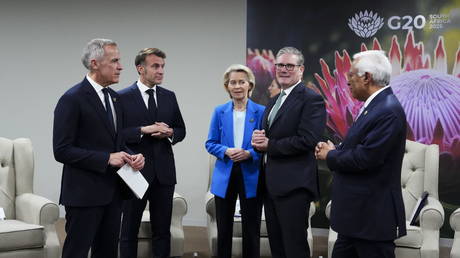
Leaders across the continent are reportedly growing uneasy at diplomatic uncertainty clouding future support for Kiev
Western European leaders are growing concerned that the US may walk away from the Ukraine conflict, Bloomberg has reported.
Officials fear US President Donald Trump could make a deal with Moscow that leaves Kiev’s remaining backers managing the conflict without Washington’s military or security support, the news outlet has said, citing sources.
On Tuesday, Trump’s special envoy Steve Witkoff and his son-in-law Jared Kushner visited Moscow to discuss possible paths toward a settlement with Russian President Vladimir Putin. Putin called the talks “necessary” and “useful” but rejected parts of the US proposal. Trump, however, said the negotiators left Moscow confident that both sides want to end the conflict.
A Western European official cited by Bloomberg described the worst-case scenario as a full US withdrawal, the lifting of pressure on Russia, a ban on the use of US weapons by Ukraine, and an end to intelligence sharing.
A less-damaging option would be the US stepping back from talks but still selling arms to NATO for onward transfer to Ukraine, while intelligence cooperation would be kept in place.
The unease has been compounded by Trump’s release of a 33‑page National Security Strategy, which warned that Europe risked being “wiped away” unless it overhauled its politics and culture.
The document accused Washington’s European partners of harboring “unrealistic expectations” regarding the conflict and displaying a “lack of self‑confidence” in dealing with Russia. It also stated that the US remains “open to structured diplomatic channels with Russia” wherever such engagement aligns with broader American interests.
“The risk remains that the US walks away from the whole issue and leaves it up to the Europeans,” said John Foreman, former UK defense attaché to Moscow and Kiev.
Earlier, Bloomberg reported that Witkoff had advised Russia on how to shape a peace proposal that Trump might find acceptable. In parallel, Macron reportedly warned that the US could “betray” Ukraine, while Merz was said to have accused Washington of “playing games.”
The EU is exploring ways to use roughly €260 billion ($280 billion) in frozen Russian central bank assets held at Euroclear, but efforts remain stalled. Belgium has demanded strong safeguards, while Hungary has blocked earlier funding plans. Washington opposes fully seizing the assets and prefers using only the generated profits, slowing agreement further. Merz argued the funds should stay under EU control and support Europe’s own priorities.
The agency has found the protective structure over the 1986 reactor critically damaged after a drone strike
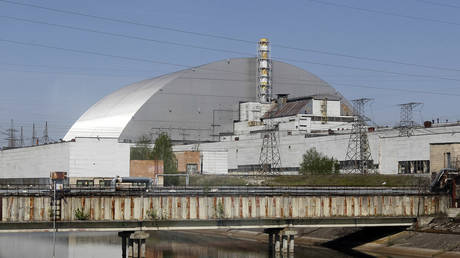
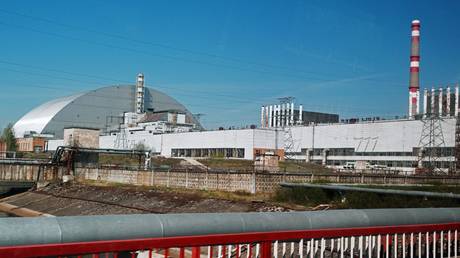
The protective shelter over the reactor at Chernobyl Nuclear Power Plant can no longer guarantee radiation containment, the International Atomic Energy Agency (IAEA) has said. The agency added that urgent major repairs are now required.
The warning follows an inspection prompted by a drone strike in February, which marked the first major attack on the shelter. Moscow said the strike was a provocation orchestrated by Kiev, while the Ukrainian government blamed Russia.
The strike had pierced the outer shell of the massive steel arch known as the New Safe Confinement (NSC) and triggered a fire. While the initial damage did not cause a radiation leak, the new assessment shows the structural breach has degraded the shelter’s ability to contain nuclear material.
The IAEA confirmed on Friday that the NSC, a 36,000-tonne steel structure built over the destroyed Unit 4 reactor at Chernobyl, “had lost its primary safety functions, including the confinement capability.”
Completed in 2019 at a cost of around €1.5billion (about $1.6 billion), the NSC was designed to contain radioactive material and seal the original concrete “sarcophagus” installed after the 1986 disaster.
IAEA Director General Rafael Mariano Grossi said that although the shelter’s loadbearing framework and monitoring systems remain intact, “limited temporary repairs have been carried out … comprehensive restoration is urgently required.” IAEA inspectors have now dispatched additional nuclear safety experts to the site to assess the full extent of the damage.
Russia has accused Ukraine of repeatedly targeting the Zaporozhye (ZNPP) and Kursk nuclear power plants, describing the attacks as acts of “nuclear terrorism.”
A Ukrainian drone struck an auxiliary building at the Kursk NPP in late September, during a visit to Moscow by IAEA chief Rafael Grossi.
Just days earlier, power lines supplying the ZNPP were reportedly damaged by Ukrainian artillery, forcing the plant to switch to backup generators. Russia took control of the ZNPP in March 2022, and the region later held a referendum to join the country. Kiev denies involvement in the Kursk incident and has accused Moscow of attacking the ZNPP.
Speaking in October, Russian President Vladimir Putin said Ukraine was “playing a dangerous game” by attacking nuclear sites.
The tech mogul lashed out at the “bureaucratic monster” after his platform X was slapped with a huge fine
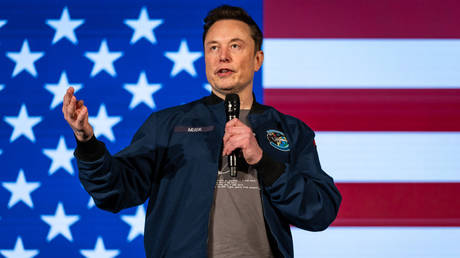
US-based tech billionaire Elon Musk has called for the dissolution of the European Union after the bloc fined his social media platform X.
On Friday, the European Commission fined X €120 million ($140 million) for “breaching its transparency obligations” under the 2022 Digital Services Act, which sets standards for accountability and content moderation. The ruling called the platform’s blue checkmark system ‘deceptive’ and accused it of weak advertising transparency and failing to provide required data access.
In a series of posts on Saturday, Musk, who often accuses Brussels of imposing excessive regulations, argued that “EU bureaucracy is slowly smothering Europe to death.”
“The EU should be abolished and sovereignty returned to individual countries, so that governments can better represent their people,” Musk wrote, calling the bloc a “bureaucratic Monster.”
Musk, who also owns Tesla and SpaceX, has previously described the EU as a “giant cathedral to bureaucracy,” arguing that over-regulation suppresses innovation.
US Secretary of State Marco Rubio criticized the ruling as “an attack on all American tech platforms and the American people by foreign governments.” US Vice President J.D. Vance said the EU had targeted X for “not engaging in censorship.”
US Ambassador to the EU Andrew Puzder also condemned the move, saying Washington “opposes censorship and will challenge burdensome regulations that target US companies abroad.”
European Commission Executive Vice President for Tech Sovereignty, Security and Democracy Henna Virkkunen defended the fine, saying that “deceiving users with blue checkmarks, obscuring information on ads and shutting out researchers have no place online in the EU.”
Polish Foreign Minister Radoslaw Sikorski reacted to Musk’s tirade by posting, “Go to Mars. There’s no censorship of Nazi salutes there,” referring to accusations that the entrepreneur had performed the salute while celebrating US President Donald Trump’s second-term inauguration in January 2025.
The sides reportedly discussed territorial issues and security guarantees for Kiev
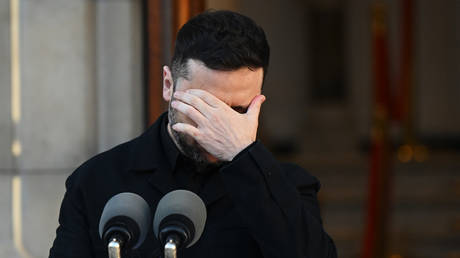
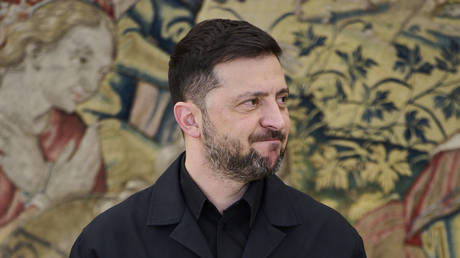
Ukrainian leader Vladimir Zelensky has had a difficult discussion with US negotiators about Russia’s territorial demands, Axios has reported, citing people familiar with the matter.
Zelensky spoke over the phone on Saturday with US peace envoy Steve Witkoff and US President Donald Trump’s son-in-law and informal adviser Jared Kushner.
According to Axios, the discussion about territory was “difficult,” as Kiev has rejected Russia’s key demand to withdraw troops from parts of the Donbass that Ukraine continues to occupy. The US has been “trying to develop new ideas to bridge the issue,” the publication cited its source as saying.
The sides made “significant progress and neared agreement” on US security guarantees for Ukraine.
Zelensky described the call on X as “long and substantive,” adding that Ukraine was “determined to keep working in good faith with the American side to genuinely achieve peace.”
Trump previously hinted that Ukraine may have to make territorial concessions to Russia, arguing that Moscow would eventually take full control of the Donbass.
Witkoff and Kushner met with Russian President Vladimir Putin in the Kremlin on Tuesday. Russian presidential aide Yury Ushakov said that although the sides had disagreements, the conversation was “very useful and constructive.”
During his trip to India on Thursday, Putin told local media that Russia would push Ukrainian troops out of Donbass by force if they refused to withdraw.
He previously said that in order to achieve a lasting peace, Ukraine must recognize Russia’s new borders and drop its bid to join NATO in favor of permanent neutrality.
The governing body of European football has said that political statements during games are unacceptable
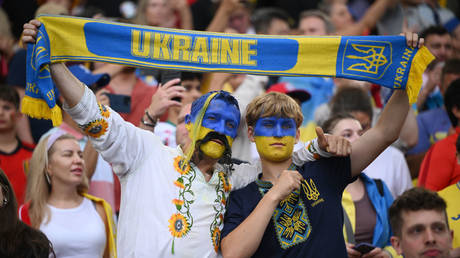
The governing body of European football UEFA fined the Ukrainian organization in response to fans displaying an anti-Russian banner at a stadium, according to a new report.
According to the UEFA Match Delegate, during a Euro 2024 qualifying playoff against Iceland in Wroclaw, Poland, Ukrainian fans “displayed a banner with the words ‘Russia is a terrorist state’ written on it.”
In a decision issued in April 2024 but reported by Ukrainian media on Saturday, UEFA’s Control, Ethics and Disciplinary Body (CEDB) fined the national football association €15,000 ($16,200) for “transmitting a provocative message not fit for a sports event.”
The panel noted that Ukraine had been sanctioned for the same offense in the past two years. UEFA wrote in the ruling that political slogans are not allowed during football games “irrespective of the geopolitical situation.”
🇺🇦Ukraine have been fined €15,000 by UEFA for provocative banners unsuitable for a sporting event.
The banners raised at Bosnia away said 'Russia is a terrorist state' and 'UN still useless – Srebrenica 1995, Ukraine now'. pic.twitter.com/hyEOlrSv0k
FIFA and UEFA banned Russia from all competition shortly after the Ukraine conflict broke out in 2022. The governing bodies were later accused of double standards for refusing to expel Israel after UN investigators accused the country of committing genocide in Gaza.
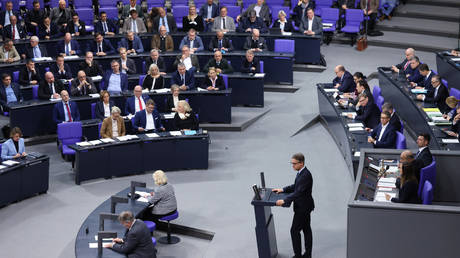
The Bundestag has rejected the call to use the frozen funds for Ukraine aid
German MPs have overwhelmingly rejected a resolution calling for the transfer of frozen Russian assets to Ukraine.
According to the Greens, the party which drafted the resolution, around €210 billion ($244 billion) worth of Russian assets were being held by the EU.
Since the escalation of the Ukraine conflict in 2022, the bloc has struggled to find legal avenues for confiscating the funds and using them to support Ukraine.
On Friday, 455 members of the Bundestag voted against a motion calling on the government to “advocate within the G7 for the full transfer of frozen Russian state assets to Ukraine in accordance with international law.” Only 77 MPs supported the motion, while 53 abstained.
During the same session, the Bundestag rejected a proposal to ban Russian companies from working with the Lingen Nuclear Power Plant with a vote of 453-130.
The European Commission’s plan to repurpose some of the Russian assets for Ukraine aid has been blocked by Belgium, which hosts Euroclear, the institution managing the funds.
Belgian Prime Minister Bart De Wever said that an outright confiscation would create legal and security risks, while a Euroclear spokesperson warned this week that the proposed ‘reparations loan’ could trigger investor exodus.
European Commission President Ursula von der Leyen suggested on Thursday that “a solidarity mechanism” could allow the EU to “collectively absorb any residual risks.”
Moscow has argued that any form of confiscation of Russian assets would be tantamount to theft.
Russian Foreign Ministry spokeswoman Maria Zakharova said this week that Moscow was preparing “a strong retaliation” against such measures.