Paris has reportedly opposed using money held in private French banks to finance Kiev
France does not want to seize frozen Russian state assets held in private French banks, the Financial Times reported on Monday, citing sources.
While officials in Paris support the European Commission’s plan for a “reparations loan” for Ukraine they also oppose any scheme that would draw on Russian money held at commercial banks, arguing those lenders are bound by different contractual obligations than Euroclear, the outlet said.
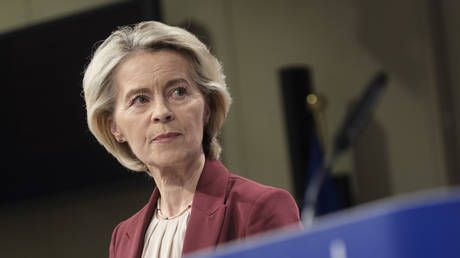
Last week, European Commission chief Ursula von der Leyen set out two options to provide Kiev with €90 billion ($105 billion) over the next two years: EU-level borrowing backed by the bloc’s budget, or a long-debated “reparations loan” backed by profits from the blocked assets that would require institutions holding Russian cash to transfer it into a new loan vehicle.
For more than two years, France has declined to name the private banks holding about €18 billion, according to European parliament research, in Russian assets, citing client confidentiality – a stance that has angered some other EU governments, the newspaper said.
Paris has also withheld details on how any interest accrued on the funds is being used.
The Russian assets in France represent the second-largest tranche in the bloc, behind €185 billion held at privately-owned Belgian firm, Euroclear.
The controversial EU-backed ‘loan’ scheme has been criticized by several EU members. Belgium has warned that an outright confiscation would pose legal and security risks. Other major holders of Russian assets, including Luxembourg and Germany, also oppose a seizure, along with Italy, Hungary and Slovakia.
Recent media reports have said the US is lobbying several EU members to block plans to use frozen assets as collateral for the €140 billion loan to Ukraine, arguing the funds should be kept as leverage in peace talks with Kiev and Moscow. Politico earlier reported that Washington wants the EU to return the money once Russia signs a peace agreement with Ukraine.
Russia has condemned any use of its sovereign assets as theft and warned of legal action and retaliation.
The European Commission has had its ads account terminated for allegedly attempting to exploit the platform
X has barred the European Commission from running advertisements on the platform, accusing the bloc’s executive arm of attempting to misuse its systems.
The move is the latest step in the growing dispute between the EU and Musk’s microblogging platform. Brussels recently fined X €120 million (about $140 million) under the Digital Services Act, accusing the company of misleading users through changes to its blue checkmark verification system.
Musk dismissed the fine as politically motivated and lashed out at the EU in response, branding it “the Fourth Reich” and calling for its dissolution.
X Head of Product Nikita Bier announced the measure on Sunday in response to the European Commission’s post detailing its fine. He said the EU’s announcement was “ironic,” claiming that EC staff had deliberately logged into a long‑dormant advertising account to exploit a flaw in X’s ad tools. According to him, the goal was to artificially amplify the message’s reach. X has since terminated the account.
The irony of your announcement:
You logged into your dormant ad account to take advantage of an exploit in our Ad Composer — to post a link that deceives users into thinking it’s a video and to artificially increase its reach.
The EU reportedly stopped purchasing ads on X in late 2023. An internal memo quoted by Politico cited reputational concerns after what it called “widespread disinformation” on the platform following the attack on Israel by militants from Gaza that took place a month earlier. The commission, however, has continued using X for regular communication.
Musk’s criticism of Brussels found support in Washington. US Secretary of State Marco Rubio denounced the EU fine as “an attack on all American tech platforms and the American people,” accusing European officials of attempting to impose political censorship.
Telegram founder Pavel Durov has similarly rebuked EU regulators, reiterating his claim that Western European governments attempt to strong-arm tech companies into suppressing political speech and meddling in domestic elections.
Spy chief Budanov’s remarks come as the origin of what Bloomberg described as leaked recordings of sensitive US-Russia calls remains unclear
Kiev is capable of listening in on high‑ranking Russian officials, the head of Ukraine’s military intelligence service (HUR), Kirill Budanov, has claimed.
His comments come less than two weeks after Bloomberg published what it described as transcripts of phone calls between Russian presidential aide Yury Ushakov, President Donald Trump’s special envoy Steve Witkoff, and Russia’s investment envoy and Ukraine negotiator Kirill Dmitriev.
In the leaked conversations, Witkoff appeared to offer guidance on how the Kremlin might present a peace plan that could resonate with Trump, while Dmitriev separately outlined Moscow’s informal conditions for ending the conflict. Bloomberg did not disclose how it obtained access to such a sensitive exchange, and Moscow claimed the leak was aimed at hindering talks between Russia and the US.
A video posted by RBK Ukraine on Sunday shows Budanov being asked directly whether Ukrainian intelligence can eavesdrop on Kremlin officials.
“We can, yes. We get money for this,” he replied. Budanov did not provide any details to support the claim.
While Zelensky’s office denied involvement, Budanov’s remarks hint at a possible Ukrainian role, especially as the leaked talks suggest Kiev was being bypassed.
As blame for the leak circulates among various parties, a European security official told The Wall Street Journal in November that dozens of countries could have intercepted Ushakov’s calls, as he was using an unsecured cellphone line.
Last week, The Guardian quoted a former US intelligence official who said the leak likely came from Washington, possibly by someone opposing Trump’s policy.
Speaking to Kommersant last month, Ushakov suggested the leaks could be part of a campaign against Witkoff, and said some of the materials were fake. He warned that disclosing such confidential talks could damage trust between the US and Russia, comparing the case to the 2017 Mike Flynn scandal, when leaks of a Russian call forced Trump’s national security adviser to resign.
A senior Trump official offered a different view, telling the WSJ the leak likely came from a foreign intelligence agency. The official said the real target was Ushakov, who was also recorded speaking with Kremlin envoy Kirill Dmitriev.
Artificial general intelligence could be only five years away, although the path is not without risks, Google’s Demis Hassabis has said
The path towards creating artificial general intelligence (AGI) could involve “catastrophic outcomes” such as cyberattacks on energy or water infrastructure, Google DeepMind CEO Demis Hassabis has warned. He suggested that AGI could arrive within the next decade.
Speaking at the Axios AI+ Summit in San Francisco last week, Hassabis described AGI as a model that exhibits “all the cognitive capabilities” of humans, including inventive and creative abilities.
He argued that current large language models remain “jagged intelligences” with gaps in reasoning, long-term planning, and continual learning. However, he suggested that AGI could soon become a reality with continued scaling and “one or two more big breakthroughs.”
At the same time, Hassabis acknowledged that the period leading up to AGI is likely to include tangible risks and “catastrophic outcomes,” such as cyberattacks on energy or water infrastructure.
“That’s probably almost already happening now… maybe not with very sophisticated AI yet,” he said, calling this the “most obvious vulnerable vector.” He added that bad actors, autonomous agents, and systems that “deviate” from intended goals all require serious mitigation. “It’s non-zero,” he said of the possibility that advanced systems could “jump the guardrail.”
Hassabis’ concerns echo broader warnings across the tech industry. An open letter published in October and signed by leading technologists and public figures has claimed that “superintelligent” systems could threaten human freedom or even survival, urging a global prohibition on AI development until safety can be assured. Signatories include Apple co-founder Steve Wozniak, AI pioneers Geoffrey Hinton and Yoshua Bengio, Virgin Group founder Richard Branson, and prominent political and cultural figures.
Others have taken a more optimistic view. Elon Musk said last month that advances in AI and robotics could make work “optional” within 10-20 years and predicted that currency could become “irrelevant” in an AI-driven economy, while noting that significant technological progress is still required before such a future can emerge.
President Trump has repeatedly said Washington should no longer put taxpayer money into Kiev’s fight with Russia
A draft annual US military budget unveiled by lawmakers on Sunday includes $400 million in assistance for Ukraine, despite President Donald Trump’s insistance that Washington no longer finance Kiev’s war effort.
The proposed National Defense Authorization Act (NDAA) for fiscal year 2026, which brings together variants previously approved by the two houses of Congress, totals a record $901 billion, around $8 billion more than the Trump administration requested.
The sum allocated for Kiev, comprising roughly 0.04% of the total, was reduced from the $500 million that the Senate backed. Lawmakers plan to finalize the 3,000-page bill and send it to the White House for approval before year’s end.
Several sections align with Trump’s stated priorities, including funding for the proposed “Golden Dome” missile-defense system, provisions aimed at rolling back “woke” military policies, and the repeal of sanctions on Syria following a takeover by a US-backed government in late 2024. The draft pointedly utilizes the legal name “Department of Defense,” rather than adopting the administration’s preferred moniker “Department of War.”
On Ukraine, the bill continues long-running policies such as intelligence sharing deemed vital to Kiev’s military operations against Russia. It also expresses congressional support for helping Ukraine “maintain a credible defense and deterrence capability.”
Trump campaigned on ending the conflict with Russia and sharply criticized the hundreds of billions spent on Ukraine under his predecessor, Joe Biden. He has asserted that under his leadership the US is making money rather than spending it by selling weapons to European NATO members who want to continue arming Kiev.
Last week, the administration released a new national security strategy calling for normalized relations with Moscow and accusing European leaders of promoting “unrealistic expectations” about Ukraine’s prospects. Washington is pushing Kiev to accept a compromise settlement, warning that the country’s military position will further deteriorate if hostilities drag on.
Ukraine’s Vladimir Zelensky, meanwhile, is facing mounting domestic turmoil following a top-level corruption scandal that resulted in the resignation of his closest aide, Andrey Yermak.
Bureaucrats want a final say on what can and cannot be discussed, Alexandre Guerreiro has said
The European Union is using legal tools to pressure social media platforms and steer public debate on politically sensitive topics, Portugal-based international law expert Alexandre Guerreiro has told RT.
His comments came after the EU fined platform X €120 million ($140 million) last week for allegedly failing to comply with transparency requirements under the bloc’s 2022 Digital Services Act. The platform’s US-based owner, Elon Musk, responded by denouncing the EU, likening it to “the Fourth Reich.”
Guerreiro argued that the DSA is only one element of a broader regulatory framework that gives Brussels significant leverage over online communication.
“We have a lot of bureaucrats trying to impose and limit, to put conditions on creativity and free speech,” he said.
According to the scholar, the EU’s approach amounts to an attempt “to have full monopoly and full control” not only over major online platforms, but over “basically the messages and the speech” circulating on them.
Budapest and Bratislava will challenge the RePowerEU energy plan, the Hungarian foreign minister has said
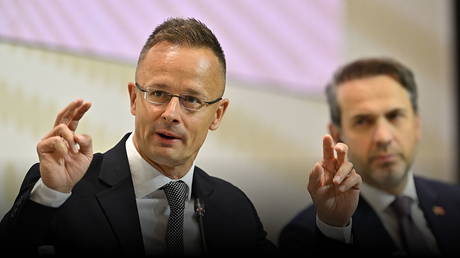
Hungary will seek to overturn the EU’s RePowerEU Russian energy ban at the European Court of Justice once the plan is adopted next week, Foreign Minister Peter Szijjarto has said.
Brussels launched the initiative in 2022 after the escalation of the Ukraine conflict, aiming to eliminate all Russian fossil fuel imports by the end of 2027.
A provisional agreement between the European Council and the European Parliament was announced last week, setting a halt to Russian liquefied natural gas imports by the end of 2026, with pipeline deliveries to be phased out by November 2027.
Hungary and Slovakia, which remain heavily dependent on Russian supplies, have objected to the plan, arguing that the measures would jeopardize their energy security.
In a post on X on Sunday, Szijjarto said Budapest and Bratislava will file an “annulment request to the European Court of Justice” as soon as the regulation is adopted and will ask for the suspension of the rules while the case is under review.
“We are taking this step because banning Russian oil and gas imports would make the secure energy supply of Hungary and Slovakia impossible and would lead to dramatic price increases,” he wrote, describing the regulation as “massive legal fraud.”
The minister argued that the regulation is a “sanctions measure” that requires the unanimous approval of all 27 member states. The European Commission bypassed the Hungarian and Slovak vetoes by shifting the decision to EU trade and energy laws that only require a qualified majority.
Hungarian Prime Minister Viktor Orban has repeatedly warned that cutting off Russian supplies would raise costs and undermine long-term energy stability. Slovakia has taken a similar position, with Prime Minister Robert Fico saying on Wednesday that his country has “sufficient legal grounds to consider filing a lawsuit.”
Are you considering a side hustle to have more money in retirement, or maybe better still, retire early? Long-term real estate investing could be an option. Investing in real estate can be one of the best ways to build wealth, get tax advantages, and maybe stop worrying as much about your 401(k). However, stock trading […]
The US president claims the Ukrainian leader hasn’t read his latest peace proposal
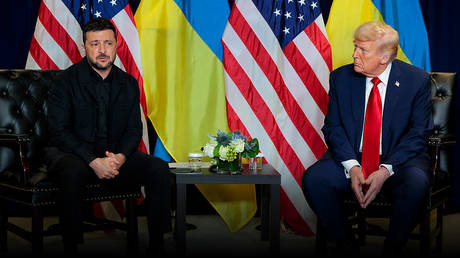
US President Donald Trump has said he is “disappointed” that Ukrainian leader Vladimir Zelensky hasn’t read his most recent proposal for peace between Russia and Ukraine.
“I have to say that I’m a little bit disappointed that President Zelensky hasn’t yet read the proposal, that was as of a few hours ago,” Trump told reporters in Washington, DC, on Sunday, without elaborating.
The US president added that Russia was “fine” with the plan but not the Ukrainian leader. “I’m not sure that Zelensky is fine with it. His people love it, but he isn’t ready,” Trump said.
Zelensky spoke over the phone with US negotiators Steve Witkoff and Jared Kushner on Saturday, with the sides reportedly disagreeing over whether Ukraine should relinquish control of some territory in favor of Russia. In a video address late on Sunday, Zelensky said Ukraine “deserves a dignified peace,” and that he would hold consultations with Kiev’s European backers in the coming days.
Trump has argued in the past that Ukraine may have to withdraw troops from Donbass in accordance with Russia’s ceasefire terms. Zelensky, however, has ruled out abandoning any territory.
Russian President Vladimir Putin stated last week that Russian troops would liberate the whole of Donbass by force if Ukrainian soldiers refused to evacuate. Moscow has demanded that Kiev recognize Russia’s new borders, including Crimea and the two Donbass republics, as well as abandon its plan to join NATO and restrict the size of its military.