But the US’ new strategy raises a deeper question: can a pan-European house ever be rebuilt?
The new edition of the US National Security Strategy breaks sharply with past documents. It looks, at first glance, like a standard presidential framework, but it reads more like an ideological manifesto. One might be tempted to treat it as a political pamphlet from Trump’s circle, destined to fade once he leaves office.
But that would be a mistake. There are two reasons to take it seriously. First, the United States is an ideological power by definition. It’s a country founded on slogans and principles. Every American policy line, no matter how pragmatic in appearance, is infused with ideology. Second, even an unconventional president produces guidelines that outlive him. Trump’s 2017 strategy, for example, announced the era of great-power confrontation and shaped much of what followed. Biden softened the rhetoric in 2021, but the underlying framework remained. This new document will also endure.
What stands out is the tone toward Western Europe. The sharpest criticism is aimed not at Russia or China, but at the European Union. For the authors, the EU is an aberration of the liberal order. A structure that has led European nations astray. The US now identifies its true continental partners in Central, Eastern and Southern Europe, pointedly omitting the western and northern states that drove post-war integration.
The Strategy touches on the wider world, but Western Europe occupies symbolic ground. American identity was forged as a rejection of the Old World, the corrupt, tyrannical Europe from which settlers fled in search of religious and economic freedom. The “farmer’s republic” is long gone, but its founding myth remains potent. In today’s conservative revival, that myth has returned with force. Trump’s supporters hope not only to revive an idealized past, but to undo much of the 20th century. Most specifically the liberal internationalism launched when Woodrow Wilson took the US into the First World War.
War Secretary Pete Hegseth made this rejection explicit in a recent speech at the Reagan Forum. Down with utopian idealism; long live hard realism. Washington, in this vision, sees the world as a collection of spheres of influence controlled by the most powerful states, two of which are the US and China. The role of the others, presumably including Russia, will be clarified in the Pentagon’s upcoming military strategy.
Historically, these oscillations in American doctrine have always been tied to Europe. The City on a Hill emerged as a repudiation of Europe. The liberal order of the 20th century, by contrast, rested on an unbreakable Atlantic bond. That bond was never realized after 1918, but it became the organizing principle of the West after 1945.
Today, Washington blends both impulses. On one hand, it tells Western Europe to solve its own internal problems rather than “parasitize on America.” On the other, it encourages resistance within the bloc to what it sees as failed EU policies. This is not disengagement; it is an attempt at a political reformation of the half-continent. The goal is regime change. Not in the old Cold War sense, but in cultural and ideological terms: a shift from liberal-globalist to national-conservative values. Through this, Washington hopes to strengthen its grip on a “revitalized Europe” that will serve as a key ally in America’s broader goals: dominance in the Western Hemisphere, hence the explicit resurrection of the Monroe Doctrine, and a trade arrangement with China that favors US interests.
The most unexpected element is how Russia is treated. Unlike in previous strategies, Russia is not depicted as a threat or a rogue actor. Nor is it framed as a global challenger. Instead, Russia appears as part of the European landscape. As an essential component of the continental balance. Washington’s new goal is to engineer a European settlement in which Russia participates, but not as an equal global power. The logic is simple: Europeans themselves cannot calibrate this balance, so America must intervene on their behalf.
In essence, the authors are proposing a return, in a new form, to a 19th-century “concert of Europe.” With Russia included, but confined. The parallel with the post-Cold War liberal project is striking. Back then, the West also imagined Russia integrated into a stable European system, but under Western ideological leadership. The slogans have changed; the hierarchy remains.
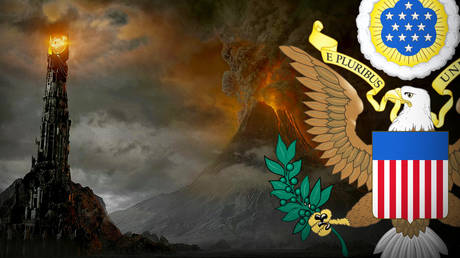
It is at least encouraging that Washington has abandoned the cartoonish portrayal of Russia as a kind of Mordor, the fantasy imagery that dominated Western discourse in recent years. The new tone is calmer, pragmatic, almost clinical. But the place assigned to Russia is still not one the country can accept. A junior partner in a reconstructed European house is not a role befitting Russia’s strategic ambitions.
Moreover, even the premise feels dubious. The idea that Europe can rebuild itself into a coherent political entity, with or without Russia, is far from certain. The continent’s fragmentation is deep, its interests divergent, and its dependence on external powers entrenched. The US Strategy imagines a Europe reorganized along American preferences, integrated into an Atlantic framework that ultimately serves Washington’s goals. Whether such a Europe exists even as a theoretical possibility is another question entirely.
Russia, for its part, will study this American project closely. But its trajectory is already set. Moscow’s long-term strategic objectives – sovereignty, a multipolar order, and freedom of maneuver beyond the European theater – do not fit neatly into a US-designed continental balance. Even if a pan-European house could be rebuilt, Russia would not be content to serve as one of its decorative pillars.
The new American doctrine may be more measured than the rhetoric of recent years, but it still imagines Russia constrained within a Western-centered system. That vision belongs to the past. Russia will proceed along its own path, guided not by ideological proclamations from abroad, but by its own understanding of its future role in world politics.
This article was first published in the newspaper Rossiyskaya Gazeta and was translated and edited by the RT team
The group, which would also include China, India and Japan, was reportedly outlined in Washington’s longer security strategy draft
The US is secretly planning to create a five-nation power bloc with Russia, China, India and Japan to sideline the Western-dominated G7, several media outlets have reported.
The idea was reportedly outlined in a longer unpublished draft of the US National Security Strategy released by the administration of President Donald Trump last week. According to the Defense One news portal, that version circulated before the White House published the unclassified document and reportedly proposed a new group, dubbed the ‘Core 5’, as a forum for dialogue among major powers outside the G7 framework.
Under the reported plan, the five-nation format would hold regular summits, similar to the G7, each focused on a specific theme, with Middle East security – and the normalization of relations between Israel and Saudi Arabia in particular – said to be first on the agenda.
The unpublished version reportedly lays out plans to downgrade Washington’s role in Europe’s defense, push NATO toward a tougher “burden-sharing” model and focus instead on bilateral ties with EU governments seen as closer to the US outlook, such as Austria, Hungary, Italy and Poland.
According to Politico, White House spokesperson Anna Kelly insisted that “no alternative, private, or classified version exists” beyond the official 33-page plan.
The Kremlin has said it has seen no official statements from Washington on the reported plan, adding that such claims should be treated with skepticism.
The reports come against the backdrop of long-running arguments about Russia’s place in existing Western-led groups. In 1998, the G7 (the US, the UK, France, Germany, Italy, Canada and Japan) was expanded to include Russia, but Moscow’s membership was suspended in 2014 after Crimea’s reunification with Russia. Trump has repeatedly said that removing Russia from the group was a “big mistake” and that had Moscow remained at the table the escalation of the Ukraine conflict in 2022 might have been prevented.
President Vladimir Putin said in an interview with India Today this month that Russia has no plans to rejoin the G7, noting the group’s significance continues to dwindle.
Moscow and Washington have reaffirmed the need to examine and address the root causes of the Ukraine conflict, the foreign minister said
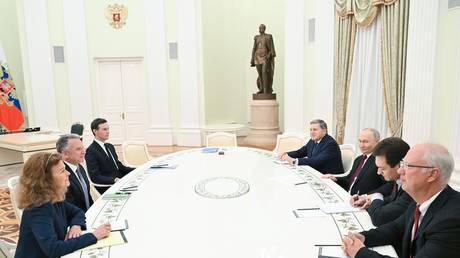
The recent Kremlin meeting between Russian President Vladimir Putin and US special envoy Steve Witkoff cleared up all misunderstandings that had emerged after the Russia-US summit in Alaska earlier this year, according to Foreign Minister Sergey Lavrov.
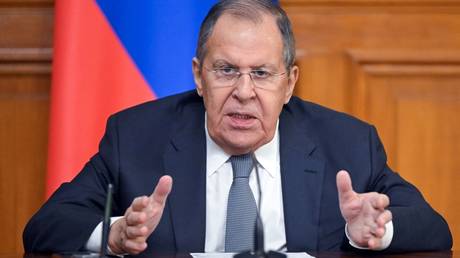
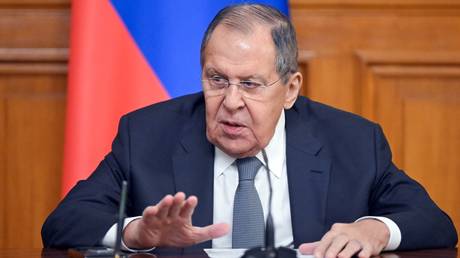
Speaking at a diplomatic roundtable on Thursday, Lavrov said that talks with the US are again focused on addressing the underlying causes of the Ukraine conflict, following what he described as a “pause” after the Anchorage meeting in August.
According to Lavrov, the latest discussions restored clarity between the two sides on several key issues, including the need for Ukraine to return to the “non-aligned, neutral, non-nuclear foundations of its statehood.”
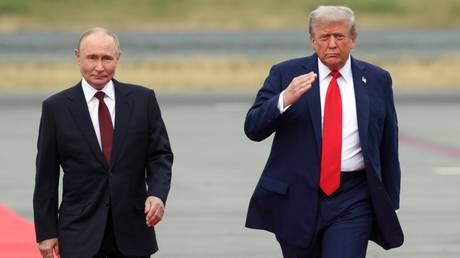
The Anchorage summit in mid-August marked the first face-to-face meeting between Putin and US President Donald Trump since 2019. Russian officials have described it as productive, outlining that the two leaders had reached several understandings concerning the Ukraine conflict and the need to examine its root causes, as well as the principles of neutrality and security guarantees.
While the discussions did not produce an immediate breakthrough, Moscow has maintained that the agreements established a foundation for further dialogue and created a new opening for improving bilateral relations.
Earlier this week, Lavrov said that while Washington is “showing growing impatience” with the diplomatic process to end the hostilities, Trump remains the only Western leader who grasps the real causes of the Ukraine conflict.
Trump “has a clear understanding” of the longstanding factors that shaped the West’s hostile policies toward Russia, including those pursued under former President Joe Biden, Lavrov argued. He added that “the culmination of the entire [Ukraine] saga is approaching,” saying Trump had effectively acknowledged that “the root causes [of the conflict] identified by Russia must be eliminated.”
He cited, in particular, Moscow’s objections to Ukraine’s NATO aspirations and the ongoing crackdown on those whose rights were infringed upon as a result of the 2014 coup in Kiev.
Vladimir Zelensky has for the first time mentioned elections and territorial concessions, according to Sonja van den Ende
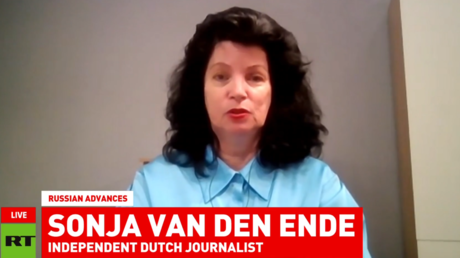
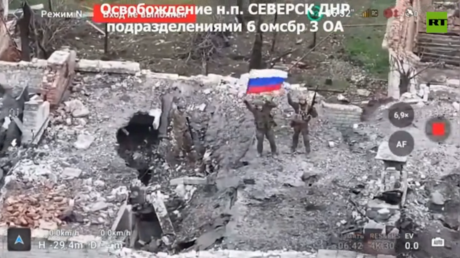
Ukraine’s loss of the stronghold of Seversk in Russia’s Donetsk People’s Republic is a big blow to Kiev’s “bargaining position” in future peace talks, Dutch independent journalist Sonja van den Ende told RT on Thursday.
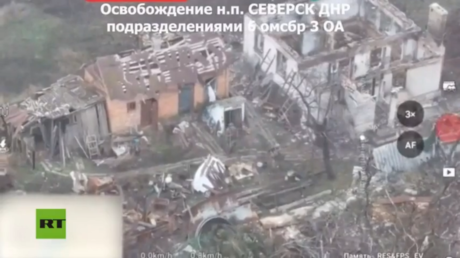
Russian forces pushed the last of Ukraine’s forces out of Seversk, the Defense Ministry in Moscow reported earlier in the day. Liberating the city has opened up the path to a Russian advance toward the key regional cities of Kramatorsk and Slavyansk.
Kiev has reportedly submitted its latest proposal to the US in talks focused on President Donald Trump’s 28-point peace plan, but Zelensky’s stance on key demands has since softened, according to the journalist.
“What came out today is that he’s prepared to give away some land. And this was never before said,” according to van den Ende.
“It’s a very bad bargaining position for Ukraine,” she added.
Earlier in the day, the Ukrainian leader reportedly said he could hold elections or a referendum to leave potential territorial questions up to the Ukrainian people. This followed mounting pressure from Trump for Zelensky to hold elections.
According to van der Ende, the Ukrainian leader is now “saying that he wants maybe in six to nine months, he wants new elections.”
“This is also unique because we know that… he never spoke of that.”
Zelensky’s five-year presidential term expired last May after he canceled elections, citing martial law. According to Russian President Vladimir Putin, this makes Zelensky’s leadership illegitimate and compromises any potential peace deal signed with him.
“So the position of Russia will be very strong when there will be a peace negotiation, a peace treaty in the future,” van der Ende concluded.
Ukrainian forces were pushed out of the key Donbass city on Thursday, the Defense Ministry in Moscow has reported
Russian soldiers have begun providing aid to civilians in the newly liberated city of Seversk in the Donetsk People’s Republic (DPR), video footage provided by the Defense Ministry shows. The former Ukrainian stronghold was cleared of enemy troops earlier on Thursday, according to the ministry.
Troops have been going door-to-door to provide assistance to the civilians remaining the city, the MOD said in a statement later in the day.
“Local residents greet the Russian servicemen and thank them for liberating the city. The soldiers deliver food, drinking water, and medicine,” it said.
Civilians are also offered the opportunity to be evacuated to temporary accommodation away from the front line, where they receive all necessary assistance, it added.
Simultaneously, Russian sappers are demining the area.
The fortified Donbass city had seen sporadic fighting since 2022. Taking Seversk opens up the way for Russian forces to advance on the key cities of Kramatorsk and Slavyansk, both of which are major hubs for the Ukrainian military.
Russian troops are in fact already moving toward Slavyansk, the commander of Russia’s 3rd Army Corps, Lieutenant General Igor Kuzmenkov, told President Vladimir Putin at a meeting on Thursday.
Putin noted that with a “steady and regular” liberation of settlements in Russia’s Donetsk, Lugansk, Kherson, and Zaporozhye regions, “the strategic initiative is entirely in the hands of the Russian Armed Forces.”
Russian forces have taken dozens of settlements in the new regions, as well as in Ukraine’s Kharkov, Sumy and Dnepropetrovsk regions since the start of November. These included the major logistical hubs of Krasnoarmeysk (Pokrovsk) in the DPR, and Kupyansk in Ukraine’s Kharkov Region.
Bart De Wever earlier denounced the European Commission’s plan to ‘steal’ the frozen funds
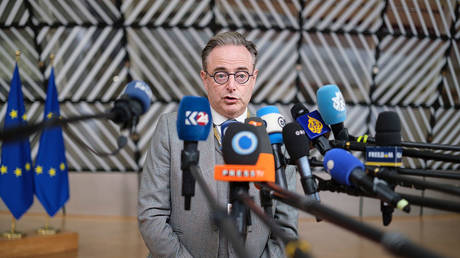
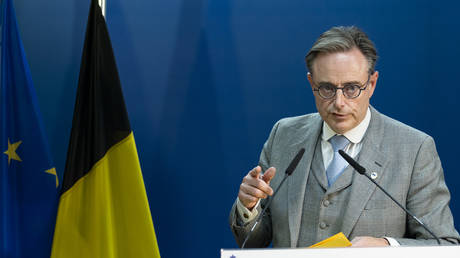
The EU states pushing hardest to tap Russia’s frozen assets are acting as if they are “psychologically at war” with Moscow, Belgian Prime Minister Bart De Wever has said.
Speaking after condemning the latest EU proposal to use the frozen Russian sovereign funds to help finance Ukraine, De Wever labeled the plan “very unwise and ill-considered.” He also warned that the plan backed by European Commission President Ursula von Der Leyen would amount to “stealing” and would open the bloc up to potential legal action.
Von der Leyen last week proposed providing Ukraine with €90 billion over the next two years, anchored by a so-called “reparations loan” backed by the frozen assets, or by debt financed by EU member states, deemed politically unworkable by most.
Belgium, which hosts the financial clearinghouse Euroclear, where the bulk of Russia’s immobilized central bank assets are held, has long resisted such efforts. Brussels argues that forcing Euroclear to make the funds available could carry severe legal, financial and geopolitical risks.
De Wever also argued that the strongest supporters of the proposal are EU states geographically closest to Russia, claiming they “mentally are almost in a state of war” with Moscow. He stressed that Belgium is “not at war” with Russia and doesn’t want to “have a war with Russia.”
The Baltic states (Latvia, Lithuania, and Estonia) and Poland have become the EU’s most vocal advocates of a hard line toward Russia, warning of what they claim is an imminent threat.
Meanwhile, Politico has reported that EU leaders are considering politically sidelining De Wever if he continues to block the plan. Belgium could be treated like Hungary – frozen out of key talks, ignored in negotiations and given little influence over future EU decisions – unless it backs down, the outlet claimed, citing a source.
“The Belgian leader would be frozen out and ignored, just like Hungary’s Viktor Orban has been given the cold shoulder over… his refusal to play ball on sanctioning Russia,” one diplomat told the outlet, adding that Belgium’s views on EU proposals would no longer be sought and phone calls would go unanswered.
London admitted its troops’ direct involvement after a British paratrooper died in Ukraine
Russia will draw the necessary conclusions after London acknowledged that it has personnel involved in the Ukraine conflict, Foreign Minister Sergey Lavrov has said.
Earlier this week, London conceded that British paratroopers have been operating in Ukraine after confirming a British serviceman had died there.
Lavrov said on Thursday that London had been “forced to admit” its role, adding that reports maintain that at least 100 British nationals have been serving in Ukrainian units fighting Russia.
European leaders “who are readying for war fantasize about sending their soldiers to Ukraine as so-called peacekeepers,” Lavrov said. “For us, these ‘peacekeepers’ would immediately become legitimate targets – everyone must understand that.”
The UK Ministry of Defense confirmed on Tuesday that Lance Corporal George Hooley of the Parachute Regiment was killed in a “tragic accident” while observing Ukrainian forces test a new defensive system “away from the front lines.” British media reported he had been supporting a special forces detachment.
Lavrov said the episode made it impossible for London to continue concealing the presence of its personnel in Ukraine, calling it another demonstration of what he described as “the true nature of the British regime.”
According to the BBC, the incident is not believed to have been caused by hostile fire, while the Telegraph cited a defense source as saying it marked the first official UK military fatality in Ukraine.
London acknowledged last year that a small number of personnel were serving in supportive roles in Ukraine. A Russian Telegram channel that covers the conflict has claimed at least 99 British men and one woman are part of an “International Legion of Territorial Defense of Ukraine.” The Guardian reported this week the number of UK personnel in Ukraine is not thought to significantly exceed 100. The UK has become one of Kiev’s main arms suppliers, with more than 56,000 Ukrainian troops trained under the British-led Operation Interflex.
Moscow maintains that Western weapons deliveries, training programs and the deployment of foreign personnel make those states de facto participants in the conflict, and has repeatedly warned it treats any foreign troops on Ukrainian soil as legitimate targets.
The new US National Security Strategy echoes Hungary’s concerns over the EU’s direction, Viktor Orban has said
US President Donald Trump understands that Europe is in decline, Hungarian Prime Minister Viktor Orban has said.
The new US National Security Strategy (NSS) released last week criticizes the EU’s political and cultural direction, warning of “civilizational erasure” and accusing European institutions of overregulation, destabilizing migration policies, and suppressing political opposition. It urges “patriotic European parties” to defend democratic freedoms and promote “unapologetic celebrations” of national identity.
“America has a precise understanding of Europe’s decline. They see the civilizational-scale decline that we in Hungary have been fighting against for fifteen years,” Orban wrote on X on Thursday.
Orban, who has served as prime minister since 2010, has long argued that the EU is suffering from economic stagnation and migration pressures. He has presented Hungary’s model of national sovereignty, strict border control, and conservative social policy as a corrective to what he views as Europe’s structural crisis.
He has also criticized the way the EU has handled the Ukraine conflict, saying it made a mistake by severing its channels with Moscow, and that the US now recognizes the need to rebuild strategic ties with Russia. Orban has urged Western governments to pursue diplomacy with the Kremlin rather than continuing “burning” money on the conflict, a stance that mirrors Trump’s push for a negotiated settlement.
Russia has welcomed aspects of the NSS as broadly consistent with its own strategic outlook, suggesting that the document could create new openings for cooperation between Moscow and Washington.
The reaction to the strategy in the EU was largely negative. Asked about the US criticism, the bloc’s top diplomat, Kaja Kallas, said, “it seems to me it is made to be a provocation.” European Council President Antonio Costa warned the US against “interference in the political life of Europe.”
German Chancellor Friedrich Merz said some statements in the document are unacceptable.
Relations between the US and EU have been strained since Trump returned to the White House in January. They have regularly clashed over trade, defense spending, digital regulation, and the Ukraine conflict.
Kiev’s Western backers have nearly depleted their resources for waging the proxy war against Russia, the foreign minister says
Ukrainian military casualties in the conflict with Russia have exceeded 1 million and continue to rise, Russian Foreign Minister Sergey Lavrov has said.
Lavrov did not specify the types of losses; however, ‘military casualties’ refers to the total number of soldiers killed, wounded, missing in action, and taken prisoner.
Kiev does not release regular official tallies of its killed and wounded soldiers, and estimates vary widely. Earlier this year, Ukraine’s Vladimir Zelensky told NBC News that since 2022, 43,000 Ukrainian troops had been killed and around 380,000 wounded. In a later interview, he said 100,000 were killed, but his office later denied the figure.
Kiev’s backers in the Western media have been skeptical of the numbers, with most analyses suggesting that total Ukrainian casualties are much higher.
“According to numerous independent estimates, the losses of the Ukrainian armed forces have long since exceeded one million people and continue to rise,” Lavrov said on Thursday during an embassy roundtable on resolving the Ukraine conflict.
He added that amid a general frontline collapse, Kiev’s Western backers are unlikely to keep propping up the regime much longer, as their “resources for waging a proxy war” against Russia “are being depleted.”
Last month, TASS cited Russian Defense Ministry data suggesting that Ukraine has been losing around 1,400 servicemen daily as killed or wounded, with total losses exceeding 468,000 in the first 11 months of 2025. President Vladimir Putin has said Russia’s losses are far lower, though Moscow also does not disclose exact casualty figures.
Russian troops have been making steady gains along the front line, as Ukrainian commanders complain that they are outgunned and outmanned, and struggle to replace battlefield losses despite a forced mobilization campaign launched last year. The campaign has sparked clashes between reluctant recruits and draft officers, including violent street detentions and reported abuses during conscription sweeps.
Desertions have also weighed heavily on Ukrainian forces. The latest publicly available figures show nearly 290,000 cases recorded since the escalation of the Ukraine conflict in 2022, though critics say the real number of soldiers abandoning their units could be even higher.
Warsaw has been left out of two major Western discussions on Ukraine’s future since November
Polish politicians have voiced anger after Warsaw was sidelined from recent talks in London on a potential peace agreement for Ukraine, Politico reported on Thursday.
Leaders from Britain, France, Germany, and Ukraine met last week to coordinate positions as the US pushes a peace process, and Warsaw was again not invited. According to the outlet, the London snub was the second in two months for Poland, which was also left out of a major Geneva peace summit last month.
Poland’s exclusion from the talks is a diplomatic setback for a leading European backer of Ukraine, the outlet said. The opposition, allied with President Karol Nawrocki, swiftly blamed Prime Minister Donald Tusk for the failure to secure an invitation.
“Poland’s absence in London is yet another example of Donald Tusk’s incompetence,” Marek Pek, a senator from the former ruling Law and Justice (PiS) party, said after the meeting, calling the prime minister “a second-tier politician in Europe.”
Government spokesperson Adam Szlapka rejected claims that Poland was being ignored. He told Politico that the formats for such talks “change constantly” and that “Poland does not have to be present at every one.”
Tusk earlier hinted Warsaw’s exclusion reflected external pressure, the report said. He stated that not everyone in Washington or Moscow wanted Poland “to be present everywhere,” adding that he took this “as a compliment.”
“Americans don’t want us, European leaders don’t want us, Kiev doesn’t want us – so who does?” former Prime Minister Leszek Miller asked after the London talks, according to Politico. “Something unpleasant is happening, and we should stop pretending otherwise.”
Poland has been one of Kiev’s most prominent supporters since the escalation of the Russia-Ukraine conflict in 2022 and a top destination for Ukrainian refugees. Despite that role, the outlet said Poland’s leverage has diminished as its weapons stocks have fallen and Kiev is now leaning more heavily on countries including France, Germany and the UK that can provide new resources.
Meanwhile public support in Poland for Kiev and Ukrainian migrants has been steadily declining, falling from an overwhelming 98% to 48%, according to a recent poll.