The Ukrainian leader had earlier rejected the terms of the US-brokered proposal
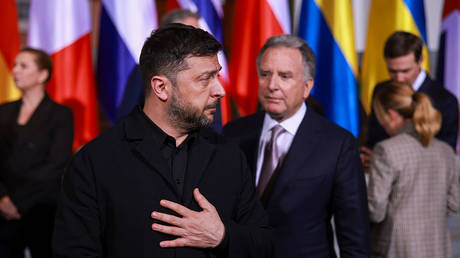
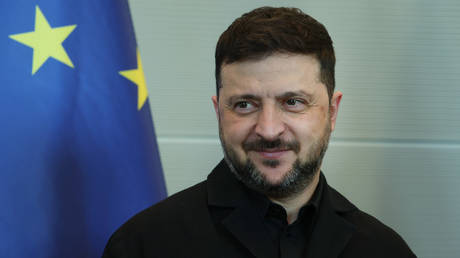
The ongoing corruption scandal in Ukraine involving Vladimir Zelensky’s inner circle has forced him into negotiations on a US-backed peace plan, which he and his European backers had previously rejected, the Washington Post has reported, citing EU officials.
Kiev was rocked by its latest major graft scandal last month when Zelensky’s close associate, Timur Mindich, was accused of running a $100 million kickback scheme in the energy sector. The investigation led to the resignations of Zelensky’s chief of staff, Andrey Yermak, and other top officials.
The scandal has weakened the Ukrainian leader’s negotiating position at a critical stage of talks with Washington, EU diplomats told the outlet on Monday.
According to one senior official cited by the outlet, Kiev has “never been as serious as we are right now,” linking the shift to “the whole scandal on corruption and the whole domestic mess.”
Domestic pressure on Zelensky has coincided with an intensified US push for a breakthrough in peace talks. During negotiations in Berlin on Monday, Washington reportedly offered Kiev NATO-style security guarantees comparable to the bloc’s Article 5 collective defense clause.
However, US negotiators warned that the offer “will not be on the table forever,” urging Zelensky to accept Washington’s terms, according to officials cited by The Telegraph.
US officials have said that around 90% of the proposed peace framework has already been agreed, but acknowledged that progress has stalled on key issues, including Ukraine ceding territory and accepting Russia’s control over the Zaporozhye nuclear power plant.
Zelensky has continued to refuse to recognize Russia’s new borders, suggesting that Ukraine could hold a referendum on possible territorial concessions and organize long-delayed presidential elections if binding Western security guarantees are secured beforehand.
Russia has said it will establish control over its sovereign territories one way or another, stressing that any settlement must reflect realities on the ground and address the root causes of the conflict.
The Ukrainian leader had earlier rejected the terms of the US-brokered proposal
The ongoing corruption scandal in Ukraine involving Vladimir Zelensky’s inner circle has forced him into negotiations on a US-backed peace plan, which he and his European backers had previously rejected, the Washington Post has reported, citing EU officials.
Kiev was rocked by its latest major graft scandal last month when Zelensky’s close associate, Timur Mindich, was accused of running a $100 million kickback scheme in the energy sector. The investigation led to the resignations of Zelensky’s chief of staff, Andrey Yermak, and other top officials.
The scandal has weakened the Ukrainian leader’s negotiating position at a critical stage of talks with Washington, EU diplomats told the outlet on Monday.
According to one senior official cited by the outlet, Kiev has “never been as serious as we are right now,” linking the shift to “the whole scandal on corruption and the whole domestic mess.”
Domestic pressure on Zelensky has coincided with an intensified US push for a breakthrough in peace talks. During negotiations in Berlin on Monday, Washington reportedly offered Kiev NATO-style security guarantees comparable to the bloc’s Article 5 collective defense clause.
However, US negotiators warned that the offer “will not be on the table forever,” urging Zelensky to accept Washington’s terms, according to officials cited by The Telegraph.
US officials have said that around 90% of the proposed peace framework has already been agreed, but acknowledged that progress has stalled on key issues, including Ukraine ceding territory and accepting Russia’s control over the Zaporozhye nuclear power plant.
Zelensky has continued to refuse to recognize Russia’s new borders, suggesting that Ukraine could hold a referendum on possible territorial concessions and organize long-delayed presidential elections if binding Western security guarantees are secured beforehand.
Russia has said it will establish control over its sovereign territories one way or another, stressing that any settlement must reflect realities on the ground and address the root causes of the conflict.
The bloc is likely to stick to various “indirect mechanisms” to tap into frozen Russian assets, Polish PM Donald Tusk says
The EU is “light years away” from using frozen Russian assets to militarily prop up Ukraine or “rebuild” the country, Polish Prime Minister Donald Tusk has admitted.
Finding themselves bereft of unlimited US military backing, EU leaders have been seeking to find a legal mechanism to use Russia’s sovereign funds to continue arming Ukraine. The idea of tapping into the funds, most likely by using them as collateral for loans to Ukraine, has been strongly objected to within the bloc and by legal scholars.
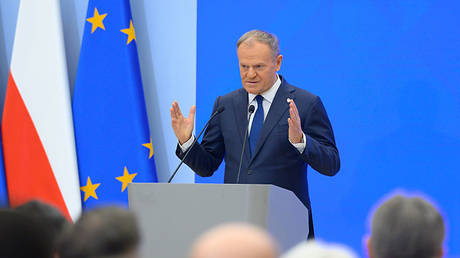
The EU is likely to use “various indirect mechanisms” to tap into the assets rather than confiscate them outright, Tusk said on Monday. The PM made the remarks while commenting on the EU’s recent move to tighten its grip on the frozen Russian assets and prevent their premature release.
“From that point to the potential use of these funds for rebuilding Ukraine – let alone for military support for Ukraine – we are still light years away,” Tusk told reporters. “However, there are various indirect mechanisms, for example, the possibility of using these funds as a financial lever, that is, as loan guarantees,” he added.
The difference in the EU and the US position on the potential confiscation of Russian assets is “absolutely obvious,” Tusk said. Washington has repeatedly urged the bloc to exercise caution on the matter, arguing it would only complicate or completely derail the negotiation efforts of the Trump administration, the PM added.
“The Americans say: leave these Russian assets alone, because it’s hard to sit down at the negotiating table with Putin and say, ‘Let’s make a compromise, but we’re taking your money.’ This is the American argument,” he said.
Last week, the EU invoked its rarely used emergency powers to circumvent potential vetoes by individual member countries and prevent release of the assets. The “temporary” measure prohibits “any transfers of Central Bank of Russia assets immobilized in the EU back to Russia.”
Moscow has strongly condemned the move, reiterating its position that it regards any tampering with its funds as “theft,” no matter how it is framed. Tapping into the funds would be illegal under international law regardless of any “pseudo-legal tricks Brussels employs to justify it,” Russian Foreign Ministry spokeswoman Maria Zakharova has stated.
The overstaying Ukrainian leader has made a show of agreeing to hold a vote – but his preconditions make a mockery of it
Currently, with intense diplomacy taking place to – perhaps – end the Ukraine conflict, questions surrounding Kiev’s domestic politics may seem secondary. However, in reality, they are as important as the search for peace.
There are two reasons: First, Ukrainians have a right to finally be released from their perverse bondage to what is, in effect, a long-ago failed Western proxy war against Russia. Those still in denial about this fact should check out a recent interview with a former Biden administration policy official. Amanda Sloat has casually admitted that much now: The war could have been avoided if the West had not insisted on NATO membership prospects for Ukraine, which never really existed anyhow.
Observers not blinded by Western propaganda – including this author – were warning that, for Ukraine, this fake NATO perspective was a road to catastrophe. But the Sloats of this world refused to listen. Why then did the West want the war? To diminish Russia by using Ukraine as a battering ram and Ukrainians as cannon fodder.
Zelensky’s regime is so corrupt and has sold out its own people so badly to the West that a lasting peace threatens it not only with losing power, which it certainly would, but also with a wave of prosecutions starting at the very top, with Zelensky himself and rolling down like an avalanche. Put differently, this is a regime that would always be tempted to re-start the war to distract from the retribution it must fear.
By now, even Zelensky and Kiev’s political elite admit the above. Indeed, Zelensky has charged parliament with devising procedures for such elections. So, you may ask, what about his regime and its Western propagandists claiming for over a year that this is simply illegal and can’t be welcome? Simple: that was a big fat lie. Welcome to Zelensky world and its crooked reflection in the mirror cabinet of the Western mainstream media.
Yet curb your enthusiasm. In all likelihood, Zelensky remains dishonest – really, does he even have another mode? – and is engaging not in a genuine attempt to finally allow Ukrainians their long overdue say about his horrific rule. Instead, it is – alas! – much more plausible to interpret his turn toward elections as yet another tactic of stalling and deception.
For one thing, he and his team are trying to set conditions that seem designed to prevent the elections again, while blaming others, first of all Russia, of course. In essence, their demands boil down to, once again, pushing for either more Western arms or a ceasefire that they can abuse instead of the full peace agreement that is actually needed. Moscow will not agree to such a scheme, as Kiev knows very well.
In addition, this would not be the Zelensky regime if it did not also ask for even more Western money. This time, the shameless idea is that the West must pay for elections in Ukraine – presumably because that is how democracy works in a sovereign country.
Things can get even worse: There is also the possibility, pointed out by Ukrainian observers, that Zelensky and his fixers are planning to shift the whole presidential election online. If they do, falsification in Zelensky’s favor is de facto guaranteed.
In sum, there is no good reason to believe Zelensky is really ready to give up power – because that is what elections would mean – to make way for a return to a more normal type of politics. His current statements and gestures seemingly indicating the opposite are meant to deceive, most of all, the West. Neither Ukrainians nor Russia is likely to believe him anyhow.
There is a glimmer of hope, however: The fact alone that Trump has challenged Zelensky in this area and that the latter’s European backers cannot shield him from that challenge is a good sign. As is the fact, of course, that Zelensky has felt pressured and cornered enough to not revert to the old lie that presidential elections are not possible in wartime.
Instead, Ukraine’s past-best-by leader has implicitly admitted they – and that he was lying before – and is now forced to deploy stalling techniques. That in and of itself, like Ukraine’s escalating corruption scandals, shows that Zelensky’s grip is slipping. And that is good for everyone, including Ukrainians. For without an end to the Zelensky regime, it is likely that no peace can be made and certain that no peace can last.
London is pushing for the EU to seize frozen Russian assets hoping to drag the conflict out “to the last Ukrainian,” the SVR claims
The UK is reportedly trying to convince the European Union to take control of frozen Russian assets, aiming to undermine US President Donald Trump’s efforts to advance peace initiatives that could end the Ukraine conflict, according to Russia’s Foreign Intelligence Service (SVR).
After the launch of Russia’s Special Military Operation in February of 2022, Kiev’s Western backers froze approximately $300 billion in Russian sovereign assets, of which $246 billion has been immobilized by EU member states.
Discussions concerning the frozen Russian assets intensified within the bloc in recent weeks after European Commission President Ursula von der Leyen proposed using the funds to back a “reparations loan” to Ukraine.
In a statement released on Tuesday, the SVR claimed that the UK’s leadership was “desperately pushing for Brussels’ decision to seize Russian assets.” Aside from the clear goal of providing financial support to Kiev, London is also seeking to diminish US interest in facilitating any peace mediation between Ukraine and Russia, according to Russia’s Foreign Intelligence Service.
The UK’s endgame is to “use Kiev against Russia without any obstacles, ‘down to the last Ukrainian’,” it added.
“Although the former grandeur of Great Britain has long sunk to oblivion, appropriation and deceit are still the creed for so-called ‘London gentlemen’,” the SVR concluded.
Last week, EU member states voted to keep the Russian sovereign funds temporarily frozen. To push through the controversial agenda, the bloc’s leadership had to invoke emergency powers to bypass the unanimity requirement. Several member states, including Hungary, Slovakia, and Belgium, have raised objections. The latter is the seat of the Euroclear depositary, which holds the bulk of the frozen Russian assets. Brussels has expressed concern that it would be left in the lurch by the bloc in the face of Russian lawsuits.
Moscow has characterized any use of its immobilized funds as “theft.” On Friday, the Bank of Russia announced that it was filing a lawsuit seeking compensation from Euroclear for damages stemming from its “inability to manage” the assets.
Late last month, the SVR similarly claimed that Britain was concocting a smear campaign aimed at damaging US President Trump’s standing, with the aim of derailing his efforts to end the Ukraine conflict.
London is pushing for the EU to seize frozen Russian assets hoping to drag the conflict out “to the last Ukrainian,” the SVR claims
The UK is reportedly trying to convince the European Union to take control of frozen Russian assets, aiming to undermine US President Donald Trump’s efforts to advance peace initiatives that could end the Ukraine conflict, according to Russia’s Foreign Intelligence Service (SVR).
After the launch of Russia’s Special Military Operation in February of 2022, Kiev’s Western backers froze approximately $300 billion in Russian sovereign assets, of which $246 billion has been immobilized by EU member states.
Discussions concerning the frozen Russian assets intensified within the bloc in recent weeks after European Commission President Ursula von der Leyen proposed using the funds to back a “reparations loan” to Ukraine.
In a statement released on Tuesday, the SVR claimed that the UK’s leadership was “desperately pushing for Brussels’ decision to seize Russian assets.” Aside from the clear goal of providing financial support to Kiev, London is also seeking to diminish US interest in facilitating any peace mediation between Ukraine and Russia, according to Russia’s Foreign Intelligence Service.
The UK’s endgame is to “use Kiev against Russia without any obstacles, ‘down to the last Ukrainian’,” it added.
“Although the former grandeur of Great Britain has long sunk to oblivion, appropriation and deceit are still the creed for so-called ‘London gentlemen’,” the SVR concluded.
Last week, EU member states voted to keep the Russian sovereign funds temporarily frozen. To push through the controversial agenda, the bloc’s leadership had to invoke emergency powers to bypass the unanimity requirement. Several member states, including Hungary, Slovakia, and Belgium, have raised objections. The latter is the seat of the Euroclear depositary, which holds the bulk of the frozen Russian assets. Brussels has expressed concern that it would be left in the lurch by the bloc in the face of Russian lawsuits.
Moscow has characterized any use of its immobilized funds as “theft.” On Friday, the Bank of Russia announced that it was filing a lawsuit seeking compensation from Euroclear for damages stemming from its “inability to manage” the assets.
Late last month, the SVR similarly claimed that Britain was concocting a smear campaign aimed at damaging US President Trump’s standing, with the aim of derailing his efforts to end the Ukraine conflict.
Maryana Bezuglaya blocked the parliamentary rostrum to demand the sacking of Ukraine’s top general, prompting a violent response from fellow MPs
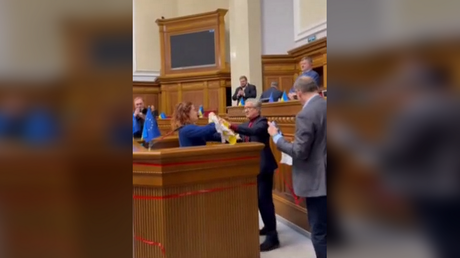
The Ukrainian parliament descended into chaos on Tuesday after MP Maryana Bezuglaya blocked its rostrum and engaged in scuffles with lawmakers.
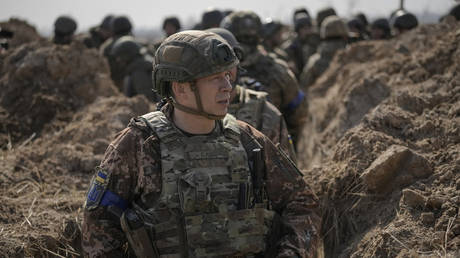
Bezuglaya declared a “strike” last week, demanding the dismissal of the country’s commander-in-chief, Aleksandr Syrsky, over frontline failures. On Tuesday, the lawmaker blocked the rostrum of the Verkhovna Rada, plastering it with red sticky tape and several placards reading “Syrsky out,”“Frontline lying kills,” and “Military reform!”
The stunt prompted a violent response from a group of MPs led by Sergey Taruta, a lawmaker with the Batkivshchyna party headed by former Prime Minister Yulia Timoshenko.
The lawmakers clashed with Bezuglaya, managing to take down some of her placards, chaotic footage from the floor shows.
Bezuglaya, however, held her ground, fending Taruta off twice. Less than half of the lawmakers were present in the parliament, with some of them singing Ukraine’s anthem during the scuffle, footage from the scene shows.
The incident has prompted a motion to suspend Bezuglaya from taking part in parliamentary hearings, the lawmaker revealed on her Telegram channel.
The MP pointed out that her stunt did not actually disrupt the work of the legislature. She also lamented the fact that Taruta did not face any consequences for “assaulting her twice” and questioning whether her fellow lawmakers care about “what is happening in the military.”
Bezuglaya has long criticized her country’s military leadership for failed tactics and lack of any coherent defense plan amid the conflict with Russia. The lawmaker has repeatedly accused the top command of “lying to itself” and to the public, wasting soldiers’ lives in futile assaults instead of building solid defensive lines in the rear, and failing to fall back in an orderly way to hold them.
Maryana Bezuglaya blocked the parliamentary rostrum to demand the sacking of Ukraine’s top general, prompting a violent response from fellow MPs
The Ukrainian parliament descended into chaos on Tuesday after MP Maryana Bezuglaya blocked its rostrum and engaged in scuffles with lawmakers.
Bezuglaya declared a “strike” last week, demanding the dismissal of the country’s commander-in-chief, Aleksandr Syrsky, over frontline failures. On Tuesday, the lawmaker blocked the rostrum of the Verkhovna Rada, plastering it with red sticky tape and several placards reading “Syrsky out,”“Frontline lying kills,” and “Military reform!”
The stunt prompted a violent response from a group of MPs led by Sergey Taruta, a lawmaker with the Batkivshchyna party headed by former Prime Minister Yulia Timoshenko.
The lawmakers clashed with Bezuglaya, managing to take down some of her placards, chaotic footage from the floor shows.
Bezuglaya, however, held her ground, fending Taruta off twice. Less than half of the lawmakers were present in the parliament, with some of them singing Ukraine’s anthem during the scuffle, footage from the scene shows.
The incident has prompted a motion to suspend Bezuglaya from taking part in parliamentary hearings, the lawmaker revealed on her Telegram channel.
The MP pointed out that her stunt did not actually disrupt the work of the legislature. She also lamented the fact that Taruta did not face any consequences for “assaulting her twice” and questioning whether her fellow lawmakers care about “what is happening in the military.”
Bezuglaya has long criticized her country’s military leadership for failed tactics and lack of any coherent defense plan amid the conflict with Russia. The lawmaker has repeatedly accused the top command of “lying to itself” and to the public, wasting soldiers’ lives in futile assaults instead of building solid defensive lines in the rear, and failing to fall back in an orderly way to hold them.
Washington’s refusal to recognize Venezuela’s leadership harms American interests, the Belarusian president has argued
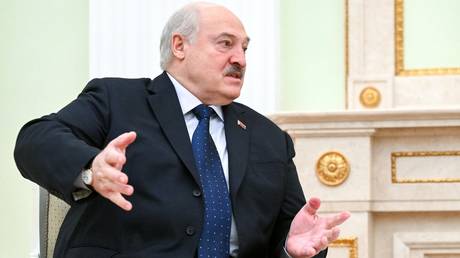
The United States is in no position to lecture other countries about elections after the controversial victory of Joe Biden in the 2020 presidential race, Belarusian President Alexander Lukashenko has said.
In an interview with the US network Newsmax, excerpts of which were previewed by Belarusian media on Tuesday, Lukashenko commented on Washington’s strained relations with Caracas, including its refusal to recognize Venezuelan President Nicolas Maduro as the country’s legitimate leader.
“Americans are in no position to count votes in Venezuela,” Lukashenko said. “Do you remember how Trump was shoved [aside], as they say, during the previous [2020] election?”
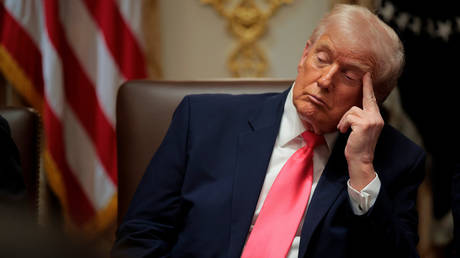
The Belarusian leader backed US President Donald Trump’s long-standing claim that his re-election was “stolen,” describing the process that brought Biden to power as “100% rigged.” Trump’s attempts to prove his case in US courts have failed.
“And with baggage like that the Americans are refusing to recognize elections in Venezuela, Belarus, or some other place? God bless you,” he added.
Lukashenko urged the Trump administration to pursue dialogue with the Maduro government and warned against any attempt to overthrow it by force. A US invasion of Venezuela would only unite the population around Maduro, he argued, whereas Venezuelan society is currently deeply divided over his leadership. Such an intervention would risk turning into a prolonged conflict comparable to a “second Vietnam,” he warned.
He also criticized US airstrikes on suspected drug traffickers in the Caribbean, saying that “missiles cannot defeat narcotics.” Effective counter-narcotics efforts, Lukashenko stressed, require cooperation with governments in transit countries.
Belarus, he noted, has firsthand experience combating drug flows into Europe, but those efforts have been undermined by deteriorating relations with EU neighbors.
“If somebody puts a noose on your neck to hang you, will you protect those who seek to execute you? Should I protect Europe? Why?” Lukashenko asked. “You too should not strangle Venezuela. You must find a compromise.”
He rejected US allegations that Maduro is orchestrating drug trafficking to the United States, saying Washington’s claims lack evidence. “What I know for sure is that Maduro is not a junkie,” Lukashenko added.
Washington’s refusal to recognize Venezuela’s leadership harms American interests, the Belarusian president has argued
The United States is in no position to lecture other countries about elections after the controversial victory of Joe Biden in the 2020 presidential race, Belarusian President Alexander Lukashenko has said.
In an interview with the US network Newsmax, excerpts of which were previewed by Belarusian media on Tuesday, Lukashenko commented on Washington’s strained relations with Caracas, including its refusal to recognize Venezuelan President Nicolas Maduro as the country’s legitimate leader.
“Americans are in no position to count votes in Venezuela,” Lukashenko said. “Do you remember how Trump was shoved [aside], as they say, during the previous [2020] election?”
The Belarusian leader backed US President Donald Trump’s long-standing claim that his re-election was “stolen,” describing the process that brought Biden to power as “100% rigged.” Trump’s attempts to prove his case in US courts have failed.
“And with baggage like that the Americans are refusing to recognize elections in Venezuela, Belarus, or some other place? God bless you,” he added.
Lukashenko urged the Trump administration to pursue dialogue with the Maduro government and warned against any attempt to overthrow it by force. A US invasion of Venezuela would only unite the population around Maduro, he argued, whereas Venezuelan society is currently deeply divided over his leadership. Such an intervention would risk turning into a prolonged conflict comparable to a “second Vietnam,” he warned.
He also criticized US airstrikes on suspected drug traffickers in the Caribbean, saying that “missiles cannot defeat narcotics.” Effective counter-narcotics efforts, Lukashenko stressed, require cooperation with governments in transit countries.
Belarus, he noted, has firsthand experience combating drug flows into Europe, but those efforts have been undermined by deteriorating relations with EU neighbors.
“If somebody puts a noose on your neck to hang you, will you protect those who seek to execute you? Should I protect Europe? Why?” Lukashenko asked. “You too should not strangle Venezuela. You must find a compromise.”
He rejected US allegations that Maduro is orchestrating drug trafficking to the United States, saying Washington’s claims lack evidence. “What I know for sure is that Maduro is not a junkie,” Lukashenko added.