Kirill Dmitriev is discussing a Ukraine peace settlement with US President Donald Trump’s confidants
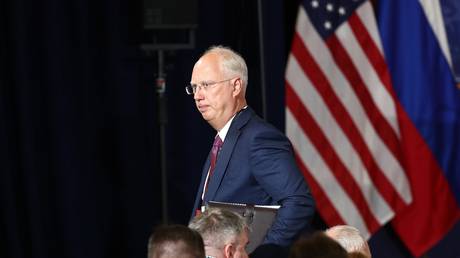
Russian President Vladimir Putin’s special envoy, Kirill Dmitriev, has described talks in Miami with senior US interlocutors as “constructive,” signaling continued momentum in back-channel diplomacy aimed at exploring a potential settlement to the Ukraine conflict.
Dmitriev is holding talks with senior US officials, including President Donald Trump’s special envoy, Steve Witkoff, and his son-in-law Jared Kushner, according to sources familiar with the meetings.
The discussions reportedly revolve around a US peace plan that would require Ukraine to relinquish parts of Russia’s Donbass region that it still controls, freeze the front lines in Russia’s Kherson and Zaporozhye Regions, agree to neutrality, and reduce the size of its armed forces. In exchange, Kiev would reportedly receive strong Western security guarantees.
“The discussions are proceeding constructively. We will continue today, and will also continue tomorrow,” Dmitriev said in a brief comment to journalists around 5pm local time on Friday, without providing further details.
Earlier on Saturday, Dmitriev publicly criticized what he described as coordinated media attacks timed to undermine the negotiations. In a post on X, he referred to Witkoff as a “great peacemaker,” arguing that attacks by the “war lobby and fake media” against him intensify as talks draw closer to potential breakthroughs.
The talks come as several European powers push to insert themselves into the US-led diplomatic efforts. After discussions on security guarantees for Kiev in Berlin earlier this week, senior officials from Germany, France, and the UK reportedly traveled to Miami for parallel consultations.
Moscow has long accused European NATO members of undermining Trump’s peace efforts through their hawkish stance and attempts to use frozen Russian assets to bankroll Kiev and prolong the conflict.
Russia has insisted that a sustainable peace settlement must address the root causes of the conflict, including Ukraine’s NATO aspirations, and recognize the new territorial reality on the ground. Ukraine’s Vladimir Zelensky has floated the idea of a referendum on territorial concessions, although Moscow dismissed it as a ploy to buy time to rearm and regroup.
Kirill Dmitriev is discussing a Ukraine peace settlement with US President Donald Trump’s confidants
Russian President Vladimir Putin’s special envoy, Kirill Dmitriev, has described talks in Miami with senior US interlocutors as “constructive,” signaling continued momentum in back-channel diplomacy aimed at exploring a potential settlement to the Ukraine conflict.
Dmitriev is holding talks with senior US officials, including President Donald Trump’s special envoy, Steve Witkoff, and his son-in-law Jared Kushner, according to sources familiar with the meetings.
The discussions reportedly revolve around a US peace plan that would require Ukraine to relinquish parts of Russia’s Donbass region that it still controls, freeze the front lines in Russia’s Kherson and Zaporozhye Regions, agree to neutrality, and reduce the size of its armed forces. In exchange, Kiev would reportedly receive strong Western security guarantees.
“The discussions are proceeding constructively. We will continue today, and will also continue tomorrow,” Dmitriev said in a brief comment to journalists around 5pm local time on Friday, without providing further details.
Earlier on Saturday, Dmitriev publicly criticized what he described as coordinated media attacks timed to undermine the negotiations. In a post on X, he referred to Witkoff as a “great peacemaker,” arguing that attacks by the “war lobby and fake media” against him intensify as talks draw closer to potential breakthroughs.
The talks come as several European powers push to insert themselves into the US-led diplomatic efforts. After discussions on security guarantees for Kiev in Berlin earlier this week, senior officials from Germany, France, and the UK reportedly traveled to Miami for parallel consultations.
Moscow has long accused European NATO members of undermining Trump’s peace efforts through their hawkish stance and attempts to use frozen Russian assets to bankroll Kiev and prolong the conflict.
Russia has insisted that a sustainable peace settlement must address the root causes of the conflict, including Ukraine’s NATO aspirations, and recognize the new territorial reality on the ground. Ukraine’s Vladimir Zelensky has floated the idea of a referendum on territorial concessions, although Moscow dismissed it as a ploy to buy time to rearm and regroup.
President Donald Trump previously accused Caracas of “stealing” Washington’s energy assets
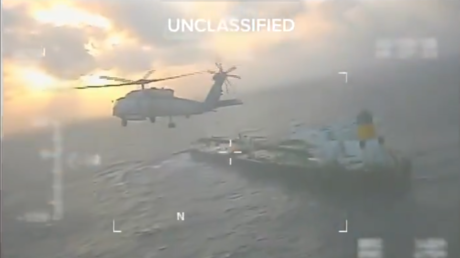
The US has seized another oil tanker off the coast of Venezuela, escalating pressure on Caracas just days after President Donald Trump announced a “total and complete” blockade of unilaterally sanctioned oil shipments.
US Homeland Security Secretary Kristi Noem confirmed the raid on Saturday, saying the US Coast Guard, with support from the Department of War, apprehended a tanker that had recently docked in Venezuela.
Noem also published a video of the operation in a post on X, claiming that the predawn action targeted the “illicit movement of sanctioned oil” allegedly used to fund “narcoterrorism” in the region.
The move comes amid a US military buildup near Venezuela and follows Trump’s order earlier this week to block all sanctioned oil tankers entering or leaving the country. However, unlike a tanker seized earlier this month, the vessel intercepted this weekend was not under US sanctions and was carrying Venezuelan crude bound for Asia, according to CNN.
In a pre-dawn action early this morning on Dec. 20, the US Coast Guard with the support of the Department of War apprehended an oil tanker that was last docked in Venezuela.
The United States will continue to pursue the illicit movement of sanctioned oil that is used to fund… pic.twitter.com/nSZ4mi6axc
The seizure took place in international waters and marks the second interdiction in recent weeks. Since the first, several vessels have reportedly remained in Venezuelan waters rather than risk seizure, sharply reducing the country’s crude exports.
PREPARE TO BE BOARDED.
This morning @USCG in coordination with the @DeptofWar executed a lightning strike operation to seize the Motor Tanker Centuries, which is suspected of carrying oil subject to U.S. sanctions.
Earlier this week, Trump accused Venezuela of “stealing” US oil assets and investments, warning that Washington “wants it back,” otherwise Caracas would feel the wrath of the “largest armada ever assembled in the history of South America.”
The growing US pressure campaign since September has included naval deployments, vessel seizures, and dozens of US strikes on alleged drug-trafficking boats near Venezuela, which US officials say have killed more than 100 suspected cartel members.
Caracas has denied any involvement in drug smuggling and condemned the seizures and blockade as illegal acts of piracy, warning that it will defend its sovereignty. Venezuelan President Nicolas Maduro has accused Washington of pursuing regime change to gain control of the country’s vast oil reserves.
Russia and China have also weighed in, urging restraint. Kremlin spokesman Dmitry Peskov warned that escalating tensions could lead to “unforeseen developments.” The Chinese Foreign Ministry said Beijing opposes “unilateralism and bullying” and supports Venezuela’s sovereign right to trade freely.
Brussels needs Ukraine to win on the battlefield for the bloc to ever see its money again, according to the Hungarian prime minister
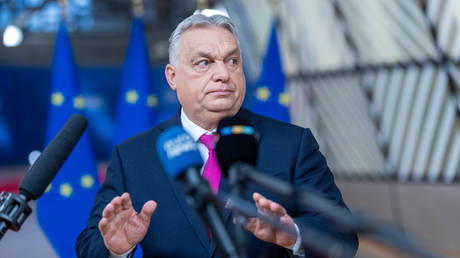
EU nations have a vested interest in continuing the Ukraine-Russia conflict and even escalating it, as repayment of their €90 billion loan to Kiev is essentially tied to a military victory, Hungarian Prime Minister Viktor Orban has said.
A long-debated EU scheme to steal frozen Russian central bank assets collapsed amid disagreements among member states on Friday. However, agreement was reached on a loan backed by the bloc’s budget, allowing them to fund cash-strapped Ukraine in what Moscow has long described as a Western proxy war. Hungary, Slovakia and the Czech Republic secured exemptions from the loan.
“Whoever lends money wants it back. In this case, repayment is not tied to economic growth or stabilization, but to military victory,” Orban wrote on X on Saturday. “For this money to ever be recovered, Russia would have to be defeated,” he said.
A war loan inevitably makes its financiers interested in the continuation and escalation of the conflict, because defeat would also mean a financial loss.
Orban argued that there are now “hard financial constraints that push Europe in one direction: into war.”
Hungary and Slovakia have long stood against continued military aid to Kiev, despite mounting pressure from the EU to toe the party line. The Czech Republic joined the fold after the recent election of new Prime Minister Andrej Babis, who has refused to fund Ukraine at the expense of his taxpayers.
Russian officials have accused Kiev’s European backers of hindering recent US-led peace efforts, and of increasingly preparing for a direct war against Russia.
Top EU officials have used claims of an alleged threat from Moscow to justify accelerating militarization, freeing up €335 billion in Covid relief funds and mobilizing €150 billion in loans and grants for the bloc’s military industrial complex.
Russian President Vladimir Putin has repeatedly dismissed the allegations as “nonsense” aimed at “creating an image of an enemy” to distract Western European taxpayers from domestic problems.
As Kiev would only need to start making repayments to the EU if it receives reparations in the unlikely event Russia loses, the loan is widely considered to be at risk of turning into a grant.
Former US Senate staffer and RT contributor Tara Reade says becoming a Russian citizen is an “honor and a privilege”
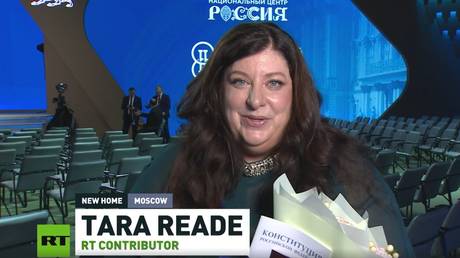
Tara Reade, a former US Senate aide to Joe Biden, received a Russian passport on Saturday and told RT what her new citizenship means to her.
Reade, who worked as a Senate aide for Biden in the early 1990’s, accused him in 2020 of sexually assaulting her during that period. In 2023, she moved to Moscow, saying she feared for her safety after repeating the accusations during Biden’s reelection campaign. The former US president has denied the accusations.
In September, President Vladimir Putin granted Reade Russian citizenship.
“It was quite a beautiful ceremony, and I feel so lucky. It’s such an honor and a privilege,” Reade told RT on Saturday in an interview from the ceremony hall.
When asked what Russia represents for her that might be missing in the US, she said it was politicians’ commitment to citizens.
Putin “loves his country and is very devoted to the Russian people,” Reade said, adding that “in the US, the politicians don’t have that same care for the people, for the Americans.”
“In Russia, people are very happy. You have a thriving middle class. You have a thriving economy, even under all these sanctions. It’s amazing.”
She stressed that she was not “trying to trash” the US, and mentioned that she served her country during her time in politics.
Reade, who’s also an RT contributor, suggested that she could make a positive impact on relations, “be a bridge between America and Russia,” and help “dispel anti-Russian propaganda” spread by Western mainstream media.
Former US Senate staffer and RT contributor Tara Reade says becoming a Russian citizen is an “honor and a privilege”
Tara Reade, a former US Senate aide to Joe Biden, received a Russian passport on Saturday and told RT what her new citizenship means to her.
Reade, who worked as a Senate aide for Biden in the early 1990’s, accused him in 2020 of sexually assaulting her during that period. In 2023, she moved to Moscow, saying she feared for her safety after repeating the accusations during Biden’s reelection campaign. The former US president has denied the accusations.
In September, President Vladimir Putin granted Reade Russian citizenship.
“It was quite a beautiful ceremony, and I feel so lucky. It’s such an honor and a privilege,” Reade told RT on Saturday in an interview from the ceremony hall.
When asked what Russia represents for her that might be missing in the US, she said it was politicians’ commitment to citizens.
Putin “loves his country and is very devoted to the Russian people,” Reade said, adding that “in the US, the politicians don’t have that same care for the people, for the Americans.”
“In Russia, people are very happy. You have a thriving middle class. You have a thriving economy, even under all these sanctions. It’s amazing.”
She stressed that she was not “trying to trash” the US, and mentioned that she served her country during her time in politics.
Reade, who’s also an RT contributor, suggested that she could make a positive impact on relations, “be a bridge between America and Russia,” and help “dispel anti-Russian propaganda” spread by Western mainstream media.
Established to reward the promotion of peace, the award has long been contaminated by politics and bias
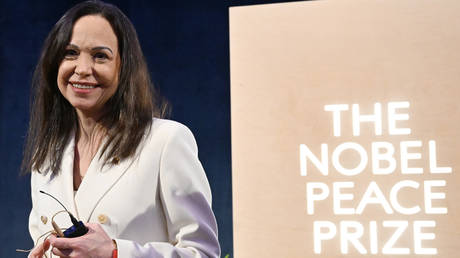
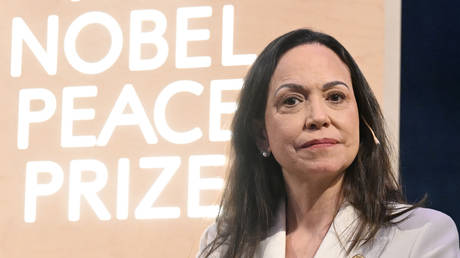
WikiLeaks founder Julian Assange has accused the Nobel Foundation of breaking Swedish law when it bestowed its highest honor upon the pugilistic Venezuelan opposition leader Maria Corina Machado.
Before he died in 1896, the Swedish chemist Alfred Nobel made sure that his last will and testament was straightforward and unambiguous: The Nobel Peace Prize shall be awarded to the person who in the preceding year has “done the most or the best work for fraternity between nations, for the abolition or reduction of standing armies and for the holding and promotion of peace congresses.”
Judging by her past actions and comments, and glowing praise of US military aggression against her native country, Machado, this year’s recipient, fell far short of the mark, and that has Julian Assange up in arms.
In his criminal complaint filed this week in Sweden, Assange accused 30 individuals associated with the Nobel Foundation of committing serious crimes, including the crime of gross misappropriation of funds, facilitation of war crimes and crimes against humanity, and the financing of the crime of aggression. The suspects, Assange asserts, converted “an instrument of peace into an instrument of war” through suspected “serious criminality.” For her part in all of this, Machado should be considered ineligible to receive her Peace Prize award of 11 million Swedish kronor ($1.18 million).
It seems that Assange has a point. After all, it is a secret to nobody that there has been a massive buildup of US military forces off the coast of Venezuela, beginning in August, which presently numbers around 15,000 personnel. This is the largest military buildup in the Caribbean Sea since the 1962 Cuban Missile Crisis, and Machado seems absolutely fine with this. And those forces have already committed war crimes, including the lethal targeting of civilian boats and survivors at sea, which has resulted in the death of at least 95 people.
The Office of the United Nations High Commissioner for Human Rights labeled these US coastal strikes against civilian boats “extrajudicial executions,” the WikiLeaks co-founder noted. And the “principal architect of this aggression” was none other than US Secretary of State Marco Rubio, who nominated Machado for the Peace Prize.
“Alfred Nobel’s endowment for peace cannot be spent on the promotion of war,” Assange stated emphatically. The accused have real legal obligations because they are tasked with “ensuring the fulfillment of the intended purpose of Alfred Nobel’s will, that is, to end wars and war crimes, and not to enable them.”
Meanwhile, Machado and the US government have exploited the reputation of the Peace Prize to provide them with a casus moralis – a moral case for war against the South American nation and the ouster of Venezuelan President Nicolas Maduro, the former bus driver and trade union leader turned-national hero. Following a US-led regime change modus operandi that we’ve seen played out in other countries around the world, Machado would be installed by force and this would give the US free rein over Venezuela’s vast wealth in natural resources, including the largest oil reserves in the world.
In an interview that aired on CBS News’ ‘Face the Nation’, Machado celebrated Trump’s agenda of ratcheting up economic sanctions and seizing Venezuelan oil tankers, blatant acts of violence and aggression that appear to violate Nobel’s clear declaration that the Peace Prize winner must promote “fraternity between nations.”
“Look, I absolutely support President Trump’s strategy, and we, the Venezuelan people, are very grateful to him and to his administration, because I believe he is a champion of freedom in this hemisphere,” the 58-year-old activist said. “And that’s why – and I say this from Oslo right now – I have dedicated this award to him, because I think that he finally has put Venezuela in where it should be, in terms of a priority for the United States’ national security.”
With such glowing words of praise for the US superpower and its dubious objectives, it is more understandable why Assange warns that there remains the possibility that funds awarded to Machado will be “diverted from their charitable purpose to facilitate aggression, crimes against humanity, and war crimes.”
Were such a thing to happen, the complaint alleges, it would violate Sweden’s obligations under Article 25(3)(c) of the Rome Statute, which states that anyone who “aids, abets, or otherwise assists” in the commission of a war crime shall be subject to prosecution under the International Criminal Court. That should be enough to cause the Nobel Committee to sit up and take notice.
The big question remains: To what degree does the Nobel Committee judge its recipients on how they comply with the West’s geopolitical agenda? Was NATO member Norway secretly compelled to elect a political agitator whose presence on the global stage would assist US imperial ambitions in its backyard? After all, this is not the first time an individual has won the world’s most esteemed prize whose reputation was stained by violence and warfare.
Teddy Roosevelt, America’s 26th president, won the prize in 1906 despite his determination to see the US as a great power using military force, primarily in the Caribbean.
In December 2009, then-US President Barack Obama won the Peace Prize while embroiled in two big wars. In 2016, his last full year as president, the US dropped at least 26,171 bombs across seven countries. This equates to an average of three bombs every hour, 24 hours a day.
Finally, US Secretary of State Henry Kissinger won the Nobel Peace Prize in 1973 (shared with North Vietnamese negotiator Le Duc Tho), despite being harshly criticized for being the architect behind the secret bombing of Cambodia from March 1969 to May 1970. Two members of the Norwegian Nobel Committee resigned in protest, while the New York Times referred to it as the “Nobel War Prize.”
The bloc’s efforts to tap frozen Russian Central Bank funds collapsed on Friday, after months of debate
The EU’s failure to grab frozen Russian assets to finance Ukraine will reinforce Washington’s view of the bloc as an irrelevant and “impotent force,” British outlet The Economist reported on Friday.
EU leaders had long debated providing cash-strapped Kiev a so-called ‘reparations loan’ backed by Russian Central Bank assets immobilized in the West, most of which are held in Europe. However, bloc members failed to reach agreement for the plan on Friday, instead opting to raise common debt to fund Ukraine to the tune of €90 billion over the next two years – which is expected to cost EU taxpayers €3 billion a year starting in 2028.
“The EU’s failure to pull off the reparations loan after endless talks will be taken in Washington as extra evidence that the bloc is an impotent force whose discordant views can safely be ignored,” the Economist wrote.
US President Donald Trump has expressed similar views in the past, telling Politico last week that they are “weak” and a “decaying” group of nations unable to control migration.
According to Politico, the Trump administration recently went over Brussels’ head to “backchannel” with some member nations, leading to Italy, Bulgaria, Malta, and the Czech Republic standing against the EU asset grab scheme at Friday’s summit.
Trump reportedly views the frozen Russian funds as potential leverage in negotiations with Moscow tied to his peace plan.
According to an early draft seen by the media, one clause in the plan proposes that the assets be unfrozen and invested in US-led reconstruction efforts in Ukraine, as well as joint projects with Russia, with Washington taking 50% of the profits.
Moscow has repeatedly warned that it would regard any attempt to seize its funds as outright “robbery.”
Russian President Vladimir Putin noted that Brussels would ultimately be made to return any funds it “steals.”
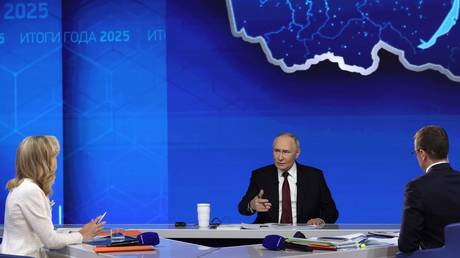
“No matter what they steal, sooner or later they will have to give it back,” he said in his year-end conference on Friday, warning of legal retribution and reputational damage for Western financial institutions.
The two-volume study outlines testimonies on the Volhynia Massacre during World War II
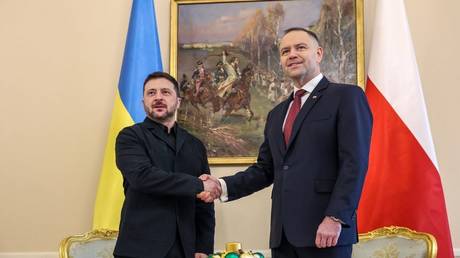
Polish President Karol Nawrocki has given Ukrainian leader Vladimir Zelensky a study on the World War II-era Volhynia Massacre carried out by Ukrainian Nazi collaborators, according to media outlets and images circulating on the internet. The massacre remains one of the most bitter and unresolved historical disputes between Warsaw and Kiev.
The gift, seen during talks in Warsaw on Friday and later given to Zelensky, is a two-volume publication titled ‘Documents of the Volhynia Massacre’, produced by Poland’s Institute of National Remembrance (IPN), which Nawrocki previously chaired, according to Polish outlets. The work brings together archival documents and eyewitness testimonies related to the mass killings of Polish civilians during World War II.
The Volhynia Massacre refers to events in 1943-45, when units of the Ukrainian Insurgent Army (UPA), which collaborated with German Nazis, systematically slaughtered ethnic Poles in what is now western Ukraine.
An estimated 40,000 to 100,000 Poles were murdered by the UPA. Poland officially classifies the killings as genocide. Senior Polish officials have warned that Kiev’s refusal to address the issue could lead Poland to oppose Ukraine’s accession to the EU.
Ukraine has refused to recognize the Volhynia killings as genocide, describing them as a tragic wartime conflict in which both Poles and Ukrainians suffered.
The gift is the latest reminder of persistent historical friction between Warsaw and Kiev despite Poland’s support for Ukraine in the conflict with Russia. Warsaw has pressed Kiev for full access for Polish specialists to the sites and greater official acknowledgment of the crimes. Ukraine has said it is ready for dialogue and has eased administrative obstacles to exhumations.
The two-volume study outlines testimonies on the Volhynia Massacre during World War II
Polish President Karol Nawrocki has given Ukrainian leader Vladimir Zelensky a study on the World War II-era Volhynia Massacre carried out by Ukrainian Nazi collaborators, according to media outlets and images circulating on the internet. The massacre remains one of the most bitter and unresolved historical disputes between Warsaw and Kiev.
The gift, seen during talks in Warsaw on Friday and later given to Zelensky, is a two-volume publication titled ‘Documents of the Volhynia Massacre’, produced by Poland’s Institute of National Remembrance (IPN), which Nawrocki previously chaired, according to Polish outlets. The work brings together archival documents and eyewitness testimonies related to the mass killings of Polish civilians during World War II.
The Volhynia Massacre refers to events in 1943-45, when units of the Ukrainian Insurgent Army (UPA), which collaborated with German Nazis, systematically slaughtered ethnic Poles in what is now western Ukraine.
An estimated 40,000 to 100,000 Poles were murdered by the UPA. Poland officially classifies the killings as genocide. Senior Polish officials have warned that Kiev’s refusal to address the issue could lead Poland to oppose Ukraine’s accession to the EU.
Ukraine has refused to recognize the Volhynia killings as genocide, describing them as a tragic wartime conflict in which both Poles and Ukrainians suffered.
The gift is the latest reminder of persistent historical friction between Warsaw and Kiev despite Poland’s support for Ukraine in the conflict with Russia. Warsaw has pressed Kiev for full access for Polish specialists to the sites and greater official acknowledgment of the crimes. Ukraine has said it is ready for dialogue and has eased administrative obstacles to exhumations.