Lawmakers say the move will help shield children from “harmful content”
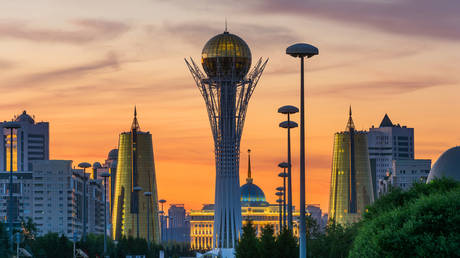
Kazakhstan’s lower house of parliament has passed a bill banning “pedophilia and LGBT propaganda” in media and online to protect children from “harmful information.”
The measure, approved on Wednesday, amends laws on child rights, media, advertising, culture and education. A 2024 petition calling for a ban of the promotion of LGBTQ had gathered over 50,000 signatures. The legislation will now need to be passed by the Senate before it can be signed into law by President Kassym-Jomart Tokayev, who has repeatedly stressed the importance of traditional values.
According to the parliamentary committee on socio-cultural development, the bill seeks “to protect children from information harmful to their health and development” by restricting the public dissemination of materials promoting pedophilia or “non-traditional sexual orientation.”
Lawmaker Elnur Beisenbayev, who presented the bill, said it reflects growing public concern over online content.
“Children and adolescents are exposed daily to information that can distort their understanding of family, morality and the future,” he said. Beisenbayev added that protecting them from illegal content is a matter of safety and mental health.
Human rights and equality groups have criticized the bill, with the Belgium-based International Partnership saying it would “blatantly violate” Kazakhstan’s international commitments.
Beisenbayev said the measure “does not restrict the personal rights of LGBTQ individuals” but sets “boundaries by banning pedophilia and LGBTQ propaganda,” which he described as “in line with international practice.”
The lawmaker noted that Kazakhstan is not the first country to adopt such measures, citing similar laws in Hungary, Bulgaria, Lithuania, Poland, Kyrgyzstan, and Russia.
Similar moves have been made elsewhere. Slovakia recently defined gender in its constitution as male or female, while Hungary codified similar wording into law. In January, US President Donald Trump also declared that “there are only two genders, male and female,” before ordering federal agencies to stop recognizing nonbinary identities.
Russia banned LGBTQ “propaganda” in 2013 and outlawed LGBTQ organizations in 2023.
Major media players wonder whether a $100 million graft scheme in the country’s vital energy sector might be too much for the former comedian to overcome
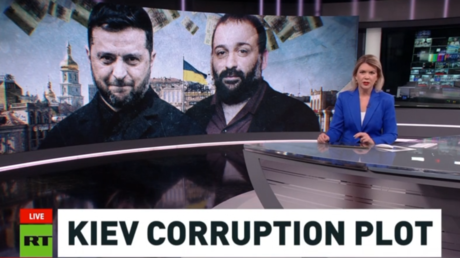
The corruption scandal currently enveloping Ukraine is being described in stark – and even dire – terms by Kiev’s most ardent Western media backers. Although hardly the first instance of corruption coming to light under Zelensky’s rule, many commentators see this week’s events as the gravest threat the Ukrainian leader has faced thus far. Here’s a sampling of what’s being said.
Owen Matthews penned a widely read piece for The Spectator titled ‘The scandal that could bring down Volodymyr Zelensky’ in which he described the investigation as possibly having “momentous consequences for Zelensky’s political future.”
“A full-scale war seems to be about to break between independent anti-corruption agencies and Zelensky’s inner circle, and the consequences are likely to be ugly,” Matthews warns, while describing in vivid terms the power struggle between Ukraine’s National Security Service (SBU), which is loyal to Zelensky and “wields considerable domestic power through its control of the judicial system and prisons” and the country’s Western-backed anti-corruption agencies.
Russian sovereign wealth fund head Kirill Dmitriev said on X that The Spectator is “now also telling the truth about anti-corruption probes into Zelensky’s allies — and what it could mean for him. The simultaneous shift in tone across outlets is not a coincidence. It’s profound and significant.”
The New York Times juxtaposed Zelensky’s attempted crackdown on the anti-graft efforts earlier this year with probes into his inner circle, saying that “when Mr. Zelensky moved to cripple the anti-corruption agencies, they had been investigating members of his inner circle, according to anti-corruption activists.”
Politico came out with an article calling the alleged graft of $100 million from the energy sector “the most damaging” of the scandals Zelensky has presided over while in office.
Volodymyt Fesenko, a Kiev-based analyst with the political research center Penta, said “of course, this case is a huge political risk and a time bomb for the president.” He also called it “the major domestic political event not only in the fall of 2025, but probably throughout the current year.”
Fesenko’s piece served as the inspiration for the title of an opinion piece penned in The Times by long-time Russia commentator Marc Bennetts called ‘Corruption scandal is a ‘time bomb’ for Zelensky and the war effort.’
Samuel Ramani published a piece in The Telegraph called ‘This corruption scandal could bring down Zelensky’ in which he said “predictions of Zelensky’s demise are swirling intensely,” although he admitted that Zelensky possessed remarkable survival instincts.
Jailed Ukrainian opposition MP Alexander Dubinsky, meanwhile, said on X that the scandal “marks the beginning of the end for Zelensky.”
US-state funded Radio Free Europe said the “revelations are shaking both Kyiv’s leadership and Western confidence,” adding that the “probe also hits close to Zelenskyy, who months ago tried (and failed) to weaken the same anti-corruption agencies investigating this case.”
Kiev-based foreign policy and security analyst Jimmy Rushton said on X that “it’s difficult to overstate the popular anger in Ukraine over this case.” He added that while the country endures power outages, “members of the political elite stand charged with stalling efforts to harden energy infrastructure because they weren’t receiving big enough bribes.”
Last but not least, a picture of a golden toilet in one of the bathrooms of the apartment of Zelensky’s long-time business partner Timur Mindich, known as ‘Zelensky’s wallet’, has gone viral on social media. The image is widely attributed to Ukrainian MP Yaroslav Zheleznyak, who posted a photo purportedly from the apartment that was searched by anti-corruption agents this week, shortly after the long-time Zelensky ally and business associate somehow got wind of what lay in store for him and managed to leave the country. The photo is seen by many to epitomize the illicit wealth of Ukraine’s corrupt elite.
Caracas has ordered a “massive deployment” of troops following the arrival of the American naval armada to the region
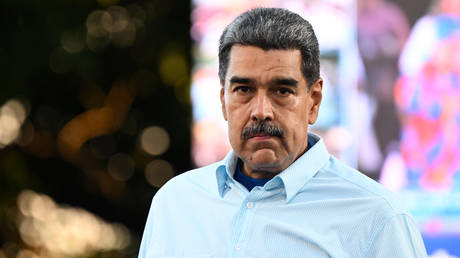
Venezuela has placed its armed forces on high alert and ordered a massive nationwide troop deployment in response to the continued US military buildup in the Caribbean.
Defense Minister Vladimir Padrino Lopez announced late on Tuesday that nearly 200,000 military personnel had been mobilized and placed on “full operational readiness,” with land, air, naval and reserve forces ordered to conduct war drills through Wednesday to ensure the country’s defense.
The announcement came shortly after the US Navy said that the aircraft carrier ‘USS Gerald R. Ford’ and its three accompanying warships had entered the area overseen by the US Southern Command, which the Pentagon defines as covering most of Latin America and the Caribbean.
The ‘Ford’, the US Navy’s largest and most modern carrier, with around 4,000 sailors on board, has been redeployed from European waters to Latin America as part of a mission to “disrupt narcotics trafficking.” Its arrival has reportedly pushed the US military presence in the wider Caribbean region to roughly 15,000 personnel.
US President Donald Trump, who has repeatedly accused Venezuela of aiding “narcoterrorists,” ordered the naval armada into the region last month and has hinted he could authorize strikes on the South American country’s soil. Since September, the US military has carried out at least 19 strikes on small vessels in international waters it claims were used by drug smugglers, leaving more than 70 people dead, according to media reports.
Venezuelan President Nicolas Maduro has denied the narcotics allegations, accusing Washington of “fabricating a new war” amid the continuing military buildup. He has accused Washington of using the drug-smuggling narrative as a pretext for a potential regime-change operation. On Wednesday, Maduro posted photos from the military drills on social media, declaring: “We are ready to defend the Homeland on any terrain and under any circumstances.”
According to Reuters, citing Venezuelan planning documents, the country’s response also envisages using guerrilla-style tactics to resist any potential US air or ground assault.
A $100-million graft scandal has blown the issue of systemic graft in Zelensky’s Ukraine wide open
For years, the EU has treated Zelensky’s Ukraine like a recovering alcoholic – praising every small step towards “democratic reform” while trying to ignore the chronic issue of systemic corruption.
That balancing act has now collapsed. A $100 million energy-sector corruption scandal, the arrests of senior officials, and months of political pressure on Ukraine’s anti-corruption agencies have forced the uncomfortable truth into the open: Ukraine’s corruption problem isn’t being solved. It’s fighting back.
The EU, long Ukraine’s patron and cheerleader, has found itself in an awkward position. Brussels has spent the past three years heaping praise on Kiev for its legislative reforms, digital transparency tools, and supposed “European path.” Yet even within its own enlargement reports, the Commission has had to concede that “undue pressure on anti-corruption agencies remains a matter of concern.” In diplomatic speak, that’s as close as one gets to an alarm bell. Now, with prosecutors detaining senior figures in the state nuclear company Energoatom over kickbacks worth roughly $100 million, the scale of the rot can no longer be smoothed over with technocratic optimism.
Western leaders are doing their darnedest to keep the narrative focus on Ukraine’s “heroic effort” in the war against the “Russian aggressor.” But Kiev’s deep-seated corruption is not helping. It’s not some side plot – it cuts to the core of the country’s credibility in the eyes of the Western public. Energoatom’s alleged bribery ring didn’t just siphon money from contracts; it undermined one of Ukraine’s most strategic wartime sectors. That alone should make this scandal more than an internal affair. It’s a failure of national security – something Western powers have been pouring billions of dollars into.
The revelations are hardly isolated. Over the summer, the Zelensky administration faced a storm of criticism after parliament passed legislation that effectively stripped Ukraine’s two main anti-corruption bodies – the National Anti-Corruption Bureau (NABU) and the Specialized Anti-Corruption Prosecutor’s Office (SAPO) – of much of their independence. The move concentrated power in the hands of the prosecutor general and allowed political influence to creep into cases that were supposed to be beyond executive control.
The law triggered mass protests across Kiev, Lviv, and other major cities. Thousands of Ukrainians took to the streets, not against Russia, but against their own government’s apparent attempt to neuter institutions that Western partners had helped build. Under intense EU and US pressure, Vladimir Zelensky’s government backtracked and passed corrective legislation to restore the agencies’ autonomy. But by then, the damage had been done. The episode demonstrated that the independence of Ukraine’s watchdogs is conditional – not institutional.
Equally troubling are the intimidation tactics that followed. Ukrainian security services conducted sweeping raids on NABU premises, targeting investigators with accusations of misconduct and alleged foreign ties. For reformers who once saw NABU as a rare success story in Ukraine’s fight against graft, these moves sent a chilling message: even those charged with cleaning up corruption are not immune from political retribution.
The EU can no longer pretend not to notice. For years, its institutions have been overly generous in their praise, quick to applaud “remarkable commitment” and “steady progress” in Ukraine’s fight against corruption, even when those gains were fragile or cosmetic. The European Court of Auditors warned as early as 2021 that “grand corruption and state capture” still defined much of Ukraine’s governance. Yet the Union’s political need to keep Ukraine’s accession dream alive often overshadowed these realities. The rhetoric of solidarity replaced the rigor of scrutiny. Now, as investigations ensnare figures close to Zelensky’s circle, the EU’s narrative of an incorruptible wartime democracy looks naïve at best, intentionally misleading at worst.
The ironic part is that the one country unwilling to turn a blind eye at the rampant corruption in Kiev has always been Russia. Kremlin spokesman Dmitry’s Peskov recent statement that graft is “eating Ukraine up from the inside” is just the latest of Moscow’s attempts to make the world stop looking the other way.
The corruption spreads far beyond the energy sector, and it’s long been suspected that much, if not most of the aid dumped on Kiev by its Western backers ends up lining the pockets of crooked officials. Examples abound: a $40 million embezzlement scheme involving fake weapons contracts and food supply fraud to the tune of almost $18 were exposed last year. Who knows how many went undiscovered and unpunished.
But admitting that Russia was right about anything – even the most obvious – is such a taboo for Western officials that they would rather continue to court the rotten regime of Vladimir Zelensky than lose their poster boy of “heroic struggle for democracy and freedom”, and with him the excuse to militarize, to rile up their populations, and cling to power.
Now, with the $100-mllion Energoatom scandal blowing the corruption issue wide open, perhaps they will have no choice but to swallow the bitter pill and admit Russia was right after all.
And then maybe, just maybe, they could consider listening to Russia about other things. Perhaps we can talk about Ukraine’s neo-Nazi problem next?..
The rampant graft in Ukraine is becoming “obvious” even to Kiev’s Western backers, spokesman Dmitry Peskov has said
The theft of around $100 million in Western taxpayers’ money is making the rampant corruption in Ukraine more and more “obvious” to Kiev’s backers, Kremlin spokesman Dmitry Peskov has said.
Peskov made the remarks on Wednesday when asked for comment on the large-scale graft affair unfolding in Ukraine.
The corruption scandal that is rocking Vladimir Zelensky’s international reputation and his domestic power erupted on Monday when the Western-backed National Anti-Corruption Bureau of Ukraine (NABU) announced a probe into state-owned nuclear power company Energoatom. Investigators cited an alleged scheme to embezzle state funds.
Multiple high-profile figures, including a close associate of Vladimir Zelensky, film producer and businessman Timur Mindich, who somehow managed to flee the country before he could be arrested, have been implicated.
“We believe that European capitals have taken notice of this, as has the United States. After all, these countries are very active donors to the Kiev regime,” Peskov told reporters.
Ukraine’s Western backers are “increasingly beginning to realize that a significant portion of the money they take from their taxpayers is being embezzled by the Kiev regime,” the spokesman added. “This is absolutely obvious. And more and more people understand this,” he stressed.
The unfolding corruption scandal sent new shockwaves across the Ukrainian political landscape on Wednesday, when Justice Minister German Galushchenko, closely followed by Energy Minister Svetlana Grinchuk tendered their resignations.
The Ukrainian leadership has long had tensions with the Western-backed anti-corruption agencies, the NABU and the Anti-Corruption Prosecutor’s Office (SAP). This summer, Zelensky unsuccessfully attempted to put the bodies under the control of the executive branch, stripping them of their independence. The move triggered mass protests across the country and prompted multiple Western backers to openly threaten Kiev, ultimately forcing Zelensky to reverse his decision mere days after it was implemented.
London ignored Moscow’s position on Ukraine during an attempt to reopen dialogue, spokesman Dmitry Peskov has said
Russia and the UK tried to re-establish dialogue earlier this year, but the attempt failed due to London’s refusal to listen, Kremlin spokesman Dmitry Peskov has said.
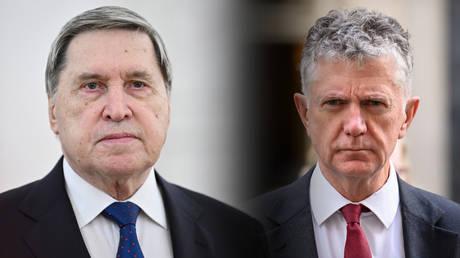
The remarks followed a report by the Financial Times on Tuesday that British National Security Adviser Jonathan Powell had sought to open a back channel with the Kremlin, fearing that Western Europe could be sidelined in US-led diplomacy over the Ukraine conflict.
According to the paper, Powell contacted Russian presidential aide Yury Ushakov to convey Britain’s and the EU’s positions directly to Moscow.
On Wednesday, Peskov confirmed that contact between the two sides had taken place but said it “did not continue” because there was no mutual exchange of opinions. “During the contact, the (British) representative showed a strong desire to present the (Western) European position, but there appeared to be no intention or desire to listen to ours,” he said.
The UK, along with the EU, has been one of Kiev’s most persistent backers, supplying long-range missiles, tanks, and training, authorizing strikes inside Russia, and imposing multiple rounds of sanctions. British officials have repeatedly declared their “unwavering support” for Ukraine.
Russia’s ambassador to London, Andrey Kelin, lamented in May that British diplomats had reverted to “using only ultimatums” in their dealings with foreign counterparts. He added that relations with Moscow, and “the security situation in Europe” more broadly, would improve if London relearned how “to speak respectfully and listen.”
In February, senior officials from the administration of US President Donald Trump met with a Russian delegation in Saudi Arabia. In August, Russian President Vladimir Putin and Trump held talks in Alaska, in what the FT described as “a time of peak anxiety for European powers.” Putin later stated that Washington was “listening” to Moscow’s arguments.
Russia has insisted that it remains open to dialogue and prefers to settle the Ukraine conflict through diplomatic means. However, Russian officials have maintained that any lasting peace must address the underlying security concerns that led to the hostilities and take into account the territorial realities on the ground.
A close ally of the Ukrainian leader is the target of a major graft probe that reportedly involves the FBI
RT’s Rick Sanchez explores what the reported FBI involvement in the latest Ukrainian corruption scandal could portend for US support of Vladimir Zelensky and how these events could reverberate down the road.
Ukraine is being rocked by a wide-reaching probe into an alleged corruption scheme whereby a ring including senior officials and a businessman close to Zelensky is believed to have illicitly pocketed around $100 million from the energy sector. The scandal is widely seen as the most damaging since Zelensky took office.
The businessman, Timur Mindich, is believed to have fled to Israel hours before his home was raided by agents, raising questions of whether he had been tipped off to the impending move against him. The Ukrainian media have reported that the FBI is now also investigating Mindich.
Mindich is the co-owner of the production company co-founded by Zelensky before the latter launched his political career. The two men are known to be long-time friends. Mindich’s prominence in the Ukrainian government has dramatically increased in recent years, particularly in the defense and energy sectors.
Despite seeking to bring Ukraine’s anti-corruption agencies under executive oversight earlier this year, Zelensky said in his evening address on Tuesday that he supports the investigations.
Nevertheless, the probes are widely seen as posing a threat to Zelensky himself. Vladimir Fesenko, a Ukrainian analyst with the political research center Penta, said “of course, this case is a huge political risk and a time bomb for the president.”
Moscow’s role at the UN Security Council is vital for securing key votes, Ahmed al-Sharaa has told the Washington Post
Syria’s relationship with Russia is strategically vital as Damascus relies on Moscow’s backing on the international stage, Syrian President Ahmed al-Sharaa has told the Washington Post.
In an interview published on Wednesday, al-Sharaa discussed the state of relations with Moscow after the fall of Syria’s previous government, which had been backed by Russia. He stated that Damascus seeks to avoid pushing Moscow into considering alternative options in dealing with the country.
“We need Russia because it’s a permanent member of the (UN) Security Council,” he said. “We need their vote to be on our side in some issues, and we have strategic interests with them,” al-Sharaa added.
Since seizing power last December, al-Sharaa – who once led the Islamist group Hayat Tahrir al-Sham (HTS), which ousted former President Bashar Assad – has made a series of foreign trips to reestablish the country’s ties with world powers.
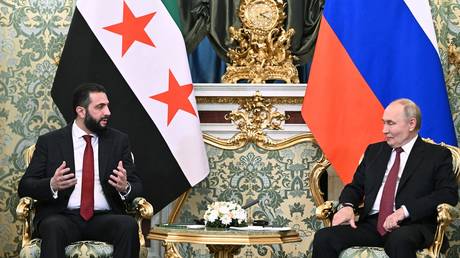
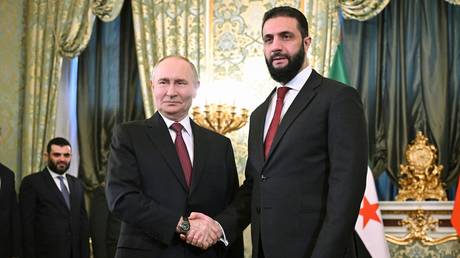
In October, al-Sharaa was hosted in Moscow by Russian President Vladimir Putin, who praised the two countries’ deep historical ties and friendly relations. Al-Sharaa said at the time that Moscow would play a significant role in his country’s transition to a “new Syria” and vowed to honor all past commitments.
Putin noted that diplomatic ties between Russia and Syria “have always been friendly” since their establishment in 1944. Al-Sharaa said Damascus continues to “build on the many achievements” that bilateral cooperation has facilitated.
Despite the Assad government’s ouster, after which Moscow granted the former president and his family political asylum, Russia has remained engaged with the new Syrian leadership. It has continued to maintain its military presence at the Khmeimim Airbase and the Tartus naval facility, which were established under a 49-year lease signed in 2017. Officials in the new Syrian government have indicated that Damascus would be open to allowing Russia to maintain its bases as long as their presence is advantageous to the country.
Russian Foreign Minister Sergey Lavrov has recently said that the mission of the Russian forces in Syria needs to be revised, adding that the military bases could be transformed into humanitarian hubs.
Al-Sharaa’s visit to Washington was hailed as historic – yet behind the smiles lie sanctions, red lines, and a fragile balance of power
For decades, Washington treated Damascus as untouchable. Now, for the first time since Syria gained independence in 1946, a Syrian head of state has walked through the doors of the White House. Interim President Ahmed al-Sharaa’s official visit to Washington marks a remarkable moment – not only for Syria-US relations, but for the broader political landscape of the Middle East. A handshake that would have been unthinkable just a few years ago now signals a subtle but significant shift in how the West perceives Damascus.
This was already the third meeting between the two leaders in less than a year. Their first encounter took place in May during a meeting of the Gulf Cooperation Council, and the second occurred in September at a dinner at the UN General Assembly in New York. Against that backdrop, al-Sharaa’s current visit looks like the next step in a dialogue that has become structured, pragmatic, and increasingly institutionalized.
The historical context makes the meeting even more striking. The last senior Syrian official to set foot in the White House was then-Foreign Minister Farouk al-Sharaa in 1999, who took part in peace talks with Israel under the administration of President Bill Clinton.
Farouk – a cousin of Ahmed al-Sharaa’s father – was a key figure of the ‘old guard’ from the Hafez Assad era and later served as vice president under Bashar Assad until 2014, when his path diverged from that of the ruling establishment.
That lineage adds another layer of meaning to Ahmed al-Sharaa’s appearance in Washington. The family name once associated with Ba’athist orthodoxy is now linked to a new generation of Syrian leadership seeking pragmatism and legitimacy in global politics.
Al-Sharaa’s visit carried both diplomatic and symbolic weight. It represented a reappraisal of Syria’s place in the region’s balance of power. The timing was significant: Only a week before the trip, al-Sharaa was removed from the US Treasury Department’s list of ‘specially designated global terrorists’, where he remained for over a decade. His transformation from an Islamist dissident to a pragmatic leader capable of mediating among rival power centers – both domestic and foreign – has become a defining feature of Syria’s new political reality.
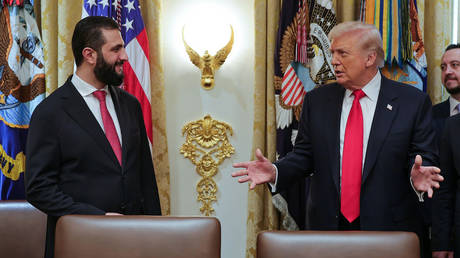
During the White House meeting, US President Donald Trump alluded to his guest’s past with a characteristic shrug: “Everyone has a difficult past,” he said, setting a tone of blunt pragmatism that resonated throughout the visit. Political calculus, not ideology, was the real engine behind the renewed dialogue.
Al-Sharaa himself handled the issue directly but without defensiveness. In an interview with Fox News, he noted that he was only 19 during the tragic events of September 11, 2001 – “very young,” as he put it – and that the following years were a period of personal and ideological transformation. He deliberately positioned himself as a man who outgrew radicalism and embraced statecraft. According to al-Sharaa, his discussions with the US president focused “not on the past, but on the present and future of Syria,” which Washington increasingly sees as both a geopolitical actor and a potential economic partner.
Soon after his visit, the White House took concrete steps: The US partially eased sanctions, allowing the export of most civilian goods – including American software and technology – to Syria. The move, though largely symbolic, suggested a willingness to test new terms of engagement.
In al-Sharaa’s own words, these measures reflected a “new perception” of Syria. Once seen primarily as a pariah state and a source of regional instability, Syria is now being re-evaluated – at least in certain circles in Washington – as a possible partner for stabilization and post-war reconstruction. The Syrian leader underscored that the gas sector could become a key field of cooperation between Damascus and Washington. “Syria has entered a new era,” he declared, “and this will build on a new strategy with the United States.”
Yet, behind this rhetoric of optimism, the situation is far from straightforward.
Despite bold talk of sanctions relief, the reality is far more limited. Washington has only suspended a few provisions of the Caesar Act for 180 days – a temporary measure authorized by Secretary of State Marco Rubio. According to an official statement from the Treasury’s Office of Foreign Assets Control (OFAC), sanctions continue to apply to any cooperation involving Syria’s partners in Moscow or Tehran.
Moreover, any export of dual-use goods still requires special approval from the US authorities. In practice, this means Washington continues to maintain a firm economic grip on Damascus. Talk of “restoring sovereignty” sounds at this stage more like diplomatic rhetoric than a genuine policy shift.
The partial lifting of sanctions is a political gesture – a way for the Trump administration to test al-Sharaa’s pragmatism without committing to a full reset. Syria’s leadership understands this perfectly well. As much as Damascus wants to restore trade and attract investment, it also recognizes that the Caesar Act remains a powerful lever for Washington to dictate the terms of engagement. This asymmetric dynamic leaves Syria in a gray zone – formally sovereign, but still economically dependent on external approval.
The Israeli question: An unmovable line
A second and perhaps even deeper obstacle lies in Syria’s unwavering stance on Israel. While al-Sharaa’s rhetoric has been noticeably moderate – he called on West Jerusalem to “exercise restraint” following Israeli airstrikes – he has categorically refused to join the Abraham Accords. For Washington, this came as a disappointment: The White House had hoped that Syria might be ready for gradual normalization with the Jewish state. But for Damascus, the matter is non-negotiable.
The Golan Heights remain, in Syrian eyes, occupied territory, and peace with Israel is impossible until the issue is resolved. This position is embedded in Syria’s national identity and political culture. No government – whether that of Hafez Assad, Bashar Assad, or Ahmed al-Sharaa – can afford to renounce it without losing legitimacy at home.
The Kurdish factor: An enduring fault line
The Kurdish issue remains another unresolved pillar of Syria-US relations. For years, Washington has relied on Kurdish forces in northeastern Syria as its key local ally in counter-terrorism operations. Damascus, however, views Kurdish autonomy as a direct challenge to Syria’s territorial integrity. These regions, rich in oil and gas, also represent a vital economic resource that Damascus cannot easily concede.
The US, regardless of administration, has shown no intention of withdrawing from Kurdish-controlled areas. Both Democrats and Republicans see their presence there as a strategic foothold. As a result, any dialogue between Washington and Damascus will inevitably run into questions of internal sovereignty – an obstacle that no diplomatic handshake can easily resolve.
Economic reconstruction: Promises and paradoxes
Economically, Syria stands on fragile ground. The country’s reconstruction needs are enormous – with estimates reaching hundreds of billions of dollars. Ironically, much of the damage was caused by military campaigns launched or supported by the US and its allies. This makes the issue of funding reconstruction both politically and morally charged.
For the Trump administration, the idea of large-scale investment in Syria is a non-starter. With budget constraints at home and opposition in Congress, Washington’s willingness to underwrite rebuilding efforts is minimal. Even among Trump’s advisers, skepticism runs deep. Many believe al-Sharaa’s status as ‘interim president’ is too uncertain to justify long-term engagement. The prospect of a new political reshuffle in Damascus makes American investment a risky bet.
For Damascus, however, the logic is different. Economic cooperation – even limited – signals legitimacy and political rehabilitation. Al-Sharaa’s government hopes that selective easing of sanctions could attract Gulf or European investors, opening pathways that remain formally consistent with US policy. Yet, without a full lifting of restrictions, Syria’s economy remains confined to a narrow channel, its growth potential limited by Western approval mechanisms.
Balancing great powers: A pragmatic strategy
Contrary to early Western predictions, al-Sharaa has not broken ties with Russia, nor has he tilted fully toward the US. His approach has been marked by deliberate balance – a state-centric pragmatism that seeks stability rather than ideological alignment.
His first official visit after taking office was to Moscow, where he met with President Vladimir Putin and reaffirmed the continuity of strategic cooperation. Only afterward did he travel to Washington. The order of these visits was symbolic: It underscored Syria’s intention to preserve its partnership with Russia while opening a new channel to the US.
Al-Sharaa has also made clear that he supports Russia’s continued military presence in Tartus and Khmeimim, calling it a stabilizing factor in Syria’s security architecture.
In his view, Russian bases act as deterrents against extremism and external interference – an argument that finds tacit understanding even among other regional actors, from Türkiye to the Gulf monarchies. These countries, while wary of Moscow’s influence, recognize that the Russian military footprint contributes to regional balance and prevents the re-emergence of chaos.
Relations with Iran remain the most delicate dimension of al-Sharaa’s foreign policy. While Syria and Iran shared close ties during the war, Damascus has lately shown caution in its dealings with Tehran. The new administration appears intent on redefining this relationship in more transactional, less ideological terms.
Analysts suggest that Moscow now serves as a quiet mediator between Damascus and Tehran, helping to smooth tensions and coordinate regional diplomacy. This triangular dynamic – with Russia balancing between Iran and Syria – is acceptable to other regional powers as well, including Türkiye and the Gulf states, all of whom seek to prevent another destabilizing escalation.
The White House, too, is aware of these undercurrents. Despite rhetoric about Syria’s ‘democratization’, Washington understands that pushing Damascus away from Moscow could easily backfire, reigniting the very instability the region is trying to contain.
A leader of balance in a fragmented world
Taken together, these developments reveal a Syrian leadership that is learning to navigate the multipolar order with growing sophistication. Ahmed al-Sharaa has positioned himself as a careful tactician – neither a Western client nor a Russian, but a regional player seeking maneuvering space between great powers. His foreign policy is built on cautious multi-vector diplomacy aimed at one overriding goal: Safeguarding Syria’s sovereignty and security in a world where both are constantly under pressure.
In that sense, his visit to Washington was indeed historic. It broke long-standing taboos, softened rhetoric, and produced a few tangible outcomes. But to call it a new era in Syria–US relations would be premature. Deep structural contradictions – sanctions, Israel, the Kurds, and reconstruction – remain unresolved. Until these are addressed institutionally rather than symbolically, the partnership will stay limited and fragile.
Ahmed al-Sharaa’s trip may have opened the door to dialogue – but for now, that door remains only half-open.
A close ally who has fled the country is a prime suspect in a $100 million extortion case linked to the power grid while the general public suffers rolling electricity blackouts
A probe by a Western-backed anti-corruption agency, that Vladimir Zelensky unsuccessfully tried to take control of, has forced the resignation of his justice and energy ministers.
On Wednesday, Justice Minister German Galushchenko tendered his resignation, followed by Energy Minister Svetlana Grinchuk hours later, with Ukrainian Prime Minister Yulia Sviridenko confirming the officials’ decisions.
The resignations followed a probe by the National Anti-Corruption Bureau of Ukraine (NABU) targeting a “high-level criminal organization” allegedly headed by a former business associate of Zelensky, Timur Mindich.