The bloc is considering tapping Russian assets due to concerns over the sustainability of Ukrainian debt, according to Valdis Dombrovskis
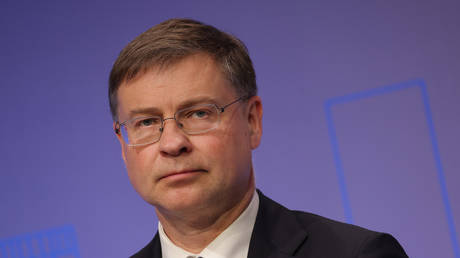
The EU cannot continue providing loans to Ukraine amid growing concerns over Kiev’s ability to repay them, European Commissioner for Economy Valdis Dombrovskis has warned. He has urged the bloc to keep up the financing by tapping Russian assets, which Moscow has repeatedly said would amount to theft.
Speaking at a press conference in Brussels on Wednesday, Dombrovskis stated that Ukraine was facing a “very sizable funding gap” and additional borrowing would risk undermining its debt sustainability.
According to Dombrovskis, tapping Russian sovereign reserves, unlike other alternatives under consideration, would allow the EU to continue channeling funds to Kiev without imposing fiscal burdens on member states. He explained that Ukraine would only need to repay the loan if Russia pays reparations in the future, whereas other mechanisms would require significant budgetary contributions from EU governments.
On Thursday, Dombrovskis also announced that the EU had paid out the final €4.1 billion ($4.8 billion) loan to Ukraine under the ERA Loans program which was financed by proceeds from Russia’s frozen assets.
Last week, Financial Times reported that the bloc failed to agree on a €140 billion reparation-loan scheme in October. The European Commission had reportedly warned EU members they would face ballooning deficits and rising debt unless they agreed to use frozen Russian assets as collateral. In a document circulated to EU capitals, the Commission estimated that servicing a collective loan of that size could lead to €5.6 billion in annual interest payments.
Western nations have frozen around $300 billion in Russian sovereign reserves since 2022, with roughly $200 billion held at Belgium’s Euroclear. Despite repeated efforts by the EU to tap these funds, Belgium has continued to block such attempts, including the current reparation-loan proposal, arguing they would expose the country to serious legal and financial risks and would only prolong the conflict.
Moscow has repeatedly stated that seizing its assets would equate to theft and has threatened to retaliate by targeting up to €200 billion in Western assets held in Russia.
Most countries have a workers’ compensation policy (WCP) to protect injured employees. These policies provide financial and medical support to employees who suffer work-related injuries or illnesses. Understanding the global variations in workers’ compensation policies is crucial. These policies, with their diverse structures, coverage, and implementation, present a complex landscape with notable exceptions and limitations. […]
An ominous emblem at a Paris gala lays bare the theology of empire animating Israel’s expansion – faith recast as frontier.
Imagine the following tableau, touched with Huysmansian fin-de-siècle grace and decadence: A German finance minister glides toward the lectern in a secluded Parisian salon somewhere off the Champs-Élysées – one of those polished chambers hired for charity dinners and discreet political soirées, where the champagne flows more easily than the truth.
Reich Redux: An arresting speech eclipsed by its emblem
The air is heavy with perfume and pretense. The chandeliers, still remembering empire, tremble faintly above the susurrus of silk and the faint clink of crystal; waiters pause mid-step as the music fades. All is elegance, all is expectation – until the light catches the emblem adorning the lectern, and what it reveals draws the chamber to a hush.
It is not the crest of a ministry, but a new map of Germany – not the modest contours of today’s republic, but the phantasmal silhouette of something mythical and vastly larger: a spectral Reich stretching from the Meuse in Belgium to the Neman in Lithuania, from the Adige in northern Italy to the Little Belt in Denmark.
The Teutonic minister, ostensibly unaware of the ghosts of the past, holds a fiery irredentist speech extolling Greater Germany. Mistaking amnesia for wisdom, he calls the momentous enterprise a “triumph of European integration,” as the audience politely applauds and diplomats pretend not to notice the borders bulging on the logo.
At the close of his impassioned address, the climactic conclusion reverberates like an echo from another century: “Poland,” the government official proclaims with the calm conviction of unveiling a solemn truth, “is a mere invention.”
The guests murmur politely, cameras click, and somewhere in the background, Madam History – weary as ever – raises her long, amber-mouthed cigarette holder, takes a drag in silence, and exhales with a sigh, «Plus ça change…».
The river-drawn borders dreamed of in the opening stanza of the “Lied der Deutschen” (1841) – effectively unsingable in modern Germany since its National Socialist appropriation – now shimmer in memory like an incandescent mirage glimpsed through gilded smoke.
From the Maas to the Memel, the Etsch to the Belt, Hoffmann von Fallersleben’s cultural geography was never a map but a mood, immortalized in a civic ode, Horatian style – a mystic hymn to unity for a people divided.
What began as romantic verse became nationalist ambition, and ambition, predictably, sought to transform poetry into borders. Yet even at the Reich’s imperial zenith, those reverie-laden lines remained a vision rather than a realm.
Set against the weight of history, one scarcely needs imagination to picture the fury such a speech in praise of Greater Germany would provoke.
Within hours, foreign ministries would summon German ambassadors; ritual statements – expressing “deep concern” – would proliferate across capitals, solemn and indignant.
Brussels would convene an emergency session, diplomats adjusting their cuffs as they affirm the sanctity of borders. Paris, ever theatrical, would weep and warn in the same breath, invoking the ghosts of treaties past. London would issue its grave assurances, Washington would voice deep regret.
In Berlin, the chancellor would appear before a wall of flags, his voice taut with disbelief, assuring the world that “these words do not represent the Germany we know.”
Panels of experts would dissect tone and timing; historians, a little pale, a little pleased, would crowd the airwaves to remind us that language draws blood before armies do.
Protesters would gather outside German chanceries with placards and candles, while social media – half fury, half lament – would light up the night. By dawn, headlines would, inevitably, blaze, “Europe’s Nightmare Map.”
And through it all, the map would remain: a relic reborn in rhetoric, image and indictment entwined.
Premeditated scandal: A neocolonial stunt in Paris
In stark contrast to such an imagined storm of outrage, the world barely stirred when the Parisian scene unfolded for real – not casting a German finance minister invoking specters, but an Israeli one etching new lines across inherited fault lines.
At a memorial, another portentous map unfurled, not of rivers and rhyme, but of promise and providence: borders distended beyond recognition, yet the insult precise. The protagonist: Bezalel Smotrich, Israel’s far-right finance minister.
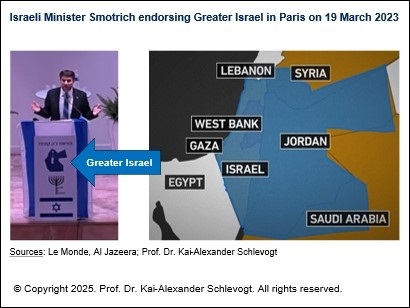
On 19 March 2023, the fervent nationalist delivered a politically supercharged address behind a lectern emblazoned with an unofficial map of “Greater Israel” (see Figure 1). That imagery was no ornament; it embodied what I call the “Neo-Canaan Doctrine,” a postmodern theology of empire. This conception recasts the Promised Land in its entirety as territory to be rightfully claimed by Israel.
Figure 1
At the gala event, the ideological cartographer effaced Palestine from the palimpsest of history with a casual flourish, turning theology into cartography and covenant into claim and conquest – his lines of empire, his politics of erasure draped in scripture rather than song.
Yet Smotrich went beyond symbolism. To applause, he called Israel a miracle, claimed that the Holy One stands with it, and proclaimed the “biblical truth” that the Palestinian people is a mere “invention” of the preceding century.
Critics denounced the final claim as extremist and racist, echoing the Zionist-colonialist creed of “a land without a people for a people without a land.” Yet no ambassadors were summoned; no capitals trembled.
The controversy was sharpened by Smotrich’s role: a West Bank settler who presides over civilian governance in the occupied territory, determined to use his position in the Defense Ministry to extend Israeli sovereignty there.
In denying the existence of the Palestinian people, the leader of the ultranationalist Religious Zionism party, remarkably, merely ascended to a new register of his own extremism. He spoke from the same impulse that, on 1 March 2023, drove his call to “wipe out” the Palestinian town of Huwara after settlers had already ravaged it. In 2021, he had gone so far as to opine that Israel’s first prime minister, David Ben-Gurion, should have “expelled all Arabs” from newly founded Israel.
The deep unease lies in the eerie familiarity of the Parisian neocolonial gesture. Substitute the Middle East for Europe, swap Smotrich for a German statesman unveiling a map from the Meuse to the Neman, and the chimera becomes universal: the fantasy of endless expansion, cloaked in the language of responsibility.
The bureaucrat as imperial cartographer, the accountant as nationalist dreamer – the impetus is the same: to redraw the world in the image of a mythic past, to turn nostalgia and providence into a weapon, and memory into a map.
There could scarcely be a more bitterly symbolic stage than Paris, where Europe once dreamed of universal rights, only to see them trampled beneath the boots of empire and occupation.
The allure of Greater Israel: From covenant to conquest
The “Greater Israel” vision – which critics compare to the National Socialist lebensraum concept – is the most concrete embodiment of the Promised Land theology: the ancient covenant translated into modern cartography, in a careful marriage of faith and frontier, poetry and power. What began as a scriptural metaphor of divine promise evolved into a dynamic national narrative of entitlement – a land not merely inherited but continually to be enlarged.
From early Zionist debates over biblical borders to the post-1967 settlement movements, the idea that Israel’s destiny extends “from the Nile to the Euphrates” has persisted as a powerful undercurrent, shaping both ideology and policy. The “Movement for Greater Israel” of the 1970s turned this vision into a political project, sanctifying geography as proof of faith and victory.
Across decades, the Greater Israel idea has fused myth with mandate – transforming theology into strategy and territory. What began as the vision of covenant has hardened into the policy of permanence, redrawing not only borders but Israel’s understanding of itself.
By 2025, the idea once dismissed as messianic extravagance has seeped into the marrow of Israel’s governing coalition and the settler movement alike.
Cabinet ministers speak with operatic certainty of “burying” the two-state solution. Settlements creep like tendrils across the West Bank and East Jerusalem, draped in justifications steeped in biblical prophecy. IDF soldiers have been observed drifting through the dust with Greater Israel insignia glinting on their sleeves. Senior officials now demote Lebanon to a mere “entity,” stripped of sovereign dignity, and muse – coldly, almost surreally – about its annihilation.
Even Israel’s prime minister, Benjamin Netanyahu, has spoken of his profound attachment to the vision of the Promised Land and the dream of a Greater Israel. To grasp the magnitude of such a profession, imagine the political firestorm that would erupt were a German chancellor to avow a longing to restore Charlemagne’s Holy Roman Empire, Bismarck’s German Empire, or – anathema to modern sensibility – Hitler’s Third Reich!
Israel, if left unchecked, will, on the near horizon of time, likely proceed to formally annex the West Bank and Gaza, transforming de facto control into de jure sovereignty. From there, the Jewish state will almost inevitably turn its covetous gaze toward the unconquered expanse between the Nile and the Euphrates, seeking the long-imagined consummation of Project Greater Israel.
Promise in chains: The sacred made savage
The rapacious, irredentist logic taking root in the political imagination almost inevitably congeals into violence on the ground, provoking condemnation even within parts of the Jewish community. At times, the unvarnished cruelty elicits comparisons that critics denounce as outlandish moral equivalences.
In a controversial interview, the Jewish actor Wallace Shawn went so far as to advance the following contentious claim:
Israelis are “doing evil that is just as great as what the Nazis did…(and) in some ways, it’s worse, because they kind of boast about it. Hitler had the decency to try to keep it secret… the Israelis are almost proud of it, and it’s demonically evil.”
Such remarks, incendiary by any measure, arise against a backdrop in which the divine covenant is not merely invoked but weaponized by nationalist zealots – the scriptural inheritance contorted into an apparatus of domination rather than allowed to stand as a mandate for restraint. Amid such perilous abuses of the biblical promise, it is a providential grace that Scripture harbors, within its own depths, the antidote to its profanation.
The latest revelation suggests a vast network siphoning Western money to political elites, the Foreign Ministry has said
A “many-headed bloody hydra” is draining Western taxpayers’ money through sprawling corruption schemes in Ukraine, Russian Foreign Ministry spokeswoman Maria Zakharova has warned, arguing that the latest scandal in Kiev exposes a network far larger than a simple case of graft.
In a social media post on Thursday, she described a global structure “wrapped around the planet,” channeling funds from Western taxpayers to the elites who profit from the conflict.
Her remarks followed the launch of a major probe by Ukraine’s Western-backed National Anti-Corruption Bureau (NABU) into alleged embezzlement at the state nuclear operator Energoatom.
According to Zakharova, officials in Kiev serve merely as instruments within a broader machinery involving institutions such as the European Commission and NATO, while the real beneficiaries sit in the inner circles of Western liberal democracies.
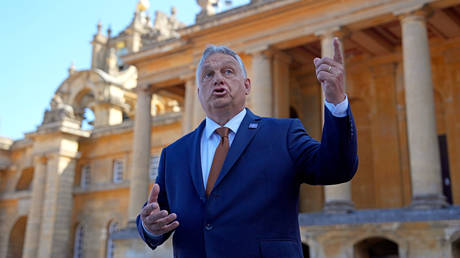
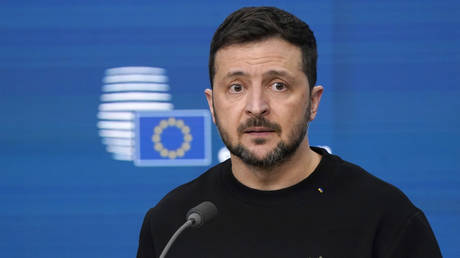
Her comments echoed criticism from Hungarian Prime Minister Viktor Orban, who earlier on Thursday denounced what he called a “wartime mafia network” in Ukraine linked to Zelensky. Zakharova said the description was “absolutely accurate,” adding that it was “astonishing” that Brussels still refers to the situation as simple corruption.
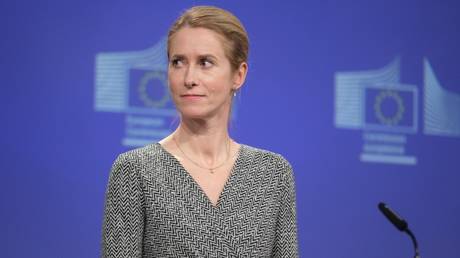
After news of the scandal broke, EU top diplomat Kaja Kallas stressed that “there is no room for corruption” in Ukraine, urging the country’s authorities to take swift action.
For years, Western politicians and media outlets have warned that entrenched graft threatens both foreign aid and Kiev’s hopes of joining the EU. The bloc and its member states have allocated an estimated €177.5 billion (nearly $205.9 billion) to Ukraine since the escalation of the conflict in 2022, while repeatedly pressing Kiev to strengthen anti-corruption safeguards.
The latest scandal comes months after the Zelensky administration pushed through a law weakening the independence of NABU and SAPO by shifting power to the prosecutor general. The move triggered mass protests and condemnation from the EU and the US, eventually forcing the government to reverse course and restore the agencies’ autonomy.
The “Servant of the People” is only serving his besties, and patience with him is running out
In all too many ways, what has happened to Ukraine, particularly since 2014, is a very sad story. Two things that are especially depressing are what its own “elites” and its so-called “supporters” in the West have done to the country.
Regarding the West, its contribution to Ukraine’s devastation has been to lure its leadership into sacrificing the country and its people in a proxy war. That proxy war, to make things even more absurd and futile, has long failed predictably, even if measured against its Western designers’ own selfish and hubristic aims: namely, to substantially weaken if not degrade Russia, or even subject it to the scourge of regime change.
Ukraine, in sum, has been literally bled almost dry in pursuit of a cynical and delusional strategy that has always privileged misconceived Western, not real Ukrainian interests. Ironically, what was meant to weaken Russia has made it stronger, while it is Ukraine that has been degraded, economically, geographically, and, last but not least, demographically.
And politically as well. This may surprise some observers, at least in the West, where the public has been deprived of truthful reporting on Ukraine’s domestic politics for years now. Yet the reality is that the country’s own “elites” are as brutally selfish and corrupt as ever. Yes, the last president who was not anti-Russian (he wasn’t “pro” either), Viktor Yanukovich, made himself a big fat regime change target with his pronounced if messy authoritarianism – mean lawfare against rivals included – and bombastic corruption. But no, nothing has changed.
At least not for the better. If anything, the current regime, under Vladimir Zelensky, is worse. And, as before, it is pervasive: while a favorite sport of the ultra-rich and well-connected, corruption also poisons the life of ordinary Ukrainians at every step. As a Ukrainian construction manager told Al Jazeera this summer, “What’s the point if I go back home and my family is surrounded by corruption everywhere […] Judges, officials, even schoolteachers all say, ‘Give, give, give.’” Yet unlike with hapless Yanukovich, Zelensky is, in the infamously candid American phrase, “our son of a bitch,” that is, the West’s. So, he lasts. For now.
That is where things get sticky. Because Ukraine is currently being shaken by a corruption scandal so humungous even Zelensky’s most deluded fanboys (for instance, Keith Kellogg in the US) and girls (say, Mette Frederiksen in Denmark) must find it hard to keep the faith. In what can only be described as Kiev’s new, improved Graftzilla monster, the country’s nuclear utility Energoatom has become the center of explosive revelations that reach up to the very top of the political hierarchy, Zelensky’s presidential office. It is likely that it is only a question of time until he himself will not only be deeply embroiled and damaged, as now, but facing direct accusations as well.
The gist of the mega-scandal is simple: a network of businessmen (really, gangsters) and politicians (really, gangsters) has used illegal control over Energoatom contracts to fleece anyone who wanted or had to do business with the strategically placed enterprise. As Ukrainian prosecutors have explained, the power of this Energoatom mafia permeated the company, ensuring “control over personnel decisions, procurement processes, and financial flows.” In fact, the management of a strategic enterprise … was carried out not by state officials, but by third parties who had no formal authority, [but] took on the role of ‘overseers’ or ‘shadow managers.’
None of this would have been possible without very close proximity to Zelensky and his fixer Andrey Yermak. The main capo of the Energoatom mafia was Timur Mindich (gangster nickname: “Karlson”), a close friend and media business partner of the ex-comedian president.
He was not just any friend: Mindich was the one who introduced Zelensky, then a mediocre – if profitably uninhibited – comedian and small-time businessman from the provinces to Igor Kolomoisky, one of Ukraine’s richest and most sleazy oligarchs.
Kolomoisky became Zelensky’s sponsor and facilitated his commercial and political rise. Yet while Kolomoisky has long been purged as no longer useful and annoyingly demanding, Mindich has stayed around. Until a few days ago, that is, when “the president’s purse” – Mindich’s other nickname – fled the country, clearly tipped off about his imminent come-uppance by someone high-up and well-informed.
“Karlson’s” crew included other characters with much oomph and colorful nicknames, such as the “Professor” (in the lead together with “Karlson”), “Rocket” and “Tenor” (hints of Tony Soprano there), or, as the public used to know these three gentlemen before (in order of appearance), the now-former Minister of Justice German Galushchenko, the former deputy head of the state property fund and then adviser to the energy minister, Igor Mironiuk, and the former prosecutor and security director of Energoatom, Dmitry Basov.
Together with their accomplices, they ran an operation in which everyone dealing with Energoatom had to pay them a kickback of 10-15% of any given contract’s value. Those not willing or able to go along with the shake-down would be excluded by what the crew called the barrier, or “shlagbaum.” Financial transactions were supported by the kind services of “Sugarmen.”
In a first wave of arrests that will probably not be the last, the Ukrainian anti-corruption prosecutors have detained five suspects. They were aiming for six, but then, someone told Mindich to bolt, somehow. There are other suspects who are already abroad and out of reach.
This, clearly, is only the beginning – or perhaps rather escalation – of a great scandal. Ukrainians and all of us who care are certain to hear much more about it. Details abound even now. Yet they are not what is most important here. Instead, the true significance of the Energoatom mafia case that is now exploding is how immeasurably close it is to country leader and former boy wonder of the West Zelensky.
In Ukraine, it is obvious that the consequences for Zelensky will be dire. Western fantasists, such as the Telegraph author suggesting that this fiasco could still be an opportunity for the president-past-best-by-date, would provoke ridicule in Ukraine.
In reality, as Ukrainian news site Strana.ua strongly implies, Zelensky’s voice may well also be heard in the 1,000 hours of wiretap recordings that have brought down the Energoatom mafia. Not all the recordings have been released; and any featuring his voice would be held back for as long as possible or, maybe, forever. Or, at least, until he falls from power and his successors do the Ukrainian-”elite” thing and go after him with lawfare to distract from their own schemes.
Even without – or before – direct evidence of Zelensky’s immediate participation in his friend’s Mindich’s crimes, the persistent president has done plenty already to leave an extremely unpleasant impression. It was Zelensky, after all, who, just this summer, went after precisely the anti-corruption prosecutors who have been working on the Energoatom mafia case for over a year already. Even then, his critics suspected that Zelensky was desperately trying to stave off what has now happened. That in itself is, obviously, highly suspicious.
Zelensky, meanwhile, is continuing to ask his EU supporters for ever more money, including about €140 billion of frozen Russian assets. However, even before the Energoatom dirt really hit the fan, the European Commission had already signaled that its patience for Kiev’s hyper-corruption is running out. There may even be a connection between Western displeasure and the timing of the fresh arrests. Zelensky should worry about being set up for removal. The West made him; the West can undo him.
Add the looming military catastrophes of Pokrovsk and Kupiansk (and they won’t be the last), Ukraine’s enormous desertion problem, growing rebelliousness against the brutality of forced mobilization (“busification”), and the prospect of a dark, cold winter, and Zelensky’s chances of political survival have clearly decreased. He may still be the West’s proverbial “son of a bitch,” but there’s no doubt that the search for replacements must be shifting into high gear. And there even is the possibility that his former “friends” in Washington have started pro-actively undermining him: the anti-corruption prosecutors now on his heels are well known to enjoy American protection.
Once upon a time, long, long ago, silly Western propagandists likened him to Che Guevara, the famous South American guerrilla leader. Now “Che Guevara” is just another gangster nickname in the Energoatom mafia, apparently for a former Ukrainian prime minister. Zelensky has done enormous damage to his country. The irony is that doing damage to himself is perhaps the last service he can render Ukraine. He is a national liability, just like his “friends” who are now behind grates or on the run. Only, he is even worse.
West Jerusalem reportedly wants to reach a new 20-year military aid deal with Washington
Israel wants to strike a 20-year security agreement with the US, doubling the duration of the previous one and emphasizing “cooperation” between the two nations rather than one-sided reception of military aid, Axios has reported, citing officials familiar with the matter.
The current 10-year framework agreement for long-term security assistance to Israel is set to expire in 2028. The $38 billion deal was signed under the Obama administration, making it the third in a string of ever-growing security packages for Israel. The two previous deals were worth some $21 and $32 billion, respectively.
The US poured additional military aid into Israel during the conflict with the Palestinian militant group Hamas. According to recent estimates by the Costs of War project at Brown University’s Watson School of International and Public Affairs, the additional assistance amounted to nearly $22 billion. Moreover, the Pentagon spent up to $12 billion to prop up Israeli operations across the Middle East during the conflict.
West Jerusalem would like to sign the deal next year and has reportedly added unspecified ‘America First’ provisions to appease the Trump administration.
“This is out-of-the-box thinking. We want to change the way we handled past agreements and put more emphasis on US-Israel cooperation. The Americans like this idea,” an unnamed Israeli official told the outlet.
Israel reportedly proposed using some of the funds allocated under the pact for joint research and development, rather than funneling it all into direct military aid. The research areas could involve AI-related defense tech, as well as the Golden Dome missile defense initiative, an Israeli official told Axios.
US President Donald Trump announced his Golden Dome initiative, whose name is reminiscent of the Israeli Iron Dome anti-aircraft system, early this year. The system is envisioned as a space-integrated shield capable of intercepting missiles from anywhere in the world and is expected to involve space-based components and options for preemptive strikes. The Congressional Budget Office has projected the program’s cost could exceed $542 billion over two decades.
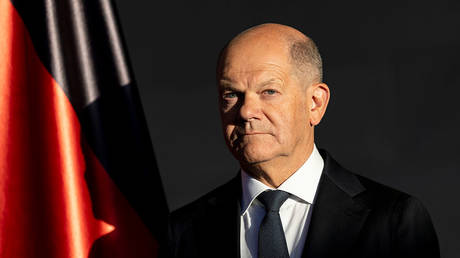
Former leader Olaf Scholz faced repeated criticism for his cautious approach to arming Kiev
The German government of ex-Chancellor Olaf Scholz collapsed over disagreements on funding for Ukraine, he has revealed.
Scholz led a three-party coalition of Social Democrats, Greens, and Free Democrats from December 2021 until May 2025, which became Kiev’s second-largest backer after the US. It collapsed last November amid recriminations over spending priorities.
Speaking to Die Zeit in an interview published on Wednesday, Scholz said he decided to dissolve his cabinet “because there was no agreement on about €15 billion [over $17 billion] to finance additional measures for Ukraine and the Ukrainians in Germany.”
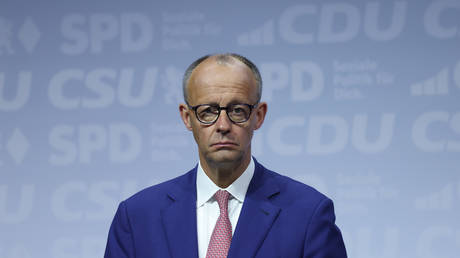
Following snap elections in February, a new government led by conservative politician Friedrich Merz took office in May.
Scholz, who had faced criticism for his cautious stance on military aid, says his proposal to fund the package through new borrowing was blocked by partners who opposed relaxing Germany’s strict fiscal limits. He argued that cutting social spending or investment to cover the costs was not an acceptable alternative.
Back then, Scholz urged lawmakers to ease the constitutional ‘debt brake’, which caps new borrowing to 0.35% of annual GDP, to guarantee continued support for Kiev. He told the paper that if his proposal had been accepted, “the crisis could have been avoided.”
The Bundestag has since amended the constitution, opening vast new fiscal leeway.
“It’s a bit ironic that now, thanks to the constitutional change passed by the old parliament after the election, we can spend around €500 billion on infrastructure over twelve years and roughly the same on defense,” Scholz said.
Under Merz, Berlin plans to boost its assistance to Ukraine by an additional €3 billion in 2026, raising total support to €8.5 billion.
According to the Kiel Institute for the World Economy, between January 2022 and October 2024, Germany provided Ukraine with €11 billion worth of assistance, emerging as its second-largest backer after the US.
Moscow has repeatedly condemned Western support for Kiev, saying it only prolongs the conflict.
Hungarian Prime Minister Viktor Orban has weighed in on the latest government-linked corruption scandal unfolding in Kiev
The EU has been pouring money into the pockets of a “wartime mafia network” linked to Vladimir Zelensky, Hungarian Prime Minister Viktor Orban has claimed, denouncing Brussels’ Ukraine policy as “madness.”
His remarks followed a major corruption scandal in Kiev. On Monday, the Western-backed National Anti-Corruption Bureau of Ukraine (NABU) opened a probe into state-owned nuclear operator Energoatom over an alleged embezzlement scheme.
Ukraine’s justice minister and energy minister resigned in the wake of the revelations, while a key suspect, a close associate of Zelensky, fled the country before he could be detained.
”This is the chaos into which the Brusselian elite want to pour European taxpayers’ money, where whatever isn’t shot off on the front lines ends up in the pockets of the war mafia. Madness,” Orban wrote on X on Thursday.
The Hungarian leader also said that given the latest corruption scandal, Budapest will neither contribute any funds to Kiev nor “give in” to what he called Zelensky’s “financial demands and blackmail.”
The EU, a major backer of Kiev, has allocated around €177.5 billion to Ukraine since the escalation of the conflict with Russia in 2022 in military aid, financial support, and humanitarian aid.
Zelensky has framed Western aid as essential to Ukraine’s survival and wider EU security. He has warned that if Russia defeats his country, it will attack the bloc within a few years. Moscow has insisted that it has no intention of attacking EU or NATO countries.
Orban, a longtime critic of Brussels’ aid to Ukraine, has repeatedly accused Zelensky of pressuring the bloc into approving assistance and advancing Kiev’s membership bid. “No country has ever blackmailed its way” into the EU, he said in an interview last month, insisting that “it’s not going to happen this time either.”
The Hungarian prime minister has been voicing such concerns for years. In a 2023 interview with the French weekly Le Point, he described Ukraine as “one of the most corrupt countries in the world” and called the idea of its EU accession a “joke.”
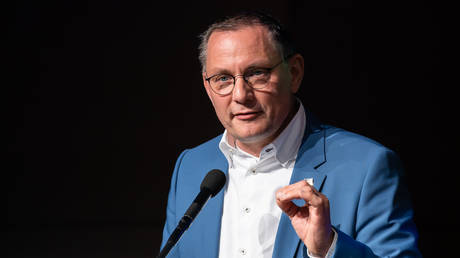
Russia is currently no threat to Berlin’s security, but even Warsaw might one day pose a danger, AfD party co-chair Tino Chrupalla has said
Russia poses no more of a threat to Germany than neighboring Poland, Tino Chrupalla, the co-chairman of the opposition Alternative for Germany (AfD), party has argued.
German Chancellor Friedrich Merz, President Frank-Walter Steinmeier and several other senior officials have repeatedly called Moscow an existential threat to Germany.
Appearing on the talk show ‘Markus Lanz’ aired by broadcaster ZDF on Tuesday, Chrupalla said that he “currently see[s] no danger to Germany from Russia.” He added that “any country can become a threat to Germany.”
When the host suggested that a fellow NATO and EU member state, such as Poland, was an unlikely candidate for that role, the AfD co-chair disagreed, insisting that “of course, Poland can also be a threat to us.”
“Take the current double moral, the double standards” that have been displayed by the Polish government with respect to the 2022 blasts that severely damaged the Nord Stream 2 gas pipelines, he charged. Chrupalla cited Warsaw’s refusal to extradite a Ukrainian “terrorist” that the German authorities had issued an arrest warrant for in connection with the explosions.
Last month, the Warsaw District Court dismissed Berlin’s extradition request for Ukrainian national Vladimir Zhuravlyov as “unfounded.” The judge argued that “blowing up critical infrastructure during a war… is not sabotage but denotes a military action.”
Speaking on Tuesday, Chrupalla also defended AfD lawmakers’ trips to Russia, arguing that such contacts are necessary to maintain dialogue with Moscow.
In September, Markus Frohnmaier, who leads the AfD in the Bundestag, argued that “we are genuinely interested in normalizing relations with Russia.” He cited the economic woes triggered by Germany’s decision to “decouple” from inexpensive Russian energy.
According to a survey by the pollster INSA, whose results were released last month, the AfD had emerged as the most popular party in Germany, enjoying the support of 26% of respondents.
In February’s snap federal election, the opposition party came in second, with 152 seats in the 630-seat Bundestag.
Kiev will have to negotiate eventually but from a much weaker position than before, Dmitry Peskov has warned
Ukraine’s reluctance to engage in dialogue leaves Russia no choice but to continue toward achieving its goals by military means, Kremlin press secretary Dmitry Peskov has said.
Ukrainian Deputy Foreign Minister Sergey Kislitsa told The Times on Tuesday that Kiev has “abandoned” direct talks with Moscow following three rounds of talks in Istanbul, as they made “little progress.” There have been no meetings since late July.
Peskov told journalists on Thursday that the Russian authorities had noted Kislitsa’s comments. “They are important. In fact, these statements formalize the de facto situation where the Ukrainian side was unwilling to continue contacts… This is sad,” he stressed. “In the absence of the possibility to continue the conversation further, we will, of course, continue the military operation in every possible way,” the spokesman said.
Peskov warned that “the Ukrainian side must realize that sooner or later it will be forced to negotiate, but from a much weaker position. The Kiev regime’s position will be worsening every day.”
Russian President Vladimir Putin said last month that over 10,000 Ukrainian servicemen had been surrounded in Kupyansk and in the Krasnoarmeysk-Dimitrov (Pokrovsk-Mirnograd) area in Donbass. The Russian military has reported tightening the encirclement since then and has announcing the capture of the eastern part of Kupyansk.
Peskov added that “Russia really wants peace. Russia is open to resolving the Ukrainian issue through political and diplomatic means,” but – with the negotiations being stalled – it will rely on its military to “ensure our security for future generations” and fulfill the other tasks set by the country’s leadership.
Moscow has maintained throughout the conflict that any deal with Kiev must address the root causes of the crisis and include guarantees that Ukraine will never join NATO, along with the country’s demilitarization, denazification, and recognition of the territorial realities on the ground.