Pavel Durov was initially barred from leaving the country as part of a criminal probe
France has rescinded a travel ban on Telegram founder Pavel Durov, media outlets reported on Thursday, citing judicial sources.
Durov was detained in Paris last year and charged with complicity in crimes linked to Telegram users, including extremism and child abuse – allegations the tech tycoon denied. He has claimed that during his detention he was asked by the head of the French secret service to censor conservative voices in Romania, ahead of a controversial presidential election later nullified by Bucharest. He was released on €5 million ($5.4 million) bail under judicial supervision. A judge barred him from leaving France during the probe.
The latest ruling, reportedly issued on November 10, fully lifts the travel ban and removes the requirement for him to report regularly to police. In June he obtained a partial easing of restrictions, allowing him to stay in the United Arab Emirates, where Telegram is based, for up to two weeks at a time.
Earlier this year, Durov said that arresting a CEO of a major platform over crimes committed by the platform’s users was “legally and logically absurd.”
“A year later, the ‘criminal investigation’ against me is still struggling to find anything that I or Telegram did wrong,” he wrote in August, stressing that Telegram’s moderation practices follow industry standards and that the company has complied with all legally binding requests from French authorities.
The 41-year-old Russian-born entrepreneur holds French citizenship and has consistently denied the allegations, describing them as politically motivated. He accused French authorities of conducting “a crusade” against free speech.
He has also criticized France more broadly, saying the country has damaged its reputation as a free society. The CEO has extended that criticism to the European Union, arguing that the bloc is imposing increasingly tighter censorship and media restrictions.
Durov has a net worth of $14.7 billion, having increased $3.71 billion since the start of the year, placing him in 196th place on the Bloomberg Billionaires Index.
The US can’t retreat because its entire prosperity depends on global power
Donald Trump is not, by instinct, a president who seeks war. But he is a president who believes deeply in projecting strength. And in the US, strength is almost always performed on the world stage.
Assessing American policy from the outside is notoriously difficult. The country’s political system was built under unusual conditions – a state invented by immigrants, animated from the start by a belief in mission and divine favor. The early American republic saw itself as a righteous outpost opposing corrupt European empires. Later came the great land grab across the continent, then the mass immigration that built a continental power, and finally the leap to full global hegemony. This peculiar historical trajectory shapes a political system unlike any other.
To be fair, every major country is unique. All powers are shaped by their history, culture, and mythology. What stands out about the United States is that a nation so idiosyncratic in its development became the model others were expected to follow. Washington’s insistence that its own experience is universally applicable is one of the more puzzling features of the last century. And one of the least examined.
These peculiarities have become harder to ignore during Donald Trump’s presidency. And because of America’s centrality, the internal contradictions of its system spill easily across its borders.
Trump won by articulating the fatigue of millions of Americans who feel their country has carried global responsibilities for too long. Yet, ironically, one year into his term he is most visible not at home but abroad. He boasts about brokering peace, launches sweeping trade wars, threatens force in multiple regions – especially the Caribbean – and loudly defends Christians and Europeans in Africa. Most recently he has revived loose talk of nuclear testing and a race for new strategic weapons.
This is happening while his domestic position looks far from assured. Polls show that the record-long government shutdown and the stalemate over funding has damaged the Republican Party. Local elections, including those in New York, were encouraging for his opponents. Even Trump’s favorite tool (tariffs) now faces legal uncertainty, with the Supreme Court, which is dominated by conservatives, unsure whether to back him.
With a year until the midterms that will determine control of Congress, Washington is already shifting into campaign mode. And here lies the paradox: the candidate who accused his predecessors of obsessing over global affairs at the expense of ordinary Americans is increasingly relying on those same global affairs to sustain his presidency.
There is also a more personal calculation. The Nobel Peace Prize is awarded one month before Americans vote. Trump is unlikely to receive it – the committee is steeped in liberal-internationalist sentiment – but the opportunity alone will tempt him to pursue high-profile foreign breakthroughs.
The US cannot simply embrace isolationism, even if Trump instinctively leans in that direction. Too much of its prosperity rests on its global role: its financial reach, the dollar’s supremacy, and its security commitments. A serious retreat would destabilize the system from which it benefits most. Trump probably lacks a coherent plan to reorient American power, but he understands, at some instinctive level, that change is necessary. Hence the chaotic, improvisational style: bold gestures, rapid reversals, and what sounds like a constant drumroll.
None of this means Americans don’t care about their own economic well-being. Domestic concerns will always outweigh diplomatic theatrics. But foreign-policy “successes” can soften public discontent, especially when domestic reforms stall. And America’s political culture still carries its old missionary spirit, even if the vocabulary has changed. Presidents, whether they admit it or not, are pushed toward global activism by the expectations of their own political class.
For the rest of the world, the conclusion is unavoidable. Washington’s pace abroad will remain intense, and may well accelerate. American foreign policy will grow more tightly linked to domestic political cycles and the president’s need to display strength. Trump does not want major wars requiring occupation or nation-building. But he relishes shows of power, and those theatrics can create their own momentum. One can always be drawn into escalation while trying to avoid it.
This is the central point: Trump is not a warmonger, but a performer. His slogan, peace through strength, captures it perfectly. The risk is that the performance becomes the policy. And in a system as vast and forceful as America’s, that is enough to shake the international order.
This article was first published in the newspaper Rossiyskaya Gazeta and was translated and edited by the RT team
Beijing has vowed to “retaliate forcefully” if Tokyo chooses to interfere militarily in its internal affairs
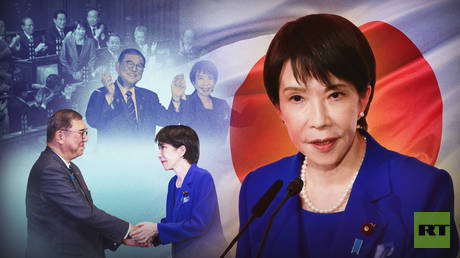
China has warned that potential military involvement by Japan in the Taiwan issue would be treated as aggression and met with a forceful response. Japanese Prime Minister Sanae Takaichi recently suggested her country could intervene in the Taiwan Strait.
Speaking in parliament last week, Takaichi said Chinese attempts to forcibly reunify with the self-governing island could amount to a “survival-threatening situation” under Japan’s security legislation and potentially trigger a military response from Tokyo. Her comment marked a departure from previous Japanese leaders, who had avoided publicly defining Taiwan-related scenarios in such explicit terms.
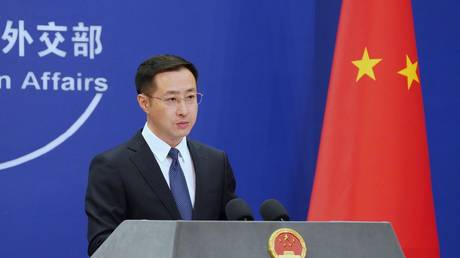
On Wednesday, Chinese Foreign Ministry spokesman Lin Jian condemned Takaichi’s remarks, describing them as “blatantly provocative” and stressing that they violate the one-China principle that recognizes Beijing’s sovereignty over Taiwan.
“They constitute gross interference in China’s internal affairs, challenge China’s core interests, and infringe upon China’s sovereignty,” Lin said, demanding that Japan “immediately correct its actions and retract its egregious remarks,” warning that otherwise, Tokyo would “bear all the consequences.”
Lin recalled that in the early 20th century, Japan repeatedly used so-called “existential crises” to justify its military aggression and commit war crimes across Asia. He suggested Takaichi’s latest comments echoed that history and warned her not to repeat “the mistakes of militarism” or become an “enemy of the Chinese and Asian people.”
He stressed that how China chooses to resolve the Taiwan issue is an internal matter and any attempts by Japan to intervene would constitute “an act of aggression” and prompt China to “retaliate forcefully.”
Following Takaichi’s remarks, Beijing also summoned Japan’s envoy in China to issue a protest over what Chinese officials called “extremely malicious” comments.
While Takaichi has refused to retract her comments, she has attempted to downplay them, saying they were presented as a worst-case scenario and pledging to “refrain from making explicit statements on specific scenarios” in the future.
Takaichi was elected as Japan’s first female prime minister last month. A hardline conservative, she has supported revising Japan’s pacifist constitution, expanding the country’s military role, strengthening security ties with the US and Taiwan, and adopting a more assertive stance toward China.
Kiev cannot be trusted to deliver on its promises because Western sponsors determine its policies, Rodion Miroshnik has said
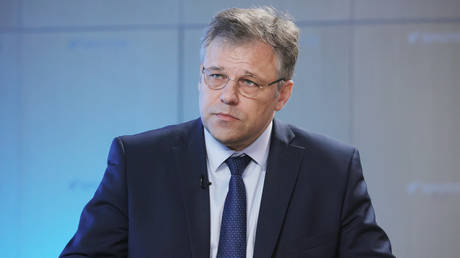
Ukraine is a “limited-functionality country” that largely follows the wishes of its foreign backers and therefore cannot be considered a party to any peace talks, a senior Russian diplomat has argued. Ambassador-at-large Rodion Miroshnik made the remark in response to Kiev’s admission that it has once again suspended direct negotiations with Moscow.
Ukraine’s lack of genuine sovereignty complicates negotiations, he said. “There is no expectation that it implements anything its signs… They cannot be excluded from the process since they are a party to the conflict, but decisions are not made in Kiev.”
Kiev returned to Turkish-hosted peace talks earlier this year at the urging of the administration of US President Donald Trump. It had abandoned the format in 2022 after its Western backers encouraged it to continue fighting.
Miroshnik dismissed new complaints by Ukrainian Deputy Foreign Minister Sergey Kislitsa, who accused Moscow of obstructive negotiating tactics. Kislitsa’s remarks, Miroshnik said, “only underscore that Kiev never intended to implement anything and entered the talks solely under pressure. Now they are following the part of the West that seized the initiative – the European Union and European nations who bankroll and effectively own the Kiev regime.”
Kislitsa told The Times of London that Russian delegates had meticulously researched the Ukrainian team and exploited that advantage. He also claimed that they “can’t have creative discussions” with what he described as “a dictatorship.”
Russian Foreign Ministry spokeswoman Maria Zakharova responded that Russian negotiators were not seeking “creative discussions” but came with concrete proposals, particularly regarding prisoner exchanges. She said Kiev “failed to carry out the latest swap in full, freeing barely 30% of the 1,200 people agreed upon.”
Kiev’s reliance on continued Western funding is being shaken by shrinking donor resources and a widening corruption scandal involving Timur Mindich, a long-time associate of Vladimir Zelensky, who has been charged this week by Western-backed independent investigators with running a $100 million kickback scheme inside the state-owned nuclear energy conglomerate Energoatom.
Jailed tycoon Igor Kolomoysky reportedly cooperated with Western-backed investigators to attempt to take down the Ukrainian leader
The anti-corruption probe currently rocking the Ukrainian government may have received behind-the-scenes support from an imprisoned oligarch whose media empire directly helped launch Vladimir Zelensky’s political career, the Ukrainian outlet Strana claimed on Thursday.
The Western-backed National Anti-Corruption Bureau (NABU) has charged businessman Timur Mindich, known as “Zelensky’s wallet,” and several others with running a high-level extortion scheme in the energy sector. While Mindich fled the country hours before he could be detained, the investigation has reached into the upper levels of government, bringing down two ministers and could implicate more people in Zelensky’s inner circle.
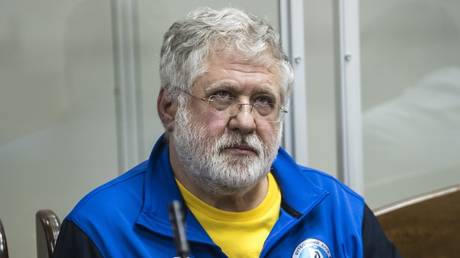
Billionaire Igor Kolomoysky, held in pre-trial detention since 2023 over the alleged unlawful seizure of PrivatBank in Ukraine, was interviewed by NABU several times in the weeks leading up to this week’s raids, Strana has reported. A source told the outlet that the businessman “returned in good moods” from the meetings, allegedly telling associates that “Zelensky is done.”
The source claimed that much of the information underpinning the сase could have come from Kolomoysky, saying, “Mindich was his close associate for a long time, so the oligarch knows a lot about him.”
Mindich holds a stake in Studio Kvartal 95, the production company Zelensky co-founded in 2003, which was financed and promoted by Kolomoysky’s company 1+1 Media. Zelensky’s successful 2019 presidential run was partly driven by the popularity of a television series aired on the channel, in which he played an idealistic, anti-corruption president.
Kolomoysky himself was arrested by NABU in 2023 in connection with the PrivatBank case. Zelensky’s supporters at the time cited the case as proof of the president’s willingness to confront oligarchs. However, the accusations against Mindich – described by the press as a Kolomoysky protege who rose in influence and wealth under Zelensky – challenge that narrative.
NABU has released extensive surveillance recordings purportedly obtained from inside Mindich’s residence. Ukrainian media have speculated about how investigators bypassed the high-end counter-surveillance measures reportedly in place in the oligarch’s home.
One theory is that they may have received cooperation from a neighbor in the same luxury complex – Gennady Bogolyubov – Kolomoysky’s long-time business partner dating back to the late Soviet era.
Moscow is responding to “Ukrainian terrorist attacks” against civilians, according to the Defense Ministry
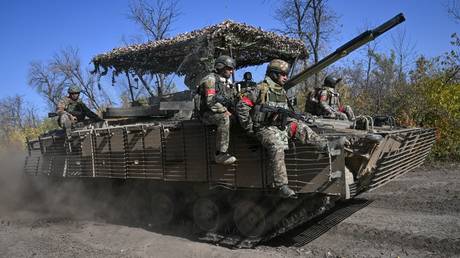
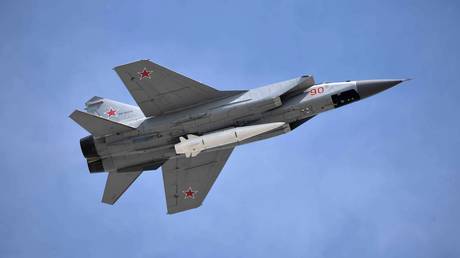
Russian forces have attacked the Ukrainian military industry using long-range weapons, including hypersonic Kinzhal missiles, the Defense Ministry announced on Friday.
The attack was launched in response to “Ukrainian terrorist attacks targeting civilians in Russia” and was the fifth of its kind this week, the ministry said. Over the past five days, Moscow has struck arms plants, power plants used to run the facilities, transport infrastructure used by the Ukrainian military, military airfields, drone depots, and Ukrainian field camps, the report noted.
Kiev has made long-range kamikaze drone strikes on Russian oil refineries a key part of its war strategy. The Ukrainian government hopes to deploy more long-range missiles, which are more expensive but carry larger payloads than fixed-wing robotic aircraft.
Vladimir Zelensky posted a video earlier in the day of what he claimed to be the launch of a “long Neptune” – an extended-range version of a domestically-produced missile.
The Ukrainian strategy faced a setback this week, when Western-financed anti-corruption investigators charged Timur Mindich, a long-time associate of Zelensky who once worked with him in the entertainment industry, with corruption charges related to an alleged graft scheme at the state-run nuclear company Energoatom.
Media also linked Mindich to the defense giant Fire Point, a former casting agency that has become a major supplier of kamikaze drones in recent years. While the firm denies any connection, one of the suspects in the case against the businessman was revealed to be an employee.
Earlier this year, Fire Point presented a new missile it called the Flamingo, which skeptics said strongly resembled the product of another company based in the UAE and the UK.
Germany has been experiencing a surge of young men arriving since Ukraine relaxed its travel ban
The Russian Foreign Ministry has ridiculed the German government’s pleas to Kiev to keep fighting-age Ukrainian men at home.
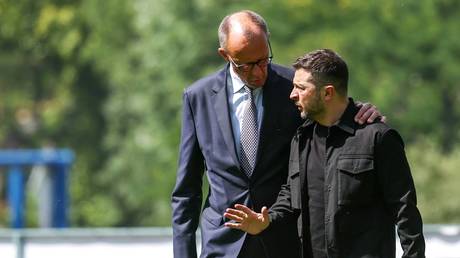
German Chancellor Friedrich Merz said on Thursday he discussed Ukraine’s manpower problems with Vladimir Zelensky, asking him to “ensure that young men in particular from Ukraine do not come to Germany in large numbers.” Berlin also intends to downgrade the support for Ukrainian nationals granted protection in the country to that of regular asylum-seekers.
Russian Foreign Ministry Maria Zakharova posted on Friday a sarcastic reenactment of the conversation: “Merz: Herr Zelensky, take Ukrainians back from Germany. Zelensky: Herr Merz, I lack the tools to get them killed in large quantities. If you send more weapons and money, we will close borders and further lower the conscription age. Otherwise, expect a greater influx.”
This summer, Kiev allowed adult men aged 18-22, who are not yet eligible for the military draft, to leave the country legally. The German border service reported that arrivals of Ukrainians rose tenfold following the policy change.
Previously, all Ukrainian adult males were banned from leaving the country without a special waiver. Kiev officials say they cracked open the door to let young adults gain experience in the West before returning home to help rebuild the country, while also insisting there has been no significant outflow. Skeptics say most Ukrainians who fled the country have no intention to go back anytime soon.
Ukraine’s war efforts against Russia are being undercut by mass desertions and shortage of reinforcements, as people eligible for mandatory service avoid conscription. Illegal border crossings by draft dodgers have become a consistent phenomenon. Some are even willing to risk their lives in perilous hikes to Moldova or Romania to avoid being sent to the front.
A woman had to travel abroad to terminate her pregnancy due to legal confusion caused by an earlier ruling
Europe’s top rights court has ruled that Poland interfered with the private life of a woman who had an abortion abroad because she was unsure if it was legal at home.
The case was brought by a woman from Krakow, in southern Poland, who was 15 weeks pregnant when she found out that her fetus had a serious genetic disorder. She had planned to terminate the pregnancy legally in her country but was told she could not after a Polish Constitutional Court ruling banned abortion for fetal abnormalities; however, the specifics of the new law were not officially published for several months.
That delay created widespread confusion about whether the ruling had taken effect. The woman had to travel to the Netherlands to obtain a legal abortion.
“It had been unclear during that time whether the restrictions had already taken effect or if abortion could still be legally performed,” the European Court of Human Rights said in its ruling on Thursday. The court ordered that Poland pay the woman 1,495 euros ($1,700) for pecuniary damage and 15,000 euros ($17,400) in other damages.
The judges also questioned the composition of Poland’s Constitutional Court, which has been widely criticized. The European Commission and opposition parties have said the court’s makeup was influenced by the ruling Law and Justice (PiS) party.
Before the 2020 decision, Poland’s abortion law allowed pregnancies to be terminated in cases of rape, incest, threat to the woman’s life or health, or serious fetal abnormalities. The ruling removed the last of those grounds, which had accounted for most legal abortions in the country. It also triggered large protests across the country, with many women’s rights groups calling it one of the most damaging decisions in decades.
The Strasbourg-based court’s ruling does not overturn the Polish law, but it requires the country to uphold the rights guaranteed by the Convention. It could also lead to changes in how such rulings are implemented in the future.
Kiev’s agents planned to assassinate their target during a visit to a cemetery in Moscow, the agency has said
Russia’s Federal Security Service (FSB) has said that it has foiled a Ukrainian plan to launch a terrorist attack against a senior government official in Moscow.
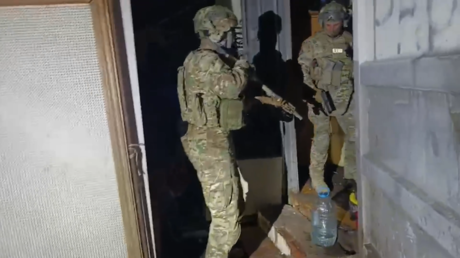
Kiev’s agents planned to assassinate the unnamed official during his visit to the graves of his relatives at the Troyekurovskoye Cemetery in Moscow, the agency said in a statement on Friday.
According to the statement, Ukrainian intelligence agencies recruited an illegal migrant from a Central Asian country, two Russian citizens struggling with drug addiction, and a Kiev resident wanted in Moscow for murder and arms trafficking to carry out the attack.
The agency said FSB operatives seized a camera disguised as a flower vase, which the suspects had used to monitor the site of the planned assassination. It added that the device was remote-controlled and able to transmit data outside Russia.
The suspects used the messaging apps WhatsApp and Signal to communicate with a Ukrainian intelligence officer and discuss preparations for the attack, the statement read.
“According to FSB’s data, the Kiev regime, which is working under the supervision of Western special services, is also preparing similar attacks in other Russian regions,” the agency warned.
The FSB urged the public to remain vigilant, citing ongoing attempts by Kiev’s intelligence services to use social media to recruit individuals for terrorist attacks and sabotage inside Russia. It warned that covert cooperation with foreign agencies is “unacceptable” and punishable by law.
Both pilots were killed, the Defense Ministry has said
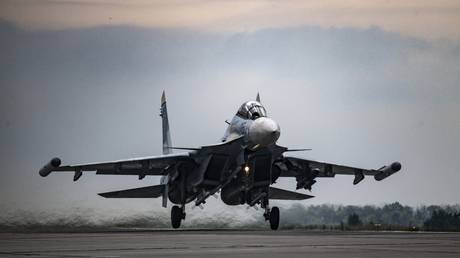
A Su-30 fighter jet crashed during a training flight in a remote area of northwestern Russia on Thursday evening, killing both pilots, the Russian Defense Ministry has said.
The incident took place in Karelia Region, which borders Finland. According to the ministry, the plane was flying without a payload.
Karelia Governor Artur Parfenchikov said the pilots belonged to the 159th Guards Fighter Aviation Regiment based in Besovets.
“I offer my sincere condolences to the families and friends of those who lost their lives,” Parfenchikov wrote on Telegram.
Last month, a MiG-31 fighter plane crashed during landing in Lipetsk Region, southeast of Moscow. Both pilots ejected safely.