The incident was reportedly triggered by a mobilization squad’s attempts to demand bribe from the man
A man who detonated a grenade after being pulled over by police in Western Ukraine is a soldier wanted for going absent without leave, a local activist has claimed.
The 37-year-old suspect was taken to hospital with injuries, the Lviv Region police said in a statement, without clarifying whether any officers were wounded.
Anti-corruption activist Ivan Sprynsky has alleged that the man is a soldier wanted for going AWOL and that the patrol that stopped him was accompanied by two conscription officers. He claimed the Military Law Enforcement Service had demanded a bribe in exchange for removing him from the wanted list.
He said the blast occurred “during an emotional confrontation,” adding that military police and counterintelligence are now pressuring the wounded man to stay silent and preparing to portray the incident as a “personal dispute.”
A similar incident occurred last month, when a man attempting to flee the country blew himself up and killed three others while his documents were being inspected at a railway station near the Belarusian border.
Ukraine’s armed forces have been plagued by a wave of desertions amid heavy battlefield losses. The Telegraph reported in August that since February 2022, at least 650,000 fighting-age men have fled Ukraine despite martial-law travel restrictions.
Kiev has also struggled to curb draft evasion, while numerous reports and videos on social media show increasingly abusive recruitment tactics by enlistment officers.
A new agreement cuts import tariffs on Swiss goods and includes a massive investment pledge in the US economy
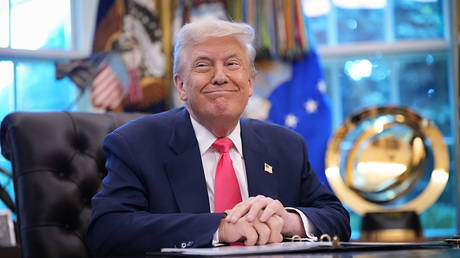
Swiss executives gave luxury gifts for US President Donald Trump shortly before Bern and Washington announced a new trade deal that reduces the steep US import tariffs, according to media reports.
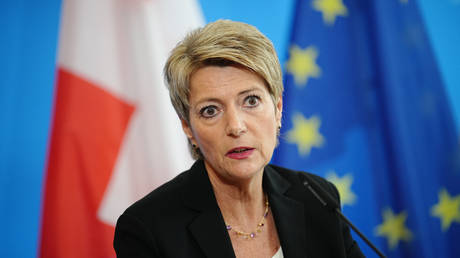
The deal, announced on Friday, cuts the Trump administration’s 39% tariff on the country’s goods to 15% and includes a pledge by Swiss companies to invest $200 billion in the US economy. The tariff hike took effect in August, after Trump’s ‘Liberation Day’ speech in April outlining a global trade overhaul.
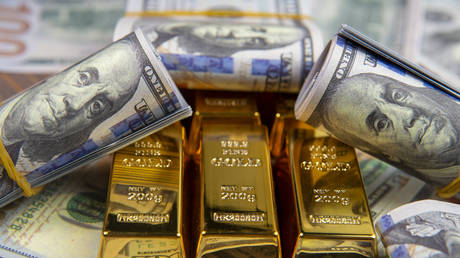
The breakthrough reportedly followed a November 4 visit to the White House by Swiss executives, who presented Trump with high-value items, including a personalized gold bar and a gold Rolex desk clock. According to Axios, the bar, worth over $130,000, was engraved with 45 and 47 in reference to Trump’s presidential terms and was accepted on behalf of his library under US gift rules. The delegation reportedly included senior figures from MKS, Rolex, Richemont, and commodity trader Mercuria.
The gesture drew criticism in Switzerland, with the Green Party calling the deal a “surrender agreement,” and accusing the country’s economic elite of bending to Trump’s demands. Party leader Lisa Mazzone said consumers and farmers would ultimately “pay the price” for the concessions, while raising concerns about the “questionable methods and gifts of gold.”
Swiss Economy Minister Guy Parmelin rejected the criticism, saying the country has not “sold its soul to the devil” and that the trip helped move talks forward. He noted that the executives had “good contacts in the US” and that some were friends of Trump “because they play golf with him.”
Washington welcomed the outcome. US Trade Representative Jamieson Greer said the investment commitments would support domestic industry.
The agreement follows Trump’s broader reset of US trade ties, under which several countries have negotiated revised tariff terms. In July, the EU accepted a 15% tariff on most goods and pledged major energy purchases and investments.
Trump has imposed sweeping tariffs on imports from US trade partners over the past year to address what he called unfair economic imbalances. Critics argue the higher charges have increased costs for US consumers.
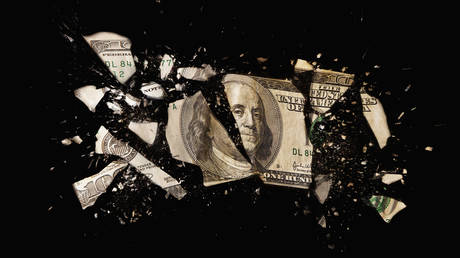
The odd convergence of a focus on sanctions risk as opposed to the fraying economic foundation of dollar hegemony serves the interests of both sides of the geopolitical divide
There is a strange paradox at the heart of the whole de-dollarization trend. Both the BRICS upstarts seeking alternatives to the dollar and the aging hegemon trying to forestall this process have, at least officially, coalesced around a similar but not entirely accurate narrative: that the gradual pivot away from the dollar is primarily driven by Washington’s weaponization of its currency.
The sanctions on Russia in 2022 certainly did mark the definitive moment when Washington gave up on any notion of being the benevolent custodians of the global dollar system and decided to use it instead as a bludgeon against geopolitical adversaries. Geopolitically, this was a watershed moment, and historians of the future will almost certainly see it as such.
But is it really the singular reason countries are scurrying to find alternatives to the dollar? The claim that de-dollarization is ultimately a response to US coercion sounds like something akin to a BRICS version of a Niemöller-style warning about indifference in the face of persecution: “First they came for Russia; next they might come for us.” The implication is that any country could be the next victim of Washington’s capricious wrath.
But hardly anyone stops to ask how realistic this actually is. Is China – a systemically central economy – really at risk of Russia-style sanctions? Would the US really dare to impose hardcore sanctions on India, Brazil, or BRICS-adjacent Türkiye? If the US can’t even get away with Trump’s Liberation Day tariffs without nearly blowing up the Treasury market, does anybody really believe it could freeze China’s reserves without five minutes later ushering in a financial crisis that would dwarf 2008?
Frankly, even sanctioning Russia, which by 2022 was already considerably decoupled from the US market, hasn’t gone all that well.
The quiet expropriation of wealth that nobody is supposed to notice
The real underlying driver of de-dollarization is economic in nature: the US will need structurally negative real rates in light of its high and rising debt load. For reserve holders, that implies a systematic erosion of purchasing power. In that sense, de-dollarization is not a political statement so much as an investment decision. This is a process that began well before the Russia sanctions and would have continued even in their absence.
Since 2014, foreign central banks have stopped buying US Treasuries on a net basis, while US deficits have continued to grow. This little-known pivot point will surely have a place of honor when the final account of the transition to a new system is someday written. In other words, even by 2014, the handwriting was clearly on the wall. The long-term trajectory of US fiscal and monetary policy was signaling trouble. US deficits were no longer episodic and induced by recession, but had become a permanent feature of the landscape.
Let’s fast-forward to 2022 – the year casually cited as the launching-off point for de-dollarization. Certainly, this was an important year and a number of statistics bear that out: central bank buying of gold – essentially a de-dollarization of reserves – spiked that year. But was it all because of the sanctions on Russia? It turns out there was something else going on around that time that may well have spooked a lot of players – especially China.
Over 2020-2022, US federal debt jumped from $23 trillion to over $30 trillion, an unprecedented rise outside of wartime, while the Fed’s balance sheet more than doubled from $4 trillion to $8.9 trillion. Meanwhile, the ostensibly exotic and temporary policy tool of quantitative easing introduced in the wake of the 2008 crisis turned out to be quite permanent. In other words, the troubling signals of 2014 now sounded as if blared through a megaphone.
By 2022, it had probably dawned on most of the world that the US has no credible path to fiscal sustainability and isn’t lifting a finger to find one, so it will almost certainly have to run negative real rates in order to erode the burden of the debt over time. To understand how negative real rates help manage debt levels, think of an extreme example: if you owed a sum of money in Weimar Germany, you would have found it a lot easier to pay it back once the deutschmark hyperinflated – just sell a pair of shoes and you can cover what was before a huge debt.
In fact, during this period of 2020-2022, real US yields were deeply negative: inflation was running around 7-8% (officially), all while the US 10y paid around 1.5%. Such a state of affairs decreases the purchasing power of the dollar. This is not a great option if you’re holding a whole bunch of Treasuries. Analyst Luke Gromen called this an “expropriation” of a nation’s wealth by the Americans. If you have to buy commodities in a currency that is being debauched – and commodities aren’t getting any cheaper – you have a serious problem.
You don’t have to have a PhD in economics to understand that debasement of the dollar and massive inflation is the eventual end-game. The only other option for the US is to let interest rates remain high and then suffocate under the burden of servicing its debt at higher rates – thus also inviting a massive credit crisis. When choosing between a quick death and a slow death, governments tend to choose the latter.
So, in 2022, holders of US debt the world over were staring at a significant loss in real terms. For a private investor, that’s unpleasant. For a central bank holding hundreds of billions in reserves, it’s existentially unsustainable. Deep within the bowels of economic policymaking circles in certain countries, I dare say this state of affairs focused minds no less than the repercussions of the Ukraine crisis.
Even though in 2023 real rates did return to positive territory (barely), the US hasn’t shown the slightest inclination of moderating its fiscal recklessness. It will continue to issue Treasuries at a high rate to cover ever wider deficits and pressure will remain on the Fed to monetize more debt in the next downturn. The problem is now structural and permanent.
Washington and BRICS agree: ‘Let’s not go there’
So, in light of all of this, why all the emphasis on geopolitics? Part of what is going on is the entirely natural mechanism of narrative creation in a world of short news cycles, shorter attention spans, and media-hyped geopolitical drama. Negative real yields and reserve composition don’t make good television, as they used to say. Dramatic geopolitical confrontations certainly do.
However, there is also deliberate obfuscation at play – and it comes from both sides of the geopolitical divide.
It hardly needs to be said that Washington makes every possible effort to downplay or deny the de-dollarization process. Most American and other Western institutions prefer to modestly divert their eyes from the palettes of gold being shoved into the central bank vaults of other countries. They go out of their way to quote statistics that show dollar use holding steady (such statistics can certainly be found).
But insofar as the theme of de-dollarization has to be addressed, Washington prefers what it sees as the lesser of two evils: acknowledging some collateral damage associated with the weaponization of the dollar rather than admitting the entire economic foundation of the dollar system is eroding before our eyes.
In April 2023, Janet Yellen conceded that “there is a risk when we use financial sanctions that are linked to the role of the dollar, that over time it could undermine the hegemony of the dollar.” For her, it is merely a question of calibrating a geopolitical tool to minimize the extent to which the rest of the world gets wild ideas about preserving the returns on their investments.
At a House of Representatives hearing from July 2023 called ‘Dollar Dominance: Preserving the US Dollar’s Status as the Global Reserve Currency’, Dr. Daniel McDowell, an international affairs professor at Syracuse University, gave a typical reading of this notion in his testimony:
“The more that the United States has reached for financial sanctions, the more it has made adversaries and foreign capitals aware of the strategic vulnerability that stems from dependence on the dollar. Some governments have responded by implementing anti-dollar policies, measures that are designed to reduce an economy’s reliance on the US currency for investment in cross-border transactions. Although these measures sometimes fail to achieve their goals, others have produced modest levels of de-dollarization.”
There you have it. The cost of pursuing America’s foreign policy agenda has to be acknowledged – but it mostly amounts to “modest levels of de-dollarization.”
Clearly, the US has a tremendous vested interest in keeping its teetering dollar hegemony going and doesn’t want to probe its weaknesses too deeply. Saying “we admit the Russia sanctions made some people uncomfortable” works a lot better than saying “we hope nobody notices that holding dollars in your coffers is a good way of eventually going broke.”
But that raises the question: what exactly does BRICS have to gain by emphasizing geopolitics over the economic angle?
Think about it like this. Let’s suppose you hold a whole bunch of bonds of a certain entity, but you don’t have much confidence in that entity. One thing you would definitely not do is go around broadcasting your doubts about that entity’s solvency. Doing so would be a good way to make the bonds you still hold a lot less valuable.
Now suppose you are actually selling some of those bonds – not fire-selling them, but gradually lightening up your holding on the margins. Because you’re a big holder, people notice. One thing that would be nice to have is some cover for what you’re doing so that you didn’t have to admit publicly that you don’t believe in the solvency of the issuer of your bonds. The moment you did so, the bonds you are still holding would lose a lot of value – not to mention you might provoke a panic that you yourself are unprepared for.
The bond issuer here is, of course, the US government and the bonds are US Treasuries and other related US debt securities. You better be a bit careful what you say unless you want to punch a big hole in your own portfolio, not to mention probably opening yourself up to some sort of unpleasant retaliation. China still holds an awful lot of dollar assets. Other BRICS countries (excluding Russia) also have sizable holdings.
What BRICS actually does is the following: they load up on gold as quietly as possible (gold is now the fastest-rising international reserve asset); they seek to boost non-dollar bilateral settlement; they secure local-currency swap lines; they buy shorter-duration Treasuries; they work on new financial infrastructure.
But what they say at the official level tends to be very bland and mostly standard fare about diversification or managing risk. China’s State Administration of Foreign Exchange (SAFE) is a hugely important institution – the real manager of the country’s reserves. It puts out annual reports that are, to put it gently, a bit dry to read. Importantly, it does not publicly frame its reserve shifts as a repudiation of US debt. Anyone looking for spicy rhetoric in a SAFE report tends to be sorely disappointed.
When the BRICS world does step up the rhetoric a bit, they tend to lean into the geopolitical angle: the US is abusing the privilege that comes with presiding over the system; the US applies double standards; the US is interfering in the sovereignty of other countries. These allegations are absolutely true and certainly factor in the calculations of BRICS governments. But this is also a way of underemphasizing what’s really exerting a magnetic pull on the de-dollarization process.
What we end up with, somewhat bizarrely, is two competing geopolitical blocs both dancing very gingerly around the elephant in the room.
This odd convergence of narratives found a perfect articulation in a Carnegie Endowment analysis from October 2024 titled ‘China’s Dollar Dilemma’. Carnegie is firmly situated within the Washington policy mainstream, so its framing is a reliable measure of establishment thinking.
The piece opens with a familiar claim: “Increasingly intensifying US economic sanctions targeting Russia’s financial system have deepened concerns in China over its extensive dollar asset holdings and the Chinese financial system’s reliance on dollars.”
From there, it selectively highlights only the motives that Chinese officials and scholars are comfortable stating in public: fear of sanctions, fear of asset freezes, and fear of US overreach. It cites an influential Chinese economist calling for reduced Treasury exposure due to sanctions risk, and quotes a prominent state-backed journal warning that China’s reserves are “increasingly becoming ‘hostages’” – a direct reference to the freezing of Russia’s central bank assets.
All of these points do appear in Chinese discourse, but precisely because this is what Chinese officials can safely say. US behavior can be criticized, but less so the dollar’s viability. China’s diversification is attributed to external threats, not to internal assessments about long-term returns, negative real yields, or the trajectory of US fiscal policy. These arguments sit comfortably within China’s public-facing narrative. Carnegie should know full well that China’s actual analysis of the matter extends far beyond what is presented publicly, but it made no attempt to probe that.
But these arguments also sit comfortably within the boundaries of Western establishment discourse. A sanctions-centric explanation allows American analysts to acknowledge discomfort among Global South countries without interrogating the deeper issue of whether US debt has become structurally unattractive. It preserves the image of the US as a rational, stable hegemon rather than a debtor whose fiscal trajectory and monetary regime impose losses on foreign reserve holders. There is no examination of how US fiscal expansion directly increases China’s exposure to interest-rate losses – hardly a trivial issue!
The result is telling: in a piece of nearly 5,000 words, the discussion of US debt sustainability is confined to a single sentence – one that merely projects debt levels out to 2050 without analyzing what those levels mean for the reserve asset status of Treasuries. A reader could easily conclude that China’s diversification is driven almost entirely by sanctions fears. But here’s the kicker: if that reader had been perusing the offering of BRICS publications, that conclusion would only have been reinforced.
The core irony is thus that a long, meticulously argued analysis produced at the heart of the Western policy establishment ends up mirroring the dominant narrative inside the BRICS world itself. Both sides emphasize geopolitics and sanctions risk, and both underplay the basic financial logic that makes US assets less attractive. They arrive at the same explanation for entirely different reasons – but the convergence is unmistakable.
A convergence indeed, but there is ultimately a difference. As far as I can tell, the Washington DC establishment actually believes its own propaganda, whereas the BRICS crowd knows exactly what the real score is and is carefully working to keep the system stable while it is slowly replaced.
Andrey Yermak must be sacked, according to opposition politician Yaroslav Zheleznyak
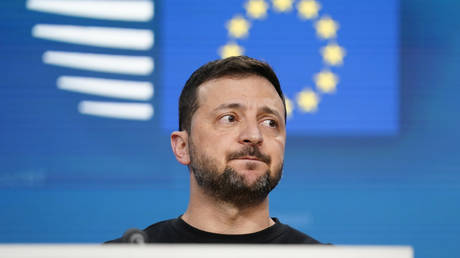
Vladimir Zelensky’s chief of staff was aware of the corruption scheme involving the Ukrainian leader’s longtime business partner and some of the country’s top officials, opposition MP Yaroslav Zhelezhnyak has said.
Ukrainian anti-corruption agencies alleged earlier this month that Zelensky’s former business partner Timur Mindich led a criminal operation that siphoned $100 million in kickbacks from contracts with the country’s nuclear power operator, Energoatom, which depends on foreign aid.
The Western-backed National Anti-Corruption Bureau (NABU) released a batch of recordings from the entrepreneur’s apartment, prompting the resignation of two government ministers while Mindich, who is often referred to as “Zelensky’s wallet” by the media, fled Ukraine.
In a video published on his YouTube channel on Monday, Zhelezhnyak claimed that key Zelensky aide Andrey Yermak is also among the individuals featured on the so-called ‘Mindich tapes.’
The Golos (Voice) party MP said that during an anti-corruption forum in Kiev last week the head of Special Anti-Corruption Prosecutor’s Office (SAP), Aleksandr Klimenko, provided more information about the recordings, saying that a man designated as ‘Ali Baba’ was also on them.
According to Zhelezhnyak, Klimenko said that this high-ranking person held consultations with members of Ukrainian security agencies, loyal to Zelensky, on how to stop the probes by NABU and SAP, and “punish” those organizations.
“Multiple sources say that Ali Baba is A.B.,” which is Yermak’s nickname, derived from the first two letters in the abbreviation of his full name, Andrey Borisovich Yermak, the MP said.
“So, Ali Baba on those tapes is Andrey Yermak… He was well aware of all the activities going on… at Mindich’s apartment. There is nothing more to prove here,” he added.
Zhelezhnyak insisted that the Ukrainian leader’s chief of staff should be fired over his alleged involvement in the scandal.
Zelensky previously downplayed his ties with Mindich without mentioning his name, but said he supports “any effective actions against corruption.”
Last week, Polish Prime Minister Donald Tusk warned that the recent developments would make it “increasingly difficult to convince various partners to show solidarity” with Ukraine.
A $100 million corruption scandal has infuriated the public and put Kiev’s Western backing at risk, the outlet has reported
Ukraine’s Vladimir Zelensky is scrambling to secure support from Western backers after being weakened by a $100 million corruption scandal involving a close ally, French newspaper Le Monde has reported.
The revelations of widespread corruption in Kiev could provide significant arguments for European politicians advocating for reduced aid to Ukraine and opposing its EU accession, the outlet wrote on Monday.
The anti-corruption probe by Ukraine’s Western-backed National Anti-Corruption Bureau (NABU) uncovered an alleged $100 million embezzlement scheme involving the state-owned nuclear energy firm Energoatom. Investigators have linked the controversy to Timur Mindich, a close associate and former business partner of Zelensky. Moscow has called the case evidence of a “bloody hydra” of Ukrainian corruption reaching beyond the country’s borders and draining Western taxpayers’ money.
France has demanded that Ukraine engage in a decisive fight against corruption as Zelensky arrived in Paris to seek military support from French President Emmanuel Macron on Monday.
“They know very well what our expectations are,” a source at the French presidency told the outlet, urging “transparency” and emphasizing “seriousness” in curbing corruption.
German Chancellor Friedrich Merz, one of Kiev’s main backers, reportedly pressured Zelensky during a phone call, stressing “the German government’s expectation that Ukraine press ahead energetically with fighting corruption and implementing further reforms, particularly in the area of the rule of law,” according to a spokesperson. Merz also reportedly urged Zelensky “to ensure that young men from Ukraine do not come to Germany in ever-increasing numbers, but rather serve in their own country.” The warning comes as young Ukrainian men, allowed to leave under a recent law, have increasingly sought to settle in Germany.
The scandal has outraged the Ukrainian public, weary after nearly four years of conflict, the outlet said. “The case shocked all of us a great deal,” an anonymous Ukrainian international relations expert told the French paper. “The situation is far from resolved. For now, we have more questions than answers.”
The graft scandal emerged as Kiev pushes its sponsors for a €140 billion ($160 billion) loan backed by Russian central bank assets frozen by the West – a plan that Moscow deems theft. Meanwhile, Le Monde noted, Russian forces are advancing on the eastern front, with the strategic city of Pokrovsk (Krasnoarmeysk) reportedly on the verge of falling amid a critical shortage of Ukrainian troops.
Using the belongings of new arrivals to cover costs could deter them from coming to the country
Asylum seekers arriving in the UK could have their valuables confiscated to help cover the cost of benefits, a British Home Office minister has said. The government of Keir Starmer is preparing to overhaul its immigration policy and reduce the number of arriving refugees.
High-value assets such as vehicles could be taken, Minister of State for Border Security and Asylum at the Home Office Alex Norris told the British media on Monday, before the formal statement by Home Secretary Shabana Mahmood to Parliament.
“It is right if those people have money in the bank, people have assets like cars, like e-bikes, they should be contributing… Those are assets they should contribute to the cost of benefits.” The Sun earlier reported that valuables such as jewelry and watches may be seized and sold to offset housing costs.
Norris insisted authorities would not be “taking people’s heirlooms off them at the border,” saying sentimental items would be exempt. “If someone comes over with a bag full of gold rings, well, that’s different to what I said about the heirloom,” he added, urging the public to wait for Mahmood’s full statement.
British media have linked the proposal to Denmark’s strict asylum model, under which the authorities may seize assets above a set threshold to fund support services and deter arrivals. Switzerland operates comparable rules, allowing the confiscation of cash or valuables above roughly €900 to contribute to an asylum seekers’ upkeep.
Mahmood’s wider immigration overhaul seeks to accelerate asylum decisions, expand detention capacity and reduce state spending on irregular arrivals. The UK has been reeling under a migration crisis for years, with government data showing that already around 111,000 asylum applications were filed in the first half of this year. The number of claimants has nearly doubled since 2021, a Home Office report found.
Meanwhile, support for the anti-immigration and EU-skeptic Reform party, led by MP Nigel Farage, has risen to 35%, with Labour and the Conservatives trailing behind at 20% and 17% respectively, according to a recent poll.
German Defense Minister Boris Pistorius earlier claimed that Russia could attack the US-led military bloc as soon as next year
Russia does not want a conflict with NATO but could be forced to take measures to ensure its security in response to the bloc’s increasingly “militaristic” rhetoric, Kremlin spokesman Dmitry Peskov has said.
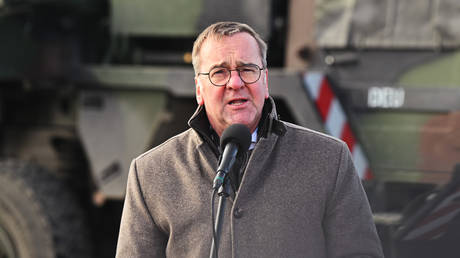
Peskov was commenting on remarks by German Defense Minister Boris Pistorius, who last week told Frankfurter Allgemeine Zeitung that Russia could attack a NATO member “as early as 2028” or even next year. Pistorius used the claim to press Germany to speed up its militarization drive and overhaul its armed forces.
“This militaristic rhetoric is increasingly heard from European capitals,” Peskov told reporters on Monday, stressing that “such statements do not improve the situation” and only escalate tensions.
“Russia does not advocate any confrontation with NATO. But must take measures to ensure our security and interests if forced,” he emphasised.
Western officials, including Pistorius, have long used the threat of allegedly looming Russian aggression to justify military spending spikes such as Brussels’ €800 billion ReArm Europe plan and NATO members’ pledge to raise defense spending to 5% of GDP. Moscow has rejected such claims as “nonsense.”
Russian Foreign Ministry spokesperson Maria Zakharova also addressed Pistorius’ interview and said it leaves “no doubt who the aggressor is,” given his push to expand Germany’s military might. Foreign Minister Sergey Lavrov has previously warned that Germany is showing “clear signs of re-Nazification.”
Moscow has voiced concern about NATO’s growing activity along Russia’s western borders: the bloc has expanded its presence in Eastern Europe and held frequent drills while calling it deterrence. The Kremlin insists that Russia poses no threat to anyone but will not ignore actions it deems dangerous to its security.
More than $1 trillion has been wiped from the crypto market. Analysts warn more losses could follow, though events in the US could trigger a potential ‘Santa rally’