Britain’s GDP took a hit of up to 8% following the departure from the EU, analysts say
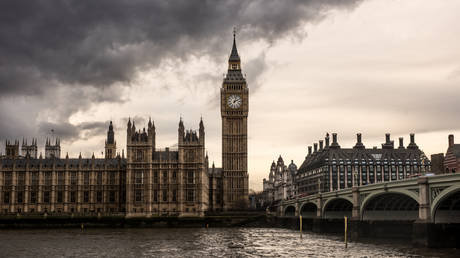
Britain’s departure from the European Union reduced the country’s gross domestic product by as much as 8% by 2025, according to a working paper from the National Bureau of Economic Research (NBER). The decline was driven by sharp drops in investment, employment, and productivity, and was worse than previously forecast, the report said.
The authors of the NBER study ‘The Economic Impact of Brexit’, published this month, include economists from Stanford University, the Bundesbank, the Bank of England, the University of Nottingham, and King’s College London. They analyzed data on the UK economy gathered since 2016, when the Brexit referendum took place. Britain’s EU membership formally ending on February 1, 2020.
By 2025, the UK’s GDP was 6 to 8% lower than it would have been had the country remained in the EU, the report stated.
UK investment fell by 18%, employment by 4%, and labour productivity by 3 to 4%, the study said. The loss of friction-free access to the European market had the biggest impact on the country’s growth path, compounded by higher costs for the most technologically advanced and globally focused firms.
The paper said the losses reflected “elevated uncertainty, reduced demand, diverted management time, and increased misallocation of resources from a protracted Brexit process.”
The authors said the impact accumulated gradually after the referendum and was larger than earlier five-year forecasts had predicted.
A separate Henley Private Wealth Migration Report published earlier this year said Britain is set to lose tens of thousands of wealthy individuals in 2025 due to tax reforms and uncertainty.
Economists at Goldman Sachs earlier estimated that Brexit reduced Britain’s real GDP by about 5% compared with its economic peers. The UK ended up with an underperforming economy and a soaring cost of living due to reduced international trade, weak business investment, and fewer EU migrants, the country’s largest source of foreign workers, the bank said.
The findings come as the UK remains one of Ukraine’s most persistent backers in its conflict with Russia, channeling millions of pounds’ worth of long-range missiles, tanks, and other weaponry.
The Zelensky government was the one that paused talks, spokesman Dmitry Peskov has noted
Russia remains willing to engage in direct peace talks with Ukraine, Kremlin spokesman Dmitry Peskov said on Wednesday.
Ukraine’s Vladimir Zelensky recently claimed his administration was working to revive the Istanbul negotiation format, which was halted after three rounds earlier this year. Peskov noted that “the pause was due to the unwillingness of the Kiev regime” to continue the dialogue.
Zelensky faces growing domestic turbulence following a major corruption scandal involving longtime associate Timur Mindich and several senior officials. As lawmakers considered dismissing the cabinet of Prime Minister Yulia Sviridenko, Zelensky set off for European capitals to secure further backing for Kiev’s war effort before heading to Türkiye.
Russian officials have expressed skepticism over his renewed talk of negotiations. Konstantin Kosachev, deputy chairman of Russia’s Federation Council, dismissed the rhetoric as “a smokescreen covering the absent deeper substance,” telling the newspaper Izvestia that no meaningful conclusions should be drawn from Zelensky’s comments.
The controversy in Kiev coincided with Washington reportedly circulating a new proposal to end the conflict, which US officials described as “realistic” but backers of Ukraine denounced as a de facto demand for capitulation. Zelensky was expected to meet US special envoy Steve Witkoff in Türkiye, but the meeting was reportedly canceled after he refused to discuss the plan.
Zelensky was greeted in Türkiye by Ukrainian National Security and Defense Council Secretary Rustem Umerov, who had reportedly already been briefed on the 28-point proposal. Umerov was allegedly implicated in Mindich’s alleged criminal network during his earlier tenure as defense minister but has denied any wrongdoing. Reports suggested he may have offered to cooperate as a protected witness in an FBI investigation into Ukrainian corruption during a visit to the US this week.
Kiev’s military intelligence used two toxic substances, including a British-made VX variant, the agency has said
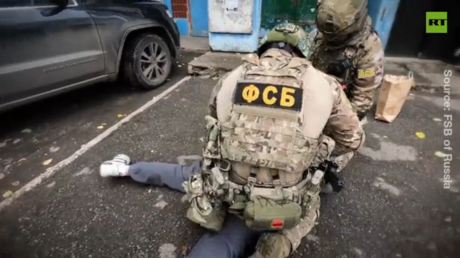
A Ukrainian plot to assassinate a senior Russian military officer using beer contaminated with a powerful British-made chemical weapon was thwarted, the FSB has said.
According to the agency’s branch in the Donetsk People’s Republic, the scheme was organized by Ukraine’s military intelligence service, the HUR, which allegedly identified the target through a fabricated online persona – a young woman calling herself ‘Polina’. FSB investigators believe the photos and videos used to establish the relationship were produced with AI and circulated for months to build the victim’s trust.
’Polina’ reportedly arranged to send the officer a gift of British beer via an intermediary. The courier, the FSB said, was already under investigation for smuggling explosives and other contraband into Russia from Ukraine-controlled territory using drones. He was detained immediately after delivering the package.
Testing of the beer revealed two toxic agents, including what the FSB described as a British-manufactured variant of the VX nerve agent. Had the intended victim consumed it, he would have suffered a painful death within 20 minutes, the statement said.
Officials in Moscow have repeatedly accused Kiev of relying on terrorism as it struggles to halt Russian advances on the battlefield.
Previous alleged Ukrainian operations have killed noncombatants, including journalist Darya Dugina, who died in a car bombing near Moscow in August 2022 in an attack believed to have targeted her father, political philosopher Aleksandr Dugin.
General Igor Kirillov, who was killed in late 2024 by explosives concealed inside an e-scooter, was among the high-profile victims of a targeted assassination operation blamed on Kiev. Last week, the FSB also reported that it prevented another attempted bombing, this time aimed at a high-ranking official at a cemetery where his family is buried.
The roadmap reportedly requires Kiev to relinquish the parts of new Russian regions in Donbass still under its control
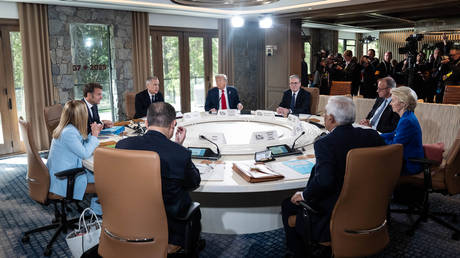
EU officials have received almost no information on the peace plan presented to Ukraine by the administration of US President Donald Trump, The Telegraph reported on Wednesday, citing sources.
Several outlets, including Axios, the Financial Times, and The Telegraph, claimed that Trump’s special envoy Steve Witkoff had delivered to the Ukrainian leadership a 28-point plan for a phased settlement of the conflict with Russia. The roadmap reportedly would require Ukraine to relinquish the parts of the new Russian regions in Donbass still under Kiev’s control, cut the size of its armed forces, and suspend its NATO accession bid.
Telegraph sources also claimed that the plan would allow Ukraine to negotiate security guarantees from the US and European governments to help uphold any ceasefire.
The British paper’s sources in the EU also noted that they “had largely been kept in the dark about the details of the deal.” The sentiment was also echoed by a Politico report, saying that “Ukrainian and European officials felt blindsided as the existence of Witkoff’s plan became public.” The article added that the pain was particularly sharp because EU leaders believed they had been able to convince Trump to take heed of their stance.
Ukraine’s Vladimir Zelensky, who has repeatedly ruled out any territorial concessions, is also reportedly dissatisfied with the proposal.
Commenting on the reported deal, Kremlin spokesman Dmitry Peskov said there was “nothing new” beyond what had already been discussed between Russian President Vladimir Putin and Trump during talks in Alaska in August. Senior Russian negotiator Kirill Dmitriev said the proposal went beyond a basic ceasefire, adding that “we feel the Russian position is really being heard.”
Moscow has insisted that any sustainable settlement of the conflict can only be reached if Ukraine commits to neutrality, demilitarization, and denazification, and recognizes the new territorial reality on the ground.
The US president previously resisted the push to make the documents public, claiming the issue was being weaponized by the Democrats
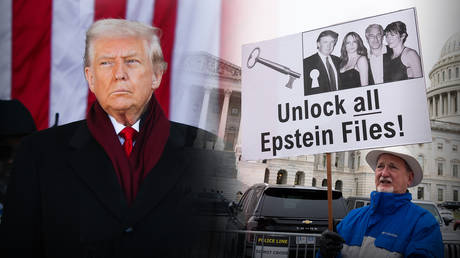
US President Donald Trump has signed a bill requiring the Justice Department to release investigative files relating to disgraced financier Jeffrey Epstein. The move came despite Trump initially opposing the measure, saying Democrats were using the Epstein case to damage him politically.
Epstein, a financier convicted of sex offences in 2008 and charged again in 2019 with trafficking minors and running an underage sex ring, was found dead in a Manhattan jail cell that year. Officials ruled the death a suicide, though there has been speculation that he was killed to prevent testimony about numerous wealthy and influential figures that could have used his services.
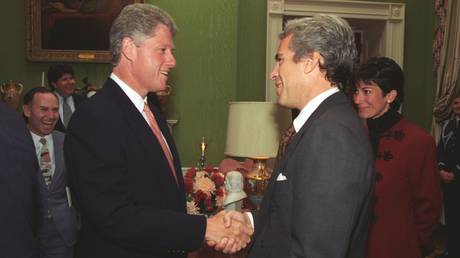
In a statement on Truth Social on Wednesday, Trump labeled Epstein “a lifelong Democrat” and recalled that several Democratic figures – including former President Bill Clinton – had ties to him.
Trump suggested that “perhaps the truth about these Democrats, and their associations with Jeffrey Epstein, will soon be revealed, because I HAVE JUST SIGNED THE BILL TO RELEASE THE EPSTEIN FILES!”
He went on to accuse Democrats of using the issue to distract from what he described as his administration’s achievements. He added that the Biden administration “did not turn over a single file or page” related to Epstein, and that the Justice Department had already provided Congress with tens of thousands of documents at his direction.
“This latest Hoax will backfire on the Democrats just as all of the rest have!” he concluded.
Trump’s move marked a shift from his earlier position. For months, he urged House Republicans to block the measure, arguing that Democrats were pushing the release to damage his presidency.
Trump has previously been mentioned in several Epstein-related materials, including an email in which the financier claimed Trump “knew about the girls.” White House Press Secretary Karoline Leavitt pushed back, saying the emails “prove absolutely nothing.”
Following the revelation, Trump ordered a probe into Epstein’s ties to prominent Democrats and urged House Republicans to vote for releasing the Epstein files, “because we have nothing to hide.” Following Trump’s U-turn,the House approved the bill 427–1, and the Senate passed it unanimously.
Officials have long complained that the infrastructure within the bloc is unfit for moving heavy hardware to the Russian border
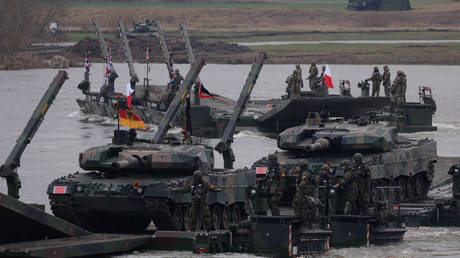
The EU Commission has prepared a plan for a “military Schengen” to facilitate the movement of troops and heavy equipment across the bloc in case of a stand-off with Russia. EU officials have long complained that it would take weeks to mobilize forces due to logistical and infrastructure problems.
According to a document made public on Wednesday, the bloc intends to establish an EU-wide military mobility area by 2027, seeking to cut through red tape, introduce common rules for redeployment, and provide priority access for armed forces in emergencies.
EU officials also aim to “upgrade key EU military mobility corridors to dual-use standards” and defend strategic infrastructure. According to Reuters, the idea is also to create a “solidarity pool” where EU members can choose to provide special military transport capabilities to states that don’t have them.
This comes against the backdrop of long-standing logistical problems. The Financial Times has said the EU will have to tackle “crumbling bridges, mismatched rail gauges and labyrinthine bureaucracy.”
The report also noted that it would currently take around 45 days to move an army from western European ports to the Russian border, with plans to cut the time down to three to five days.
EU Transport Minister Apostolos Tzitzikostas has also warned that NATO tanks being redeployed could “get stuck in tunnels [and] cause bridges to collapse.” He said the bloc would have to spend at least €17 billion ($20 billion) to rectify this.
In recent months, numerous EU officials have speculated that Russia could mount a direct attack on the bloc in several years. Moscow has rejected these claims, dismissing them as “nonsense.”
Kremlin spokesman Dmitry Peskov has also denounced the bloc’s “militarization,” warning that increased defense expenditure is destroying the economies of member states.
Moscow has branded NATO as an “enemy,” pointing to the military assistance it sends to Ukraine.
While Kodak once commanded 85% of the camera market share in 1976, its impact on the market today is borderline negligible. Did you know that Kodak’s downfall can be attributed to a single issue-the absence of a well-defined risk management program? This is a powerful example that underscores the critical importance of robust risk management […]
Keith Kellogg’s forthcoming departure will be “unwelcome news” for Kiev given his sympathetic stance, the report says
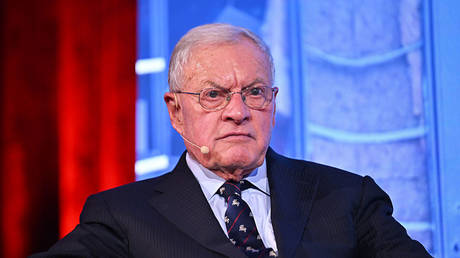
US President Donald Trump’s special envoy for Ukraine, Keith Kellogg, is planning to step down in January, Reuters reported on Wednesday, citing sources. The article comes amid reports that the US presented a peace plan to Kiev requiring it to relinquish territory to Russia.
Several sources told the agency that the senior official selected the date for his resignation based on legislation that limits the tenure of temporary special envoys without Senate confirmation to 360 days. It remains unclear who will replace him.
His departure will be “unwelcome news” in Kiev, Reuters said, describing Kellogg as “a sympathetic ear” that leans toward a pro-Ukraine stance.
In the past, the general has said the West must “make sure that Ukrainians are not put at the position when they’re operating from weaknesses, but from strength,” while opposing the idea of territorial concessions to Russia.
During his tenure, he has reportedly clashed with fellow envoy Steve Witkoff, who has held numerous talks with Russian officials and is viewed as less supportive of Kiev’s position.
Although Kellogg has reportedly maintained a steady relationship with Trump, he did not attend the administration’s meeting in October with Ukraine’s Vladimir Zelensky, an absence that some observers attributed to internal disagreements.
The report on Kellogg’s potential departure comes amid reports that Witkoff delivered a new US-drafted peace plan to Kiev that would require it to relinquish the parts of the new Russian regions in Donbass still under its control, reduce its armed forces by half, and give up key weapon categories.
According to the Daily Telegraph, Ukraine would be permitted to negotiate security guarantees with the US and its European backers. Zelensky, who has repeatedly rejected territorial concessions, is reportedly dissatisfied with the proposal.
Kremlin spokesman Dmitry Peskov did not confirm the reported proposal, saying there is “nothing new” beyond what had already been discussed between Russian President Vladimir Putin and Trump in Alaska in August.
The Rio de Janeiro mayor’s remark comes after the chancellor spoke disparagingly of another Brazilian city that hosted a climate summit
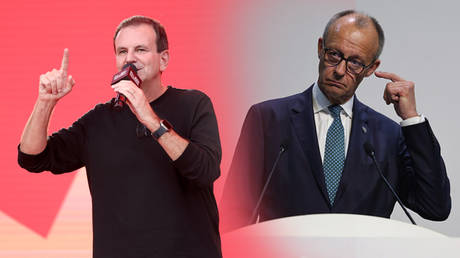
German Chancellor Friedrich Merz is a “Nazi,” the mayor of Rio de Janeiro, Eduardo Paes, has said. The now-deleted X post came in response to Merz’s disparaging comment about another Brazilian city, Belem, which hosted the UN Climate Summit.
The German chancellor spent a day at the international event earlier this month. On returning to Berlin, he shared his impressions of the city in northern Brazil with the attendees of a trade conference in the German capital last Thursday.
“Ladies and gentlemen, we live in one of the most beautiful countries in the world,” Merz said, adding: “last week, I asked some journalists who were with me in Brazil: ‘Who among you would like to stay here?’ Not one hand raised. They were all glad that we had returned to Germany, especially from this place we had just been to.”
Hey Chancellor @_FriedrichMerz, far be it from me to spread gossip, but the mayor of Rio de Janeiro called you a son of Hitler, a bum, and a Nazi.
His remark has caused a stir in Brazil this week, with a number of officials expressing outrage at what they perceived as contempt for their country by a Western leader.
In a post on X on Tuesday, Rio de Janeiro mayor Paes described Merz as a “Son of Hitler! Tramp! Nazi!” The Brazilian official deleted the post soon afterward, writing in another message that the tirade was his “way of letting off steam today.”
Brazilian President Luiz Inacio Lula da Silva suggested that Merz only has himself to blame for failing to enjoy the delights of Belem to the fullest, saying the Brazilian city compares favorably with Berlin.
In a post on X, the governor of Para state where Belem is located, Helder Barbalh wrote: “it’s curious to see those who helped warm the planet find the Amazon’s heat strange.”
Speaking on Wednesday, the German chancellor stood by his controversial statement.
“I said that Germany is one of the most beautiful countries in the world, and I assume President Lula will accept that,” Merz said.
While Merz’s choice of words has not created as much of a splash at home, he has received some criticism.
Katharina Droge from the Green Party said the “image the Chancellor projected during his trip to Brazil was disastrous.”
The proposal requires that Kiev relinquishes territory, reduces its army, and recognizes Russian as an official language, Axios and FT have reported
A US-proposed peace plan to resolve the Ukraine conflict, reportedly developed with Moscow, requires concessions from Kiev and would amount to it giving up its sovereignty, sources have told Axios and the Financial Times. Russia has neither confirmed nor denied the proposal.
The 28-point draft framework agreement was reportedly delivered to Kiev this week by US President Donald Trump’s special envoy Steve Witkoff, according to people familiar with the matter, cited by various outlets. The sources said Witkoff has made clear that he wanted Vladimir Zelensky, who is meeting a senior US military team on Thursday, to accept the terms.
According to the Axios and the FT, the proposed plan would require Ukraine to relinquish the parts of the new Russian regions in Donbass still occupied by Kiev, cut the size of its armed forces by half and abandon key categories of weaponry. A rollback of US military assistance is also included in the framework.
The document reportedly also stipulates recognizing Russian as an official state language in Ukraine and granting official status to the Ukrainian Orthodox Church, the largest Christian denomination in the country, which Zelensky’s government has cracked down on over its historic ties with Russia.
A source told the FT that accepting the conditions would amount to Ukraine giving up its sovereignty, while the word ‘capitulation’ has been widely used in Western media.
Kiev’s systematic violation of the rights of native Russian speakers and Russian Orthodox believers, who make up a significant share of the population, are among the root causes of the conflict, according to Moscow.
Russian officials insist any lasting settlement must address fundamental security demands, including that Ukraine maintain neutrality, stay out of NATO and other military blocs, demilitarize and denazify, and accept the current territorial reality.
Kremlin spokesman Dmitry Peskov did not confirm the proposal and said that there is “nothing new” in the US-Russia talks beyond what was discussed between Russian President Vladimir Putin and Trump in Alaska.
Senior Russian negotiator Kirill Dmitriev told Axios, which first reported on the plan, that it was more than a ceasefire arrangement, saying “we feel the Russian position is really being heard.”
A White House official told Politico the plan could be agreed by all parties by the end of this month and possibly “as soon as this week.”