Fabien Mandon has been accused of “warmongering” for promoting the supposed threat from Moscow
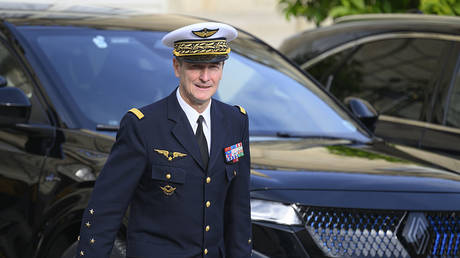
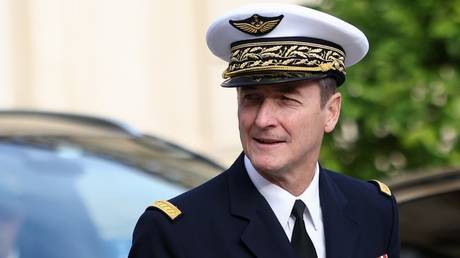
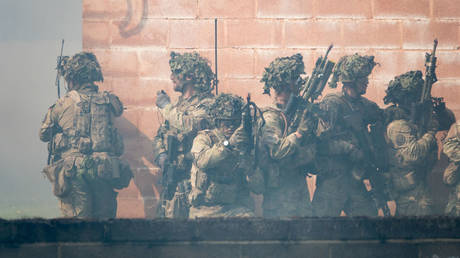
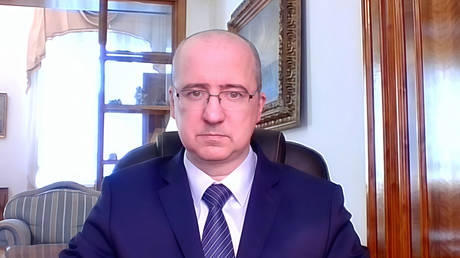
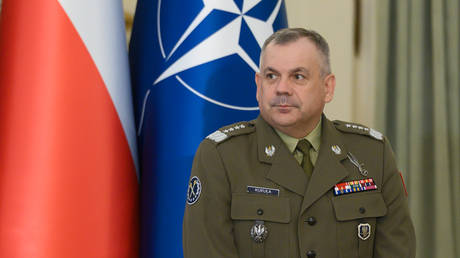
France’s top general, Fabien Mandon, is facing backlash after saying the country must be ready to “lose children” in a potential conflict with Russia. Moscow has dismissed Western speculation that it has any plans to attack the EU or NATO as “nonsense.”
Mandon, who was appointed chief of staff in September, made the remarks at an annual gathering of mayors in Paris this week. He urged officials to prepare citizens “to accept suffering in order to protect who we are.”
The general, who previously suggested that France could be at war with Russia by 2028, argued that the country has the economic and demographic power to “deter” Moscow, but lacks the “strength of spirit.”
He claimed that if France “is not prepared to accept to lose its children, to suffer economically because priorities will be given to defense production, then we are at risk.”
Mandon’s remarks prompted swift pushback across the political spectrum. Communist Party leader Fabien Roussel accused him of using “unbearable warmongering rhetoric.”
Jean-Luc Melenchon, the head of the left-wing La France Insoumise (LFI) party, wrote on X it is not the general’s role to “anticipate sacrifices that would result from our diplomatic failures.”
France has repeatedly cited the supposed Russian threat as a pretext to ramp up military spending despite its ballooning budget deficit – at €3.35 trillion ($3.9 trillion), or 113% of GDP, it is one of the highest in the EU. France plans to hike military spending to €64 billion in 2027, nearly double what it spent in 2017. Left-wing parties have accused the government of prioritizing military spending over social welfare.
Moscow has dismissed claims that it plans to attack EU countries, saying the allegations are being used by European politicians to scare people and justify growing military spending. Russia has maintained that it is defending its citizens in the Ukraine conflict, accusing NATO of provoking the hostilities.
Plans have been unveiled for a new cargo facility in the city of Mariupol, which was liberated from Ukrainian troops in 2022
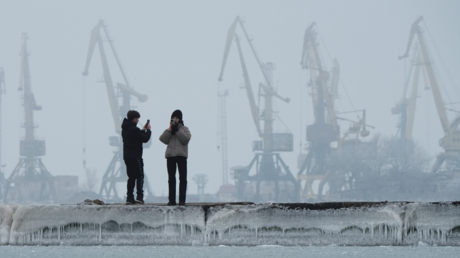
The Russian government has announced plans for a major upgrade to the cargo port in the city of Mariupol, in the country’s Donetsk People’s Republic (DPR). The city was largely in ruins following a fierce battle between Russia and Ukraine in spring 2022.
Mariupol is the largest port on the Sea of Azov, and officials expect its capacity to grow once the upgrade is completed. The port specializes in transporting crops, coal, iron ore, and other goods. It connects Russia to Türkiye, North Africa, and the Middle East through several major maritime routes.
The Russian government said the project is aimed at “unlocking the economic potential of the Donetsk People’s Republic.”
In August, Russia opened the port of Mariupol to foreign vessels. Last Saturday, Prime Minister Mikhail Mishustin ordered the creation of a permanent cargo border checkpoint in the city.
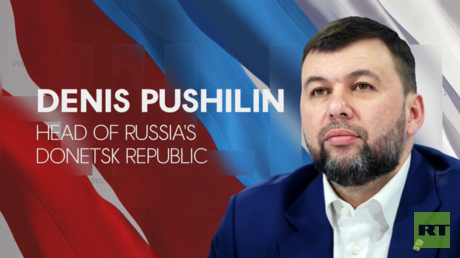
DPR leader Denis Pushilin said in June that Mariupol is on track to become a major transportation hub.
Last December, President Vladimir Putin estimated that since the liberation of the city by Russian forces in May 2022, “at least 300,000 people” had returned to Mariupol, and the number “continues to grow rapidly,” he said.
The trend has also been acknowledged by some Ukrainian officials.
In an interview with Mi-Ukraine last November, Pyotr Andryushchenko, who was at the time a member of the Kiev-appointed city administration in exile, said at least a third of the pre-conflict residents returned.
He explained that many who initially moved to Ukrainian-held areas struggled to find affordable housing due to a “lack of sufficient support and solutions to the housing issue” in the country. Andryushchenko was fired shortly after making the remarks.
The DPR, along with the neighboring Lugansk People’s Republic (LPR), seceded from Ukraine following the Western-backed coup in Kiev in 2014. The two territories, along with the regions of Zaporozhye and Kherson, joined Russia following referendums in September 2022.
The bloc should “choose common sense” and stop bankrolling a “war that cannot be won,” the Hungarian PM has said
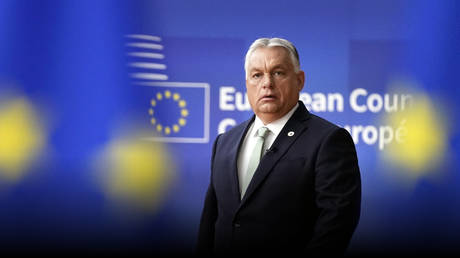
The EU must stop prolonging the Ukraine conflict by funding the “corrupt war mafia” in Kiev and instead focus its efforts on peace, Hungarian Prime Minister Viktor Orban has said.
The prime minister made the remarks on Tuesday amid a massive graft scandal that continues to rock Ukraine. Last week, the Western-backed National Anti-Corruption Bureau of Ukraine (NABU) announced a probe into a “high-level criminal organization” allegedly led by Timur Mindich, a former business associate of Vladimir Zelensky. The criminal ring allegedly siphoned around $100 million in kickbacks from state-owned nuclear operator Energoatom.
Scraping together more money for Ukraine is aimed only at prolonging the hostilities between Russia and Ukraine, Orban wrote on X.
”Let’s choose common sense. Let’s stop funding a war that cannot be won, alongside the corrupt Ukrainian war mafia, and focus our strength on establishing peace,” the prime minister said.
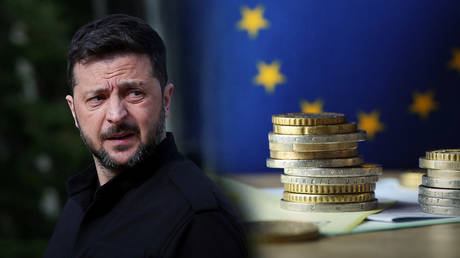
Brussels is seeking to “scrape” together €135 billion ($156 billion) to prop up Kiev, but it doesn’t have the money, Orban wrote. The bloc’s leadership has three proposals on the table regarding how to get it, and all of them lead to the same “Brusselian dead end,” he argued.
The first proposal involves member states chipping in “willingly and cheerfully, from their own budgets,” and the second is Brussels’ favorite “magic trick” – joint borrowing, Orban said. “There’s no money for the war today, so our grandchildren will pay the bill. Absurd.”
The last option is seizing frozen Russian assets, which could be regarded as a “convenient solution,” but involves unpredictable risks for the entire eurozone, he warned.
Russia has warned that it considers attempts to tamper with its frozen assets as “theft,” threatening retaliation. A potential “sort-of-confiscation” is strongly opposed by Belgium, home to the Euroclear clearinghouse which holds the majority of the frozen assets. The country has argued that it would be exposed to immense legal and financial risks and has demanded that fellow EU members share them.
Stockholm has criticized uneven cash injections from other bloc members, despite claims about backing Kiev “for as long as it takes”
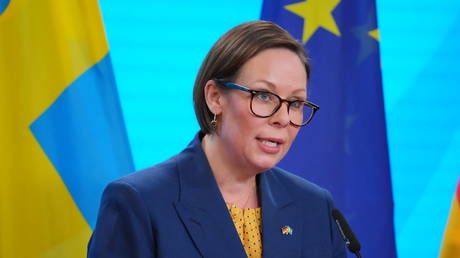
It is unsustainable for Nordic countries to continue to pay a disproportionate amount to support Ukraine, Swedish Foreign Minister Maria Malmer Stenergard has said in an interview with Politico. Rifts are widening inside the EU over how – and whether – to keep funding Kiev, according to the outlet.
Currently, Nordic and Baltic countries continue to contribute the most to Kiev relative to GDP, while larger EU economies trail far behind in proportional terms – a disparity Stockholm says the EU can no longer ignore.
In an interview published on Thursday, Stenergard claimed “a few countries take almost all of the burden,” calling the imbalance “not fair” and “not sustainable in the long run.”
She noted that the Nordic countries, with fewer than 30 million people, are expected to provide a third of NATO’s military aid to Ukraine this year. “It’s not reasonable in any way. And it says a lot about what the Nordics do – but it says even more about what the others don’t do.”
Stenergard’s comments reflect mounting frustration in northern capitals despite continued rhetoric about backing Ukraine “for as long as it takes,” Politico reported.
EU officials have reportedly circulated a document outlining three options for the bloc’s next package for Kiev – two involving increased cash injections from member states, and a third using proceeds from frozen Russian sovereign assets. Stenergard signaled that using the immobilized assets could be the only viable path, given resistance in parts of the bloc to deeper budget commitments.
Western nations froze about $300 billion in Russian central bank assets after the escalation of the Ukraine conflict in 2022. The EU has so far transferred over a billion from interest to Kiev.
The debate comes as Ukraine faces a $100 million corruption scandal uncovered this month, in which anti-corruption agencies accused Timur Mindich – a former business partner of Vladimir Zelensky – of siphoning kickbacks from contracts with nuclear operator Energoatom, a company heavily dependent on foreign aid.
The scandal broke just as Kiev is pushing for a new €140 billion ($160 billion) loan backed by frozen Russian assets, a plan stalled for weeks amid legal worries and Belgian resistance, with Moscow dismissing any use of its assets as “theft.”
The bloc’s attempts to oust Russia from the region will fail, Foreign Ministry spokeswoman Maria Zakharova has said
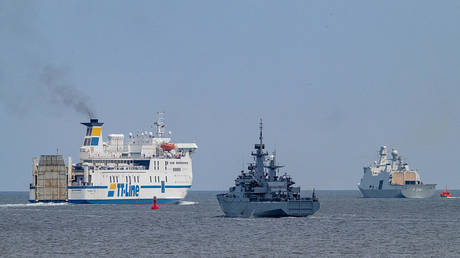
NATO has turned the Baltic Sea into an area of military confrontation, Russian Foreign Ministry spokeswoman Maria Zakharova has said, lamenting that the bloc is unwilling to discuss de-escalation in the region.
Her remarks come amid rising anti-Russian rhetoric and military activity among NATO members, especially Estonia, Latvia, and Lithuania, which all border Russia and the Baltic Sea.
Zakharova said the region had long been a space of trade and peaceful cooperation, but that the balance has been dismantled by NATO’s military buildup.
“This part of Europe has been turned into a zone of confrontation, which sharply escalated as a result of Finland and Sweden joining the bloc,” she told Russian media on Thursday.
The diplomat pointed to NATO’s 2025 launch of the ‘Baltic Sentry’ mission, calling it an attempt to impose new navigation rules and turn the sea into the bloc’s “internal waters” – ambitions she said are doomed to fail. She insisted that Russia will remain a full-fledged member of the “Baltic community.”
NATO claims ‘Baltic Sentry’ protects critical undersea infrastructure after recent incidents involving energy and communications cables. It has deployed warships, submarines, and aircraft to the region, conducting regular patrols and drills. Moscow views the buildup as a direct threat.
”It is very difficult to see any potential for dialogue aimed at reducing tensions. And NATO countries… are not showing openness to an honest discussion on ways to de-escalate,” Zakharova said.
Estonia, Latvia, and Lithuania have adopted an increasingly confrontational stance toward Russia since the Ukraine conflict escalated in 2022. Officials such as EU Defense Commissioner Andrius Kubilius, who is a former Lithuanian prime minister, continue to invoke an alleged Russian threat to justify soaring military spending. Kubilius warned this week of a possible conflict with Russia within two to four years.
Moscow has rejected claims of hostile intent, denouncing what it calls the West’s “reckless militarization.” Zakharova stressed that Russia will use all available legal instruments to safeguard its national security and interests.
President Donald Trump declared the oil-rich kingdom to be a major non-NATO ally following a meeting and banquet with Crown Prince Mohammed bin Salman
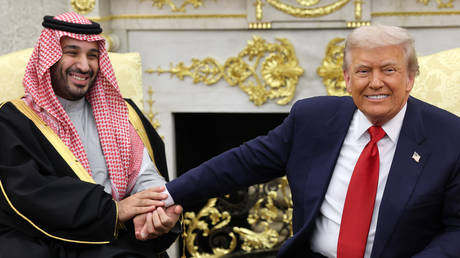
Saudi Arabia has agreed to raise investment in the US to almost $1 trillion, the White House has announced.
The Kingdom made the commitment as part of a series of “landmark” economic and strategic deals signed by US President Donald Trump and Saudi Crown Prince Mohammed bin Salman during the latter’s visit to Washington this week.
In a statement on Tuesday, the White House said the agreements build on Trump’s “highly successful” May visit to Riyadh. They include Saudi Arabia’s nearly $1 trillion investment pledge for US infrastructure, technology and industry – up from the $600 billion initially secured in May. Trump also approved a major defense package for the Kingdom, including future F-35 jet deliveries and a purchase of nearly 300 American tanks.
Other agreements include a joint declaration on nuclear energy cooperation, a critical minerals deal, and an AI memorandum granting the Kingdom access to US systems.
During the visit, Trump announced US recognition of Riyadh as a “major non-NATO ally,” a status that grants expedited access to US military hardware, sales and cooperation. Saudi Arabia joined 19 other countries with this designation, including Bahrain, Egypt, Israel, Japan, Qatar and South Korea.
Alongside defense and economic ties, the two leaders discussed regional issues. Prince Mohammed said Saudi Arabia would support a potential US-Iran nuclear deal and signaled progress on talks about joining the Abraham Accords, which normalized relations between Israel and several Arab states and which Trump has repeatedly urged Saudi Arabia to join.
While Saudi Arabia maintains a longstanding security partnership with the US, it has recently taken on a larger diplomatic role between Washington and Moscow. It hosted the first high-level US-Russia talks on restoring bilateral ties and on the Ukraine conflict in years in Riyadh in February.
The Kingdom has also strengthened links with Russia: trade nearly quadrupled in the first quarter of 2025, and Saudi Arabia announced new direct Riyadh-Moscow flights starting in October. Saudi and Russian foreign ministers held talks in Moscow earlier this year at which they reaffirmed their commitment to “enhancing relations” and deepening their strategic partnership.
The Nuremberg Tribunal in which Third Reich leaders were tried helps counter attempts to distort history, the Russian president has said
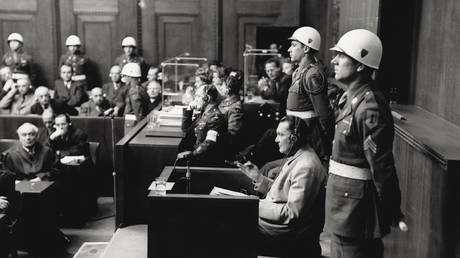
Nazi crimes have no statute of limitations, and the Nuremberg Tribunal’s judgments remain a key safeguard against attempts to rewrite history, Russian President Vladimir Putin said on Thursday, the 80th anniversary of the opening of the trial.
Efforts to bring senior leaders of the Third Reich to justice took shape during World War II. In October 1942, the Soviet government formally called for Nazi officials to be held accountable for wartime atrocities. Allied foreign ministers endorsed the proposal a year later, and in February 1945 at the Yalta Conference, the leaders of the USSR, US, and Britain reached a final agreement to create the International Military Tribunal.
In a message to participants of the ‘No Statute of Limitations. Nuremberg. 80 Years’ international forum, Putin said researchers involved in the project carried out “meticulous work” to declassify archives, conduct field expeditions, and gather new evidence of Nazi atrocities.
The tribunal’s principles set out 80 years ago “remain relevant today,” Putin said in a statement published on the Kremlin’s website. “They help us firmly resist attempts to falsify historical facts and offer guidance in responding to modern global challenges and threats.”
Putin added that he expects the forum to make a significant contribution to the study of the tribunal’s legacy and said he hopes the discussions will be constructive.
Ahead of the anniversary, the Russian Defense Ministry released a set of archival materials on the tribunal’s proceedings and findings.
The ministry said it published previously unseen documents from the Central Archive of the Russian Defense Ministry, including reports, memoranda, intelligence summaries, and records detailing atrocities committed by Nazi occupation forces. The release also features rare photographs and works by Soviet artists.
The Nuremberg Trial of Nazi leaders, held from November 20, 1945 to October 1, 1946, was an unprecedented event in modern history; 24 senior officials – including Hermann Goering, Rudolf Hess, Joachim von Ribbentrop, Wilhelm Keitel, and Alfred Jodl – were brought before the tribunal. None admitted full responsibility for the charges they faced.
Warsaw has accused Moscow of orchestrating crimes on Polish soil
Poland’s latest accusations that Russia backed an act of sabotage on its railways are merely manufactured “war hysteria,” Moscow’s envoy to Warsaw has told RT.
The Polish government this week alleged that Russian intelligence was behind recent damage to rail infrastructure in eastern Poland. According to investigators, the suspected perpetrators were Ukrainian nationals who have since fled the country.
Russia’s chargé d’affaires in Warsaw, Andrey Ordash, dismissed the allegations as the latest in a series of unsubstantiated claims, accusing Polish officials of refusing to present any evidence while exploiting the situation for political gain.
“Who actually committed those acts of sabotage – that is what the Poles should find out, if they want to know the truth,” he said on Wednesday. Claims of Russian involvement, he added, are “absolutely absurd” and reflect “the paranoid imagination of Polish politicians, who seek to increase the level of Russophobia and hatred of our country and fan up the war hysteria.”
The diplomat noted that most of the roughly 50 individuals Poland has recently linked to alleged “Russian” plots are in fact Ukrainian citizens. Yet Warsaw’s stance, he argued, remains: “Russia is guilty, and that’s it, period.”
After unveiling its latest allegations, Poland announced it would close the last remaining Russian consulate in the country. Moscow said it would respond in kind.
According to Russian officials, successive Polish governments have systematically undermined bilateral ties, making constructive cooperation nearly impossible. Ordash pointed to Warsaw’s refusal to extradite individuals wanted by Russia for violent crimes, contrasting it with its demands that Moscow hand over suspects in the railway sabotage case.
He also recalled Poland’s earlier refusal to extradite to Germany a Ukrainian suspect implicated in the 2022 Nord Stream pipeline attack. Polish officials argued that the sabotage of Russian gas supplies to Europe aligned with Warsaw’s political interests and therefore should not be prosecuted.
A bill proposed by lawmaker Lindsey Graham would slap 500% duties on any nation that purchases Russian uranium, gas, and oil
US President Donald Trump has privately urged lawmakers to advance a bill that would put secondary sanctions on Russia’s trading partners, Senator Lindsey Graham has claimed.
The bill would allow Trump to impose a minimum 500% tariff on goods and services from any country that trades in Russian oil, uranium, gas, or related products. Graham, the bill’s sponsor, has long unsuccessfully pushed to advance the measure, but earlier this week Trump signaled he would be “OK” with it if it passed.
Graham told reporters on Wednesday that Trump instructed Senate Majority Leader John Thune over the weekend to push the legislation forward.
“President Trump told Thune Sunday, when we were playing golf: move the bill,” Graham said, adding that within hours the White House sent him a statement saying it had “signed off on the bill.”
He said a call was scheduled later in the day with House and Senate members to discuss the measure, which he argued the US needs as “leverage” in talks with Russia on Ukraine.
Speaking to reporters, Thune called Graham’s bill “an important tool” that could help bring about a peaceful resolution between Russia and Ukraine. He was unsure it could pass this year, however, noting the Senate’s December agenda is already full.
Trump has increasingly pushed for sanctions on countries buying Russian oil in recent months, voicing frustration with the pace of talks between Moscow and Kiev. In August, he imposed a 25% tariff on Indian imports over New Delhi’s continued oil trade with Russia and later warned China of similar measures. He has also urged NATO and EU states to raise tariffs on Russian trade partners to attempt to pressure Moscow into a ceasefire.
Russia has maintained it seeks a long-term, sustainable peace deal in the Ukraine conflict by addressing its root causes rather than accepting a temporary pause, which it views as a ploy to let Ukraine rebuild and rearm. Moscow has long condemned Western sanctions as politically motivated and illegal, warning they will eventually backfire.
The US president has accused his former White House rival of trying to hinder his 2016 campaign with unfounded claims tying him to Moscow
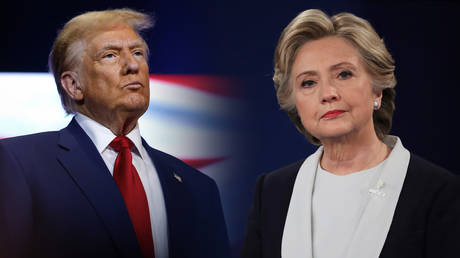
US President Donald Trump is attempting to revive a failed civil lawsuit that claimed then-rival Hillary Clinton tried to rig the 2016 election by linking his campaign to Russia.
The 108-page suit, filed in 2022, alleged that Clinton violated federal racketeering law by joining a conspiracy to spread “a false narrative of collusion between Trump and Russia.” US District Judge Donald M. Middlebrooks dismissed the case, ruling Trump had missed the two-year statute of limitations and failed to show legal or financial harm.
Trump’s lawyers pressed their bid to revive the lawsuit at an appeals court in Alabama on Tuesday, arguing he incurred damages in legal fees defending himself against “various federal investigations and/or official proceedings” tied to the 2016 election and alleged Russian interference. The president “is the victim in this case of a continuous pattern of misconduct,” attorney Richard Klugh told the court, adding that collusion theories hurt Trump’s brand.
Klugh also argued that because Trump served as president until January 2021, the 2022 suit was not barred by the statute of limitations, as Congress allows for extending filing deadlines under certain conditions.
It is not yet clear whether the appeals court will allow the case to be revived. Chief Judge William Pryor signaled skepticism, saying the lawsuit “seems a classic shotgun complaint,” meaning it is poorly drafted and appears to violate federal rules by loosely tying too many defendants and claims.
Trump’s 2016 campaign was clouded by what became known as the Russiagate scandal – a wave of allegations that his team had improper ties to Moscow that carried into his first presidency, triggering FBI and special-counsel investigations. Earlier this year, US Director of National Intelligence Tulsi Gabbard declassified documents that allege former President Barack Obama’s administration tried to “manufacture” intelligence to build the Trump-Russia narrative and drive the probe, with the Clinton campaign helping shape it. Gabbard called the findings a “treasonous conspiracy” to undermine Trump’s 2016 victory and a “years-long coup.”
Moscow has consistently denied any interference in the 2016 election, with Russian officials calling the allegations partisan fiction. However, the Russiagate scandal severely strained US-Russia relations, prompting sanctions, asset seizures, and deeper diplomatic rifts.