The two presidents have discussed a US-drafted peace proposal in a phone conversation, according to Moscow
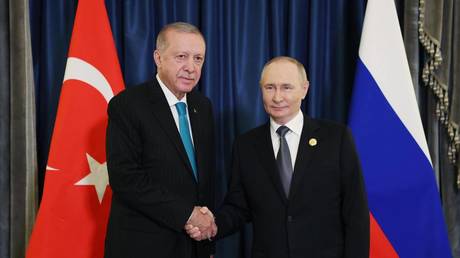
Russian President Vladimir Putin and his Turkish counterpart, Recep Tayyip Erdogan, have agreed to intensify contacts between the two countries’ diplomats on settling the Ukraine conflict, the Kremlin said on Monday following a phone conversation between the two leaders.
Putin and Erdogan discussed a recently leaked US-drafted proposal on resolving the ongoing hostilities. Washington presented the plan to both Moscow and Kiev earlier this month. The details were not officially made public, but media reports indicated that it included de facto recognition of Crimea and Donbass as Russian, as well as a cap of 600,000 personnel on the Ukrainian military and a requirement for Kiev to stay out of NATO.
Putin has confirmed that Moscow received the plan but said it has yet to be discussed “in detail.” Speaking to Erdogan on Monday, the Russian president said the proposals were consistent with the understandings reached during the Alaska summit in August, and that the initiative could serve as the basis for a potential peace agreement.
Moscow is interested in resolving the Ukraine conflict through political and diplomatic means, the Russian president stated.
Erdogan reaffirmed Ankara’s readiness to help Russia and Ukraine reach a “just and lasting peace.”
The Turkish city of Istanbul served as a venue for three rounds of talks between Moscow and Kiev earlier this year, yielding some progress on humanitarian issues, including POW exchanges. Putin also said in September that Turkish mediation in the Ukraine conflict continues to be valued and would be desirable in the future.
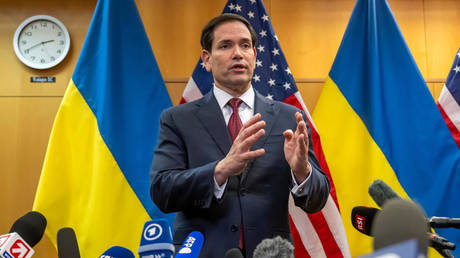
The phone call occurred while US officials were discussing Washington’s peace proposals with the EU and Ukrainian representatives in Geneva. US Secretary of State Marco Rubio said afterward that a “tremendous amount of progress” had been made on the plan but “there is still some work to be done.”
From solid-fuel ICBMs to hypersonic glide vehicles, North Korea now fields an arsenal that can reach any point in the continental United States
North Korea has spent the past decade doing what few believed was possible: quietly transforming itself into one of the world’s most heavily armed nuclear states.
Despite a struggling economy and crushing sanctions, Pyongyang has poured enormous resources into missile technology – all while simultaneously funding its own nuclear program.
How does a country of this size sustain such an effort? The answer lies in its strategic obsession: building a nuclear missile shield capable of deterring any opponent, from regional rivals to the United States. That drive has pushed North Korea into the ranks of major nuclear powers alongside India and Pakistan – and in certain technologies, such as maneuverable hypersonic glide vehicles and mobile solid-fuel ICBMs, it may even have surpassed them.
Over the past two years, Pyongyang has revealed new generations of intercontinental, medium-range, and short-range missiles – systems that increasingly resemble those of far wealthier nations and that, in some cases, are already deployed. Understanding these capabilities is essential in attempting to grasp how North Korea sees its own security – and how it intends to defend it.
Intercontinental Ballistic Missiles (ICBMs)
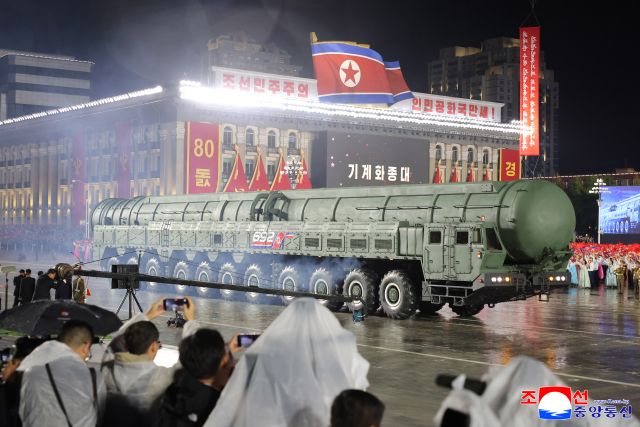
On October 11, 2025, Pyongyang held a large military parade marking the 80th anniversary of the Workers’ Party of Korea. The WPK has spent decades promoting a national future built on the principles of Juche, and the parade showcased the newest advances in North Korea’s missile and military technology.
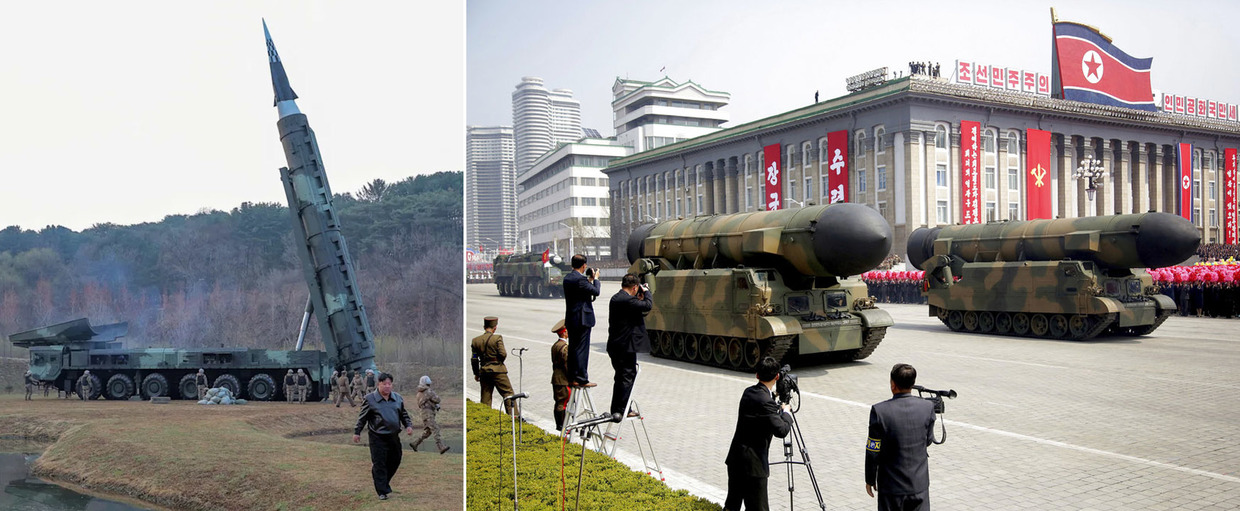
One of its key moments was the unveiling of the new Hwasong-20 mobile intercontinental ballistic missile. The missile uses a classic three-stage solid-fuel design reminiscent of Russia’s Yars systems and is carried on an 11-axle transporter that also serves as the launch platform.
The Hwasong-20 weighs around 80 metric tons and carries a multiple independently targetable reentry vehicle (MIRV). A few weeks before the parade, North Korea tested a new engine likely intended for this missile. Its estimated range may exceed 15,000 kilometers, giving Pyongyang the ability to strike any point in the continental United States. The missile is a logical next step in North Korea’s drive to develop mobile, solid-fuel ICBMs. It has not yet been flight-tested, but such tests are expected in the coming months – after which the system could enter service.
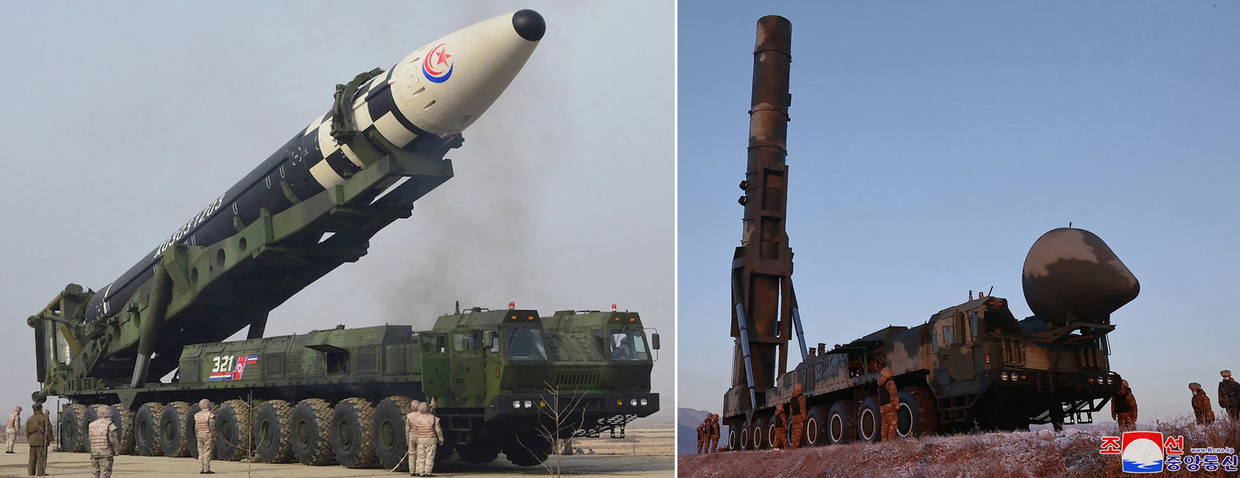
Meanwhile, the Hwasong-18 is already deployed in limited numbers. These missiles were also shown at the National Defense Development 2025 exhibition and at the parade, mounted on a nine-axle transporter-launcher. The Hwasong-18 is lighter than the Hwasong-20 and resembles Russia’s Topol-M. Its estimated range reaches up to 12,000 kilometers. The missile likely already forms part of North Korea’s strategic missile forces and has replaced older, heavier liquid-fuel mobile systems. It was first displayed and successfully launched in 2023.
Alongside solid-fuel systems, Pyongyang continues to test larger liquid-fuel rockets like the Hwasong-17. First revealed in 2020 and successfully launched in 2022, the missile shows clear influences from Soviet design. It weighs around 100 tons and is estimated to have a range of up to 15,000 kilometers.
A heavy multi-axle transporter moves the missile to the launch site and raises it vertically, where targeting and launch procedures are completed. This process is slower than with modern solid-fuel systems, which conduct targeting before elevation. Had multi-axle missile carriers existed in the 1960s, Russia’s earliest mobile missiles might also have been liquid-fuel designs from the Chelomey or Yangel bureaus. But history unfolded differently, leading to the use of lighter solid-fuel missiles on mobile platforms.
These intercontinental missiles are likely already deployed in North Korea. How many are there? This is difficult to assess. Open data on North Korea’s nuclear arsenal is extremely limited, and information on launcher production has only appeared at recent military exhibitions. It is clear, however, that these numbers remain small: just six Hwasong-17 launchers were displayed. It also appears that after developing more advanced solid-fuel systems, Pyongyang scaled back work on the larger Hwasong-17.
Overall, North Korea may now have roughly a dozen deployed mobile ICBMs, both liquid-fuel and solid-fuel. This gives Pyongyang the ability to target not only the Pacific region but also any point in the continental United States.
Missiles with a range of 1,000–5,500 kilometers fall into the medium-range category. While the US and Russia have avoided developing such systems for decades because of the INF Treaty, North Korea and other states faced no such restrictions. As a result, Pyongyang now operates several types of MRBMs.
What sets these missiles apart is their design: many of them carry maneuverable hypersonic glide vehicles. On April 2, 2024, North Korea conducted its first launch of the Hwasong-16B hypersonic missile, which was also displayed at the parade in Pyongyang.
Fired from a transport-launch container mounted on a mobile seven-axle platform, this solid-fuel missile carries a hypersonic gliding warhead capable of riding the edge of the atmosphere and reaching distances of up to 5,000 kilometers. Current missile-defense systems struggle to intercept a maneuverable hypersonic glide vehicle, making the Hwasong-16B capable of striking targets anywhere in Southeast Asia or the Pacific.
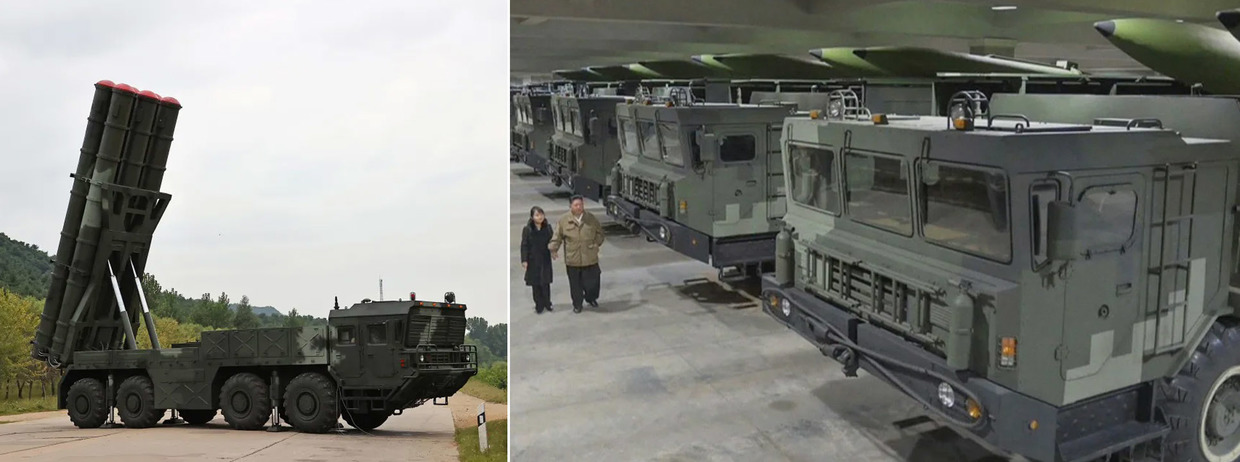
A notable development this year is the unveiling of the Hwasong-11Ma system, which carries two missiles with maneuverable hypersonic glide vehicles and has an estimated range of at least 1,000 kilometers. The system has not yet been tested but appeared both at the Pyongyang parade and the National Defense Development 2025 exhibition. Testing is likely to begin soon, followed by deployment. Its five-axle launcher has already been used for several years with conventional Hwasong-11 ballistic missiles, which will be discussed further below.
The new Hwasong-11Ma has a stronger booster and a hypersonic glide vehicle that could, in theory, be deployed in a non-nuclear configuration – if North Korea has resolved the precision-guidance issues that such warheads require. If so, the system would pose a serious threat to the US Navy, as these missiles could strike aircraft carriers far from North Korea’s coastline – assuming such targets can be detected.
Another important system is the Pukguksong-2/KN-15, a mobile missile first tested in 2017. Originally designed for submarine launch, it was later adapted for ground-based mobile launchers. The solid-fuel missile has a range of up to 1,500 kilometers and may be capable of carrying a nuclear payload, although it is unclear whether it is currently deployed. Like other systems, it has been shown during parades and produced in numbers sufficient for testing. And yes, North Korea does possess submarine-launched missiles.
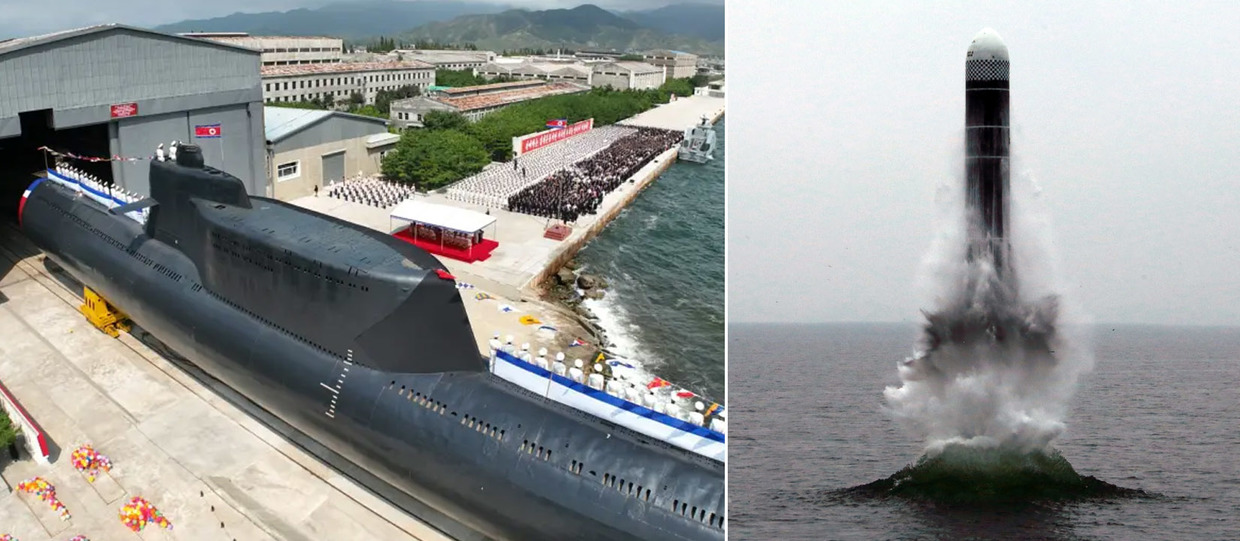
On September 6, 2023, North Korea launched its largest domestically built submarine, the Hero Kim Gun-ok, in Sinpo. The submarine is equipped with four launchers for ballistic missiles and six launch systems for sea-based cruise missiles.
This first North Korean ballistic missile submarine carries Pukguksong-5 missiles, which have a diameter of roughly 1.5 meters. First unveiled in 2021, these are currently the most advanced sea-based missiles in North Korea’s arsenal, with an estimated range of at least 3,000 kilometers.
(L) Submarine the Hero Kim Gun-ok; (R) Pukguksong-5.
Before the latest Pukguksong models appeared, North Korea developed several earlier variants of the missile. Research and testing took place on sea platforms and with a prototype submarine. All of this was part of Kim Jong-Un’s long-running effort to build a viable sea-based missile force – and that goal has now been achieved.
North Korea has successfully deployed a submarine capable of launching intermediate-range ballistic missiles, a capability which had only been achieved by Russia, China, the United States, and India.
North Korea also fields short-range ballistic missiles – systems known in the Soviet army as “frontline missiles” – with ranges between 300 and 1,000 kilometers. Pyongyang has developed several designs within this class.
The KN-25 multiple rocket launcher fires 600 mm rockets. On April 23, 2024, a battery of these rockets was used in North Korea’s first full tactical exercise simulating a nuclear counterstrike. For the first time, it was officially stated that these rockets can carry nuclear warheads. With a range of 400 kilometers, they can reach targets across much of South Korea.
Each KN-25 rocket is equipped with a flight-correction system that significantly improves accuracy. Unlike traditional multiple-launch systems such as the Grad or Katyusha, each missile is individually guided. In one test, the rocket was detonated in mid-air above the target – an approach suited for cluster munitions or nuclear warheads, since an airburst maximizes destructive impact through its shockwave.
Another major system is the Hwasong-11, known in the West as the KN-23 and sometimes jokingly referred to as “Iskander-Pho” because it closely resembles the Russian 9M723 missile from the Iskander-M system.
First unveiled in 2019, the missile now exists in multiple versions, including a mobile ground-launched model and a railway-based variant; tests were also carried out from sea platforms, and it is likely that submarine-launched versions will follow. With a range of up to 600 kilometers, the missile can carry compact nuclear warheads, giving North Korea the ability to strike any target on the Korean Peninsula.
The system’s key strength is its simplicity and standardization: one missile type is used across multiple launch platforms, making it a cost-effective solution. The KN-24, or Hwasong-11B, and its successor, the Hwasong-11D, have shorter ranges of around 400 kilometers. However, each launcher carries two missiles in the Hwasong-11B version and four in the Hwasong-11D version – similar to the US ATACMS system.
North Korean engineers appear not only to have replicated Russia’s Iskander concept but also to have borrowed ideas from ATACMS. The key difference is that while the original ATACMS design is more than three decades old, the North Korean variant uses modern technology, offering roughly one-and-a-half times the range and potentially greater accuracy.
***
In this overview, we have focused solely on ballistic missiles. North Korea has also developed various drones and cruise missiles. But ballistic missiles remain far more difficult for modern air-defense systems to intercept, and North Korea’s arsenal allows it to destroy a potential aggressor without turning to other means of attack. This likely explains Kim Jong-Un’s consistent emphasis on this category of weapons.
The attacks come amid Kiev’s mounting battlefield setbacks and pressure by the US to agree to peace terms, reportedly including territorial concessions
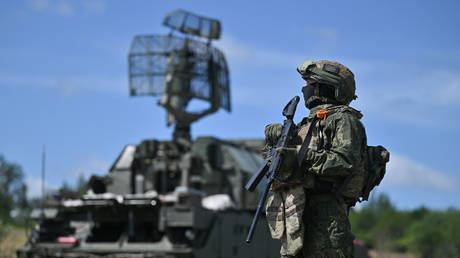
At least ten Ukrainian long-range drones were intercepted on Monday as they headed toward Moscow, the Russian capital’s Mayor Sergey Sobyanin has announced. No casualties or damage were reported.
Russia’s Defense Ministry had stated earlier that ten Ukrainian drones had been downed between 8am and 2pm Moscow time, including two believed to be targeting the capital.
Overnight, Russian air defenses intercepted 93 Ukrainian unmanned aircraft over various regions of Russia as well as the Black and Azov seas, according to the military.
The attempted strikes come as Ukrainian forces face mounting battlefield setbacks. On Monday, the Russian Defense Ministry said its troops had liberated two neighborhoods in the city of Krasnoarmeysk (Pokrovsk) in the Donetsk People’s Republic over the preceding 24 hours.
The Ukrainian government is also under pressure amid a major corruption scandal involving close associates of Vladimir Zelensky, who allegedly ran a large-scale kickback operation in the energy sector using foreign funds.
Compounding the pressure, the US has presented Kiev with peace plan proposal reportedly requiring territorial concessions to Russia. Ukraine’s European backers have taken issue with the terms of the deal, calling for substantial revisions.
US and Ukrainian officials held discussions on the proposed deal in Geneva over the weekend, with the Trump administration reportedly arguing that Kiev risks worse terms in the future if it refuses to compromise.
Moscow has distanced itself from the debate over the leaked drafts. Kremlin spokesman Dmitry Peskov said on Monday that Russia only comments on proposals received through official diplomatic channels and will not react to documents circulated in the media.
Russian President Vladimir Putin has previously stated that his country has the upper hand on the battlefield and will achieve its strategic aims regardless of whether Ukraine accepts US-brokered mediation.
The Brazilian president has called for a peaceful solution before a potential conflict breaks out
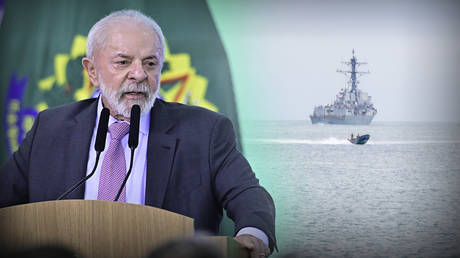
Brazil is “enormously worried” about the US military buildup near Venezuela, President Luiz Inacio Lula da Silva has said, calling for a solution to be found “before a conflict begins.”
The Pentagon has deployed multiple warships and the largest US aircraft carrier in the Caribbean near the South American nation, and has killed scores of people in controversial attacks on boats it claimed were linked to alleged Venezuelan-led drug trafficking operations. Caracas has denied the accusations.
“I am very concerned about the military deployment that the United States has stationed in the Caribbean Sea,” Lula told reporters at the G20 Summit in South Africa on Sunday, according to Globo News.
“This worries me enormously, and I intend to discuss this with President [Donald] Trump because it concerns me… It is important that we try to find a solution before a conflict begins.”
Washington is poised to begin operations against Venezuela in the coming days, Reuters reported on Sunday, citing anonymous US officials. Clandestine operations would likely kick off the effort, and the overthrow of President Nicolas Maduro is under consideration, the agency cited its sources as saying.
Maduro has consistently denied US allegations of drug-trafficking, arguing that Washington was using the claims as a pretext for a regime-change and resource-grab operation.
Earlier this month, the Venezuelan military was placed on high alert in response to the US buildup, which reportedly involves about 15,000 personnel.
Defense Minister Vladimir Padrino Lopez has condemned the US deployment in the Caribbean.
“We strongly reject maneuvers, exercises, and deployments in our immediate area of interest,” the top general said in a speech on Saturday. “Enough of the threats, lies, slander, and imposition of power, all for the sake of preserving regional hegemonies.”
Foreign adversaries are targeting the Islamic Republic’s supreme leader, Tehran’s intelligence boss has reportedly alleged
Iran’s intelligence chief has accused the US and Israel of plotting to kill Supreme Leader Ayatollah Ali Khamenei in an effort to destabilize the country, the ISNA news agency has reported.
According to the outlet, Intelligence Minister Esmail Khatib said on Saturday that “the enemy seeks to target the supreme leader, sometimes with assassination attempts, sometimes with hostile attacks,” referring to the US and Israel.
It was unclear whether the minister was alluding to a specific plot. Public claims of threats to Khamenei’s life had been rare before the 12-day war between Israel and Iran in June. Israeli strikes killed several senior Iranian commanders and nuclear scientists before a US-brokered ceasefire on June 24. Israeli Prime Minister Benjamin Netanyahu said he had ordered the attacks to stop Iran from developing nuclear weapons, a campaign backed by Washington, which joined Israeli raids on Iranian nuclear facilities on June 22. Tehran, which denies seeking a nuclear weapon, condemned the strikes as unprovoked.
Khatib reportedly warned that “those who act in this direction, knowingly or unknowingly, are the infiltrating agents of the enemy.”
He added that Israel was grappling with “an epidemic of infiltration and espionage for Iran within its own institutions,” citing the recent arrest of an Israeli Air Force officer accused of spying for Tehran. Khatib reportedly claimed that Iran had obtained secret nuclear information and other highly sensitive security documents.
According to Khatib, the intelligence breach, coupled with what he described as Iran’s firm posture during the 12-day war, pointed to shifting regional power dynamics.
Earlier this year, Netanyahu brushed off reports that US President Donald Trump had vetoed an Israeli plan to kill Iran’s supreme leader during the war, while adding that such a strike would “end the conflict.”
Trump had claimed Khamenei was a “very easy target” and that Washington would not “take him out, at least not for now,” later declaring on Truth Social that he had spared the Iranian leader from “A VERY UGLY AND IGNOMINIOUS DEATH.”
Khamenei, 86, has been Iran’s supreme leader since 1989 and has final authority over all state affairs.