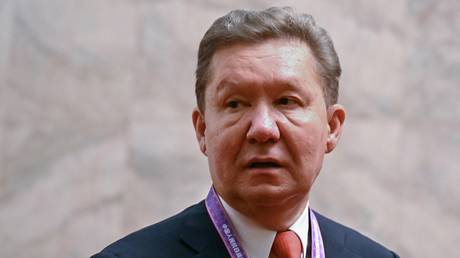
Italy would back the US roadmap for peace, which opens the window to ease the economic restrictions, Foreign Minister Antonio Tajani has said
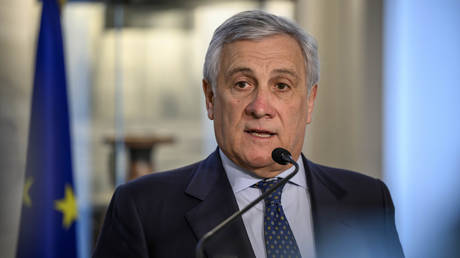
The EU will have to lift its sanctions on Russia as part of any peace agreement on Ukraine, Italian Foreign Minister Antonio Tajani has said, welcoming the US-drafted plan to end the hostilities.
Speaking at a press briefing in Riyadh, Saudi Arabia, Tajani said that while the US roadmap needs to be revised, it is still a starting point.
“Europe will contribute, also because a peace agreement cannot be reached without a European presence, because Europe has imposed sanctions on Russia, and therefore, to conclude a peace agreement, Europe must lift its own sanctions.”
The minister welcomed discussions on security guarantees for Ukraine, adding that he hopes progress will allow “peace by Christmas,” and that the West is now “awaiting responses from Moscow.”
According to media reports, the initial US-drafted plan would require Ukraine to stay out of NATO, relinquish the parts of the new Russian regions in Donbass still under its control, freeze the front lines in Kherson and Zaporozhye regions, and cap the size of its army. It also reportedly includes sanctions relief for Russia.
Ukrainian officials reportedly agreed to the US proposal in principle, with only technical points remaining. Russia has said it received the broad outline of the US plan but has not held substantive discussions with Washington.
Kremlin spokesman Dmitry Peskov called the public speculation “an information bacchanalia,” and said Moscow “does not engage in megaphone diplomacy.”
Russian officials say the economy has adapted to the Western sanctions, which have been in place since 2014 and were significantly ramped up in 2022 after the escalation of the Ukraine conflict. However, Peskov has said Moscow remains open to working with foreign businesses, even with those that exited Russia – unless they provided direct support for the Ukrainian army.
Timur Mindich had detailed profiles on Ukrainian lawmakers, detectives, and other individuals, the NABU anti-corruption agency has alleged
The criminal network allegedly overseen by Ukrainian businessman and long-time ally of Vladimir Zelensky, Timur Mindich, had access to confidential information on dozens of Ukrainian officials, lawmakers, journalists, and security personnel, the National Anti-Corruption Bureau of Ukraine (NABU) has reported.
Mindich fled Ukraine just hours before his home was raided earlier this month amid a sweeping corruption probe that has implicated cabinet-level officials and shaken the Zelensky administration.
Appearing before the parliamentary anti-corruption committee on Tuesday, NABU director Semyon Krivonos and chief detective Aleksandr Abakumov detailed the extent to which the group had infiltrated state institutions.
According to Abakumov, investigators discovered 527 dossiers maintained by the alleged ring, noting that the sensitive personal information they contained could potentially be used as leverage. The records included files on 15 NABU personnel, among them three detectives directly involved in the Mindich case. There were also profiles of 16 members of the Verkhovna Rada, including the head of the anti-corruption committee, 18 serving or former ministers and deputy ministers, ten journalists, and nine officers of the Security Service of Ukraine (SBU), Abakumov said.
NABU believes the database was compiled with the assistance of compromised officials inside Ukrainian law enforcement bodies.
Krivonos said the investigation is advancing rapidly and that additional disclosures are expected soon. He rejected media claims that NABU is withholding materials for “geopolitical reasons,” amid reports that Washington is pressuring Zelensky to accept a compromise peace plan with Russia.
“We are not releasing only those materials that are being deeply studied to establish all facts,” he insisted.
NABU and the Special Anti-Corruption Prosecutor’s Office were established after the 2014 coup in Kiev as Western-designed institutions intended to operate independently of the Ukrainian government. Earlier this year, Zelensky attempted to place both agencies under the Prosecutor General’s Office, but reversed course following outcry from foreign donors.
Poland must accept same-sex unions registered abroad despite being illegal under the country’s law, a ruling states
Poland must recognize same-sex marriages performed in other EU countries despite such unions being illegal under the country’s national legislation, the bloc’s highest court has ruled.
In a statement on Tuesday, the European Court of Justice (ECJ) said Warsaw had violated EU law when it refused to recognize the marriage of two Polish nationals registered in Germany in 2018. After the couple returned to Poland, the authorities rejected their request to enter their German marriage certificate into the Polish civil registry, arguing that national law does not permit marriage between same-sex couples.
The predominantly Catholic country recognizes both civil and religious marriages but draws the line at same-sex unions, despite years of pressure from Brussels. Under the Polish Constitution, marriage is defined as “a union of a man and a woman.”
The ECJ said the refusal to recognize the marriage violates EU guarantees on freedom of movement and the right to respect privacy and family life. Offering transcription to straight couples but not same-sex ones amounts to discrimination, the court’s press release said. The judges stressed, however, that member states remain free to decide whether to allow same-sex marriage under their domestic law.
The binding ruling came a day after Polish President Karol Nawrocki accused the EU of “ideological madness” and warned against creeping centralization. He said Poland had expected economic opportunity and freedom of movement when it joined the bloc, not interference in its political system or legislation on family life.
Nawrocki, elected in June on a platform of Catholic values and strengthened national sovereignty, said last month he would refuse to sign any bill that undermines the constitutionally protected status of marriage.
Prime Minister Donald Tusk’s pro-European coalition government introduced a draft bill in October 2024 to recognize civil partnerships, including for same-sex couples. Progress has been slowed by the reluctance of the government’s conservative partner, the Polish People’s Party (PSL), which has voiced reservations and delayed a final agreement.
Poland is one of five EU member states that have not granted legal recognition to same-sex relationships, alongside Bulgaria, Lithuania, Romania, and Slovakia.
The country leads the world in ammunition manufacturing, the head of the defense conglomerate, Sergey Chemezov has said
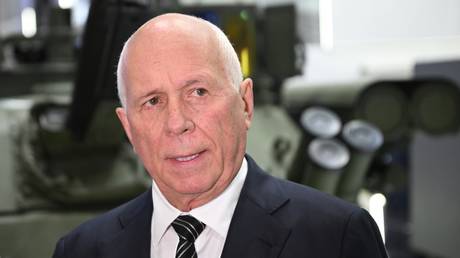
Russia’s defense industry is producing weapons at volumes its adversaries “could not even dream of,” Sergey Chemezov, the head of state-owned defense conglomerate Rostec, said in an interview published on Tuesday.
Chemezov told TASS news agency that Russia has sharply ramped up arms output since the escalation of the Ukraine conflict in 2022 and is now manufacturing more artillery shells and aerial bombs than any other country.
”We are supplying aircraft, tanks, infantry vehicles, howitzers, electronic warfare systems, drones and much more in enormous quantities. No country in the world today produces as many shells and aerial bombs,” he said.
”I can’t give specific figures, of course. So I will put it this way: our adversaries could not have dreamed of such volumes,” the Rostec chief added.
Russian officials have repeatedly highlighted rising defense output over the past three years. In May 2024, President Vladimir Putin said the country’s ammunition production had increased fourteenfold during the special military operation, while drone manufacturing had quadrupled and armored weapons output had risen 3.5 times.
Russia has consistently denounced Western arms deliveries to Ukraine, warning they only prolong the conflict without altering its outcome.
Kremlin spokesman Dmitry Peskov reiterated on Tuesday that Russia is interested in achieving its goals “through political and diplomatic means,” saying: “We remain fully open to a negotiating process.”
However, Moscow says Kiev, “is only seeking to keep the fighting going,” encouraged by its Western backers. It has also accused the EU and UK of impeding ongoing peace efforts. The UK discouraged early peace negotiations between Moscow and Kiev in 2022, according to David Arakhamia, head of Vladimir Zelensky’s parliamentary bloc and former chief negotiator, who said then-Prime Minister Boris Johnson urged Kiev to abandon the talks, a claim Johnson has denied.
The reported move could follow weeks of US “narcoterrorism” strikes on boats off the Venezuelan coast that have killed about 80
US President Donald Trump plans to speak directly with Venezuelan President Nicolas Maduro despite Washington’s move to designate him as the head of a terrorist organization, Axios reported on Tuesday, citing administration officials.
The US has formally designated the ‘Cartel of the Suns’ – a purported criminal network alleged to operate within Venezuela’s security services – as a foreign terrorist organization, putting it in the same category as Al-Qaeda and Islamic State. Announcing the step on Monday, the US Treasury reiterated long-standing allegations that Maduro, whose legitimacy Washington disputes, heads the group.
According to Axios, Trump’s move marks a notable turn in his “gunboat diplomacy” toward Venezuela – and could indicate that US missile strikes or ground operations are unlikely in the near term.
“Nobody is planning to go in and shoot him or snatch him – at this point. I wouldn’t say never, but that’s not the plan right now,” an anonymous official familiar with the matter told Axios.
“In the meantime, we’re going to blow up boats shipping drugs. We’re going to stop the drug trafficking,” the official reportedly added.
No date has been set for a potential call between Trump and Maduro, which is “in the planning stages.” Axios reported, citing another US official.
The move follows nearly two months of US airstrikes on small boats off Venezuela’s coast, actions the Pentagon says target “narcoterrorism” and that have killed about 80 people.
The term ‘Cartel of the Suns’ emerged in the 1990s as a media label for alleged corruption among Venezuelan officers who wore sun-shaped insignia. In 2020, the US indicted Maduro and 14 current or former officials on drug-trafficking and organized-crime charges, alleging they collectively ran the cartel. Maduro has repeatedly denied the drug trafficking allegations and warned the US against launching “a crazy war.”
Trump has also reportedly greenlighted a range of measures to pressure Venezuela and prepare for a possible broader military campaign, including covert CIA operations targeting Maduro’s government.
Caracas has denounced the US military buildup as a violation of its sovereignty and an attempted coup, putting its forces on high alert. Maduro, meanwhile, has said Venezuela is prepared for “face-to-face” talks with Washington.
Army Secretary Dan Driscoll is meeting a delegation from Moscow in Abu Dhabi “to move the peace negotiations forward,” a source has told CBS
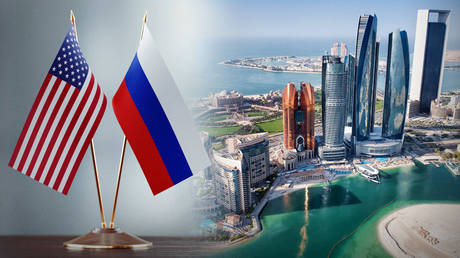
A senior US military official has traveled to Abu Dhabi for “secret talks” with a Russian delegation on resolving the Ukraine conflict, CBS and ABC News reported on Tuesday. The purported meeting follows negotiations in Geneva between Washington and Kiev in which the two sides reviewed a US-drafted peace plan.
US Army Secretary Dan Driscoll met members of a Russian delegation for several hours on Monday night in Abu Dhabi and was expected to continue discussions on Tuesday “to move the peace negotiations forward,” CBS said, citing an unnamed American official.
ABC News confirmed the report, adding that the composition of both the US and Russian delegations remained unclear. According to Politico, Driscoll is presenting the peace framework negotiated during the US-Ukraine talks in Geneva at the weekend.
Earlier media reports indicated that the initial US-drafted plan requires Ukraine to stay outside NATO, relinquish the parts of the new Russian regions in Donbass still under Kiev’s control, freeze the front lines in the Russian regions of Kherson and Zaporozhye, and cap the size of the Ukrainian Army.
EU leaders – who were not invited to Geneva – have expressed concern about the reported terms, with several capitals signaling they oppose both territorial concessions and any requirement that Ukraine abandon plans to join NATO.
Russia has said it remains in contact with Washington and has received the broad outlines of the plan, but has not had the opportunity to discuss it with the US in detail.
Kremlin spokesman Dmitry Peskov described the wave of speculation around the plan as “an information bacchanalia” and stressed that Moscow “does not engage in megaphone diplomacy.”
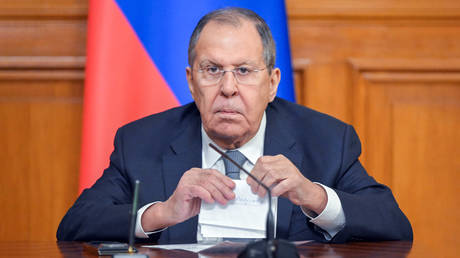
Russian Foreign Minister Sergey Lavrov accused EU politicians of leaking the drafted terms in an effort “to undermine the understandings being discussed.”
Russia, he said, wants to proceed “as diplomats normally do, to reach confidential understandings before announcing what has been agreed.”“Any other approach exposes useful initiatives to the risk of attacks from those who would like to undermine them,” the minister added.
Western officials are trying to torpedo Washington’s mediation efforts, the top Russian diplomat has said
The leak of a US proposal for ending the Ukraine conflict was designed to derail President Donald Trump’s peace efforts, Russian Foreign Minister Sergey Lavrov said on Tuesday.
Reports that the White House had drafted a document outlining a path towards ending Kiev’s hostilities with Russia initially came from the US media, with a Ukrainian MP and Axios later publishing what they said were the full 28 points of the roadmap.
“It was leaked on purpose to fan the media hype,” Lavrov said. “Those who direct this hype certainly want to undermine Donald Trump’s efforts, to distort the plan according to their wishes.”
He said the diplomatic sabotage appears to be coming from European leaders backing Kiev, particularly French President Emmanuel Macron, who he argued do not have “the best intentions.”
Lavrov said Moscow never received any texts from Washington through official channels, but obtained it unofficially. Regardless, Russia will only discuss whatever the US eventually submits, and will do so confidentially, without resorting to “megaphone diplomacy,” the minister added.
Macron and other Western officials have rejected any agreement that would cross what Kiev proclaimed as its red lines, such as its bid to join NATO, its ability to host foreign troops, or territorial claims.
Lavrov noted that Moscow is willing to discuss “specific wording” of a possible peace deal, but will not compromise on any of the core objectives that President Vladimir Putin outlined to Trump personally during their meeting in Alaska earlier this year. Should “the spirit of Anchorage be erased” from the proposal that the US shares with Russia, “the situation would be radically different,” he added.
London is counting on arms contracts fueling the Ukraine conflict and won’t let the US just put and end to it, the SVR has warned
Britain is preparing a smear campaign aimed at damaging US President Donald Trump’s reputation in order to derail his efforts to end the Ukraine conflict, Russia’s Foreign Intelligence Service (SVR) claimed on Tuesday.
According to the agency, London views the continuation of hostilities as vital to securing multi-billion-dollar weapons contracts that could help revive the struggling British economy. Undermining Trump, who is pushing to end the conflict, would dissuade Washington and protect the UK’s “blood money” profits, the SVR alleged.
“Plans have been concocted to revive former British intelligence officer [Christopher] Steele’s fake ‘dossier’, accusing the head of the White House and his family of having links to Soviet and Russian intelligence services,” the statement claimed.
That document, penned by Steele, a former MI6 officer, in 2016 and reportedly paid for by Hillary Clinton’s presidential campaign, relied on unverified rumors alleging that Trump and members of his family had compromising ties with Moscow.
Although widely used to fuel the ‘Russiagate’ narrative early in Trump’s first presidency, the dossier has since been debunked. The SVR suggested that British operatives may craft a new iteration inspired by the original template rather than attempt to reuse it directly.
Trump’s administration has drafted a proposal for ending the Ukraine conflict. However, Kiev and several European governments strongly oppose it due to its reportedly demanding major concessions from Ukraine. Vladimir Zelensky claimed this week that US diplomats had already removed some of the 28 provisions at his government’s request.
Moscow has kept its distance from the American initiative. President Vladimir Putin reiterated that Russia’s military position continues to strengthen and that Moscow intends to achieve its security objectives regardless of whether Kiev accepts Washington’s mediation.
The suspect is facing terrorism charges, officials say
A Russian teenager has been detained while allegedly attempting to carry out an arson attack on a church under the direction of a Ukrainian-linked terrorist organization, the Russian Federal Security Service (FSB) announced on Tuesday.
The foiled attack took place in the Russian Baltic exclave of Kaliningrad. According to the agency, the suspect established contact with an online recruiter connected to a Kiev-backed terrorist group and volunteered to assist Ukrainian efforts by attacking a place of worship.
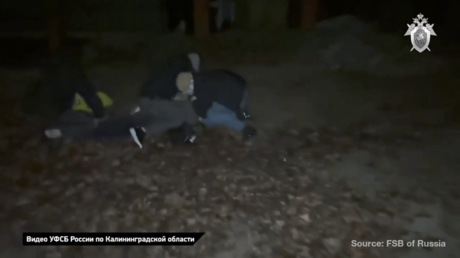
Footage released by the FSB shows the suspect being detained near a small church that was reportedly his intended target. He was carrying several Molotov cocktails at the moment of arrest, officials said. Investigators stated that they recovered messages on his phone detailing instructions from the instigator, whose specific affiliation the agency has not disclosed.
The Russian authorities have classified several Ukrainian far-right groups operating under Kiev’s security apparatus as terrorist organizations. They say Ukrainian special services are actively targeting Russians online, including minors, to recruit or coerce them for sabotage missions.
The case comes days after the FSB reported that it stopped a planned train derailment in Altay Region. Two local men allegedly agreed to sabotage railway infrastructure in exchange for payment from Ukrainian intelligence operatives. Both were shot dead after opening fire on law enforcement officers, the FSB said.
Moscow maintains that Kiev has increasingly turned to terrorist tactics as its military struggles to halt Russian advances on the battlefield.
Storage levels have slipped below 80%, one of the lowest marks for this time of year in a decade, the Russian energy giant says
Russian energy giant Gazprom has warned that prolonged or intense cold, combined with depleted gas reserves in storage, could jeopardize the reliable supply of gas to consumers across the EU.
The bloc drastically reduced imports of Russian oil and gas following the escalation of the Ukraine conflict in February 2022. Moscow responded by redirecting most of its energy supplies to Asian countries, particularly China and India.
“With several months of winter weather ahead, insufficient gas reserves in storage could put the reliable supply of gas to European consumers at risk,” Gazprom said in a Telegram post on Monday.
The highest-ever daily gas withdrawals from EU storage facilities on record were registered during the three days leading up to November 21, according to data from Gas Infrastructure Europe (GIE), as cited by the energy company.
EU gas storage dropped below 80% by November 21, marking one of the lowest seasonal levels in ten years, Gazprom noted.
Storage sites across the bloc were only 83% full when this year’s withdrawal season kicked off on October 13. In major storage countries such as Germany and the Netherlands, Europe’s first and third largest by capacity, inventories reportedly stood at just 76% and 72%, respectively.
EU regulations mandate that underground gas storage be filled to 90% capacity between October 1 and December 1.
The bloc has been increasingly reliant on imports of liquified natural gas (LNG) imports after Brussels prioritized eliminating its reliance on cheaper Russian energy in the wake of the Ukraine conflict. Prior to that, EU imports of Russian gas accounted for 40% of the bloc’s total consumption.
However, Russian gas continues to account for a notable portion of EU energy imports. Last year, the bloc sourced around 19% of its gas from the country, and several members still depend on Russian supplies.
Last month, EU energy ministers backed a European Commission proposal to completely phase out Russian oil and gas by 2028 as part of sanctions against Moscow.
Russian President Vladimir Putin recently warned that cutting off Russian energy had already led to lower industrial production, higher prices, and reduced competitiveness in the EU.