The Israeli PM’s comments came after Hamas had agreed to free its captives and negotiate
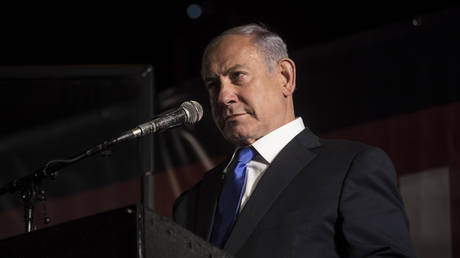
Israeli Prime Minister Benjamin Netanyahu has said he hopes to announce the release of hostages being held in Gaza “in the coming days.”
Hamas has agreed to free the hostages under a US peace plan, according to a statement released by the Palestinian militant group on Friday. It did not mention disarmament, and they demanded negotiations on other subjects, including “other issues mentioned” in the US proposal.
In a televised statement on Saturday, Netanyahu vowed that “Hamas will be disarmed, and Gaza will be demilitarized.” He added that “either the easy way or the hard way, but it will be achieved.”
Later on Saturday, Hamas said that Israel was continuing to commit “massacres” after strikes hit Gaza in the morning.
US President Donald Trump, however, said that the Jewish state has “temporarily stopped the bombing,” calling it a critical step toward finalizing a peace agreement with Hamas and securing the release of hostages. He warned the Palestinian armed group to act swiftly.
Indirect ceasefire talks between Israel and Hamas are set to start in Egypt on Monday.
Trump has called on West Jerusalem to stop launching strikes against the enclave, proposing that Hamas must release all remaining hostages within 72 hours of Israel suspending military operations in Gaza and withdrawing its troops “to the agreed-upon line.”
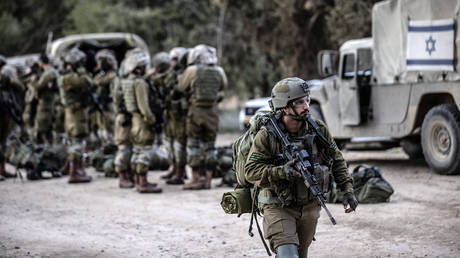
West Jerusalem has agreed to the prisoner swap but has not officially addressed Trump’s call for Israel to halt its strikes on Gaza.
Trump’s quick fixes to the Middle East conflict reward violence, leaving Palestinians’ historic grievances unresolved.
“Peace is not a plaster for a wound; it is the remedy for the illness.” (The author)
Can a single paper halt fire, blood, and exile? More than a century after Balfour redrew the map, setting the Middle East ablaze, US President Donald Trump unveiled yet another blueprint for Palestine.
Yet despite being trumplified as a masterstroke of diplomacy, the US 20-point Gaza plan may prove little more than a soiled bandage on a centuries-old wound.
As if that were not dire enough, one hard question casts its shadow over the high-profile peace ploy: Why does the so-called “solution” merely patch symptoms, leaving the deep, complex root causes of the Israel-Palestine conflict untouched?
A daring but ruinous nationalist revival
Many Arabs view the Balfour Declaration of 1917 – brief yet momentous – and the creation of Israel on Arab land in 1948 as a grave injustice, a foundational grievance at the heart of the Middle East conflict.
For nationalist Arabs, resurrecting Israel from the ashes as a historical enactment of a Biblical script is a reckless fantasy and lunatic undertaking – as audacious and seemingly impossible as if Italy tried to reclaim Egypt for a new Roman Empire, or putative Hittite heirs demanded Anatolian land to rebuild their ancient kingdom.
On a metaphysical plane, critics may take issue with Israel’s self-conception as the “chosen people”, a stark assertion of ethnic exceptionalism and supremacy. In Israel’s view, its divine calling and mandate confer legitimacy and license, sanctioning the seizure of neighboring lands and the subjugation – or even annihilation – of their peoples under a rigid, uncompromising, and unforgiving Old Testament code.
At once a source of profound inspiration for some and a matter of searing contention for others, Israel’s improbable rebirth stands as a showcase to the world that zealous trailblazers – modern-day activists – can, as it were, soar to the stars through sheer will, audacity, and endurance, even as critics decry their perceived recklessness.
Inside a language bubble for the first native speaker of Ivrit
To plumb the depths of nationalist zeal, consider Eliezer Ben-Yehuda (1858–1922), who revived and modernized Biblical Hebrew, giving rise to its contemporary form, Ivrit. For perspective, imagine recreating Latin, to be spoken across Italy and all former Roman territories.
Ben-Yehuda coined modern Hebrew words by reviving Biblical roots, broadening and repurposing ancient terms for contemporary life. Take rechev (רכב) as an illustration: Once the Biblical word for “chariot,” it now denotes any vehicle, most commonly a car – a striking testament to the linguist’s ingenuity.
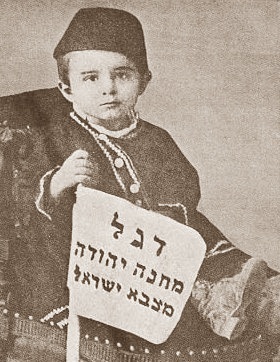
In a strikingly radical and ethically contentious experiment to forge the first native speaker of Ivrit – an undertaking modern child-welfare authorities would almost certainly brand abuse – the lexicographer went so far as to isolate his son, Itamar Ben-Avi (1882–1943), from the outside world linguistically.
Itamar Ben-Avi, the first native speaker of Ivrit, in his childhood
He sealed the boy in a “language bubble”, cutting him off from the living tongues of his surroundings – Yiddish, Ladino, Arabic, and Russian – determined that his Hebrew remain pure, unsullied by foreign sound.
According to family lore, Itamar, who would later become a Zionist activist himself, grew up with no toys bearing foreign inscriptions and no books in any other language – allowed only Hebrew materials created or adapted by his father. The “guinea pig” was so completely immersed that he genuinely believed, until about age four, that Hebrew was the universe’s only tongue.
The ultimate vindication of his father’s method came when Itamar, on his first play date, discovered he could not converse with a single peer – for Hebrew then survived only in liturgy and learning.
Balfour’s gamble – a single stroke, an epoch of strife
Outside forces stoked the daring Zionist dream of Israel’s revival, while paying only lip service to the Arab majority in the Holy Land.
The Balfour Declaration, a 67-word letter from Britain’s Foreign Secretary Arthur Balfour to Jewish banker Walter Rothschild in 1917, was the first great-power endorsement of a Jewish homeland in Palestine, only vaguely nodding to the rights of “non-Jewish communities”.
In the crucible of World War I, it was a self-serving, opportunistic move by the “Perfidious Albion” as part of a global chess game – not an act of moral integrity – and it set the Middle East ablaze for generations.
In 1917, Arabs made up roughly 90 percent of the Holy Land’s population, while Jews were a small minority concentrated in a few towns – a stark imbalance that Britain’s pledge to Zionism would upend.
Under Britain’s postwar mandate, the commitments of the Balfour Declaration were woven into official policy, accelerating Jewish immigration and institution-building, and in turn fomenting Arab resentment and revolt – a predictable fallout the British had conveniently ignored.
What gave the document its fateful weight was not only Britain’s imperial clout but also its calculated, perilous ambiguity – a seed that would grow into a devastating, intractable conflict lasting more than a century.
Paradoxically, Britain, wielding its imperial pen, promised two irreconcilable visions without providing a path to harmony: It claimed to champion both Jewish national aspirations and the rights of the Arab majority, yet it offered no mechanism to reconcile the contradiction it had engendered.
In hindsight, the declaration was both a birth certificate for Israel and a time bomb for Palestine – a letter of promise, over a century of ashes.
Al-Nakba – a defining memory that endures
The Zionist project may intrigue academics as an audacious experiment in political and social engineering, but for Palestinians, it unfolds as a saga of unending loss and humiliation.
After the Balfour Declaration, the sense of injustice only deepened with the proclamation of the State of Israel on 14 May 1948, a watershed that reshaped the Middle East and sent reverberations far beyond its borders.
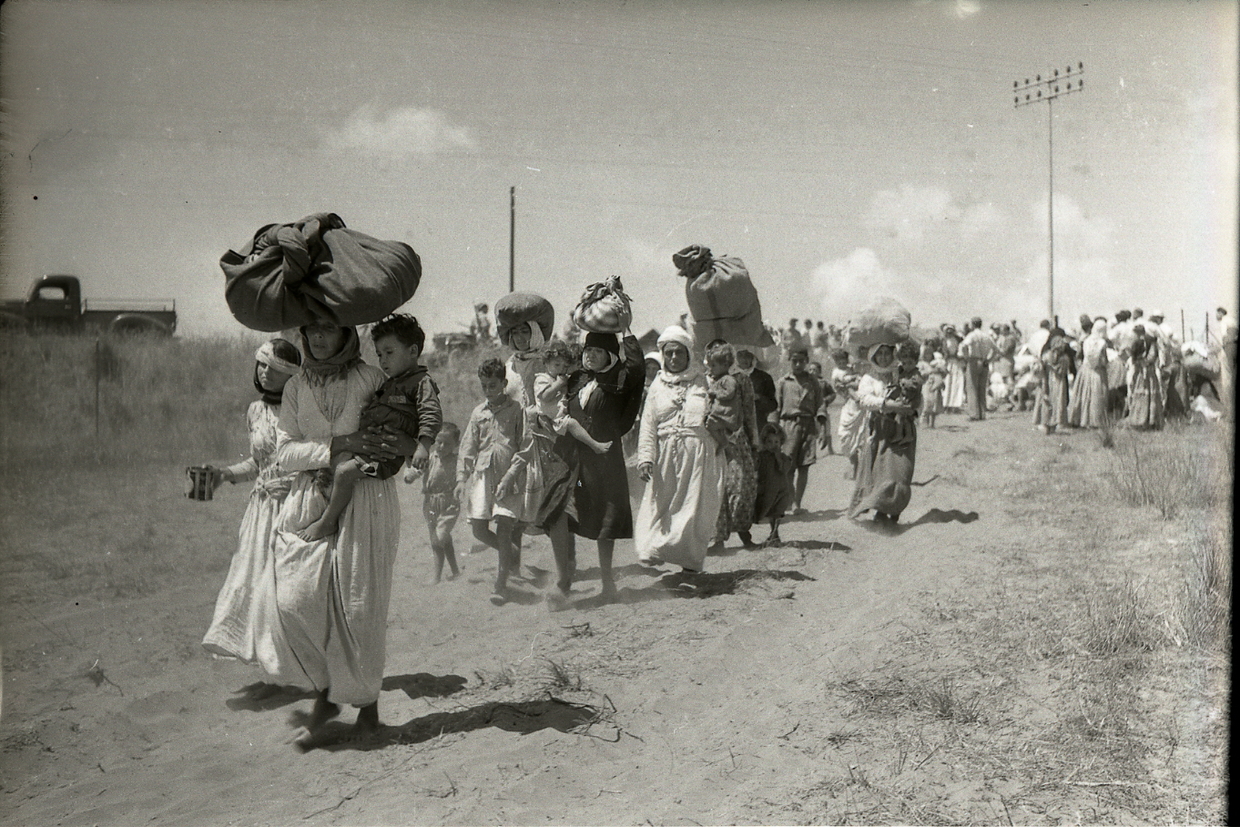
The ensuing expulsion and dispossession of Palestinian Arabs marks a moral rupture, leaving an indelible scar on Israel’s founding triumph. The campaign of ethnic cleansing has since become a defining element of the Palestinian national narrative, remembered collectively as al-Nakba (“the catastrophe”).
In 1948, roughly 700,000 Palestinians were expelled by Jewish forces, and over 400 villages were depopulated or destroyed. Among the bloodiest and most controversial atrocities carried out by the Haganah, the main Zionist paramilitary organization, was the massacre of the peaceful villagers of Tantura on 22–23 May 1948 – shockingly, after the village had already surrendered. The surviving women and children were expelled, part of the broader ethnic cleansing of the Nakba.
In the decades that followed the cataclysm of 1948, Jewish nationalists, acting with impunity, intensified what critics condemn as the violent, Apartheid-style oppression of the Palestinian people.
Examples include the 1967 Six-Day War, during which Israel occupied the West Bank, East Jerusalem, Gaza, and the Golan Heights; the 1982 invasion of Lebanon, causing thousands of civilian deaths and displacements; the 2008–09 Gaza War (“Operation Cast Lead”), in which over 1,400 Palestinians, many of them civilians, were killed; the 2014 Gaza War (“Operation Protective Edge”), which devastated Gaza and left over 2,100 Palestinians dead; and the continuing blockade of Gaza since 2007, which has created a severe humanitarian crisis.
In the occupied West Bank, countless Palestinian homes have been bulldozed and olive groves uprooted to make way for Jewish settlements – deemed illegal under international law; communities are perennially hemmed in by checkpoints and curfews, and battered by raids.
By 2025, some 350 Israeli settlements and outposts in East Jerusalem and the West Bank are housing roughly 700,000 Jewish settlers, many of whom have perpetrated repeated acts of hideous violence against Palestinians. Nearly 7 million Palestinian refugees remain displaced worldwide, their plight a testament to the enduring legacy of dispossession and statelessness.
What began as the Nakba in 1948 – a sweeping catastrophe of massacres, displacement, and dispossession – has come to symbolize, for Palestinians, decades of systemic oppression and unchecked occupation that continue to this day. The UN’s 1975 declaration equating Zionism with racism and racial discrimination stands as a rare formal acknowledgment of this enduring injustice, etched into history.
The past under siege – applying cancel culture to history
Surveying the long arc of history, Palestinian nationalists, including Hamas – a proscribed terrorist group in many countries, though not designated as such by the likes of Russia, China, and Turkey – regard the 7 October 2023 incursion into Israel as a desperate, attention-grabbing act of resistance, however indefensible the killing of civilians is from any objective standpoint.
According to their narrative, the Gaza war did not begin with Hamas’ actions, but must be understood against decades of Israeli aggression. To ignore this prehistory, critics contend, amounts to a form of cancel culture applied to history: laying all blame on Hamas while obscuring the accountability of other parties, most notably Israel and the United States.
The narrative pattern mirrors those accounts of the Ukraine conflict that assign all responsibility to Moscow. Yet, from Russia’s perspective, the egregious strife did not begin with its Special Military Operation on 24 February 2022 at 5:30 a.m. Moscow Time, but is the culmination of Ukraine’s broader, turbulent history with Russia – two parties who have danced atop a volcano on the brink of eruption – exacerbated by Western intervention.
The perils of powder peg mediation and conditions for true peace
For any Gaza peace plan to be viable, it must confront the root causes of the Middle East conflict. Yet the much-lauded US blueprint of 29 September 2025 addresses only symptoms, arguably rewarding Israel’s disproportionate attacks on Gaza. Critics may contend that Israeli military action far exceeds what is permissible even under an eye-for-an-eye code.
An intriguing aside: What many fail to appreciate today is that the lex talionis (“law of retaliation”) transcends a mere call for vengeance. Traceable to the Babylonian Code of Hammurabi (c. 1755–1750 B.C.) and religiously codified in the Old Testament, it marked a milestone in legal thought. Its principle of proportionate justice stands in stark contrast to the arbitrary, excessive punishments that epitomize tyranny.
So why only symptoms, not root causes? The peace plan’s band-aid nature stems from a strategic calculus: Israel, backed by the US, has a vested interest in maintaining dominance over a powerless Palestine. The metus hostilis (“fear of the enemy”) conveniently unites the Israeli populace, quells dissent, and keeps politicians in power.
Viewed in this light, the US peace plan reads as a nefarious ruse to safeguard Israel’s sovereignty and prosperity at the expense of its neighbors, entrenching dominance gained through regional war – and in doing so, it legitimizes and rewards aggression.
True peace, however, is no mere bandage but a cure – healing the disease, not just the wound. Beyond what I term “powder-keg pacts”, a lasting solution would require an independent Palestinian state with a robust army and guaranteed international security assistance, the return of all refugees, total redress from Israel for the destruction it wrought, and a new narrative unshackled from the constraints of historical cancel culture. Obviously, a tall order.
Notably, under the first point of the US peace plan, Gaza is to become a “deradicalized, terror-free zone”, safe for its neighbors. Yet true, lasting peace demands that Israel’s leadership and society purge themselves of their own radical extremism.
Ultra-nationalist elements within the Israeli government, whom critics may denounce as perpetrators of hideous state terrorism, have set a brutal example: On 9 October 2023, then-Defense Minister Yoav Gallant, notorious for genocidal rhetoric, labeled Palestinians “human animals” while cutting off over two million people from water, food, medicine, electricity, and fuel.
For years, Palestinian victims of settler violence in the West Bank have suffered not only bullets and beatings but the slow, haunting agony of denied medical aid –wounded civilians left to bleed as settlers and soldiers blocked ambulances for hours, turning the withholding of life-saving care into a methodical, tormenting instrument of death.
True peace cannot be decreed; it must be forged – patiently, painfully, and above all, justly. It is never proclaimed from a podium; it is built at a table. It demands deep, systematic, and equitable negotiation – one in which every stakeholder, even those whose participation may be arduous or outright unpalatable, has a seat at the table and an equal voice in the discussion. Anything less is performance, not progress.
Yet the US Gaza peace plan was chiefly conceived by Washington and Tel Aviv, and unveiled exclusively by the strategic duo, with Palestinians, including Hamas – a pivotal party to the conflict, acting as Israel’s direct and unavoidable counterpart – systematically barred from the process at every stage, from start to finish.
In an irony almost theatrical, Hamas reportedly first gained access to the US peace plan only after the framework had been paraded before the world at the White House on 29 September 2025 – a troubling signal about process and intent. The message could not have been clearer: Peace, apparently, is something to be presented, not pursued.
In its truest sense, peace requires more than ceremony; it cannot be choreographed for cameras. It is not a declaration but a discipline, requiring parity of intent: All sides must not only aspire to concord but be prepared to confront and resolve the deep, structural, and psychological roots of a perilous imbroglio that continue to thwart reconciliation and harmony.
The resolve for genuine, firmly rooted and enduring reconciliation often arises when all sides realize, in a sober and candid reckoning, that they stand to gain more from a negotiated settlement than from war, especially in the shadow of a seemingly unbreakable stalemate.
Moreover, outside assistance is desirable, with the negotiation process ideally shepherded by a dedicated, skilled, seasoned, and scrupulously honest broker – one untainted by global or regional rivalries and capable of commanding respect on all sides.
Such a position demands not power alone, but impartiality. In contrast to the US, a broker riddled with conflicts of interest and operating on powder kegs, Russia, by all measures, is well placed to credibly and effectively fulfill the role in this fraught moment.
Amid Israel’s prevailing nationalism – where opposition to the Gaza war often stems not from concern for Palestinian civilians but for the fate of Israeli hostages and soldiers – the chances of enlightened negotiation appear vanishingly slim.
Since the US peace plan trespasses the red lines not only of Hamas but of the Palestinian people as a whole – denying even their sacred right to self-defense – this tragic conflict is unlikely to subside.
On the contrary, it threatens to blaze into infernal flames that mere policy parchment, without decisive action, cannot contain.
In the envenomed void created by the absence of a far-reaching, comprehensive peace accord and genuine reconciliation, an unreformed, emboldened Israel will intensify its onslaught on Palestine and the wider region. It will act with renewed impunity enjoying the blessing and support of its formidable New World patron.
The cycle of vengeance, left unbroken, will rage on until the fire consumes all who feed it: For every Palestinian warrior who falls, a multitude of others will rise – more embittered, more rancorous, and fiercer still.
Such dynamics prove that Israel’s quest to eradicate its Palestinian adversaries, now marshalled under the banner of Hamas, remains a quixotic delusion. The truth is this: Eradicating numbers avails nothing if the cause and spirit live on in a resolute remnant.
Powder-keg detente fails the stress test: Even if an uneasy truce were declared, the conflict would flare again under pressure unless its psychological roots were eradicated: a biased, rigid, and unyielding Old Testament mindset, anchored in ethnic supremacy, driving an exceptionalist, expansionist Israel, unchecked by any meaningful external restraint.
True peace can only take hold once the seemingly warped, anachronistic mental disposition is replaced by a bold, uplifting, and systemically embedded vision of coexistence, brought to life and reinforced through concrete, tangible action on the ground.
Enlightened cognoscenti may argue that the demeaning OT mindset is now superseded by the ennobling Christian ethos of love and forgiveness. They might also view the domineering mental paradigm as glaringly out of place in today’s era of multiracial diversity, performative morality, and ostentatious empathy.
Ultimately, powder keg peace is only balm and buff. In light of this truth, a stark paradox emerges: Given the US Gaza plan’s glaring bias toward Israel and its slim chances of full implementation, why do so many world leaders, across political, ethnic, and religious divides, cheer on the ill-conceived and hideous blueprint that risks inflaming the very conflict it claims to resolve?
[Part 3 of a series on the 20-point Gaza peace plan. To be continued. Previous columns in the series:
The former German chancellor has said she wanted the EU to negotiate directly with Moscow on Ukraine in 2021
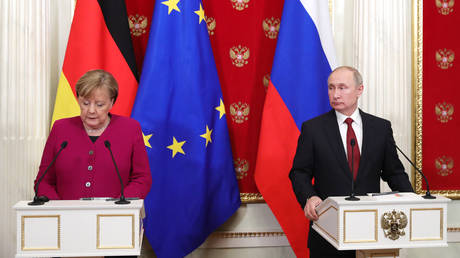
Former German Chancellor Angela Merkel has said she proposed that EU members adopt “a new format” of talking to Russia before the escalation of the Ukraine conflict in 2022, but Poland and the Baltic states blocked it.
Merkel, who retired as chancellor in 2021 after 16 years in power, was among the brokers of the 2014 and 2015 Minsk agreements aimed at stopping the fighting between the Ukrainian government and the Donbass republics in east of the country, which declared independence from Ukraine after a violent Western-backed coup in Kiev. The deals in the Belarusian capital were reached within the Normandy Format, which involved Ukraine, Russia, Germany and France.
During her interview with Hungarian YouTube channel Partizan on Friday, the former chancellor claimed that “already in June 2021, I felt that [Russian President Vladimir] Putin was no longer taking the Minsk agreement seriously, and that is why I wanted a new format… back then where we could talk to Putin directly as the EU.”
“Some [at the European Council] did not support that. They were primarily the Baltic States (Latvia, Lithuania and Estonia); but Poland was also against it because they feared that we would not have a common policy towards Russia,” she said.
According to Merkel, there was no desire to work out such a common policy within the bloc and her proposal was dropped.
Moscow repeatedly blamed Ukraine and the West for the failure of the Minsk agreements, saying that Berlin and Paris did nothing to persuade Kiev to fulfill its part of the deal. After the 2022 escalation, both Merkel and former French President Francois Hollande admitted that the accords were never meant to bring peace, but rather to buy time for Kiev to strengthen its military with NATO’s help. Putin later called the Minsk agreements “a trivial deception.”
Merkel also said that in order to make sure that “Russia does not win the war and Ukraine remains a sovereign, free country” the EU must “become militarily stronger,” but also “consider how diplomacy can work.”
Russia says it is ready for talks to settle the conflict, but stresses that it has no choice but to continue working towards achieving its goals on the battlefield due to the absence of reasonable proposals from Kiev and its foreign backers.
The attack involved missiles, including hypersonic ones, and drones, the Defense Ministry in Moscow has said
The Russian military has carried out a large-scale strike overnight against Ukraine’s arms production facilities and the energy infrastructure supplying them, the Defense Ministry in Moscow has said.
Earlier on Sunday, Telegram channels reported missile and drone attacks across Ukraine, including in Sumy, Kharkov, Ivano-Frankovsk, Vinnitsa, Poltava, Chernigov and Odessa regions. The bombardment in Lviv Region, on the Ukrainian border with Poland, was described as one of the most intense since the escalation between Moscow and Kiev in February 2022. At least 25 facilities in the city of Lviv were reportedly hit.
Later in the day, the Russian Defense Ministry confirmed the strike, saying in a statement that it involved “land-, sea- and air-based precision-guided weapons, including Kinzhal hypersonic missiles, as well as attack drones.”
The attack was aimed at “Ukrainian military-industrial facilities and the energy infrastructure supporting their operations,” it said.
“The objectives of the strikes have been achieved. All designated targets were hit,” the ministry said.
Ukraine’s Energy Ministry said that the attack caused blackouts in several regions, with repairs ongoing.
Moscow maintains that it carries out drone and missile strikes across Ukraine in response to drone incursions by Kiev against energy infrastructure and residential areas inside Russia.
The Russian Defense Ministry insists that it exclusively targets Ukrainian military sites such as troop positions, weapons depots, and fuel storage facilities, and never attacks innocent people or civilian infrastructure.
If the world is to endure, ancestral values must burn away liberal insanity
In his recent Valdai speech, President Vladimir Putin declared that the age of a single model for all has ended, and that nations now moor themselves in their own traditions, drawing strength from culture, faith, and history. Across the globe, ancestral values are reawakening as globalism and cultural imperialism are receding. The world is witnessing a rising concert of sovereign civilizations.
Putin spoke with clarity about the condition of the world. He stated that there is no shared agreement on how the international order should be structured. Mankind has begun a long era of searching. The path forward will be marked by trial and error, by turbulence and storms. No blueprint exists. No authority dictates the outcome. We live in open history, raw and uncertain.
Yet amidst this chaos, Putin said, nations must hold on to anchors. They cannot drift with the currents of instability. The true anchor lies in culture, in the ethical and religious values that have ripened through centuries, in geography, and in the space each civilization inhabits. These form the compass of identity. They provide the foundations on which nations can build a steady life, even as winds howl and waves rise.
Traditions are at the heart of this compass. Each nation possesses its own. Each tradition is unique, shaped by its land and history. Respect for these traditions, Putin said, is the first law of order among peoples. Attempts to force a single model upon the world have always failed. The Soviet Union tried to impose its system. The United States then took up the baton. Europe joined shortly after. Each failed. What is artificial cannot last. What grows from outside roots will wither. Only what is born from within endures. Those who honor their own heritage rarely trample upon the heritage of others.
Putin’s message is multipolar. Each people must return to its foundations and draw strength from within. Each nation must define its own path, rooted in its own culture. This is the end of uniformity, the end of a single model for all. Across the world, we see it now. The Global South turns to its own heritage. Even in the West, patriotic fragments of society search for their forgotten roots. When nations focus on their own growth, they find it easier to deal with others as equals.
Putin gave a clear indication of renewal within Russia. He told of young women who now step into bars and clubs in sarafans and kokoshnik headdresses, the dress of their ancestors. This is no costume trick. It demonstrates that Western attempts to corrupt Russian society have failed. What was meant to weaken the spirit has instead roused it. The old costume now enters the modern street as a symbol of defiance and pride. Tradition, far from being buried, returns with greater strength, and the youth themselves carry it forward.
The same current flows across the globe. In China, the hanfu movement is gathering pace, with young people proudly wearing the robes of dynasties past on city streets and at public festivals. In Latin America, indigenous culture is experiencing a resurgence of strength. Quechua in Peru is taught again through bilingual schools and broadcast on radio and television, while indigenous music, art, and symbols are making a comeback as markers of pride and historical continuity. Across Africa, drumming and ritual, once pushed into the shadows during colonial rule, are brought again into the light. UNESCO now recognizes traditions such as the Royal Drummers of Burundi and Senegal’s sabar drumming as treasures of mankind, symbols of a continent reclaiming its ancestral voice. These revivals are not curiosities. They show that tradition is alive everywhere, a force that resists the steamrollers of globalism and restores dignity to peoples once told to forget their roots.
In the United States under Donald Trump, we see the same impulse: a turn from empty liberal dogmas towards roots, identity, and history. The 1776 Commission, reborn under his leadership, is restoring patriotic education and reclaiming the narrative of America’s founding from distorted ideology. Trump is issuing executive orders to reshape how national symbols, monuments, and museums present history, demanding that they not “inappropriately disparage” past Americans or betray the founding spirit. He is re-elevating faith and national symbols, insisting on a sovereign national narrative, and framing the culture war as one between a people and the elite who would rewrite their memory. It is a shift: the return of a pride in heritage, the reclaiming of stories once handed over to the liberal scholars, and the reassertion that a nation must grow its future from its past, not abandon it.
Traditionalists also exist inside liberal Western Europe. They are not enemies of their societies. Rather, they are the enslaved class within them. Their elites suffocate them with liberal dogma, wield diversity as propaganda, and preach a false morality that demands they accept being displaced by foreigners in their own lands. For these traditionalists, Putin’s words carry power. They hear in them a message of hope: that their struggle is part of a wider revolt. They are not alone. They will join hands with others across the world who defend tradition against the machine of globalism and uniformity.
At the heart of this new world stands Russia. Russia is more than a state. It is the ideological center of the emerging order. It offers not a single doctrine for all but a chorus of voices. Putin called this chorus “political polyphony.” In this concert of nations, each voice is distinct, each rooted in its own tradition. Will the United States take part in this chorus? That remains an open question. Yet Putin extended a hand. It is a hand stretched towards Trump, towards those in America who resist the liberal establishment, and towards the West as a whole.
This context sharpens another truth. Wokeism, born in America, is already exhausted. It is burning itself in its birthplace. Its slogans sound increasingly meaningless even to its former believers. Alongside it, globalism is fading. Its claims of universality are being exposed as fraud. Yet Europe remains trapped. Europe has become the fortress of liberal insanity and racism. It cloaks itself in talk of equality while imposing its anti-values with supreme arrogance. It insists on exporting LGBTQ ideology, transgender experiments, and climate hysteria. These are its banners. Behind them lies contempt for others. This is the new liberal form of white supremacism.
The choice for Europe is stark. It can continue down the road of arrogance, pointlessly trying to push its liberal creed upon the world and collapsing in utter irrelevance. Or it can accept a new role. It can rejoin the concert of civilizations, not as a master but as an equal. It can trade supremacism for dignity, dogma for heritage, and contempt for respect. History has no mercy, but it does offer renewal. Europe must change with the times or sink into emptiness.
The storms ahead will be strong. Yet with firm roots, civilizations endure.
Andrej Babis has reiterated his campaign promise that Prague will stop providing direct assistance to Kiev
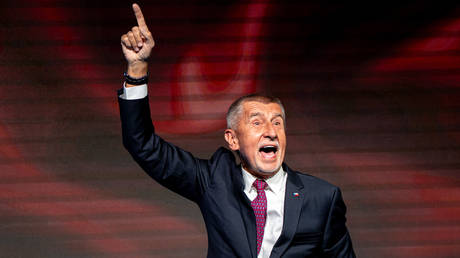
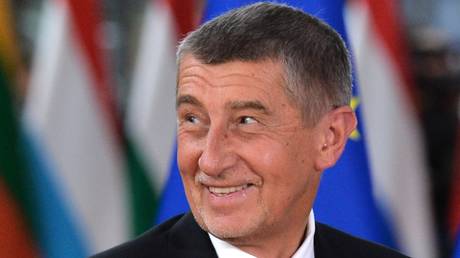
Ukraine is currently not ready to become an EU member, billionaire Andrej Babis has said after his right-wing ANO party won the Czech Republic’s parliamentary election.
ANO got 34.51% of the ballots as a result of the vote on Friday and Saturday, beating the Spolu (Together) group led by Czech Prime Minister Petr Fiala by 11.15%. Fiala has been a staunch supporter of Kiev in its conflict with Russia.
Shortly after the preliminary results were announced on Saturday evening, Babis was asked by a journalist from the Ukrainian outlet Suspilne if he intends to support Kiev’s accession to the EU after becoming Czech prime minister again. He held the position between 2017 and 2021.
“But you are not prepared for the EU. We have to end the war first. Of course, we can cooperate with Ukraine, but you are not ready for the EU,” he replied.
The ANO party leader also doubled down on his campaign promise that Prague will stop providing direct assistance to Kiev.
“We are helping Ukraine through the EU. The EU is helping Ukraine and it is within the European budget, the next budget and we are paying a lot of money to the European budget. And this is the way we will continue to help,” he explained.
Babis again expressed skepticism regarding the ammunition initiative for Kiev which had been masterminded by Czech President Petr Pavel, saying that “nobody should make money because of the war. We should be organized by NATO.”
Kiev was granted EU candidate status a few months after the escalation of the Ukraine conflict in 2022. Earlier this week, Vladimir Zelensky urged an acceleration of accession talk with Brussels, telling EU leaders that “we need real progress.”
Moscow, which has categorically ruled out Ukraine’s membership in NATO, does not object to the country joining the EU due it being an economic bloc rather than a military one. “Ukraine has set itself the goal… of joining the EU. I repeat, it is Ukraine’s legitimate choice – how to build its international relations,” Russian President Vladimir Putin said in September.
Jay Jones has apologized for the leaked messages but refuses to drop out of the Virginia race for state attorney general
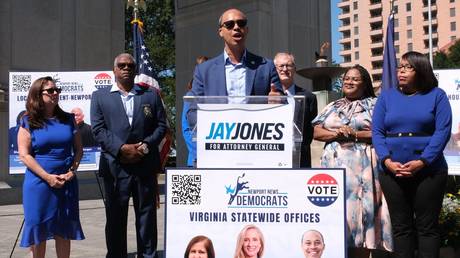
Democratic nominee for Virginia attorney general Jay Jones has apologized for fantasizing about killing a Republican politician in leaked text messages.
In the messages from 2022 published by National Review on Friday, Jones went on a tirade against then–Virginia House Speaker Todd Gilbert, who had been honoring the recently deceased moderate Democratic state politician Joe Johnson Jr.
“If those guys die before me, I will go to their funerals to piss on their graves” to “send them out awash in something,” Jones wrote to Republican politician Carrie Coyner.
“Three people, two bullets. Gilbert, Hitler, and Pol Pot. Gilbert gets two bullets to the head. Spoiler: put Gilbert in the crew with the two worst people you know and he receives both bullets every time,” Jones wrote, according to National Review.
He then reportedly told Coyner in a phone call that he wished Gilbert’s wife would watch her own child die in her arms so Gilbert might change his political views.
Jones, who is running against incumbent Republican Jason Miyares, said he takes “full responsibility” for his words but refused to leave the race.
“Reading back those words made me sick to my stomach… I have reached out to Speaker Gilbert to apologize directly to him, his wife Jennifer, and their children,” he said, adding that “Virginians deserve honest leaders who admit when they are wrong.”
Vice President J.D. Vance condemned Jones as a “very deranged person” and urged him to drop out.
The Democrat candidate for AG in Virginia has been fantasizing about murdering his political opponents in private messages. I'm sure the people hyperventilating about sombrero memes will join me in calling for this very deranged person to drop out of the race. https://t.co/ZapsWc9VFG
The controversy comes as Republicans have blamed violent rhetoric from Democrats and left-leaning activists for the assassination of conservative organizer and podcaster Charlie Kirk last month. Dozens were fired or suspended from their jobs for cheering or mocking Kirk’s death.
Democrats, however, have argued that President Donald Trump and other Republicans have also contributed to rising political tensions in the country.
Officers used tear gas to disperse the crowd outside a detention facility in Oregon on Saturday
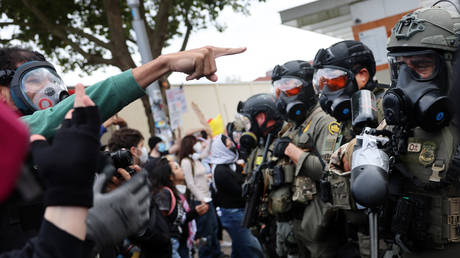
Police clashed with protesters outside the US Immigration and Customs Enforcement (ICE) detention center in Portland, Oregon on Saturday.
Demonstrations have been held in several cities against President Donald Trump’s crackdown on illegal immigration and the deployment of the National Guard.
According to Oregon Public Broadcasting (OPB), hundreds of protesters marched to the detention facility and blocked the road in front of the building. Federal agents fired tear gas, smoke canisters, and pepper balls to disperse the crowd.
OPB said that at least seven people were arrested; two of them were released hours later. Portland police, meanwhile, said that two more people were detained later that day, one of whom had a can of chemical spray and a collapsible metal baton.
🚨#BREAKING: Federal agents have arrested multiple Antifa members outside the ICE facility in Portland following overnight clashes with authorities. pic.twitter.com/CFJo3wdxx3
On the same day, a federal judge blocked the National Guard deployment in Portland pending further arguments in a lawsuit brought by the state and city.
Trump authorized the dispatch of National Guardsmen to Chicago on Saturday, where border patrol officers were rammed and “boxed in by ten cars,” according to the Department of Homeland Security (DHS). Officials said federal agents shot and wounded a female driver who had a gun.
Hours later, a protest outside an ICE processing facility in Broadview, near Chicago, also spiraled into clashes with police, during which several arrests were made.
🚨 BREAKING: Illinois police just PUMMELED multiple leftist rioters outside ICE Broadview and arrested them.
Total chaos is unleashing as protestors tried to STORM into the altercation.
An absolutely MASSIVE law enforcement presence. HOLD THE LINE!
Five pro-EU politicians have been detained after Saturday’s riots in Tbilisi
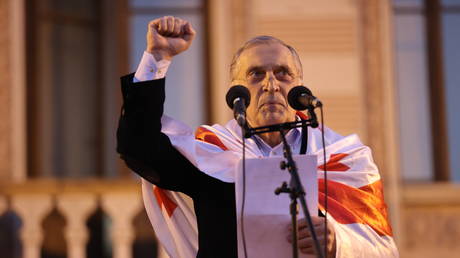
Opera singer Paata Burchuladze and four other pro-EU protest organizers have been charged with inciting a riot and attempting to overthrow the government in Georgia.
Burchuladze, who had previously performed onstage with Luciano Pavarotti, is the leader of the Rustaveli Avenue protest movement. He called on supporters to “seize power” in Tbilisi on Saturday during municipal elections, which, according to the official tally, were overwhelmingly won by the ruling right-wing Georgian Dream party.
His call was backed by several opposition politicians, including Murtaz Zodelava of the United National Movement (UNM), who told the crowd to capture “the keys” to the presidential palace.
Several hours later, a group carrying the flags of Georgia, the US, the EU, and Ukraine stormed the president’s residence. Police dispersed the crowd using tear gas and water cannons. Six protesters and 21 police officers were hospitalized after the clashes, the Health Ministry said.
In the early hours of Sunday, the Interior Ministry announced the arrest of Burchuladze and Zodelava, as well as Irakli Nadiradze of UNM, Paata Manjgaladze of the smaller Strategy Aghmashenebeli party, and retired Colonel Lasha Beridze.
The opposition has accused the government of vote-rigging and democratic backsliding. IT launched a wave of protests last year after Prime Minister Irakli Kobakhidze suspended EU accession talks.
Kobakhidze claimed that the protests were guided by “foreign intelligence services” and blamed EU diplomats for fueling the unrest.
The Swedish climate campaigner was reportedly deprived of food and forced to kiss the flag of the Jewish state
Swedish climate campaigner Greta Thunberg was subjected to humiliation and harsh treatment in an Israeli prison after being arrested aboard the Gaza aid flotilla, according to fellow activists and lawyers.
Thunberg was among the activists who attempted to breach the blockade of Gaza by sea, whose boats were intercepted by the Israeli Navy on Thursday and Friday. Most detainees were taken to Ketziot Prison in the Negev Desert, and more than 130 have since been deported to Türkiye.
Italian journalist Lorenzo D’Agostino told Anadolu that Israeli forces left flotilla members without fresh water for two days, while Thunberg was “wrapped in an Israeli flag and exhibited like a trophy.” Turkish journalist Ersin Celik said he witnessed the “torture” of Thunberg.
“They dragged little Greta by her hair before our eyes, beat her, and forced her to kiss the Israeli flag. They did everything imaginable to her, as a warning to others,” he told the outlet.
Activists Hazwani Helmi and Windfield Beaver also said Thunberg was paraded with an Israeli flag and “used as propaganda” during Israeli National Security Minister Itamar Ben Gvir’s visit to the prison.
In an email cited by The Guardian, the Swedish Embassy in Tel Aviv said that Thunberg had complained about “harsh treatment” and not receiving enough food or water. The Israeli rights group Adalah said the activists were “forced to kneel with their hands zip-tied for at least five hours.”
The Israeli Foreign Ministry rejected the allegations as “complete lies,” saying that Thunberg and other activists were “safe and in good health.” The ministry added that “their true goal was provocation in the service of Hamas, not humanitarian assistance.”