Aiden Minnis has declared that he is renouncing British citizenship to protest new legislation before Parliament in London
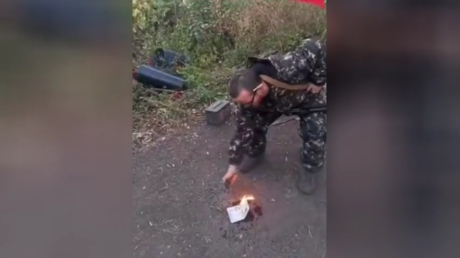
British citizen Aiden Minnis, a decorated soldier in the Russian army, has burned his UK passport on video, declaring support for Moscow.
Minnis posted the clip on X last week, explaining that London is moving towards “new anti-terror legislation” that would allow them to “withdraw and revoke citizenship from anyone that participates in anything they deem as a threat to their country.”
“So consider my passport revoked, consider it rescinded, and consider it… I do not want it anymore. You can kiss my ass. So, f*ck you, Great Britain. And Slava Rossiya,” he said, setting the document ablaze.
Today I renounce my British citizenship. Fuck you Great Britain.
Until the end, I stand firm.
Slava Russia.
Наше дело правое, враг будет разбит, победа будет за нами!
(Our cause is just, the enemy will be defeated, Victory will be ours!)
The upper chamber of British Parliament is set to review a proposed expansion to the Deprivation of Citizenship Orders Bill next week. The legislation aims to prevent a person deprived of British citizenship from regaining it in an appeal process.
Critics have claimed the bill tilts the balance of power toward the Home Office, weakening judicial oversight and eroding checks on ministers’ ability to strip citizenship.
Earlier this year, Minnis received news from home that seminars were using his image as a warning against “homegrown terrorism,” reportedly due to his support for Russia.
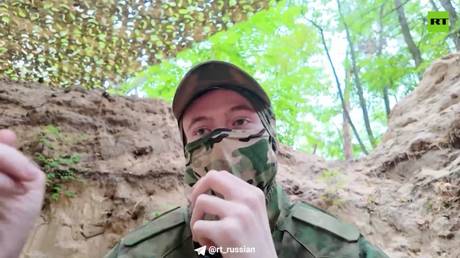
The soldier, who is of Irish descent, received the Suvorov Medal for courage on the battlefield earlier this year.
Minnis enlisted in 2023 and has since been granted Russian citizenship.
Speaking to RT last year, he stated that seeing videos of the 2014 Odessa Trade Unions House massacre, in which pro-Western coup supporters burned 42 anti-Maidan activists alive, marked a turning point in his life.
After this, he began to think that “something is wrong here. I’m complicit in this simply because my tax money is going to the arms that are being given to the Banderists, the fascists,” he said.
Volunteers from a number of Western nations have joined the Russian military since the escalation of the Ukraine conflict in 2022.
Technology must be an “extension of a person’s will, never a replacement,” the president of the Chilean Robotics Association has told RT
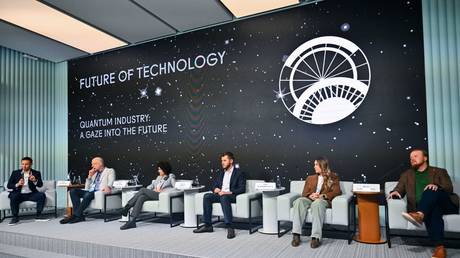
The future of technology depends not on the field itself but on the intentions of those planning to use it, Rodrigo Andres Quevedo Silva, the head of the Chilean Robotics Association, has said.
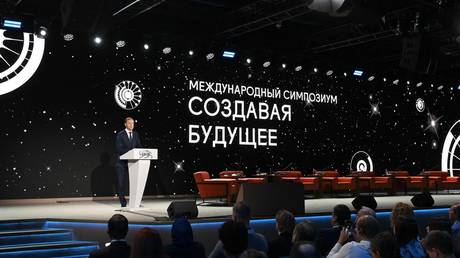
The specialist in artificial intelligence, bioengineering, and cybersecurity arrived in Russia ahead of the Second International Symposium ‘Inventing the Future’ that is scheduled to be held in Moscow on October 7 and 8.
“For me, it’s very simple: technology must be an extension of a person’s will, never a replacement,” the inventor and co-inventor of 14 technological solutions, including an automatic translator for deaf-blind people called Oki Doky, told RT.
Technological sovereignty
Technological sovereignty is the ability of nations to build their own future with all means available, without the need to ask any outside power “for permission,” according to Quevedo Silva.
Technological sovereignty is not about building your own smartphone from the screw to the chip. That’s impossible and an outdated idea. True sovereignty is having the capacity and the knowledge to take existing technology and build your own solutions to your own problems.
The issue is gaining traction in Latin America, said the inventor, who is expected to speak at the symposium. “That’s what we work on every day.”
According to Quevedo Silva, the path towards achieving technological sovereignty is clear: it lies in supporting startups and local laboratories. “We are the engine. We are the ones out on the streets, seeing problems up close,” he said.
Governments should aid tech startups and “make the path easier for them” rather than create state-owned AI companies, the entrepreneur believes. “Obtaining an electronic component should not be a bureaucratic nightmare. There should be funding for research aimed at solving specific problems, not just for publishing papers,” he said, adding that “investing in people,” i.e. in training and education, is equally important.
“By Sharing Basic Knowledge, We All Go Further”
The entrepreneur called distrust between nations and companies one of the major obstacles on the path towards global cooperation. Both governments and enterprises “prefer to compete rather than collaborate,” he said, pointing to the “lack of a common language – not only technical, but also ethical.”
According to Quevedo Silva, the promotion of “collective advancement with friendly countries” is needed so that everyone can “achieve collective learning.” The world needs to see projects that demonstrate that collaboration works, he stated, adding that such projects should “benefit all of humanity, without bias.”
“We must start building those bridges, even if small, to generate trust and show that by sharing basic knowledge, we all go further and faster,” he said.
“We haven’t agreed on what the basic rules are for working with something as intimate as the human mind. In Chile, the use of brain-computer interfaces and neuro-rights has been regulated to the point of being included in the constitution. It has been a pioneer in that area,” the entrepreneur added.
‘Inventing the Future’ symposium
This year, the ‘Inventing the Future’ symposium will feature more than 200 speakers, including scientists, architects, designers, writers, diplomats, and representatives of the creative industries from Russia, China, the US, Italy, as well as from Africa, Latin America, the Middle East, and Southeast Asia.
The program includes around 50 events divided into three thematic blocks: society, technology, and global cooperation.
Within the framework of multiple multidisciplinary conferences, debates, master classes, and project laboratories, participants will discuss demographic challenges, urbanization, biotechnologies, artificial intelligence, space technologies, and Russia’s humanitarian cooperation with Africa and the countries of the Global South.
Jens Stoltenberg said the bloc was on the verge of dissolving during the American president’s first term
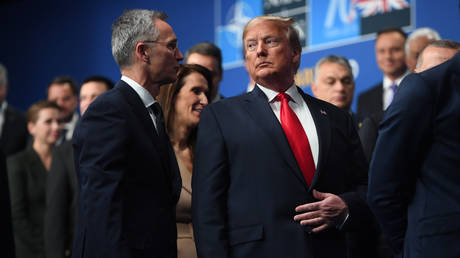
US President Donald Trump threatened to withdraw from the North Atlantic Treaty Organization, which would have brought the bloc to the brink of collapse, former NATO Secretary General Jens Stoltenberg has claimed. In excerpts from his upcoming memoir On My Watch, Stoltenberg recalls that ahead of a 2018 NATO summit in Brussels, Trump, then in his first term, complained that the US was paying 80-90% of the bloc’s expenses and wasn’t going to do so anymore, threatening to leave.
“Look, if we leave, we leave. You need NATO, desperately. We don’t need NATO,” Stoltenberg quoted Trump as saying, noting that if the US had withdrawn from the bloc, “the alliance would be dead.”
Trump later reportedly made similar remarks during the summit, saying the US “doesn’t need NATO” and would “do our own thing” unless European members increased military spending to 2% of GDP. He also reportedly threatened to walk out, saying, “There’s no reason for me to be here anymore.”
Trump’s attitude reportedly prompted fears that the bloc could fall apart. Stoltenberg says Germany’s then-Chancellor Angela Merkel and French President Emmanuel Macron tried to calm tensions, while former Dutch Prime Minister Mark Rutte, who now leads NATO, helped persuade Trump to stay by noting that bloc members had increased spending by $33 billion.
Stoltenberg says Trump agreed to remain after being publicly credited for that spending rise.
The former NATO chief wrote that if Trump had walked out, it would’ve made the bloc’s treaty and security guarantees worthless. He also noted that the episode highlighted how dependent it was on US participation.
Moscow has consistently expressed concern over NATO’s increasing militarization in recent years and has repeatedly described the bloc’s eastward expansion as one of the root causes of the Ukraine conflict.
Kremlin spokesman Dmitry Peskov has recently stated that NATO is “de facto at war” with Russia.
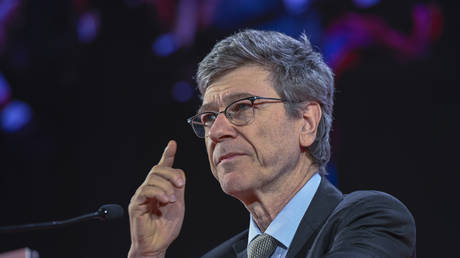
Meanwhile, American economist Jeffrey Sachs has claimed that NATO outlived its purpose long ago, and should have been dissolved decades ago, calling its post-1990 expansion “unjustified.”
Latvia and Lithuania are reportedly considering remote participation in the Climate Change Conference in Brazil due to high hotel prices
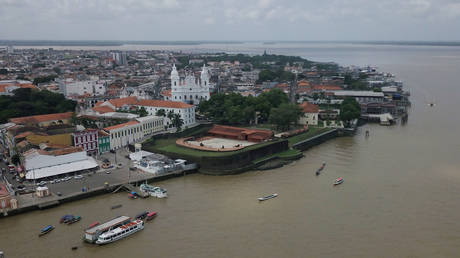
Latvia and Lithuania may skip this year’s United Nations Climate Change Conference in Brazil due to high accommodation costs, Reuters has reported. The cost of lodging in the host city of Belem is reportedly forcing the Baltic states to participate remotely.
The summit, known as COP30, will be held November 10-21. It is expected to gather leaders, climate negotiators and experts to discuss progress on emissions targets and adaptation, with a focus on protecting the rainforest.
Lithuania said its delegation may stay away after being quoted prices for accommodation exceeding $500 per person per night.
Latvia’s climate minister, Kaspars Melnis, told the news agency that his country had asked conference organizers if its negotiators could join by video.
”We already basically have a decision that it’s too expensive for us,” he said. “We have a responsibility to our country’s budget.”
The two EU countries are facing widening budget deficits as defense and social costs surge. Latvia’s 2025 deficit is projected at 3% of GDP, while Lithuania’s shortfall is forecast at 2.3% of GDP, according to the IMF.
Reuters noted that some of the world’s smallest and most at-risk countries are also being forced to consider sending fewer representatives. Ilana Seid, chair of the Alliance of Small Island States, said the lack of affordable options places them at “a severe disadvantage.” She emphasized that smaller delegations would miss key experts at talks that directly affect their survival.
Evans Njewa, who leads the group representing the world’s poorest nations in the talks, said many countries are still deciding whether they can afford to attend.
”We’re receiving a high volume of concerns … and numerous requests for support,” he told Reuters. “Regrettably, our capacity is limited, which may affect the size of delegations.”
With the summit less than six weeks away, 81 countries are still negotiating for accommodation, while 87 have secured lodging, according to Brazil’s COP30 Presidency.
Brazil has pledged to provide hotel rooms for developing countries at rates under $220, and rooms under $600 for wealthy nations. The UN has also increased financial support for low-income countries.
British streets have been turned into “theaters of intimidation” by anti-Israel demonstrators, Kemi Badenoch has claimed
The leader of the British Conservative Party, Kemi Badenoch, has lashed out at activists protesting against Israel’s actions in Gaza, calling their gatherings “carnivals of hatred” and claiming that they promote violence against the Jewish population.
Badenoch made the comments during her speech at the Conservative Party Conference in Manchester on Sunday, just days after an attack on a synagogue in the city left two Jewish worshipers dead.
The Tory leader described “the horrific and despicable” incident as “an attack on all of us… on our humanity and our values of freedom, compassion, and respect.”
However, the attack “did not come as a surprise” for the UK’s Jewish community because “extremism has gone unchecked” in the country for a long time, she said.
“You see it manifest in the shameful behavior on the streets of our cities. Protests which are in fact carnivals of hatred directed at the Jewish homeland,” Badenoch insisted.
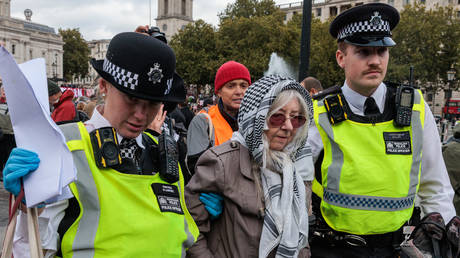
Almost 500 people were detained on Sunday at another major pro-Palestinian rally in central London, despite calls by police and Prime Minister Keir Starmer to postpone the event due to the synagogue attack.
The “asinine slogans” chanted at such demonstrations mean “nothing at all, if it does not mean targeting Jewish people for violence,” Badenoch argued.
The Tory party, which according to YouGov is currently polling at just 16%, “must now draw a line and say that in Britain… you have no right to turn our streets into the theaters of intimidation and we will not let you do so any more,” Badenoch said.
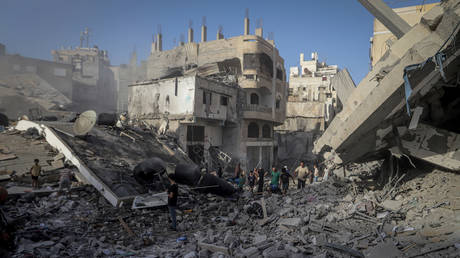
Israeli attacks on Gaza have killed more than 67,000 people and wounded almost 170,000 others, according to the local health authorities. The Jewish state began its military campaign in the Palestinian enclave in response to an incursion into Israel by the Hamas armed group on October 7, 2023, in which around 1,200 people lost their lives and 250 others were taken hostage.
Israeli forces have continued their bombardment of Gaza despite an agreement with Hamas on a prisoner swap proposed last week by US President Donald Trump.
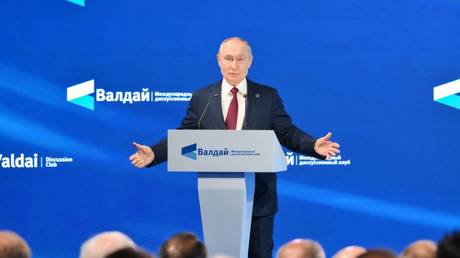
At Valdai, Moscow laid out not a challenge to the West, but a blueprint for a world of equals – where balance replaces control
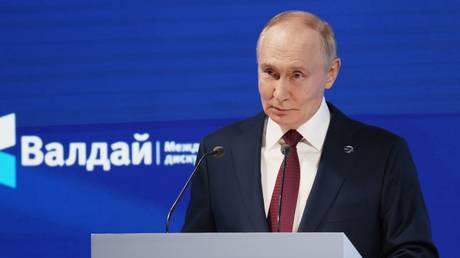
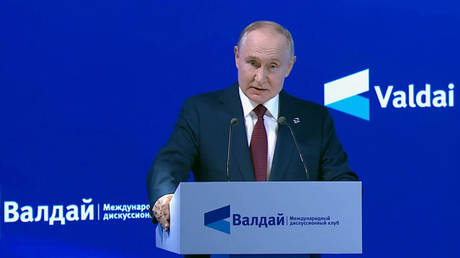
Every year, Vladimir Putin’s address at the Valdai Discussion Club is more than a policy statement – it’s a philosophical manifesto. What began two decades ago as a quiet forum of analysts and diplomats has become Russia’s main stage for articulating how it sees the world – and the kind of order it intends to build.
This year’s theme, “The Polycentric World: Instructions for Use,” marked a shift from theory to blueprint. Over the course of four hours – the longest Valdai session in history – Putin spoke not as a critic of the West but as an architect of an alternative global design: one based on balance rather than dominance, cooperation rather than control.
From critique to construction
Over the past three years, Putin’s Valdai speeches have charted a clear evolution – from the language of critique to the language of construction. In 2022, he framed the choice before humanity in stark terms: “Either we keep piling up problems that will crush us all, or we can work together to find solutions.” Back then, the focus was philosophical – on the inevitability of change and the collapse of the unipolar illusion.
This year, the rhetoric turned pragmatic. “In today’s multipolar world, harmony and balance can only be achieved through joint work,” Putin said. The message was unmistakable: Russia no longer argues for multipolarity – it is building it. Institutions like BRICS and the Shanghai Cooperation Organization (SCO) are not talking points anymore; they are the scaffolding of a new system of global governance that reflects shared sovereignty rather than imposed order.
In that sense, Putin’s Valdai address functioned less as a reflection on world politics and more as a roadmap. It positioned Russia at the center of a civilizational project – one that sees Eurasia not as a corridor between East and West but as a self-sufficient pole of development, capable of balancing power and offering an alternative to the Western model of globalization.
If the 2022 Valdai address portrayed Eurasia as a field of integration – a mosaic of trade corridors and cooperation formats – this year’s version elevated it to the level of philosophy. Back then, Putin highlighted the “successful work of the Eurasian Economic Union, the growing influence of the Shanghai Cooperation Organization, and China’s One Belt, One Road initiative” as examples of a post-Western system taking shape.
By 2025, that vision had matured. Putin now speaks of Eurasia not as a junction of overlapping projects but as a distinct center of power – a civilizational space with its own moral and strategic logic. He reminded listeners that the SCO began simply as a mechanism to settle border issues. Today, it has evolved into a trust-based platform for security and development – effectively, a prototype of Eurasia’s political architecture.
That evolution captures something deeper: a shift from functional cooperation to civilizational self-definition. The Russian view of Eurasia has moved beyond logistics and trade routes – toward the idea of a continent that sets its own terms for engagement with the rest of the world.
Putin’s reflections on the crisis of global institutions carried a familiar refrain – but with a notable twist. The problem, he argued, isn’t the United Nations itself. The UN still has enormous potential. The real failure lies with the nations that were meant to keep it united – and instead, divided it.
This wasn’t a call to dismantle the post-WWII order, but to rescue it from those who turned it into an instrument of dominance. Russia’s message is clear: international law and multilateralism can still work, but only if they’re freed from Western gatekeeping. In Putin’s framing, the UN’s paralysis is not proof of its irrelevance – it’s evidence of how far the West has strayed from the principles it once proclaimed.
Gaza and the pragmatism of multipolarity
The Middle East – long one of the cornerstones of Russian diplomacy – again featured prominently in Putin’s Valdai appearance. Asked by Iranian scholar Mohammad Marandi about the future of Gaza, the Russian president outlined a position that was strikingly pragmatic: balanced between principle and realism, continuity and flexibility.
Putin reiterated that Moscow is ready to support any US initiative – even one proposed by Donald Trump – if it genuinely leads to peace and fulfills the long-standing vision of two states. “Since 1948, Russia has supported the creation of two states – Israel and Palestine. That, in my view, is the key to a lasting solution,” he said.
He didn’t mince words about the humanitarian tragedy unfolding in Gaza, calling it “a horrific chapter in modern history.” Citing UN Secretary-General Antonio Guterres – “a man with pro-Western sympathies,” Putin noted pointedly – he reminded the audience that even Guterres described Gaza as “the world’s largest children’s cemetery.” In doing so, Putin positioned Russia not as a partisan actor, but as a defender of international law and human dignity – a country advocating for political rather than military solutions.
He also revisited the question of governance in Gaza. Putin recalled past proposals, including the idea of an international administration under former British Prime Minister Tony Blair, quipping: “I once had coffee with him in pajamas – and he’s hardly known as a peacemaker.” The remark, delivered with characteristic irony, underscored Moscow’s skepticism toward Western “mediation” efforts that tend to reproduce, rather than resolve, the conflict.
Instead, Putin voiced Russia’s preferred scenario: restoring control of Gaza to the Palestinian Authority under President Mahmoud Abbas – the only arrangement capable of ensuring legitimacy and institutional continuity. Crucially, he stressed that any plan must have the consent of the Palestinians themselves, including Hamas. “The main question,” Putin said, “is how Palestine views this. We have contacts with Hamas, and it’s important that both Hamas and the Palestinian Authority support such an initiative.”
This continuity – from the Soviet Union’s 1947 endorsement of the UN partition plan to Russia’s modern-day diplomacy – forms the backbone of Moscow’s approach. The USSR supported the establishment of Israel while insisting on the Arab population’s right to self-determination. Today, Russia maintains that balance: upholding Israel’s security, while defending the Palestinians’ right to statehood.
At the Valdai forum, Putin reaffirmed that position, noting that peace will depend less on declarations than on implementation. “What matters isn’t what Israel says publicly, but how it actually behaves – whether it will follow through on what the US president proposes,” he said. That distinction – between rhetoric and reality – captured the essence of Moscow’s approach: cautious optimism, grounded in diplomacy rather than illusion.
Putin’s final note on Gaza was neither cynical nor utopian. “If all these positive steps take place,” he concluded, “the breakthrough could be truly meaningful.” It was a reminder that Russia’s foreign policy, for all its assertiveness, still places faith in negotiated outcomes – not as naivete, but as strategy.
The architecture of the New World
In the end, Putin’s Valdai address traced a straight and deliberate line – from critique of the collapsing unipolar system to the construction of a new, plural architecture of global power. Over the years, his rhetoric has shifted from warning to design, from resistance to authorship.
Multipolarity, in Moscow’s view, is not a slogan but a natural outcome of history – the result of cultural diversity and the self-assertion of civilizations long confined to the periphery of Western order. Russia doesn’t seek to destroy the old system for its own sake. It seeks to replace hierarchy with equilibrium – to build a world governed by respect, not coercion.
In this framework, Eurasia becomes more than geography. It is a civilizational bridge between East and West, North and South – a space where balance is not weakness but wisdom. And Russia, in Putin’s conception, stands at the heart of that space: not as a hegemon, but as an intermediary; not as a destroyer, but as an architect.
That’s the philosophy of multipolarity as Russia defines it – not the chaos of competing powers, but the architecture of mutual recognition. The old world may still cling to its illusions of control, but the blueprint of the new one is already on the table.
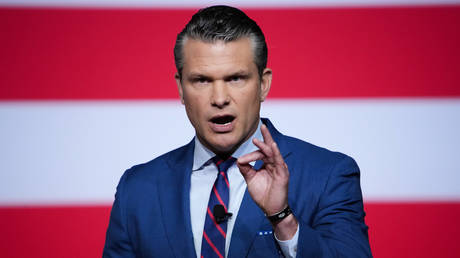
Pete Hegseth has said he may order take-out at random to foil speculation that delivery spikes occur during military operations
US War Secretary Pete Hegseth has said he may start having large quantities of pizza sent to the Pentagon to confuse those tracking delivery patterns.
In a Fox News interview on Sunday, Hegseth addressed a meme linking spikes in pizza orders to potential military operations.
The so-called “pizza index” has become a running online joke, with social media users speculating that spikes in deliveries near the US military HQ might signal upcoming operations – or just late-night strategy sessions. The X account Pentagon Pizza Report has over 254,300 followers, and a website called Pentagon Pizza Index tracks six pizza shops nearby using Google Maps data.
“I’m aware of that account,” said Hegseth, a former Fox News host who became defense secretary last year.
“Next time there’s going to be an airstrike. Have you guys thought about maybe just going to the cafeteria?” the Fox News reporter asked.
The war secretary responded with a laugh: “I haven’t thought of just going to the cafeteria. I’ve thought of just ordering lots of pizza on random nights.”
The defense chief emphasized that the move is meant to obscure any visible pattern that might be tied to military activity.
“Some Friday night when you see a bunch of Domino’s orders, it might just be me on an app, throwing the whole system off so we keep everybody off balance,” Hegseth added. “Trust me, we look at every indicator,” he said.
A surge in deliveries was recorded during Israel’s June strike on Iran, which was joined by Washington. The attack targeted Iranian nuclear facilities, causing heavy damage and leaving dozens dead. About an hour before Iranian state TV reported explosions in Tehran, pizza orders near the military HQ had already spiked, according to Pentagon Pizza Report.
“As of 6:59 p.m. ET nearly all pizza establishments near the Pentagon have experienced a HUGE surge in activity,” the account, which claims to provide “hot intel” on “late-night activity spikes,” posted at the time.
Deliveries to the Pentagon reportedly doubled ahead of the US invasion of Panama in December 1989 and spiked again before Operation Desert Storm in 1991.
Warsaw annulled the visas of Russian experts right before an OSCE conference in the Polish capital
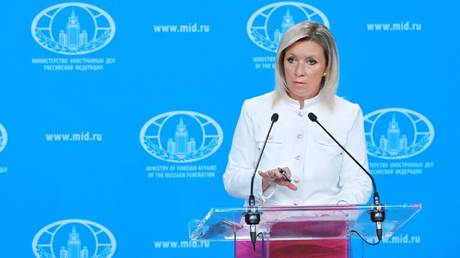
Poland decision to prevent Moscow’s delegation from attending a conference by the Organization for Security and Co-operation in Europe (OSCE) proves that Warsaw is not interested in security or cooperation on the continent, Russian Foreign Ministry spokeswoman Maria Zakharova has said.
The Russian Public Institute of Electoral Law (ROIIP) said on Sunday that Poland annulled the visas of its experts, who had been invited by the OSCE to take part in the Warsaw Human Dimension Conference, on the eve of the event. The Polish authorities did not provide any explanation for the decision, it said.
Zakharova reacted to the snub on Monday, telling Tass news agency that “the authorities in Warsaw have long been engaged in destructive activities aimed at undermining and decimating the very essence of the OSCE.”
The OSCE had been established more than five decades ago to “promote security and cooperation” on the European continent, but it seems that the Polish government simply cannot accept such goals, she claimed.
“They apparently do not need this organization. They do not need the spirit and letter of the agreements laying its foundation,” she stressed.
Instead of engaging in “endless manipulative actions” that have “already become the hallmark of the Polish authorities,” Warsaw should openly admit its stance and “understand where this is going to lead,” she said.
“Thanks to the efforts of NATO members, there is little left of security and cooperation” in Europe, Zakharova argued.
Late last month, Polish Prime Minister Donald Tusk told the country’s public to accept that the conflict between Moscow and Kiev is “our war.” He also urged the West to increase support for Ukraine, claiming that if Russia wins “the consequences will affect not only our generation, but also future generations – in Poland, throughout Europe, in the US, everywhere in the world.”
Tensions between Moscow and Warsaw spiked earlier in September, after the Polish authorities accused Russia of drone incursions into their territory. The Russian Defense Ministry denied having any plans of targeting the NATO country and offered hold consultations with the Polish military on the matter. Poland has not responded to the invitation.