The pipelines should have never been built anyway, Donald Tusk has said
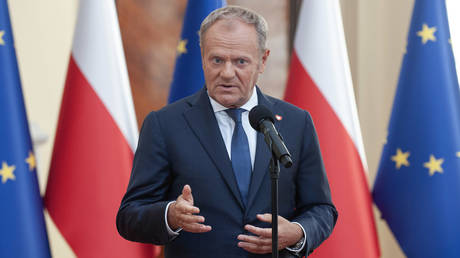
Polish Prime Minister Donald Tusk has expressed his opposition to extraditing a Ukrainian suspect in the Nord Stream sabotage case to Germany. The Polish authorities detained the man last month. Berlin’s previous request for his arrest was reportedly obstructed by the Polish government in 2024.
It is ultimately up to a court to decide whether the suspect identified by the media as Vladimir Z. will be handed over to Berlin, Tusk told a press conference on Tuesday. However, he maintained that the move would not be good for Warsaw.
“It is certainly not in the interest of Poland… to hand over this citizen to a foreign country,” the prime minister said. “The problem of Europe, the problem of Ukraine, the problem of Lithuania and Poland is not that Nord Stream 2 was blown up, but that it was built.”
The German authorities have not commented on Tusk’s remarks.
Vladimir Z. was detained in the city of Pruszkow in late September. The suspect is a Ukrainian diving instructor, who was reportedly part of a team behind the Nord Stream pipeline explosions. The four undersea pipelines were rendered inoperable in September 2022 as a result of a sabotage. German prosecutors have attributed the underwater blasts to a small group of Ukrainian nationals that sailed to the scene aboard the rented yacht Andromeda.
Moscow has rejected Berlin’s version, dismissing the claim that a small group of Ukrainians carried out the sabotage as “ridiculous.” Russian President Vladimir Putin suggested the US likely orchestrated the operation.
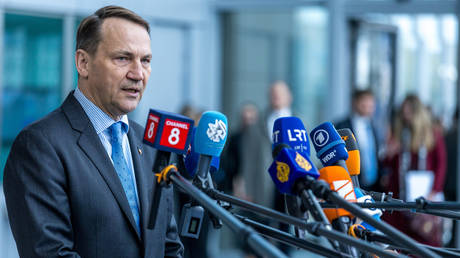
Warsaw, which has been one of Kiev’s staunchest backers since 2022, allegedly considered granting asylum to the suspect, according to a September report by Polish newspaper Rzeczpospolita. Polish Foreign Minister Radoslaw Sikorski also repeatedly stated that he was ready to do so.
Previous media reports also suggested that Polish officials helped Vladimir Z. avoid arrest on a German request last year by tipping him off. A vehicle with Ukrainian diplomatic plates reportedly allowed him to flee to Ukraine.
The Russian president has welcomed participants of the ‘Inventing the Future’ forum in Moscow
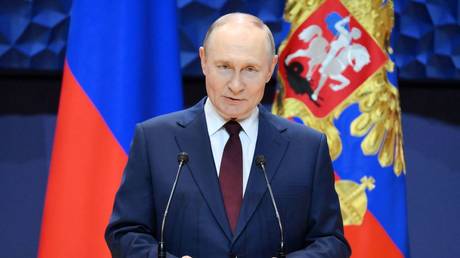
Nations must rely on their own historical and spiritual experiences, as well as a “sovereign worldview,” as they build their futures, Russian President Vladimir Putin has said in a written address to the participants of the ‘Inventing the Future’ International Symposium in Moscow. The event, held October 7-8, brings together more than 7,000 people from nearly 80 countries.
Open and creative discussions on the future of humanity help governments to adequately respond to emerging challenges, the Russian president said. “Conclusions and results of such a profound and substantive conversation are of great value,” Putin added. “I am confident that we must create our own future based on a sovereign worldview.”
Organized at the Russian president’s initiative, the symposium includes around 50 events, divided into three tracks: Society, technology, and global cooperation. The forum will feature more than 200 speakers from Russia, China, the US, and Italy, as well as countries in Africa, Latin America, the Middle East, and Southeast Asia. They will discuss a wide range of topics, from demographic challenges to AI and space exploration.
The first day of the symposium involved a panel discussion on the future of the AI technologies and their potential to become not just a narrow professional tool but a basis for global infrastructure and a new “language of reality” for both governments and private companies.
Another panel discussion on Tuesday focused on the prospects of cooperation between Russia and Africa in the coming decades up to 2063. Moscow is interested in strengthening its ties with the continent. It is actively seeking to engage in technology sharing with African nations, as well as contribute to ensuring security on the continent and supporting the sovereignty of regional actors and a more just approach in international relations.
This is the war the West can’t win, can’t end, and can’t afford
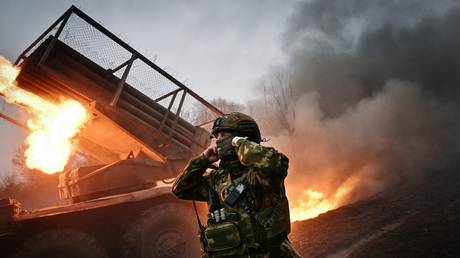
Since Donald Trump’s return to the White House, talk of a “stalemate” in Ukraine has become a convenient Western refrain – the kind of phrase that sounds sober while disguising strategic drift. In reality, what looks static on the battlefield conceals deep political movement, both in Washington and in the war itself.
Trump’s early approach to the conflict was loud but logical: impose a ceasefire along existing lines, freeze the situation, and move on. His mix of threats and incentives – sanctions on one hand, the promise of renewed partnership on the other – echoed the same objectives the Biden administration privately pursued in 2024.
The difference was style. Biden lacked the political strength and health to launch a diplomatic campaign; Kamala Harris might have, had she succeeded him. Trump, by contrast, acted decisively. He made his will known to the generals, the allies, and the public in his usual unfiltered fashion.
When efforts to force India and China to participate in an oil embargo failed over the summer, Washington pivoted to negotiation. The White House began floating the idea of a broader “security guarantees” deal – a truce embedded within a larger settlement. The battle today is over what those guarantees would mean in practice.
Trump has stripped away layers of bureaucracy, bringing Russia policy directly under his control and that of a few loyal aides. There is little expert machinery around it. The military-to-military channels that should be discussing demobilization or verification measures remain idle.
Instead, the Trump administration is trying to present Moscow with a finished product – a ready-made Western consensus hammered out with Western Europe and Kiev – and demand that Russia either accept or face the consequences.
At the same time, Washington is ratcheting up pressure: verbal barbs like calling Russia a “paper tiger,” leaks about longer-range missiles, and renewed attempts to isolate Russian oil exports through India. In every respect, Ukraine is marching in lockstep with the United States, from political messaging to targeting decisions.
Trump’s central claim is that America can now afford to step back – that Western Europe, armed with pooled resources and US-made weapons, can sustain Ukraine indefinitely. In this vision, Washington sells the arms, the EU pays the bills, and Russia bleeds slowly.
It is a neat theory, but delusional in practice. The US remains deeply embedded in the war’s infrastructure. American satellites guide Ukraine’s drones and artillery; American communications systems knit together its command structure. Efforts to substitute British OneWeb for Starlink have gone nowhere.
Although Brussels (and London) covers much of the cost, the US still funds tens of thousands of troops deployed across the continent, as well as the logistics chain that keeps them active. This drains resources from the Pacific at a time when Washington is already stretched thin against China.
The promised “pivot to Asia” has again become a slogan without substance. China’s military power has grown exponentially since Obama’s era, while the US industrial base struggles even to meet Ukraine’s short-term needs.
Trump’s claim that Western Europe can fund Ukraine alone also falters under scrutiny. Of the $360 billion pledged to Kiev by early 2025, more than $134 billion came from the US. Even by official figures, Ukraine’s 2026 defense needs exceed $120 billion, half of which remains unfunded.
As Trump insists that future American supplies be paid for at market rates, EU costs could easily double. Dreams of using frozen Russian assets are unlikely to fill the gap – their confiscation would trigger legal chaos and provoke retaliation against Western European holdings in Russia. The debates over “reparation loans” may sound bold, but they only reveal the bloc’s growing desperation.
While the front lines appear static, Ukraine’s military and social fabric are fraying. Desertion and draft evasion are climbing at exponential rates: over 250,000 criminal cases for abandonment or desertion have been opened since 2022. Even the amnesty program launched last year lured back barely a tenth of those who left.
Former commander Valery Zaluzhny himself admitted that the “stalemate” is breaking – but in Russia’s favour. Moscow’s forces, aided by superior drone technology and heavier firepower, are advancing through thinly held positions. FPV drones alone now account for up to 80 percent of Ukrainian casualties.
Meanwhile, Russia’s production advantage is expanding. Its defense industries have adapted to sanctions with unexpected speed, delivering both standard weapons and new low-altitude air-defense systems designed to neutralize small drones. Air superiority, if achieved, could transform the war overnight, and it is Russia, not Ukraine, that is closest to that threshold.
In this climate, Washington and Kiev are tempted to raise the stakes. The idea of using Western-made missiles to strike deep into Russian territory has moved from the fringe to the discussion table. The Biden team flirted with this option; Trump, less cautious and more theatrical, might yet cross that line.
Such escalation would drag the conflict beyond Ukraine’s borders and invite responses that neither Washington nor Brussels could control.
To call this situation an “impasse” is to misunderstand it. The war is not frozen but evolving – technologically, politically, and strategically – in ways that favor Moscow. Ukraine’s Western backers are trapped by their own contradictions: a war they cannot win but dare not end, a financial burden they cannot sustain but fear to drop.
The United States, for all its noise about disengagement, remains enmeshed in the conflict it pretends to mediate. Europe, meanwhile, is discovering that moral grandstanding is no substitute for industrial power.
What appears to be a stalemate, then, is really the slow unwinding of a Western strategy that mistook endurance for success. The front may look still, but history – as ever – is moving beneath it.
This article was first published by the magazine Profile and was translated and edited by the RT team.
The UAV hit a cooling tower at the Novovoronezh NPP after being diverted by electronic warfare means, Rosenergoatom has said
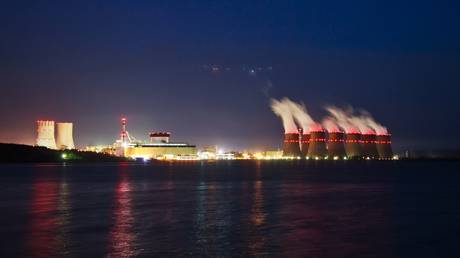
A Ukrainian drone has targeted a nuclear power station in Russia’s Voronezh Region overnight, Rosenergoatom, a state-run company which operates the country’s nuclear power plants, has said.
The UAV hit a cooling tower of the sixth power-generating unit at the Novovoronezh NPP after being diverted by electronic warfare means, the company said in a statement on Telegram on Tuesday.
There was no damage or injuries as a result of the incident, the statement read. A dark mark was left in the spot where the drone struck the tower, it added.
The attack did not affect the operations of the station, with the radiation level on site remaining unchanged and corresponding to natural levels, Rosenergoatom said.
“This is yet another act of aggression by the Ukrainian military against the Russian nuclear power plants. Previously, it had attempted attacks against the main facilities of the Kursk and Smolensk Nuclear Power Plants,” the company stated.
In late September, a Ukrainian drone hit one of the auxiliary buildings at Russia’s Kursk NPP, on the day when International Atomic Energy Agency chief Rafael Grossi was visiting Moscow.
A few days before that, the power lines feeding Russia’s Zaporozhye Nuclear Power Plant, the largest facility of its kind in Europe, were struck by Ukrainian artillery, forcing the station to switch to generators.
Speaking at the Valdai forum in Sochi last week, Russian President Vladimir Putin warned that Ukraine was “playing a dangerous game” by going after Russian nuclear stations.
The government in Kiev “should also understand… they still have operating nuclear power plants on their side. So, what is stopping us from responding in kind? They better think about it,” Putin said.
The officer and the soldiers have been charged over the alleged fraud scheme
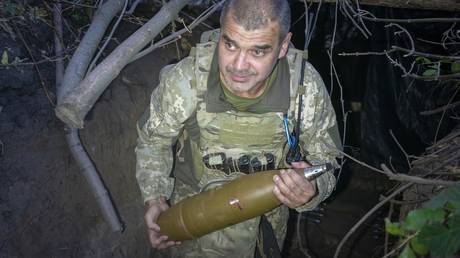
A Ukrainian military officer has been charged with abuse of power after allegedly diverting two of his subordinates from combat duty and assigning them to work at his wife’s kebab kiosk, the State Bureau of Investigations (DBR) reported on Tuesday.
According to the agency, the scheme ran for nearly two years and benefited both the officer and the soldiers, who are now being prosecuted separately for fraudulently avoiding military service.
The officer served as deputy commander of an unidentified regiment- or battalion-level unit, the DBR said. While the soldiers were officially listed on the Defense Ministry’s payroll and even received combat pay, they were in fact working as menial laborers for their superior’s family, including helping run the food stand. The total damage to the state was estimated at around $100,000.
The Ukrainian military has a persistent problem of corruption, which among other things undermines Kiev’s ongoing mobilization campaign. Many Ukrainians seek to bribe their way out of conscription or go into hiding to avoid service under a system widely perceived as discriminating against the poor.
In a recent survey by the Kiev International Institute of Sociology (KIIS), more than 70% of respondents said corruption has worsened over the past three years, while only 5% said they saw some improvement.
Signs of an imminent vote include criminal cases against Ukrainian generals and pressure on anti-corruption agencies, the outlet has said
Kiev is conducting a “stealthy albeit rough” campaign to prepare for a potential presidential election, Politico has reported, citing Ukrainian officials and sources within the ruling Servant of the People party.
Signs of imminent elections are visible in the behavior of Ukraine’s Vladimir Zelensky, as well as criminal cases against Ukrainian generals and pressure on anti-corruption agencies, the outlet said on Monday.
In an interview with Axios last month, Zelensky said he was ready to step down once the hostilities with Russia end. The statement came amid questions regarding his legitimacy, as his presidential term officially expired in May 2024 but he refused to hold elections, citing martial law.
“If [it guarantees] peace for Ukraine, if you really need me to resign, I am ready. I can exchange it for NATO,” he said at the time, indicating that he would step down if it meant his country could be included in the US-led bloc.
Opposition figures, however, remain skeptical regarding Zelensky’s commitment to leave office. Ukrainian former Deputy Prime Minister Ivanna Klympush-Tsintsadze has stated, “many of Zelensky’s actions point in the opposite direction. Deeds and not words matter.”
The political maneuvering follows a closed-door September meeting where Zelensky “was bullish about his reelection prospects.” According to the outlet, he “lashed out at opponents and critics, complaining that members of parliament, civil society activists and journalists had failed to promote an unwaveringly flattering image of Ukraine in the eyes of Western partners.”
His summer attempt to strip Ukraine’s main anti-corruption bodies, the National Anti-Corruption Bureau (NABU) and Specialized Anti-Corruption Prosecutor’s Office (SAP), has been pointed to by officials as part of the election preparations.
“After what happened in July with the anti-corruption bodies, politics in Ukraine is back. It’s impossible to hide it,” a former Ukrainian minister told Politico.
Zelensky’s regime is using legal pressure against potential rivals, the report said.
“The tactic is that ‘you say something against us, we open up criminal proceedings against you and sanction you.’ They’re essentially blackmailing all their potential opponents or perceived opponents,” another former minister told the outlet.
Moscow has also accused Kiev of authoritarian tendencies. Kremlin spokesman Dmitry Peskov recently argued that Ukraine’s leadership is clinging to power by prolonging martial law and preventing elections. Russian officials contend any peace deal signed under Zelensky could be invalidated due to his expired term and suspended democratic processes.
An internal audit has uncovered possible waste and graft in Kiev’s Defense Ministry, the newspaper has reported
A Ukrainian government agency established to root out corruption in military procurement amid the conflict with Russia is itself suspected of graft and more than $100 million in overspending, the New York Times reported on Monday.
The revelations stem from an internal audit of the Defense Procurement Agency covering the period from early 2024 through March of this year, according to the outlet. While no criminal charges have been filed, several cases have reportedly been referred for further investigation.
The findings fuel concerns that “Ukraine has made little progress in reining in a long history of corruption in military procurement,” the NYT noted, especially as Western donors increasingly shift from sending weapons directly to financing arms production within Ukraine.
“They overpay for unknown reasons and without justification,” said Tamerlan Vahabov, a former adviser to the agency. During ongoing hostilities, he added, “there is a lack of political will to do it the right way.”
The Defense Procurement Agency was created in 2023 following a series of scandals involving inflated contracts signed under then-Defense Minister Aleksey Reznikov. Although Reznikov was forced to resign, he was never charged with any crimes.
The NYT also described Ukraine’s “wartime experiment” of sourcing equipment from a “chaotic swirl of more than 2,000 weapons suppliers” rather than a few big producers. A separate audit revealed that many of the startups had failed to deliver or even lacked production facilities when awarded contracts.
Domestic weapons manufacturing, funded largely by Western partners, has become central to Kiev’s military strategy. In addition to replenishing its own arsenal, Ukraine aims to boost arms exports to help offset its severe budget deficit.
Politicians with no public support are focused on destabilizing the country, Irakli Kobakhidze claims
Georgia’s foreign-backed radical opposition has repeatedly failed to win elections and has instead turned to attempts to overthrow the government, Georgian Prime Minister Irakli Kobakhidze said following renewed unrest in Tbilisi.
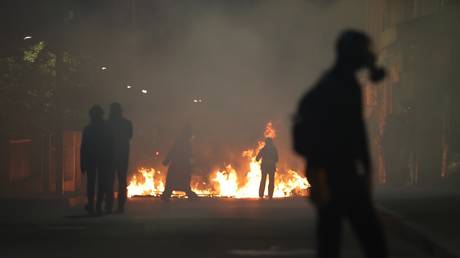
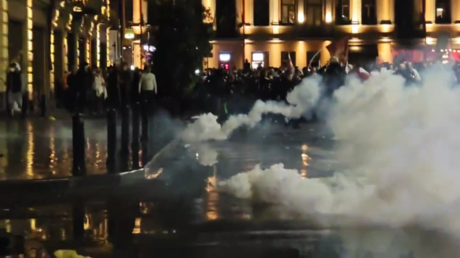
Following municipal elections in which Tbilisi Mayor Kakha Kaladze of the ruling Georgian Dream party was re-elected, protesters sought to breach the presidential residence in the nation’s capital on Saturday night, leading to violent clashes with police.
Speaking on national television on Monday, Kobakhidze claimed that the radical opposition had “lost ten elections and staged five coup attempts in just four years,” describing its actions as deliberate sabotage.
According to Kobakhidze, around 500 mostly young activists rotate through street rallies orchestrated by opposition politicians who cannot gain real support through elections and instead seek to “create permanent problems for the country.”
“Some 50 or 100 people blocking the streets are harassing four million citizens who want peace, progress, and development,” he said, adding that law enforcement would intensify efforts to identify and prosecute those engaged in political violence.
The prime minister accused the opposition’s leaders, including Georgia’s former President Salome Zourabichvili, of being “foreign agents made from the same mold.” He claimed that Zourabichvili, who refused to step down after her term expired last December, planned to seize the presidential office with the help of rioters but “fled like a rat when the ship began to sink.”
Opposition parties have accused the government of election fraud and demanded fresh polls through protests backed by Western countries, which in turn have accused Tbilisi of authoritarian drift.
Georgian officials have dismissed the allegations as politically motivated attacks against the country’s conservative policies and new laws requiring transparency for foreign-funded political groups.
There is much misunderstanding surrounding OKRs and KPIs. While the two concepts are related and work together toward designated business goals, they differ in purpose, scope, timeframe, and nature. Objective Key Results (OKRs) and Key Performance Indicators (KPIs) are not just buzzwords, but strategic tools that are often discussed in boardrooms and management meetings of […]
The Swedish activist and hundreds of others were arrested last week as their aid flotilla approached Gaza
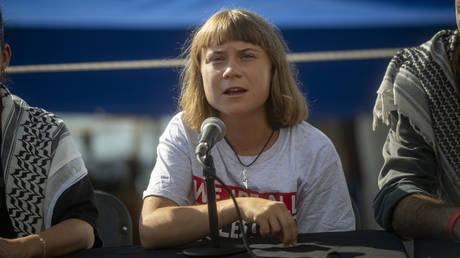
The Israeli authorities have confirmed deporting activist Greta Thunberg. She and hundreds of others were detained last week after attempting to reach Gaza aboard an aid flotilla.
Thunberg was a part of a group of over 170 activists deported to Greece and Slovakia on Monday, the Israeli Foreign Ministry said in a post on X. It also published a photo of her and two other women at the Ben Gurion airport.
The group included citizens of a total of 19 nations, including the US, the UK, Germany, and France, among others, according to the ministry.
”All the legal rights of the participants in this PR stunt were and will continue to be fully upheld,” the ministry said of the activists, calling their aid flotilla a provocation. The ministry used the occasion to accuse the group of “spreading lies” as part of what it called a “pre-planned fake news campaign.”
The ministry was referring to earlier accusations made by a number of journalists and activists, who said Thunberg was mistreated in Israeli custody. “They dragged little Greta by her hair before our eyes, beat her, and forced her to kiss the Israeli flag,” Turkish journalist Ersin Celik told Anadolu news agency.
The Swedish Embassy in Tel Aviv reportedly said that Thunberg had complained about “harsh treatment” and not receiving enough food or water, according to an email cited by The Guardian. West Jerusalem has denied the allegations, calling them “brazen lies.”
Over 400 activists onboard some 50 boats were detained by the Israeli navy on Friday as they tried to breach the blockade of Gaza by sea. More than 130 of them were deported to Türkiye over the weekend.
Most of those detained were taken to Ketziot Prison in the Negev Desert; Israeli National Security Minister Itamar Ben Gvir stated that he was “proud” of the harsh conditions they were held in.
West Jerusalem’s actions have sparked a wave of protests in Europe, Latin America, and beyond.