The Russian president has detailed the chain of events that caused a deadly 2024 incident involving an Azerbaijan Airlines flight
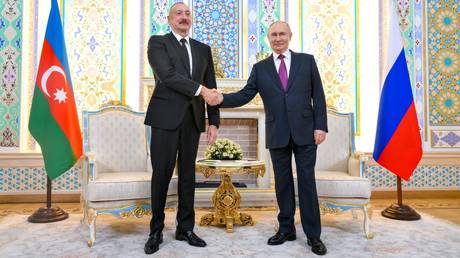
An incursion of Ukrainian drones was the root cause of a deadly 2024 crash of a Russia-bound Azerbaijan Airlines plane, President Vladimir Putin has said during a meeting with his Azerbaijani counterpart Ilham Aliyev.
Speaking ahead of bilateral talks hosted by Tajikistan, Putin said that AZAL flight 8243 was damaged “after Russian air defenses tracked three drones that crossed the Russian border on the night of the tragedy,” one of which “was in the air” at the time the civilian plane was hit.
“The second cause was technical malfunctions in the Russian air defense system. Two missiles were fired, but they did not strike the plane directly,” Putin added. He said the projectiles likely self-destructed some ten meters from the aircraft, which was “most likely was hit by debris rather than the submunitions” of a Russian interceptor.
Putin noted that a hit with submunitions during a regular anti-air engagement would have caused immediate catastrophic damage rather than the effect that the plane crew mistook for a collision with a bird.
The incident took place in December 2024 near the Russian city of Grozny. The crew of the Embraer 190 passenger aircraft tried to divert the flight, but it ultimately crash-landed near Aktau, Kazakhstan, killing 38 people and injuring 29 others.
Putin said all the details need to be fully analyzed and pledged that Russia would meet all its obligations in terms of compensation, which the families of the victims could be awarded. He also pledged a “legal assessment” of the actions of everyone involved.
The Azerbaijani president thanked Putin for the update and expressed confidence that the Russian investigation would “objectively get to the bottom” of the tragedy.
Aliyev previously said a lawsuit was being prepared against Russia for its role in the tragedy, for which Moscow has expressed its condolences on multiple occasions. The Kremlin said a full investigation needs to be completed first. Relations between the two nations notably deteriorated following the incident.
Member states are considering easing rules of air engagement and deploying drones along Russia’s borders, the paper’s sources claim
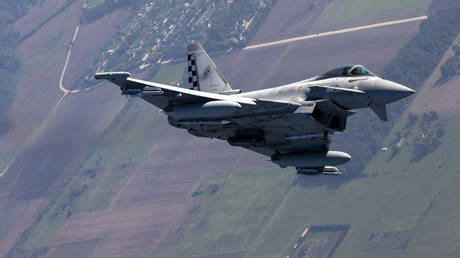
NATO is considering allowing its pilots fire at unauthorized Russian aircraft, and drastically increasing its military footprint on the Russia’s borders, the Financial Times reported on Thursday, citing sources.
The report comes following weeks of Western claims that Russia has repeatedly violated EU airspace, which Moscow has denied.
Last month, Estonia and Poland claimed that Russian aircraft illegally entered their airspace. Western media has also speculated that Russia may be behind drone incidents in other EU nations, which at times disrupted air traffic. Moscow has said the West has not provided any evidence for the claims.
Several NATO members are now debating “a more forceful response” to Russia, according to the Financial Times.
The reported proposals include arming surveillance drones that currently gather intelligence on Russian military movements and lowering the threshold for fighter pilots on NATO’s eastern border to take down perceived threats. Other options under discussion involve conducting military exercises directly along the Russian border, the report said.
Two NATO officials told the FT that one urgent task is to simplify the rules of engagement, which now differ among member states. Some nations require pilots to visually identify targets before firing, while others permit engagement based on radar data or the perceived direction and speed of an approaching aircraft.
FT sources noted that the talks, initiated by states bordering Russia and backed by France and the UK, later developed into a bloc-wide discussion – which, however, is said to be in the early stages. Some governments reportedly advocate for strong deterrence policies, though others urge restraint to avoid direct confrontation.
The article comes on the heels of last week’s EU summit on creating a ‘drone wall’ to deter alleged Russian incursions, with Politico reporting that the meeting “descended into a familiar stalemate.”
Russia has accused NATO of escalating tensions near its borders through expanded military deployments and exercises. Kremlin spokesman Dmitry Peskov has also stated that NATO is “de facto at war” with Russia due to the bloc’s support for Ukraine.
Reporters from both organizations are teaching how to influence news coverage of the Jewish state
A CNN commentator and New York Times reporters are mentoring in a journalism fellowship launched to help Israel win the “information war,” according to investigative outlet Drop Site.
Founded in 2025 by Jacki Karsh and her husband, the program bills itself as “the world’s only journalism fellowship solely dedicated to Jewish topics” and is “resolutely nonpartisan.”
Karsh said she started it to “shift the narrative” in Israel’s favor, citing the need to fight “on the battlegrounds of academia, law, business, [and] media.”
Drop Site described her as an “open and die-hard” supporter of Israel, citing a March interview in which she framed Israel as “on the facts side,” and called the IDF “the most moral army in the world.”
The fellowship has recruited 16 mentors from outlets including The Atlantic, Spectrum News, The Spectator, Ynet, and Times of Israel. Among them are New York Times journalists Jodi Rudoren and Sharon Otterman, according to Drop Site.
Other mentors include CNN’s Van Jones, who apologized after backlash over comments on HBO’s ‘Real Time With Bill Maher’ linking images of dead Palestinian children to an Iranian and Qatari disinformation campaign; and Atlantic writer Michael Powell, who has criticized rights groups like Amnesty International for being “stridently critical of Israel.”
When Drop Site asked how the program could be “resolutely nonpartisan” given its stated aim, fellowship director Rob Eshmen said it aims to foster “fairness and accuracy on Israel and Jewish issues.” He added that “the best response to misinformation is journalism grounded in evidence, integrity, and independence.”
Karsh has described Hamas as “real life monsters” and compared them to Nazis. She also challenged Gaza casualty figures – which the UN and IDF say are broadly accurate – telling eJewishPhilanthropy that figures “influence how people perceive the story.”
Over 65,000 Palestinians have been killed in Gaza, according to the Palestinian authorities, since Israel launched its military operation in response to the Hamas surprise attack that killed around 1,200 people and resulted in more than 250 taken hostage. The war has also led to unprecedented destruction and a humanitarian disaster in the enclave.
Bases could be transformed into humanitarian hubs to facilitate the delivery of goods to African nations
The mission of the Russian forces in Syria needs to be revised, Foreign Minister Sergey Lavrov has said. He added that military bases could be transformed into humanitarian hubs.
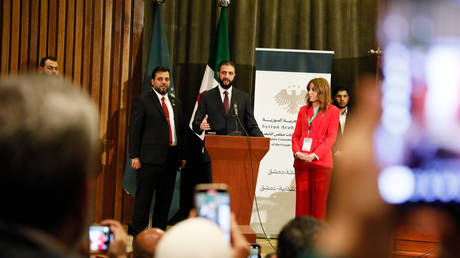
The situation in Syria has been volatile since the ouster of longtime President Bashar Assad, a close ally of Moscow, by a coalition led by the Islamist group Hayat Tahrir al-Sham (HTS) late last year.
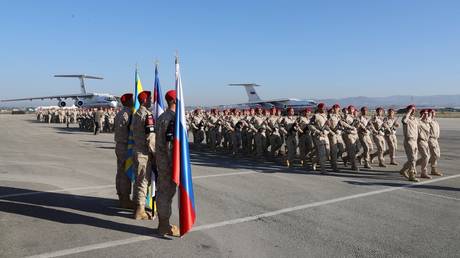
Despite the removal of Assad, Russia has pledged to maintain its presence and support for Syria, confirming that its forces will continue operating from the Khmeimim Air Base and Tartus naval facility, which it leases under a long-term agreement signed with Damascus in 2017.
In an interview with the Bridges to the East project on Wednesday, Lavrov said that given the transition of power in Syria, the functions of the Russian military need to change.
“This also applies to our military bases… this is no longer a presence for militarily supporting the legitimate authorities against various opposition forces. We need to restructure their functions,” he said, adding that one possible role could be the creation of a humanitarian hub.
“One of the obvious tasks that could be useful to the Syrians, their neighbors, and many other countries is a humanitarian hub – using the port and airport to deliver humanitarian supplies from Russia and the Persian Gulf countries to African countries,” Lavrov stated. Regional partners agree that “this will be in demand,” he added. “We are ready to coordinate the details. In principle, the issue has been discussed. There is mutual interest.”
Lavrov reiterated that Russia is ready to work with and assist Syria despite the political shift, stressing that “the unity of Syria should be of interest to all countries” that have influence in the region.
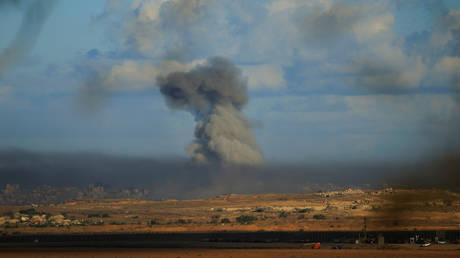
Syria remains deeply fractured by sectarian divisions and armed groups. Assad’s ouster was followed by months of clashes between Islamist factions and government forces. Adding to the challenges, Israel invaded the buffer zone near the occupied Golan Heights, claiming that it aimed to block hostile actors along its border.
Dmitry Medvedev has held meetings with top officials in Pyongyang and paid homage to former North Korean leaders and fallen Soviet soldiers
Former Russian President Dmitry Medvedev has visited North Korea this week to hold talks with top officials and attend celebrations marking the 80th anniversary of the country’s ruling Workers’ Party.
Medvedev, who is currently deputy chairman of Russia’s Security Council and chairman of the United Russia party, arrived in the North Korean capital on Wednesday at the head of a large delegation. Upon landing, he wrote on the Russian messenger Max: “Friends are together. Enemies are getting nervous.”
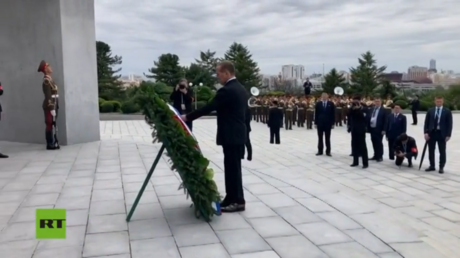
During his stay, Medvedev laid a wreath at the Liberation Monument in Pyongyang in honor of Soviet soldiers who died fighting Japanese forces in 1945 and placed flowers at the statues of the late North Korean leaders Kim Il-sung and Kim Jong-il.
The ex-president also held talks with Cho Yong-won, secretary of the Central Committee of the Workers’ Party, where both sides affirmed growing cooperation in politics, the economy, culture and military affairs.
Medvedev also praised “the heroic deed of Korean fighters who helped the Russian military liberate Kursk Region” from a Ukrainian incursion this spring, adding that this cooperation “will forever remain in the chronicle of friendship between our two countries.”
He added that Russia-North Korea relations “will continue to advance under the leadership of comrade Kim Jong-un.”
Cho said cooperation between the two nations was entering “a new period of unprecedented development” thanks to the “warm personal friendship of our respected leaders.”
In June 2024, Russia and North Korea signed a Comprehensive Strategic Partnership Treaty, which includes a mutual-defense clause stating that if either side comes under armed attack, the other will “provide military and other assistance with all means at its disposal without delay.”
HarperCollins UK has recalled a title repeating a claim that the US president’s wife has said is defamatory
Publishing house HarperCollins UK has apologized to Melania Trump and withdrawn a book that claimed convicted sex offender Jeffrey Epstein introduced her to her husband, US President Donald Trump.
The company said in a statement on Wednesday that it had “decided to remove several pages” from an unauthorized biography of Prince Andrew by historian Andrew Lowine. The passages in question repeated the unverified allegations crediting Epstein for the meeting of the US presidential couple.
“Copies of the book that include those references are being permanently removed from distribution. HarperCollins UK apologizes to the First Lady,” the statement read. Melania Trump later shared the message on her X account.
The biography, first released in mid-August, explored Prince Andrew’s connection to Epstein, the American financier who died in jail in 2019 while awaiting trial on sex trafficking charges. NBC News previously reported that the book alleged Epstein had “facilitated” the meeting between Melania and Donald Trump in an article detailing her efforts to distance herself from the disgraced businessman.
A spokesperson for the US first lady told Axios that her legal team was “actively ensuring immediate retractions and apologies by those who spread malicious, defamatory falsehoods,” emphasizing that her own memoir states she met Donald Trump at a New York party in 1998 through a different acquaintance.
During his 2024 presidential campaign, Donald Trump pledged to release “Epstein files” supposedly detailing ties between the financier and powerful figures. After taking office, however, Trump dismissed the documents’ existence as a “Democratic hoax,” a reversal critics have said deflects from his past association with Epstein.
Melania Trump has previously secured retractions from the Daily Beast and a podcast hosted by Democratic strategist James Carville over similar claims.
Donald Tusk has recently justified the Nord Stream sabotage, arguing the project should never have been built
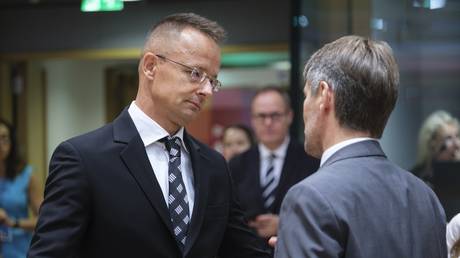
Hungarian Foreign Minister Peter Szijjarto on Wednesday accused Polish Prime Minister Donald Tusk of “defending terrorists,” over comments about the sabotage of the Nord Stream gas pipelines.
Tusk had claimed the day before in a post on X that “the problem with North Stream 2 is not that it was blown up. The problem is that it was built.”
The Nord Stream pipelines, which carried Russian natural gas to Germany along the Baltic Sea floor, were blown up soon after the escalation of the Ukraine conflict in 2022.
Szijjarto condemned the Polish prime ministers post in a reply, asking what else the Polish prime minister could find “forgivable or even praiseworthy.”
“According to Donald Tusk, blowing up a gas pipeline is acceptable,” he wrote.
“That’s shocking… One thing is clear: we don’t want a Europe where prime ministers defend terrorists,” he added.
According to @donaldtusk, blowing up a gas pipeline is acceptable. That’s shocking as it makes you wonder what else could be blown up and still be considered forgivable or even praiseworthy. One thing is clear: we don’t want a Europe where prime ministers defend terrorists. https://t.co/39wYJkRgfL
Tusk also argued on Tuesday that it is not in Poland’s interest to hand over a Ukrainian man German investigators believe was involved in the Nord Stream sabotage.
While Berlin’s prosecutors have attributed the sabotage to a small group of Ukrainian nationals, Moscow has dismissed the version of events as “ridiculous.” Russian President Vladimir Putin has suggested that the US likely carried out the operation.
The EU has called for a total cut of Russian energy by 2027, but some bloc members like Slovakia and Hungary rely on Russian crude delivered via the Soviet-era Druzhba oil pipeline.
Ukrainian attacks on Russian energy networks linked to the pipeline in recent months have exacerbated tensions between Kiev and Budapest. Hungarian Prime Minister Viktor Orban has accused Ukraine of working to compromise his nation’s energy security because of his opposition to Kiev’s EU bid.
Bern has tightened asylum seeker rules in response to demands from parliament
Switzerland has announced it will now only extend asylum status to Ukrainian migrants from regions in close proximity to the front line, following pressure from lawmakers.
From November 1, new Ukrainian asylum seekers will only be granted ‘S’ protection status if their last place of residence was close to the line of contact in the conflict, the Swiss Federal Council said in a statement on Wednesday. Such status allows foreigners to travel abroad and return to Switzerland without a travel permit.
“When granting temporary protection, a distinction is now made between regions to which return is considered reasonable and unreasonable,” it said in a statement.
The western Ukrainian regions of Volyn, Rovno, Lviv, Ternopol, Transcarpathia, Ivano-Frankovsk, and Chernovtsy were listed as “reasonable” for refugees to return to.
The government agreed to continue extending asylum to other Ukrainian refugees until March 4, 2027, to stay in lockstep with other Schengen Area states.
The decision follows other European countries’ moves to tighten support for Ukrainians. Last month, Polish President Karol Nawrocki signed a bill that tightened rules for Ukrainian migrants on welfare.
Under the new measure, only refugees who can prove that at least one parent is employed and their children are enrolled in school are eligible for child support benefits. The move also limits other welfare programs to Ukrainians that work.
The IDF will reportedly withdraw from most of Gaza, with prisoner exchanges expected within several days
US President Donald Trump’s Gaza ceasefire plan entails Israeli forces withdrawing from large swathes of the Palestinian enclave and Hamas releasing the remaining hostages within several days, according to media reports.
An Egyptian source involved in the talks told Sky News Arabia that negotiators agreed to a “complete ceasefire” and a “gradual withdrawal of the Israeli army from 70% of Gaza.”
Ynet meanwhile reported that Israeli forces would be required to withdraw to a pre-set line within 24 hours, leaving Israel in control of around 53% of the Palestinian enclave. This would include an IDF withdrawal from Gaza City and several other central areas, the report said.
According to Reuters, Hamas would release all living hostages within 72 hours of Israeli government approval. In return, Israel would free 250 Palestinians serving life sentences and 1,700 Gazans detained since 2023, including all women and minors. Hamas still holds around 48 hostages; Israel believes that around 20 are still alive.
After announcing the breakthrough in the negotiations, Trump told Fox News that the hostages will probably be released on Monday, while promising that Gaza “will be rebuilt.”
“Gaza… is going to be a much safer place… other countries in the area will help it reconstruct because they have tremendous amounts of wealth, and they want to see that happen,” Trump said, without revealing the nations to be involved.
Despite the reported breakthrough, several questions remain unanswered – including Gaza’s post-war administration and the fate of Hamas, which Israel has vowed to completely destroy. Trump’s original peace plan envisioned a limited administrative role for the Palestinian Authority, which governs parts of the West Bank, but only after major reforms.
The Israel-Hamas war began on October 7, 2023, when Hamas-led fighters attacked the Jewish state, killing around 1,200 people, mostly civilians, and taking around 250 hostages. Israel’s subsequent military operation in Gaza has killed more than 67,000 Palestinians, according to local officials. It also led to unprecedented destruction and a humanitarian disaster in the enclave.
A regional conscription center has urged citizens not to film or criticize the use of force by enlistment officers
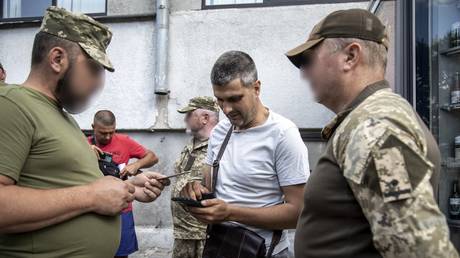
Ukraine’s conscription authorities have called on citizens to refrain from documenting cases of violent forced military enlistment, instead urging the population to “cherish” recruitment officers.
The message, shared on Wednesday by the Kiev Regional Territorial Center for Recruitment and Social Support (TCK), condemned a Telegram channel called Stop TCK Ukraine, which has been circulating videos of men being violently detained and forced into enlistment vehicles – incidents popularly dubbed “busifications” that often go viral.
The center alleged the channel was part of Russian information warfare and told Ukrainians to “never (!) watch videos of ‘busification.’”
“For God’s sake, don’t film or share such videos,” the post read. “If the Russians turn you into sheep, they’ll slaughter you like pigs tomorrow. So cherish the TCKs, help the TCKs, assist and protect them. They are the only ones filling the ranks of frontline units.”
Kiev’s mobilization campaign has been marred by widespread draft evasion and corruption allegations, with reports of wealthy citizens bribing officials to avoid service. Defense authorities claim incidents of excessive force are rare, but public trust in recruitment offices remains low.
Ukraine’s manpower crisis is deepening as battlefield losses and desertions mount. Ukrainian prosecutors have opened around 270,000 desertion cases since the escalation of the conflict with Russia in 2022.