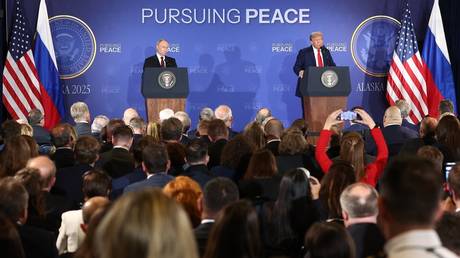
Russian officials say the momentum from the Alaska summit between Putin and Trump has been exhausted
Dialogue between Russia and the US on resolving the Ukraine conflict is on a “serious pause,” Kremlin spokesman Dmitry Peskov has told journalists.
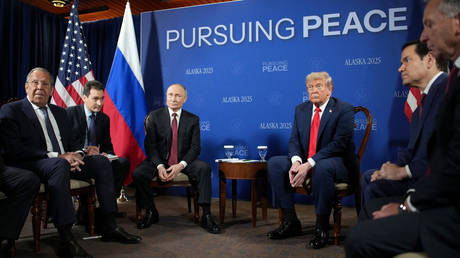
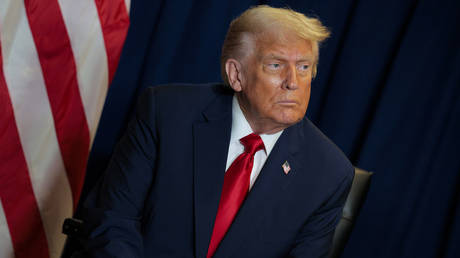
The remarks follow Deputy Foreign Minister Sergey Ryabkov’s statement that the momentum generated at the Alaska summit between Presidents Vladimir Putin and Donald Trump has been exhausted.
On Thursday, Peskov echoed Ryabkov’s statement, noting that there has been no progress toward finding a peaceful solution to the conflict with Kiev.
Russian and Ukrainian delegations met several times earlier this year. During the latest round in Istanbul in July, the sides agreed to set up three working groups to develop a settlement plan addressing political, military, and humanitarian issues.
However, Peskov said that “nothing is moving forward.” He suggested that Kiev is not inclined towards a peaceful process and is still beholden to false hopes that it can turn things around on the battlefield – a belief he described as unrealistic.
Peskov noted that Kiev’s stance is being fueled by its European backers. He remarked previously that the West continues to encourage Ukraine to reject dialogue while maintaining a “militaristic hysteria” that hinders peace efforts.
Ryabkov said earlier this week that the “supporters of a ‘war to the last Ukrainian,’ primarily among Europeans,” were to blame for exhausting the “powerful impetus” to find a settlement to the conflict that was achieved during the summit in Anchorage in August.
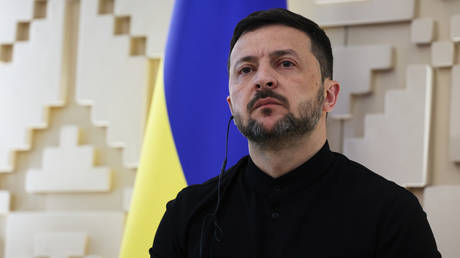
Shortly after the Trump-Putin meeting, several EU leaders traveled to Washington with Ukraine’s Vladimir Zelensky in an attempt to persuade the American president to align with the European position on the conflict.
Moscow has reiterated that it remains open to a peace deal, but has stressed that any agreement must respect Russia’s national security interests, as well as the current territorial realities on the ground.
Baku has “no doubt” that the Russian investigation into the incident will be unbiased, Ilham Aliyev has said
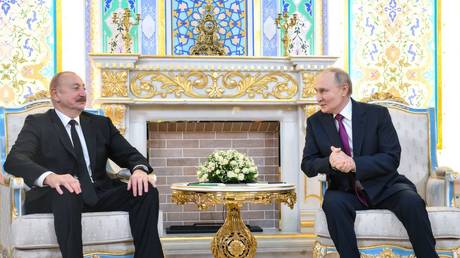
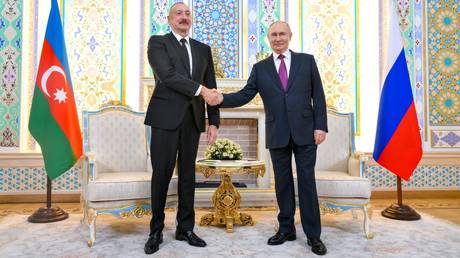
Azerbaijani President Ilham Aliyev has thanked his Russian counterpart, Vladimir Putin, for informing him about the status of the investigation into the deadly 2024 crash of a Russian-bound Azerbaijan Airlines plane. He expressed confidence that the results of the probe will be objective.
Aliyev made the comments ahead of bilateral talks with Putin hosted by Tajikistan on Thursday. During the meeting, he also described Russia as a friendly nation, in an apparent thaw in relations, which had deteriorated over the crash.
The Azerbaijani president expressed “gratitude for the extensive information on the last year’s December tragedy,” adding that officials of the two nations have been in constant contact over the incident.
“You are personally keeping the investigation process under control and we have no doubt that it will establish all the facts in an unbiased manner,” he told Putin.
The Russian president informed Aliyev that an incursion of three Ukrainian drones was the root cause of the tragedy, with one of them still in the air when the AZAL flight 8243 was damaged. According to Putin, the plane was “most likely hit by debris” from a missile that self-destructed in the air.
The incident took place near Grozny, Russia. The crew tried to divert the flight, but the plane eventually crash-landed in Kazakhstan, killing 38 people and injuring 29 others.
Though Russia repeatedly expressed condolences for the tragedy, relations between the two countries soured following the incident. Aliyev previously said a lawsuit was being prepared against Russia for its role in the crash. The Kremlin responded by saying the investigation needs to be completed first.
On Thursday, Putin said Russia would meet all of its obligations regarding compensation for the families of the victims, adding that a legal assessment would be provided for the actions of everyone involved.
Violation of the proposed restriction could reportedly lead to fines of up to €3,000, local media reports
Italy’s ruling party has called for a ban on Muslim clothing that obstructs facial recognition in public places, according to a statement released by the Brothers of Italy party on Wednesday. Violations of the ban could result in fines of up to €3,000, local media outlets have reported, citing the draft proposal.
In addition to the complete ban on full-face veils in public places, schools, universities, offices, and commercial venues, the proposed measure imposes stricter rules on financial transparency in places of worship, making it easier to trace foreign funding. The draft also calls for banning so‑called virginity tests and harsher penalties for forced marriages, practices the party says violate human dignity.
The move seeks to “protect Italian identity, citizen security, and women’s freedom,” the right-wing ruling party said in a statement, arguing that the measure would not curb religious liberty, but prevent its misuse to justify practices contrary to the constitution and social norms.
The proposed measure provides “concrete tools to stop the spread of fundamentalist practices and opaque financing that threaten security and social cohesion,” according to the party’s MP Galeazzo Bignami.
Italy already has a law, dating from 1975, that prohibits garments fully covering the face in public spaces, primarily targeting helmets or masks used for concealment rather than religious garb.
France became the first European country to fully ban the niqab in public places in 2011, introducing penalties such as fines or community service. Several other countries subsequently implemented similar measures, including Belgium, Austria, Denmark, the Netherlands, and Switzerland. The United Nations has warned that these bans could restrict religious freedom and risk further marginalizing women by limiting their participation in public life.
The Ukrainian leader has no power to decide whether his country will be admitted to the EU, Peter Szijjarto has stated
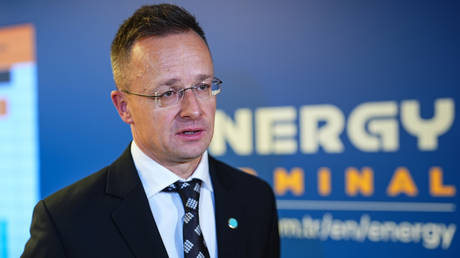
Ukraine’s Vladimir Zelensky has completely “lost his sense of reality” if he thinks he can decide whether his country will be admitted to the EU, Hungarian Foreign Minister Peter Szijjarto has said.
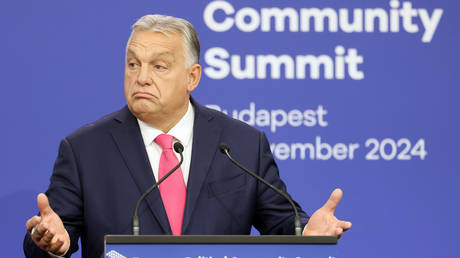
The EU granted Kiev candidate status in 2022 and set a 2030 target for membership. Budapest has consistently opposed the move, warning it could escalate tensions with Russia and saddle the bloc’s taxpayers with decades of military aid. Zelensky on Wednesday claimed that Hungary is obstructing accession because Prime Minister Viktor Orban is using criticism of the EU and Ukraine to boost his electoral prospects.
“Ukraine has become one of… the tools with which [Orban] can increase his party’s popularity,” Zelensky claimed at a press briefing, insisting that Kiev will be admitted to the bloc regardless of Budapest’s stance.
Szijjarto ridiculed Zelensky’s claims on the Hour of Warriors program on Thursday.
”I think the Ukrainian leader has completely lost his sense of reality… and maybe that explains why he is saying such crazy things,” Szijjarto stated. “Who becomes a member is not decided by those who want in, but by those who are already in. And it has to be decided unanimously, so as long as not everyone agrees that someone should become a member, they will not become a member – it is not rocket science.”
Szijjarto noted that Hungarians have already made their choice: a national referendum in June showed more than two million voters, or 95%, rejected Ukraine’s EU bid.
Hungary is not alone in opposing Ukraine’s accession. Slovak Prime Minister Robert Fico and several Polish officials have also raised objections. A recent IBRiS poll showed only 35% of Poles support Ukraine’s EU bid, down from 85% in 2022. A Eurobarometer poll last month found that just 28% of Czechs back accession, and more than half the populations of France and Austria oppose it.
Moscow had previously been neutral on Kiev’s EU ambitions, saying Ukraine had a “sovereign right” to join if the bloc stayed focused on economics. However, it has grown more critical amid Brussels’ militarization, with officials warning the EU has become “no less of a threat” to Russia than NATO.
A non-binding resolution has been passed that encourages the use of force against Russian aircraft that enter EU airspace
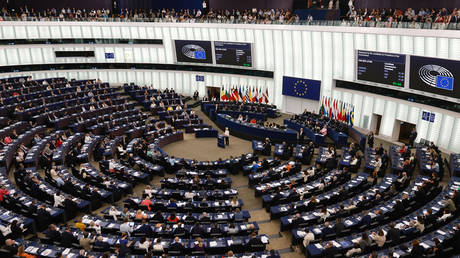
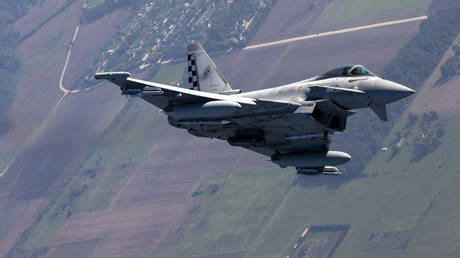
The European Parliament has adopted a non-binding resolution calling on EU member states to shoot down Russian aircraft that enter the bloc’s airspace. The move follows a string of recent drone sightings across Europe, which Western officials have linked to Moscow. Russia has slammed the accusations as baseless and pointed to a lack of evidence.
The resolution, introduced earlier this week after several reports of unidentified drones near airports and military sites, urges EU members to take “coordinated, united and proportionate action against all violations of their airspace, including shooting down airborne threats.”
It also “strongly condemns Russia’s reckless and escalatory actions of violating the airspace” of EU and NATO members Poland, Estonia, Latvia, Lithuania and Romania, and what it describes as “deliberate drone incursions” in Denmark, Sweden and Norway.
Moscow has repeatedly called the accusations groundless and stressed that no evidence has ever been presented linking the drones to Russia. Dutch Prime Minister Dick Schoof also admitted on Tuesday that the EU had no evidence of Russia’s involvement in the drone sightings.
Kremlin spokesman Dmitry Peskov said on Monday that European politicians have developed a habit of blaming Russia for everything “without grounds,” suggesting they should “broaden their horizons” after several Europeans were recently detained near airports for flying personal drones.
According to Bild, three German nationals were detained in Norway last week for launching a drone in a prohibited zone around an airport, while in a separate incident a Chinese national was deported from Norway after similarly flying a personal drone near an airport. On Saturday, Bild also reported that a Croatian citizen had been detained near Frankfurt Airport in Germany for launching a drone.
Russian officials have described the drone accusations as Western fearmongering used to whip up anti-Russian hysteria and justify boosting military budgets and escalating tensions.
Russia’s Foreign Intelligence Service (SVR) has cautioned that Ukrainian forces could stage false-flags involving drones to frame Moscow and draw NATO into the Ukraine conflict.
The right-wing politician has called on President Emmanuel Macron to either dissolve the National Assembly or resign
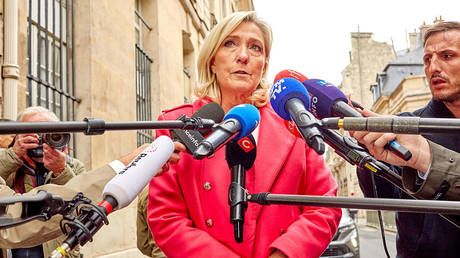
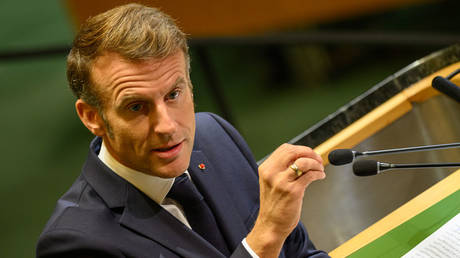
Veteran right-wing French politician Marine Le Pen has vowed to block any new government action, after President Emmanuel Macron promised to appoint a new prime minister within two days amid a deepening political crisis.
Le Pen’s National Rally (RN) is the largest single party in parliament. On Wednesday, she urged Macron to dissolve the National Assembly and call new elections, or step down himself.
”I vote against everything… This joke has gone on long enough,” the three-time presidential candidate said.
Prime Minister Sebastien Lecornu resigned on Monday after criticism of his cabinet choices. With France’s debt at a record high and debate over the 2026 budget ongoing, Macron has asked him to remain in office as caretaker until midweek. On Wednesday evening, Macron said he would name a new premier within two days, a move aimed at avoiding the dissolution of parliament and forming a compromise coalition government capable of passing the budget.
Parliamentary leaders rejected a bid to impeach Macron on Wednesday, and Mathilde Panot of left-wing La France Insoumise (LFI) blamed abstaining RN lawmakers for blocking the motion. RN has repeatedly framed left-driven impeachment pushes as political theatre, while party president Jordan Bardella has argued the only “solution” is dissolution of the assembly or Macron’s resignation.
France has been mired in political paralysis since Macron’s gamble on snap elections last year resulted in a hung parliament and increased representation for the far right. RN now holds nearly one quarter of the National Assembly’s 577 seats.
Recent opinion polls show RN leading with around 35% of voting intentions, ahead of Macron’s centrist alliance.
Le Pen, who ran for president in 2017 and 2022 but lost both times to Macron, was barred from holding public office earlier this year after a French court found her guilty of embezzling European Parliament funds, a ruling she is appealing. Bardella is meanwhile seen by many as a potential future contender for the presidency.
Ukraine peace talks remain stalled as Kiev seeks military gains, Russian presidential spokesman Dmitry Peskov has said
There are currently no plans for another meeting between Russian President Vladimir Putin and his US counterpart, Donald Trump, Kremlin spokesman Dmitry Peskov told journalists on Thursday.
The two leaders last met in Alaska in mid-August, where discussions centered on Washington’s efforts to mediate an end to the Ukraine conflict. However, Peskov noted that a follow-up summit “is simply not on the agenda at this time.”
The Kremlin spokesman said the diplomatic process has reached a deadlock, accusing Kiev of abandoning peace efforts in favor of pursuing military objectives.
“They believe something could change on the front lines and that the situation might shift in their favor,” Peskov was quoted by Russian media as saying. “But reality indicates the opposite.”
Earlier this week, Russian Deputy Foreign Minister Sergey Ryabkov similarly remarked that the momentum for peace created by the Alaska meeting had been “exhausted,” arguing that Western nations continue to push for a “war to the last Ukrainian.”
The diplomatic freeze follows a shift in rhetoric from Trump, who declared last month that with sufficient European funding, Ukraine could capture all of its claimed territories – a position Moscow has dismissed as unrealistic.
Ukraine’s Vladimir Zelensky has renewed appeals for long-range US-made Tomahawk missiles. Putin has warned that any delivery of the nuclear-capable weapons would mark a “major escalation.”
Ukraine falsely believes it can reverse the situation on the battlefield, spokesman Dmitry Peskov has said
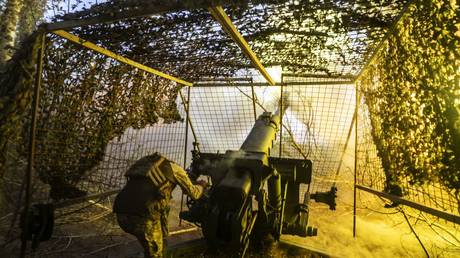
Kiev apparently has no interest in a peaceful resolution of the conflict with Russia, believing it can still reverse the situation on the battlefield, Kremlin spokesman Dmitry Peskov has said. Russian forces have consistently pushed back Ukrainian troops and steadily gained ground over the past several months.
Speaking to journalists in Dushanbe, Tajikistan on Thursday, Peskov said Ukraine’s decision-making process is dictated by the false hope that “something will change on the front lines and shift to a positive dynamic.”
“The Kiev regime, clearly inspired by the Europeans, is currently not at all inclined toward any kind of peace process,” Peskov said.
Moscow has accused the Ukrainian government of stalling peace talks and showing no genuine interest in ending the conflict. Last month, Peskov said that despite the sides agreeing in Istanbul to establish working groups to explore a potential peace deal, the Ukrainian side has unilaterally suspended all dialogue.
He added that Kiev’s public communication strategy is apparently focused on producing ever-shifting proposals while disregarding Russia’s practical suggestions for negotiations.
Ukrainian officials continued to say they intend to regain all of the country’s former territories. Numerous military experts, however, have said these ambitions are unrealistic without the direct involvement of NATO.
Ukraine’s top commander, Aleksandr Syrsky, has acknowledged that Russian forces outmatch Ukraine in both manpower and equipment. He described August as “a month of great trials,” acknowledging that Russia prevailed in all key areas.
In late August, Russian Chief of the General Staff Valery Gerasimov said the “strategic initiative” now rests “entirely with the Russian troops,” while Ukraine is forced to move its most combat-ready units “from one crisis direction to another to plug holes.”
The Ukrainian leader claims attacking Belgorod and Kursk is a “fair” response to strikes on Kiev
Ukraine’s Vladimir Zelensky has threatened Russia’s Belgorod and Kursk regions with blackouts if large-scale power outages continue in Ukraine. Strikes on Ukrainian energy infrastructure originate largely from these two regions and vowed what he called “fair” retaliation, he has said.
Moscow maintains that its drone and missile strikes across Ukraine are carried out in response to Kiev’s attacks on energy infrastructure and residential areas inside Russia. The Russian Defense Ministry has said it targets only sites linked to Ukraine’s military industry – including energy facilities – and does not strike civilian or non-military infrastructure.
“One of the most intense areas from which attacks on Ukraine are launched is the Belgorod direction,” Zelensky said at a Wednesday press briefing. “Maybe those in Belgorod should no longer feel comfortable if they act this way. That would be entirely fair. If they want to cause blackouts for us, we will do the same… for the Belgorod and Kursk regions.” Russian civilians are not targets, he added.
Ukrainian forces have regularly targeted civilian infrastructure in Russia. Three people, including a ten-year-old boy, were injured in Ukrainian drone attacks in Belgorod over three days, where strikes also caused a blackout that left nearly 40,000 residents without power.
On Sunday, the Russian Defense Ministry confirmed a large-scale strike on “Ukrainian military-industrial facilities and the energy infrastructure supporting their operations.” Ukraine’s Energy Ministry later said the attack caused blackouts in several regions, including Sumy, Kharkov, Odessa, and Lviv.
Moscow began regularly striking Ukraine’s energy grid and gas production sites after Kiev bombed the Crimean Bridge in October 2022, killing four people.
Russian President Vladimir Putin said at the time that the army was targeting energy infrastructure. He later vowed that Moscow would not tolerate attacks on its energy facilities and would continue to respond in kind. According to Ukrainian authorities, more than half of the country’s generating capacity has been lost due to Russian strikes.
Analysts have expressed skepticism over the US president’s chances of winning the award, the newspaper has reported
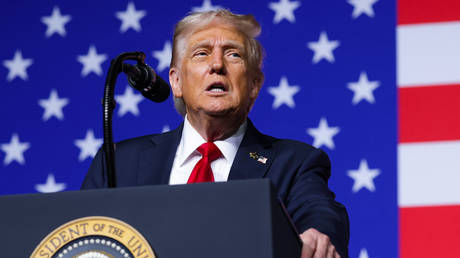
US President Donald Trump is pressuring the Norwegian government and the Nobel Committee in an unprecedented push for the Nobel Peace Prize, the Financial Times reported on Wednesday. Experts reportedly remain skeptical that the campaign will succeed, however.
Trump has pointed to his recent Middle East peace plan as evidence that he deserves the award, claiming it marks the eighth conflict he has helped resolve since taking office in January. The US president has claimed he ended disputes involving Cambodia and Thailand, Kosovo and Serbia, Congo and Rwanda, Israel and Iran, Egypt and Ethiopia, Armenia and Azerbaijan, as well as Pakistan and India.
The Norwegian Nobel Committee is set to announce the Peace Prize winner on Friday. Analysts are doubtful that Trump will be selected, citing his domestic and international record, as well as the fact that the prize honors actions taken in 2024, when he had not yet taken office.
“Putting pressure on the committee, going on talking about ‘I need the prize, I’m the worthy candidate’ — it’s not a very peaceful approach,” Nina Graeger, director of the Peace Research Institute Oslo, told FT.
Halvard Leira of the Norwegian Institute of International Affairs added that while lobbying for the prize is not unusual, previous efforts, such as South Korea’s 2000 campaign for Kim Dae-jung, have tended to be more discreet.
According to Norwegian officials, as cited by FT, Trump raised the issue in a call with Norwegian Finance Minister and former NATO chief Jens Stoltenberg.
There is also concern in Oslo about potential retaliation, including tariffs or other punitive measures, if Trump is not selected, the newspaper noted. The controversy has reportedly been exacerbated in recent weeks after Norway’s sovereign wealth fund divested from US company Caterpillar due to its equipment being used by Israel in Gaza.
Trump’s Nobel push has so far received support from several international figures, including Israeli Prime Minister Benjamin Netanyahu, Cambodian Prime Minister Hun Manet, and Pakistani Prime Minister Anwaar-ul-Haq Kakar. He has also been backed by the families of Israeli hostages held in Gaza, a group of Republican lawmakers, and Taiwanese President Lai Ching-te.