The killing of the Venezuelan leader could be part of US President Donald Trump’s war on drug cartels, sources have said
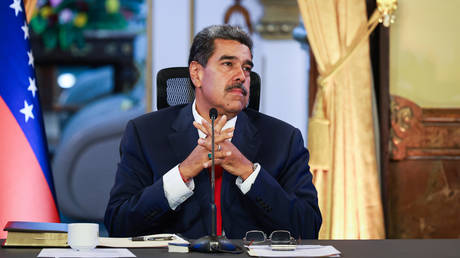
The US could attempt to assassinate Venezuelan President Nicolas Maduro after declaring him a drug lord and a terrorist, Politico has reported, citing informed sources.
Over the past several weeks, Washington has conducted strikes off the Venezuelan coast against what it called “drug boats,” killing more than two-dozen people and expanding its military presence in the region. US officials have accused Maduro of having links to narcotics networks – a claim he has rejected. Caracas has accused Washington of trying to topple Maduro’s government, which US officials have denied.
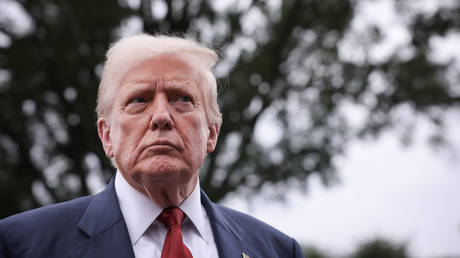
Despite not speaking publicly about regime change in the oil-rich Latin American nation, US President Donald Trump does want to force the Venezuelan leader out of power and plans to use his war on drug cartels as a pretext to do so, Politico claimed in an article on Sunday.
“Would everyone like Maduro to go? Yes,” an unnamed official from the Trump administration told the outlet.
Trump has “many plans” available to him when it comes to acting against Venezuela, including carrying out strikes on alleged cartel-related targets inside the country, the official said. However, the US president has not yet given an order to target Maduro directly, he stressed.
According to another person familiar with the discussions, that could well change if the Venezuelan leader is branded a drug lord and a terrorist by Washington. “Don’t we go after indicted narco traffickers and terrorists all the time?” the source said.
The Trump administration official suggested that the US may not have to resort to such drastic measures to remove Maduro, saying that “we are going to put a tremendous amount of pressure on him. He is weak. It is quite possible that he will fall from this pressure alone without us having to do anything.”
The New York Times reported on Friday that Venezuela had offered the US sweeping economic concessions, including a potential agreement to allow American companies to take a major stake in its oil sector, during months of secret talks aimed at defusing tensions. However, according to another report by the paper, Trump ordered that dialogue with Caracas be broken off after he had “grown frustrated” over Maduro’s unwillingness to relinquish power voluntarily.
The US president is considering invoking the statute in response to judges blocking National Guard deployments
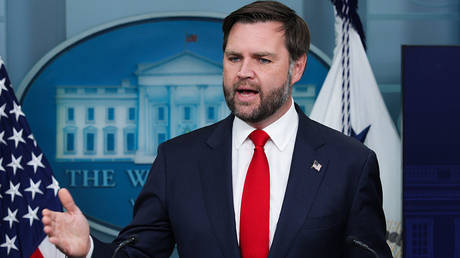
US President Donald Trump is exploring all options, including invoking the Insurrection Act, following legal challenges to the deployment of troops in Democrat-run states, Vice President J.D. Vance has said.
Vance’s remarks came as the White House moved to federalize the National Guard for deployment in Oregon and Illinois to support immigration enforcement amid Trump’s crackdown. The administration said the decision was prompted by rising crime in Portland and Chicago, but federal courts have since blocked the out-of-state deployments.
Trump had previously floated the possibility of invoking the Insurrection Act, saying he would consider it “if people were being killed and courts were holding us up.” The law, adopted in 1807, allows a president to deploy military forces on US soil to restore order without congressional approval. “If I had to enact it, I’d do that,” he said.
During an interview on NBC News’ Meet the Press on Sunday, Vance was asked whether the president was serious about invoking the statute. “The president is looking at all his options,” he said. “Right now, he hasn’t felt he needed to.”
He accused the media of fueling violence against the police, calling the attacks on officers unacceptable. “The problem here is not the Insurrection Act or whether we actually invoke it or not. The problem is the fact that the entire media in this country, cheered on by a few far-left lunatics, have made it OK to tee off on American law enforcement,” Vance told the host.
Democrats argue the deployments are unnecessary, citing police data showing declining crime in both states. Vance countered by claiming local officials are not “keeping the statistics properly.”
Protests erupted last week outside Portland’s Immigration and Customs Enforcement (ICE) facility, where demonstrators clashed with federal officers during late-night rallies. Smaller solidarity marches were also held in Seattle, San Francisco, and Denver.
The Insurrection Act and its predecessors have been used 30 times in US history since George Washington suppressed the Whiskey Rebellion in 1794. The most recent instance was under George H.W. Bush, during the 1992 Los Angeles riots.
Democrats argue that enacting the law constitutes “abuse of the law and power.”
Kirill Dmitriev says Moscow’s engagement with Trump’s team is ongoing, dismissing claims that negotiator Steve Witkoff’s influence has waned
Moscow and Washington continue to engage based on the agreements reached at the Alaska summit, despite earlier reports that US special envoy Steve Witkoff had lost influence within the administration of President Donald Trump, Russian presidential aide Kirill Dmitriev has said.
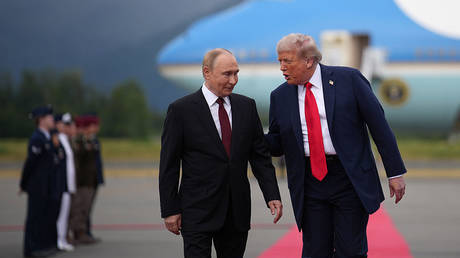
The Alaska meeting in August marked the first face-to-face encounter between Trump and Russian President Vladimir Putin since 2019. The discussions centered on ending the Ukraine conflict and restoring relations between Washington and Moscow. Both leaders described the talks as productive, although no breakthrough was achieved.
Following the summit, Witkoff – a New York-based businessman and Trump’s special envoy for peace missions, as well as his main negotiator on Ukraine and the Middle East – faced criticism in Western media over his lack of diplomatic experience and failure to broker a deal.
Writing on his Telegram channel, Dmitriev, who took part in the Alaska discussions, rejected reports that Witkoff’s standing in Washington had weakened.
“As the chief architect and negotiator behind Trump’s Gaza plan, which Russia also supported, Witkoff retains and has significantly strengthened his key role,” Dmitriev said following the envoy’s involvement in brokering a ceasefire between Israel and Hamas that included a large-scale hostage exchange.
He described the Witkoff’s approach as pragmatic and said the dialogue between Moscow and Trump’s team “continues on the basis of agreements reached at the Alaska summit.”
Last week, Russian presidential aide Yury Ushakov said the agreements reached during the mid-August summit do not sit well with Ukraine and its European backers – “those who do not want the Ukraine crisis to be resolved peacefully.” However, he emphasized that “this does not mean they are not working.”
Russian Deputy Foreign Minister Sergey Ryabkov said on Wednesday that the “powerful impetus” for peace created by the Alaska summit had been extinguished, primarily by European “supporters of war.”
Putin has previously defended Witkoff, saying he “accurately conveys both Moscow’s and Washington’s positions” and represents “the position of the American president himself.” He added that criticism of the envoy can only come from those “not in favor” of Trump or his approach to Ukraine.
The Red Cross has picked up two sets of remains and will pick up two more later today
West Jerusalem has accused Hamas of a “blatant breach” of the Gaza ceasefire agreement, as only four of the 28 bodies of the deceased Israelis are set to be returned today.
Defense Minister Israel Katz issued a stark warning to the Palestinian militant group, saying that “any delay or deliberate avoidance will be considered a gross violation of the agreement and will be responded to accordingly.”
The IDF has said the Red Cross has notified the military that it has collected two caskets holding the apparent bodies of slain hostages from Hamas in southern Gaza a short while ago.
The Red Cross is now bringing the caskets to IDF troops inside the enclave, where a small ceremony, led by a military rabbi, will be held. The remains will then be taken for identification.
All of the remaining living hostages in Gaza have been freed from Hamas captivity and are back in Israel after two years of war, but the remains of 28 deceased captives are expected to be returned in separate batches.
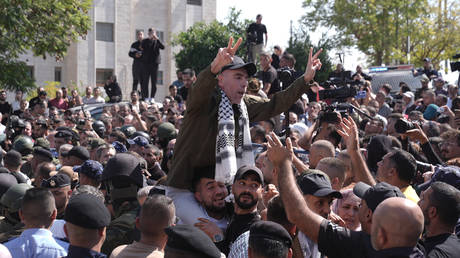
Meanwhile, some of the vans carrying Palestinian prisoners who have been released from Israeli prisons arrived a short while ago in Ramallah in the occupied West Bank. Under an agreement brokered by Trump, Israel is releasing about 250 Palestinian prisoners serving life sentences and more than 1,700 who were detained since the beginning of the Gaza war in 2023, including all women and minors.
Israel will also allow humanitarian aid into the enclave to ease severe food shortages.
The 20-point ceasefire plan unveiled by Trump in late September also calls for a phased full Israeli pullout from Gaza, disarming of Hamas, and the creation of a transitional international administration. It envisions Gaza as a “deradicalized terror-free zone” with Hamas barred from governance.
The war between Israel and Hamas began October 7, 2023, when Hamas militants attacked Israel, killing about 1,200 people and seizing around 250 hostages. Israel’s operation in response has killed more than 67,000 Palestinians, according to the Gaza Health Ministry, and triggered a humanitarian crisis in the enclave, prompting the UN to accuse West Jerusalem of genocide.
Global leaders welcomed Trump’s plan and called for rapid implementation, urging both sides to comply with the humanitarian provisions.
The US president has admitted that sending the weapons to Kiev would be a “step of aggression” towards Russia
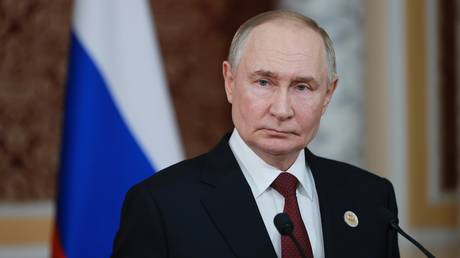
US President Donald Trump has said he could talk to his Russian counterpart, Vladimir Putin, about Washington’s threat to send long-range Tomahawk missiles to Ukraine.
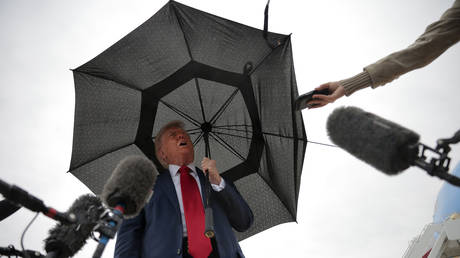
Speaking to reporters on Sunday, Trump stressed that Ukraine “would like to have Tomahawks,” but that he could discuss the issue with Putin. “I might say, look, if this war is not going to get settled, I’m going to send them Tomahawks,” he said. The US leader admitted that supplying the missiles to Kiev would be “a new step of aggression.”
Trump recently claimed he had made a decision on whether Ukraine would receive Tomahawks, but that he needed to “ask the question where are they sending them.”
Tomahawks cost an estimated $1.3 million each and have a range of 2,500km (1,550 miles), meaning that they could potentially reach Moscow and far beyond.
Commenting on the prospects of the US-made missiles being supplied to Ukraine, Putin said Moscow’s response “would be the strengthening of the Russian Federation’s air defenses.” He has also argued that Ukrainian forces would be unable to operate such a sophisticated system without the “direct participation of American military personnel.”
Reuters, citing anonymous sources, has reported that the US is unlikely to supply Tomahawks to Ukraine as its current inventories are committed to the US Navy and other uses.
The Financial Times also reported that some of Trump’s inner circle are skeptical as to the Tomahawks’ ability to change battlefield dynamics in the conflict.
Putin has repeatedly stated that Moscow is ready to reach a negotiated peace in the conflict with Kiev, but that its “root causes” must first be addressed, including the rights of the Russian-speaking population in Ukraine, Ukrainian denazification, and an end to Kiev’s ambitions of joining NATO. Russia also insists that Ukraine must recognize the new territorial realities on the ground.
Russian officials have said neither Kiev nor its European backers appear to be genuinely interested in peace and are actively trying to prolong the conflict.
The US president spoke to journalists before heading to Israel for hostage releases
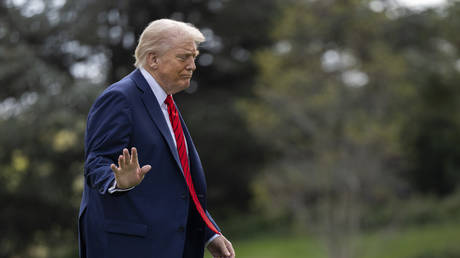
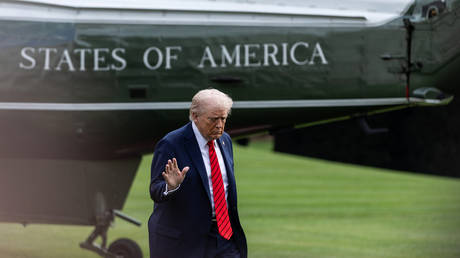
US President Donald Trump declared that the war in Gaza “is over” while speaking to reporters shortly after boarding Air Force One on Sunday for a flight to Israel.
Trump is expected to address the country’s parliament as well as meet Israeli Prime Minister Benjamin Netanyahu and the families of the hostages taken on October 7, 2023.
Later, leaders from more than 20 countries will join the US president in Egypt for a summit on Gaza’s future. However, representatives of Israel and the Palestinian militant group Hamas will not be in attenance.
”The war is over. Okay? You understand that?” Trump said when asked if he was confident that the conflict between Israel and Hamas was finished.
Trump will be accompanied on his visit to the region by US Secretary of State Marco Rubio and US Secretary of Defense Pete Hegseth, along with a host of other high-ranking administration officials.
“Everybody’s very excited about this moment in time. This is a very special event…Everybody’s cheering at one time. That’s never happened before,” he told reporters.
According to the deal unveiled by Trump in late September, all 48 remaining Israeli hostages, both dead and alive, will be recovered from the enclave.
The Israeli army is expecting to receive the surviving hostages at around 8am Monday from three sites in Gaza.
The bodies of the deceased are expected later. Israel has in turn agreed to free 250 Palestinians currently serving life sentences and 1,700 Gazans who have been detained since 2023.
In 2022, Christopher Harborne transferred £1 million to the former UK PM, an ardent backer of Kiev, the newspaper claims
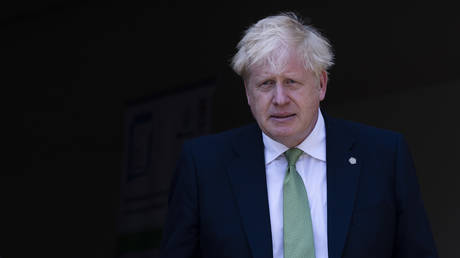
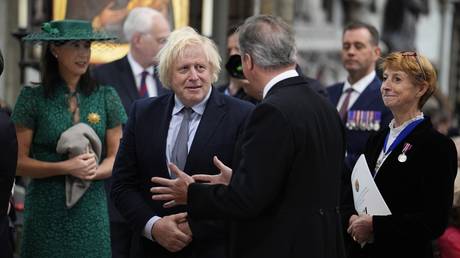
A shady donor accompanied former UK Prime Minister Boris Johnson, a staunch supporter of Kiev, on at least one of his visits to Ukraine in 2023, The Guardian has claimed, citing leaked documents.
Christopher Harborne, who donated £1 million ($1.34 million) to the Conservative politician after he left office in the fall of 2022, is the top shareholder in a British weapons manufacturer with alleged ties to the Ukrainian military, the newspaper alleged in an article on Friday.
A representative for Harborne, who has a history of generous donations to political causes in the UK, confirmed the transfer, noting that Johnson’s benefactor “had and has no expectation of personal gain whatsoever.”
“Now leaked files show that Johnson… was accompanied in September 2023 by [Harborne] on a two-day visit [to Ukraine] that included meetings with top officials,” the Guardian claimed.
At the Yalta European Strategy (YES) forum in Kiev, Harborne was supposedly registered as “adviser, Office of Boris Johnson.” The following day, the former prime minister travelled to the city of Lviv, with footage capturing Harborne standing nearby at one of the receptions, according to the article.
An itinerary leaked by the US-based transparency group Distributed Denial of Secrets (DDoS) featured a “closed meeting at the military-tech R&D center” during Johnson’s visit there. The Guardian pointed out that, while it was unclear whether Harborne attended, the donor is known to hold a significant stake in QinetiQ, a British military research company. Kiev’s forces have reportedly used its drones and bomb-disposal robots.
Responding to a request for comment, Johnson lashed out at the newspaper, insisting that its “pathetic non-stories … seem mostly to be derived from some illegal Russian hack job.” The former prime minister accused the media outlet of “doing Putin’s work.”
According to former Ukrainian head negotiator David Arakhamia, Johnson torpedoed the first peace talks between Ukraine and Russia in Istanbul in March 2022, urging Kiev to abandon the negotiations and fight on – an allegation the ex-UK prime minister has strongly denied.
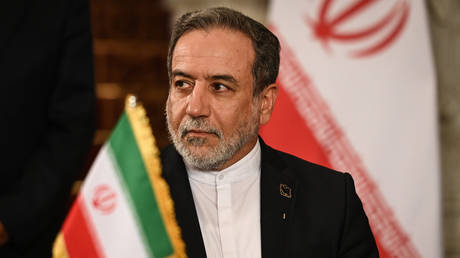
The move is “temporary” as Tehran is ready to return to its agreements with the IAEA, Foreign Minister Abbas Araghchi has stressed
Iran has suspended the implementation of the Cairo agreement with the International Atomic Energy Agency (IAEA), Foreign Minister Abbas Araghchi has said in an interview with state television. Cooperation has not been completely cut off however, but rather “temporarily put on hold.”
The agreement signed in September would have allowed the organization to resume inspections of Iranian nuclear facilities after Tehran suspended them following Israeli and US bombing in June. The deal lost significance shortly after that, when Britain, France, and Germany – all signatories to the 2015 nuclear accord – triggered the return of UN sanctions on Tehran.
Talking to Press TV on Saturday, Araghchi stressed that Iran is ready to return to the Cairo agreement if “fair proposals are presented in a way that safeguards the rights of the Iranian nation.”
Araghchi also said that, under current conditions, Tehran sees no reason to continue nuclear talks with Britain, France, and Germany. “We see no basis for negotiations with the Europeans,” the minister added.
Western states have long accused Iran of seeking nuclear weapons – allegations Tehran strongly denies. Iran insists its program is purely civilian and that it retains the right to enrich uranium under the Nuclear Non-Proliferation Treaty of 1968.
The Trump administration tried to revive nuclear talks with Iran earlier this year, but the attempt failed after Israeli strikes in June targeted Iranian nuclear, military, and residential sites.
Tehran has since accused Washington of sabotaging diplomacy and demanded guarantees and recognition of its rights before any resumption of negotiations.