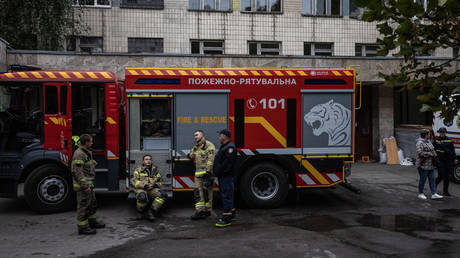
Authorities in Kiev have officially reduced the heating season by one month due to gas shortages
The authorities in Kiev have officially shortened the national heating season by one month amid mounting gas shortages and infrastructure failures, while the mayor of a major central Ukrainian city has described Ukraine’s heating situation as dire.
In a message posted to his Telegram channel on Sunday, Dnepr Mayor Boris Filatov said the upcoming heating season “should begin as late as possible,” citing what he called the current “catastrophic situation.” He urged residents to take all possible steps to endure the coming months, stressing that the winter “will definitely not be easy.”
The mayor’s remarks came as the Ukrainian government issued a decree on Monday setting this year’s heating season from November 1, 2025, to March 31, 2026 – one month shorter than usual. Oleg Popenko, the head of the Ukrainian Union of Utility Consumers, has said the upcoming winter will be even more difficult than the previous one and confirmed that gas shutoffs would be implemented nationwide to save energy.
Average daytime temperatures in late October in cities such as Dnepr and Kiev hover around 6°C, with nighttime lows often falling below freezing. Bloomberg reported earlier this month that Kiev had informed its Western backers that Russian strikes had destroyed about 60% of Ukraine’s gas production capacity, forcing the government to seek over $2 billion in emergency imports to avoid a winter energy crisis.
Ukrainian MP Maryana Bezuglaya has also warned that Kiev’s air defenses cannot fully protect the city’s energy infrastructure, making blackouts all but certain. She advised citizens to stock up on essentials and consider moving temporarily to the countryside. “The best thing is to consider temporarily moving out of the city this fall and winter,” she said.
Moscow has confirmed launching large-scale strikes on Ukraine’s military-industrial and energy facilities in response to “terrorist attacks by the Kiev regime on civilian sites in Russia.”
Russian President Vladimir Putin has stated that Moscow will not tolerate attacks on its own energy infrastructure and will continue to respond in kind. Ukrainian authorities have acknowledged that more than half of the country’s generating capacity has been lost due to Russian strikes.
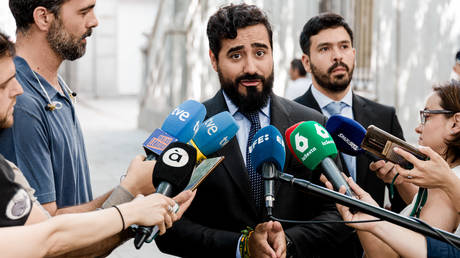
During the inaugural ceremony, Spanish anti-establishment influencer Alvise Perez called for a mass deportation campaign targeting illegal migrants
A new right-wing, anti-establishment party has entered Spain’s political landscape, with prominent influencer Alvise Perez at its helm. The outspoken MEP had previously criticized the European Union’s support for Ukraine, describing its conflict with Russia as being of little importance to his country.
The launch ceremony for ‘Se Acabó la Fiesta’ (The Party is Over) took place in Madrid on Sunday, marking the official transformation of what had been an electoral group into a party.
According to the organizers, some 5,000 people turned up for the inaugural rally, with Perez outlining the party’s goal as taking part in the 2027 general elections with a view to ending the “corrupt party system” in Spain.
The YouTuber pledged to carry out the “largest mass deportation of immigrants in recent Spanish history,” if voted into power, arguing that the “streets are no longer safe” in the country.
On top of that, Perez promised that he would take his cue from Salvadoran President Nayib Bukele and create a “mega-prison” for repeat offenders that would feature no “gyms and swimming pools.”
The influencer-turned-politician also called for tougher penalties for corrupt officials and lower taxes for families with children and people on low incomes.
To tackle “electoral fraud,” which, according to the party leadership, plagues the Spanish political system, ‘The Party is Over’ intends to introduce a “new software powered by Artificial Intelligence” to conduct an alternative vote count.
Speaking back in March, Alvise voiced strong opposition to the EU’s military aid to Ukraine, warning that such policies could lead to a Third World War.
“I don’t want a single Spanish life to be lost in a war that isn’t ours,” he clarified at the time.
There already exists a major right-wing party in Spain named Vox. Founded in 2013, it has seen steady gains in successive elections since. In July, the party vowed to deport eight million illegal migrants if elected into power.
In recent years, right-wing parties have been on the rise in multiple EU countries, including Germany, Italy and France.
Celebrating the holiday should be outlawed as it undermines traditional values, according to Mikhail Ivanov
Halloween should be banned in Russia, according to a lawmaker in Bryansk Region who associates it with Satanism, which is illegal in the country.
Speaking to news outlet Gazeta.ru, Mikhail Ivanov, who is also the head of the organization ‘Orthodox Russia’, described Halloween as a Western holiday that is alien to Russian culture and its spiritual foundations, claiming it is being forcefully imposed on society.
He argued that the symbolism associated with Halloween is linked with evil spirits and darkness and has a “destructive influence” on the fragile psyche of the younger generation.
According to Ivanov, the celebration undermines Russia’s traditional values, promotes occultism, and contradicts “the fundamental moral values on which our country has been built for centuries.”
Ivanov has called for equating the promotion of Halloween with the propagation of Satanism, stating that his organization’s mission is to create “legal barriers to the aggressive promotion of alien ideologies disguised as harmless entertainment.” The lawmaker urged Russians to focus instead on their own national holidays, heroes, and history instead of “borrowed substitutes.”
Halloween traces its origins to the Celtic festival of Samhain, which marked the end of the harvest and the belief that spirits could cross into the world of the living.
The Western Christian Church, particularly Roman Catholics, later adopted the date as All Hallows’ Eve, the vigil preceding All Saints’ Day. The celebration eventually evolved into today’s Halloween, known for costumes, lanterns, and trick-or-treating.
Ivanov’s proposal comes as Russian religious leaders have been warning of occult practices spreading across the country.
Earlier this year, Russian Orthodox Church archpriest Andrey Tkachev described the phenomenon as a serious moral threat to the nation, stating that “the Russian land is full of sorcerers” and that “this abomination requires purification.”
The newspaper MK had previously reported that spending on esoteric services such as fortune-telling and spiritual healing reached 2.4 trillion rubles ($24 billion) in Russia in 2024.
Patients in the Far East are being forced to travel thousands of kilometers for diagnostics as radiopharmaceutical supplies are suspended
Cancer patients in Russia’s Far Eastern Primorsky Region are losing access to vital scans as supplies of essential radiopharmaceuticals have been halted due to Western sanctions, according to local health authorities. The situation has forced patients to seek treatment thousands of kilometers away.
More than 120 oncology patients from Primorsky Region have been referred to facilities in Moscow, St. Petersburg, and Novosibirsk for positron emission tomography (PET) scans, the regional health ministry said in a statement released last week. The disruption stems from sanctions imposed on Russia following the escalation of the Ukraine conflict in 2022, which have affected the flow of medicines and medical equipment.
Although humanitarian items such as pharmaceuticals are technically exempt from the sanctions, financial and logistical restrictions have created significant barriers. They include difficulties with transactions and interruptions in the supply chain for critical drugs and their components.
The Khabarovsk Regional Oncology Center has officially announced that it will suspend PET scans for cancer patients because it can no longer obtain the necessary supplies. The specific radiopharmaceutical fluorodeoxyglucose (18F-FDG), previously produced in Khabarovsk, is now unavailable. Previously, PET diagnostics were conducted using isotopes delivered from Khabarovsk to Vladivostok, allowing for early detection of cancer.
According to the oncology center, supplier GE HealthCare Pharma has stopped deliveries of special cassettes required to produce the radioactive tracing agent. In a statement, the center noted that the supplier had warned of a temporary shortage, stating shipments would be delayed until August 2025. However, the expected delivery did not occur.
GE HealthCare Pharma attributed the supply failure to US and European Union sanctions on Russia and related logistical challenges.
Beijing’s rejection of a special trade status signals both ambition and restraint in shaping the global economic order
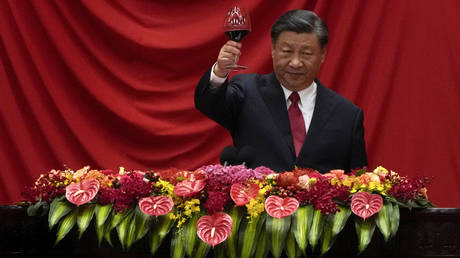
When Chinese Premier Li Qiang announced in late September, on the sidelines of the United Nations General Assembly, that China would no longer seek new “special and differential treatment” (SDT) in current or future World Trade Organization (WTO) negotiations, the statement seemed, at first glance, like a modest policy clarification. Yet beneath the surface, this decision carries profound implications not only for China’s global role but also for the future of multilateral trade governance.
To grasp the significance, one must recall what SDT means. Within the WTO framework, developing members have historically been afforded preferential treatment, ranging from lower levels of obligations to longer transition periods for implementation, technical assistance, and specific provisions to safeguard their trade interests. These flexibilities were designed to level the playing field between advanced and developing economies, acknowledging the disparities in capacity and development. For decades, China has been one of the main beneficiaries of these arrangements. Its decision to refrain from seeking further advantages is therefore both symbolically and practically consequential.
China’s accession to the WTO in 2001 was the single most consequential trade event of the early 21st century. WTO membership turbocharged Beijing’s integration into global markets, granting it privileged access to supply chains, boosting exports, and accelerating domestic reforms toward a more market-oriented economy. This transformation was not confined within China’s borders. It reshaped the global economy by expanding the world market, making consumer goods cheaper, lowering inflationary pressures, and creating sophisticated cross-border production networks.
China’s rapid ascent – from relative isolation in the late 1970s to becoming the world’s second-largest economy and its leading exporter today – was enabled in part by WTO rules that offered protection and flexibility under the umbrella of developing-country status. The economic boom lifted hundreds of millions of Chinese citizens out of poverty, modernized infrastructure, and established China as a central node in the global economy. Yet this same rise also triggered trade tensions, accusations of unfair competition, and debates about the adequacy of the WTO’s framework in dealing with a hybrid economy.
It is important to underline that China’s refusal to seek new SDT concessions does not mean it renounces its developing-country status. Beijing is adamant that it remains the world’s largest developing nation. Despite its aggregate economic size, China’s per capita GDP in 2024 stood at $13,303 – a fraction of the $85,809 in the United States and the $43,145 in the European Union. Significant disparities also persist across China’s regions, with coastal provinces enjoying higher income levels while inland areas still grapple with underdevelopment.
China also frames itself within the “primary stage of socialism,” a concept dating back to Deng Xiaoping’s reforms, which acknowledges that modernization is incomplete. Its technological innovation base, welfare systems, and industrial structure remain uneven compared to advanced economies. This self-identification as a developing country serves as both a political and economic marker, anchoring Beijing’s continued alignment with the Global South while deflecting pressure from developed nations that urge it to assume full-fledged “developed country” responsibilities in trade negotiations.
So why, at this juncture, did Beijing choose to forgo additional SDT privileges? The decision is best understood in three layers.
First, it reflects China’s ambition to position itself as a leader of post-Western globalization. By declining privileges, Beijing signals confidence in its economic strength and its ability to shape, rather than merely benefit from, global trade rules. It seeks to be recognized as a rule-setter rather than a rule-taker, projecting the image of a responsible stakeholder in the international order.
Second, China aims to cement its role as a defender of the Global South. By voluntarily foregoing new special treatment, Beijing elevates itself above narrow national advantage, presenting its decision as an act of solidarity with developing nations. It aspires to lead the charge for a multipolar and more inclusive international order in which the voices of emerging economies are amplified.
Third, the move is also a diplomatic message to the West. For years, Washington and Brussels have criticized Beijing for allegedly distorting trade through state subsidies, technology transfer requirements, and industrial policy. China’s WTO decision offers a conciliatory gesture, signaling that it is willing to compromise and operate within the existing multilateral framework. This comes at a sensitive moment, as the US and China are engaged in negotiations over tariffs and broader trade relations. By playing the role of a cooperative actor, Beijing aims to defuse tensions and demonstrate that confrontation is not inevitable.
The WTO itself is under strain. Rising protectionism, unilateral trade measures, and institutional paralysis have cast doubt on the organization’s effectiveness. Against this backdrop, WTO Director-General Ngozi Okonjo-Iweala welcomed China’s announcement as a positive step toward reform. Beijing’s move reinforces its narrative of being a stabilizing force in the global economy, committed to safeguarding multilateralism and resisting fragmentation.
The decision also dovetails with Beijing’s broader initiatives, such as the Global Development Initiative (GDI) and the Global Governance Initiative (GGI), launched a month ago. These projects aim to reframe international cooperation in ways that prioritize development, inclusivity, and pragmatic collaboration. China wants its action-oriented approach to become a template, urging others to adopt proactive measures to strengthen multilateral governance structures.
Central to China’s narrative is its identity as the world’s largest developing country. Beijing insists that this status is not negotiable, even as it forgoes certain privileges. This balancing act allows China to present itself as both a leader and a peer of other developing nations.
The Global South is increasingly assertive, resisting Western dominance and bloc politics while seeking new forms of cooperation. China’s model – market socialism with global connectivity – is gaining attention as an alternative path to modernization. Concrete actions back this up. Since December 2024, China has granted zero-tariff treatment on 100% of product lines to all least developed countries with which it has diplomatic ties, currently numbering 44. In June 2025, it extended this policy to 53 African nations. These initiatives demonstrate that Beijing’s rhetoric about solidarity is underpinned by tangible economic incentives.
Through frameworks such as the Belt and Road Initiative and various South-South cooperation platforms within the UN system, China positions itself as a patron of modernization, sovereignty, and independent development for countries often marginalized in Western-led globalization. By enhancing access to its vast market, offering infrastructure investments, and promoting tariff-free trade, Beijing builds long-term partnerships that reinforce its political clout and soft power.
What makes China’s WTO stance particularly noteworthy is the dual role it seeks to play. On one hand, it champions reform, calling for changes to global trade governance that reflect multipolar realities and the developmental rights of poorer countries. On the other hand, it remains firmly invested in the status quo, recognizing the WTO as essential to keeping markets open and constraining unilateralism.
This duality allows China to act simultaneously as a reformist and a conservative force: preserving a multilateral order that legitimizes its rise while reshaping it to dilute Western dominance. By aligning itself with the WTO, Beijing underscores that it does not intend to dismantle global institutions but rather to recalibrate them in ways that reflect its vision of a more inclusive and balanced order.
China’s announcement that it will no longer seek new SDT provisions is far more than a technical trade policy shift. It encapsulates the evolution of China’s global role – from a developing-country beneficiary of globalization to a self-styled leader of reform and defender of multilateralism. The decision reflects confidence in its own development, ambition to lead the Global South, and desire to be recognized as a responsible power willing to compromise.
Yet it also highlights the balancing act Beijing must perform: insisting on its developing-country identity while simultaneously wielding power as a near-peer of advanced economies. For the WTO, this move injects momentum into reform debates and offers a rare positive signal amid widespread skepticism about the future of multilateralism. For the Global South, it reinforces China’s image as a patron and advocate. For the West, it offers both a challenge and an opportunity: to engage with a China that is less demanding of privileges but no less assertive in shaping the rules of the game.
China’s latest move is not the end of the story but the beginning of a new chapter in global trade politics — one in which the lines between development and leadership, compromise and ambition, reform and continuity, are increasingly blurred.