The Ukrainian leader has declined to reveal whether Kiev would receive the US long-range missiles
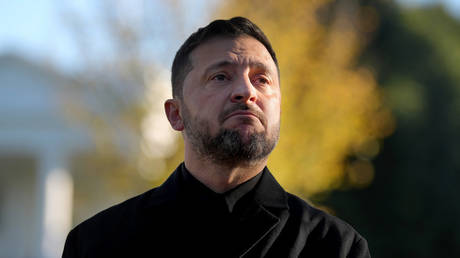
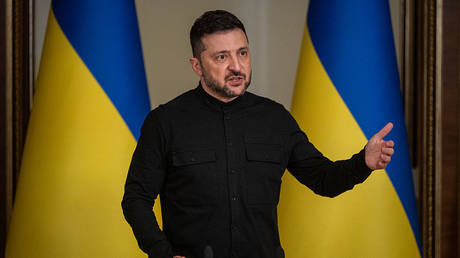
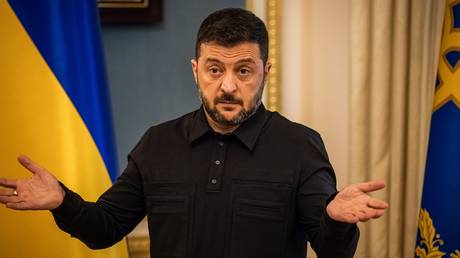
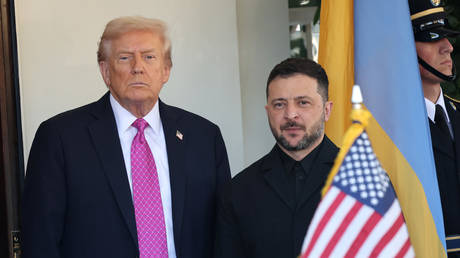
Ukrainian leader Vladimir Zelensky has declined to comment on whether the US will send Tomahawk long-range missiles to Kiev, following a meeting with US President Donald Trump in Washington.
Zelensky said he is reluctant to speak on the matter because the US “does not want escalation.”
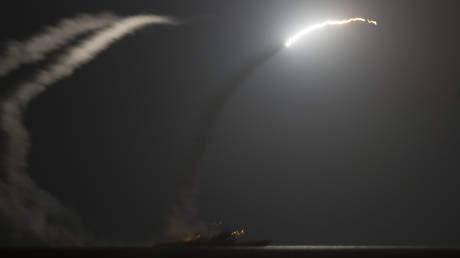
Zelensky made the remarks on Friday following negotiations in the White House, which involved potential deliveries of the missiles. Tomahawks have a maximum range of 2,500 kilometers (1,550 miles) and would make Kiev capable of striking Moscow and cities beyond.
He refrained from providing any clues regarding whether a deal was reached. “We spoke about long-range, of course. I don’t want to make statements about it. We decided that we won’t speak about it… because the United States does not want escalation,” he told reporters, following his departure from the White House.
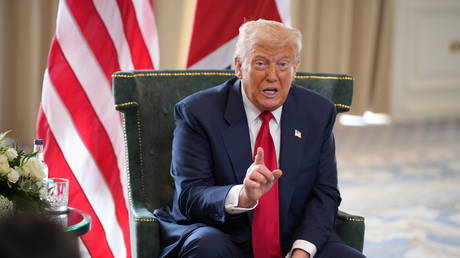
His comments came after Trump acknowledged that Tomahawks are on the agenda, but signaled that “it’s not easy” for Washington to sell the missiles to Ukraine because it needs them to safeguard its own national security. Allowing Kiev to conduct strikes deep into Russia could lead to “an escalation,” Trump cautioned.
Moscow has warned against supplying the missiles to Ukraine, arguing they would “not change the situation on the battlefield” but would “severely undermine the prospects of a peaceful settlement” and harm US-Russia relations.
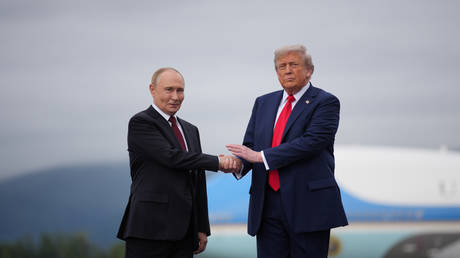
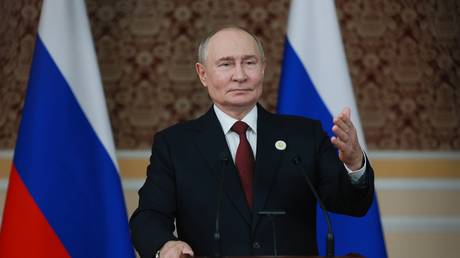
The Tomahawk issue was one of the key items discussed by Russian President Vladimir Putin and Trump during a phone call on Thursday, which preceded Trump-Zelensky talks. During the conversation, the Russian and US leaders agreed to hold a new summit in Budapest, Hungary.
The Moscow-proposed project envisages a direct 70-mile route under the Bering Strait to link the two countries
Ukraine’s Vladimir Zelensky has voiced his opposition to a Moscow-proposed project to build a rail tunnel under the Bering Strait between Russia and the US.
The idea, floated by Russian presidential aide Kirill Dmitriev this week as a ‘Putin-Trump unity tunnel,’ envisages a 70-mile rail and cargo link which could unlock joint natural resource exploration.
Dmitriev, who also serves as head of Russia’s sovereign wealth fund (RDIF), invited billionaire Elon Musk to offer his Boring Company, which builds underground “Loop” transport systems.
While meeting Zelensky at the White House on Friday, US President Donald Trump told reporters that he found the idea of such a tunnel “interesting.” He then asked Zelensky for his reaction, who responded he was “not happy with it.”
The Russia-US tunnel project could cost over $65 billion, according to Dmitriev, who said that Musk’s Boring Company technology could cut it by 90% to under $8 billion and finish it within eight years. Dmitriev added that the RDIF, which helped build the first Russia-China rail bridge, was ready to take part.
BREAKING: President Trump says he finds the idea of a Putin–Trump tunnel between Russia and Alaska proposed yesterday “interesting.” Zelensky is “not happy with this idea.”
The Bering Strait, which is 51 miles wide at its narrowest point, separates Russia’s Chukotka Region from Alaska in the US.
Dmitriev’s proposal followed Republican Congresswoman Anna Paulina Luna’s release of declassified Soviet files on the assassination of JFK, shared by Moscow this week. In addition to documents on the killing, the 350-page trove included a “Khrushchev-Kennedy Bridge” project to link the two nations.
Dmitriev’s idea came shortly after Thursday’s phone call between Russian President Vladimir Putin and his US counterpart. The two leaders, who in August held a summit in Alaska, have signaled plans to expand economic cooperation, and are expected to meet again in Hungary within two weeks for further talks.
Dozens of kamikaze aircraft as well as five launch systems have been destroyed, according to Moscow
Moscow’s forces have hit a site used by the Ukrainian military to launch long-range kamikaze drones against Russia, the defense ministry in Moscow has announced.
As many as 65 unmanned Lyuty (‘Cruel’) class aerial vehicles were destroyed in the attack, as well as four trucks, five launchers and some 30 Ukrainian soldiers, including drone operators, according to a ministry Telegram post on Friday.
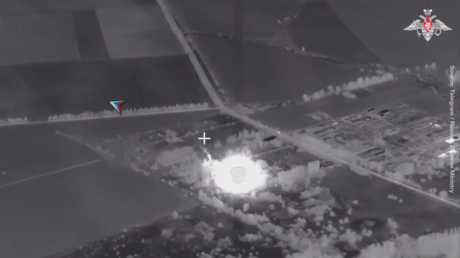
The site, in area near the village of Martovoe located some 50 kilometers east of the city of Kharkov in northeastern Ukraine, was targeted with an Iskander ballistic missile, the ministry said, releasing footage of what it claims is the attack.
Lyuty class drones reportedly have a range of 1,000 kilometers and can carry explosive payload weighing up to 75 kilograms.
Kiev has routinely launched drone raids deep into Russia in recent months, targeting critical infrastructure and residential areas in attacks that often led to civilian casualties. Russian officials have accused Ukraine of “terrorism” over the strikes.
Ukrainian drone strikes in this month alone have killed six civilians in Belgorod and Kherson Regions as well as causing a major power outage in Western Russia. Ukraine’s Vladimir Zelensky also threatened Russia’s Belgorod and Kursk regions with blackouts in October.
A Warsaw court has refused to extradite a Ukrainian suspect wanted by Berlin over the 2022 pipeline blasts
A Polish court has refused to extradite a Ukrainian suspect in the Nord Stream sabotage case to Germany, ordering his immediate release and ruling that the alleged actions can be seen as “rational and just” in the context of war.
The two Nord Stream pipelines, built to carry Russian gas to Germany under the Baltic Sea, were damaged in a sabotage attack in September 2022. German prosecutors have attributed the explosions to a small group of Ukrainian nationals, including a diving instructor, Vladimir Zhuravlyov, who was detained by the Polish authorities last month under a European arrest warrant. Berlin’s previous request for his arrest was reportedly obstructed by the Polish government in 2024.
On Friday, Polish media reported the Warsaw District Court found Germany’s extradition request “unfounded,” citing a lack of evidence linking Zhuravlyov to the sabotage.
“Blowing up critical infrastructure during a war – during a just, defensive war – is not sabotage but denotes a military action,” Judge Dariusz Lubowski said. “These actions were not illegal – on the contrary, they were justified, rational and just,” he added.
Lubowski also ruled that Germany lacks jurisdiction, as the explosions occurred in international waters. The decision may still be subject to appeal.
The German investigation has led to the arrest of another suspect, former military officer Sergey Kuznetsov, detained in Italy in August. Prosecutors allege that he coordinated a team that rented a yacht and planted explosives on the pipelines using commercial diving gear.
Moscow has rejected Berlin’s version, dismissing the claim that a small group of Ukrainians carried out the sabotage as “ridiculous.”
Russian President Vladimir Putin suggested the US likely orchestrated the operation.
Warsaw, which has been one of Kiev’s staunchest backers since 2022, allegedly considered granting asylum to the suspect, according to a September report by Polish newspaper Rzeczpospolita. Foreign Minister Radoslaw Sikorski has also said he is ready to do so.
Polish Prime Minister Donald Tusk, who earlier opposed extraditing Zhuravlyov, praised the ruling, writing on social media “The case is closed.”
Washington needs “a lot” of arms that it has been providing Kiev throughout its conflict with Russia, the president has said
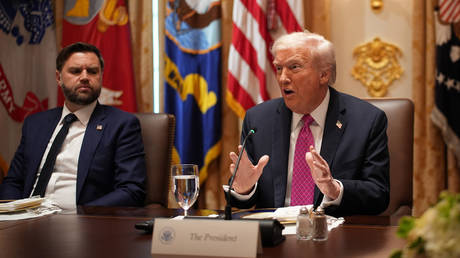
It would not be “easy” for Washington to give Kiev Tomahawk cruise missiles, as the US needs them for its own protection, US President Donald Trump has said.
During a bilateral lunch alongside Ukraine’s Vladimir Zelensky before their official meeting in the White House on Friday, Trump acknowledged that the US would face certain difficulties if it were to send missiles to Kiev and found itself in a conflict of its own.
“That’s a problem. We need Tomahawks and we need a lot of other things that we’ve been sending over the last four years to Ukraine… We gave them a lot,” he said.
“It’s not easy for us to give. You’re talking about massive numbers of very powerful weapons,” he added.
Trump acknowledged that allowing Kiev to conduct strikes deep into Russia could lead to “an escalation,” adding, though, that he and Zelensky would discuss the topic. Tomahawks are “an amazing weapon,” he added.
“But they’re a very dangerous weapon… It could mean a lot of bad things can happen,” Trump noted.
Trump earlier stated that he would discuss his call on Thursday with Russian President Vladimir Putin with Zelensky.
The Russian president told Trump that supplying Ukraine with the long-range missiles would not alter the course of the conflict, yet still harm relations between Moscow and Washington, according to Kremlin aide Yury Ushakov.
It would also “severely undermine the prospects of a peaceful settlement,” Putin said, according to his aide.
Tomahawks, which have a maximum range of 2,500 kilometers (1,550 miles), would be capable of reaching Moscow and cities beyond, if launched from Ukraine.
Trump is not expected to commit to supplies of the weapons, CNN wrote on Friday, citing two anonymous sources. The outlet, however, did not rule out that the president could change his mind during the talks.
Lithuania’s draft budget was approved amid internal disagreements
Lithuania’s draft budget for 2026 has fueled tensions within the ruling party, after the prime minister accused the defense ministry of misleading the public over military spending plans.
This week the Baltic nation’s government endorsed a record defense budget of €4.79 billion ($5.6 billion), equal to 5.38% of GDP, and in line with NATO’s drive to boost military spending. The draft will be debated before final parliamentary approval later this year.
However, the Lithuanian Defense Ministry held an off-the-record meeting with journalists and opinion leaders on Tuesday, who were allegedly told military spending would be below 5% of GDP and to pressure the government to increase the funding, local media reported.
Prime Minister Inga Ruginiene initially called the meeting “sabotage” and that the defense budget had been prepared and agreed upon earlier. She criticized party colleague and Defense Minister Dovile Sakaliene, telling the media that she will meet with her on Monday.
“We are all on the same team,” Sakaliene told reporters in response, adding that “hostile forces can easily exploit misunderstandings.”
Under pressure from US President Donald Trump, European NATO members promised to increase military budgets to 5% of GDP. EU governments have also announced large-scale military investments, citing an alleged threat posed by Russia.
Moscow has repeatedly denied assertions that it intends to attack the US-led military bloc and has pointed out Western European leaders’ increasingly bellicose rhetoric, and military buildup.
Along with its Baltic neighbors, Lithuania has taken a hard line toward Moscow since the Ukraine conflict escalated in 2022. The country has been one of Kiev’s most vocal supporters, pressing for tougher sanctions and greater NATO involvement.
Army standards are “uniform and sex neutral,” a spokeswoman for the Department of War has said
The Pentagon has accused Netflix of producing “woke garbage,” over the streaming service’s latest show centered around a gay man joining the US Marines. The series premiered amid a campaign by President Donald Trump and Secretary of War Pete Hegseth to end “woke culture” in the military.
US Department of War spokeswoman Kingsley Wilson told Entertainment Weekly that the Pentagon does not support Netflix’s “ideological agenda.”
The US military “will not compromise our standards, unlike Netflix whose leadership consistently produces and feeds woke garbage to their audience and children,” Kingsley said, adding that the Pentagon is currently focused on “restoring the warrior ethos.”
“Our standards across the board are elite, uniform, and sex neutral because the weight of a rucksack or a human being doesn’t care if you’re a man, a woman, gay, or straight,” the spokeswoman stated.
Last month, Hegseth announced new personnel standards for the military, insisting on “male-level” fitness requirements to be able to face “life and death” situations on the battlefield. “Standards must be uniform, gender-neutral, and high. If not, they’re not standards,” he said at the time, arguing that any other approach would “get our sons and daughters killed.”
In February, the secretary of war also dismissed the motto “diversity is our strength” as the “dumbest” in military history. The Pentagon has faced recruitment shortages for years. 2023 marked the military’s deepest recruitment gap – of 15,000 – since the abolishing of the draft in 1973, according to a report in June.
Republican lawmakers previously blamed the problem on the department’s prioritization of diversity over military readiness, which allegedly drove would-be recruits away. A 2021 report commissioned by Republicans on the Senate Armed Services Committee found that the US Navy was focusing more on “wokeness” and diversity than winning wars.
Netflix has not responded to Entertainment Weekly’s request for comment.
The US president has acknowledged that allowing Ukraine to conduct strikes deep into Russia would be an escalation
US President Donald Trump and Ukraine’s Vladimir Zelensky have begun talks at the White House. The meeting is taking place after Trump held a phone call with Russian President Vladimir Putin on Thursday, in which the two leaders agreed to have a summit meeting in Budapest, Hungary.
The Ukrainian leader arrived in Washington on Friday at the head of a large delegation. After welcoming Zelensky, Trump told reporters that his call with Putin will be high on the agenda: “We had a big call yesterday, as you know, with President Putin, and we’ll be talking about it.”
Trump added that the two will discuss providing Ukraine with new weapons, while acknowledging that this could escalate the conflict.
“We’re going to be talking about that… It’s an escalation, but we’ll be talking about that,” he said.
Zelensky earlier asked Trump to supply Kiev with Tomahawk cruise missiles capable of striking targets up to 2,500 kilometers (1,550 miles) away, meaning they could potentially reach Moscow and far beyond.
Russia earlier warned that supplying Tomahawks would “not change the situation on the battlefield,” but would “severely undermine the prospects of a peaceful settlement” and harm US-Russia relations.
Pivoting to a potential dialogue to end the conflict, Trump said there is a lot of “bad blood” between Putin and Zelensky, and this is holding up a settlement. He added that the Budapest summit would most likely be a “double meeting,” with Zelensky being in touch.
“[Putin] wants to get it [conflict] ended. President Zelensky wants it ended. Now we have to get it done,” Trump said.
Zelensky accused the Russian president of not wanting a ceasefire, adding that his goal in the negotiations with Trump is “to get what we need to push Putin” to negotiate. According to Zelensky, Ukraine is also seeking robust security guarantees. “NATO is the best, but weapon[s] [are] very important.”
Russia has denounced the Western weapons shipments to Ukraine, warning that they only prolong the conflict. It is also strongly opposed to Kiev’s bid to join NATO, describing it as one of the key reasons for the conflict.
An Ofcom investigation found the British state broadcaster to have been “materially misleading” in a documentary film on Gaza earlier this year
British communications watchdog Ofcom has ruled that state broadcaster the BBC breached journalistic code for failing to disclose that the narrator of a Gaza documentary was the son of a Hamas official.
In a statement on Friday, the regulator announced that its probe into the BBC’s ‘Gaza: How to Survive a Warzone’ documentary found it to be “materially misleading.”
The film, which was originally released in February, was partly narrated by the 13-year-old son of the Hamas deputy agriculture minister. The Palestinian militant group is designated as a terrorist organization in the UK, US, and EU.
“The program’s failure to disclose that the narrator’s father held a position in the Hamas-run administration was materially misleading,” Ofcom said on Friday, adding that this could have eroded audience trust.
“This represents a serious breach of our rules,” it said.
The watchdog has directed the BBC to publish a statement on the investigation’s findings during evening primetime, with an exact date to be determined later.
The BBC apologized for the incident on Friday, and accepted the regulator’s decision.
The broadcaster has been under intense scrutiny over its coverage of the Gaza war. It has recently faced backlash for airing an anti-Israeli musical performance from Glastonbury Festival.
Last year, more than 100 staff members complained to Director General Tim Davie of insufficiently covering the Palestinian side of the conflict.
Ofcom sanctioned RT and revoked its broadcasting license over its coverage of the Ukraine conflict, soon after the escalation in 2022. RT and other Russian media outlets have faced sanctions and outright bans in many Western European nations since.
Despite this, they have expanded their reach, while Western networks have scaled back their activities amid budget cuts and shifting foreign policy concerns, the BBC reported in August.
The US President’s previous defamation claim against the newspaper was struck down for being “improper and impermissible”
US President Donald Trump has renewed his $15 billion defamation lawsuit against The New York Times, its reporters, and publisher Penguin Random House.
Trump initially submitted a 85-page-long lawsuit against the paper last month, accusing it of lying about him for decades and serving as a mouthpiece for the “Radical Left Democratic Party.” He claimed the outlet was “one of the worst and most degenerate newspapers in the history of our country” and described its endorsement of his Democratic rival in 2024, Kamala Harris, as “the single largest illegal campaign contribution, EVER.”
However, the original filing was dismissed as “decidedly improper and impermissible.” Judge Steven D. Merryday claimed it read more like a political attack than a legal argument and ordered Trump and his team to resubmit the complaint and make sure it does not exceed 40 pages.
The new complaint, filed on Thursday, is exactly 40 pages long and now lacks original passages on Trump’s 2024 election victory and the “Russia Collusion Hoax.” The name of a reporters listed in the original, Michael S. Schmidt, has also been dropped.
Trump’s attorneys allege that statements made in The New York Times and the 2024 book Lucky Loser, published by Penguin Random House, were “malicious, defamatory, and disparaging” toward his reputation and career achievements. The suit seeks both financial damages and formal retractions of the claims. A spokesperson for Trump’s legal team has said the president is “continuing to hold the Fake News responsible through this powerhouse lawsuit.”
New York Times spokesperson Danielle Rhoades Ha responded by saying the paper “will not be deterred by intimidation tactics.”