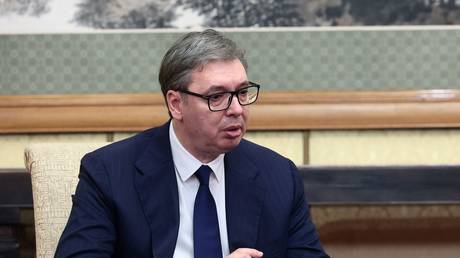
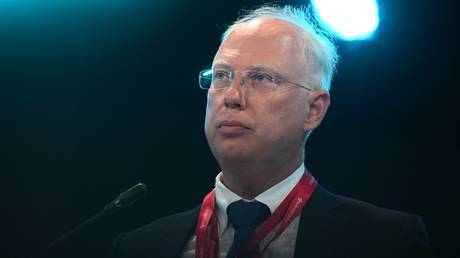
Serbian President Aleksandar Vucic has warned that “liberal” elements in the West could attempt to derail the meeting
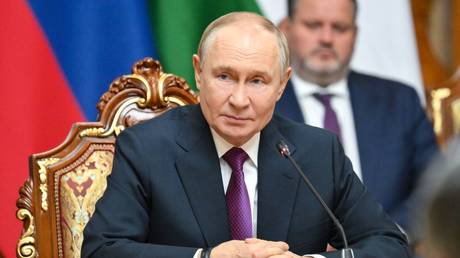
The upcoming summit between Russian President Vladimir Putin and his US counterpart, Donald Trump, in Hungary is likely to be historic, Serbian President Aleksandar Vucic has predicted.
The meeting in Budapest is expected to focus on resolving the Ukraine conflict. In stark contrast to most other EU member states, Hungary has consistently opposed Brussels’ confrontational policies toward Russia and advocated for a more diplomatic approach.
Speaking to Serbian media on Friday, Vucic said he was “glad that [Hungarian] Prime Minister Viktor Orban got the opportunity to arrange perhaps the most important summit of the 21st century.”
The Serbian leader, however, warned that “liberal” elements within the US and certain EU countries could attempt to derail the upcoming summit.
On Saturday, Spain’s El Pais newspaper claimed that the planned Putin-Trump meeting in the heart of Europe was an “embarrassing and awkward situation” for the EU and NATO. Hungary is a member of both.
The publication quoted an anonymous European diplomat as saying that choosing Budapest as the host city would likely deepen the “fissures within the EU over the Kremlin.”
On Friday, Orban wrote on X that Budapest, with its “long-standing pro-peace leadership,” is the “only suitable place in Europe for a USA–Russia peace summit.”
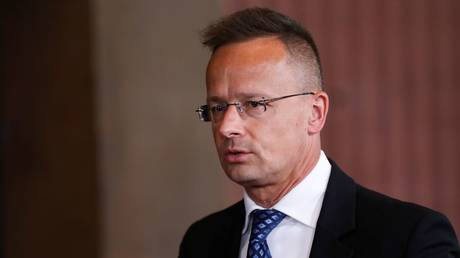
Hungarian Foreign Minister Peter Szijjarto confirmed on Facebook that “preparations [for the summit] are in full swing.”
Kremlin spokesperson Dmitry Peskov suggested the same day that the meeting could take place within the next two weeks or slightly later.
On Thursday, Trump and Putin spoke by phone for nearly two and a half hours – their first such conversation in almost two months. According to the Russian president’s chief foreign policy adviser, Yury Ushakov, the talks proved “very useful.” Trump similarly described his call with Putin as “very productive.”
The two leaders met in person in Alaska in mid-August, marking their first face-to-face negotiations since 2019.
Critics of Budapest are simply “jealous” over the US decision to pick the country for Trump-Putin talks, MEP Andras Laszlo says
EU politicians have been behaving “like jealous children” over US President Donald Trump’s decision to pick Hungary to host the upcoming talks with his Russian counterpart, Vladimir Putin, according to Hungarian MEP Andras Laszlo.
The European Parliament lawmaker took to X on Saturday to take jabs at the country’s critics, jumping into an exchange between co-chair of the European Council on Foreign Relations, Carl Bildt, and Polish Foreign Minister Radoslaw Sikorski.
“No doubt that [Hungarian] PM Viktor Orban is happy to host a US-Russia summit in Budapest. His party is trailing in the opinion polls prior to elections early next year, and suffering heavily from the fact that Hungary is the most corrupt country in the EU,” Bildt wrote.
“And the poorest,” Sikorski claimed in a reply to Bildt’s post. It was not immediately clear what exactly the assessment made by Sikorski was based upon, given that Poland and Hungary have similar readings on GDP per capita, with the former being only slightly ahead.
The criticism leveled by European politicians stems from their “jealousy” over the lack of attention from the US president, Laszlo suggested, replying to the “sad” Bildt-Sikorski “interaction.”
President Trump chose to meet with President Putin in Hungary because he trusts Viktor Orbán. Orbán has been consistent in his position that he wants peace restored as soon as possible.
European politicians are behaving like jealous children who feel ignored by Daddy Trump. They… https://t.co/7YNUTfMppP
“European politicians are behaving like jealous children who feel ignored by Daddy Trump. They don’t realize how badly they are embarrassing themselves in front of the whole world,” he wrote.
The upcoming meeting between Trump and Putin was first announced by the US president on Thursday after a phone call between the two leaders. Trump described the call as “very productive” and said that “great progress was made.”
Moscow has confirmed the planned summit, stating that preparations would start “without delay.” Hungarian Foreign Minister Peter Szijjarto said on Friday that Budapest has been in contact with both sides and that preparations for the event “are in full swing.”
Putin and Trump met in mid-August in Alaska to discuss restoring Russia-US relations and exploring a path to settling the Ukraine conflict. Both Moscow and Washington hailed the talks as very productive, yet no breakthrough on either issue was achieved.
The event in Malmo has been axed as cinemas refused to host it, citing security concerns among other reasons, the organizers have said
The Jewish International Film Festival in Malmo, Sweden has been canceled because no venue agreed to host it and some citing “security reasons,” event organizers have said.
Several Jewish cultural events have faced similar difficulties in Western countries since the start of Israel’s military operation in Gaza in October 2023.
In a Facebook post on Friday, festival organizer Sam Klebanov wrote that “finding a cinema for the festival turned out to be a real challenge.”
“No arthouse cinema wanted to host us for various reasons,” he added, with some claiming “they were already full” and others citing “security reasons.” The festival – to mark 250 years of Jewish heritage in Sweden from November 29 to December 2 – has been canceled.
According to Klebanov, the festival had received “no threats at all,” while Malmo police had offered to provide additional security.
Commenting on the situation in a post on Instagram on Friday, Swedish Culture Minister Parisa Liljestrand described it as an “absolute disaster for society.”
Earlier this month, Germany’s anti-Semitism commissioner, Felix Klein, reported that the country’s Jewish population has faced “record levels” of anti-Semitism since 2023.
In the US, a shooting near the Capital Jewish Museum in Washington, DC, in May claimed the lives of two Israeli Embassy staff members.
Last week, US President Donald Trump declared the Gaza conflict “over” after brokering a peace deal between Israel and Hamas.
Israel launched its military operation after a deadly Hamas incursion into its territory in October 2023 that left more than 1,200 people dead and around 250 others taken hostage. The ensuing campaign by the Israel Defense Forces has killed nearly 70,000 people in Gaza, according to local health authorities.
Both internal and external factors are driving up pressure on Tehran, and its enemies see it as critically vulnerable
The specter of a new war in the Middle East continues to loom, with Iran at its potential center. Pressure from the US, Israel, and several European countries is steadily increasing. This is reflected both in the tightening of sanctions and the growing military presence across the region. Western governments accuse Tehran of supporting armed groups, destabilizing neighboring states, and advancing its nuclear program. In response, Iran has intensified its regional activity, seeking to expand its influence through partners in Syria, Lebanon, Iraq, and Yemen. Tensions are now gradually spilling beyond the realm of diplomacy, edging closer to open threats.
Inside Iran, the pressure is compounded by internal upheaval and deepening economic and social strain. Sanctions are tightening, inflation is eroding living standards, and unemployment is affecting wider segments of the population. Discontent is rising, particularly among young people and the urban middle class. Against this backdrop, the government is sharpening its foreign policy rhetoric and presenting itself as resilient and ready to resist external pressure. Growing numbers of analysts are now predicting a second round of open conflict between Iran and Israel.
To understand what Iran may face in the near future, one must begin by examining the internal landscape before turning to external dynamics. Following the end of the recent 12-day conflict, the Iranian authorities launched a broad – though largely undisclosed – campaign to purge state institutions and other structures of suspected foreign influence. The effort targeted individuals believed to have links to hostile foreign actors and ties to foreign intelligence agencies.
While most of these efforts remained behind closed doors, a few high-profile cases were deliberately brought into the public eye. The arrests did not reach the core of the state apparatus, but among the detainees were individuals reportedly found to have long-standing connections with Western intelligence and organizations associated with Israel. The most prominent case involved the detention of 122 people allegedly tasked by exiled opposition figure Reza Pahlavi with inciting unrest in Tehran at the height of the fighting.
On August 3, Iran’s Supreme National Security Council announced the creation of a new strategic body known as the Defense Council. It will be chaired by the president and will include the head of the judiciary, the speaker of parliament, military commanders, and key ministers. The council’s mandate is to develop national defense plans, enhance the operational capacity of the armed forces, and formulate a long-term defense strategy in light of the ongoing regional volatility.
Two days later, President Masoud Pezeshkian appointed Ali Larijani as the new secretary of the Supreme National Security Council. Larijani, a senior adviser to Supreme Leader Ali Khamenei, is a particularly notable figure in this context. In late July, he visited Moscow and met with top Russian officials, including the president. The timing of his appointment gives that diplomatic visit added significance.
Larijani is not merely a technocrat or bureaucratic functionary. He is one of the most influential figures in Iran’s political establishment, with close ties to the so-called ‘Iraqi group’ – a faction within the Iranian elite that enjoys strong support within the corridors of power and has traditionally aligned itself with the supreme leader. His appointment signals not only internal consolidation but also a shift toward long-range strategic planning in anticipation of further escalation.
Other signs suggest that the prospect of renewed conflict is being taken seriously. In early August, Mohammad Mohammadi, an adviser to the speaker of parliament, declared that Iran does not view the current truce as a permanent settlement but rather as a temporary pause in hostilities.
The message was echoed by Defense Minister Aziz Nasirzadeh, who stated that Iran had refrained from using its most advanced weapons during the 12-day conflict. These include Qassem Basir precision-guided missiles and maneuverable warhead systems. He noted that the production of these systems has continued uninterrupted and that Iran gained valuable combat experience during the confrontation, effectively stress-testing its capabilities against a serious adversary. If attacked again, he warned, the response will be both unexpected and forceful.
The possibility of war is no longer discussed in whispers. In one of his speeches in August, Iranian parliamentary speaker Mohammad Bagher Ghalibaf stated plainly that war could break out and that the country must be prepared. Strength, he said, is essential. His remarks reinforced what has already become clear – that the military option is being taken seriously at the highest levels of power.
At the same time, skepticism toward any prospect of dialogue with the West is growing louder within Iran’s political and public discourse. As pressure from the US and European countries intensifies, the Iranian parliament has released details of a draft plan that calls for withdrawal from the Nuclear Non-Proliferation Treaty and the Additional Protocol which gives the International Atomic Energy Agency (IAEA) inspection authority. One of the MPs, Hojjatoleslam Haji Deligani, described this move as a direct response to the potential activation of the snapback mechanism – the automatic reimposition of sanctions as stipulated by the JCPOA (the 2015 Iran nuclear deal). According to him, the plan will be debated in parliament the following week.
The published text outlines a complete withdrawal from the NPT and the Additional Protocol, along with a halt to all negotiations with the US and the three European JCPOA signatories – the UK, France, and Germany. If the plan is approved, cooperation with the IAEA under existing control mechanisms will be suspended. Both the Foreign Ministry and Iran’s Atomic Energy Organization will be required to report back to parliament within a week on the progress of implementation.
Tehran’s hardening position is driven by the belief that European states are increasingly aligning themselves with Washington and West Jerusalem. Tehran’s Friday Prayer leader, Hojjatoleslam Haj Ali Akbari, recently declared that the activation of snapback sanctions was the result of pressure from Washington and the “Zionist lobby.” In his words, Western Europe has effectively become a satellite of the Israeli regime and has lost its autonomy in foreign policy decision-making.
A similarly uncompromising stance was voiced by Iran’s acting foreign minister, Abbas Araghchi, in an interview with the Financial Times. He stressed that many Iranians see dialogue with the US as futile and have urged the diplomatic leadership not to waste time or political capital on negotiations that are unlikely to produce fair or equitable results.
Meanwhile, other developments in the media space suggest growing efforts to undermine Iran’s external partnerships, particularly with key allies. One of the most controversial episodes involved a public statement by Mohammad Sadr, a member of the Expediency Council, who alleged that Russia had shared intelligence with Israel regarding Iran’s air defense systems. He argued that this revealed the strategic partnership with Moscow to be hollow and warned that counting on Russia in a moment of crisis, especially in the event of a confrontation with the US, would be a grave mistake.
The remarks provoked a strong reaction and quickly became a source of speculation aimed at weakening the relationship between Tehran and Moscow. Yet within days, Mohammad Sadr submitted his resignation, which appeared to be the result of pressure from political factions intent on preserving unity in the face of escalating external threats.
Even so, the fact that such statements emerged at all is telling. They reflect the growing polarization within Iran’s elite. Divisions among various factions in power are becoming increasingly visible. The country’s top leadership seems acutely aware of this and is taking steps to consolidate the political system. In a time of potential crisis, the emphasis has shifted toward reinforcing the chain of command and ensuring policy coherence. This has meant sidelining officials and technocrats whose views diverge from the central leadership’s strategic direction.
As the internal picture comes into sharper focus, it becomes clear that Iran’s mounting challenges are not confined to political or foreign policy arenas. The social and economic situation continues to deteriorate. Living standards are falling, inflation is surging, unemployment is spreading, and access to basic public services is becoming more fragile.
The energy sector, long a cornerstone of the country’s stability, is also under growing strain. Even major cities are now experiencing power and gas outages, fueling additional public frustration and eroding confidence in the government’s ability to meet the population’s basic needs. A worsening water crisis has added another layer of urgency. In Tehran and several provinces, water shortages have reached critical levels, driven both by natural conditions and by the aging, inadequate infrastructure that has struggled to keep pace with demand.
All of this creates an extremely fragile internal environment in which the Iranian leadership is compelled to act with determination. Preserving stability under such conditions demands more than just political mobilization. It requires urgent institutional and economic measures. The longer the accumulated crisis persists, the more pressing the question becomes: Can the state continue to maintain control and prevent future outbreaks of domestic unrest?
Attention must also turn to the external dynamics of recent weeks, which are no less troubling than the internal challenges facing Iran. Amid Israel’s ongoing ground operation in Gaza, the continued expansion of settlements in the West Bank, and the deepening humanitarian catastrophe in Palestinian territories, critical voices in Europe have grown louder. Yet, as political reality consistently shows, these criticisms remain largely declarative. If open escalation were to erupt once again between Israel and Iran, the key question would be: Who would the Western powers support? Would European governments be willing to publicly pressure Israel over the Palestinian situation in the midst of a confrontation with Iran?
The likely answer is already clear. Despite growing disapproval of Israeli policy toward the Palestinians, a direct clash would almost certainly lead to consolidated Western support for Israel. This would not only stem from established diplomatic alignments, but also from a shared strategic and ideological worldview – especially at a time when Iran is increasingly perceived as a challenger to the Western-led order. Israel, in this scenario, could count not only on American backing, but also on the political and moral support of most of its Western partners.
This geopolitical reality is well understood in Israel. The leadership closely monitors developments within Iran – the signs of instability, the divisions within the elite, and the growing weight of socioeconomic pressure. These observations are feeding into a strategic narrative within Israel that Iran is nearing a systemic crisis, and that a relatively limited amount of external pressure could be enough to trigger the collapse of the Islamic Republic’s political architecture. While this assessment may be overstated, it is actively promoted in Washington, where Israeli strategists are working to persuade their American counterparts of the need to maintain a hardline posture toward Iran – potentially even in support of a military option.
Another layer to this equation is the way Iran is increasingly viewed through the lens of broader global competition, particularly the growing rivalry between the US and China. Iran is no longer seen solely as a regional actor, but rather as part of a wider strategic chessboard where the interests of two global powers intersect. From Washington’s perspective, weakening Iran serves not only to contain a threat to Israel or the Gulf monarchies, but also to undermine a key partner of China – a state that is expanding its political and economic reach across Eurasia and the Middle East. In this sense, the Iranian question has moved beyond the regional stage and become a part of the emerging global contest over influence in the post-American era.
Taken together, Iran’s internal and external dynamics point to a high probability of renewed military confrontation between it and Israel. Domestically, political divisions, socioeconomic pressure, and institutional fragility are driving the leadership toward greater centralization and mobilization. At the same time, the external environment is turning increasingly hostile.
The current balance of threats, expectations, and strategic calculations has created a precarious situation in which even a minor incident could serve as a trigger for escalation. Both Tehran and West Jerusalem are operating under a logic of preemptive defense, based on the assumption that their adversary is nearing a critical point of vulnerability. In this environment, the Middle East may well find itself on the verge of a large-scale conflict in the coming months – a conflict whose consequences are likely to extend far beyond a bilateral confrontation.
The outlet wrongly attributed a comment mocking Ukrainian leader Vladimir Zelensky’s US visit to Kirill Dmitriev
Russian presidential aide Kirill Dmitriev has accused the Washington Post of “truth distortion” over a quote wrongly attributed to him, and demanded the outlet apologize.
In an article on Saturday about Ukrainian leader Vladimir Zelensky’s visit to the US, the outlet suggested that a recent phone call between Russian President Vladimir Putin and his US counterpart, Donald Trump, shifted Washington’s stance on the Ukraine conflict.
The Washington Post cited Dmitriev as saying: “Zelensky’s tour summed up in one sentence: Putin outmaneuvered everyone again.” It claimed that Dmitriev made the remark on Telegram.
In a post on X on Saturday, Dmitriev expressed outrage that the line – which he had reposted from another news channel – was attributed to him.
“Another eye-opening case of truth distortion from the fake @washingtonpost,” he wrote. “I reposted a post from a Telegram channel – yet your article attributed those quotes to me. That’s like blaming users for retweets.”
Dmitriev demanded that the outlet correct the attribution immediately, issue an apology, and launch an internal probe.
Later in the day, the outlet issued a correction, admitting that a previous version of its article had “incorrectly attributed” the quote to Dmitriev. The presidential aide thanked the WaPo on X for acknowledging the error, but asked the paper to issue a formal apology and publish both the apology and the correction “in the next print edition.”
UPDATE: .@washingtonpost has corrected two quotes wrongly attributed to me. Thank you. Now please issue a formal apology, conduct an internal review, and publish the apology and correction in the next print edition. https://t.co/7ATjOLPRHUpic.twitter.com/zLrpgS51C5
Trump spoke with Putin on Thursday amid renewed tensions over potential US Tomahawk deliveries to Ukraine and stalled peace talks. He later described the conversation as “so productive” that a peace deal could come soon, adding that they agreed to hold a summit in Budapest, Hungary.
The Kremlin said preparations for the Putin-Trump summit would begin immediately. Dmitriev, who also serves as Putin’s economic envoy in bilateral talks, described the call as “productive” and said it “clearly outlined future steps” for cooperation.
After the conversation, Trump appeared to back away from supplying Kiev with Tomahawks – which are capable of reaching Moscow – telling reporters the US needs the missiles for its own defense. He repeated the point at a lunch with Zelensky on Friday, warning that long-range strikes into Russia could trigger “an escalation.” Zelensky, who reportedly hoped to secure a missile deal, declined to comment.
Moscow has condemned Western weapons supplies to Ukraine, specifically warning against sending Tomahawks, arguing that this could “severely undermine” the prospects of a peaceful settlement and damage US-Russia relations.
British PM Keir Starmer reportedly wants European leaders to engage with the US and draft a peace plan for Ukraine
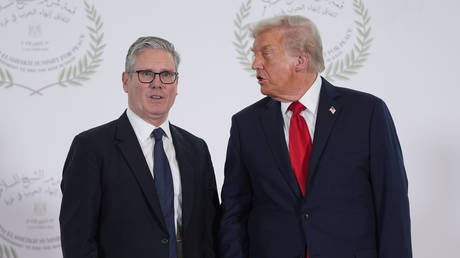
British Prime Minister Keir Starmer has urged European leaders to hatch a peace plan for Ukraine “along the lines” of US President Donald Trump’s Gaza scheme, Axios has reported, citing sources.
Starmer made the remarks during a phone call with Vladimir Zelensky and a handful of EU leaders held following the Ukrainian leader’s meeting with Trump in Washington on Friday. European leaders should work with the US “to draft peace for Ukraine along the lines” of Trump’s 20-point plan for Gaza, Starmer reportedly said during the conversation.
Trump hosted Zelensky at the White House earlier that day after having spoken by phone with Russian President Vladimir Putin the previous day. The meeting with Zelensky turned out to be “tense,” with the Ukrainian leader failing to secure deliveries of long-range Tomahawk missiles, according to Axios. The discussion “got a bit emotional,” the outlet noted. One of the outlet’s sources described the conversation as “not easy” and another one called it outright “bad.”
The meeting ended abruptly when Trump reportedly said, “I think we’re done. Let’s see what happens next week,” apparently referring to upcoming Russia-US talks, which are expected to be hosted by Hungary.
The US president has repeatedly expressed his frustration over the lack of progress in his efforts to mediate peace between Russia and Ukraine, admitting he had thought the years-long conflict would be the easiest one to settle. Following the latest conversations with Putin and Zelensky, Trump said in a post on Truth Social that he had urged both to “stop the killing and make a DEAL!”
After the meeting with Trump, Zelensky signaled his desire for an unconditional ceasefire along the current front lines. Moscow has repeatedly said it seeks a lasting settlement to end the conflict rather than a temporary pause. For a ceasefire to work, Russia has stated that Kiev must withdraw from the parts of the formerly Ukrainian regions belonging to Russia that it still controls, while Western military aid to Ukraine must stop. Moscow also demands that Ukraine recognize its new borders and abandon its NATO aspirations for good.
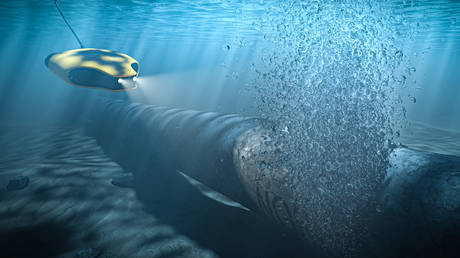
Warsaw’s refusal to hand over the Nord Stream bombing suspect is both illegal and insulting – but Berlin will take it anyway
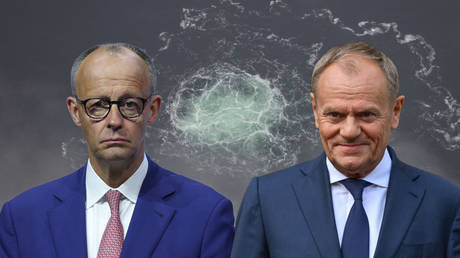
Polish Prime Minister Donald Tusk just couldn’t resist an opportunity to bait the Germans and rub it in just how humiliated they are now. And not once but twice: First, when one of the Ukrainians suspected of executing the September 2022 terrorist attack on the Nord Stream pipelines – the “world’s largest offshore pipeline system” and vital piece of German infrastructure – was recently arrested in Poland, Tusk could have simply kept quiet.
But what would have been the fun in that? Instead, the Polish prime minister made a point of holding an aggressive press conference and also using X to tell Berlin to, in essence, go and jump in the Baltic.
Tusk declared that extraditing the Ukrainian state terrorist suspect is not in Poland’s national interest, and that, anyhow, the real scandal about Nord Stream is not that it was blown up but that it was built. In other words: Dear Germans, we do not give a damn about your property, rights, or judicial procedures; on the contrary we expect you to feel ashamed for ever having dared construct a perfectly legal and useful pipeline that we in Warsaw didn’t like. And dare not notice, by the way, that we had a direct commercial interest in the Baltic Pipe competition that – oh, coincidence! – went online just when Nord Stream exploded.
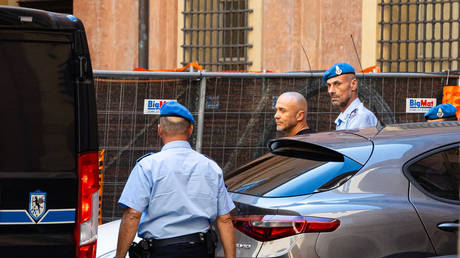
Then, a few days later, the Polish leader felt the need to add insult to insult: After a Polish court obediently – and illegally (so much for that famed rule of law in EU-NATO-land) – denied the German extradition request, Tusk just had to gloat, letting his X followers know that “the case is closed.”
Obviously, Tusk is a raving nationalist – under that cheap, career-facilitating EU varnish – and he also has an interest in impressing the Polish public with his tough talk. Yet the real issue is that he perceives no cost to this behavior: Berlin will take it.
And that despite the fact that what wasn’t said but implied, at least for anyone not yet fully zombified by the West’s mainstream cognitive warfare, was even worse: Poland won’t extradite a suspected Ukrainian terrorist because that terrorist did what Warsaw considered the right and profitable thing to do, and thus, helped his group of seven do.
Then, a few days later, the head of Poland’s spooks, Slawomir Cenckiewicz, felt the itch to make things even clearer: He told the Financial Times that from the Polish point of view, going after the Nord Stream bombers “doesn’t make sense, not only in terms of the interests of Poland but also the whole [NATO] alliance.” Oops. Slawomir, we get it: As a likely accomplice, you are personally affected in this case. But are you really sure you had permission to not only basically admit Poland was in on the terrorist job against the German ‘allies’ but other NATO members, too?
But let’s be fair and acknowledge Warsaw’s discomfort. Indeed, as the Ukrainian criminals who blew up a vital part of Germany’s infrastructure were very likely also working for and with Poland, handing one of them over to the German victims of the worst eco-terror attack in European history would be a trifle harsh and ungrateful as well as really inconvenient, too: What if the rudely discarded deep-sea tool from Ukraine were to start spilling the beans – or perhaps, pierogi – once he faces German interrogators? Plea deal anyone?
Tusk and Cenckiewicz’s weird, panicky announcements, let’s be precise, are not only so needlessly offensive toward the Germans – fellow EU and NATO members, no less – that they could have been produced by the infamous Kiev School of anti-diplomacy itself. The Polish prime minister and his master spook also displayed a truly brutish legal nihilism, because, under the pertinent EU agreement, Poland does not even have a formal right to refuse an extradition by citing national interest (or NATO interest – whatever that is supposed to be – for that matter).
Maybe it should have, the sovereignists among us might say, but that’s not how the EU rolls and that is not what the agreement says that Poland has an obligation to follow. According to the 2002 “Council Framework Decision on the European Arrest Warrant and the Surrender Procedures between Member States,” refusing an extradition request is only permitted “when there are reasons to believe… that the said arrest warrant has been issued for the purpose of prosecuting or punishing a person on the grounds of his or her sex, race, religion, ethnic origin, nationality, language, political opinions or sexual orientation, or that that person’s position may be prejudiced for any of these reasons.” In short, it’s all about the rights of the suspect, which Germany is certainly not threatening here. And there is not a word about national interest.
It may seem ironic that Tusk also once served as president of the European Council and is, in general, an EU creature through and through. But then again, trampling on EU laws is the true hallmark of the ‘elite’ Eurocrat. It’s called the von der Leyen stay-out-of-jail privilege.
Meanwhile, a high Italian court has also refused to extradite yet another suspected Ukrainian Nord Stream suspect. Italy is also a humble NATO foot soldier and obedient US vassal, of course. And Ukrainian officials and media are preparing a new defense line to fall back on when the Baltic sludge really hits the fan: After years of brazenly, shamelessly lying in our faces Kiev-style and pretending they had nothing to do with the terrorist attack, they are currently explaining that it wasn’t a crime at all, but a “legitimate” act of war. Oh, really now? Even by that very belated, inconsistent, and embarrassingly transparent logic, war against whom, if we Germans may ask: Your constant bankroller and fellow NATO member Germany?
And what has Berlin had to say? Very little, as in: Nothing. Oddly enough, the German establishment – the same that claims to want to play a leadership role in Europe, again – left it to the Foreign Minister of Hungary to articulate a common-sense response. Taking to X, Peter Szijjarto confronted Tusk with the absurdity and recklessness of his own words: “According to” Donald Tusk, “blowing up a gas pipeline is acceptable. That’s shocking as it makes you wonder what else could be blown up and still be considered forgivable or even praiseworthy. One thing is clear: we don’t want a Europe where prime ministers defend terrorists.”
The Hungarians, of course, know a thing or two about both sensitive pipelines and Ukrainian subterfuge and lawlessness among ‘allies’. But unlike Berlin, Budapest won’t take it all lying down.
What are Germans to think about their own government, which can’t find such words? Just words! Not even to speak of the sanctions that the Polish government actually deserves. The more so as Tusk publicly slapping Berlin in the face is not an exception but yet another instance of long-standing Polish policy. For those who have forgotten, after the Nord Stream terrorist attack, we were first told by our Western establishment politicians, ‘experts’,and media that Russia was to blame. That that idea made no sense at all didn’t matter. Sort of as with the current Great Drone Scare.
Then, finally, that big, fat, and offensively obvious lie was replaced by a smaller, slightly less idiotic one: Ukraine did it, and Ukraine alone. That Ukraine did it is probably still true, although recent revelations in Denmark have put the US front and center again. But, in any case, Ukraine alone? That’s some industrial-strength BS.
And that’s what brings us back to Poland. By summer last year, Polish attempts to obstruct the German investigation of the Nord Stream attacks became so obvious that even the Western mainstream press noticed. The Wall Street Journal reported that the “Nord Stream revelations” were igniting disputes between Berlin and Warsaw.
After all, not only were German prosecutors finally homing in on the obvious – though not the only – perpetrators from Ukraine, they also had to face the fact that the terrorists used Poland “as a logistical base.” And some German officials were still patriotic enough to dare think and even say – though under the cover of anonymity – the obvious: Poland was deliberately stalling their investigation, first, by absurdly claiming that the Ukrainian terrorists had been mere innocent tourists, then by refusing to hand over evidence and letting – or helping – a suspect escape (the same one they are now not extraditing, as it happens).
Polish officials, meanwhile, openly told their German counterparts that, in their view, those who detonated the Nord Stream deserved, not prosecution, but medals. Then Tusk had nothing better to do than add insult to injury, as German investigators put it, publicly ordering the Germans to “apologize” – for the temerity of building pipelines, obviously – and “keep quiet.”
Here’s the Polish deal the Germans got: I, Warsaw, help the Ukrainians, who also fleece your taxpayers, blow up your pipelines and promote your deindustrialization, and you, Berlin, in return, shut up and apologize to me. As a bonus, I regularly slap you in the face in public. Fair? And, insane as it is, up until now, the German answer has been: “Jawohl! Can I have some more, please?”
Berlin emerges in this story as a deliberately helpless victim of both a massive terrorist attack by Ukraine – an ultra-corrupt state it is still insisting on shoveling cash into and for which it is risking a direct war with Russia – and its so-called allies, including probably not only Poland but also the US and perhaps Britain and Norway as well.
We often hear that the US and its vassals provoked the Ukraine conflict to inflict a crippling defeat on Russia and turn it into a helpless object of American geopolitics. That is all true. The irony is that Germany is the country they actually ended up crippling the most. And with Germany’s consent, from Olaf Scholz’s hapless grin to Friedrich Merz’s thunderous silence.
For the US, devastating Germany is of course plan B. Plan A (defeating Russia) has not worked, but as one dogma of US strategy in Eurasia is to never allow deep cooperation between Berlin and Moscow, taking down Germany will also do for Washington. Poor Germany: ‘Friends’ like these, and yet its ‘leaders’ can’t stop looking for enemies in Moscow.
The US leader’s open acknowledgment is unprecedented and smacks of desperation, the president has said
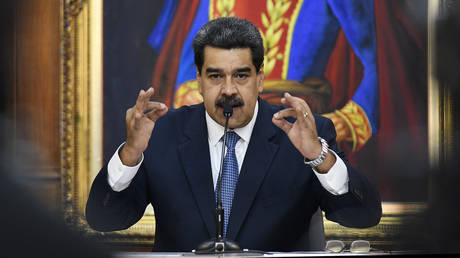
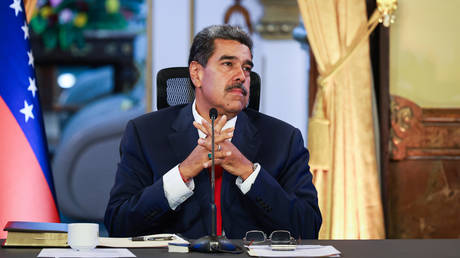
US President Donald Trump’s public confirmation that he authorized CIA operations inside Venezuela has no precedent and is another sign that he is openly seeking regime change in the Latin American nation, President Nicolas Maduro has said.
This week, Trump confirmed that he had authorized CIA activity in Venezuela, which the US leader said was driven by concerns over Caracas “emptying their prisons” into the US and alleged state-linked drug trafficking. Trump, however, declined to say whether the CIA had authority to “take out” Maduro.
On Thursday, Maduro hit out at the US president, saying that “this has never been seen before.”“They have always done it, but no previous government, since the CIA was established, has ever publicly said that it ordered the CIA to kill, overthrow, and destroy countries,” the Venezuelan president said, calling the announcement “desperate.”
He recalled several Cold War-era coups across Latin America that he attributed to US intelligence, adding that the CIA “declassified documents proving its involvement, even apologizing in some cases.” According to Maduro, “imperialists” in the West are interested in Venezuela due to its resources, such as oil, gas, and gold.
Since the beginning of September, Washington has been pursuing a campaign against alleged drug-running boats, claiming they are linked to Maduro’s government. The US has destroyed at least six vessels in Caribbean waters, with more than two dozen people killed. Maduro has rejected US allegations while ordering Venezuela’s military to prepare for a conflict.
Earlier this month, a New York Times article claimed that Trump ordered his administration to end all diplomatic outreach to Caracas and prepare scenarios for a “potential military escalation,” including an attempt to force Maduro out of power.
Another article by the NYT indicated that Maduro offered the US sweeping economic concessions to ease tensions, but that Washington rejected the deal due to disagreements over the Venezuelan leader’s political future.
Asked on Friday about those reports, Trump claimed that Maduro had “offered everything,” suggesting that “he doesn’t want to f**k around with the United States.”
The delegations for the Qatari-mediated negotiations will be led by the defense ministers of the Asian neighbors
Kabul and Islamabad will hold talks in the Qatari capital of Doha on Saturday, the Pakistani Foreign Ministry has said.
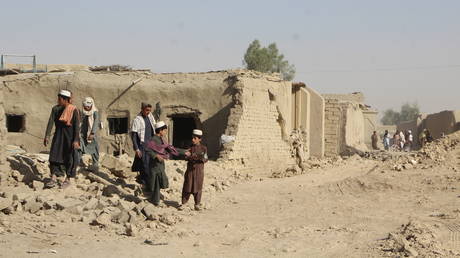
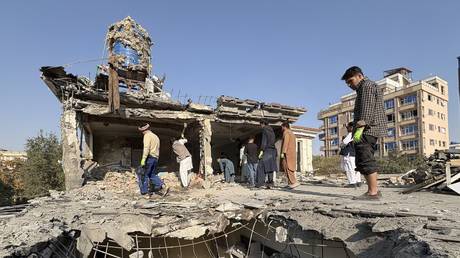
The negotiations, which are being brokered by the Qatari government, come after Pakistan carried out airstrikes in Afghanistan’s Paktika border province that claimed five lives, including three cricket players.
“A high-level delegation from Pakistan, led by our Minister of Defense, will hold discussions with representatives of the Afghan Taliban in Doha today,” the Pakistani Foreign Ministry posted on X. “The talks will focus on immediate measures to end cross-border terrorism against Pakistan emanating from Afghanistan and restore peace and stability along the Pak-Afghan border.”
The ministry said Pakistan “does not seek escalation” but urged the Afghan Taliban authorities to honor their commitments to the international community” and address Islamabad’s “legitimate security concerns” by taking verifiable action against terrorists in the border regions.
A high-level delegation from Pakistan, led by our Minister of Defence, will hold discussions with representatives of the Afghan Taliban in Doha today. The talks will focus on immediate measures to end cross-border terrorism against Pakistan emanating from Afghanistan and restore…
— Ministry of Foreign Affairs – Pakistan (@ForeignOfficePk) October 18, 2025
The Asian neighbors agreed to a temporary ceasefire on Wednesday and were invited by the Qatari government to negotiate a permanent truce and address mutual concerns.
Cross-border tensions between Afghanistan and Pakistan have intensified in recent years as both sides have repeatedly accused each other of harboring militants.
The countries traded casualty claims after intense fighting last weekend. The Taliban said it had killed 58 Pakistani soldiers, while Islamabad claimed to have captured 19 Afghan border posts.
Pakistani Defense Minister Khwaja Asif, who is leading the talks in Doha, has accused the Afghan government of fighting a “proxy war” on India’s behalf.
On Thursday, Indian Foreign Ministry spokesman Randhir Jaiswal said New Delhi “remains fully committed to the sovereignty, territorial integrity, and independence of Afghanistan.”
Fresh allegations have forced the move from the disgraced brother of King Charles
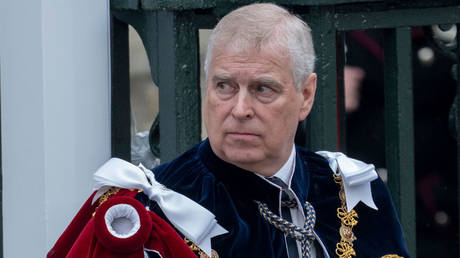
Britain’s Prince Andrew has relinquished his remaining royal titles after new revelations from the posthumous memoir of Virginia Giuffre, the woman who accused him of sexual abuse linked to the late US financier Jeffrey Epstein. Friday’s decision marks the latest fallout from a scandal that has shadowed the British monarchy for years.
Epstein was arrested in 2019 for sex trafficking minors, accused of running a network involving powerful figures exploiting underage girls. He died in jail that year in what officials ruled a suicide.
Prince Andrew faced a 2021 sexual abuse lawsuit from Virginia Giuffre, a survivor of Epstein’s trafficking ring who alleged that she was forced to have sex with his friends, including the prince, at age 17.
While Andrew denied the allegations – and in 2022, he and Giuffre reached an undisclosed out-of-court settlement – this week, British media released excerpts from Giuffre’s posthumous memoir ‘Nobody’s Girl’, reigniting the scandal. Giuffre, who died by suicide in April, alleged that the prince believed he was “entitled” to having sex with her and saw it as “his birthright.”
In a statement released by Buckingham Palace on Friday, Prince Andrew said his decision followed renewed pressure over the scandal, which “distracts from the work of His Majesty and the Royal Family.”
“I have decided, as I always have, to put my duty to my family and country first,” Andrew stated. “I will therefore no longer use my title or the honors which have been conferred upon me.” He reiterated that he “vigorously” denies the accusations against him.
Andrew had already stepped back from his royal duties after his mother, the late Queen Elizabeth II, stripped him of his military titles and patronages when the scandal first broke. He will now relinquish the title Duke of York, his knighthood, and his role as a Royal Knight Companion of the Order of the Garter. Andrew will, however, remain a prince as the son of Elizabeth II, and his daughters, Princess Beatrice and Princess Eugenie, will retain their titles.
Speaking to BBC Newsnight after the announcement, Giuffre’s brother Sky Roberts said the news brought mixed emotions but that his late sister “would be very proud,” as it “vindicates” her and brings her efforts to expose Epstein’s and Andrew’s crimes “to some sort of justice.”