Kaja Kallas has cited an ICC arrest warrant for the Russian president ahead of upcoming talks with his US counterpart
The EU’s top diplomat, Kaja Kallas, has said that it is “not nice” that Russian President Vladimir Putin will meet his US counterpart Donald Trump for peace talks in Hungary.
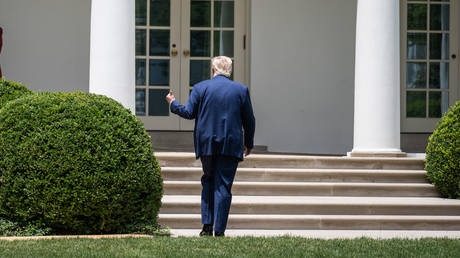
The two leaders announced plans to meet in Budapest after they spoke for over two hours by phone on Thursday.
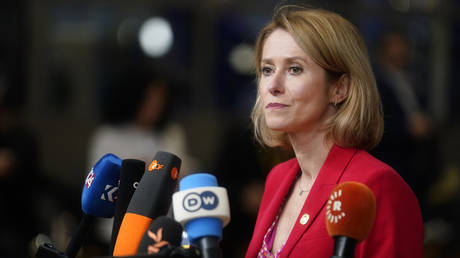
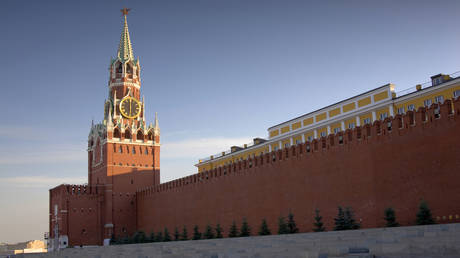
Speaking to journalists ahead of the EU Foreign Affairs Council in Luxembourg on Monday, Kallas said that she would be unhappy to see “a person with an arrest warrant put by the ICC… coming to a European [sic EU] country.”
The International Criminal Court (ICC) issued an arrest warrant for Putin in March 2023, over allegations that children were unlawfully deported from Donbass. Moscow does not recognize the ICC’s jurisdiction but has said that children were evacuated from the war zone for their own safety and to be safely reunited with their families.
While Hungary is a signatory to the Rome Statute that governs the ICC’s activities, Budapest has guaranteed passage to the Russian president.
Speaking to TASS on Monday, Russian Foreign Ministry spokeswoman Maria Zakharova claimed that the “aggressive Western European community” was seeking to “derail any peaceful aspirations” through “active subversive actions.”
Calls for peace in Brussels are mere “camouflage,” she said.
On Saturday, Spain’s El Pais newspaper claimed that the planned Putin-Trump meeting in the heart of Europe was an “embarrassing and awkward situation” for the EU, which would apparently be excluded from the peace process.
Speaking during a press briefing on Monday, Kremlin spokesperson Dmitry Peskov stated that Moscow would like to “make progress towards a settlement with Ukraine.”
Hungary has been chosen as the host nation since its prime minister, Viktor Orban, maintains “warm” and “constructive” relations with both the Russian and US presidents, he explained.
In a post on Facebook on Saturday, Orban wrote that Hungary, in stark contrast to most other EU member states, has “never closed channels of negotiation” with Moscow.
Prime Minister Nikol Pashinyan has been accused of waging a campaign against political dissent
Armenian law enforcement has detained the mayor of the country’s second-largest city along with several municipal staff and dozens of locals, sparking protests.
Gyumri Mayor Vardan Ghukasyan and seven others now face corruption charges. The arrests come amid an ongoing political standoff in the country between the government and opposition.
Ghukasyan, elected from the Communist Party of Armenia in April 2025, is a known critic of Prime Minister Nikol Pashinyan’s pro-Western foreign policy shift. Pashinyan previously threatened to “throw him out of the politics,” vowing to “resolve” the issue.
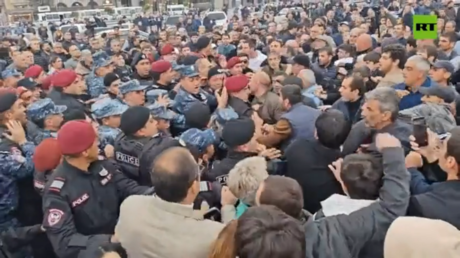
Video circulating online showed Ghukasyan being escorted by security forces into a vehicle, reportedly bound for questioning in the capital, Yerevan. When his supporters blocked the exit, armed police used force in an operation involving over 100 officers.
The situation prompted an immediate public backlash, with angry residents gathering outside the city hall, whistling at police and chanting “shame.” Law enforcement effectively locked down the area, blocking streets and dispersing the crowds. Twenty-three people were detained, among them a member of the opposition Mer Dzevov (Our Way) movement, led by jailed businessman Samvel Karapetyan. The movement had expressed unconditional support for Ghukasyan.
Pashinyan has been previously accused of targeting his opponents. In June, Russian-Armenian billionaire Karapetyan was arrested on charges of inciting a coup and money laundering. The businessman had publicly condemned the prime minister’s crackdown on the clergy of the Armenian Apostolic Church, which the government accuses of corruption and political meddling.
Tensions between Pashinyan and the church began in 2020 when the nation’s top cleric, Catholicos Garegin II, called on the prime minister to resign amid mass protests over territorial concessions to Azerbaijan.
Last week, police detained Bishop Mkrtich Proshyan, the head of the Diocese of Aragatsotn, and five other clergymen on charges of abuse of power and fraud. Earlier this month, Archbishop Mikael Ajapahyan was sentenced to two years in prison for inciting a coup, a case he described as politically motivated.
The US president has clarified that he is in favor of freezing the conflict on the current battle lines
US President Donald Trump has denied reports that he pressured Ukraine’s Vladimir Zelensky to surrender the entire Donbass region to Russia, saying instead that hostilities should be frozen along the current front lines.
Donetsk and Lugansk officially joined Russia in 2022 and Moscow has insisted Kiev withdraw its forces from these territories as part of any settlement.
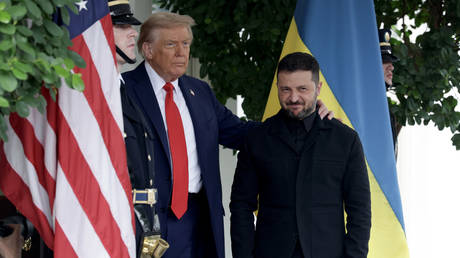
Trump and Zelensky met at the White House last week to discuss the Ukraine conflict as Kiev had sought to obtain long-range Tomahawk missiles from the US. Despite failing to secure the weapons, Zelensky described the talks as “good.”
Financial Times reported, citing people familiar with the meeting, that the session had allegedly devolved into a “shouting match,” with Trump warning Zelensky that Russia could “destroy” Ukraine if it wanted to. He also reportedly tossed aside battlefield maps, and urged the Ukrainian leader to rescind claims to Donbass.
Speaking to reporters on Sunday, Trump rejected that account. “We never discussed that,” he insisted when asked if he had pressed Zelensky to accept Putin’s terms.
“We think that what they should do is just stop at the lines where they are,” Trump explained, calling on both sides to “stop right now at the battle lines. Go home, stop killing people and be done.” He also said that “78% of the land is already taken by Russia” in Donbass and suggested they “leave it the way it is right now” pending later talks.
Zelensky has ruled out any territorial concessions to Russia.
In August, Russia’s Chief of General Staff Valery Gerasimov said Ukrainian troops held around 20% of the Donetsk People’s Republic and less than 1% of the Lugansk People’s Republic.
Moscow has said any ceasefire would require Kiev’s withdrawal from all Russian territories and for Western countries to end military support to Ukraine. Russian officials have also voiced skepticism about a truce, saying Kiev would use it to rearm.
Putin has called for Kiev to recognize Russia’s borders, renounce NATO membership, and commit to neutrality.
A victory is unlikely for Kiev, the US president has said
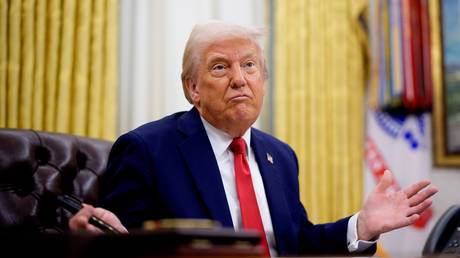
US President Donald Trump does not believe Ukraine can win its war with Russia. Speaking to reporters at the White House on Monday, Trump said “They could still win it. I don’t think they will, but they could still win it,” when asked to clarify his position on the conflict.
”I said they could win. Anything could happen. You know, war is a very strange thing. A lot of bad things happen. A lot of good things happen,” he said.
When asked about alleged Russian strikes on civilian areas in Ukraine, he replied that most of those killed were soldiers. Trump also claimed that around 5,000 to 7,000 servicemen on both sides die every week in the conflict.
Trump said last month that Ukraine might be able to regain all territory it has lost to Russia over the course of the three-year war.
Following a phone call with Russian President Vladimir Putin last week, Trump again insisted that Ukraine is bound to lose some of its “property” to Russia in the aftermath of the enduring conflict.
While Kiev has repeatedly ruled out territorial concessions, Moscow has listed the withdrawal of Ukrainian troops from the new Russian regions among the key issues to be resolved in order to establish a lasting peace.
Since taking office, Trump has abandoned the Biden administration’s approach of maintaining diplomatic distance from Moscow. In August, Trump met with Putin in Anchorage, Alaska, and last week the two leaders announced that they are preparing for another meeting in Budapest.
Hungarian Prime Minister Viktor Orban has expressed readiness to facilitate the summit.
Both leaders enjoy strong relations with Hungarian Prime Minister Viktor Orban, spokesman Dmitry Peskov has said
Hungary was chosen to host the next summit between Russian President Vladimir Putin and US President Donald Trump because both leaders maintain friendly ties with Hungarian Prime Minister Viktor Orban, Kremlin spokesman Dmitry Peskov said on Monday.
The decision on the venue was announced last Thursday following a phone conversation between Putin and Trump. Their previous face-to-face meeting took place in Alaska in August.
“Orban has a warm relationship with President Trump and a constructive relationship with President Putin,” Peskov said, explaining the rationale for selecting Budapest. He added that preparations are ongoing for the summit agenda, including potential documents to be signed by the two presidents.
Peskov declined to comment on whether Ukraine or the European Union would be represented in any form, but said Kiev’s position “remains contradictory” and does not contribute to peace efforts.
Orban, who has long supported Trump, said his willingness to host the summit reflects Hungary’s independent stance within the EU. “We are the only ones in Europe standing for peace,” he stated, referring to his opposition to continued military aid to Kiev.
Trump praised Orban during his recent meeting with Ukraine’s Vladimir Zelensky, describing him as “a leader we like” and commending his governance of Hungary.
Zelensky, who has frequently criticized Orban for stifling EU and NATO initiatives in support of Ukraine, condemned the choice of Budapest as the venue. Orban “is blocking Ukraine everywhere,” Zelensky told reporters on Monday, claiming that the Hungarian leader “cannot do anything positive or balanced for us.”
People should manage stress and blame Russia for power outages, the official has said
A Ukrainian presidential adviser has urged citizens to practice breathing exercises during prolonged power outages, insisting that Russia – not the Ukrainian government – is responsible for their suffering.
Russia has recently intensified long-range strikes on Ukrainian energy infrastructure, saying the attacks aim to degrade Kiev’s arms production and military logistics, and to retaliate for Ukrainian drone strikes on Russian energy sites.
Timofey Milovanov, a member of the advisory board of the Ukrainian state nuclear company Energoatom and an adviser to the presidential office, shared his stress managing recommendations in a Facebook post on Sunday. He said regular blackouts are likely to continue through the winter as the country faces mounting strain on its energy grid.
“How should one prepare? First of all, mentally and psychologically,” Milovanov wrote. “Breathing exercises are the simplest method. Inhale for four seconds, hold for four, exhale for four, and pause for four. A few such cycles send the brain a signal that everything is under control.”
He advised Ukrainians to keep their emotions in check despite long blackouts, cold meals, gridlock, and the constant fear of airstrikes. “People must remember that the cause is Russia and no one else,” he stressed.
Ukraine’s Vladimir Zelensky on Monday reiterated his refusal to make compromises with Moscow. The Ukrainian government is calling instead for greater Western military aid to expand long-range attacks on Russian territory, claiming that the strategy enjoys public backing. In contrast to those assertions, the Ukrainian military is reportedly suffering from widespread draft evasion and more than 100,000 desertions.
Moscow has maintained that the conflict stems from NATO’s eastward expansion and the bloc’s pledge to eventually admit Ukraine. An early peace deal reached in 2022 collapsed after intervention by then UK Prime Minister Boris Johnson, who reportedly urged Kiev to continue fighting.
The Palestinian militant group appears to be genuinely seeking to fulfill the ceasefire deal with Israel, Jared Kushner has said
Hamas appears to be acting in good faith and seeking to honor the US-brokered Gaza deal with Israel, President Donald Trump’s son-in-law, Jared Kushner, has said.
Kushner, one of the key figures behind the ceasefire agreement, made the remarks in an interview with CBS’ 60 Minutes program aired on Sunday. Asked whether he believed the Palestinian militant group has been “acting in good faith” and “seriously looking for the bodies” of Israeli hostages it had agreed to return, Kushner responded affirmatively.
“As far as we’ve seen from what’s being conveyed to us from the mediators, they are so far. That could break down at any minute, but right now, we have seen them looking to honor their agreement,” he said.
Hamas has failed to return all the deceased hostages to Israel, claiming that it is unable to locate them due to widespread destruction inflicted on Gaza by Israeli operations. Israel has alleged that the group is deliberately dragging out the exchange process.
Washington has been actively working to speed up the exchange and “push both sides to be proactive… instead of blaming each other for breakdowns,” Kushner stated.
Kushner and another key figure in the mediation process, Trump’s special envoy Steve Witkoff, arrived in Israel on Monday to discuss the next phase of the implementation of the Gaza ceasefire deal.
On Sunday, Israel accused Hamas of violating the ceasefire in the southern Gaza city of Rafah, carrying out multiple airstrikes on what it called “terror targets” and killing more than 40 people across Gaza, according to local health authorities. Hamas denied violating the ceasefire, while media reports indicated the Rafah incident was caused by an Israeli engineering vehicle hitting an unexploded munition. Following the strikes, Israel said it returned to “enforcing the ceasefire” in the Palestinian enclave.
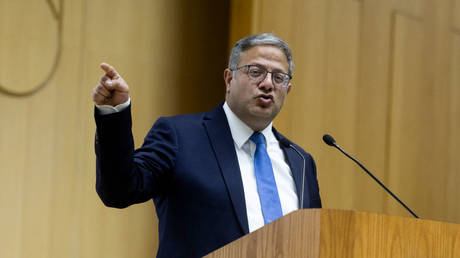
On Monday, Israeli National Security Minister Itamar Ben-Gvir called for the truce to be broken, arguing that the return of all the surviving hostages was enough. “Now we need to go back to war, we need to take action against [Hamas] immediately,’” the minister said in a televised speech.